The NRC’s approval contradicted four other agency decisions on virtually the same issue…….. http://allthingsnuclear.org/dlochbaum/nuclear-regulatory-commission-contradictory-decisions-undermine-nuclear-safety
Ecocity 2017 World Summit held in Melbourne, Australia, as cities defy Trump and climate denialists
Ecocity 2017 World Summit: Cities forge ahead on climate change action http://www.heraldsun.com.au/news/ecocity-2017-world-summit-cities-forge-ahead-on-climate-change-action/news-story/586aeb5ddd424192ca4643f81aad3f6a, IAN ROYALL, Herald Sun July 12, 2017 THE great cities of the world are forging ahead with action on climate change despite US President Donald Trump’s stance on the issue, a global conference in Melbourne has been told.
UK’s Sellafield nuclear site fails to meet safety standards
Nuclear plant failing watchdog’s standards, The Times, Plutonium facilities at the Sellafield nuclear plant do not meet high standards, a British watchdog has found…. (subscribers only)
Wylfa local community might not support £14bn nuclear power plant
Daily Post 6th July 2017, The firm behind a multi-billion-pound nuclear power station was warned “not to take local support for granted” as Anglesey council raised concerns over its latest consultation document today.
Horizon Nuclear Power hopes to start building the £14bn Wylfa Newydd plant near the existing Wylfa site in 2020, once all the consents and financing are in place. But, responding to Horizon’s third and final phase of pre-application public
consultation (PAC3), the county council today warned that its latest document contained “so little detail that it threatened the whole adequacy and lawfulness of the consultation process”.
Horizon is planning to submit a development consent order (DCO) application to the Planning Inspectorate next month, which will include the main power station proposals as well as integral off-site developments.
http://www.dailypost.co.uk/news/dont-take-local-support-granted-13294849
Trump’s Climate Policies leading planet to irreversible climate disaster – Stephen Hawking
Stephen Hawking: Trump’s Climate Policies Could Turn Earth Into Venus “…two hundred and fifty degrees, and raining sulphuric acid.”,
British theoretical physicist and cosmologist Stephen Hawking is not mincing words: President Donald Trump’s decision to withdraw from the landmark Paris accord combating climate change could cause irreversible harm to the planet.

In an interview with the BBC in honor of Hawking’s 75th birthday, the Cambridge professor said Trump will cause “avoidable environmental damage” by denying climate change evidence and leaving the agreement.
“We are close to the tipping point where global warming becomes irreversible,” he said. “Trump’s action could push the Earth over the brink, to become like Venus, with a temperature of two hundred and fifty degrees, and raining sulphuric acid.”
The president announced the decision last month, arguing that the agreement was a “bad deal” for the U.S. As multiple experts, scientists and world leaders pointed out, the deal was nonbinding and had largely been negotiated to meet U.S. expectations.
Earlier this year, Hawking, who has spoken out against Trump in the past, said the president’s anti-science agenda left him feeling unwelcome in the United States.
In an interview in March with Piers Morgan on ITV’s “Good Morning Britain,” Hawking said the president should get rid of Scott Pruitt, a climate change denier, as the leader of the Environmental Protection Agency. “Climate change is one of the great dangers we face, and it’s one we can prevent,” Hawking said. “It affects America badly, so tackling it should win votes for his second term — God forbid.” http://www.huffingtonpost.com.au/2017/07/03/stephen-hawking-trumps-climate-policies-could-turn-earth-into_a_23013506/
Contradictory decisions by U.S. Nuclear Regulatory Commission make nuclear safety more uncertain
Nuclear Regulatory Commission: Contradictory Decisions Undermine Nuclear Safety, UCS, DAVE LOCHBAUM, DIRECTOR, NUCLEAR SAFETY PROJECT | JULY 6, 2017, As described in a recent All Things Nuclear commentary, one of the two emergency diesel generators (EDGs) for the Unit 3 reactor at the Palo Verde Nuclear Generation Station in Arizona was severely damaged during a test run on December 15, 2016. The operating license issued by the Nuclear Regulatory Commission (NRC) allowed the reactor to continue running for up to 10 days with one EDG out of service. Because the extensive damage required far longer than the 10 days provided in the operating license to repair, the owner asked the NRC for permission to continue operating Unit 3 for up to 62 days with only one EDG available. The NRC approved that request on January 4, 2017.
Hinkley nuclear project – too big, too financially risky – a problem for both French and British tax-payers?
Guardian 3rd July 2017, The timing of EDF’s “clarifications” is a shock. It is very early in the life of this £18.1bn (now £19.6bn, possibly rising to £20.3bn) project to be recasting the numbers.
The tricky stages of construction, like pouring the right mix of concrete, lie ahead. The additional costs
relate to mundane matters, such as “a better understanding” of UK regulators’ requirements and “the volume and sequencing of work on site”. These are planning areas in which EDF would surely have made
allowances for uncertainties. That all that slack, and more, has been used up is puzzling. Sceptics within EDF who argued that Hinkley is too big and too financially risky will feel vindicated already.
EDF’s projected rate of return on the project was never high at 9%; now it is down to 8.5% and will fall to 8.2% if the delays materialise. Still, it’s a French problem, right? Didn’t the UK government insulate us by making EDF and
its Chinese co-financier shoulder the construction risks? Wasn’t that the trade-off for the UK guaranteeing to buy all Hinkley’s electricity for 35 years at twice the current wholesale price?
Well, yes, that’s how the contract is structured, and EDF’s UK boss was full of reassurance on
Monday that UK taxpayers remain protected. But no contract of this size is ever so straightforward, as the National Audit Office pointed out in its blistering report last week. https://www.theguardian.com/business/nils-pratley-on-finance/2017/jul/03/ofgem-energy-price-cap-shows-mays-help-for-millions-is-off-the-boil#img-1
Determined opposition to Bradwell nuclear power project, UK
BANNG Summer Newsletter. 4 Jul 16 Don’t be deceived by the silence on the Bradwell
front. The project for a new nuclear power station at Bradwell is still
very much alive although little information has been made public. BANNG
remains as determined as ever to reveal what is happening and to oppose a
project which threatens the safety and security of the Blackwater
environment and the local communities. Please continue with your support
for BANNG as we enter a new phase in the effort to stop Bradwell B
http://www.banng.info/newsletters/
What are the real costs of Britsain’ s planned Bradwell B nuclear power project?
Harwich & Manningtree Standard 1st July 2017 In September the Chinese agreed to take a stake in Hinckley on the understanding the UK Government would
approve a Chinese-led and designed project at Bradwell on the Dengie – to become Bradwell B. Now we have the authoritative national audit officer saying Hinkley C itself is a risky and expensive project………
last Wednesday the Bradwell Local Community Liaison Council, held at Mundon, was informed by the
representative from the government’s Nuclear Development Agency that they have just agreed to pay out £100 million to Magnox’s competitors as the procurement process was incorrectly done – the size of the work being far more than anticipated.
Think what that would have bought in terms of the NHS or police and fire services. It also makes you wonder how well managed the nuclear procurement process is. The same meeting also heard from another Government body dealing with radioactive waste management that finding somewhere to put the nation’s store of highly radioactive waste
is likely to take another 100 years, despite offering communities £1 million a year whilst they volunteer a site. (Yes, they are proposing to build power stations still not knowing where they will put their dangerous
waste.)

In costing Bradwell B it is important that the full costs of all these directly related items to do with waste handling are included. Including of course the cost of the Government bodies themselves. Whilst Phil Greatorex was saying to Radio 4 that Hinkley is cheaper than renewables, he wasn’t challenged as to what figures he was including, but from everything we know to date coming from the likes of authoritative sources within Baang (Blackwater Against New Nuclear Group) we can be sure he wasn’t comparing like with like.
http://www.harwichandmanningtreestandard.co.uk/news/north_essex_news/15383519.LETTER__Full_costs_of_Bradwell_B_required/
San Onofre Safety monitors The Shimkus bill H.R. 3053 on nuclear waste
San Onofre Safety Action needed: The Shimkus bill H.R. 3053 Nuclear Waste Policy Amendment Act of 2017 will make us less safe and not solve the nuclear waste problems, yet preempts existing state and local water and air rights and other rights. It removes safety requirements needed to prevent radioactive leaks. Learn more and share handouts with elected officials and others.
Nuclear waste danger – right next to the beach!
This is where you can find the deadliest substance in the world, right next to the beach. And it’s about to move closer! Catholic Online, By Marshall Connolly (CALIFORNIA NETWORK) 7/3/2017
Radioactive waste is about to be moved to a new location, closer to the water.
Nuclear power is an amazing source of energy, virtually limitless in potential. It’s extremely safe, and efficient. But it produces a byproduct that wipes out all those benefits. Spent nuclear fuel must be disposed of for hundreds of thousands of years, much longer than humans have walked the Earth. And long-term storage of such fuel is expensive.
— There are several nuclear power plants sitting unused in the United States. Renewable energy, such as solar power is taking the world by storm, eliminating the need for other forms of energy generation.
Nuclear power once held tremendous promise, but now it is seen more as a liability. Plants such as San Onofre, just north of San Diego, and situated right on the California coast, are of particular concern. At San Onofre, the spent fuel is being kept in temporary containers as lawmakers and experts spar over what to do with the dangerous material, and how to pay for it.
Spent nuclear fuel is possibly the most dangerous substance known to humanity. Exposure to a fuel rod could cause death from radiation poisoning within minutes to hours. A smaller dose would kill you within months or years. In all cases, an early death is guaranteed.
A terrorist could use radioactive material con construct a dirty bomb, that is a bomb that spreads radioactive material across a wide area, rendering the space uninhabitable. Again, the exposed people would die. Waste in the water has been known to spread across entire oceans
San Onofre, as well as many other sites are well guarded by personnel with automatic rifles. Dire warnings keep civilians out. The plant produces nothing of value anymore. It just costs money.
It’s the taxpayers who end up paying, to the tune of tens of billions. And a major reason is there remains no permanent storage site for the waste……..
Presently, the waste at San Onofre is likely to go into a temporary facility that will hold it safely for twenty more years. The facility will be built on the coast, next to the power plant. It’s closer to the water, but experts promise it will be disaster proof, protected against terrorists, tsunamis and earthquakes. But it still isn’t permanent. And area residents want it gone……
The only solution may be a tough and expensive one. Such is the cost of nuclear power. One thing is certain, the longer we delay, the more it will cost. http://www.catholic.org/news/green/story.php?id=75405
Global nuclear industry’s survival threatened by its financial disasters
Fading away: Money runs short for nuclear energy’s survival, Independent Australia, Climate News Network 30 June 2017, Renewable fuels are challenging nuclear energy’s survival everywhere, and financing new reactors is growing increasingly difficult. Paul Brown reports.
ANYWHERE YOU LOOK in the world, the future of the nuclear industry looks grim as costs escalate and politicians plump for renewables, putting nuclear energy’s survival in doubt.
The single most important fact in the industry’s demise is that its main rivals in the business of generating electricity – gas, wind and solar – are getting ever cheaper as nuclear costs only rise.
The political tide is turning against nuclear power in previously leading countries. Newly elected governments in South Korea and France, the two democratic countries most enthusiastic about the atom, are looking to reduce the role of nuclear in their energy mix.
Nuclear retreat
South Korea’s new president Moon Jae-in has vowed to scrap all existing plans for new nuclear power plants and cancel lifetime extensions for aged reactors, heralding a major overhaul for the country’s energy policy……
France’s new president, Emmanuel Macron, has said he will continue the previous government’s policy of reducing the country’s 75% reliance on nuclear power for its electricity production to 50%.
Even in the United Kingdom, where theoretically the government is still planning as many as ten new reactors, it is clear the companies that are supposed to build them are getting cold feet. The bankruptcy of Westinghouse, the U.S. nuclear giant, has led to fears that attempting to finance new nuclear build is risky, if not impossible…….
the heavily indebted French giant EDF… has already started building two giant reactors at Hinkley Point in the West of England, the only company in the free world likely to continue to try to finance nuclear new build in Britain. It plans another two reactors in Suffolk in eastern England, but these have not yet been started.
EDF, mostly owned by the French state, has 58 ageing reactors, most in need of refurbishment and extra safety features as a result of the Fukushima disaster of 2011.
The company remains publicly committed to building new reactors in Britain, but how it can finance all its projects is not explained.
Poor value
Another blow is that the UK’s National Audit Office, which monitors government expenditure, has just released a report saying that the Hinkley Point project was “risky and expensive” and not value for money for British consumers……
An extra problem for the French and for the operators of nuclear power stations elsewhere, particularly in the US, is that the cost of producing electricity from older nuclear reactors is greater than its current wholesale price.
Money-losers
A report by Bloomberg, the financial reporting service, says that more than half the U.S. reactors currently in operation are losing money and most of the rest are struggling to break even.
This has led to a debate about whether older reactors should be subsidised by the state in order to keep carbon emissions down. But even if that were to happen, the older reactors would not generate enough revenue to finance new build……..
As democratic governments with free markets become increasingly sceptical about the benefits of nuclear power, only Russia and China remain committed to it. In neither case is it possible to discover the true cost of their industry, or whether both governments intend to continue building nuclear plants.
China has announced ambitious plans for new reactors, but is pressing ahead faster with cheaper renewables and planned start-ups of new nuclear stations have been delayed.
The global nuclear industry appears to be fading away. https://independentaustralia.net/environment/environment-display/money-runs-short-for-nuclear-energys-survival,10458
If the Hinkley nuclear project bankrupts EDF, will the UK govt pour billions into it?

 Dave Toke’s Blog 27th June 2017,The latest announcement from EDF that Hinkley C will be further delayed and that EDF will be hit with even more cost overruns risks making true the prediction of EDF former Finance Officer that the project will bankrupt the company.
This may well lead to increasing pressures on the UK Government to put billions of UK taxpayers money into the project. Hinkley C, which former EDF boss Vincent de Rivaz said (in 2007) would be generating by the end of this year (2017) will now, according to EDF, not be generating electricity until 2027.
Ten years on and the project is still ten years away! But meanwhile the company has spent massive sums getting not very far towards building the plant. It is now in danger of wasting even the money the French state has pumped into EDF to save the company and build the project in Somerset. Sixteen months ago EDF Finance Director Thomas
Piquemal resigned, after EDF decided to make a ‘final investment decision’ over Hinkley C, fearing it could put the whole company at risk.
Perhaps this is an echo of policy before privatisation of electricity when nuclear power appeared to cost very little simply because the Government, through the aegis of the nationalised industry, paid for all of the construction costs, not to mention taking responsibility for ‘back-end’ decommissioning costs. Then nobody noticed that they, the taxpayer and electricity consumer, were really picking up the bill. The nuclear industry longs to return to these bad old days.
http://realfeed-intariffs.blogspot.co.uk/2017/06/could-latest-delays-in-hinkley-c.html
Russia’s nuclear marketing drive is not all plain sailing
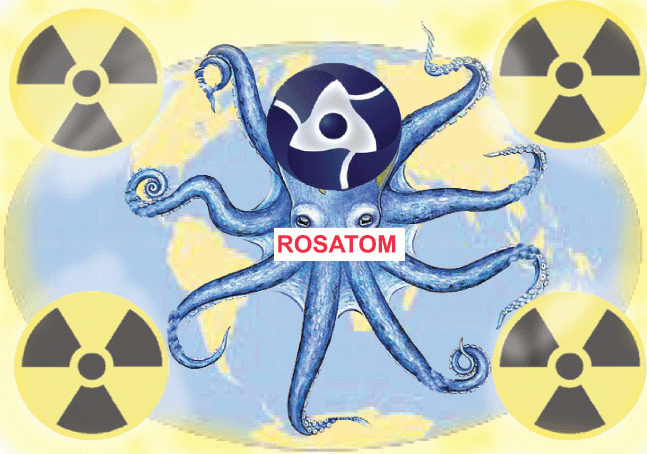 FT 28th June 2017,For most companies, problems for three of their biggest competitors would probably be cause for celebration. But at Russian nuclear conglomerate Rosatom, the recent setbacks at rivals Westinghouse, Areva and Kepco have instead caused concern.
Their woes are representative of the wider threat from renewable and other sources of energy to the nuclear industry,
according to Kirill Komarov, Rosatom’s deputy chief executive, amid ambitious growth plans by the sprawling state-run group. Many analysts still see Rosatom, a conglomerate that spans the nuclear energy industry, as a beneficiary of the crisis given its ambitions. It is managing 42 power plant projects in 12 countries, including EU members Finland and Hungary, commissioned 10 nuclear units in the past decade, and has a 10-year order book worth $133bn, excluding its domestic business. This plays a part in the forecasts of the International Energy Agency of a tripling of global nuclear capacity by 2060. Rosatom’s increased influence has unnerved some, however.
Its role as a 34 per cent shareholder and supplier of finance and atomic fuel for Finland’s Hanhikivi plant almost caused the collapse of the Finnish government in 2014, when the country’s Green party left the previous ruling coalition in protest.
The EU took three years to approve Hungary’s Pak II plant, built and financed by Rosatom, amid fears in Brussels of Russian leverage on the bloc’s eastern flank.But given the troubles at western rivals and the pivot by Seoul, some
industry analysts say only China’s collection of state-controlled nuclear firms have similar scale to challenge Rosatom.
https://www.ft.com/content/774358b4-5a4a-11e7-9bc8-8055f264aa8b
Financial problems for Britain’s nuclear power projects
Is The U.K. Nuclear Program In Disarray And Will The Wind Blow In?
Jun. 29, 2017 Keith Williams
Summary
Hinkley Point C : construction progressing, technology and cost of power the issue.
NuGen : Toshiba exiting, who will step up? Reactor design still unclear. China interested but will this be controversial?
Wylfa : Hitachi-GE ABWR reactors technically strong, but Hitachi won’t finance the project. Who will?
Meanwhile decommissioning of UK nuclear plants by 2023; where will the power come from? Wind well positioned to benefit…….https://seekingalpha.com/article/4084787-u-k-nuclear-program-disarray-will-wind-blow
Reactions to news of investigation of Los Alamos National Laboratory’s latest waste shipment violation
LANL shipment investigation draws reactions, lamonitor.com, By , June 28, 2017 The announcement of an investigation by a government oversight agency over Los Alamos National Laboratory’s latest waste shipment violation has some people questioning what it may mean for the future of the laboratory and its weapons programs.
“They hardly ever do that,” Los Alamos Study Group Executive Director Greg Mello said of the National Nuclear Security Administration’s response to LANL’s violation.
The NNSA oversees LANL and the other government facilities responsible for country’s nuclear arsenal.
“The NNSA said it was serious, and the fact that they put out a press release at all means they do think that,” Mello said. “They’re tired of screw-ups at Los Alamos.”
NNSA’s investigation is about why LANL failed to follow proper procedures when shipping “special nuclear material” to the Lawrence Livermore National Laboratory and the Savannah River National Laboratory……..
LANL’s most recent safety violation has also drawn criticism from New Mexico’s congressional delegation.
“The alleged violations of nuclear material shipping regulations at LANL, if true, are deeply concerning,” State Rep. Ben Ray Lujan, (D-NM) said. “The safety of the workers at Los Alamos National Laboratory (LANL) and in the Los Alamos community must be paramount. LANL has rigorous protocols that govern the shipping of nuclear material, and if something in this process failed or needs improvement we must correct the problem immediately. I have asked for a full briefing from the National Nuclear Security Administration (NNSA) as soon as possible to better understand the situation and what is being done to ensure the safety and security of nuclear material at the lab.”http://www.lamonitor.com/content/lanl-shipment-investigation-draws-reactions
1 This Month

of the week – Shut Down Drone Warfare!


Tell the Ukrainian Government to Drop Prosecution of Peace Activist Yurii Sheliazhenko

Petition to revoke the licensing of the Near Surface Nuclear Disposal Facility (NSDF) at Chalk River. https://www.ourcommons.ca/petitions/en/Petition/Details?Petition=e-7247
To see nuclear-related stories in greater depth and intensity – go to https://nuclearinformation.wordpress.com
-
Archives
- March 2026 (230)
- February 2026 (268)
- January 2026 (308)
- December 2025 (358)
- November 2025 (359)
- October 2025 (376)
- September 2025 (257)
- August 2025 (319)
- July 2025 (230)
- June 2025 (348)
- May 2025 (261)
- April 2025 (305)
-
Categories
- 1
- 1 NUCLEAR ISSUES
- business and costs
- climate change
- culture and arts
- ENERGY
- environment
- health
- history
- indigenous issues
- Legal
- marketing of nuclear
- media
- opposition to nuclear
- PERSONAL STORIES
- politics
- politics international
- Religion and ethics
- safety
- secrets,lies and civil liberties
- spinbuster
- technology
- Uranium
- wastes
- weapons and war
- Women
- 2 WORLD
- ACTION
- AFRICA
- Atrocities
- AUSTRALIA
- Christina's notes
- Christina's themes
- culture and arts
- Events
- Fuk 2022
- Fuk 2023
- Fukushima 2017
- Fukushima 2018
- fukushima 2019
- Fukushima 2020
- Fukushima 2021
- general
- global warming
- Humour (God we need it)
- Nuclear
- RARE EARTHS
- Reference
- resources – print
- Resources -audiovicual
- Weekly Newsletter
- World
- World Nuclear
- YouTube
-
RSS
Entries RSS
Comments RSS
 nuclear-news