The Hanford Fire Department responded to a fire at 3 a.m. burning not far from the old Hanford High School, which is part of the Manhattan Project National Historical Park, according to Mission Support Alliance, the Department of Energy contractor in charge of firefighting services……http://www.tri-cityherald.com/news/local/hanford/article161581418.html
Climate change is not friendly to water hungry nuclear power stations
 Ars Technica 26th July 2017,Unless you work at a coal, gas, or nuclear plant, you may not think about
water when you think about electricity (certainly at a household level;
they don’t mix). But water plays an important part in cooling many power
plants, and many power plants also depend on a nearby water source to
create steam that drives turbines.
So the availability of water for power production is a serious consideration. Not enough water? That power plant
could have to shut down. If the water isn’t chilly enough to cool the
plant? Same problem.
In a paper published in Nature Energy this week, a
group of researchers from the Netherlands estimated how water availability
would affect coal, gas, and nuclear plants in the European Union out to
2030. The researchers took into account a changing climate that will likely
make water reserves scarcer and warmer,
but they also accounted for
progressive renewable energy policies in EU member countries, which are
already prompting some thermoelectric plants to retire in favor of wind and
solar (which need negligible amounts of water to operate). https://arstechnica.co.uk/science/2017/07/a-potential-climate-change-consequence-not-enough-cool-water-for-power-plants/
Dopey U.S. energy secretary Rick Perry fooled by Russian comedians
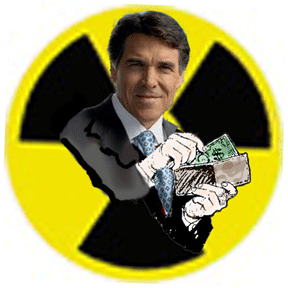 U.S. energy secretary duped into fake interview with Russian comedians, Timothy Gardner WASHINGTON (Reuters), 26 July 17 – U.S. Energy Secretary Rick Perry optimistically discussed expanding American coal exports to Ukraine and other energy matters during a lengthy phone call this month with a Russian prankster who Perry thought was Ukraine’s prime minister.
Perry actually was talking with comedians known in Russia for targeting celebrities and politicians with audacious stunts, Energy Department spokeswoman Shaylyn Hynes said in a written statement.
Pranksters Vladimir Krasnov and Alexei Stolyarov are sometimes called the “Jerky Boys of Russia,” after an American duo who put out recordings of their prank phone calls in the 1990s. They have made faux calls to British singer Elton John, who thought he was speaking to Russian President Vladimir Putin, and others……https://www.reuters.com/article/us-usa-energysecretary-idUSKBN1AB06G
Public health charity Med-act supports International Campaign to Abolish Nuclear Weapons (ICAN)
NFLA 25th July 2017, The Nuclear Free Local Authorities (NFLA) today welcomes the publication of
a major new report by Med-act that focuses on the UK’s harmful reliance
and dependence on maintaining nuclear weapons at a time when the large
majority of UN members have formally called for a ban on such weapons.
Med-act is a public health charity that inspires the medical community to
act on the social, political, ecological and economic determinants of
health. Like NFLA, it is a supporting member of the International Campaign
to Abolish Nuclear Weapons (ICAN). The Med-act report ‘A Safer World –
Treating Britain’s harmful dependence on nuclear weapons’, calls to
account the UK Government for its aggressive nuclear weapons policies and
the continued funding of the Trident nuclear weapons programme. http://www.nuclearpolicy.info/news/nfla-welcomes-med-act-report-uk-flawed-policy-nuclear-weapons/
Viability of Millstone nuclear plant to be reviewed
Connecticut Governor orders review of Millstone nuclear plant viability Reuters), 27 July 17 – Connecticut Governor Dannel Malloy has ordered state agencies to review the economic viability of Dominion Energy Inc’s Millstone nuclear power plant, which critics want shut down in the face of cheaper energy sources.
“We must objectively and thoroughly review and evaluate the relevant information and market conditions of the Millstone facility … in the context of reducing costs for consumers and moving our clean energy strategy forward,” the governor said in a statement on Tuesday…..
Millstone is among several nuclear power plants in danger of shutting before its licenses expire as cheap and abundant natural gas from shale fields keep power prices low, making it uneconomic for generators to keep some reactors operating…..
Opponents of state support for the reactors, like the Stop the Millstone Payout coalition, said “Millstone does not need a ratepayer-funded corporate payout.”
“Governor Malloy made the right call in seeking additional information from Millstone before any decision is made regarding financial support for the company,” said Matt Fossen, spokesman for the Stop the Millstone Payout coalition, in a statement…..
Since 2013, six reactors, including Dominion’s Kewaunee in Wisconsin, have shut for economic reasons. Another six are expected to shut over the next five years. https://www.reuters.com/article/us-usa-healthcare-idUSKBN1AC1G0
Hinkley Point C nuclear power plan – a Titanic folly
Why Hinkley Point is a nuclear folly of Titanic proportions https://www.newscientist.com/article/2099287-why-hinkley-point-is-a-nuclear-folly-of-titanic-proportions/ The French firm EDF has approved plans for a massive nuclear reactor in the UK, but the UK government is hesitating. Let’s hope it scuppers the project, says Michael Le Page, 26 July 17, It feels like watching Titanic. Despite numerous warnings of enormous icebergs ahead, French company EDF yesterday signalled full steam ahead for the plan to build a huge nuclear power plant at Hinkley Point in the UK. No sooner had it done so than the ship hit an iceberg.
The UK was expected to sign the contract for Hinkley within days of EDF giving the go-ahead. The champagne was already on ice. But the new government surprised everyone by instead saying it will review the project by September. What’s not yet clear is whether this is a minor dent in the hull of RMS Hinkley, or a gaping hole that could sink it.
The Hinkley plant is important for many reasons. For starters, it’s a key part of the UK’s plans to cut greenhouse emissions, meant to supply a whopping 7 per cent of the country’s electricity. If completed, it will be the UK’s first new nuclear plant for decades, the most expensive built anywhere and the biggest construction project in Europe, creating tens of thousands of jobs.
It’s also crucial for France, which largely owns EDF, the company that will build Hinkley. France needs the project to help cover the huge cost of revamping its ageing collection of nuclear plants, which currently supply three-quarters of the country’s electricity. And Hinkley matters to China, too, as one of its state-owned companies will be stumping up a third of the cost.
It is not clear why the UK government is hesitating. Is Hinkley now seen as a trump card in the Brexit negotiations with France? Many analysts, however, say things have changed since Hinkley was first planned. The UK had to agree to pay a very high price for Hinkley’s electricity. Since then, the price of renewables has plummeted, making it look like a very bad deal for the UK.
Even if the UK signs the contract in September after the review is complete, the megaproject’s future looks doubtful. There are huge financial, legal, technical and safety-related icebergs lurking in the seas ahead.
Rather than borrow the £20 billion – or more – needed to build Hinkley, the UK government asked EDF to pay for it in exchange for paying a guaranteed price for electricity for 35 years. But EDF is in financial difficulties, and even within the company many think that taking on the project is too great a risk.
Behind schedule
One reason why is that the two reactors planned for Hinkley are based on a new design. The EPR design is supposed to be safer and more efficient, but it has proved so difficult to construct that not one has yet been completed.
EDF started building the first EPR, at Olkiluoto in Finland, in 2005. It was supposed to start up in 2009. Work on the second, at Flamanville in France, began in 2007 and was due to be finished in 2012. Another two EPRs are being built in Taishan, China. All four projects are years behind schedule and have cost billions more than expected.
Worse still, weak spots have been found in the steel reactor core at Flamanville. If it has to be replaced, the still incomplete plant would have to be largely dismantled to replace it, at immense cost to EDF. And that’s not all. Earlier this year, it was reported that one of the companies supplying components to EDF had falsified safety certificates.
There are also worries about the fact that a state-owned Chinese company will be supplying some of the parts and workers for the project. The UK’s intelligence agencies are said to be concerned that a “back door” could be built into the control systems, allowing China to shut down the plant if it wanted to.
Last but not least, there are various legal challenges pending. The Austrian government, for instance, is appealing against the European Commission’s decision to approve state aid for the project, saying it breaches European laws. Meanwhile, French authorities are investigating possible financial misreporting by EDF.
So should the new UK government let RMS Hinkley sail on towards disaster, or scupper it now? The choice seems clear.
Nuclear weapons and the human toll of radioactive waste dumps
Even if we box it up and send it in train cars to remote places, it will be there, ready and waiting to kill any of us long after we’ve forgotten where we put it, or what “it” even is.
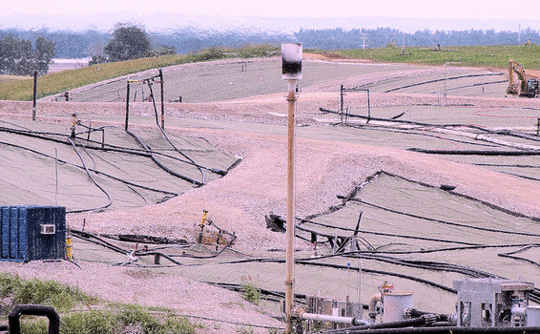
The Fallout, In St. Louis, America’s nuclear history creeps into the present, leaching into streams and bodies. Guernica, By Lacy M. Johnson, 10 July 2017 “……….Uranium, thorium, Agent Orange, dioxin, DDT. I am thinking of all the ways our government has poisoned its citizens as I board the plane that will take me back home. The sky grows darker; blue gives way to purple, to red and orange near the horizon. I read recently about a housing project in St. Louis, the infamous Pruitt-Igoe, where the government sprayed nerve gases off the roof to see what effect it would have on the people living there—testing it for its potential use as a weapon in war…….
A 2005 Gallup poll showed that a majority of Americans still approve of the dropping of bombs on Japan. Admittedly, this is down from near-total approval in August 1945, but it’s hardly a “moral revolution.” One factor in the decision to use the bomb was that their destructive power would end the war and save American lives—some estimated as many as a million American soldiers would have perished in a ground raid on Japan. Does saving one life require taking another? Must they both be soldiers, loyal to their countries and their neighbors? After Nagasaki was bombed, a woman walked through the burning streets asking for water for her headless baby. A four-year-old boy burned alive under the rubble of his crushed house was crying out, “Mommy, it’s hot. It’s so hot.” President Truman called this bombing an “achievement” in his solemn radio broadcast from the USS Augusta: “The Japanese began the war from the air at Pearl Harbor. They have been repaid many fold.”
In the last few months of his term President Obama was reportedly considering the idea of adopting a no-first-use policy on nuclear weapons—an official promise that we would only use them in response to an attack by our enemies—but ultimately his advisors talked him out of it, arguing that it is our responsibility to our allies to maintain the illusion of ultimate power. Now that we have a new president with access to the nuclear codes we must face the consequences of projecting, and protecting, that illusion.
There are about sixteen thousand nuclear warheads in the world right now, enough to destroy the planet many times over. The United States and Russia own 90 percent of these, and though various treaties prevent them from making additional weapons, both are working to modernize the bomb-delivery systems they do have. The US government recently approved a plan to spend one trillion dollars over the next thirty years to make our arsenal more modern, accurate, and efficient.
One trillion dollars. This number is staggering, not least of all because one factor—a minor one but still a factor—deterring the EPA from fully excavating the radioactive waste created by the program that developed these nuclear weapons in the first place is how much it will cost. Maybe as much as $400 million. That’s a lot of money for an EPA project. Budgets are not so simple that one government program—like the Department of Defense—could direct money to another, but the fact that they are not does makes our priorities apparent.
Even if every gram of radioactive waste were removed from the landfill, where would it go? There are facilities in Idaho and Utah willing to accept it. But those facilities are located in communities, or near them, and those people don’t want this waste in their backyards or their gardens or their rivers or their drinking water either. Even if we box it up and send it in train cars to remote places, it will be there, ready and waiting to kill any of us long after we’ve forgotten where we put it, or what “it” even is. ……..https://www.guernicamag.com/the-fallout/
U.S. State Department to clamp ban on travel to North Korea
Yeganeh Torbati and Se Young Lee, WASHINGTON/SEOUL (Reuters) JULY 22, 2017 – The U.S. government on Friday said it will bar Americans from travelling to North Korea due to the risk of “long-term detention” in the country, where a U.S. student was jailed while on a tour last year and later died.
U.S. Secretary of State Rex Tillerson has authorized a “Geographical Travel Restriction” on Americans to forbid them from entering North Korea, spokeswoman Heather Nauert said……http://in.reuters.com/article/northkorea-usa-tours-idINKBN1A61VZ
Asia’s coal-fired power boom ‘bankrolled by foreign governments and banks’
The vast majority of newly built stations in Indonesia relied on export credits agencies or development banks, says study by Market Forces, Guardian, Michael Slezak, 20 july 17, The much-discussed boom in coal-fired power in south-east Asia is being bankrolled by foreign governments and banks, with the vast majority of projects apparently too risky for the private sector.
Environmental analysts at activist group Market Forces examined 22 deals involving 13.1 gigawatts of coal-fired power in Indonesia and found that 91% of the projects had the backing of foreign governments through export credit agencies or development banks.
Export credit agencies, which provide subsidised loans to overseas projects to assist export industries in their home countries, were involved in 64% of the deals and provided 45% of the total lending.
The majority of the money was coming from Japan and China, with the Japan Bank for International Cooperation (JBIC) involved in five deals and the Export-Import Bank of China (Cexim) involved in seven deals. All the deals closed between January 2010 and March 2017.
The China Development Bank was the biggest development bank lending to the projects, imparting $3bn, with a further $240m in development funds coming from Korea’s Korea Development Bank.
The lending comes despite the world’s biggest development bank – the World Bank – warning last year that plans to build more coal-fired power plants in Asia would be a “disaster for the planet” and overwhelm the deal forged at Paris to fight climate change.
“Right now, several key countries supporting the Paris climate change agreement are actively undermining it by trying to expand the polluting coal-power sector in other countries,” said Julien Vincent, executive director of Market Forces.
According to the International Energy Agency, the world needs to phase out coal-power by 2050 in order to keep warming under 2C……..
The push of financing comes as Japan, China and Korea move to cut plans for coal-power in their own countries. Vincent said the moves were related, since Indonesia was now seen as a testing ground for new coal-fired power station technology. https://www.theguardian.com/environment/2017/jul/20/asias-coal-fired-power-boom-bankrolled-by-foreign-governments-and-banks
The Australian businessman tasked with making American manufacturing great for Donald Trump has broken with the President on climate policy
Andrew Liveris adamant US will revisit Paris climate deal, http://www.theaustralian.com.au/business/companies/andrew-liveris-adamant-us-will-revisit-paris-climate-deal/news-story/d4b0e75cb50c717220f4b13543157a67, 22 July 17 JAMIE WALKER, Associate Editor, Brisbane, @Jamie_WalkerOz
The Australian businessman tasked with making American manufacturing great for Donald Trump has broken with the President on climate policy, saying the US must re-engage with the Paris agreement.
And in a provocative address in Brisbane, Dow Chemical boss Andrew Liveris revealed that spiralling domestic gas prices had forced the multinational firm to review its Australian operations.
As the head of Mr Trump’s manufacturing council, Darwin-raised Mr Liveris is working with the embattled administration to deliver a key election promise to revitalise US manufacturing, while engineering one of the biggest corporate mergers in history between Dow Chemical and DuPont.
Warning that environmental sustainability was “no longer an initiative, it’s a business model”, Mr Liveris said Mr Trump’s decision to pull the US out of the Paris accord should not halt international co-operation on greenhouse gas mitigation. “We cannot as citizens of the world let that move impede our collective progress and our determination to remove carbon from the atmosphere,” he said, to applause from the crowd of 1500 that turned out for the UQ ChangeMakers forum, put on by his alma mater the University of Queensland and supported by The Weekend Australian.
“Many businesses in the US, NGOs and states have re-upped and picked up the commitment of what’s become the slack left behind by the federal government.
“I believe the US will re-engage ultimately with Paris and I am certainly being part of the solution to make that happen.” But he distanced himself from Mr Trump’s handling of the issue, saying it was “very unfortunate” the President had said the US was withdrawing from the 2015 Paris agreement, when the aim was to “redefine its engagement”. Under the UN-backed accord, Australia is committed to reduce greenhouse emissions by 26-28 per cent on 2005 levels by 2030. Mr Liveris said: “They are actually not withdrawing, they just want to re-engage on different terms. So if you think about it that way, I would say the odds would be very high of a re-engagement.”
Mr Liveris was one of the first business leaders to warn of the “gas cliff” that has deepened eastern Australia’s energy crisis, prompting intervention by the federal government to limit LNG exports and boost domestic gas supplies. He said yesterday that the gas price paid by Dow Chemical in Australia had rocketed from “roughly five or six dollars” to $20 in less than a year, jeopardising the business. “So my leader of Australia-Pacific … he’s got a proposal in front of us to look at exiting Australia right now in terms of uncompetitive energy prices.
We are not alone. We … can see the future in terms of the trajectory … you need to fix supply and you have got to basically recalibrate demand so that 90 per cent of the gas isn’t exported.”
Backing the controversial Finkel report to the government on energy security, Mr Liveris said it offered a “great series of policy solutions” and business would accept a target for renewables. The country, however, needed “policies that outlive” the government concerned. “What I would say is give me a policy that has a renewable target, give me time to develop it and I will develop a partnership model with you, in an innovation hub … to develop the technologies over time,” he said.

UK’s Tories well aware that the Trident nuclear deterrent is unnecessary, and a waste of money
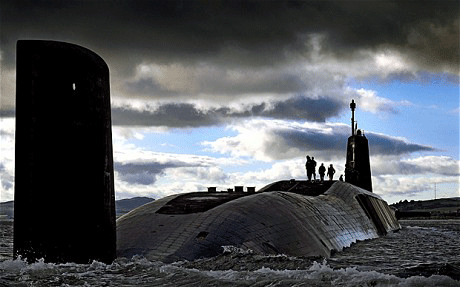 The Tories know Trident is a waste of money and only they can kill it off, Guardian, Chris Mullin, 15 July 17 Our nuclear deterrent is purely symbolic but Labour would never be forgiven for letting it go. A
few days from now parliament will be asked to make a final decision on whether or not to spend around £40bn renewing Trident. Many of the Labour MPs arguing in favour do so not because they regard nuclear weapons as an essential tool in our armoury, but because they are terrified of being thought “soft” on defence. And they are right to be worried. For years the British addiction to nuclear armaments has proved a devastating weapon in the hands of the Conservatives and their friends in the tabloid media, even if they are not much use against our enemies.
And yet just about anyone who has ever given the matter any thought knows it’s bonkers. Most Tories know in their heart of hearts that Trident is of little or no relevance to national defence in the 21st century. So, too, do a fair swath of the military. Indeed, our possession of nuclear weapons was never primarily about defending us from the Russians. On the contrary, it made us a target……….
None of this, if course, cuts any ice with our hysterical tabloids or our political masters. Trident might not prove much use against the Russians, but it is a valuable – if rather expensive – stick with which to beat the government’s political opponents. In the past the Labour party has been deeply damaged by the – false – allegation that it would leave the country defenceless and understandably most Labour MPs have no desire to repeat the experience. Paradoxically, the opposite is true. Dispensing with Trident would enable badly needed investment in our conventional forces. Something many senior Tories and members of the military establishment are only too well aware of.
For Labour the only way out of the current dilemma is to allow its MPs a free vote and then forget about it. The stark political reality is that only a Tory government could phase out our nuclear arsenal. The case for doing so is not difficult to argue, if only they could bring themselves to forgo the short-term political advantages of pro-Trident posturing and address the long-term national interest. Were they to do so, it would be a five-minute wonder and then quietly forgotten. https://www.theguardian.com/commentisfree/2016/jul/14/tories-trident-waste-money-nuclear-deterrent-symbolic-labour
Media ignores the fact that the full nuclear power chain releases much carbon
Nuclear power still a concern for many http://www.sandiegouniontribune.com/opinion/letters-to-the-editor/sd-nuclear-power-dirty-utak-letters-20170714-story.html Nuclear power not as clean as depicted
It was discouraging to see the front-page article “Nuclear power plant concerns shifting” (July 9) repeat the common misstatement about nuclear power’s “relatively small carbon footprint.”
This inaccurate assertion results from such articles looking only at pollution produced at the nuclear power plant. Naturally its carbon footprint will be small; it’s not burning fossil fuels.
But the pollution produced in manufacturing the fuel must also be considered. In the case of nuclear fission, the energy required to concentrate, enrich and fabricate nuclear fuel requires burning large amounts of carbon-based energy resources, often coal, at fossil fuel power plants. Additionally, the energy expended to safeguard spent fuel must also be considered.
Unless those attempting to assess pollution from nuclear power plants take into account emissions resulting from the entire fuel cycle, not just the power plant, misleading conclusions will result and suboptimal decisions will be made.
Trident Ploughshares campaigners blocked roads into nuclear warhead store
CND 13th July 2017,This morning, for the second time in three days, Trident Ploughshares
campaigners blocked roads into the nuclear warhead store at Coulport on
Loch Long as part of a week of peaceful disruption of the UK Trident bases
in Scotland.
A group of four protesters blocked the main route to the base
by lying in the roadway joined to each other through “lock-on” tubes
while a different group, in carnival costume, occupied an alternative
access route. Access to the base via these roads was blocked for over two
hours. http://www.cnduk.org/cnd-media/item/3460-coulport-nuclear-weapons-base-blockaded-again
Dialogue between Pyongyang and Washington – a good idea, despite the two bullies in charge
‘Grown-ups’ of the world must rein in the bullies, Mahir Ali The Asian Age, 13 Jul 17 There have been plenty of indications that direct dialogue between Pyongyang and Washington could conceivably lead to some kind of closure.

Back in 1962, John F. Kennedy held back his belligerent generals from attacking Cuba, which in all likelihood would have sparked a nuclear exchange with the Soviet Union, while he pursued back-channel contacts with Nikita Khrushchev. The strategy worked. Although Kennedy subsequently lost his life and Khrushchev his job in what were, in all probability, related developments, they succeeded in averting what might have turned into the third world war.
This time, hopes hang on the prospect of US generals holding back their President from potentially disastrous misadventures, rather than the other way around. One can only hope there are roughly equivalent grown-ups in North Korea keeping an eye on how far their nation can go without becoming a party to unleashing Armageddon.
The image of Trump and his North Korean counterpart, Kim Jong-un, as recalcitrant toddlers with eccentric hairstyles, twiddling with lethal knobs while competing for title of chief playground bully, is hard to dismiss. One of them has more playthings than he could possibly handle. The other considers his toys crucial to his survival.
During his sojourn in Warsaw last week, where Trump talked about existential threats to Western civilisation, he also talked up the possibility of doing “some pretty severe things” in response to North Korea’s “very bad behaviour”, but then added: “That doesn’t mean we are going to do them.”………
Donald Trump and Kim Jong-un display the very reason that the new UN nuclear werapons ban treaty is so critically important
Nuclear weapons – the only man made threat that could virtually destroy our planet in an afternoon – have hit the news again, in two ways that represent polar opposites of the struggle to banish them forever.
In New York at the United Nations we have just witnessed historic progress towards realising the goal of a nuclear weapons free world. Late last week, the UN adopted the new ‘Treaty on the Prohibition of Nuclear Weapons’, to prohibit states from developing, testing, producing, manufacturing, acquiring, possessing, stockpiling, transferring, deploying, stationing, using or threatening to use nuclear weapons, under any circumstances.
That’s a fairly comprehensive thumbs down to the weapons, the strongest collective statement yet from governments that they are totally illegitimate in every respect.
Meanwhile, in Washington DC and Pyongyang, two people – chronologically adults but in other respects displaying no signs of maturity – are squaring off at each other, each with a finger on a button that can incinerate cities.
Donald Trump and Kim Jong-un display the very reason that the new UN treaty is so critically important, because it categorically rejects any role for any nuclear weapons in anyone’s hands. As Ban Ki-Moon, former UN Secretary-General said, “There are no right hands for the wrong weapons”.
The treaty leaves no doubt that its prohibitions apply not only to actually using nuclear weapons but also to their possession. The myth of nuclear “deterrence”, which tells us that nuclear-armed nations will not go to war against each other because the response from their adversary would make it a suicidal gesture, is exposed as being not only immoral but also fraught with danger.
Enter Trump and Kim Jong-un to demonstrate the point. If the deterrence theory holds true, why all the fuss now, when these two leaders clearly have it all under control?
“Stable nuclear deterrence”, that notion so beloved of Australia and a minority of other governments, might sound comforting, but in the real world – a very messy place with some grossly deficient and unstable people – it’s a total fraud.
Australia’s position is stark. Like a drunkard preaching abstinence, our government strongly supports US nuclear weapons in keeping us “safe” (even as officials scurry to reassure the public that North Korean nuclear missiles couldn’t really reach Australia) and insists shamelessly on disarmament for others. So supportive are we of US nuclear weapons that Australia did not even show up at the UN treaty talks.
Foreign Minister Bishop disingenuously argued that, for the process to be effective, the countries with the weapons must be part of it right from the start. By that logic, we would insist on criminals helping draft any legislation that might curtail their activities.
In any event, all UN member states were strongly encouraged to attend and have input; any empty seats were not from a lack of invitation. And judging by the determined – but unsuccessful – efforts on Australia’s part to see the talks fail, one suspects that our government knows exactly how powerful an instrument this global prohibition treaty will prove to be.
Criticisms that the treaty will be a “toothless tiger” miss the whole point of it. The key to its utility was encapsulated last week by Tim Wright, the Asia-Pacific Director of ICAN*, the International Campaign to Abolish Nuclear Weapons, an organisation which played a pivotal role in achieving the treaty.
“[It] will stigmatise possession of nuclear weapons by any state, provide a source of legal, political, ethical, economic and civil society pressure on nuclear armed states to disarm, and encourage financial institutions to divest from companies that produce nuclear weapons.”
As one example of this stigmatising effect, how different the discussion of Trident’s renewal in the UK might have been last year if the nuclear weapons submarines fell into the “illegal” category at that stage. A government voting to renew weapons that most of the world has prohibited would be one step too far, even for many of those stuck in a Cold War mindset.
In the meantime, what do we do about North Korea, or, more to the point, about North Korea and the US?
There is in fact plenty that could be done. Rather than turning up the volume on our echoes of Washington, Australia could urge a reduction of tension by the cessation of provocative military exercises by both sides. The North Korean leader has called for an end to US hostility and nuclear threats. Unless we regard the current situation as stable – nuclear deterrence just giving us a little fright as it tends to do – then an end to nuclear threats by both sides is absolutely critical.
History is granting us another chance to get rid of what Indian writer Arundhati Roy called “the most anti-democratic, anti-national, anti-human, outright evil thing that man has ever made”.
A strong civil society movement and a majority of the world’s governments working through the UN have just provided the best tool we’ve had for a long time with which to do this, a tool that delegitimises every one of the world’s 15,000 nuclear weapons.
The stand-off between two dangerous nuclear-armed leaders, each of whom places his ego above the welfare of humanity, possibly even that of his own people, demonstrates that these weapons have no place in human society.
* Dr Sue Wareham is the Vice-President of ICAN Australia.
1 This Month

of the week – Shut Down Drone Warfare!


Tell the Ukrainian Government to Drop Prosecution of Peace Activist Yurii Sheliazhenko

Petition to revoke the licensing of the Near Surface Nuclear Disposal Facility (NSDF) at Chalk River. https://www.ourcommons.ca/petitions/en/Petition/Details?Petition=e-7247
To see nuclear-related stories in greater depth and intensity – go to https://nuclearinformation.wordpress.com
-
Archives
- March 2026 (222)
- February 2026 (268)
- January 2026 (308)
- December 2025 (358)
- November 2025 (359)
- October 2025 (376)
- September 2025 (257)
- August 2025 (319)
- July 2025 (230)
- June 2025 (348)
- May 2025 (261)
- April 2025 (305)
-
Categories
- 1
- 1 NUCLEAR ISSUES
- business and costs
- climate change
- culture and arts
- ENERGY
- environment
- health
- history
- indigenous issues
- Legal
- marketing of nuclear
- media
- opposition to nuclear
- PERSONAL STORIES
- politics
- politics international
- Religion and ethics
- safety
- secrets,lies and civil liberties
- spinbuster
- technology
- Uranium
- wastes
- weapons and war
- Women
- 2 WORLD
- ACTION
- AFRICA
- Atrocities
- AUSTRALIA
- Christina's notes
- Christina's themes
- culture and arts
- Events
- Fuk 2022
- Fuk 2023
- Fukushima 2017
- Fukushima 2018
- fukushima 2019
- Fukushima 2020
- Fukushima 2021
- general
- global warming
- Humour (God we need it)
- Nuclear
- RARE EARTHS
- Reference
- resources – print
- Resources -audiovicual
- Weekly Newsletter
- World
- World Nuclear
- YouTube
-
RSS
Entries RSS
Comments RSS
 nuclear-news
That’s largely hyperbole, but to the extent that there is some veracity in the claim, it may have less to do with the troubling mindset in Pyongyang than with the policy incoherence that has accompanied Donald Trump into the White House.