Let’s start with the “ugly”. We are assured that nuclear weapons keep us safe, but with almost 15,000 in existence and more than 4000 deployed, the reverse is true. To say they will never be used is magical thinking, the stuff of fairy stories. It is only a matter of time. There have been many near misses, due to human or technical error, where only luck has stopped a nuclear launch. This luck cannot hold indefinitely.
The extent of destruction is so vast it’s difficult to contemplate. The fears of the 1950s and ’60s have given way to a sort of collective denial. But the horrors of the past are just a pale shadow of what lies ahead, with current weapons 30 to 50 times more powerful than those used on Hiroshima and Nagasaki.
No response will be possible. All hospitals and health workers will be destroyed. The thermonuclear blast will be followed by a massive firestorm, reaching temperatures of 800 degrees. All oxygen within a radius of 25 kilometres will be consumed, killing anyone who survives the fire.
After the blast, the soot in the atmosphere will create a decade-long nuclear winter, damaging crop yields and resulting in global famine. Careful modelling has found up to 2 billion lives will be put at risk from starvation.
Jong-un and Trump are unequivocally “bad”, way beyond the Twitter use of the word. They have horrified millions with their immature brinkmanship, name-calling and threats. Not since the Cuban missile crisis has there been such public concern.
The United States blames North Korea for acquiring these weapons yet, given the fate of Iraq and Libya, it’s unsurprising that the North feels it needs them. Clearly, as long as these weapons are regarded as legitimate, nations will try to acquire them. Indeed, the US is spending $US1.2 trillion($A1.5 trillion) to update its nuclear arsenal.
It’s appalling that North Korea has them yet, in many ways, inevitable given the nuclear-armed states’ abject failure to honour their undertakings to disarm under the non-proliferation treaty.
So where is the “good” in all this? The new UN treaty finally places nuclear weapons on the same footing as biological and chemical weapons. Stigmatising these weapons and holding governments to account is a critical next step in restarting the disarmament process. One-hundred-and-twenty-two countries voted in favour of this treaty and, once 50 countries sign and ratify it, it will become international law. Fifty-six countries have signed so far.
Once it is international law, using these weapons will constitute a war crime. Major divestment and a shift in how the public and the military view these weapons will follow. There needs to be serious negotiations, with an agreed, verifiable, balanced, stepwise reduction in stockpiles, with a specific timetable. No one is saying the new treaty is a magic wand. All this will take time and extensive diplomacy.
In Australia, the government continues to cling to the belief that nuclear weapons make us safer. By legitimising these weapons, it ultimately encourages proliferation. Japan, South Korea, Saudi Arabia and the United Arab Emirates are all considering becoming nuclear-armed.
We are at a turning point. New Zealand, Thailand and the Philippines were among the first to sign the treaty, and all remain US allies.
People say nuclear disarmament is unrealistic, but what is truly unrealistic is to pretend our luck will continue to hold, and that these appalling weapons will never be used. The humanitarian impacts are too great, and the risks too high. The treaty offers a new impetus and renewed hope for a safer world. It’s high time for our government to acknowledge this, and sign it.
Dr Margaret Beavis, a GP, is a board member of ICAN (Australia) and the Medical Association for Prevention of War.
Thatcher demanded nuclear plans after ‘shambles’ Chernobyl response, The Scotsman, PARIS GOURTSOYANNIS, 29 DEC 17, Margaret Thatcher demanded the government draw up new contingency plans for a major nuclear incident after the response to the Chernobyl disaster was branded a “farce” and a “shambles”.
Classified government papers released today reveal concern in the weeks following the disaster that failings in the government’s response could give ammunition to opponents of nuclear power and snarl proposed new power stations.
Ministers had agreed to the construction of a second nuclear reactor at Sizewell in Suffolk at the time of the disaster but the decision had not been made public.
Margaret Thatcher demanded the government draw up new contingency plans for a major nuclear incident after the response to the Chernobyl disaster was branded a “farce” and a “shambles”.
Classified government papers released today reveal concern in the weeks following the disaster that failings in the government’s response could give ammunition to opponents of nuclear power and snarl proposed new power stations.
Ministers had agreed to the construction of a second nuclear reactor at Sizewell in Suffolk at the time of the disaster but the decision had not been made public……..
On 16 May, the prime minister received a damning assessment of the government’s response from her policy adviser on energy, John Wybrew. On 16 May, the prime minister received a damning assessment of the government’s response from her policy adviser on energy, John Wybrew.
Ecowatch 27th Dec 2017, Germany has broken another renewable energy record, with clean power
providing a third of of the country’s electricity in 2017. Preliminary data
from the Association of Energy and Water Industries show that renewable
electricity generation grew to a record 33 percent this year, up from 29
percent in 2016. “The figures show impressively that there is already an
accelerated shift in power generation from CO2-intensive to low-carbon and
almost CO2-free energy sources,” Stefan Kapferer, the chairman of the
association, said. “The energy industry is clearly on course with regard
to energy and climate targets: our industry is able to reduce CO2 emissions
by 40 percent by 2020 compared to 1990.” Onshore and offshore wind power
has now surpassed natural gas, nuclear, and hard coal as the second largest
electricity source, with a 16 percent slice of Germany’s power mix. https://www.ecowatch.com/renewable-energy-germany-2520322211.html
How Close Are We Really to Achieving Nuclear Fusion? Geek.com, 29 Dec 17 Nuclear fusion has been the practical Holy Grail for clean, sustainable power for decades. Based on the same process that powers the sun, a controlled, human made nuclear reactor could solve a lot of Earth’s biggest problems. One plant could power a significant percentage of the US, and a few more — each of which only need small pellets of cheap, plentiful fuel to operate — could run the planet. And all without any extra greenhouse gas emissions, or the risk of a catastrophic meltdown. So… what’s stopping us from putting these things everywhere? Well… unfortunately, the laws of physics.
That’s not to say that building a fusion reactor is impossible (though that may well be, at least for cheap power generation), just that it is very, very hard. Scientists have been working on this since the 50s and, at the time, they suspected the final breakthrough wasn’t too far off. But then, as now, the running joke is that fusion is still a staggering 50 years away. But is that even true? How could it be?
Because we aren’t working with stars, humans have some major hurdles in fusing atoms and creating the tremendous amounts of energy we see in the sun. Most of those come from the incredible heat involved. Hot gasses and plasmas expand, but to keep the reaction going, you need the atoms to keep smashing together. You can use magnets to force the material to stay contained, but that uses a lot of power. That’s the fundamental problem with fusion as it stands today.
Reactions can be started, but, thus far, they’ve all taken more energy to control than we get out of them. In fact, starting that initial fusion reaction is quite easy, but it can’t just be the spark. That spark has to stick and kick up a nuclear furnace that yields enough to operate what are, in essence, force fields to contain the reaction and send the excess to the mains.
Paul Donovan: As renewable energy gets cheaper and cheaper, ministers minds are clouded by the ridiculously high guaranteed “strike price” of £92.50 per megawatt hour for Hinkley generated power, who can
be surprised?
Thanks to all those who work with us – to cut through the corporate spin, and aim for freeing this planet from the nuclear horror, and from disastrous climate change. We cannot afford to give up hope.
Why Has One of the World’s Biggest Funders of Environmental Conservation Also Given $4 Million to a Climate Denial Group? deSmog Blog By Graham Readfearn • Thursday, December 14, 2017 The Pew Charitable Trusts, one of the world’s biggest funders of environmental conservation groups, has given almost $5 million since 2011 to an organization that rejects the overwhelming evidence that human-caused climate change is dangerous, DeSmog has found.
Kathleen Hartnett White, who is President Donald Trump’s nominee to lead the White House Council on Environmental Quality, heads TPPF’s Armstrong Center for Energy and the Environment.
Hartnett White, who hopes to chair the influential federal council, also rejects the science linking fossil fuel burning to dangerous climate change.
Some of the groups that have received major grants from Pew have been outspoken in their criticisms of Hartnett White, describing her as a “climate change denier” who was unfit for the role. The Pew Charitable Trusts confirmed the grants, but said they were unrelated to work on climate change.
Senate Democrats are accusing Hartnett White of plagiarizing her responses to questions from the Committee on Environment and Public Works. Hartnett White was unable to answer basic questions about climate change during her nomination hearing.
Backing Texas Public Policy Foundation
In December 2016, TPPF co-hosted an energy summit where it gave a platform to several well-known climate science deniers.
Among them was Professor William Happer, who has said the “demonization of CO2 … really differs little from the Nazi persecution of the Jews.”
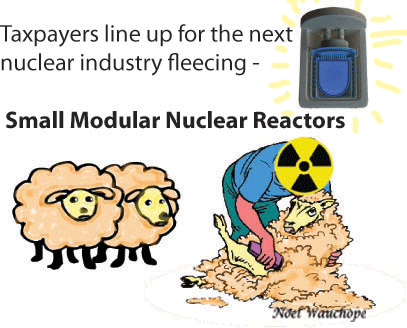
WWF 7th Dec 2017,Gareth Redmond-King, head of Energy and Climate at WWF commented on the announcement by the UK Government of £56 million of funding for new advanced and small modular reactors – “mini nuclear power stations”
“At a time when the cost of large-scale nuclear is increasing, and the cost of renewables is plummeting, it is bewildering that the UK Government should be committing yet more money to new nuclear – only a matter of weeks after a freeze on renewables funding was announced.
2017/12/11 SEOUL, Dec. 11 (Yonhap) —South Korean Foreign Minister Kang Kyung-wha on Monday raised the need to establish effective communication lines with North Korea to convey the international community’s voice for the country’s denuclearization.
“Opening effective communication channels should be pursued in order to deliver the international community’s voice to the isolated and secluded North Korea,” Kang said in an international forum on a “Nuclear-Free Korean Peninsula” hosted by the state-run Institute for Foreign Affairs and National Security (IFANS).
“It’s (also) crucial to arrange reunions of separated families between South and North Korea and restore a hotline between the military authorities,” she also said, stressing the Moon Jae-in government’s policy vision to increase engagement with the North.
“The South Korean government plans to start with contact (with North Korea) to achieve those specific tasks in the process of seeking a more meaningful inter-Korean relationship,” said the foreign minister.
As the Nobel Committee prepares to present its Peace Prize to the International Campaign Against Nuclear Weapons, campaigners will be celebrating this weekend. Among them will be many Scots, including members across various churches.
The Church of Scotland has highlighted the sterling efforts of members Molly Harvey of Glasgow and Judith McDonald of Cromarty. Molly Harvey’s work with poverty meant she could not thole the cost of nuclear weapons. Judith MacDonald, a doctor, could not countenance the carnage nuclear war would bring.
This terrible issue of our times is one some people might wish away while others make calculations based on realpolitik. No one in their right mind wants nuclear weapons. The issue is whether we can rationally do without them. We have to hope that the same human intelligence that invented them can devise ways to control them. Those with the courage to confront the issue deserve our admiration. Regardless of its feasibility, a nuclear-free world is a noble goal worth a Nobel Prize.
This is how nuclear war with North Korea would unfold
In one all-too-plausible worst-case scenario, millions die from mistakes and a tweet. WP, By Jeffrey LewisDecember 8 ,Jeffrey Lewis is a scholar at the Middlebury Institute of International Studies at Monterey.
No one wants to fight a nuclear war. Not in North Korea, not in South Korea and not in the United States. And yet leaders in all three countries know that such a war may yet come — if not by choice then by mistake. The world survived tense moments on the Korean Peninsula in 1969 , 1994 and 2010. Each time, the parties walked to the edge of danger, peered into the abyss, then stepped back. But what if one of them stumbled, slipped over the edge and, grasping for life, dragged the others down into the darkness?
The media-mogul’s Santa Monica vineyard was saved from wildfire destruction, but the world may yet burn thanks to his climate views, says Richard Schiffman New Scientist, By Richard Schiffman, 9 Dec 17
A wildfire has ripped through one of the wealthiest neighbourhoods in the US, damaging Rupert Murdoch’s $28.8 million vineyard estate in the Santa Monica mountains at the edge of Los Angeles.
The media-mogul’s palatial house was saved, thanks to firefighters who spent the afternoon and night battling the conflagration. Others weren’t so lucky. Hundreds of homes and scores of lives have been lost in both northern and southern California in a spate of recent wildfires that were fiercer and moved faster than any in recent memory.
Such fires are made more likely as the world warms. California has just had its hottest summer on record, and the recent wildfires came much later in the year than normal. We also know that seven of California’s 10 largest recorded wildfires have occurred in the last 14 years.
Steve Dale Nuclear Fuel Cycle Watch South Australia, 6 Dec 17
Poor workers, poor reporters – “TEPCO officials cautioned media representatives about standing too long right next to the storage pool, which could be seen located about six meters below the roof. Debris was found within the pool while insulating material floated on the pool surface.
The radiation level near the pool was 0.68 millisieverts per hour. While that was a major improvement from the 800 millisieverts per hour recorded in the immediate aftermath of the nuclear accident close to seven years ago” – 0.68 millisieverts is 6800 times the background radiations level of Adelaide (0.1 MICROsieverts/hour)Fukushima dome roof takes shape, but radiation remains high:The Asahi Shimbun
High radiation levels are still limiting recovery work at the Fukushima No. 1 nuclear plant, a stark
Two earthquakes strike Japan https://www3.nhk.or.jp/nhkworld/en/news/20171206_04/An earthquake with an estimated magnitude of 5.2 struck Nagano Prefecture in central Japan around 12:13 AM on Wednesday.
The Meteorological Agency says the epicenter was in the central part of the prefecture and the depth was 10 kilometers. It says there is no risk of tsunami.
The jolt registered 4 on the Japanese seismic scale of 0 to 7 in cities including Matsumoto and Ueda in Nagano Prefecture. It registered 3 in Nagano and other cities, as well as Itoigawa City in neighboring Niigata Prefecture.
Highway traffic and railway operations have not been disrupted.
Another earthquake hit northeastern Japan around 12:22 AM on Wednesday. No tsunami is expected.
The quake registered 3 on the Japanese scale in Yamatsuri Town in Fukushima Prefecture and Hitachiota City in Ibaraki Prefecture.
Officials at the Meteorological Agency say the epicenter was in the northern part of Ibaraki Prefecture and the depth was 10 kilometers. They estimate that the magnitude was 4.4.










 nuclear-news