Making sure that Pyongyang actually destroys its nuclear weapons may be impossible.
What a Secret Cold War Game of Nuclear Hide-and-Seek Teaches Us About North Korean Verification
Making sure that Pyongyang actually destroys its nuclear weapons may be impossible. FP, BY SHARON WEINBERGER |
Belgium’s DOEL NUCLEAR PLANT SHUT OWN AFTER DISRUPTION
https://nltimes.nl/2018/06/11/doel-nuclear-plant-shut-disruptionBy Janene Pieters on June 11, 2018
Belgian nuclear reactor Doel 4, just across the Dutch border, shut down automatically due to a fault on Saturday evening. The shutdown was an automatic procedure and there is no danger for the environment and the population, a Doel spokesperson said, ANP reports.
According to reports in Belgian media, the fault occurred in the non-nuclear part of the plant. The reactor was to be restarted on Sunday night, but that was postponed until Monday for unknown reasons.
The Doel nuclear power plant is located northwest of Antwerp, just across the Dutch border. The plant faced multiple problems in the past, causing unrest among local residents, both in the Netherlands and Belgium. In April nuclear reactor Doel 1 was shut down due to a leak in the nuclear part of the plant.
Theresa May’s massive financial blunders- going ahead with Hinkley and Wylfa nuclear power projects

 FT 7th June 2018 Every government makes mistakes, but it takes a really special administration to make a massive blunder and then go on to make the same fundamental error again, just months later. The blunder is the £20bn
Hinkley Point nuclear power station, which Theresa May bottled out of scrapping, and which will force UK customers to buy some of the most expensive electricity on the planet — an inflation-linked £105 per MWh in today’s money.
Despite this fabulous, guaranteed price, the project is so financially toxic that it threatened to break EDF, its contractor. It
seems that Hitachi, which fancies building a £16bn nuclear power station at Wyfla in north Wales, has noticed and wants us to share the risk.
Ominously, it seems we are going to. The Hitachi design is said to be better than EDF’s, in that there is an actual working example, and the guaranteed price is rumoured to be about £15 per MWh less than Hinkley’s (though still wildlyexpensive).
Yet if even this is not attractive enough for Hitachi to go ahead unaided, is any big nuclear plant worth building?
While wind and solar costs are falling, ever-stricter safety rules continue to drive up those for nuclear. Changing patterns of use and advancing storage technology also undermine the “base load” case on which nuclear is built. Elsewhere in the land of white elephants, here’s the Swansea barrage, optimistically priced at £1.3bn and recently described by business secretary Greg Clark as “an untried technology with high capital costs and significant uncertainties”. Pulling the plug on that would at least avoid a hat-trick of terrible energy policy decisions.
https://www.ft.com/content/a1ac14a2-6a65-11e8-aee1-39f3459514fd
Navy cites concerns with nuclear work at Newport News shipyard
Hugh Lessig Contact Reporter Daily Press 10 June 18 The Navy has cited a developing shortage of skilled employees that handle nuclear-related work at Newport News Shipbuilding as an important concern that affects current operations and could delay future work if not addressed.
A draft report from Naval Sea Systems Command issued last fall — reviewed by the Daily Press earlier this year — lists problems stemming from a lack of radiological control technicians (RCTs), shift-test engineers and other nuclear trades workers who perform tasks on nuclear-powered aircraft carriers and submarines.
The Newport News yard, a division of Huntington Ingalls Industries, is the sole builder of carriers and one of two yards that builds subs for the Navy. It faces a coming boom in shipbuilding as the Trump administration seeks to expand the Navy’s fleet of warships, including a possible bulk purchase of aircraft carriers.
“The potential shortfall in critical nuclear resources is a significant problem that impacts the shipyard’s ability to complete nuclear work today, and could impact successful delivery of ships to the Navy if not adequately addressed,” the draft states……..http://www.dailypress.com/business/newport-news-shipyard/dp-nws-navy-nuclear-shipyard-20180403-story.html
Growth predicted in linear accelerators for producing medical radioisotopes
New Research Study on Linear Accelerators for Radiation market predicts steady growth till 2024
‘We’re WATCHING’ – Mike Pompeo THREATENS Iran over nuclear weapons development
US SECRETARY of State Mike Pompeo has declared the US will not allow Iran to develop a nuclear weapon following reports Iran intends to increase its uranium enrichment capacity. By MATTHEW ROBINSON Jun 7 2018
Iran’s nuclear chief, Ali Akbar Salehi, said Iran intends to complete the construction of a facility in its Natanz nuclear plant to produce advanced centrifuges within a month.
Mr Salehi’s threats come in response to the US’s withdrawal from the Joint Comprehensive Plan of Action (JCPOA), also known as the Iran nuclear deal, and their threats to reintroduce stringent sanctions against the Middle East nation.
Mr Pompeo commented on the threats, stating: “We’re watching reports that Iran plans to increase its enrichment capacity.”…..https://www.express.co.uk/news/world/970618/World-War-3-Iran-nuclear-deal-Mike-Pompeo-threatens-Iran-nuclear-weapons-development
Nuclear power at a huge disadvantage in Middle East – but do they want it for nuclear weapons?
Nuclear Power’s Fading Moment in the Middle East, Stratfor, 7 June 18,
Highlights
- Demographic, climatic, economic and technological pressures over the next several decades will force key countries in the Middle East and North Africa to gradually expand and diversify their electric power grids.
- Advances in competing technologies and high costs will put nuclear power at a disadvantage compared with other electricity-generating options. Even so, countries in the region will continue to pursue nuclear power given its accompanying political prestige.
- The window for regional powers to develop unrestricted nuclear programs is closing fast. Economic realities will weaken their arguments for civilian nuclear power, allowing global powers to justify asserting more control over the expansion of nuclear programs in the region.
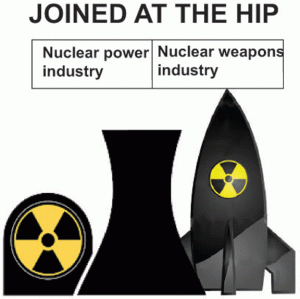 …… A Tale of Two Uses
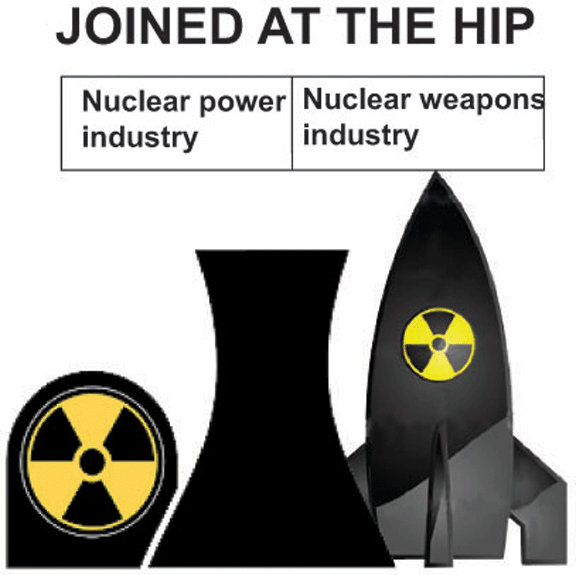
Nuclear technology has always had a civilian side and a military side. Clearly, there’s a difference between a peaceful, civilian-led nuclear energy program and one used to develop nuclear weapons. But the civilian and military sides share processes that inextricably link them and that have profound security and proliferation implications. Countries with end-to-end nuclear programs — that is, programs that include processing, enrichment and reprocessing capabilities — may insist their intentions are peaceful, but the dual-use nature of the technology puts them closer to producing enough nuclear material to build a weapon should they decide to take that route.
Throughout much of the world, nuclear power is struggling to compete economically; the capital costs are high, and lengthy construction delays plague most ongoing nuclear projects. As storage technologies improve, and as the use of smart and distributed power grids increases, the argument countries make for why they want to develop a civilian nuclear program becomes weaker, raising questions about motives and making it even more difficult for them to justify to global powers the need for them to develop an end-to-end nuclear program. Political control over nuclear proliferation may be slipping as the Nuclear Nonproliferation Treaty weakens, but economic realities will help limit nuclear expansion just the same.
………While natural gas will remain the largest fuel source for electricity in the region, generation powered by renewables and nuclear is poised to play a more prominent role. Those two modes of power production don’t directly compete in a traditional electrical grid, but advancing technology and changes in grid makeup will bring them into closer proximity.
When both capital costs and variable costs such as fuel are factored in, nuclear power generally struggles to compete economically with natural gas, wind and solar power — though it might make sense in some cases. Nuclear power’s advantage is its ability to provide baseload power — it produces electricity at a constant, continuous level. Some other forms of generation — renewables, in particular — would need to be paired with storage or a baseload plant to meet demand on a constant basis.
Improvements in efficiency technologies, the declining cost of energy storage, the development of smart grids and the increased use of decentralized grids (especially in the developing world) will combine to minimize baseload requirements, leaving traditional nuclear power behind. While new technology, such as small, modular reactors, could play a role in making nuclear energy more competitive, the industry likely will be forced to play catch-up to some degree.
And though nuclear power’s contribution to regional electrical grids is expected to rise over the next 20 years, its declining economic competitiveness means there is a narrow window for countries to exploit nuclear power’s role in diversifying energy grids to support the development of domestic nuclear programs that may have a more nefarious dual use. https://worldview.stratfor.com/article/nuclear-powers-fading-moment-middle-east
Bangkok restaurants stop serving fish recently imported from Fukushima Pref
. (Mainichi Japan)
FUKUSHIMA — Eleven Japanese restaurants in the Thai capital of Bangkok have stopped serving imported fish caught off the coast of the Fukushima prefectural city of Soma, the prefectural government here said on March 12.
The decision of each restaurant came following fears that they might experience a backlash and a reduction in customer numbers — fueled by citizen group protests that have spread online — even though Thailand does not restrict the import of goods from Fukushima Prefecture…….https://mainichi.jp/english/articles/20180313/p2a/00m/0na/002000c
As costs of renewable energy continue to fall, UK’s Hinkley and Wylfa nuclear power projects look more and more financially risky
Current News 5th June 2018 The UK’s renewables lobby has scrutinised the government’s decision to
directly invest billions of pounds in Hitachi’s proposed nuclear project,
suggesting renewables to be a far cheaper and quicker way of decarbonising
the country’s power.
Yesterday energy secretary Greg Clark confirmed to
parliament that the government had entered into negotiations with
Hitachi’s nuclear unit Horizon Nuclear Power over the proposed
development of a 2.9GW nuclear facility in north Wales. But rather than
leave the development risk with third parties like it has with Hinkley
Point C and EDF, the government is discussing the prospect of directly
investing billions of pounds into the project in what constitutes a
significant U-turn in government policy.
Nina Skorupska, chief executive of the Renewable Energy Association, responded to the news by stating that the
government needed to “carefully consider” the value for money argument
before intervening. “Hitachi’s struggles to fund the project privately
represent one of the great challenges facing the nuclear industry, that it
is highly complex and costly to design, build, operate and maintain a
nuclear power station,” she said.
Furthermore, Skorupska added that as
the cost of renewables like solar and wind continues to fall, they stand to
be better suited to the wider nuances the energy transition presents.
“The costs of renewables are falling all the time whilst the clean
technology sector continues to set records for generation, it is much
quicker and cheaper to build an energy from waste, solar, wind or biomass
plant than continue to pursue nuclear investment. Research shows that in
the future the inflexible properties of nuclear will also become a
liability to the system rather than an asset as it cannot respond quickly
enough to changes in demand and supply on the system.”
The hypocrisy of Trump, in leaving the Iran nuclear agreement
Trump keeps up US nuclear hypocrisy by leaving the Iran deal, SCMP, Tuesday, 05 June, 2018 “……. it would behove the Trump administration to remember that America is the first and only nation to use a nuclear weapon on other humans.
But, despite these justifications, Trump cannot erase the hypocrisy of history. Whereas Iran was at least willing to limit its nuclear programme in return for a lifting of economic sanctions, the US has more nuclear weapons than any other nation in the world, the US has tested more nuclear weapons than any other nation, and the US has actually used them on another country.
George Cassidy Payne, adjunct professor, State University of New York http://www.scmp.com/comment/letters/article/2149318/trump-keeps-us-nuclear-hypocrisy-leaving-iran-deal
This New Zealand broadcaster out to get an award for sheer nuclear ignorance
Mark Richardson calls for nuclear-powered transport
https://www.newshub.co.nz/home/new-zealand/2018/06/mark-richardson-calls-for-nuclear-powered-transport.html04/06/2018 Mark Richardson has put forward the idea that New Zealand shouldn’t bother with electric vehicles, but rather focus on nuclear-powered transport.
Japan still at a loss in how to deal with Fukushima’s radioactive water
NZ Herald, 20 May, 2018
The number of storage tanks for contaminated water and other materials has continuously increased at the Fukushima No. 1 nuclear power plant in Japan, and space for still more tanks is approaching the limit.
It is seven years since an eathquake and tsunami overwhelmed Fukushima and a way to get rid of treated water, or tritium water, has not been decided yet.
The Government and Tokyo Electric Power Company will have to make a tough decision on disposal of tritium water down the road.
At the Fukushima No. 1 nuclear plant, groundwater and other water enters the reactor buildings that suffered meltdowns, where the water becomes contaminated.
This produces about 160 tons of contaminated water per day. Purification devices remove many of the radioactive materials, but tritium – a radioactive isotope of hydrogen – cannot be removed for technical reasons. Thus, treated water that includes only tritium continues to increase.
Currently, the storage tanks have a capacity of about 1.13 million tons. About 1.07 million tons of that capacity is now in use, of which about 80 per cent is for such treated water.
Space for tanks, which has been made by razing forests and other means, amounts to about 230,000 sq m – equivalent to almost 32 football fields. There is almost no more available vacant space.
Efforts have been made to increase storage capacity by constructing bigger tanks when the time comes for replacing the current ones. But a senior official of the Economy, Trade and Industry Ministry said, “Operation of tanks is close to its capacity.”
TEPCO plans to secure 1.37 million tons of storage capacity by the end of 2020, but it has not yet decided on a plan for after 2021. Akira Ono, chief decommissioning officer of TEPCO, said, “It is impossible to continue to store [treated water] forever.” https://www.nzherald.co.nz/world/news/article.cfm?c_id=2&objectid=12055127
Fallout from Fukushima exaggerated? But Still….
What was the fallout from Fukushima? Guardian, Fred Pearce 3 June 18 When a tsunami hit the nuclear plant, thousands fled. Many never returned – but has the radiation risk been exaggerated?
“……..Seven years on, many people in Japan say they will never listen to nuclear experts again, including radiation doctors. Some of those experts call this “radiophobia”, but that is to blame the victims when the real problems lie elsewhere. So what harm was done?
In most nuclear accidents, the biggest concern is the risk of getting thyroid cancer from the release of radioactive iodine-131. Iodine-131 is nasty. It has a half-life of only eight days, so it doesn’t stick around. But if breathed in or ingested, for instance, in milk from cows grazing on contaminated pastures, it concentrates in thyroid glands and can cause thyroid cancer that emerges within a few years. Children are especially at risk. The only prophylactic is to give exposed people tablets of non-radioactive iodine to flood their thyroid glands and prevent uptake of the radioactive version.
There was an epidemic of thyroid cancer after Chernobyl. Radioactive iodine was also released during the Fukushima accident, though only about a tenth as much as at Chernobyl. Doctors I spoke to all agreed that the actual uptake by people near the plant was tiny. This is because most of the fallout initially headed out to sea, because the authorities quickly removed potentially contaminated foodstuffs from sale and because iodine tablets were issued………..
A quarter of young girls surveyed feel they might not be able to have a baby because of the accident. Many parents fear their children will get thyroid cancer. Masaharu Maeda, the head of disaster psychiatry at the FMU, calls it “the Godzilla effect”, after the film about a mutant monster created by atomic tests.
Some call this “radiophobia”, suggesting that this absolves the nuclear industry of responsibility. But these are real psychological and social consequences of the accident – and are surely just as much the responsibility of the operators of the plant as any radiological consequences. And they mean that the prospects for repopulating the region, including four ghost towns where 150,000 people once lived, remain small.
The stricken reactors still contain terrifying amounts of radiation. Cleaning up the mess will take decades and tens of billions of dollars. But outside, away from a few hotspot zones in the mountains, most of the radioactive isotopes that fell in the evacuated zone have now decayed away and huge amounts of contaminated soil and vegetation have been bagged up and removed. ……https://www.theguardian.com/environment/2018/jun/03/was-fallout-from-fukushima-exaggerated
Demand for answers over claims of cold war radiation experiments on UK pilots
Demand for answers over claims of cold war radiation experiments Gibraltar Chronicle Press Association 1 June 18 Politicians have called for answers from the Ministry of Defence (MoD) over claims that British nuclear test pilots were deliberately exposed to radiation in experiments during the Cold War.
The widow of one pilot claims to have obtained secret documents which show her husband was ordered to fly through the cloud of a thermonuclear explosion at Christmas Island in the Pacific.
Shirley Denson, 83, said husband Eric was exposed to so much radiation that it caused crippling headaches that became so bad he later killed himself, the Mirror reports.
Two of their four daughters were also said to have been born with abnormalities.
Deputy Labour leader Tom Watson described the documents as “shocking”, and said the Defence Secretary should issue an unqualified apology to Mrs Denson in the Commons.
He told the paper: “We need answers about what experiments were conducted, and how many of the 22,000 nuke vets were involved in them.”
Shadow defence secretary Nia Griffiths said they were “deeply worrying revelations” and called for them to be investigated by the MoD.
The department has denied claims the pilots were subject to an experiment to test the effects of radiation, and said there was no valid evidence to link the programme with ill health.
According to the Mirror, the documents revealed Flight Lieutenant Denson had flown his Canberra B6 bomber into the mushroom cloud of a 2.8 megaton nuclear explosion on April 28 1958, with X-ray badges on the seat to measure radiation.
He was reportedly exposed to 65 years’ worth of normal background radiation during the six-minute flight.
Mrs Denson told the paper: “It’s absolutely wicked… It seems our government used and abused its own men.”…..http://chronicle.gi/2018/05/demand-for-answers-over-claims-of-cold-war-radiation-experiments/
As long as UK tax-payer coughs up, £20bn Hitachi nuclear plant looks set to be built in Wales
New £20bn Hitachi nuclear plant looks set to be built in Wales – with taxpayer funding, Compelo.comBy Felix Todd, 31 May 18,
Japanese multinational conglomerate Hitachi has been in talks with UK Government concerning the construction of its nuclear plant in Anglesey, Wales – which, despite local protesters, appears to have been given the go ahead at the cost of the taxpayer
UK Government ministers are reportedly planning to pay £15bn worth of taxes to aid the construction cost of Japanese multinational Hitachi’s proposed nuclear power plant in north Wales.
The news comes as a hammer blow to those opposed to the plant’s construction in Wylfa Newydd, including Welsh protesters from the group Pawb (People against Wylfa B), who went to Japan earlier this week to voice their opposition.
1 This Month


Tell the Ukrainian Government to Drop Prosecution of Peace Activist Yurii Sheliazhenko

Petition to revoke the licensing of the Near Surface Nuclear Disposal Facility (NSDF) at Chalk River. https://www.ourcommons.ca/petitions/en/Petition/Details?Petition=e-7247


of the week – STOP SMALL MODULAR REACTORS IN CANADA
To see nuclear-related stories in greater depth and intensity – go to https://nuclearinformation.wordpress.com
-
Archives
- March 2026 (212)
- February 2026 (268)
- January 2026 (308)
- December 2025 (358)
- November 2025 (359)
- October 2025 (376)
- September 2025 (258)
- August 2025 (319)
- July 2025 (230)
- June 2025 (348)
- May 2025 (261)
- April 2025 (305)
-
Categories
- 1
- 1 NUCLEAR ISSUES
- business and costs
- climate change
- culture and arts
- ENERGY
- environment
- health
- history
- indigenous issues
- Legal
- marketing of nuclear
- media
- opposition to nuclear
- PERSONAL STORIES
- politics
- politics international
- Religion and ethics
- safety
- secrets,lies and civil liberties
- spinbuster
- technology
- Uranium
- wastes
- weapons and war
- Women
- 2 WORLD
- ACTION
- AFRICA
- Atrocities
- AUSTRALIA
- Christina's notes
- Christina's themes
- culture and arts
- Events
- Fuk 2022
- Fuk 2023
- Fukushima 2017
- Fukushima 2018
- fukushima 2019
- Fukushima 2020
- Fukushima 2021
- general
- global warming
- Humour (God we need it)
- Nuclear
- RARE EARTHS
- Reference
- resources – print
- Resources -audiovicual
- Weekly Newsletter
- World
- World Nuclear
- YouTube
-
RSS
Entries RSS
Comments RSS
 nuclear-news