Radiation Free Lakeland 26th June 2018 , The STOP URENCO Declaration was read out by dedicated folk who would
hesitate to call themselves Protectors. That is what they are though in a
BIG way. They made the journey to Capenhurst in Cheshire to remind us all
that enough is enough of this nuclear crapola spewing out of the North
West.
Uranium (from which all obscenely long lived nuclear nastiness
derives, up to and including plutonium) is poisoning our land, our seas,
our rivers and even our DNA all courtesy of the civil, military nuclear
industrial complex. Many thousands of tonnes of uranium products including
deadly enriched uranium, nuclear fuel and nuclear wastes travel up and down
(and above!) the length and breadth of our country.
These uranium time bombs are ‘unseen’ ‘not on the radar.” They damn well should be on
the radar, our lives and lives of future generations depend on it and
depend on those brave souls who continue to protest this nuclear crapola
decade after cumulatively poisoned decade. Uranium is enriched here at
Capenhurst as it has been for decades. The enriched uranium is then trucked
to Springfields at the end of Preston New Road to make nuclear fuel and
other nuclear materials for sale worldwide. Russia is they say an
“important” market. Capenhurst and Springfields in the North West of
the UK are Fuelling nuclear reactors, nuclear weapons and nuclear accidents
worldwide. https://mariannewildart.wordpress.com/2018/06/26/enriching-the-future-with-uranium-no-thanks/
Weatherwatch: the nuclear option and rising levels of anxiety Danger of coastal flooding might make sensible people think …
Nuclear pollution is a genome destroying thing. I guess that people who have never taken genetics or biochemsitry just dont get it. Perhaps they have another agenda. Ignorance being brainwashed and spreadin propaganda memes is no excuse . The greedgut gulpers will all go too. It is a psychotic death spiral. We could use a few less people but i am not for genocide.
Nuclear and radiation is not a culling event it is insane lose-lose extinguishment.People noted no flies for months after three mile island meltown. Same for chernobyl. Whole species of insects extinct there. Considering that radiation and radionuclides cause exponentially increasing destructive heritable mutations in a species, this makes sense. Insects in a space with concentrated cesium 137 or some other shit can breed themselve into extinction in a couble of years or less in places like chernobyl, fukushima, mayak because insects can produce several generations in 1 or 2 years.
It is amazing there are any insects left in the world now. After all the bombs detonated. The numerous undocumented meltdowns. The radioactive medical waste. Fracking making nuclear waste. 170 million americans drink the most radioactive water in the world! Thorium welding rods used all over the us that are full blown radionuclide death. Americium in smoke detectors throughout the world. Americium being a very close cousin to plutonium in deadliness, radiation, and effects. The millions upon millions of tons of nuclear waste from uranium, reactors, processing, in landfills, from medical waste bomb making , depleted uranium in the world now. A thousand or more nuclear reactors w 400 being huge nuclear power murder stations and many others in nuke ships. So many hi level nuke fuel pools. Huge nuclear reactors belching out huge amounts of radioactive
http://ifyoulovethisplanet.org/?p=6431
Interview with genetecist wertelecki about the heritability rule of genetic mutation heritability from nuclear radiation mutations that increases with each generation. Will cause extinction a species in 10 generations
Eurasia Daily Monitor Volume: 15 Issue: 97, The Jamestown Foundation, By: Sergey SukhankinJune 25, 2018 Russia’s Kaliningrad Oblast is currently hosting several of the games of the World Cup soccer championship, but this Baltic exclave has recently attracted widespread attention for an entirely different reason. On June 18, Western media reported on Russia apparently undertaking ambitious renovation works on a military bunker located in the oblast, which is to be used to store nuclear weapons. This was corroborated by satellite images. The director of the Nuclear Information Project at the Federation of American Scientists, Hans M. Kristensen, has claimed that “during the past two years, the Russian military has carried out a major renovation of what appears to be an active nuclear weapons storage site in the Kaliningrad region, about 50 kilometers from the Polish border” (Kyiv Post, June 18; Poland Radio, June 19). The Swiss paper Tages-Anzeiger additionally argued that, thanks to the renewed infrastructure, should a major crisis break out, the Russian side would be able to rapidly deploy to the exclave non-strategic nuclear weaponry currently stored in the central part of the Russian Federation. This would expose all of Poland to a potential strike (Inopressa.ru, June 20).
On the basis of the available images, Russian sources have been able to identify the location of the reported bunker: between the villages Kulikovo and Zviagintsevo (Rosbalt, June 18). Although, data presented last year strongly suggested that a greater number of such sites in Kaliningrad could be used in a similar capacity (Bmpd.livejournal.com, March 27, 2017). The majority of Russian outlets have only partially agreed with the recent information reported in the Western media. ……..https://jamestown.org/program/against-background-of-world-cup-russia-restores-nuclear-potential-of-kaliningrad/
Unherd 22nd June 2018 , The great British cock-up: ten times the state got it catastrophically
wrong. Tony Benn, that great champion of socialist state planning, was, as
‘Minister of Technology’, instrumental in saving Concorde from
cancellation in late 60s.6 Fittingly, he also played a pivotal role in
another ill-fated venture – the Advanced Gas-cooled Reactor or AGR. The
supposedly superior design was meant be a sure-fire winner for British
industry. In practice, the AGRs were plagued by construction delays and
operational problems. Many of the problems continue to this day and we
still have the decommissioning costs to look forward to – which were, of
course, significantly underestimated.
With an unerring failure to learn
from past mistakes, the current UK Government is now committed to Hinkley
Point C – the fabulously expensive new nuclear power station due to be
built next to Hinkley Point B, the first of the AGRs. HPC is of a different
and more recent design – but one that already has a track record of
construction delays and cost overruns. Undaunted, the Government has signed
us up to the project – only this time we’ll be blowing billions to the
benefit of French-owned industries instead of British ones. Brilliant! https://unherd.com/2018/06/great-british-cock-ten-times-state-got-catastrophically-wrong/
Trump became the fourth U.S. president to uphold the decades-long pledge not to press Israel to give up its nuclear weapons, The New Yorker reports, Haaretz 19 June 18,
Israel wants to keep aging Dimona nuclear reactor operating until 2040, when it will be 80
Thorium Contamination for military use and more. The misinformation on thorium is highly promoted by the nuclear industry and various criminal companies that want investment dollars for thorium reactors and fuel that are conducting victorious wars in the mafious control of mines in the world and using slavery at very low cost of labor based on the bare-handed employment of rare earth miners .
Contrary to the widespread criminal propaganda on the web, thorium has a long historical tradition linked to the use for military purposes and weapons of mass destruction since the Second World War which has plagued large areas now returned to the chronicles for the almost impossible decontamination work starting from the United States. Thorium is NOT “green”, NOT “safe”, NOT “peaceful” and, overall, Thorium is NOT “the Nuclear Savior” claimed.
U.S. nuclear, coal plant bailout plan still being ‘fleshed out’: Perry, Reuters Staff BARILOCHE, Argentina (Reuters) 15 June 18 – A plan requested by U.S. President Donald Trump to prevent struggling nuclear and coal power plants from shutting is still being “fleshed out” by the U.S. Department of Energy (DOE) and the White House, Energy Secretary Rick Perry said on Friday.
The Bulletin of the Atomic Scientists favors all dialogue aimed at reducing nuclear risks, and it therefore supports US President Donald Trump’s decision to engage with North Korean Chairman Kim Jong-un in Singapore.
But media pomp and video symbolism cannot substitute for arms control substance. The high-level goals listed in the joint statement Trump and Kim issued after their meeting are extremely vague, but concrete steps are required, if the nuclear risk that North Korea poses to the United States and the international community is to be reduced. The vagueness of the joint statement creates a distinct possibility that it will quickly evaporate, with regrettable—and possibly catastrophic—results for the region and the world.
The Bulletin is deeply concerned the United States has already committed to cease large-scale military exercises in Northeast Asia without, apparently, first consulting its South Korean allies. This move is part of a deeply problematic pattern, in which the Trump administration aligns with dictators at the expense of longtime US allies and important multinational agreements. It is a pattern that must end, if negotiations with North Korea are to have any chance of succeeding.
As a next step, the United States and North Korea need to agree in specific terms on the characteristics of a “freeze” in activities that would continue during negotiations that could well take years to complete. The United States should insist that the North formally agree to cease all nuclear weapons tests, missile launches, and fissile material production while talks continue. Without such an agreement, talks could drag on fruitlessly for years, perhaps even acting as a cover for continued development of North Korea’s nuclear capabilities.
The Bulletin encourages the United States and North Korea to seek assistance from a wider range of scientific and policy experts, within and outside their governments, during negotiations. Such technical advice is absolutely necessary, if North Korea’s nuclear program is to be dismantled in a verifiable way that serves the security interests of both countries and, just as important, the interests of South Korea and Japan, longstanding US allies who are vital to securing peace in Northeast Asia.
Notwithstanding the gauzy verbiage of the Singapore joint statement, we think it unlikely that negotiations will soon achieve the complete denuclearization of North Korea (if that goal is ever reached). But the nuclear risk that North Korea poses to the world can be reduced and managed, if negotiations follow a concrete, verifiable, step-by-step roadmap. Frankly, that roadmap should have been drawn long before the Singapore meeting occurred. It should be drawn now.
We are hopeful that Tuesday’s meeting in Singapore was a first step toward a safer Korean Peninsula, but we remain doubtful about prospects for progress in this regard, given the Trump administration’s erratic approach to international affairs. When top-level scientific experts from the US national laboratories and elsewhere are brought into the North Korean talks—as they were for the Iran nuclear deal that President Trump has tried so hard to sabotage—we will know his administration is as serious about the substance of addressing North Korea’s nuclear program as it is about the styling of grand public relations events.
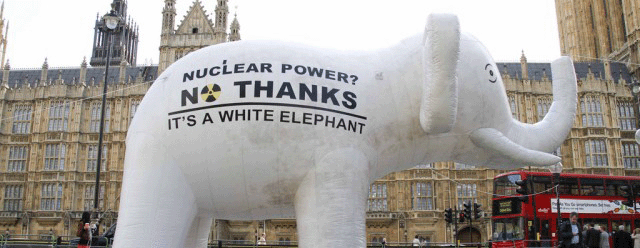
Jeremy Leggett: Why Are Nations Throwing Cash At Nuclear ‘White Elephants’? Impact4All.org, 14 June 18
In recent weeks we have seen evidence on the one hand of the fast advance of renewable energy, and on the other the incredible resilience of the energy-incumbency defence against that advance, including big oil and nuclear.
Celebrations of the fast growth of renewables I will leave to the inestimable REN21 report, published on 4 June. All clean-energy advocates should spend some time immersed in it, arming themselves with bullish ammunition. The point I want to make in this column is about the residual strength of the incumbency rearguard action.
In the last week of May and the first week of June the UK, US, and Canadian governments all tried to bail out uneconomic or stranded fossil fuel and nuclear projects with many billions in public funds. I have dubbed it “The Week of the White Elephants.”
First, the Canadian government bailed out a stranded Kinder Morgan oil pipeline system for US$3.5 bn. They hope to sell this, the Trans Mountain pipeline, in due course. Analysts doubt they can, so economically unattractive and risky is the proposition. In the interim, protestors have labelled Canadian
PM Justin Trudeau – who says he aspires to be a climate hero – a climate criminal.
Second, US President Donald Trump ordered emergency federal action to stem coal and nuclear plant shutdowns. Proposals in a leaked memo included forcing utilities to buy electricity from coal and nuclear operators for two years, despite the fact that renewables and gas are both better value. The Economist describes Trump’s gambit as follows: “The plan would benefit a handful of firms the president favours at the expense of consumers: it entails up to $12bn worth of ‘cash for cronies’.”
Third, in a remarkable U-turn, the UK government agreed to a £5bn injection of taxpayer money into a Welsh nuclear power station, Wylfa. The total cost, to be shared with Hitachi and Japanese government, is £16 bn. The price of power will be £75-77 MWh (they say). That is more than solar and wind.
These are all very strange things to do when you consider not just the economics but the general direction of travel in all relevant areas
……..As for the UK nuclear decision, in France nuclear regulators now fear an “epidemic” safety-culture collapse at Flamanville, the supposed precursor of the British Hinkley Point C reactor. 150 weld failures mean the nuclear plant scheduled online in 2012 at €3.5bn is now probably delayed to 2020, at €10.5bn and counting. This is not the same type of reactor that Hitachi intends for Wylfa, but the horror show at Flamanville shows how badly, and quickly, things can go wrong in modern nuclear.As the formerly pro-nuclear The Economist put it in 2016, in a analysis entitled “Hinkley Pointless”, “Britain should cancel its nuclear white elephant and spend the billions on making renewables work.”…….https://impact4all.org/jeremy-leggett-new-coal-and-nuclear-deals-show-power-of-incumbent-energy-players/
High costs and renewables challenge the case for nuclear power, Economic risks of atomic plants threaten their place in future energy mix, Ft.com Sylvia Pfeifer, -14 June 18 The island of Anglesey, off the north-west coast of Wales, is famous for ancient sites and prehistoric ruins. If all goes to plan over the next few months, the island will make history again — this time as the scene of the next stage in the revival of the UK nuclear industry.
Britain has announced an outline agreement with Hitachi of Japan to build two reactors on the site. If a final deal is struck next year, the plant could be producing electricity by the mid-2020s.
The development, called Wylfa Newydd, would be only the second nuclear plant built in Britain for decades. Together with Hinkley Point C, the £20bn plant under construction in Somerset, in the south-west, by EDF of France, it would generate much-needed low-carbon electricity. They will help ensure the UK’s energy security as coal-fired power stations and ageing nuclear reactors close.
Their fate is also a wider test of the nuclear industry’s ability to compete at a time of rapid change in energy. The nuclear industry has been under threat since the disaster at the Fukushima plant in Japan in 2011 revived concerns about safety and prompted several developed countries, notably Germany, to phase out nuclear power.
The biggest danger to the industry however is that of spiralling costs. Given cheap and plentiful gas and the rise of renewable power whose costs are falling, many industry observers wonder how nuclear power can compete.
“We’ve seen a substantive decline in the share of nuclear of total electricity generation worldwide,” says Paul Dorfman, of the Energy Institute at University College London. “Increasing nuclear costs along with the technological advances and the plummeting price of renewables are the key dynamics, and there’s a clear trend emerging.”
……. competition from gas, wind and solar has grown, nuclear’s share of global electricity generation has declined to 11 per cent from a peak of 17 per cent in the mid-1990s. In its Energy Outlook report published in February, BP forecast that renewable energy would be the fastest-growing source of energy by 2040.
…… Rising costs remain the big challenge. A recent analysis of the history of reactors published in the journal Energy Policy concluded the following: nuclear power projects are more expensive than in the early 1980s; nuclear construction lead times have increased two-fold in the past 50 years; and the increase in complexity and risks of nuclear projects results in high financial costs.
“Nuclear projects are actually becoming more complex to carry out, inducing delays and higher costs,” says the study’s lead author, Joana Portugal Pereira, from the Centre for Environmental Policy at Imperial College London. “Safety and regulatory considerations play heavily into this, particularly in the wake of Fukushima.”
……. In the case of Wylfa Newydd, the government will consider attaching taxpayer funds to the construction of the site, but with the ambition of achieving a strike price for the electricity that will be about £15/MWh cheaper than for Hinkley.
FRENCHTOWN TOWNSHIP, Mich. (AP) — Southeastern Michigan officials say a nuclear plant’s move to slash its property taxes by 60 percent could be devastating to the community.
DTE Energy filed for a property tax reduction for its Fermi 2 nuclear plant with the Michigan Tax Tribunal last month, the Monroe News reported . The Detroit-based utility’s plant is located along Lake Erie in Monroe County’s Frenchtown Township.
The county could lose nearly $11.6 million in property taxes from the nuclear plant. That is in addition to an expected devaluation of the company’s Monroe Power Plant, which could result in a $12 million loss in property taxes.
Officials confirmed the Monroe coal plant filing was made at the same time as the Fermi request, but its details haven’t been made available.
Many community leaders were caught off guard by the decision, which will affect municipalities, schools, the Monroe County Library System and Lake Erie Transit, among others.
Frenchtown Township Supervisor James McDevitt said officials were working with the company and expected to continue to do so next year while settling the coal plant devaluation. He called the move a “letdown” that could cost the township a $1.5 million tax loss.
“We understood that there would be a gradual decline in the value of the power plant and we thought that was reasonable,” said Michael Bosanac, county administrator and chief financial officer. “This is not reasonable and it is not fair.”
Bosanac said the 60 percent cut to the nuclear plant’s taxes could have a more than $1 million impact on the county’s budget.
DTE Energy has said it’s seeking devaluation for the plants because of the market shift to clean energy, which is due in part to aging plants.
The company also filed for a property tax decrease at its Trenton Channel coal plant, as well as similar requests at its wind farms across Michigan.
Observer 10th June 2018, Set aside the debate over whether it’s right that the government should
be proposing to use more than £5bn to help Hitachi. There is a more
fundamental problem with the project: it’s a rip-off.
Even with a state stake, the project will be ridiculously costly for consumers and
alternatives are much cheaper. The government is understood to be
considering a guaranteed price from the Wylfa project on Anglesey of around
£77.50/MWh of electricity: a subsidy to be paid through energy bills for
35 years.
It looks cheap compared to the £92.50/MWh promised to EDF Energy
for Hinkley Point C in Somerset. But that is like saying a Lotus is
affordable compared with a Ferrari. Hinkley was branded “risky and
expensive” by the spending watchdog. It is not a good yardstick.
As one MP pointed out, offshore windfarms have won contracts for as little as
£57.50/MWh. “That is the real cost benchmark that the government should
use,” said the SNP’s Alan Brown. Solar and onshore windfarms would be
even cheaper, but have had their subsidies scrapped. Storage, smarter grids
and imports can help the UK manage renewables’ variable output. Clark’s
intervention shows the economics of new nuclear do not work. Why should
consumers pay through the nose when there are lower-cost alternatives?








 nuclear-news