Right wing nationalism is linked to climate denial
Bill Bufford, 31 Aug 18 Right wing nationalism is now linked to climate denial. In Sweden recently a rightwing nationalist-racist party took over. They threw out plans for renewables, and put an end to the phasing out of nuclear and nuclear reactors in sweden. Rightwing nationalism is racist and chauvenistic in nature. Right wing nationalism-racism is shown to be linked to a rise in climate denial as we see in america, sweden. It is linked to the invigoration of dangerous nulear reactors in japan post fukushima. Even with the continued earthquakes and dramataic increases in dangerous tropical storms there. The Swedes were growing renewables and cutting nuclear. Trump counts wwhite nationalst-racists as his base. Trump is a strong climate deniar that is heavily into nuclearism. The same can be said of nationalist racists in Britain like UKIP. In germany. In Hungary. In Poland.
Abe in Japan engenders nationalism through hatred of korean and chinese immigrants. Through hatred of other immigrants and refugees. He even illegally uses refugees to work for nothing at Fukushima; while they are irradiated to death.
With neonazis and rightwing nationalists in power in sweden, they are scrapping renewables and planning on keeping old reactors open . They are planning on opening new nuclear reactors.
Why is rightwing nationalism and, their awful racism linked to fracking, more fossil fuel-oil rigs and exploitattion, more nuclear reactors?
It is because they have to manufacture the fake motivations and anger of racism, to justify their corporate bosses and others, disconnection from reality. Also they have to have a rallying cause for their fake and amoral cult like with Trump in america and Abe in Japan.The racism card fits the bill!
Corporations have long been linked to climate denial. They are now cultivating and
Engendering rightwing nationalism and racism to further their dirty deeds and aims. Same can be said for nuclearists.
ENVIRONMENTAL SOCIOLOGY recently published an article where M Hultman and his research colleagues show the connections between conservatism, xenophobia, and climate change denial, through a study in Norway
Hultman an expert explains:
“That many of the right-wing nationalist parties in Europe now have climate change denial as one of their most important issues.
These parties are increasing in significance.
We see it in Denmark and Norway, in Britain with UKIP, and Front National in France. But also, in Sweden, with the Sweden Democrats’ suspicion towards SMHI (Swedish Meteorological and Hydrological Institute), their dismissal of the Paris Agreement and of climate laws, and in their appraisal of climate change denier Václav Klaus as a freedom-fighting hero.”
The planet in the Epoch of Stupid
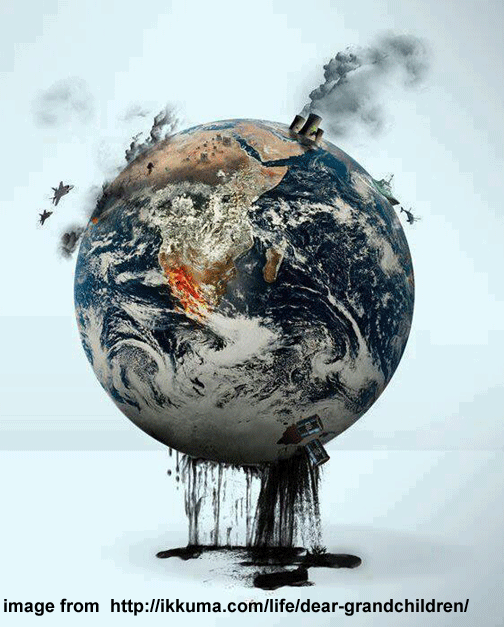 The Ass Clown Epoch, Counter Punch, , 28 Aug 18 How do we define “dumb” in the Age of Stupid? Whether you call it the Anthropocene, or the more scientific ‘Ass Clown Epoch’, stupid is the defining feature of our “smart” everything society: From our phones to the lampshades and corkscrews that increasingly depend on them to function. When the greatest minds of your generation came up with the idea of enriching themselves to the extent that no one else can survive – financially or even physically – it’s time to acknowledge that we are in the throes of irreversible human cognitive collapse. Some would point to the Supreme Dotard at its apex as symptomatic of its underlying causes rather than the cause itself. After all, stupid is the fertile foundation from which both “intelligent life” and Donald Trump evolved. ……
If a person is somehow able to mathematically chart a course for himself to a distant, freezing planet, having helped mastermind the destruction of his own, we somehow consider this development an achievement milestone ……..Jennifer Matsui is a writer living in Tokyo. https://www.counterpunch.org/2018/08/28/the-ass-clown-epoch/
Climate change is real. We must not offer credibility to those who deny it

We are no longer willing to lend our credibility to debates over whether or not climate change is real. It is real. We need to act now or the consequences will be catastrophic. In the interests of “balance”, the media often feels the need to include those who outright deny the reality of human-triggered climate change.
Balance implies equal weight. But this then creates a false equivalence between an overwhelming scientific consensus and a lobby, heavily funded by vested interests, that exists simply to sow doubt to serve those interests. Yes, of course scientific consensus should be open to challenge – but with better science, not with spin and nonsense. We urgently need to move the debate on to how we address the causes and effects of dangerous climate change – because that’s where common sense demands our attention and efforts should be.
Fringe voices will protest about “free speech”. No one should prevent them from expressing their views, whether held cynically or misguidedly. However, no one is obliged to provide them with a platform, much less to appear alongside them to give the misleading impression that there is something substantive to debate. When there is an article on smoking, newspapers and broadcasters no longer include lobbyists claiming there are no links to cancer. When there’s a round-the-world yacht race we don’t hear flat-earthers given airtime: “This is madness; they’ll sail off the edge!”
There’s a workable model for covering fringe views – which is to treat them as such. They don’t need to be ridiculed, just expected to challenge the evidence with better evidence, and otherwise ignored. As campaigners and thinkers who are led by science and the precautionary principle, and who wish to debate the real and vital issues arising from human-triggered climate change, we will not assist in creating the impression that climate denial should be taken seriously by lending credence to its proponents, by entertaining ideas that lack any basis in fact. Therefore we will no longer debate those who deny that human-caused climate change is real. There are plenty of vital debates to be had around climate chaos and what to do about it; this is simply no longer one of them. We urge broadcasters to move on, as we are doing.
Jonathon Porritt Chair, Sustainable Development Commission 2000-11 Continue reading
Tokyo Olympics have offical dance – ? The Radiation Tango?
 ICYMI, the Tokyo 2020 Olympics Have an Official Dance This month marks just 24 months (squee!) until the next Summer Olympics, set to go down summer 2020 in Tokyo, Japan. And what better way to get in the Olympic spirit starting RIGHT NOW than to learn a surprisingly intense choreographed dance?
The Tokyo 2020 Organizing Committee based this ditty and its accompanying moves on the theme song for the 1964 Summer Olympics, aka the last time Japan’s capital city hosted the Games……https://www.dancespirit.com/tokyo-2020-dance-2598707903.htm
Mary Olson warns on the danger to women of ionising radiation
 Resource Service, talks about the greater danger faced by women and girls
exposed to ionizing nuclear radiation.
nuclear weapons facilities. Mary Olson’s research and activism is a
driving force for the Treaty to Abolish Nuclear Weapons. This Nuclear Free
Future conversation takes heed of this topic 73 years after the bombing of
Hiroshima and Nagasaki on August 6 and August 9, 1945.
https://www.cctv.org/watch-tv/programs/gender-matters-atomic-era
Cesium in California’s wine – from Fukushima nuclear accident
 The Register 19th Aug 2018 , Savants reckon radiation released by the 2011 Fukushima nuclear kerfuffle
has made its way into California’s wine. A paper emitted this month by
researchers at the University of Bordeaux Centre d’Études Nucléaires de
Bordeaux-Gradignan (CNRS) in France revealed that levels of cesium-137 in
the atmosphere rose as a result of the reactor accident, judging by Cali
tipple tested before and after Japan’s level-7 nuclear disaster.
where trace amounts of the highly soluble cesium isotope got into the
grapes used to make the region’s famed wines.
https://www.theregister.co.uk/2018/07/19/fukushima_cesium_wine/
Nuclear has left its run too late
Nuclear has left its run too late: a response to Ian Hore-Lacy, ETHOS, 14 August 2018 | Robert Farago “………… Nuclear as the solution? There are a number of unresolved problems around nuclear power and questions of whether nuclear energy can grow quickly enough to solve our climate change problem. I will just list some of these problems with a sentence each:
- Weapons proliferation – enriching Uranium for civilian nuclear energy programs can lead to fuel being diverted and further enriched for nuclear weapons programs.
- Safety – although less deaths have been recorded from nuclear power than from coal mining, nuclear accidents such as Three Mile Island, Chernobyl and Fukushima have shaken the confidence of citizens to have nuclear reactors near their homes and food sources.
- Waste – although we have generated nuclear waste for 70+ years we still don’t have a solution. Nuclear waste needs to be stored safely for hundreds of thousands of years, longer than settled agricultural society has existed.
- Decommissioning – cost estimates vary wildly and it’s particularly technically challenging and expensive after nuclear accidents.
- Water use – like thermal coal generators, nuclear needs large quantities of water for cooling, making droughts and heatwaves a problem.
- Capacity – if we moved to a large portion of our global electricity generation to nuclear power, will there be enough Uranium to fuel them?
- Timeliness – can we move quickly enough to a majority nuclear electricity future and meet our global emission reductions?
Assuming the above problems can be quickly resolved, despite decades of not resolving them, and we can somehow scale nuclear by an order of magnitude from today, will it be cheap enough?
When I was a child in primary school (in the late 1970s), I read that in the future nuclear energy had the potential to generate electricity that would be ‘too cheap to meter’. That future never came and sadly never will.
Overseas examples are not encouraging. Recent nuclear reactor constructions in Finland, USA and UK are taking much longer than expected, costing much more than expected and in some cases being abandoned.
Australian governments have on several occasions investigated the feasibility of nuclear energy being adopted in this country. Two recent reports were the Switkowski Report in 2006 and the South Australian Nuclear Fuel Cycle Royal Commission’s Report in 2016.
The Switkowski Report had the cost of nuclear higher than new coal at the time. The more recent South Australian (SA) Royal Commission report looked at Uranium mining, nuclear fuel enrichment, electricity generation as well as nuclear waste disposal opportunities for SA. The SA government’s response to the royal commission concluded:
The government considers that nuclear power in the short to medium term is not a cost-effective source of low-carbon electricity for South Australia.
Even Ziggy Switkowski, a nuclear physicist and strong nuclear proponent, has recently said that ‘the window for GW scale nuclear has closed’ and:
With requirements for baseload capacity reducing, adding nuclear capacity one gigawatt at a time is hard to justify, especially as costs are now very high (in the range of $5 billion to $10 billion), development timelines are 15+ years, and solar with battery storage are winning the race.
Meanwhile many GW of wind farms, solar farms (a 35GW pipeline) and rooftop solar continue to be planned and built. Battery storage and pumped hydro projects to help balance the system are also being planned before our old coal power stations reach their end of life. Electricity prices are also stabilising and coming down slightly at the retail level, and more dramatically at the wholesale level, according the ASX electricity futures market.
Nuclear energy in Australia may have had a role to play if we had adopted the technology in the 1970s, when other countries were rapidly adopting the technology, and renewables like solar cost 100 times as much as today. While cheaper, safer and better nuclear designs have been proposed and been under development for some time overseas, their promise has not yet been proven. Nuclear energy also takes a very long time to adopt in countries like Australia that don’t have the required nuclear engineering and regulatory expertise, i.e. at least 15 years to build the first power station. Nuclear has simply left its run too late in Australia. The economics of renewable energy, being cheaper than all other forms of generation in Australia in 2018, has been the final straw in halting the possibility of nuclear energy being adopted here before it has even begun, except for that one fusion reactor in the sky, 150 million km away.
Robert Farago is an Engineer with 30 years’ experience. He has worked on writing software, building the internet and installing renewable energy, sometimes simultaneously.
http://www.ethos.org.au/online-resources/Engage-Mail/nuclear-too-late-a-response-to-ian-hore-lacy
A Green Wave is coming to USA Politics This November

 The Coming Green Wave This silent majority will no longer stand by as the Trump administration tries to destroy a century of bipartisan love of the land. NYT, By Timothy Egan, Aug. 17, 2018
If emotions were water, and you took all the heartbreak felt by the millions who followed the plight of a starving orca whale grieving over her dead calf, you’d have a river the size of the mighty Columbia.
If anger were a volcano, and you let loose all the rage felt by people over the daily assaults on public land by the Trump administration, you’d have an eruption with the fury of Mount St. Helens.
And if just one unorganized voting segment, the 60 million bird-watchers of America, sent a unified political message this fall, you’d have a political block with more than 10 times the membership of the National Rifle Association.
-
A Green Wave is coming this November, the pent-up force of the most overlooked constituency in America. These independents, Teddy Roosevelt Republicans and Democrats on the sideline have been largely silent as the Trump administration has tried to destroy a century of bipartisan love of the land.
-
But no more. Politics, like Newton’s third law of physics, is about action and reaction. While President Trump tries to prop up the dying and dirty coal industry with taxpayer subsidies, the outdoor recreation industry has been roaring along. It is a $374-billion-a-year economy, by the government’s own calculation, and more than twice that size by private estimates.
That’s more than mining, oil, gas and logging combined. And yet, the centerpiece of a clean and growing industry is under attack by a president with a robber baron view of the natural world.
I write from the smoke-choked West, where the air quality in major cities has been worse than Beijing this month. While Trump spends his days comparing women to dogs, and tweets nonsense about rivers flowing to the sea, the biggest wildfire in California history blazes away.
After the four warmest years ever recorded, scientists have now warned that the next five will be “anomalously warm.” But Trump doesn’t even understand time zones, let alone atmospheric upheaval.
In the face of these life-altering changes, Trump is drafting rules to make it easier for major polluters to drive up the earth’s temperature. While the orcas of Puget Sound are starving, Trump is trying to weaken the law that protects endangered species. And while lovers of the outdoors break visitation records at national parks and forests, Trump is removing land from protection.
This is not green goo-goo or fantasy projection. You can see and feel the energy in places ignored by the national political press.
“If D.C. comes for our public land, water or monuments again, they’ll have to come through me,” says Xochitl Torres Small, a Democrat with an even chance of taking a longtime Republican seat in New Mexico, in an ad showing off her political chops.
……… Only one in 10 voters think Americans should use more coal. And more than 80 percent of millennials, soon to be the largest cohort of voters (if they ever turn out), believe there’s solid evidence behind these freakish manifestations of an overheated earth.
Science, a huge majority believes, is not a conspiracy. And yet, this huge majority has been ignored. These people are now ready to “put aside our differences and stand together for the places we love,” as Tawney and Yvon Chouinard, the founder of Patagonia, wrote in The Denver Post.
You will see it in Minnesota, where the 140,000 people who work in outdoor recreation are furious at Trump’s attempt to open a sulfide-ore copper mine near Boundary Waters Wilderness. You will see it in a half-dozen tossup congressional races in California, where the administration is mounting the biggest assault yet on public health, with its attack on emission rules.
If it’s self-interest powering the wave, such is the nature of politics. At a time of real peril for the things that most Americans love, the silent green majority has had enough.
I invite you to follow me on Twitter (@nytegan). https://www.nytimes.com/2018/08/17/opinion/trump-environment-green-wave.html
FirstEnergy Solutions, going through bankruptcy, in process for decommissioning Beaver Valley Nuclear Power Station
Nuclear plant owners take next steps in decommissioning process, The Times Aug 15, 2018
Lewis County Coalition to Abolish Nuclear Weapons calls for USA support of Nuclear Weapons Ban
Nuclear Weapons Should be Unacceptable Option http://www.chronline.com/opinion/letter-to-the-editor-nuclear-weapons-should-be-unacceptable-option/article_5c725692-9feb-11e8-9425-6737078872dc.html, Larry Kerschner
The Lewis County Coalition to Abolish Nuclear Weapons wrote a resolution asking the Lewis County Board of County Commissioners to support the abolition of nuclear weapons. We asked them to place it on the agenda of a regular meeting in order to have a public discussion on this important issue. The commissioners have refused to even discuss the resolution.
Knowing the conservative bent of the commissioners, we didn’t have high expectation of the BOCC passing the resolution. We did have an expectation that since the United States Constitution and the Washington State Constitution guarantee a right of redress to the government they would place it on the agenda of a public meeting for citizen discussion.
There are approximately 1,000 nuclear weapons nearby at the Bangor Submarine Base on the Kitsap Peninsula, approximately 65 miles north of Lewis County and 20 miles west of Seattle. The United States has plans to spend between $1 trillion and $2 trillion over the next 30 years to completely rebuild all of its nuclear weapons and weapons systems (missile, submarine and airplane delivery systems).
The willingness to inflict massive indiscriminate destruction on civilian populations undermines our deepest human and ethical values. Massive nuclear retaliation is a form of genocide that should be completely unacceptable from any legal or sane point of view. It violates not only the principles of international law, common decency and common sense, but also the ethical principles of every major religion.
The United States and all of its communities, instead of continuing the manufacturing of and the threat of the the use of nuclear weapons, should instead take the lead in the global rejection of nuclear weapons.
The New Strategic Arms Reduction Treaty was signed April 8, 2010, in Prague by Russia and the United States and entered into force on Feb. 5, 2011. New START replaced the 1991 START Treaty, which expired December 2009, and superseded the 2002 Strategic Offensive Reductions Treaty, which terminated when New START entered into force.
New START continues the bipartisan process of verifiably reducing U.S. and Russian strategic nuclear arsenals begun by former Presidents Ronald Reagan and George H.W. Bush. New START is the first verifiable U.S.-Russian nuclear arms control treaty to take effect since START I in 1994.
Despite some recent belligerent talk, the governments of the two largest nuclear powers recognize the need to vastly reduce the number of nuclear weapons in the world. Previous treaties have called for the eventual abolition of such weapons.
The Treaty on the Prohibition of Nuclear Weapons was negotiated at the United Nations headquarters in New York in March, June and July 2017, with the participation of more than 135 nations.
Similar resolutions have been discussed in a number of cities and counties around the country. I would be willing to predict that the majority of people in Lewis County if asked would agree that nuclear weapons should be eliminated. This should not be a difficult decision for the BOCC to make. Ask your commissioner to make it.
Lower Richland residents lambast Westinghouse over nuclear leak many knew little about
Angry crowd blasts Westinghouse over nuclear leak many knew little about, The State, BY SAMMY FRETWELL
sfretwell@thestate.com August 14, 2018 HOPKINS
Upset about contamination from a Westinghouse nuclear fuel plant, Lower Richland residents lambasted the company Monday night for failing to tell them about a recent uranium leak and for ignoring the rural, working-class community the company has operated in for nearly 50 years……..
The leak occurred in June, but high levels of uranium in the soil were not reported to state and federal regulators until July 12. Some people said they knew nothing of the leak until reading about it in The State newspaper in late July, shortly after the leak became public on a federal website.
Uranium levels in the soil were more than 1,000 times higher than what is normally found in dirt. The leak occurred when acid from part of the plant ate through a concrete floor, allowing the hazardous pollution to occur. A plastic liner atop the concrete failed, exposing the concrete to acid. Westinghouse and state regulators now are investigating to learn more about the contamination. …….
Regardless of whether the leak pollutes wells or not, some speakers at the meeting said Westinghouse’s overall operating practices are a concern. Groundwater pollution from plant operations has existed on the site for nearly 40 years, although the company says it has never gotten off site. …….. https://www.thestate.com/news/local/article216593920.html
Need to carry on the torch against nuclear weapons, as hibakusha numbers dwindle

Keep up the fight to eliminate nuclear weapons, Japan Times, 10 Aug 18 “……… The number of surviving hibakusha as of the end of March was 154,859, a decline of 9,762 from a year earlier. In recent years, nearly 10,000 hibakusha have been passing away annually. Their average age has surpassed 82. This nation’s firsthand experience of the atomic bombings will fade with time. That is all the more reason for us to keep pushing for the elimination of nuclear weapons.
In his address during this year’s anniversary ceremony marking the Hiroshima atomic bombing, Hiroshima Gov. Hidehiko Yuzaki summed up the danger of believing in the balance of power ensured by nuclear deterrence by asking how would you explain it to your children.
“You see, we don’t get along well with our next-door neighbor. So we have set a bomb that can blow up their house with all the family inside, just in case. We can press the button to set off this bomb any time. Our neighbor, on the other hand, has also set a bomb to blow up our house. Of course, neither family wants both families to end up dead, so I feel assured that they will never press the button. We will never do so, either. In short, we will never go into battle against each other. And the bombs will probably not malfunction. And we won’t press the button by mistake, either, I hope. So you don’t have to worry,” the governor said, adding, “How many of you could seriously offer such an explanation to your children?”
How can we continue with a policy that we cannot explain to our next generation? https://www.japantimes.co.jp/opinion/2018/08/10/editorials/keep-fight-eliminate-nuclear-weapons/#.W24MLyQzbGg
On Hiroshima anniversary – fading commitment to nuclear weapons control
The Hiroshima anniversary: 5 things you should know about nuclear weapons today
Seventy-three years after the first use of the atomic bomb in wartime, commitment to arms control is fading. By
Greenpeace’s drone crash into nuclear power plant illustrates the danger of nuclear terrorism
Bulletin of Atomic Scientists 3rd Aug 2018 , When a Superman-shaped drone crashed into a French nuclear plant on July 3
of this year, officials were lucky it was just Greenpeace demonstrating
vulnerabilities at the facility, and not a terrorist group intent on
attacking the site.
This incident highlights why the 2010 Nuclear Posture
Review’s assessment that nuclear terrorism is “today’s most immediate
and extreme danger” remains relevant: It underscores the importance of
the sustained and persistent six-year effort from 2010 to 2016 to reduce
the threat posed by nuclear terrorism, far from the headline nuclear issues
of Iran, North Korea, and arms control with Russia.
https://thebulletin.org/2018/08/why-countries-still-must-prioritize-action-to-curb-nuclear-terrorism/
Nuclear power takes a hit as European heatwave rolls on
https://reneweconomy.com.au/nuclear-power-takes-a-hit-as-european-heatwave-rolls-on-87477/
A scorching European summer has been doing its best to prove that renewables are not the only energy sources at the mercy of the elements – and that climate change is a thing – with nuclear reactors from France to Finland being shut down or their output restricted due to record heat.
Over the weekend, French energy company EDF said it was forced to temporarily halt four nuclear reactors in soaring temperatures, including a reactor at the country’s oldest plant, Fessenheim, to stop it from overheating the water in the nearby river.
The Independent reports that EDF had already shut down three other power plants near the Rhine and Rhone rivers for similar reasons earlier last week.
A scorching European summer has been doing its best to prove that renewables are not the only energy sources at the mercy of the elements – and that climate change is a thing – with nuclear reactors from France to Finland being shut down or their output restricted due to record heat.
Over the weekend, French energy company EDF said it was forced to temporarily halt four nuclear reactors in soaring temperatures, including a reactor at the country’s oldest plant, Fessenheim, to stop it from overheating the water in the nearby river.
The Independent reports that EDF had already shut down three other power plants near the Rhine and Rhone rivers for similar reasons earlier last week.
Nuclear plants like these use the river water to regulate the temperature of their reactors, discharging warm water back into the waterway. But restrictions are put on the volume of water plants can use as the temperatures rise, to protect the rivers’ ecosystems.
In Sweden, state-owned power company Vattenfall was forced to close the 900MW number 2 reactor at its Ringhals nuclear plant on Monday, when the temperature of the sea water used to cool that plant reached its limit of 25°C – threatening the safety and function of the reactor.
Other plants in the Nordic region, while not completely shut down, have had to curb the power output of their reactors to avoid worse, and more dangerous outcomes.
Finland’s Fortum reduced power at its Loviisa plant last week when water temperatures reached 32°C, close to its threshold of 34°C.
As Reuters explains, the northern European summer has been 6-10°C above the seasonal average so far and has not only caused outages for nuclear, but depleted the region’s hydropower reservoirs.
It has been so hot in Finland, that a a supermarket chain invited customers to spend the night at its air-conditioned store in Helsinki on the weekend, because so few homes in the Nordic country actually have air-con.
And in Sweden – which is also suffering through a drought that sparked dozens of severe forest fires through July – the record heat has melted a glacier on the nation’s Kebnekaise mountain, rendering it no longer the country’s highest point.
And the weather is not just hotter than normal, but also more erratic, reports the New York Times.
“Torrential rains and violent thunderstorms have alternated with droughts in parts of France. In the Netherlands, a drought — rather than the rising seas — is hurting its system of dikes because there is not enough fresh water countering the seawater,” it says.
“The preliminary results of the Oxford study found that, in some places, climate change more than doubled the likelihood of this summer’s European heat wave.”
1 This Month


Tell the Ukrainian Government to Drop Prosecution of Peace Activist Yurii Sheliazhenko

Petition to revoke the licensing of the Near Surface Nuclear Disposal Facility (NSDF) at Chalk River. https://www.ourcommons.ca/petitions/en/Petition/Details?Petition=e-7247


of the week – STOP SMALL MODULAR REACTORS IN CANADA
To see nuclear-related stories in greater depth and intensity – go to https://nuclearinformation.wordpress.com
-
Archives
- March 2026 (212)
- February 2026 (268)
- January 2026 (308)
- December 2025 (358)
- November 2025 (359)
- October 2025 (376)
- September 2025 (258)
- August 2025 (319)
- July 2025 (230)
- June 2025 (348)
- May 2025 (261)
- April 2025 (305)
-
Categories
- 1
- 1 NUCLEAR ISSUES
- business and costs
- climate change
- culture and arts
- ENERGY
- environment
- health
- history
- indigenous issues
- Legal
- marketing of nuclear
- media
- opposition to nuclear
- PERSONAL STORIES
- politics
- politics international
- Religion and ethics
- safety
- secrets,lies and civil liberties
- spinbuster
- technology
- Uranium
- wastes
- weapons and war
- Women
- 2 WORLD
- ACTION
- AFRICA
- Atrocities
- AUSTRALIA
- Christina's notes
- Christina's themes
- culture and arts
- Events
- Fuk 2022
- Fuk 2023
- Fukushima 2017
- Fukushima 2018
- fukushima 2019
- Fukushima 2020
- Fukushima 2021
- general
- global warming
- Humour (God we need it)
- Nuclear
- RARE EARTHS
- Reference
- resources – print
- Resources -audiovicual
- Weekly Newsletter
- World
- World Nuclear
- YouTube
-
RSS
Entries RSS
Comments RSS
 nuclear-news