Iran’s nuclear reactor starts
|
On 12 September Iran brought its first nuclear power plant in Bushehr online, connecting it to the country’s electrical grid. Iranian officials at the opening ceremony said that the 1,000 megawatt plant has begun generating electricity at 40 percent of its capacity and will reach full capacity by the year’s end following further testing.
Quite aside from demonstrating Iran’s touching post-Fukushima faith in nuclear energy despite being a seismically active country, Bushehr represents a Rorschach test of sorts for all the fears and anxieties in the Middle East, in which everyone looking at the facility has his preconceptions reaffirmed. Continue reading
Energy’s new frontier – offshore wind power
 Offshore Wind Energy – opening up a New Frontier, Renewable Energy World, By Matthew Allen | September 13, 2011, German American Offshore Wind Conference, October 18 in Jersey City, NJ
Oct 18th, 2011 in Jersey City, NJ German Government sponsored Conference emphasizes cooperation between US and Germany More than 21,607 wind turbines currently produce about 7% of Germany’s total electrical power, providing over 96,100 jobs. As of 2011, Germany’s federal government is working on a new plan for increasing renewable energy commercialization, with a particular focus on offshore wind farms. In the United States, Wind power accounted for 2.3% of the electricity generated in 2010, all from inland based sources, none off shore. By 2030, the U.S. Department of Energy’s envisions a 20% wind energy contribution, including 4% from offshore wind power. Continue reading
Unsatisfactory basis for nuclear safety rules in USA
Nuclear miscalculation: Why regulators miss power plant threats from quakes and storms Huffington Post, The Center for Public Integrity By Susan Q. Stranahan, 13 Sept 11,
How well are nuclear plants near you prepared for disaster? Look it up here
“……Day-to-day operation and oversight of the nation’s 104 nuclear plants rely heavily on assumptions and statistical calculations: The earthquake won’t be stronger than seismologists predict. Floodwaters won’t rise higher than hydrologists estimate. Tornadoes won’t knock out off-site power supplies on which nuclear plants depend. Switches and valves will work.
The unexpected won’t happen.
Such calculations deem unlikely that terrorists will gain access to poorly-secured spent reactor fuel storage facilities. Or that seemingly minor transmission line maintenance won’t accidentally trigger a blackout affecting millions in the West and forcing two reactors to automatically shut down – another unexpected event, last week.
Regulation by predicting what’s probable has been evolving since 1975, when the NRC and reactor owners began moving from a traditional rulebook form of regulation — involving specific requirements, for instance, about equipment and procedures — toward what is known as probabilistic risk assessment, or PRA. Such “risk-based” regulation gives the companies running nuclear plants wider leeway in determining how they are going to operate safely. Reactor owners and government safety officials argue that the old “one-size-fits-all” rulebook approach is expensive and inefficient.
At the heart of the strategy are questions: How likely is something to go wrong? What would be the consequences?…..
The underlying weakness of the approach – faulty assumptions or underestimates – is coming into sharper focus….. The effects of weak policing….. http://www.huffingtonpost.com/the-center-for-public-integrity/nuclear-miscalculation-wh_b_960417.html
Arizona – ignorance and lies about hazards of uranium mining
When asked during the hearing if any of the panel members present were concerned about contamination to the environment, specifically the air and water, or the threat to the health and safety of people, the answer was a resounding and unanimous “no.”
Read that again. Uranium, a known radioactive element, is being presented by the panel as harmless so long as it is not processed.
Uranium mining in Arizona Strip: What would Brigham Young say?, St George Utah.com by Dallas Hyland September 12, 2011 This past week, a public hearing was held in St. George to discuss uranium mining on the Arizona Strip, as reported in St. George News story, Uranium Mining on Arizona Strip Threatened by Federal Government. A panel from the Arizona-Utah Local Economic Coalition and concerned citizens from Arizona and Utah met to discuss and put comments on the record about the Secretary of the Interior’s moratorium on mineral extraction in the region.
The main thrust of the argument against the ban on mining permits from the perspective of the panel was its dramatic impact on local economies dependent on jobs and revenue from mining. Continue reading
Some Idaho people keen to host nuclear wastes?
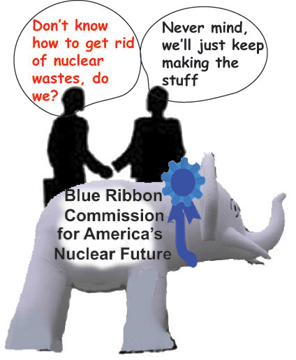 It [Blue Ribbon Copmmission]wants a new organization solely dedicated to waste management with the power and access to the funds to succeed.
It urged the U.S. to continue its leadership in international waste and nonproliferation issues. And it wants to reconsider long term geologic storage options like Yucca Mountain. But it also proposed a stable, long-term program to support research, development and demonstration of advanced reactor and fuel cycle technologies and supporting workforce development, subjects near and dear to people in eastern Idaho around the Idaho National Laboratory……
Idaho groups seek to influence nuclear waste future decisions Voices IdahoStatesman.com by Rocky Barker , 09/12/2011 “……nationally U.S. reactors have generated 65,000 metric tons of spent fuel, of which 75 percent is stored in pools, according to Nuclear Energy Institute data. A spent fuel rod gives off enough radiation to kill people a foot away in a matter of seconds. Continue reading
Costs, risks, and myths of nuclear power – full report
at the Fukushima Dai-ichi Nuclear Power Station
 There is a new international NGO world wide study on nuclear issues in light of the Fukushima disaster 6 months ago. It has a range of articles and country by country updates on the state of nukes. It is coordinated by Ray at Reaching Critical Will in New York. Its a must read and is downloadable from here:
Uranium price to fall even further – Australian assessment
 Uranium spot price could fall more, Star Tribune, Tom Mast, September 11, 2011 The spot price of uranium, which tumbled following a Japanese nuclear disaster last spring, could fall even further in the short term.
That’s the assessment of Sydney, Australia-based Resource Capital Research. In its September quarter review, the firm noted a current spot price of $48.85. It is now back to the level seen after a March 11 earthquake and tsunami crippled a nuclear power complex at Fukushima, Japan…..
The firm said the fund-implied price, which is an indicator of market price expectations looking out three to six months, points to a spot price of $45.95. This reflects expectations of possible new supplies entering the market later this year….
Strong opposition to nuclear power in Japan
 Sixty-eight percent of respondents to an Asahi newspaper poll published on Aug. 8 said they wanted Kan’s successor to continue his policy of phasing out atomic energy.
Japan Minister’s Resignation Tests Nuclear Plan, Bloomberg, By Mariko Yasu – Sep 11, 2011 Japan Prime Minister Yoshihiko Noda’s effort to win public support for restarting nuclear reactors faces a setback after his minister in charge of the industry was forced to resign just nine days into the job. Continue reading
Warning on earthquakes and multiple hazards to nuclear plants

“Any thought that we have eliminated accidents” is “hopefully vanquished from anybody’s mind who works in this industry,”
Nuke Plants Need Quake Review Each Decade: Jaczko, Bloombeg, By Brian Wingfield – Sep 7, 2011 The U.S. Nuclear Regulatory Commission should for the first time require plant owners to review earthquake hazards at least once a decade, Chairman Gregory Jaczko said, backing a proposal opposed by industry….. Continue reading
Fukushima film will include rare earths radiation pollution
Japanese filmmaker to highlight Lynas controversy, Free Malaysia Today, G Vinod, September 6, 2011“….A foreign documentary on the nuclear meltdown in Japan will also highlight the controversy over the Lynas rare earth refinery in Malaysia.
PETALING JAYA: A Japanese filmmaker plans to include the Lynas rare earth controversy in his upcoming documentary on nuclear radiation which is scheduled to be released in October 2011.The filmmaker, Shunji Iwai, decided to highlight the plight of the people in Gebeng, Pahang after hearing about the matter from his Malaysian counterpart, Tan Chui Mui.
Lynas Corporation Ltd plans to build a RM700 million rare earth refinery in Gebeng, to facilitate transportation of its mining products from Western Australia’s Mount Weld to the plant in Gebeng. The plant is expected to be operational by end of this year.
However, the community in Gebeng are up in arms against the project fearing radioactive contamination in the area surrounding the plant. Although the International Atomic Energy Agency (IAEA) had said the mine would be safe, Kuantan MP Fuziah Salleh dismissed its report, saying that most of the findings were made based on data given by Lynas itself…….
Tan herself would be directing a few parody educational video called “Survival Guide in Radioactive Village” to create awareness among the public on the Lynas scare. The documentary is scheduled for release in October for the Japanese market. It will subsequently be released to the global audience via the Internet…http://www.freemalaysiatoday.com/2011/09/06/japanese-film
Japan: zero nuclear future. AREVA wants to manage wastes
No. of Japan’s nuclear plants to be zero in future: Hachiro, Mainichi Daily News, Japan September 6, 2011, TOKYO (Kyodo) — Industry minister Yoshio Hachiro said Tuesday that the number of Japan’s nuclear power plants would be “zero” in the future, based on Prime Minister Yoshihiko Noda’s policy of not building new nuclear power plants and decommissioning aged ones.
“Considering the premier’s remarks at press conferences, it would be zero,” Hachiro told reporters in answer to the question whether the number of nuclear plants would reduce to none in the future.
Hachiro added that it would be “difficult” to proceed with plans to build new nuclear plants whose construction has yet to begin, such as Chugoku Electric Power Co.’s Kaminoseki plant in Yamaguchi Prefecture. “Public opinion is generally united in reducing (nuclear plants), instead of increasing them,” he said…….
Meanwhile, Hachiro admitted that Japan has received an offer from French nuclear power company Areva SA to take charge of spent nuclear fuel at the troubled Fukushima Daiichi plant, but he did not reveal Japan’s response to the offer…..http://mdn.mainichi.jp/mdnnews/news/20110906p2g00m0dm118000c.html
Abolish all nuclear power plants, says Nobel prize-winner
Oe cautioned Prime Minister Yoshihiko Noda against prioritizing the economy over safety. Noda has said he will allow idled nuclear plants to resume operation when their safety is confirmed.
“The new prime minister seems to think that nuclear power plants are necessary for Japan’s economy, and how to resume their operation is one of his key political agendas,” Oe said. “We must make a big decision to abolish all nuclear plants.”….http://fuelfix.com/blog/2011/09/06/nobel-winner-urges-japan-to-abandon-nuclear-power/
Intoxicated nuclear plant employee
IAEA report on Iran’s compliance with NPT
New IAEA Report Reaffirms Dangers of Iran’s Nuclear Program – MarketWatch, 4 Sept 11, “This latest IAEA report underscores yet again the danger posed by the Iranian nuclear program,” said AJC Executive Director David Harris.The nine-page report, released on Friday, examines Iran’s compliance with the Non-Proliferation Treaty and binding UN Security Council resolutions that address Iran’s nuclear program.Among its key highlights:The IAEA is “increasingly concerned about the possible existence in Iran of past or current undisclosed nuclear-related activities involving military-related organizations, including activities related to the development of a nuclear payload for a missile, about which the Agency continues to receive new information.”
AJC: New IAEA Report Reaffirms Dangers of Iran’s Nuclear Program – MarketWatch
France’s Flamanville nuclear reactors problems downplayed by management
Bouygues CEO Downplays Problems at Flamanville Nuclear Plant, Fox Business, By Inti Landauro, August 31, 2011 PARIS – – Martin Bouygues, chief executive of French construction and telecommunication group Bouygues SA, Wednesday downplayed problems in the construction of a nuclear plant in Flamanville, saying the project is a prototype and as such normally faces difficulties.
1 This Month
23 April – WEBINAR – Why new nuclear reactors are the wrong tools for decarbonization Thursday, April 23 • 1 AM – 2 AM AEST


Pine Ridge Uranium is the real threat, not Tehran- Tell Burgum: Stop the Extraction.
Chernobyl: The Lost Tapes – A good documentary on Chernobyl on SBS available On Demand for the next 3 weeks– https://www.sbs.com.au/ondemand/tv-program/chernobyl-the-lost-tapes/2352741955560
To see nuclear-related stories in greater depth and intensity – go to https://nuclearinformation.wordpress.com
-
Archives
- April 2026 (275)
- March 2026 (251)
- February 2026 (268)
- January 2026 (308)
- December 2025 (358)
- November 2025 (359)
- October 2025 (376)
- September 2025 (257)
- August 2025 (319)
- July 2025 (230)
- June 2025 (348)
- May 2025 (261)
-
Categories
- 1
- 1 NUCLEAR ISSUES
- business and costs
- climate change
- culture and arts
- ENERGY
- environment
- health
- history
- indigenous issues
- Legal
- marketing of nuclear
- media
- opposition to nuclear
- PERSONAL STORIES
- politics
- politics international
- Religion and ethics
- safety
- secrets,lies and civil liberties
- spinbuster
- technology
- Uranium
- wastes
- weapons and war
- Women
- 2 WORLD
- ACTION
- AFRICA
- Atrocities
- AUSTRALIA
- Christina's notes
- Christina's themes
- culture and arts
- Events
- Fuk 2022
- Fuk 2023
- Fukushima 2017
- Fukushima 2018
- fukushima 2019
- Fukushima 2020
- Fukushima 2021
- general
- global warming
- Humour (God we need it)
- Nuclear
- RARE EARTHS
- Reference
- resources – print
- Resources -audiovicual
- Weekly Newsletter
- World
- World Nuclear
- YouTube
-
RSS
Entries RSS
Comments RSS
 nuclear-news