Japanese government’s unseemly haste to prop up the nuclear industry
“recklessly rushing to bring the reactors back online now, saying they meet its lax safety requirements”.. “The nuclear industry and the government…. are trying to pretend they can call Oi safe without improving safety or emergency measures,”

 Criticism hits Japan’s plan to restart nuclear reactors NDTV, Agence France-Presse | April 15, 2012 Tokyo: Japan’s plan to restart two offline nuclear reactors came under fire today from media and environmental groups amid doubts over the safety of atomic power after the Fukushima accident. Continue reading
Japan could manage without nuclear power: and it might do so “momentarily”
It was not certain if and when the government could gain approval from regional authorities around the Oi plant for the reactors to be restarted amid persistent public distrust….
Independent studies show that there will be no power shortages,” said Wakao Hanaoka, the Japan campaign manager for the environment watchdog Greenpeace….
Japan may be ‘momentarily’ without nuclear power Google News (AFP) 15 April 12, TOKYO — Japan may go “momentarily” without nuclear power next month when the only one reactor still in operation shuts down for maintenance work, the country’s industry minister warned Sunday. Continue reading
Growing alarm over the unsafety of the Pilgrim Nuclear Power Station in Plymouth.

 Petitions raise alarm on N-plant, Critics want new safety rules met at Pilgrim station By Jennette Barnes Boston Globe April 15, 2012 Concern about nuclear safety is gaining visibility south of Boston as voters in several communities determine the fate of a petition that aims to shut down, at least temporarily, the Pilgrim Nuclear Power Station in Plymouth.
Although the nonbinding questions focus on making the plant safe, rather than closing it permanently, they would, in effect, endorse closing it down for more than four years.
A Town Meeting article passed in Duxbury, Kingston, and Scituate. Marshfield Town Meeting is expected to vote April 23, and Plymouth takes up the issue by ballot May 12. A number of Cape Cod communities are planning votes, as well…..
http://www.boston.com/news/local/articles/2012/04/15/nuclear_activism_gains_momentum_as_south_towns_vote_on_future_of_pilgrim_power_plant/
Really safe nuclear power, like the really unsinkable Titanic
 The Titanic and the nuclear fiasco, Japan Times, 15 April On the night of April 15, 1912, 100 years ago today, the allegedly unsinkable luxury liner RMS Titanic sank in the North Atlantic after hitting an iceberg. Of the ship’s 2,200 passengers, 1,500 lost their lives. Since then the Titanic has become an object lesson, an obsession and the subject of countless books and films…..
Presenting technology as completely safe, trustworthy or miraculous may seem to be a thing of the past, but the parallels between the Titanic and Japan’s nuclear power industry could not be clearer. Japan’s nuclear power plants were, like the Titanic, advertised as
marvels of modern science that were completely safe. Certain technologies, whether they promise to float a luxury liner or provide clean energy, can never be made entirely safe….
http://www.japantimes.co.jp/text/ed20120415a1.html
Japanese people willing to cut energy use, rather than restart nuclear reactors
“We have learned from olden times to live with natural disasters ….The difference here is that this nuclear nightmare has resulted directly from man’s will.”
Japanese wary of restarting reactors By Matthew Fisher, MINAMISOMA, JAPAN April 15, 2012 Calgary Herald, Whether to turn some of the country’s nuclear power back on is an emotive and hugely divisive issue. It pits businesses concerned about higher energy prices and electricity shortages against the general population, which is not sure it wants any of the nuclear plants turned on again even if it means that their homes will go dark for several hours every day during the summer. Continue reading
Japan’s government decides that 2 Oi nuclear reactors are ‘safe’, and can be restarted
 Japan confirms ‘safe’ to restart two nuclear reactors Google News, (AFP) –14 April 12, TOKYO — Japan on Friday confirmed it was safe to restart two offline nuclear reactors in the wake of last year’s earthquake and tsunami disaster as the country faces a summer of power shortages.
Only one of Japan’s 54 units — in northernmost Hokkaido — is in operation, but it is scheduled to be shut down for maintenance work in May.
Restarting the two reactors at the Oi nuclear power plant in western Japan will mean the country is not entirely without nuclear power. Industry Minister Yukio Edano said inspectors had “finally confirmed” the safety of the two Oi reactors…
http://www.google.com/hostednews/afp/article/ALeqM5gu–S_r8tcy3zgXvqn_b_VkVAbdQ?docId=CNG.b9db698686022e61c12be4e24e911e29.851
Continuing health problems from the atomic bombing in Japan
The Nuclear Bait-and-Switch, Fellowship of Reconciliation, By Mark Meade, April 12, 2012, Dr. Kyoko Iitaka, general secretary of the Japan Fellowship of Reconciliation branch and representative from Asia to the International Fellowship of Reconciliation (IFOR) International Committee, recently visited our Louisville FOR chapter.
Her presentation was a powerful reminder to me that issues involving nuclear weapons and energy will endure into the future whether we remain focused on them or not. Her experience of living in Japan through the Second World War and its aftermath while still championing nonviolence revealed a striking perspective from a country that has
seen too much of the dark side of nuclear power. …..
Dr. Iitaka reminds us that Fukushima is indeed an enduring disaster and will be for generations. More disturbingly, our use of atomic bombs in Hiroshima and Nagasaki are disasters of health in the present, not just for survivors of the bombing. Two generations later, there are continuing health problems that are directly related to the
fallout from those bombings.
She warns us that even though the Japanese people were very wary of nuclear power because of the terrible legacy from our bombs, no dose of caution fully inoculates a
population from the hazards of nuclear energy. A half-century national debate on nuclear power was ultimately unable to prevent this http://forusa.org/blogs/mark-meade/nuclear-bait-switch/10456
Demand for the scrapping of Kudankulam nuclear plant project
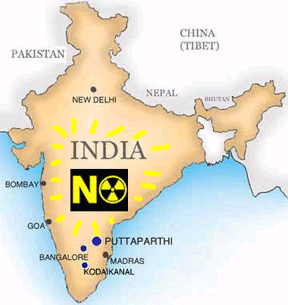 Scrap Kudankulam nuclear plant project: Swami Agnivesh
http://economictimes.indiatimes.com/news/politics/nation/scrap-kudankulam-nuclear-plant-project-swami-agnivesh/articleshow/12641010.cms, 12 APR, 2012, THIRUVANANTHAPURAM: Demanding that the Centre immediately scrap the Kudankulam Nuclear power project, activist Swami Agnivesh today demanded that a high-level panel should visit the KNPP site to address fears of locals there.
“I demand that the government scrap the plant and initiate an
alternative source of clean energy. Continue reading
The multi $trillion nightmare of ‘nuclear decommissioning’
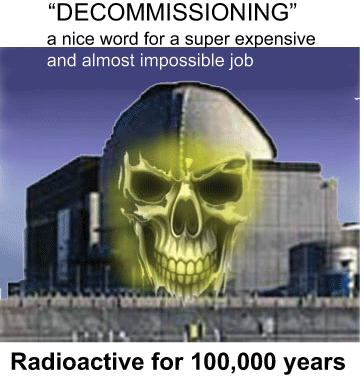 The Nuclear Powers of Japan and United Kingdom Enformable, 13 April 12,”…….so far, the true cost and impact of the Fukushima disaster has been massively and criminally downplayed and delayed.
Fukushima has resulted in vast areas of Japan, including some parts of Tokyo becoming so contaminated that the comparisons of the samples taken would show the Soviets would have evacuated and the Americans would designate the area as a hazardous radiological area if part of any US facility.
The fact of the matter remains, nuclear power is a money pit of an unrivaled parallel; whether building, operating, waiting to be transferred while waiting in spent fuel pools, waiting to be transferred to permanent storage in non-existent facilities, or smoldering as the case at the crippled Fukushima reactors.
Even the rosiest estimates for the decontamination and remediation, if such a thing is even possible, involve a multi-decade, multi-trillion dollar nightmare….. http://enformable.com/2012/04/uk-and-japanese-agree-to-act-in-unison-on-nuclear-interests/
Diplomacy the best hope in dealing with Iran’s nuclear ambitions

 Give nuclear talks a chance, Haaretz, 12 April 12, The talks due to be renewed in Istanbul on Saturday between Iran and the five permanent members of the UN Security Council along with Germany have already been dubbed “the last diplomatic opportunity.” Continue reading
San Onofre nuclear power plant staying closed
San Onofre to remain closed indefinitely, NRC chief says Los Angeles Times, Abby Sewell, reporting from San Onofre April 6, 2012 Nuclear Regulatory Commission Chairman Gregory Jaczko, who toured the shuttered San Onofre nuclear plant Friday, assured reporters that the plant would not restart until officials understand the root cause of the cause of systems failures that forced the plant’s closure.
Jaczko made a trip, accompanied by Sen. Dianne Feinstein and Rep. Darrell Issa (R-Vista), to tour the plant and talk to Edison officials about the unexpected wear in steam generator tubes that carry radioactive water in the plant’s two working reactor units.
The steam generators at both of the plant’s reactor units were installed within the last two years, at a cost of $671 million. “The issue of the steam generators is a very serious issue, we take it seriously, and after some very frank discussions today, I can say that Southern California Edison takes it seriously, too,” Jaczko told reporters.
The plant has been out of commission since a tube in the Unit 3 reactor, where the steam generators were installed about a year ago, sprung a leak and released a small amount of radioactive steam. Since then, Edison, the plant’s operator, has found unexpected wear in more tubes at both of the reactor units, and eight tubes in the Unit 3 reactor have failed pressure tests.
The tubes in Unit 2, which was already offline for planned maintenance when the issues were discovered, also showed wear, and 192 were taken out of service. Jaczko called the wear, particularly in Unit 3, highly unusual for such new equipment. “It’s certainly a very unique phenomenon, and particularly in Unit 3,” he said…….
Jaczko said part of the NRC’s inspection of the plant will be reviewing documentation relating to the replacement. He did not comment on the question of whether the design changes might have led to the wear. http://latimesblogs.latimes.com/lanow/2012/04/san-onofre-to-remain-closed-indefinately-nrc-chief-says.html
Obama sends conciliatory message to Iran, on civilian nuclear programme
Obama offers to accept Iran’s civilian nuclear programme
* Tehran wants to soothe diplomatic ties with Turkey
* China steps up pressure to prevent any attack on Iran
Daily Times, 6 April 12, WASHINGTON: President Barack Obama has told Iran the United States would accept Tehran having a civilian nuclear programme if the Islamic state can prove it is not seeking atomic weapons, the Washington Post said Friday. Continue reading
If Japan can get through summer without nuclear reactors, perhaps it won’t need them – ever!
Japan fears non-nuclear summer will hamper restarts
* Japan PM, ministers discuss reactor restarts, to meet again today
Daily Times, 6 April 12, TOKYO: Japan’s government is rushing to try to restart two nuclear reactors, idled after the Fukushima crisis, by next month out of what experts say is a fear that surviving a total shutdown would make it hard to convince the public that atomic energy is vital.
Prime Minister Yoshihiko Noda and three cabinet ministers are to meet for a third time on Friday to discuss the possible restarts of the No. 3 and No. 4 reactors at Kansai Electric Power Co’s Ohi plant in Fukui, western Japan – a region dubbed the “nuclear arcade” for the string of atomic plants that dot its coast. …http://www.dailytimes.com.pk/default.asp?page=2012%5C04%5C06%5Cstory_6-4-2012_pg4_5
Drop in Japan’s nuclear power use
Japan March nuclear plant use falls to 4.2 pct Apr 6, 2012
* Down from 6.1 pct in Feb. and 58.3 pct a year ago
* Fall reflects shutdown of Tepco’s last active reactor
* 2011/12 run rate falls to record-low 23.7 pct
TOKYO, April 6 (Reuters) – Japan’s nuclear power plant utilisation rate for 10 utilities with reactors fell to an average 4.2 percent in March from 58.3 percent a year earlier, Japan Atomic Industrial Forum Inc (JAIF) said on Friday. Continue reading
America’s 2 new nukes are on the brink of death
Harvey Wasserman April 5, 2012
The only two US reactor projects now technically under construction are on the brink of death for financial reasons.
If they go under, there will almost certainly be no new reactors built here.
The much mythologized “nuclear renaissance” will be officially buried, and the US can take a definitive leap toward a green-powered future that will actually work and that won’t threaten the continent with radioactive contamination.
As this drama unfolds, the collapse of global nuclear power continues, Continue reading
1 This Month
23 April – WEBINAR – Why new nuclear reactors are the wrong tools for decarbonization Thursday, April 23 • 1 AM – 2 AM AEST


Pine Ridge Uranium is the real threat, not Tehran- Tell Burgum: Stop the Extraction.
Chernobyl: The Lost Tapes – A good documentary on Chernobyl on SBS available On Demand for the next 3 weeks– https://www.sbs.com.au/ondemand/tv-program/chernobyl-the-lost-tapes/2352741955560
To see nuclear-related stories in greater depth and intensity – go to https://nuclearinformation.wordpress.com
-
Archives
- April 2026 (264)
- March 2026 (251)
- February 2026 (268)
- January 2026 (308)
- December 2025 (358)
- November 2025 (359)
- October 2025 (376)
- September 2025 (257)
- August 2025 (319)
- July 2025 (230)
- June 2025 (348)
- May 2025 (261)
-
Categories
- 1
- 1 NUCLEAR ISSUES
- business and costs
- climate change
- culture and arts
- ENERGY
- environment
- health
- history
- indigenous issues
- Legal
- marketing of nuclear
- media
- opposition to nuclear
- PERSONAL STORIES
- politics
- politics international
- Religion and ethics
- safety
- secrets,lies and civil liberties
- spinbuster
- technology
- Uranium
- wastes
- weapons and war
- Women
- 2 WORLD
- ACTION
- AFRICA
- Atrocities
- AUSTRALIA
- Christina's notes
- Christina's themes
- culture and arts
- Events
- Fuk 2022
- Fuk 2023
- Fukushima 2017
- Fukushima 2018
- fukushima 2019
- Fukushima 2020
- Fukushima 2021
- general
- global warming
- Humour (God we need it)
- Nuclear
- RARE EARTHS
- Reference
- resources – print
- Resources -audiovicual
- Weekly Newsletter
- World
- World Nuclear
- YouTube
-
RSS
Entries RSS
Comments RSS
 nuclear-news