UK’s nuclear industry will suffer, in withdrawing from the European Atomic Energy Community (Euratom)
 Power Technology 16th Nov 2018 The draft Brexit agreement, which was released on 14 November, includes a
provision that the UK will withdraw from the European Atomic Energy Community (Euratom), despite concerns that it could damage the UK nuclear energy industry, in particular civil nuclear power production.
Within the document titled ‘Draft Agreement on the withdrawal of the United Kingdom
of Great Britain and Northern Ireland from the European Union and the
European Atomic Energy Community’, plans are set for the UK to leave the
nuclear regulator when it leaves the European Union (EU).
The agreement states: “The [UK] shall have sole responsibility for ensuring that all
ores, source materials and special fissile materials covered by the Euratom
Treaty and present on the territory of the [UK] at the end of the
transition period are handled in accordance with relevant and application
international treaties and conventions, including but not limited to
international treaties and conventions on nuclear safety.”
https://www.power-technology.com/news/uk-euratom-brexit/
California fire near nuclear accident site
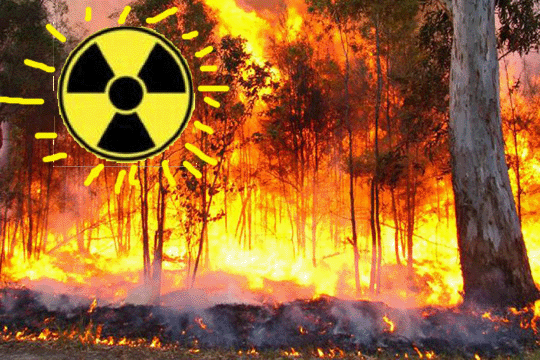 https://thebulletin.org/2018/11/california-fire-near-nuclear-accident-site/ By John Mecklin, November 14, 2018 Call it another sad chapter in the long and depressing book of governmental failures to properly clean up after nuclear research and production efforts. Last week, the Woolsey Fire—one of three major, climate change-charged conflagrations now afflicting California—apparently started on the grounds of the Santa Susana Field Laboratory, located just south of Simi Valley and west of Los Angeles. Closed in 1996, the lab site was home to rocket engine and nuclear reactor research; one of the nuclear efforts—the Sodium Reactor Experiment—led to the partial melt-down of a reactor in 1959 and the release of radioactive material. But as the Los Angeles Chapter of Physicians for Social Responsibility noted, the Santa Susana site is contaminated in a variety of ways: “Decades of nuclear and rocket-engine testing activity, including nuclear reactor accidents and other toxic spills and releases, have resulted in widespread contamination throughout [lab’s] 2,850-acre facility.”
The California Department of Toxic Substances Control (DTSC) quickly announced that it didn’t believe the fire had released significant amounts of toxins. “Our staff were able to access the site Saturday morning and assess damage caused by the fire,” a Tuesday press release said. “We confirmed that the [lab] facilities that previously handled radioactive and hazardous materials were not affected by the fire. Over the weekend our multi-agency team took measurements of radiation and hazardous compounds, both on the site and in the surrounding community. The results from this initial round of testing showed no radiation levels above background levels, and no elevated levels of hazardous compounds other than those normally present after a wildfire.”
Safecast, an international, volunteer-centered organization formed in the wake of the Fukushima Daiichi nuclear disaster, reported Wednesday that it “had no survey data from the immediate [lab] area prior to the fire, but we had a fair amount of data from nearby communities which showed it to be at normal background levels. Our real-time radiation and particulate sensors in the Southern California region, the closet of which is 30km (about 18 miles) away from [the site], have shown no measurable increases in radiation. Safecast volunteers are on the way to the site, however, so hopefully we will have new data to share soon. Though CalFire indicates that the fire danger in the [lab] area has passed, many roads are still closed, making access difficult.”
Local activists were not shy about voicing in their disbelief in governmental pronouncements about contamination and the fire. “We can’t trust anything that DTSC says,” West Hills resident Melissa Bumstead said. “DTSC repeatedly minimizes risk from [the lab] and has broken every promise it ever made about the [lab] cleanup. The public has no confidence in this troubled agency.”
Should it? The Santa Susana Field Laboratory closed 22 years ago, and cleanup efforts remain in the planning stages.
“The Woolsey Fire likely released and spread radiological and chemical contamination that was in [the Santa Susana Field Laboratory’s] soil and vegetation via smoke and ash,” said Bob Dodge, president of Physicians for Social Responsibility-Los Angeles. “All wildfire smoke can be hazardous to health, but if [the lab] had been cleaned up long ago as DTSC promised, we’d at least not have to worry about exposure to dangerous radionuclides and chemicals as well.”
Radioactive particles may have been spread by fire in area of Santa Susana nuclear lab
SoCal Fire May Have Ejected “Incredibly Dangerous” Radioactive Particles Into The Atmosphere, Zero Hedge, by Tyler Durden, Wed, 11/14/2018 The 95,000 acre Woolsey fire which has coated Southern California with an apocalyptic orange glow may have released a toxic stew of radioactive particles and toxic chemicals into the air, after scorching the land on closed-down government weapons testing facility in Simi Hills known to be heavily contaminated from decades of experiments.
Commencing operation in 1947 for Rockwell’s Rocketdyne Division, a government contractor for the Atomic Energy Commission (AEC), the Santa Susana Field Lab (SSFL) has a checkered safety record, to put it lightly. In addition to several nuclear accidents – including the worst nuclear meltdown in US history, toxic materials have accumulated on-site from years of dumping, just miles from thousands of residents.
It was the site of several nuclear accidents, including the worst nuclear meltdown in US history when, in 1959, facility operators intentionally vented nuclear material from the site’s “Sodium Reactor Experiment” to prevent it from overheating and exploding. By the time the leaks were closed, the site had released 459 times more radiation than was leaked during the better-known 1979 meltdown at Three Mile Island.
The lab property, now owned by airplane manufacturer Boeing, stretches for 2,800 acres in the Simi Hills, and remains contaminated with toxic materials. Thousands of people live within two miles of the site, and roughly half a million live within 10 miles, according to an investigation by NBC 4 Los Angeles. -Quartz
California officials with the state’s Department of Toxic Substances Control said that as of Friday, November 9, an area of the SSFL site which was scorched by the Woolsey fire posed no danger, stating “Our scientists and toxicologists have reviewed information about the fire’s location and do not believe the fire has caused any releases of hazardous materials that would pose a risk to people exposed to the smoke.”
A group of concerned physicians begs to differ.
According to Robert Dodge – a physician and president of Physicians for Social Responsibility Los Angeles, highly toxic materials embedded in SSFL’s soil and vegetation may have been spewed into the air by the Woolsey fire……
According to a Draft environmental statement from the Energy department, Santa Susana Field Laboratory and its adjoining Northern Buffer Zone has never been fully cleaned up.
A 1998 article of Los Angeles Magazine details horrific cancers and other conditions which have afflicted those living near, and working at the site.
“Children growing up near the site swam and fished in streams and played in the dry wash. And one day, Garner rode his red J.C. Higgins bike he got for Christmas through effluent flowing from the lab.
Garner, now 44, lives in Simi Valley. An ironworker, he’s done contract jobs at the lab over the years. In October 1996, he was diagnosed with lymphoma. His wife Leslie had her uterus removed because of cervical cancers. His father – like Garner an ironworker employed occasionally at the lab – has skin cancer and heart problems and is near death. His sister Vickie, 46, has heart and thyroid problems. On one side of a single block of Ramara Avenue in Woodland Hills, five miles from the plant, cancer has been diagnosed in 9 out of 10 houses.” –Los Angeles Magazine https://www.zerohedge.com/news/2018-11-13/socal-fires-may-have-ejected-incredibly-dangerous-radioactive-particles-atmosphere
As UK’s Moorside nuclear project collapses. local Councils and cites develop renewable energy
and decentralised energy as Councils pledge zero-carbon by the 2030s. This
past week have seen a number of important announcements in UK energy and
low carbon policy which, in the view of Nuclear Free Local Authorities
(NFLA), show that the direction of travel is firmly in favour of developing
renewables over new nuclear power.
that way forward.
announced that the many millions of pounds it had spent in developing a new
nuclear plant at Moorside, close to the existing Sellafield plant, had
ended in failure. This is partially due to the huge financial losses
incurred through its Westinghouse subsidiary. It has also been unable (to
date) to find an alternative buyer for the site, after extensive talks with
the South Korean utility Kepco have floundered.
issues beset the nuclear sector, NFLA is delighted to see ambitious targets
have been set this week by City Councils like Manchester and Bristol as
part of the wider effort to create ‘zero-carbon cities’. After taking
advice from the Tyndall Centre, Manchester City Council has moved its
target from 2050 to 2038 to seek to become a zero carbon city. Bristol,
which has established one of the first Council-owned energy companies in
the country, is being even more ambitious by calling for a 2030 target in
order to be zero carbon.
http://www.nuclearpolicy.info/news/moorside-project-collapses-nfla-advocate-future-renewable-decentralised-energy/
Woolsey fire has reached a Cold War-era rocket testing site, raising radiation fears
WOOLSEY fire has caused alarm in the community as the blaze has reached a Cold War-era rocket testing site. But is there a health risk as Woolsey Fire tears through a nuclear site?By RACHEL RUSSELL, Nov 14, 2018
The 2,800-acre site is also known as Rocketdyne.
Members of the community have now expressed concern that flames from the Woolsey fire, which has burning since Thursday, could have burned through toxins that have already contaminated the soil and vegetations around the site.
This potentially could have then released the toxins into the air, along with smoke and ash.
s there a health risk?
California Department of Toxic Substance Control have issued a statement to reassure people the laboratory does not pose an immediate dangers.
The statement read: “There is no evidence that smoke from the area around the SSFL is any more dangerous than other wildfire smoke.”
The statement added LA and Ventura county fire department hazardous materials experts agreed there was no risk.
The department said full testing has not yet been completed due to the area remaining an active evacuation zone.
The Nuclear Renaissance has failed. China and Russia cannot save it.
Energy Policy (accessed) 12th Nov 2018 , Steve Thomas: Is it the end of the line for Light Water Reactor technology or can China and Russia save the day?
The Nuclear Renaissance has failed. China and Russia cannot save it.
LWR technology is a blind alley. In the
late 1990s, a new generation of reactor designs evolved from existing
designs was touted as solving the economic problems that led to the
collapse of reactor ordering after the Chernobyl disaster. It was claimed
these designs would be cheap and easy to build because they would be
simpler and use passive safety, modular construction and standardisation.
The US and UK governments were convinced by this and launched reactor
construction programmes. However, 20 years on, the claims have proved false
and the US and UK programmes are in disarray. The last hope for the nuclear
industry appears to be that Chinese and Russian reactor vendors, with
powerful support from their governments, will take over, providing reactors
that are cheap but meet the safety standards required in Europe and North
America.
However, these vendors and their designs are largely unproven in
open markets. There is also little evidence that their reactors will be
cheap, there are concerns about quality and safety culture and there are
national security concerns that may deter customers. New technologies, such
as radical new ones, Generation IV, and Small Modular Reactors are unproven
and, at best, a long way from commercial deployment.
https://www.sciencedirect.com/science/article/pii/S030142151830716X?dgcid=author
Browns Ferry Nuclear Plant under investigation by NRC
Alabama, By Paul Gattis | pgattis@al.com, pgattis@al.com,
A north Alabama nuclear plant is facing investigation by the Nuclear Regulatory Commission after a high dosage of radiation was discovered in water near the plant.
The NRC announced Wednesday has initiated a “special investigation” at Browns Ferry Nuclear Plant near Huntsville ” to determine how and why a diver received a dose rate alarm during underwater work in the Unit 1 equipment pit.”……https://www.al.com/news/2018/11/browns-ferry-nuclear-plant-under-investigation-by-nrc.html
Nuclear weapons – genocidal, xenophobic and racist
Hayley Ramsay-Jones
By definition nuclear weapons are genocidal, xenophobic and racist, 11.11.2018 – Madrid, Spain – Tony Robinson At the II World Forum on Urban Violence and Education for Coexistence and Peace, in Madrid from the 5th to the 8th of November, Pressenza took the opportunity to cover activities carried out by the international team of activists from ICAN.
A combined presentation by Dr. Aurora Bilbao from IPPNW and Hayley Ramsay-Jones from Soka Gakkai International covered two very important topics: the humanitarian consequences of nuclear weapons and the intersectional aspects of gender and race discrimination in nuclear disarmament.
We were especially interested to find out more about the gender and race aspects to nuclear disarmament, so after the presentation we caught up with Hayley to ask her a few questions…https://www.pressenza.com/2018/11/by-definition-nuclear-weapons-are-genocidal-xenophobic-and-racist/
The collapse of Britain’s Moorside project shows that nuclear power has no real future

 Moorside’s atomic dream was an illusion. Renewables are the future https://www.theguardian.com/business/2018/nov/11/moorside-atomic-dream-illusion-renewables-are-the-future
The collapse of Toshiba’s project underlines the fact that new nuclear is a more unreliable proposition than wind and solar Toshiba’s decision to pull out of building a nuclear power station in Cumbria last week will cause shockwaves far beyond the north-west of England.The outcome is a disaster for the surrounding area, which is heavily reliant on the nuclear industry for jobs and prosperity. Local politicians admit it is a blow and a disappointment for Cumbrians hoping for roles at the proposed Moorside plant. They say they genuinely believe a new buyer for the site will come forward. But that looks like wishful thinking.
To an extent, the demise of Moorside can be attributed to problems with it as a specific project. It has looked doomed since Toshiba’s US nuclear unit, Westinghouse, declared bankruptcy in 2017 and the company ruled out new nuclear investments outside of Japan. Efforts to woo the South Korean energy company Kepco as a buyer then floundered. The executive leading the sale for Toshiba blamed the failure to find a buyer on being “caught between a series of unplanned and uncontrollable events”.
But the end of Moorside is also emblematic of the wider challenges that new nuclear faces. It took a decade from Tony Blair signalling the UK’s renewed interest in nuclear power in 2006 for France’s EDF Energy and the British government to sign a generous subsidy deal and green-light Hinkley Point C, the UK’s first new nuclear plant in a generation. In all likelihood, it will not be generating electricity until 2027.
Ministers insist new nuclear power stations are still an essential way of hitting the country’s greenhouse gas emission targets and providing energy security as old plants are switched off in the 2020s.
Losing Moorside means there are just five other new nuclear projects planned, including Hinkley Point C. Eyes will now turn to Hitachi’s proposed Wylfa Newydd plant on Anglesey. The project is the furthest along the line after Hinkley, but it’s far from a done deal.
The new nuclear drive was meant to be solely funded by the private sector, but the government has already made a striking exception in the case of Wylfa. Ministers have promised Hitachi they will use public money to take a £5bn stake in the scheme. Such a dramatic U-turn on policy is explained by the fact that Wylfa is about more than the UK’s  desire for new nuclear: it is also about cooperation with Tokyo and bringing forth other investment from Japanese firms, such as carmakers, after Brexit.
There is a pattern here. The subsidy deal for Hinkley was declared exceptional because it was the first new nuclear plant and the risk was loaded on to the developer. Now the second one will be exceptional too. What’s to say that the third, fourth and fifth will be any different?
The collapse of Moorside should be cause for the government to look again at whether it is backing the right horse by doggedly pursuing new nuclear. Even the government’s own advisers, the National Infrastructure Commission, are urging a rethink. Renewables, they point out, are simply less risky.
Ministers will probably invoke the spectre of missed climate-change targets to argue for nuclear. But the statutory advisers on those targets recently saidthe 2030 goal could be achieved with Hinkley alone.
The momentum is with renewables. The technology is becoming cheaper, investors view it as an increasingly safe bet and the need for subsidies is diminishing. Next year we will find out how much cheaper offshore wind, which has already halved in cost, can become in a new round of government auctions.
Ditching new nuclear would require a huge increase in the amount of wind and solar power already expected in coming years. It would need dramatic progress on energy storage, smarter grids and even more efficient use of energy. All those things will be difficult. But pursuing an impossible atomic dream, as Moorside demonstrates, looks even harder.
In USA 100 women elected to Congress- could they challenge the nuclear status quo?

As these newly-elected women converge on Capitol Hill and are sworn in January, they have the opportunity to challenge the nuclear status quo and usher in a new era of nuclear nonproliferation. Many of our nuclear policies have been the same since the invention of the atomic bomb. The president’s nuclear posture review touts “escalate to de-escalate” and relies on the Cold War tactic of mutually assured destruction. The president maintains the sole authority to launch a nuclear weapon and can do so at any time without further authorization. Right now, the United States is risking a return to the Cold War by trashing international agreements regarding nuclear weapons (INF, JCPOA) and building “more usable” nuclear weapons.
Women have played a crucial role in ending dangerous nuclear policies in the past. They led the way in demanding that the United States government put an end to atmospheric nuclear testing after their organizing efforts revealed radioactive isotopes in baby teeth. They led the nuclear freeze movement of the 1980’s. Today, Beatrice Fihn is leading the International Campaign to Abolish Nuclear Weapons (ICAN), the 2017 Nobel Peace Prize winner, in their work to advance the Treaty on the Prohibition of Nuclear Weapons which has now has 69 signatories.
While men have been caught up in the need to build bigger, better weapons regardless of the monetary, health, or environmental costs, women have understood the existential threat these weapons pose. Women have and continue to push back on the assumption that we cannot survive without our nuclear arsenal.
Right now, there’s a small but growing women’s movement against nuclear weapons taking place across the United States. Women in state legislatures from Georgia to California have introduced resolutions in nine states calling on Congress to end the president’s sole authority to launch a nuclear weapon. The president has the power to unilaterally decide to launch a nuclear first strike against another country, and no one can stop the president once that order has been issued. …….
History was made on Tuesday, but it was only a first step. The incredible women who have been newly elected to serve in the 116th Congress now have the opportunity to champion policies that have been ignored by those in power for too long. Women have played an important role in reforming reckless nuclear policies in the past, and it is time for them to do it again. https://intpolicydigest.org/2018/11/08/newly-elected-women-should-challenge-u-s-nuclear-posture/
One British nuclear build fiasco ends – Moorside. More to Come?
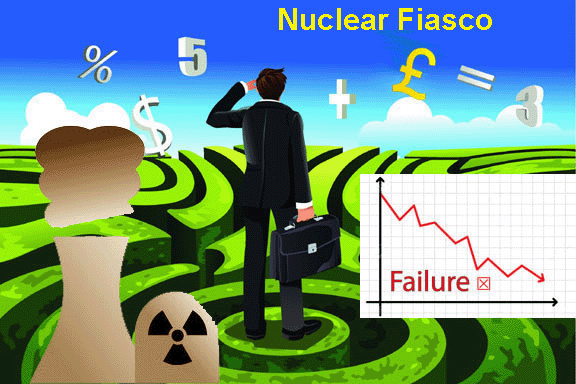 9th Nov 2018 , How radioactive can you get? “The British government has blood on its
hands”. Really? Lucky it hasn’t declared war or anything – because Justin Bowden might run out of words. Who he? The GMB union’s national secretary for energy, giving his measured response to the implosion of Moorside’s
nuclear dreams: the ones looking nightmarish ever since the Nugen project’s champion, Japan’s Toshiba, went into financial meltdown.
And maybe it will mean fewer jobs in Cumbria building a £10 billion-plus nuclear white elephant. But even so, here’s an alternative view: axing the project is a let-off for Britain.
We’ve got one nuclear fiasco already: the £20 billion Hinkley Point C, forcing consumers to pay twice the wholesale price for its electricity, or £92.50 per megawatt hour, for 35 years.
And one look at how Toshiba got into its mess shows why we don’t need another one. It was bl own up by Westinghouse, the nuclear developer Britain sold for $5.4 billion in 2006. It set about building four reactors in America with its whizzy AP1000 technology. The upshot? $10 billion of cost overruns and Chapter 11 bankruptcy. Such was the carnage that Toshiba was forced to flog its prized memory chip unit for $17.7 billion.
So, no great shock it’s gone cold on a repeat affair in Cumbria. Indeed, EDF would be in a similar pickle after the cost overruns on its Hinkley prototypes in France and Finland if it wasn’t 84 per cent-owned by the French government.
All the same, Toshiba’s decision to shut down Nugen raises key issues for Britain’s
energy policy. Moorside was meant to provide 7 per cent of our energy needs. So two key questions spring to mind. What’ll replace it? And should it be nuclear?
As the Energy and Climate Intelligence Unit points out, offshore wind and solar power is already cheaper – as is gas. Throw in smart grids, energy saving and battery technology and the case for overpriced nukes vanishes. Toshiba is proof of the dangers. https://www.thetimes.co.uk/article/0c99973c-e39a-11e8-9838-efa7e96cbe2b
Intersection of climate and nuclear dangers
 The global responsibility to prepare for intersecting climate and nuclear risks, Bulletin of the Atomic Scientists Christine Parthemore, Francesco Femia, Caitlin Werrell, November 1, 2018 The effects of climate change stand to heighten nuclear risks in various ways, including direct impacts on nuclear facilities, exacerbation of political and economic disruptions, and a diminishment of the strength of global institutions. Governments and international organizations have a responsibility to prepare for this collision of climate and nuclear threats, notably by using the unprecedented foresight that new technologies can provide………..https://thebulletin.org/2018/11/the-global-responsibility-to-prepare-for-intersecting-climate-and-nuclear-risks/?utm_source=Bulletin%20Newsletter&utm_medium=iContact%20email&utm_campaign=SpecialIssue_Nov5
UK’s Committee on Radioactive Waste Management (CoRWM) recognising that nuclear waste is not just a technical issue
GDF Watch 28th Oct 2018 The publication of the tailored review on the Committee on Radioactive
Waste Management (CoRWM) sets out some revised principles for the
Committee’s future role. While the review says that the Committee’s
role and objectives needs updating, and that these should be set out in a
new framework, the Government says little about what that role might
actually be.
However, one specific area of activity under review is the
extent to which, and on what basis, CoRWM more actively participates in
public and community engagement. The July appointment of Sir Nigel Thrift
as CoRWM’s new Chair underlines the Government’s awareness of the need
to shift priority as the siting process relaunches. Sir Nigel is a human
geographer, a social scientist.
This is a marked shift from CoRWM’s
historic technical/scientific foundations, and a recognition that the
issues are increasingly social rather than technical – civics not
science. The minutes from CoRWM’s recent public plenary sessions indicate
that the Committee itself has been examining whether and how it should
become more active and more visible. Those who gave evidence to the
Committee, including GDFWatch, were in agreement that a revamped CoRWM
could have a critical role in building public trust in geological disposal
and the siting process.
http://www.gdfwatch.org.uk/2018/10/28/a-new-corwm-possibilities-for-the-expert-committee/
UK’s Ministry of Defence (MoD) reprimanded for nuclear safety breaches
The Ferret 4th Nov 2018 , The Ministry of Defence (MoD) has been formally reprimanded by its internal
safety regulator for five nuclear safety breaches, according to documents
seen by The Ferret.
The Defence Nuclear Safety Regulator (DNSR) served MoD
nuclear agencies with one safety improvement notice in 2017, two in 2016
and two in 2010. The notices alleged a series of serious safety failings
with submarines stationed on the Clyde and at Trident bomb bases.
The DNSR accused the MoD of “a failure of safety culture”, “inadequate
resourcing” and “continued non-compliance”. In 2010 DNSR expressed
concern that “that future nuclear reactor programme safety may be
compromised.”
Green MSP and environment spokesperson, Mark Ruskell said
“It is time for Trident to be decommissioned, and the money, resources
and skills connected to Faslane redeployed towards sustainable progressive
infrastructure projects.”
https://theferret.scot/ministry-defence-nuclear-breaches/
Spiralling costs of Britain’s Sellafield nuclear site
costs and project delays that have plagued the Sellafield nuclear site,
located on the far side of the Irish Sea on the Cumbrian coast,
approximately 170 km (112 miles) from the northeast coast of Ireland, just
128 miles from Dublin. The UK’s Public Accounts Committee (PAC) said in a
report that some decommissioning projects had already been delayed by more
than a decade. It said estimated budget overruns had climbed to nearly
£1bn.
https://afloat.ie/port-news/dun-laoghaire-news/item/40975-sellafield-british-government-warned-to-get-a-grip-on-irish-sea-site
1 This Month


Tell the Ukrainian Government to Drop Prosecution of Peace Activist Yurii Sheliazhenko

Petition to revoke the licensing of the Near Surface Nuclear Disposal Facility (NSDF) at Chalk River. https://www.ourcommons.ca/petitions/en/Petition/Details?Petition=e-7247


of the week – STOP SMALL MODULAR REACTORS IN CANADA
To see nuclear-related stories in greater depth and intensity – go to https://nuclearinformation.wordpress.com
-
Archives
- March 2026 (212)
- February 2026 (268)
- January 2026 (308)
- December 2025 (358)
- November 2025 (359)
- October 2025 (376)
- September 2025 (258)
- August 2025 (319)
- July 2025 (230)
- June 2025 (348)
- May 2025 (261)
- April 2025 (305)
-
Categories
- 1
- 1 NUCLEAR ISSUES
- business and costs
- climate change
- culture and arts
- ENERGY
- environment
- health
- history
- indigenous issues
- Legal
- marketing of nuclear
- media
- opposition to nuclear
- PERSONAL STORIES
- politics
- politics international
- Religion and ethics
- safety
- secrets,lies and civil liberties
- spinbuster
- technology
- Uranium
- wastes
- weapons and war
- Women
- 2 WORLD
- ACTION
- AFRICA
- Atrocities
- AUSTRALIA
- Christina's notes
- Christina's themes
- culture and arts
- Events
- Fuk 2022
- Fuk 2023
- Fukushima 2017
- Fukushima 2018
- fukushima 2019
- Fukushima 2020
- Fukushima 2021
- general
- global warming
- Humour (God we need it)
- Nuclear
- RARE EARTHS
- Reference
- resources – print
- Resources -audiovicual
- Weekly Newsletter
- World
- World Nuclear
- YouTube
-
RSS
Entries RSS
Comments RSS
 nuclear-news