Propaganda for 2020 Olympics, and for the nuclear industry is behind lifting evacuation order for irradiated town of Namie

‘We were driven out’: Fukushima’s radioactive legacy, SMH, By Simon Denyer, 4 February 2019 Namie: Noboru Honda lost 12 members of his extended family when a tsunami struck the Fukushima prefecture in northern Japan nearly eight years ago. Last year, he was diagnosed with cancer and initially given a few months to live.
Today, he is facing a third sorrow: watching what may be the last gasps of his home town.
For six years, Namie was deemed unsafe after a multiple reactor meltdown at the Fukushima Daiichi nuclear power plant following the 2011 earthquake and tsunami.
In March 2017, the government lifted its evacuation order for the centre of Namie. But so far, hardly anyone has ventured back.
Its people are scattered and divided. Families are split. The sense of community is coming apart.
“It has been eight years; we were hoping things would be settled now,” the 66-year-old Honda said. “This is the worst time, the most painful period.”
For the people of Namie and other towns near the Fukushima plant, the pain is sharpened by the way the Japanese government is trying to move beyond the tragedy, to use the 2020 Tokyo Olympics as a symbol of hope and recovery, a sign that life can return to normal after a disaster of this magnitude.
Its charm offensive is also tied up with efforts to restart the country’s nuclear-power industry, one of the world’s most extensive networks of atomic power generation.
But in Namie, much closer to the ill-fated nuclear plant, the celebration rings hollow……….
Just 873 people, or under 5 per cent, of an original population of 17,613 have returned. Many are scared – with some obvious justification – that their homes and surroundings are still unsafe. Most of the returnees are elderly. Only six children are enrolled at the gleaming new primary school. This is not a place for young families.
Four-fifths of Namie’s geographical area is mountain and forest, impossible to decontaminate, still deemed unsafe to return. When it rains, the radioactive cesium in the mountains flows into rivers and underground water sources close to the town.
Greenpeace has been taking thousands of radiation readings for years in the towns around the Fukushima nuclear plant. It says radiation levels in parts of Namie where evacuation orders have been lifted will remain well above international maximum safety recommendations for many decades, raising the risks of leukaemia and other cancers to “unjustifiable levels”, especially for children.
In the rural areas around the town, radiation levels are much higher and could remain unsafe for people to live beyond the end of this century, Greenpeace concluded in a 2018 report.
“The scale of the problem is clearly not something the government wants to communicate to the Japanese people, and that’s driving the whole issue of the return of evacuees,” said Shaun Burnie, senior nuclear specialist with Greenpeace.
“The idea that an industrial accident closes off an area of Japan, with its limited habitable land, for generations and longer – that would just remind the public why they are right to be opposed to nuclear power.”
………..many residents say the central government is being heavy handed in its attempts to convince people to return, failing to support residents’ efforts to build new communities in places like Nihonmatsu, and then ending compensation payments within a year of evacuation orders being lifted…….. https://www.smh.com.au/world/asia/we-were-driven-out-fukushima-s-radioactive-legacy-20190204-p50vgd.html
As the Climate Collapses, We Ask: “How Then Shall We Live?”
 BY Dahr Jamail & Barbara Cecil, Truthout, February 4, 2019
This is the first installment of a monthly series by Dahr Jamail and Barbara Cecil, entitled, “How, Then, Shall We Live? Finding Our Way and Peace of Heart Amidst Global Collapse.
”Although the wind
blows terribly here,
the moonlight also leaks
between the roof planks
of this ruined house.
—Izumi Shikibu
………..Our intent with this series is not to rehash data, but to share the ways we are digesting the global decline and finding solid ground in ourselves and within our day-to-day lives. We hope that our thinking and choices will inspire readers to ponder what is uniquely theirs to do. The depth of our global crisis requires a new understanding of what hope means. At the end of each piece, we will include annotated reference material that informs our own perception in reliable and expansive ways. ……..https://truthout.org/articles/as-the-climate-collapses-we-ask-how-then-shall-we-live/
Grim outlook for uranium industry -financial analyst Jayant Bhandari
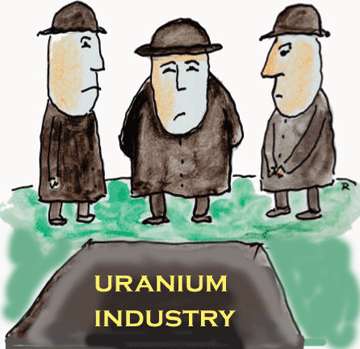 Investing News 29th Jan 2019, Speaking with the Investing News Network at this year’s Vancouver Resource Investment Conference, financial analyst Jayant Bhandari made a case for avoiding uranium projects, saying that low demand and the rise of renewable energy mean the commodity’s future is grim. “Most uranium-mining projects do not make sense unless uranium prices go up by100 or 200 percent,” said Bhandari. https://investingnews.com/daily/resource-investing/energy-investing/uranium-investing/jayant-bhandari-uranium-green-credentials-camouflage/?mqsc=E4025852
Bee-keeping business saved by the suspension of Wylfa Newydd nuclear project
 Wales Farmer 1st Feb 2019 Multi-award winning bee keeper Katie Hayward, who runs Felin Honeybees, at
Cemlyn, near Cemaes Bay, Anglesey, is one the last people living in
immediate proximity to the now suspended Wylfa Newydd development at Cemaes
Bay. Since, the nuclear plans were first mooted, the future of Katie’s
farm, honey business and education centre was in “limbo” and many of
her activities ground to a halt when she was told she would have to leave
her property. Now, with the project officially suspended, Katie says she is
feeling a little more “optimistic” about her future and anticipates at
least a 12 month reprieve to get her farm business back on track.
https://www.walesfarmer.co.uk/news/17401966.limbo-of-beekeeper-in-shadow-of-angleseys-nuclear-plant/
Alarm triggered at onetime nuclear fuel facility in Ibaraki after radioactive substances leaked
STAFF REPORT, KYODO, 29 Jan, An alarm was triggered at a onetime nuclear fuel manufacturing facility Wednesday after radioactive substances leaked from materials that were being transferred at a facility operated by the Japan Atomic Energy Agency (JAEA) in Tokai, Ibaraki Prefecture, officials with the company said. …. (subscribers only) https://www.japantimes.co.jp/news/2019/01/30/national/alarm-sounded-nuclear-facility-ibaraki/#.XFIW5tIzbGg
In Britain’s new energy era of wind and solar, nuclear power just does not add up
 In the era of cheap renewable energy, new nuclear plants don’t add up New Statesman America, 22 Jan 19, The Chair of the National Infrastructure Commission says the energy market has changed dramatically in a short time, and this should be reflected in how Britain plans its future energy supply.
For many years I’ve been an advocate of nuclear energy – I oversaw the development of Sizewell B – but I’ve started to change my mind. I’m not the only one; Toshiba abandoned its plans for a nuclear power station in Moorside, in Cumbria, last November, and last week Hitachi suspended its proposals for new plants in Wylfa in Wales and Oldbury in Gloucestershire.
The reasons for this is that new nuclear power plants are no longer adding up. As the Business Secretary told the Commons on Thursday, the falling costs of renewable energy sources have significantly altered the economics of the energy market both here and abroad……
Our National Infrastructure Assessment – the first of its kind for the UK – highlights the golden opportunity for the UK to move towards a highly renewable energy mix. We recommend that the government aim for 50 per cent of our electricity to come from renewable sources by 2030 ……
UK’s new nuclear projects are a financial dead end

 Case for abandoning nuclear energy has never been more powerful,
Grim truth is that these huge projects are a financial dead end https://www.ft.com/content/65524b36-f974-11e8-a154-2b65ddf314e9 NEIL COLLINSm, 25 Jan 19
We are in a strong position where electricity supplies are secure and costs are falling, says Greg Clark, in a letter to the Financial Times this week. He should know since he is the UK’s business secretary. Never mind that the contractors behind two nuclear power stations have pulled out because they dare not take the risk, while a third promises to be an epic financial disaster, and that the remaining two on the drawing board seem increasingly likely to stay there.
Another nail in UK’s nuclear coffin, happening as media focuses on Brexit
 Jonathon Porritt 20th Jan 2019 Were it not for blanket Brexit, smothering every other news item, I suspect there would have been a lot more coverage of the recent collapse of Hitachi’s nuclear pretensions here in the UK. And a lot more questioning
about what the hell happens next – in terms of UK energy and climate policy.
As Chair of the Sustainable Development Commission, [we] invested significant resource in seeking to persuade Tony Blair that his 2005 change of heart on nuclear (Labour’s position before then was to keep the nuclear option ‘in the long grass’), was profoundly ill-judged. And then, together with three other former Directors of Friends of the Earth,
in 2012 and 2013, warning David Cameron and his and his pro-nuclear Lib Dem groupies that his plans for six new plants by 2030 had zero prospect of ever being delivered.
Maybe even Greg Clark will be forced to recognise that his much-loved nuclear parrot really is a definitively dead parrot. After all, he’s a smart guy, and reassuringly free of the kind of ideological blinkers that make so many of his Cabinet colleagues unfit to lead anything other than an endangered cult. His statement to Parliament on the collapse of the Hitachi deal was appropriately measured, and he acknowledged unhesitatingly that nuclear power ‘is being out-competed’.
The unquestioned credibility of the Committee on Climate Change is a precious asset, and one which has served us well over the last ten years. But it cannot possibly go on pretending that nuclear power will be making much of a contribution to the low-carbon generation we need by 2030. If ever.
http://www.jonathonporritt.com/blog/yet-more-nails-nuclear-coffin
Japan had pinned its hopes on nuclear exports – that dream is over!
 Climate News Network 21st Jan 2019 Once hailed as a key part of the energy future of the United Kingdom and several other countries, the high-tech atomic industry is now heading in the opposite direction, towards nuclear sunset. It took another body blow
last week when plans to build four new reactors on two sites in the UK were abandoned as too costly by the Japanese company Hitachi. This was even though it had already sunk £2.14 billion (300 bn yen) in the scheme.
Following the decision in November by another Japanese giant, Toshiba, to abandon an equally ambitious scheme to build three reactors at Moorside in the north-west of England, the future of the industry in the UK looks
bleak. The latest withdrawal means the end of the Japanese dream of keeping its nuclear industry alive by exporting its technology overseas. With the domestic market killed by the Fukushima disaster in 2011, overseas sales
were to have been its salvation.
https://climatenewsnetwork.net/nuclear-sunset-overtakes-fading-dreams/
Renewable energy is the way to go for UK, not nuclear white elephants
 Scrapping of nuclear plant should see UK renewables filling the void https://www.theguardian.com/environment/2019/jan/18/scrapping-of-nuclear-plant-should-see-uk-renewables-filling-the-void Catherine Mitchell
Professor of energy policy, University of Exeter 19 Jan 19
Nuclear – with its huge, inflexible output – is the equivalent of a giant boulder in the middle of a motorway. We, the energy customers of Britain, would have ended up paying way over the odds for Wylva, which would have also undermined the UK’s move to a smart and flexible system – which really is the future. We are already going to do that for Hinkley Point C.
Stephen Psallidas Everyone knows that nuclear power creates lethal waste which hundreds of future generations will have to manage, and, despite the risk being very low, can lead to accidents (or terrorist attacks) with enormous impacts. But Hitachi’s abandonment of the new Wylfa nuclear power station is more evidence, as if any were needed, that nuclear power is also fundamentally uneconomic.
Renewable energy is already cheaper than all fossil fuels and new nuclear. And yet, £16bn spent on grid-level energy storage in the UK would enable a further plummet in the price of renewable energy – a huge boost to the UK economy, to energy independence and security, and to a cleaner future. Why do successive governments of both main parties continue to support these massive white elephants?
Decision on the future of Wylfa nuclear project expected very soon
 Wylfa: Decision on future of nuclear power station expected, A decision is expected about whether work to build a new nuclear power station on Anglesey will be halted. BBC 17 Jan 19,
Japanese media has reported that Hitachi will suspend construction of its £20bn Wylfa Newydd plant – with the board due to meet on Thursday.
Wales’ Economy Secretary Ken Skates said he expected an announcement to be made during the morning……. speculation has been rife that Hitachi will suspend work on Wylfa – a project of its Horizon division – or scrap it due to potential increases in construction costs……. https://www.bbc.com/news/uk-wales-46898261
Donald Trump’s administration’s plan to reclassify nuclear wastes is unacceptable to Washington State
Trump administration wants to reclassify leaking nuclear waste to avoid cleaning it up, say officials
‘This is unacceptable, and we will not stand by while this administration plans to abandon its responsibility to clean up their mess’, Independent UK Josh GabbatissScience Correspondent
Britain’s dream of nuclear power renaissance is collapsing
Bloomberg 12th Jan 2019 In 2006, Tony Blair told Britain’s biggest business lobby that the
country needed a new generation of nuclear reactors or risked becoming
dependent on imported fossil fuels while missing commitments to reduce
greenhouse gas emissions. “….. the then prime minister said in a speech at
Confederation of British Industry’s annual dinner.
Almost 13 years later, just one plant is under construction — the Hinkley Point project being
built by France’s state power company in southwest England. There’s
increasing doubt any more reactors will follow. Reports on Friday said
Japan’s Hitachi Ltd. has decided to halt work on the Wylfa project in
North Wales.
That follows Toshiba Corp.’s decision in November to
abandon a plant in northwest England. “The U.K. nuclear renaissance is a
zombie,” said Laurent Segalen, a managing partner at Megawatt-X in
London, who advises on financing wind and solar projects. The unraveling of
Blair’s energy blueprint, endorsed by all his successors, will leave
Britain short of electrons in the decades ahead as existing reactors built
in the 1970s reach the end of their lives. The new Wylfa plant alone was
designed to supply about 7 percent of the U.K.’s energy demand. Two types
of energy will likely fill most of the gap: natural gas and offshore wind.
Both come with challenges.
https://www.bloomberg.com/news/articles/2019-01-12/britain-s-failing-nuclear-plan-poses-huge-question-for-power
UAE energy minister says nuclear power project slightly delayed
https://uk.reuters.com/article/emirates-energy-nuclearpower/uae-energy-minister-says-nuclear-power-project-slightly-delayed-idUKB2N1YE024, ABU DHABI, Jan 9 (Reuters) – United Arab Emirates Energy Minister Suhail al-Mazrouei said on Wednesday that the country’s nuclear power plant project was slightly delayed.
“Nuclear is coming (but) there will be a bit of a delay,” he said at an event in Abu Dhabi. He did not provide a timeline.
The country’s nuclear regulator said last July the start-up of a reactor at the nuclear power plant, which was set to open in 2017, would depend on the outcome of further reviews of the project.
Reporting by Stanley Carvalho; writing by Alexander Cornwell; editing by Christian Schmollinger
America’s male-dominated nuclear cognoscenti have tunnel vision, oblivious to proliferation risks, and to public demand for nuclear weapons abolition
|
The blinders on the US nuclear policy establishment, Bulletin of the Atomic Scientists, By Hugh Gusterson, January 8, 2019 If there is such a thing as a nuclear deep state, it was on full display at a crowded event at Washington’s Brookings Institution on Monday. Over 160 people, 90 percent of them men, packed into a room built for about 140 to hear the nuclear cognoscenti opine on the topic of whether “the politics of New START and strategic modernization” is falling apart. The panelists were a who’s who of nuclear weapons policy: Madelyn Creedon (a former assistant secretary of defense and deputy administrator of the National Nuclear Security Administration); John Harvey (formerly principal deputy assistant secretary of defense); Rebecca Hersman (a former deputy assistant secretary of defense now lodged at the Center for Strategic and International Studies); Matthew Kroenig (a Georgetown University professor who has advised the US Defense Department and is at the Atlantic Council); and Brian McKeon (a former staffer on the Senate Committee on Foreign Relations who went on to hold high positions in the Obama White House and Defense Department).
You might think that the point of having five panelists, especially at something that calls itself a “think tank,” is that they would have diverse opinions about which they would debate. If so, you would have been disappointed. The five panelists agreed about almost everything they discussed—a dazzling display of Washington consensus thinking in action, despite the partisan polarization said to govern American politics today. They agreed that, when President Obama took office, the nuclear weapons complex was “underinvested” (McKeon), “underfunded, particularly on the manufacturing side” (Creedon), and “a nuclear wasteland” (Harvey). They agreed that the Obama Administration was right to increase the nuclear weapons budget to roughly $1 trillion over the next thirty years. (No one asked whether other urgent national needs, such as green energy, might be more important, or brought up inefficiencies in the weapons complex, such as the $3 billion cost overrun for the National Ignition Facility at the Lawrence Livermore National Laboratory). They agreed that New START, the 2010 treaty to further reduce US and Russian nuclear arsenals, provides valuable strategic stability, and that it would have been impossible to win ratification of the treaty in the US Senate absent the resolution pairing it with large amounts of money for “nuclear modernization.” They had a lively debate, though, over the semantics of whether this pairing of nuclear modernization and arms control should be characterized as the product of a “consensus” or a “coalition.” New START (which limits the United States and Russia to 1,500 deployed warheads each) is set to expire in February 2021. If the treaty were renegotiated, it would have to be ratified again by the Senate—a tall order given the rightward lurch of the Republican Party since it was first ratified in 2010. However, the treaty can be extended as written for another five years by a simple agreement between Russian and American leaders. The panelists all agreed that this would be good, but that extension of the treaty is endangered by three things. The first is a US president and national security advisor who are, at best, indifferent to arms control. The second is a Russian leader who is poisoning the well of détente by breaching the terms of the Intermediate Nuclear Forces Treaty and pursuing a policy of expansionism in Ukraine. The third is the announced ambition of some Democrats—such as Washington State’s Adam Smith, the incoming chair of the House Armed Services Committee—to cut US nuclear weapons programs. Hersman likened such a cut to a risky move in the game Jenga, where you pull a supporting block out of a wobbly tower and hope the whole edifice does not collapse. It is hard to disagree with the panelists’ view that the United States will be more secure and the world more stable if New START is extended. But listening to this star panel that had drawn a standing-room-only crowd to hear about the future of arms control, I was struck by its inside-the-Beltway myopia, by the power of Washington to enforce tunnel vision on smart people.The panelists seemed more concerned with preserving the consensus in Washington than looking afresh at the problem of nuclear weapons…… The prospect of further nuclear proliferation—the possibility that more governments will obtain nuclear weapons than the current nine—was only mentioned obliquely, an astonishing failure of realist imagination. And no one talked about the fact that 69 countries have signed and 19 have ratified a treaty banning nuclear weapons altogether. As the panelists agreed among themselves that further reductions in nuclear stockpiles were unlikely for now, given the state of relations with Russia and Washington politics, no one thought it worth mentioning that over a third of all countries believe the weapons should be abolished altogether, and no one asked how these abolitionist nations (and others) might react to the collapse of the New START regime. Nor did anyone ask whether there might be a new urgency in addressing the problem of nuclear weapons in light of what we have learned from our experiment over the last two years of handing the nuclear launch codes—and thus the power to end all life on earth—to an egomaniacal, impulsive, immature, simple-minded narcissist who likes to threaten people. Twenty-five years after the end of the Cold War, while many countries are disturbed that the two largest nuclear powers are revitalizing their nuclear stockpiles, America’s nuclear elite framed the issue largely as a problem of factional politics inside the Beltway. As anyone who has studied the history of the Roman Empire, Spain, or Great Britain knows, as empires decline, they become more provincial. This is what imperial decline looks like: a global power, whose military bestrides the world, gazing at its own navel. https://thebulletin.org/2019/01/the-blinders-on-the-us-nuclear-policy-establishment/
|
|

1 This Month


Tell the Ukrainian Government to Drop Prosecution of Peace Activist Yurii Sheliazhenko

Petition to revoke the licensing of the Near Surface Nuclear Disposal Facility (NSDF) at Chalk River. https://www.ourcommons.ca/petitions/en/Petition/Details?Petition=e-7247


of the week – STOP SMALL MODULAR REACTORS IN CANADA
To see nuclear-related stories in greater depth and intensity – go to https://nuclearinformation.wordpress.com
-
Archives
- March 2026 (204)
- February 2026 (268)
- January 2026 (308)
- December 2025 (358)
- November 2025 (359)
- October 2025 (376)
- September 2025 (258)
- August 2025 (319)
- July 2025 (230)
- June 2025 (348)
- May 2025 (261)
- April 2025 (305)
-
Categories
- 1
- 1 NUCLEAR ISSUES
- business and costs
- climate change
- culture and arts
- ENERGY
- environment
- health
- history
- indigenous issues
- Legal
- marketing of nuclear
- media
- opposition to nuclear
- PERSONAL STORIES
- politics
- politics international
- Religion and ethics
- safety
- secrets,lies and civil liberties
- spinbuster
- technology
- Uranium
- wastes
- weapons and war
- Women
- 2 WORLD
- ACTION
- AFRICA
- Atrocities
- AUSTRALIA
- Christina's notes
- Christina's themes
- culture and arts
- Events
- Fuk 2022
- Fuk 2023
- Fukushima 2017
- Fukushima 2018
- fukushima 2019
- Fukushima 2020
- Fukushima 2021
- general
- global warming
- Humour (God we need it)
- Nuclear
- RARE EARTHS
- Reference
- resources – print
- Resources -audiovicual
- Weekly Newsletter
- World
- World Nuclear
- YouTube
-
RSS
Entries RSS
Comments RSS
 nuclear-news