Rick Perry Just Agreed To Sell Saudi Arabia Our Nuclear Tech
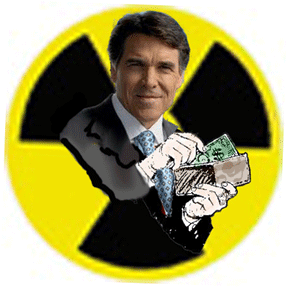
Rick Perry Just Agreed To Sell Saudi Arabia Our Nuclear Tech, Ring of Fire, https://www.youtube.com/watch?v=CVqpge-onuI For decades. The US government, the military industrial complex has been warning us of the dangers of what could happen if just one bad actor in the Middle East got their hands on nuclear weapons. It would be in times folks who would be Armageddon. We have got to go to war to stop these countries in the Middle East from getting their hands on nuclear technology. They’ve told us that we’ve done that. You know, weapons of mass destruction. We can’t let these idiots have those. They’re horrible people over there. And so what has this administration done this week? While nobody was paying attention, they approved the sale of us nuclear technology and secrets to Saudi Arabia, one of the countries that may actually be one of the worst actors over there in the Middle East. Effectively beginning this week, Rick Perry with the Department of Energy has a proved a deal that will allow six currently unnamed US firms to start selling technology secrets, documents, everything that Saudi Arabia needs to start allegedly building their nuclear reactors.
Now, don’t worry, folks, because we’re not going to sell them any information on how to enrich uranium. You know, because it’s not like they could just turn to somebody else once they have all the raw materials and get that information from them. Right. They wouldn’t ever do that. Now the group that’s being totally honest about the journalists, they just murdered, they wouldn’t try to circumvent this deal we have with them, even though they’ve literally been circumventing the other deals we have with them for weapons where they’ve turned around and sold them to groups that want to kill United States as citizens and soldiers and our allies over there in the Middle East. No, they totally mean it this time. They’re not going to screw up this deal. And yes, one of the most oil rich countries in the world totally is serious about switching to nuclear power. You would have to be the dumbest person in this country to think that Saudi Arabia wants to actually build nuclear reactors.
Oh, I’m sorry. This was Rick Perry. So he is, this is what happens folks. This is what happens when you think intelligence doesn’t matter in Washington DC. This is what happens when you elect a president who had no political experience, no foreign policy experience, had a hell of a lot of experience with bankruptcies and failures. And yet you look at him and say, Hey, that’s my guy. I think he could really do some good in Washington DC. We’re selling nuclear secrets to one of the worst countries on the planet in terms of human rights violations, in terms of aggression, other countries, but just because they sell us a lot of oil and they’re not even our, our number one oil, uh, seller, by the way, we hit most of ours from Canada, but we get a little bit from Saudi Arabia and they, you know, have a good pull on global markets. So we have to appease them. So we’re going to give them the technology that with a little bit of tweaks, could be used to wipe out entire populations. What’s the worst that could happen? Right? I think we all know the answer to that.
With the March 20 passage in the N.H. House of Representatives of a resolution calling for a policy of no-first-use of nuclear weapons and opposing development of so-called “low yield” nuclear weapons, the state’s legislators added their voices to a growing movement aimed at reducing the risk of nuclear conflict and moving the world toward abolition of nuclear weapons.
Other measures, based on a resolution known as “Back from the Brink,” also cleared the City Council in Portsmouth last Monday and town meetings earlier this month in Warner, Alstead, Lee and Exeter. The Durham Town Council passed one in December. New London’s town meeting kicked off the latest round two years ago.
It’s not a coincidence.
The resolutions flow from an organized effort by groups including N.H. Peace Action, the American Friends Service Committee, Seacoast Peace Response, Rights and Democracy, and the Union of Concerned Scientists to spotlight concerns about nuclear weapons at a time when presidential candidates are flocking to New Hampshire.
The candidates are also starting to get questions on the campaign trail.
The reason should be obvious: 75 years into the atomic age and three decades after the Cold War ended, the world is still threatened by the possibility that through escalation of international conflict, accident or technological malfunction, nuclear weapons could be exploded. Consider, for example, the festering tensions along the border between India and Pakistan, two of the world’s nine nuclear-armed powers, that could spin out of control.
As the Portsmouth resolution put it, “the detonation of even a small number of these weapons anywhere in the world could have catastrophic human, environmental and economic consequences that could affect everyone on the planet.”
“A large-scale nuclear war could kill hundreds of millions of people directly and cause unimaginable environmental damage, producing conditions wherein billions of people could die from starvation or disease,” the resolution added.
Yet, the United States and other nuclear powers are pursuing new nuclear weapons, even ones designed for battlefield use, rather than diplomatic courses to de-escalate tensions and reduce the chance that nuclear weapons would ever be used.
The decisions by U.S. and Russian leaders to pull out of the Intermediate Nuclear Forces agreement and possibility that the New START treaty might go unrenewed in 2020 stand as stark examples.
For our country, this is a dangerous change of course from the approaches of previous presidential administrations, Republican and Democratic, which even at the height of the Cold War knew that restraint was preferable to an uncontrolled nuclear arms race.
According to a recent poll conducted by the Union of Concerned Scientists, 84 percent of New Hampshire residents think it is very (54 percent) or somewhat (30 percent) important for candidates in the upcoming 2020 presidential election to lay out their views regarding nuclear weapons.
Presidential candidates take notice. When you visit New Hampshire, you may be asked questions like:
“Will you oppose current plans to spend upward of 1½ trillion dollars on a plan to rebuild the entire American nuclear arsenal?”
“Will you agree that no president, even yourself should you be elected, should have unilateral authority to launch a nuclear attack?”
“Will you live up to long-standing U.S. treaty obligations and support multilateral negotiations leading to the worldwide elimination of nuclear weapons?”
Voters will welcome the responses.
(Arnie Alpert is co-director of the American Friends Service Committee’s New Hampshire Program.)
Congress needs to fully fund cleanup of the nuclear waste at Hanford. It’s a federal responsibility. Union Bulletin, Editorial Board 24 Mar 19,
The radioactive waste stored in leaking underground tanks at the Hanford Nuclear Reservation are an environmental disaster waiting to happen. That’s something nobody wants to think about.
But, unfortunately, many of those with the power to get this nuclear mess cleaned up are among those who continue to ignore this reality.
The Trump administration is proposing cutting Hanford Nuclear Reservation spending for fiscal year 2020 by $416 million, the Tri-City Herald reported last week. The annual budget would drop from about $2.5 billion this fiscal year to $2.1 billion next year under the budget request submitted to Congress by the administration, according to the Herald……
Walla Walla is less than 70 miles away from the nuclear reservation where 56 million gallons of radioactive nuclear waste are stored in tanks: Efforts to remove the deadly waste are important. In addition, 67 of the tanks — some with confirmed leaks — are buried relatively close to the Columbia River.
The push is on in the Pennsylvania Legislature to bail out the nuclear reactors, Exelon in particular. Apparently, this is the state legislature paying back Exelon for all the campaign money it has given the politicians.
I urge readers to contact their representative, senator, the governor and the state’s Public Utility Commission and demand no nuclear bailout!
Under no circumstances should the nuclear industry in Pennsylvania be bailed out in any amount for any reason.
We are being extorted by Exelon with scare tactics and bullying. Exelon considers Pennsylvania a cash cow, and now they want to milk us even more. Ratepayers have had their electric bills go up wherever state governments have knuckled under to the nuclear lobby and bailed them out. There is no reason the free market can’t sort out the problems Exelon is having.
It is not the ratepayers’ fault that Exelon is losing money on some reactors, it is Exelon’s own fault for bad management. And it’s not the ratepayers’ responsibility to open their wallets to give Exelon the profit they seek.
Pennsylvania already has some of the highest electric rates in the country, courtesy of the PA PUC and the inability or unwillingness of the Legislature to protect the ratepayer. If they allow a bailout of Exelon or any other nuclear company, they will be betraying every ratepayer in the commonwealth.
By Justine Calmaon Mar 15, 2019Former President of Ireland Mary Robinson is a bonafide international environmental badass. Not only was she the first female president of her country, but she has also made climate justice the focus of her foundation.
Grist was invited to listen in on a taping of her podcast, Mothers of Invention, co-hosted by comedian Maeve Higgins. Their banter, along with stories from guests who brought a feminist approach to climate solutions around the world, was exactly the shot of espresso I needed for a midweek morning. Robinson, who served as the United Nations High Commissioner on Human Rights, is not completely free of controversy, but she is relentless in her work on climate.
The podcast is just the most recent of Robinson’s ongoing efforts to ensure that women and others who disproportionately bear the burdens of what she calls, the “injustice of climate change” are heard. Now in its second season, the podcast has already taken on “ghosting the planet” and “the white man [who] stole the weather.”
Before a recent taping, Robinson sat down with Grist’s Justine Calma to talk feminism, the Green New Deal, and her own carbon footprint.
Q. Are you feeling a shift globally in how we’re prioritizing climate?
A. Climate change has really come up on the agenda. It’s partly because of young people and even school children saying, ‘We want to have a future. You’re not protecting us.’ That’s a very powerful message. When I talked about the injustice [of climate change] — focusing on small island states, indigenous peoples, poor vulnerable countries, and even poor communities in developed countries — a lot of people sort of said, ‘Well that’s not me.’ But ‘children’ [is a group that involves] everyone………. https://grist.org/article/mary-robinson-international-climate-badass-on-why-green-solutions-require-a-feminist-lens/
Does the United States Need a Civilian Nuclear Industry?The National Interest, March 13, 2019
Instead of a greater financial cushion, what the nuclear industry needs is more transparent exposure to market signals.
The U.S. nuclear industry is on life support. Two nuclear reactors currently under construction have been canceled. Westinghouse, once at the vanguard of American technology, filed for bankruptcy in 2017 and is now owned by a Canadian firm. These troubles have affected the human capital—technicians, engineers, and other specialists—crucial for innovation in the industry. The United States once held the majority of nuclear-qualified manufacturing certifications—the prestigious N-stamp issued by the American Society of Mechanical Engineers to certify a level of quality for nuclear applications. That ended in 2010 as other countries expanded their nuclear workforces.
Advocates and industry lobbyists are proposing a new structure of subsidies to prop up the industry. Instead of a greater financial cushion, however, what the nuclear industry needs is more transparent exposure to market signals. …..
improved battery storage and transmission technology could make the entire idea of baseload energy obsolete. Government subsidies, whether to renewables, natural gas, or nuclear, only cloud the issue. It should be up to investors, with access to diverse and comprehensive market information, to bet for (or against) nuclear energy.
Another argument for subsidizing the civil nuclear industry relies on its importance for national defense. Here, the United States walks a fine line: on one hand, the United States has a commitment to uphold the nonproliferation regime. On the other hand, the United States seeks to maintain and even modernize its nuclear arsenal to provide deterrence. In August 2017, former energy secretary Ernest Moniz coauthored the Energy Futures Initiative, a report arguing for greater government support for “robust nuclear energy enterprise” that serves both nonproliferation and nuclear deterrence goals. A particular concern was ensuring the supply of tritium , a hydrogen isotope important for powering nuclear weapons. Government reactors produced tritium until 1988, when they were closed because of cost.
On closer inspection, however, these concerns about the health of the nuclear elements of national security are overblown. The Government Accountability Office finds that tritium reserves are sufficient through the 2030s, and there are other ways to acquire tritium by enriching uranium.
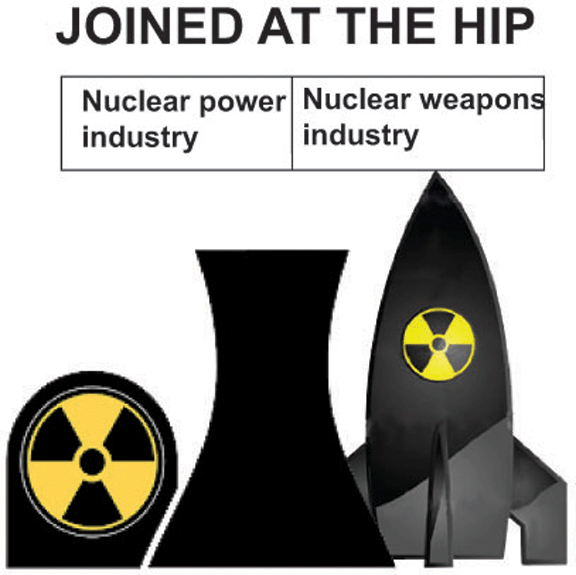
The civilian industry makes the case for electric rate subsidies and exemption of onerous licensing and export controls because of their importance for nuclear weapons and nuclear powered submarines. However, it seems just as likely that the civil nuclear industry is as dependent on the defense industry for talent and investment. The training for civil and military nuclear technology requires the same basic physics, but beyond that, the education diverges. Naval reactors are not the same as civilian ones, and the navy operates approximately 160 nuclear reactors compared to ninety-eight in the civilian sector.
Civilian universities foster research on nuclear science and technology, but the defense establishment may be more interested in state-of-the-art work on artificial intelligence or autonomous technology than nuclear energy. Many of the advances in defense nuclear operations come not from basic nuclear science, but from improved safety and storage technology or warhead design.
Is nuclear part of a solution to climate change? Houston Chronicle , By William H. Schlesinger March 13, 2019
Forty years ago this month, the United States dodged a major bullet with the Three Mile Island disaster in Pennsylvania. The fright was good for us, since it put the brakes on enthusiasm for nuclear power.
Now, as presidential candidates discuss a Green New Deal, it is easy to envision renewed interest in nuclear to reduce our nation’s impact on global climate….
Nevertheless, we should be cautious about nuclear.
We’ve seen two big examples of the dangers of nuclear power beyond the partial meltdown of a reactor at Three Mile Island, located near Harrisburg in Dauphin County. The 1986 disaster at Chernobyl left about 1,000 square miles of land uninhabitable by humans for the foreseeable future, including dangerous levels of Plutonium-239 in the soil. Plutonium-239 has a half-life of 24,000 years.
Imagine the same for a nuclear power plant near you. For central North Carolina, where I live, this would involve the exposure of 2 million people and the instantaneous and permanent abandonment of the campuses of Duke, N.C. State and the University of North Carolina.
The half-life of some of the other radioactive elements released at Chernobyl, such as Cesium-137 and Strontium-90, is about 30 years. Unfortunately, the contamination of the environment by these isotopes was more widespread, in part because they are lighter and more easily carried by winds and water. In this case, Cesium-137 was transported in the atmosphere and deposited in the United Kingdom, where dangerous levels may persist in the soil for more than 100 years. Levels of cesium in some sheep, which fed on grasses in contaminated soils, are above the standards for human consumption.
Nuclear advocates are quick to point out that some wildlife populations in the exclusion zone have increased dramatically — perhaps as a result of the relaxation of hunting and other human pressures after 1986. But the higher incidence of albinism in local barn swallows should be a reminder that radiation-induced genetic mutations afflict wildlife populations and potentially humans as well. Higher incidence of thyroid cancer and genetic irregularities are reported from human populations around Chernobyl.
Severe contamination of the local environment also resulted from the disaster at Fukushima. It is unclear whether some areas will ever be inhabited again. The worst effects of a nuclear disaster are normally found in the region around the event itself, but fallouts spread worldwide. Within a month of the catastrophe in Japan, elevated levels of Iodine-131 and Cesium-137 were recorded in rainfall collected by the National Atmospheric Deposition Stations (NADP) across the United States.
With nuclear power comes the associated problems of waste disposal, which have yet to be addressed effectively in the United States. And a proliferation of nuclear power also enhances the likelihood that nuclear materials will be diverted to nefarious purposes, such as the production of a “dirty bomb” by terrorists.
Stripped of subsidies, the cost of nuclear power is higher than that for solar and wind power to generate electricity. When the hidden costs are included, there is no contest.
Nuclear power may appear to be clean. We see no equivalent to black-lung disease among coal miners, no mercury accumulations in fishes downwind and no carbon dioxide emissions that change our climate globally. But when there is a problem with nuclear power, it is sure to be large, persistent and biocidal for the persistence of life on Earth.
Accidents always happen; we cannot afford an accident with nuclear power.
Those are the words of Leo Szilard, one of the scientists who pushed for the development of nuclear weapons. He wrote them as part of a petition signed by dozens of other scientists who had worked on the Manhattan Project pleading with President Harry Truman not to use the nuclear bomb on Japan.
Mere months after its introduction in 1945, the architects of today’s nuclear world feared the implications of the technology they had created.
Nearly 75 years later it’s time again to ask technologists, innovators, entrepreneurs and academics: will you be party to the ‘ruthless annihilation of cities’? Will you expend your talents in the service of nuclear weapons? Will you use technology to create or to destroy?
Our moment of choice
Humanity is at another turning point.
A new nuclear arms race has begun in earnest with the US and Russia leading the way; tearing up the promise of lasting peace in favor of a new Cold War. Russia’s latest weapon is built to destroy entire coast lines with a radioactive tsunami. The US is building new nuclear weapons that are ‘more likely to be used’.
Meanwhile, North Korea appears to again be building its nascent nuclear weapons program. And India and Pakistan stand on the verge of open nuclear conflict, which climate modeling shows could lead to a global famine killing upwards of 2 billion people.
How do we stop this march toward oblivion?
The Treaty on the Prohibition of Nuclear Weapons has created an opening — a chance to radically change course with the power of international law and shifting norms. The nuclear ban treaty will become international law once 50 nations have ratified it. We are already at 22.
The financial world is also recognizing the risk, with some of the world’s biggest pension funds divesting from nuclear weapons. But there is something even more powerful than the almighty dollar; human capital.
The nuclear weapons industrial complex relies on the most talented scientists, engineers, physicists and technologists to build this deadly arsenal. As more of that talent moves into the tech sector, defense contractors and the Pentagon is seeking to work with major technology companies and disruptive startups, as well as continue their work with universities.
Without those talented technologists, there would be no new nuclear arms race. It’s time to divest human capital from nuclear weapons.
A mistake to end humanity?
Just over one year ago Hawaiians took cover and frantically Googled, “What to do during a nuclear attack”. Days later many Japanese mobile phone users also received a false alert for an inbound nuclear missile.
The combination of human error and technological flaws these incidents exposed makes accidental nuclear attacks an inevitability if we don’t move to end nuclear weapons before they end us.
The development of new machine learning technologies, autonomous weapons systems, cyber threats and social media manipulation are already destabilizing the global political order and potentially increasing the risk of a nuclear cataclysm. That is why it’s vital that the technology community collectively commits to using their skills and knowledge to protect us from nuclear eradication by joining the effort for global nuclear abolition.
We need to stop this foolish nuclear escalation in its tracks. Our commitment must be to a nuclear weapons-free world, by disrupting the trajectory we are currently heading on. Business as usual will likely end in nuclear war.
It took innovation, technological disruption, and ingenuity to create the nuclear dawn. We will need those same forces in greater measure to bring about a nuclear dusk — the complete disarmament of nuclear-armed states and safeguards against future proliferation.
The belief that we can keep doing what we have done for seven decades for another seven decades is naive. It relies on a fanciful, misplaced faith in the illogical idea of deterrence. We are told simultaneously that nuclear weapons keep the world safe, by never being used. They bestow power, but only make certain states powerful.
This fallacy has been exposed by this moment in time. Thirty years after the end of the Cold War, nuclear weapons have proliferated. Key treaties have been torn up or are under threat. And even more states are threatening to develop nuclear weapons.
So I am putting out a call to you: join us with this necessary disruption; declare that you will not have a hand in our demise; declare that you will use technology for good.
By Justin Rohrlich 6 Mar 19,Drastically reducing America’s nuclear arsenal will strengthen US national security, nonproliferation expert Bruce Blair, a former US Air Force nuclear launch officer, told Congress today (March 6).
https://www.deseretnews.com/article/900058129/letter-we-cannot-let-nuclear-waste-come-to-utah.html, By Leslie and Gail Ellison, Deseret News March 1, 2019HB220 recently passed by our Legislature opens the door to allow Class B and Class C nuclear wastes to be stored at the EnergySolutions Clive Skull Valley repository. These wastes increase in toxicity over time. No matter one’s political persuasion, Independent, Republican, Libertarian or Democrat, this bill must be halted in its tracks.
This is a Utah state issue. Other states and the U.S. Department of Energy are salivating and jumping for joy about this scenario. They probably cannot believe that our state will actually welcome in these toxic wastes.I urge Gov. Gary Herbert to be courageous, put the politics aside and exercise his veto on this legislation. This should not be a political issue — these are extremely serious health and safety matters threatening our families, our children and our children’s children.
Nearly half of the people in Germany say the plan to close nuclear plants before coal is right, a survey commissioned by price comparison website Verivox has found. In the survey of over 5,000 people, 49.5 percent said the planned decommissioning of the last nuclear plant by 2022 and the last coal plant by 2038 is the right order, possibly because they consider the danger of nuclear power to be greater than the effect of carbon emissions from coal-fired power production on climate change, Verivox says…… https://www.cleanenergywire.org/news/most-germans-say-it-right-close-nuclear-plants-coal-plants
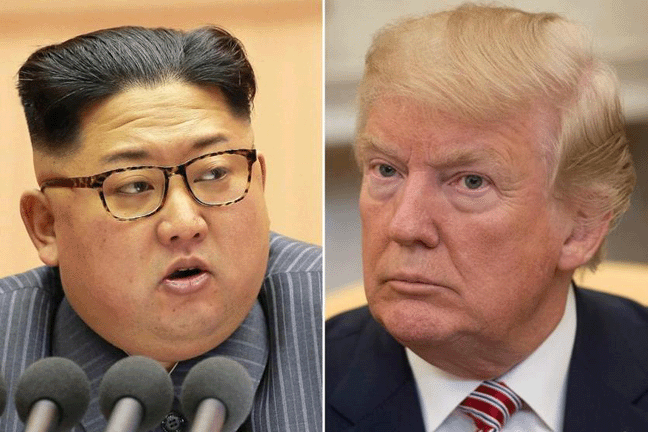
This month’s summit between President Trump and North Korean leader Kim Jong Un is likely to focus on North Korea’s main nuclear weapons center at Yongbyon.
ARI SHAPIRO, HOST:
When President Trump and North Korean leader Kim Jong Un discuss denuclearization in Hanoi, they are likely to focus on one North Korean nuclear facility in particular. NPR’s Geoff Brumfiel introduces us to it.
Is nuclear power “the only proven climate solution”? Tree Hugger, Lloyd Alterlloydalter, February 6, 2019,Instead of building giant concrete buildings filled with uranium, why not build smaller efficient buildings filled with people.
……Now Marc Gunther, who has been writing about environmental issues for years, puts his oar into these dangerous waters with a new article Nuclear power: A dilemma for climate change philanthropy. He’s worried about the organizations that are anti-nuke, like the Sierra Club and Greenpeace and the philanthropists who support them. He quotes a book by Joshua S. Goldstein and Staffan A. Qvist, who argue that “the only way to rapidly decarbonize the world’s energy systems is with a rapid rollout of nuclear power and renewable energy.”
…….. Nuclear is slow.
And then there is the question of scaling it up quickly. Reactors take a long time to build; the record is one in Argentina that took 33 years……
Nuclear is complicated.
But it is more like a bridge than a plane. It is the same argument I use when people liken building prefab housing to building cars; planes can be the same everywhere in the world. A nuclear plant is going to need different foundations, different water supplies, has different neighbours and different earthquake zones. It is hard to make them all the same. Fundamentally, they are not, and the reactor is only a portion of the cost; the rest is just a big dumb building, with few economies of scale.
Nuclear power may be carbon free but building nuclear plants is carbon intensive. Then there is the embodied carbon of concrete and steel; a typical reactor might have 40,000 tons of steel and 200,000 tons of concrete. Production of that much concrete puts out about 180,000 tons of CO2, and making that much steel puts out 79,000 tons of CO2 which is a pretty big carbon burp for each power plant that these guys want to build……..
Nuclear is NOT the only proven climate solution.
No, nuclear power is not the only proven climate solution. If you look at where the electricity is going, fully 75 percent is into buildings, with 25 percent into industry. If you look at where our biggest problems are, it is not with electricity generation; coal is down to 14 percent. Focus on where the power is going, not where it is coming from. The real and proven climate solution is to reduce demand, to fix those buildings, which would cost a whole lot less than replacing half the US electricity supply with nuclear power, and a whole lot less time.
We don’t have time.
We continue to remind readers that the IPCC’s line in the sand is that we have to cut carbon emissions by 45 percent by 2030 to limit temperature rise by 1.5°C. If we all agreed to build a fleet of new reactors starting tomorrow we wouldn’t see the first of them online by 2030.
So instead of investing in giant concrete buildings filled with uranium that increase supply of electricity, why not instead invest in smaller, efficient wood buildings filled with people that reduce demand. And while we are busy building and fixing buildings, roll out more wind turbines and solar panels and especially, lots more batteries……. https://www.treehugger.com/energy-policy/nuclear-power-only-proven-climate-solution.html










 nuclear-news