Christiana Figueres, UN’s climate chief praises Obama’s new moves to beat pollution
 UN climate change chief praises new US pollution regulations Christiana Figueres calls move ‘a good signal’ to other states, Guardian 1 June 14, Obama to use presidential power to tackle carbon emissions America’s new power plant regulations, due for release on Monday, could unlock stalled negotiations for a global deal on climate change, the United Nations’ top climate official said.
Christiana Figueres, the UN’s top climate change official, said she expects the new power plant rules could spur other big emitters – such as China and India – to begin taking action on climate change and move forward on reaching a deal by the
2015 deadline.
The Environmental Protection Agency will roll out the new rules on Monday – the most significant action taken under any president to deal with climate change.
Figueres said in a statement on Sunday she believed the rules would send “a good signal to nations everywhere” that America is serious about dealing with the threat of climate change.
The new EPA could cut carbon pollution from the country’s power plants by up to 25% by 2020 – tackling the biggest source of the greenhouse gas emissions that cause climate change……..
He said in a speech last week to West Point cadets that America needed to show it was serious about climate change, if it wanted the other big emitters to move.
“American influence is always stronger when we lead by example,” Obama said. “We cannot exempt ourselves from the rules that apply to everyone else. We can’t call on others to make commitments to combat climate change if a whole lot of our political leaders deny that it’s taking place.” http://www.theguardian.com/environment/2014/jun/01/un-climate-change-chief-praises-us-pollution-regulations
Essential that Russia and the West co-operate on nuclear security
 Why the US should keep cooperating with Russia on nuclear security Bulletin of the Atomic ScientistsSiegfried S. HeckerPeter E. Davis “…….In contrast to Moscow’s pronouncements, Russia’s nuclear specialists recognize that continued cooperation is needed. Nuclear safety and nuclear security are never-ending jobs that require cooperation and sharing of best practices. Russia’s experts do not want to return to nuclear isolation because they believe it led to the 1986 Chernobyl disaster and to the nuclear security crisis following the breakup of the Soviet Union.
Now, the crisis in Ukraine has not only put nuclear cooperation between the United States and Russia on the back burner, but Washington appears to be erecting its own roadblocks that threaten to irreparably damage such cooperation. The House Armed Services Committee recently approved legislation that would put nuclear security cooperation with Russia on hold. While the White House has opposed the committee’s efforts to limit cooperation, the Energy Department has issued its own restrictions on scientific interchanges as part of the US sanctions regime against Russia.
It is clearly in Moscow and Washington’s common interest to prevent the proliferation of nuclear weapons and global nuclear terrorism. Keeping all nuclear materials in control of governments and erecting effective barriers to nuclear trafficking requires cooperation. It is in their common interest to make further arms reductions, rather than return to the arms race era and nuclear testing. ……..
These are precisely the objectives the Obama administration had been promoting with Russia and around the world, although Moscow has become a reluctant partner. Now, Washington appears willing to sacrifice nuclear cooperation in the short term in order to sanction Russia for its actions in Ukraine. But Washington does not have to choose between the two. It should be able to pressure Moscow on Ukraine, while still cooperating on nuclear issues.
Progress on the nuclear front requires good working relationships between Russian and American scientists. These relationships, already strongly opposed by Russia’s security services, cannot be turned off and on at will. They must be nurtured and maintained over time to foster the cooperation needed to reduce the nuclear dangers. Relationships are difficult to rebuild once they have been cut off. In addition, curtailing cooperation now will threaten the gains that have been made over the past 20 years and jeopardize Washington’s enormous investment in cooperative threat reduction………
As the United States and the European Union take short-term measures to restrain Russia’s actions in Ukraine, they should not sacrifice the hard-earned gains made to stabilize the nuclear threats that arose after the dissolution of the Soviet Union. Some forms of nuclear cooperation, especially on arms control and nonproliferation, were supported even during the darkest days of the Cold War, because the alternatives proved unacceptable to both sides. With the Cold War’s end, nuclear cooperation flourished. Washington should foster continued cooperation to meet our shared challenges, rather than allowing it to be held hostage to the Ukrainian crisis. Over the past 20-plus years, when working with our Russian colleagues, we have all found that at times we must move beyond political disagreements, such as the political situation in Ukraine, to work together to advance the cause of nuclear security. http://thebulletin.org/why-us-should-keep-cooperating-russia-nuclear-security7207
Report that radiation levels are high in mainland USA
BULLSHIT UPDATE!!
This is a bogus report with no evidence to back it up.. I have checked all the usa citizen monitoring sites and enenews rad forum.. there is no major readings as this article states.. also, i was unable to post my findings on the article as disqus would not COMPLETE so no comment could be left.. it is disinfo.. untrue .. made up .. a load of rubbish.. Also, CPM is not counts per million it is counts per minute.. i was thinking of deleting it but it is worth leaving so people know to avoid the web site that posted it.. and the anonymous poster that uploaded it is one of a very few bloggers.. or a complete schill from JTRIG as i disqus comments would not let me engage with the creator of this fiction..
blimey!  Arclight2011part2
 ALMOST EVERYWHERE in Mainland USA Shows Evacuation Level Radiation Readings Right Now – Started Days Ago (Who Knew?) Investment Watch, June 1st, 2014 Aside from the map on the homepage, the site explains that all levels regarding their symbols have been ‘downgraded’ already since they were getting too high!
The real info is the CPM (counts per million) of each individual city.
From the West Coast to the East Coast, it’s going from highs of 300 to 500.
Somebody on another site mentioned potassium iodide.
The problem is that potassium iodide is only good for one kind of radiation only, but doesn’t deal with cesium or hot particles.
Warning: It should also not be taken for long lengths of time…………. http://investmentwatchblog.com/almost-everywhere-in-mainland-usa-shows-evacuation-level-radiation-readings-right-now-started-days-ago-who-knew/#1xhFVBg8CfLA6cmj.99
Radiation – cancer link near Oyster Creek Nuclear Power Plant?
Is there a radiation-cancer link? Asbury Park Press, Janet Tauro May 29, 2014 Ever since the switch was turned on at the Oyster Creek Nuclear Generating Station in Lacey in 1969, the public has received exposure to radiological releases.
Most often the releases have been extremely small, fractions of what is allowed by federal standards. But, there have been times when releases were high, according to statistics compiled by the Brookhaven National Laboratory. The public has been largely unaware of these releases, which are odorless, colorless and tasteless. And that leads to the obvious and monumental question: Have 45 years worth of radiation exposure negatively impacted public health in Ocean County?
At 6:30 p.m. Wednesday, experts from the National Academies of Science will hold a forum on an upcoming cancer study in communities around Oyster Creek at the Toms River Ramada Inn on Route 9.
Inquiries are regularly received at the Clean Water Action NJ office from citizens seeking answers on a possible link between living near a nuclear plant and health risks. We hope that the NAS study will adequately address these questions.
However, there is cause for concern about the study’s scope. Continual exposure to low-level radiation can affect human DNA and damage cells. Is there a link between radiation exposure and Ocean County’s high autism rate? Will the study look at the rates of miscarriage and birth defects? Will those who sought cancer treatment, or died, out of state be included in statistics? Will the study examine cancer incidence, as well as cancer fatalities?
Scientific studies can be frustratingly difficult in proving cause and effect. One only needs to read Dan Fagin’s Pulitzer Prize-winning “Toms River, A Story of Science and Salvation” to realize what might seem obviously apparent is often difficult to prove. Fagin showed that years of research that cost millions of dollars still left many with unanswered questions about Ciba-Geigy’s role in cancer clusters found in neighborhoods where the company discharged thousands of gallons of toxic chemicals into the groundwater.
And now a similar investigation will take place around Oyster Creek, where reports on emissions tend to be spotty and difficult to find. And sometimes, they are simply wrong. An NRC document shows that a disconnected joint in the emissions stack went undetected for four years, meaning emissions data between 2006 and 2010 was inaccurate………
A previous NAS study, commonly referred to as the Bier VII report, concluded that no amount of exposure to continuous radiological releases can be considered safe.
Researchers in France, Germany, Sweden and the United Kingdom have found increased pediatric cancer rates in communities surrounding nuclear plants. The research helped prompt Germany to abandon its nuclear program, and today, about 74 percent of the country’s power supply is generated by renewable energy sources, namely solar and wind. Germany is a shining example of what political will can achieve when public health and safety take precedent over industry profits.
It is imperative that the NAS researchers take a close look at the 1993 Brookhaven National Laboratory report that charted radiological releases at Oyster Creek, one of which was measured at more than 1 million curies in 1979.
Given that statistics by the state Department of Health and Senior Serviceshave indicated Ocean County has the highest pediatric cancer rate statewide and the third-highest autism rate, it is crucial that the NAS compile a fair, accurate, and easily accessible assessment of Oyster Creek’s impact on our health and the health of future generations.
Then, elected officials and regulators might finally realize it is time to turn the switch to the OFF position at Oyster Creek.
Janet Tauro is board chair of Clean Water Action NJ and founding member of GRAMMES (Grandmothers, Mothers, and More for Energy Safety).http://www.app.com/story/opinion/columnists/2014/05/29/editorial-radiation-cancer-link/9739433/
Finally USA nuclear weapons planners starting to realise it all costs too much
 Even Nuclear Planners Can’t Have It All | Commentary Roll Call, By Jon Wolfsthal May 29, 2014, Congress is conducting its annual debate over the defense budget and programs in the National Defense Authorization Act. Sadly missing is a debate over the nuclear weapons budget. The United States plans to spend more than $1 trillion over the next thirty years to maintain and modernize its nuclear arsenal. Some of this spending is truly needed and can help ensure that Washington maintains a safe, secure, and effective arsenal to defend itself and its allies. But many of the projects are too expensive or redundant, and out of step with today’s strategic and budgetary environment. Put simply, the United States does not need a penetrating stealth bomber, a new air dropped bomb AND a long-range standoff cruise missile armed with nuclear weapons on top of a new submarine and new ICBM. Priorities have to be set and choice have to be made.
The rationale behind each of these systems by themselves may make sense, but taken together are redundant and will require the Pentagon to spend money better spent on programs that actually contribute to national security……….
This costly, unnecessary redundancy continues when you look at the other legs of the nuclear triad. In addition to the new nuclear-capable bombers, the US is planning to buy 12 new ballistic missile submarines and a new generation of Intercontinental-Range Ballistic Missiles — costing hundreds of billions of dollars. With so many options for nuclear delivery systems, it remains unclear what unfilled mission the long-range standoff missile intends to satisfy.
During the cold war when we planned for and equipped ourselves for all and any contingencies, such a duplication of effort and expense might have made sense. But such extravagance and redundancy today does not, especially in the face of severe budget constraints that are preventing the Government from pursuing critical programs in many other areas even inside the Pentagon.
The Congress appears unable to rationalize these choices so far in its annual budget process, and the White House has yet to try to knit these long-range programs together in a way that is sustainable after the end of the five-year pentagon planning process. Finally, however, it appears that planners inside the military itself are starting to realize that the pie will not be large enough to feed every nuclear project and that some tradeoffs will have to be made. Eliminating — not just delaying — the plan for long-range standoff missiles is a small but important step toward freeing up resources for so many other more supportable, logical priorities.
Jon Wolfsthal is Deputy Director of the James Martin Center for Nonproliferation Studies and a former nuclear security Advisor to Vice President Joseph R. Biden Jr. http://www.rollcall.com/news/even_nuclear_planners_cant_have_it_all_commentary-233388-1.html?pg=2&dczone=policy
Iran to convert low-enriched uranium gas to safer form
Iran plans June launch of plant for curbing low-grade uranium stash – diplomats Firstpost World May 30, 2014 VIENNA (Reuters) – Iran is planning to start up a plant in June that will convert low-enriched uranium gas into an oxide form less suitable for making nuclear bombs, as required by a landmark deal with world powers, diplomats said. Under last year’s interim accord with six major powers to help ease tension over Iran’s nuclear programme, it needs to take action by late July to limit its stockpile of uranium gas refined to a fissile concentration of up to 5 percent.
It was one of the terms of the six-month accord between Iran and the United States, France, Germany, Britain, Russia and China to curb Tehran’s atomic activities in exchange for some easing of sanctions that took effect on Jan. 20. Iran is meeting all the other requirements of the deal that was designed to buy time for talks on a final settlement of the decade-old dispute over Tehran’s nuclear programme, a U.N. watchdog report showed last week. ….
: http://www.firstpost.com/world/iran-plans-june-launch-of-plant-for-curbing-low-grade-uranium-stash-diplomats-1549441.html?utm_source=ref_article
Uranium, coal, gas …. our lust for energy driving us to extinction
Uranium, natural gas, coal and hydroelectric are driving us to extinction Our lust for energy is killing us, one story at a time. Scholars and Rogues, by Bruce Lindwall, 28 May
Our stories aren’t the same but they rhyme.
They came to the desert to get the uranium. Tore up the ground, sucked up the water, blasted the mesa. Swept all the toxic tailings into a pile. Now the wind spreads deadly dust onto homes and streets and playgrounds. Onto vegetables and meat drying in the sun. Onto the lives and homes and bodies of the people. They took the uranium and left without a goodbye. They left the broken dam that once held the pond, now long since washed downstream past the homes of the people. Never told the people about the radium in the pond. That went downstream too. Sunk into the sand, hid amongst the rocks. Don’t listen to the clicking meter as you walk that streambed now, telling what’s left behind. You’ll only scare yourself. You’ll scare yourself enough to run. But you can’t run — you’re already home.
They came to town to get the gas. ……..
They came to the mountain to get the coal. ……http://scholarsandrogues.com/2014/05/28/uranium-natural-gas-coal-and-hydroelectric-are-driving-us-to-extinction/Scholars and Rgues
Call for Catholic Universities to take up cause of nuclear disarmament
Catholic Universities and the Nuclear Threat, Peace Policy,
May 28, 2014 Rev. John I. Jenkins, C.S.C.Fifty-one years ago, Pope John XXIII issued his encyclical Pacem in Terris, which declared that “the arms race should cease” and urged that “all come to an agreement on a fitting program of disarmament.”
In revitalizing the Catholic voice first raised by Pope John, Catholic universities play a special role. We have an obligation to use our scholarly abilities to research and teach on the most pressing issues of life and death — including on the catastrophic power of nuclear weapons. We also have the opportunity to work in collaboration with the Bishops of our Church, the ethicists and academics from other universities, and with national security experts who’ve held the highest positions of responsibility in the United States government……….
universities should serve as networks of discussion and sources of knowledge and talent and training, able to explore and address the practical, technical, and ethical issues that arise on the way to a global ban.
Albert Einstein famously said that the advent of nuclear weapons “has changed everything but our thinking.” It is the task of the religious leaders, distinguished statesmen, university leaders and scholars to begin to change our thinking.
Rev. John I. Jenkins, C.S.C., is president of the University of Notre Dame. http://peacepolicy.nd.edu/2014/05/28/catholic-universities-and-the-nuclear-threat/
Nuclear weapons and climate change: closely related and urgent
 Global Climate Change and Nuclear Abolition counterpunch. by WINSLOW MYERS, 26 May 14 The Marshall Islands are filing lawsuits against the nine nuclear powers to get them to step up to their obligations under the Nuclear Non-Proliferation Treaty to negotiate total nuclear disarmament. Meanwhile Bill McKibben is gathering citizens for a rally in support of urgent action on climate change in New York on September 21st and 22nd, where the next climate summit will be held.
No two trans-national issues are more closely related than the abolition of nuclear weapons and global climate instability, for three reasons: first, nuclear war is the biggest potential accelerant of life-threatening climate change; second, the resources desperately needed to address climate issues continue to be poured into nuclear weapons and their delivery systems; and third, the solution to both challenges depends upon the same new way of thinking based in the reality that national and international self-interests have merged.
If India and Pakistan, or the U.S. and Russia, should back into a nuclear war, the glare of the explosions will vaporize our most cherished assumptions along with the victims. Survivors will ask, how was it that we ever thought that we could achieve security with these infernal machines? What were we all thinking, national leaders, the thousands of workers who build them, the lawmakers who finance them by siphoning tax dollars away from schools and mass transit, the coolly rational generals who seek budgetary increases for ever shinier toys? Their moral authority will be as devastated as the cratered moonscapes left by the destruction…….
The two-in-one of climate change and nuclear abolition is not something to be addressed after supposedly more immediate brush-fires are extinguished; by viewing it instead as a single challenge, an opportunity for cooperative prevention based in planetary self-interest, success will become a model for resolving more local conflicts without violence.
The Marshall Islands, which endured open-air atomic testing, are courageous to speak for the powerless in bringing suit against the mighty nuclear powers. In 2013 they appealed to the U.N. for more help with climate change, already a life-and-death issue for these low-lying atolls, but soon enough for all of us. http://www.counterpunch.org/2014/05/26/global-climate-change-and-nuclear-abolition/
latest UN report shows that Iran has reduced is stockpile of uranium gas
Iran: U.N. report proves its nuclear intentions are peaceful http://english.alarabiya.net/en/News/asia/2014/05/25/Iran-U-N-report-proves-its-nuclear-intentions-are-peaceful.html Reuters, Dubai Saturday, 24 May 2014 Iran on Saturday said the latest U.N. report on its nuclear activities, which calculated it had slashed its nuclear stockpile by around 80 percent, proved its atomic programme was peaceful.
The International Atomic Energy Agency (IAEA) said in its quarterly report on Friday that Iran had reduced its stockpile of higher-grade enriched uranium gas under an interim pact with world powers.
It also said it had started to engage with a long-stalled IAEA investigation into suspected weapons research.
A steep cut in uranium gas – a relatively short technical step away from weapons-grade material – is among concessions demanded by the United States and its Western countries in return for limited easing of economic sanctions against Tehran.
“The report is an affirmation of Iran’s claim to peaceful activities,” nuclear spokesman Behruz Kamalvandi told the official news agency IRNA. “No deviations have been seen in these activities.”
Western countries have long suspected the Islamic republic of seeking nuclear weapons capability and Tehran’s cooperation with the IAEA is a test of any progress in the current talks with the six world power known as P5+1.
The latest round of negotiations failed to make much headway last week, raising doubts over the prospects for a breakthrough by the late July deadline.
Just one question at Florida NRC meeting attended by NRC and nuclear employees
Just one questioner at NRC meeting on nuclear plant By Susan Salisbury Palm Beach Post Staff Writer Fort Pierce 24 May 14 Despite controversy raised by an energy watchdog group about generator tubes at Florida Power & Light’s St. Lucie nuclear plant, only one area resident had any questions for the U.S. Nuclear Regulatory Commission Friday.
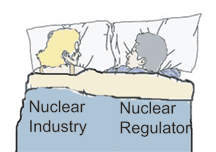 The meeting at the Havert L. Fenn Center in Fort Pierce was attended by close to 20 FPL and NRC employees as well as by St. Lucie County Commissioner Tod Mowery and county public safety managers.
This story continues on our new premium website for subscribers, MyPalmBeachPost.com. http://www.palmbeachpost.com/news/business/feds-to-hold-meeting-today-about-st-lucie-nuclear-/nf6Bh/
AREVA’s nuclear reactor sales target postponed
Areva says nuclear reactor sales target may slip by 1-2 years PARIS Tue May 20, 2014 May 20 (Reuters) – Areva’s chief executive softened his forecast that the French state-controlled nuclear group would sell 10 reactors by 2016, saying it would be no problem if that deadline slips by a year or two.
Fossil fuel lobby’s media war against climate scientists
David Suzuki Discusses the War on Climate Scientists http://ecowatch.com/2014/05/18/suzuki-climate-scientists/ Everybody ought to be doing their part to fight climate change, but instead some are focusing their energy on taking down the folks providing the research on our planet’s future.
From laughter to vehemence, it’s clear that the war on climate scientists and their research is on. In the second part of his conversation with Bill Moyers, Dr. David Suzuki says climate deniers are engaging in a good ol’ game of “kill the messenger.”
“This is a very effective thing that we know has been done by the tobacco industry [and] it’s being done by the fossil fuel industry… You attack a person on the basis of their trustworthiness, their ulterior motives, anything to get away from dealing with the issues,” the scientist, author and philanthropist said.
He said it’s not unlike the attacks he has experienced from Canada’s prime minister, corporations and others over the years for speaking his mind about the government and the fossil fuel industry.
“The fossil fuel industry knows that fossil fuel use is at the heart of climate change,” Suzuki said. “But the problem is their job as CEOs and executives is to make money for their shareholders, and they’ll do it.”
Media ignoring the catastrophic global danger of the nuclear industry
How the nuclear industry may unintentionally obliterate humankind (NaturalNews) May 20, 2014 by: J. D. Heyes In modern times, the nuclear disaster at Japan’s Fukushima Daiichi plant in March 2011 has been one of the most under-reported of cataclysmic events, and some critical analyses have concluded that coverage likely would have been more complete had the accident occurred in a country not allied with the United States.
That said, notes Andrew McKillop at 21st Century Wire, we might as well “write off” most of the American (and Japanese) media, as well as politicians from both nations, regarding the dangers that the accident truly poses to Mankind. “For reasons associated with the nuclear lobby and its corporate machine, their tongues are tied on the issue,” he writes.
The ‘alternative media’ keeping an eye on Fukushima developments
Continuing his criticism, McKillop jabbed further:
More silence, a few new theories and a couple of less than convincing assurances like, “It’s all under control, the humming birds and the badgers have returned to the exclusion zone and there’s a lot of very affordable property now, lost of economic opportunity in Fukushima”, (if you had any doubt of how spineless and redundant our leadership would be in the event of a true humanitarian crisis, this should be your ‘eureka’ moment). The best they could manage is release a new Godzilla film production — and that’s about as close as you’ll get to an admission from the global elite’s media machine.
For his part, McKillop sees the nuclear issue overall as some Darwinian self-destruction plan implemented by Man to ensure the end of the world. Why else, he argues, would so large a catastrophe be so underwhelming and unimportant?
“Incredibly, many politicians, economists and even hard-core environmental priests, still love nuclear power. It’s a strange kind of love, or a Strangelove to be precise,” he writes.
Citing The Economist magazine, which he describes as “an elite talking shop” publication, McKillop says observations made in a recent edition regarding previous nuclear disaster at Chernobyl are particularly noteworthy because they undermine the rosy picture being painted by Japanese and U.S. officials regarding environmental conditions surrounding Fukushima:….McKillop labeled such proclamations as “paid-for junk science” that has become “weaponized” and now poses a direct threat to humans……http://www.naturalnews.com/045213_nuclear_industry_humankind_extinction.html
Nuclear industry: costs and delays cast a gloom on chance of “new nuclear’
 In Europe and the U.S. cost overruns and delays raise questions about the market for a new generation of safer nuclear reactors Scientific American, May 20, 2014
 More than a decade ago a contract was signed to build the world’s first third-generation European pressurized reactor (EPR) in Finland. The cutting-edge, 1,600-megawatt nuclear power plant, Olkiluoto 3, which its French maker Areva boasted as the most advanced safety design of the time, is still under construction today. There have been various setbacks as well as endless finger-pointing between Areva and the Finnish utility TVO, which are locked in court battle over expanding costs. Now the reactor might not be completed until at least 2017, if at all, with a price tag of $11 billion, more than double its original estimate.
The Olkiluoto 3 situation is not unique. Another Areva EPR in Flamanville, France, is also behind schedule and over budget. A recent government deal for two new EPRs in the U.K. has also come under fire.
The prospects for a nuclear power revival are no better in the U.S. Although the technology has never been cheap, cost overruns and delays are plaguing the handful of next-generation pressurized water reactors currently being built, the first since Japan’s Fukushima nuclear disaster in 2011. Even before that event, a study from Massachusetts Institute of Technology found that the cost of new nuclear plants, globally, doubled from 2002 to 2009. The third-generation reactors have safety features that should prevent a meltdown similar to Fukushima’s but political controversy, along with the high price tag means that new nuclear complexes in the U.S. and Europe could be in the single digits instead of dozens originally planned less than a decade ago……….
Costs and delays are also rising for the AP1000 being built by Georgia Power, in part because the units must meet more stringent safety requirements that regulators have introduced in the wake of September 11, 2001, attacks and the Fukushima meltdown. ……
Although the AP1000 is an intrinsically simpler design than the EPR, they both have also faced cost overruns because they are first-of-their-kind deployments. A report by Citi Research found that the Vogtle project is about six months behind schedule and will cost at least $1 billion above original projections. “We’re learning how to do this as efficiently as we can,” says Benjamin, who admits there has been a learning curve. Finalizing the design for construction, which has been approved by American and Chinese regulators, has taken longer than anticipated. So has securing delivery on certain components, such as reactor coolant pumps, because they are being produced for the first time. “We take these lessons as we learn them,” says Benjamin, “and make sure these issues get [resolved] so we don’t face them again.”
Westinghouse hopes that working out the kinks in the first designs will drive down the tim
1 This Month
Chernobyl: The Lost Tapes – A good documentary on Chernobyl on SBS available On Demand for the next 3 weeks– https://www.sbs.com.au/ondemand/tv-program/chernobyl-the-lost-tapes/2352741955560

of the week–London Campaign for Nuclear Disarmament

Tell the Ukrainian Government to Drop Prosecution of Peace Activist Yurii Sheliazhenko
To see nuclear-related stories in greater depth and intensity – go to https://nuclearinformation.wordpress.com
-
Archives
- April 2026 (152)
- March 2026 (251)
- February 2026 (268)
- January 2026 (308)
- December 2025 (358)
- November 2025 (359)
- October 2025 (376)
- September 2025 (257)
- August 2025 (319)
- July 2025 (230)
- June 2025 (348)
- May 2025 (261)
-
Categories
- 1
- 1 NUCLEAR ISSUES
- business and costs
- climate change
- culture and arts
- ENERGY
- environment
- health
- history
- indigenous issues
- Legal
- marketing of nuclear
- media
- opposition to nuclear
- PERSONAL STORIES
- politics
- politics international
- Religion and ethics
- safety
- secrets,lies and civil liberties
- spinbuster
- technology
- Uranium
- wastes
- weapons and war
- Women
- 2 WORLD
- ACTION
- AFRICA
- Atrocities
- AUSTRALIA
- Christina's notes
- Christina's themes
- culture and arts
- Events
- Fuk 2022
- Fuk 2023
- Fukushima 2017
- Fukushima 2018
- fukushima 2019
- Fukushima 2020
- Fukushima 2021
- general
- global warming
- Humour (God we need it)
- Nuclear
- RARE EARTHS
- Reference
- resources – print
- Resources -audiovicual
- Weekly Newsletter
- World
- World Nuclear
- YouTube
-
RSS
Entries RSS
Comments RSS
 nuclear-news