Canada’s Federal Court agrees on poor environmental assessment by Darlington New Nuclear project
Greenpeace v. Canada: Symbolic Blow to the Nuclear Industry, Game-Changer for Everyone Else?, the energy collective, Martin Olszynski June 18, 2014 In a rather lengthy (431 paragraphs) decision, the Federal Court of Canada agreed with Greenpeace and other environmental groups that portions of the Joint Review Panel report for the Darlington New Nuclear project proposed by Ontario Power Generation were inadequate. See Greenpeace Canada v. Canada (Attorney General), 2014 FC 463 (CanLII). Justice Russell held that the environmental assessment conducted by the Panel failed to comply with the Canadian Environmental Assessment Act, SC 1992 c 37 (essentially Canada’s version of the United States National Environmental Policy Act). Specifically and as further discussed below, there were gaps in the treatment of hazardous substances emissions and spent nuclear fuel, and a failure to consider the effects of a severe “common cause” accident such as the combined earthquake and tsunami that caused the Fukushima nuclear disaster.
As noted by the media, while the decision is of limited effect on a project already indefinitely postponed by the provincial government, “it is a symbolic blow to an industry coping with the public and political fallout from Japan’s 2011 Fukushima meltdown.” As further discussed below, the decision is also likely to have implications for environmental assessment in Canada generally and several other projects currently making their way through either the regulatory process or the courts,…….. http://theenergycollective.com/energylawprof/402016/greenpeace-v-canada-symbolic-blow-nuclear-industry-game-changer-everyone-else
Earth’s hottest May on record
Earth Has Its Warmest May on Record Globally, Spring Could Be Warmest Andrew Freedman, Mashable 19 June 14 Two of the leading centers that track global surface temperatures have reported their data for May, and they both found it to be the warmest such month on record for the planet. NASA foundthat May had an average global temperature that was 1.38 degrees Fahrenheit above average, which would make it the warmest such month, coming out far ahead of May 2012. The Japanese Meteorological Agency’s separate analysis also found both May and the meteorological spring months of March through May to be the warmest on record.
These results are preliminary, with the data from both agencies subject to revision. NASA posted a note on its surface-temperature data website Tuesday that said “missing data” from China has not yet arrived, and that their data is not “directly comparable” to previous records.
Later this week, the National Oceanic and Atmospheric Administration (NOAA) will release their global numbers, which typically closely match the other centers, but sometimes differ slightly in rankings. According to the World Meteorological Agency, all but one of the 10 warmest years on record have occurred in the 21st century…..
Studies show that heat waves are already becoming more intense and long-lasting globally, as average temperatures warm in response to increasing amounts of greenhouse gases in the air.
Warmer than average temperatures also predominated during May across Australia, Europe and the western U.S.http://mashable.com/2014/06/17/earth-warmest-may-spring/
Cameco uranium company in tax trouble
Cameco provides update on tax case NewsTalk 650 CKOM Uranium miner out $103 million as it waits to go to court by Bryn Levy Apr 10, 2014 Cameco’s dispute with the Canada Revenue Agency (CRA) is a long way from settled. but it’s already starting to cost the company real cash.
The CRA has accused Cameco of dodging as much as $850 million in taxes through a deal with a Swiss subsidiary. Cameco argues the deal was an above-board way to lower its tax hit. The CRA contends the agreement violated rules requiring Canadian firms to treat subsidiaries the same as third parties.
As the agency re-assesses Cameco’s tax bill for each year between 2003 and 2013, the law requires the company to pay half of any disputed amounts up front.
With two years’ worth of re-assessments submitted so far, Chief Financial officer Grant Isaac detailed the bill:
“To date we’ve paid a net amount of $103 million to the CRA,” he said, speaking on a conference call about the company’s fourth-quarter results……http://ckom.com/story/cameco-provides-update-tax-case/250705
Independent Scotland would ban hosting Trident nuclear missile base
Nicola Sturgeon: Ban on nuclear weapons in Scotland will go ahead with Independent vote Daily Record Jun 15, 2014 08:25 By Mark Aitken TRIDENT will be removed by 2020 with a Yes vote, promises the Deputy First Minister, as part of a newly written constitution for Scotland.SCOTLAND will be a nuclear-free zone for good if the country votes for independence, Nicola Sturgeon has vowed.
The SNP have vowed that the Trident nuclear defence system would be removed from its Clyde base by 2020.
And the Deputy First Minister will promise to enshrine a ban on nuclear weapons in a written constitution after a Yes vote when she gives a speech at Edinburgh University tomorrow.
Sturgeon said: “Scottish taxpayers have been paying to have one of the largest concentrations of nuclear weapons in Europe on our doorsteps. It’s high time that comes to an end.
“The people of Scotland now have the opportunity to remove Trident before we are hit with a share of the further £100billion in costs for a new generation of weapons of mass destruction on the Clyde.
“The Scottish Government will propose a constitutional prohibition on nuclear weapons being based in Scotland. This way they would never return.”……http://www.dailyrecord.co.uk/news/politics/nicola-sturgeon-ban-nuclear-weapons-3698075
Russian bombers on training exercise intercepted by US jets
U.S. Jets Intercept Russian Bombers Near Alaska, GLOBAL SECURITY NEWSWIRE National Journal 13 June 14 On Monday, U.S. military jets intercepted four Russian heavy bombers that flew close to Alaska, a key combatant command has acknowledged.
U.S. North American Aerospace Defense Command spokesman Navy Capt. Jeff Davis told the Washington Free Beacon that U.S. radar detected four Tu-95 Bear H bombers around 4:30 p.m. local time on Monday, when the nuclear-capable aircraft flew near the western Aleutian Islands. Two U.S. F-22 fighter planes were launched to intercept the Russian bombers.
The Russian aircraft — thought to be conducting bombing drills — traveled eastward, then two of the Tu-95 aircraft reversed course and flew towards Russia’s far eastern territory. The other two bombers traveled southeast and, at approximately 9:30 p.m. local time, entered the U.S. northern air defense zone, flying as close as roughly 50 miles off the Northern California coast. Two U.S. F-15 fighter planes were then scrambled in response to intercept them……..
Davis said the Russian bombers seemed to be carrying out a training exercise: “They typically do long-range aviation training in the summer and it is not unusual for them to be more active during this time,” the Navy captain said. “They did not enter territorial airspace.”…….http://www.nationaljournal.com/global-security-newswire/u-s-jets-intercept-russian-bombers-near-alaska-20140612
Failures of bolts in 3 Salem nuclear reactor pumps
Bolt failure found in 3 Salem reactor pumps Delawareonline Jeff Montgomery, The News Journal PSEG Nuclear workers have found there is a complete failure of all bolts securing water-pushing impellers in three of four Salem Unit 2 reactor coolant pumps, with investigations continuing inside the last unit.
The findings, released Monday, emerged after the discovery of broken parts in one of the big, water-moving units forced the company to delay a post-refueling restart last month.
Nuclear Regulatory Commission officials said Monday all retaining bolts were found to be “sheared or failed” in three of four 30-foot-tall reactor coolant pumps in Salem 2 in New Jersey. The pumps force water back into the reactor core after it circulates through systems that make non-radioactive, pressurized steam used to turn generators.
The 1,158-megawatt Unit 2 went offline and began a refueling outage April 13, with the shutdown extended when broken bolt-heads were found on eight of 20 fasteners that secure a bladed “turning vane” part inside one of the pumps. Subsequent examinations found all 20 bolts to be “sheared or failed” in three of the four pumps, which had to be shipped off-site for examination.
“Because the pumps are part of the reactor coolant system, they are part of a barrier against release of radioactive water, though that water would be captured inside the reactor containment building during an accident,” said Neil Sheehan, spokesman for the NRC’s regional office in King of Prussia, Pennsylvania…….
David Lochbaum, a nuclear power engineer and specialist for the Union of Concerned Scientists, said Monday that the pumps play a part in plant cooling but are not considered part of the plant’s safety system. Loss of bolts could become a safety problem if turbine blades, which spin at thousands of revolutions per minute, or other parts broke loose and penetrated the pump housing or moved into other parts of the cooling system.
“It sounds like they caught it early enough,” Lochbaum said, noting that severe problems would likely have created vibrations or wobbling that would have been detected by plant sensors. http://www.delawareonline.com/story/news/local/2014/06/09/bolt-failure-found-three-salem-unit-reactor-coolant-pumps/10245099/
 |
Click here to Reply or Forward
|
Top Israeli intelligence official is optimistic about nuclear talks with Iran
Israel: General Has Hopeful View About the Nuclear Talks With Iran http://www.nytimes.com/2014/06/10/world/middleeast/israel-general-has-hopeful-view-about-the-nuclear-talks-with-iran.html?_r=0 By ISABEL KERSHNERJUNE 9, 2014 As Iran and the United States began two days of talks in Geneva on Monday to advance the stalled negotiations over Iran’s disputed nuclear activities, a top Israeli intelligence official said he believed that Iran was serious about ensuring the success of the negotiations.
The assessment of the official, Brig. Gen. Itai Brun, the chief analyst of Israeli military intelligence, appeared more optimistic than that of Prime Minister Benjamin Netanyahu of Israel, who has persistently warned against what he has called a bad nuclear deal with Iran. General Brun, speaking at Israel’s annualHerzliya Conference on policy and security, said that Iran was abiding by a temporary agreement with major powers, and that economic pressures on the country “are leading it toward a dialogue, which we view as serious, on a permanent agreement.” The temporary accord expires on July 20, and diplomats have said significant obstacles remain in achieving a permanent agreement to guarantee that Iran’s nuclear program is for peaceful purposes.
Control rod malfunction causes shutdown of Korean nuclear reactor
Nuclear reactor shut down in S. Korea after rod malfunction RT.com 9 June 14, The world’s fifth-ranked in nuclear power generation shut down a reactor due to a control rod malfunction. This brings the number of offline reactors in South Korea to five.”We are looking into the exact cause of the shutdown,” the state-run nuclear utility Korea Hydro and Nuclear Power Co Ltd (KHNP) said.
The spokesman said it was not known when the 950-megawatt Reactor No.1 at the Hanul Nuclear Power Plant, the Gyeongsangbuk-do province on the country’s eastern coast, would be restarted. The plant’s other five reactors remain operational so far.
The number of South Korean reactors offline now stands at five out of a total 23, which cover around one-third of the country’s electricity needs……….
The country’s nuclear watchdog also wants to expand its probe of reactor parts certified or made by foreign companies since 2008 to pin down other possible fake safety certificates. http://rt.com/news/164812-korea-nuclear-shutdown-energy/
High levels of tritium near Indian Point nuclear plant
Report: Elevated Levels Of Tritium Found Near Indian Point Nuclear Power Plant June 10, 2014 NEW YORK (CBSNewYork) – There’s been a spike in radioactive material discovered in groundwater beneath the Indian Point nuclear power plant, WCBS 880 reported.
The Nuclear Regulatory Commission and Entergy, which operates the plant, are trying to locate the source of the tritium.
Two monitoring wells picked up a spike in levels of the isotope in groundwater and bedrock under the plant in March, WCBS 880′s Sean Adams reported……http://newyork.cbslocal.com/2014/06/10/report-elevated-levels-of-tritium-found-in-ground-water-bedrock-near-indian-point-nuclear-power-plant/
Direct nuclear talks in Geneva between USA and Iran
 Iran, US hold direct talks in Geneva for nuclear deal 7 News,
June 9, 2014,Geneva (AFP) – Representatives from Iran and the United States meet in Geneva Monday for their first full-scale official talks in decades aimed at bridging the gaps in negotiations for a deal on Tehran’s disputed nuclear programme.
Neither the location nor the programme of the two-day meeting have been announced.
The main issue however is expected to be finding a route toward an eventual lifting of sanctions.
Abbas Araqchi, a vice foreign minister who will lead the Iranian delegation, said Sunday that the tete-a-tete with US officials was essential as the negotiations are delicately poised.
The P5+1 group of permanent members of the Security Council — Britain, China, France, Russia and the United States — plus Germany have long sought to reach a settlement over Iran’s nuclear programme.
But with the last round of talks in Vienna in May yielding next to no progress, there has been concern that the P5+1 process was stalling.
The announcement on Saturday of the US-Iran meetings in Geneva came as a surprise, but appeared to confirm the need for secondary steps to close big gaps between Tehran and Washington’s positions……….An interim deal struck last November led the US and its partners to release $7 billion from frozen funds in return for a slowdown in Iran’s controversial uranium enrichment.
But a long-term accord, ahead of a July 20 deadline, remains a long way off, experts say.
Cyrus Nasseri, a member of Iran’s nuclear negotiating team when it was led by Rouhani between 2003 and 2005, told AFP the US role as “the main interlocutor” explained the need for direct talks, and said Washington had to drop its “stubbornly recalcitrant” outlook.
“It’s all a matter of whether the US will be prepared to take the next step to accept a reasonable solution which will be win-win for both,” with Iran allowed to maintain a uranium enrichment programme, he said.
“The US has to bite the bullet after 10 years of wrongful accusations. It has to accept Iran will at the end of day, no matter how the settlement is made, have peaceful nuclear fuel production.” https://au.news.yahoo.com/world/a/24195668/iran-us-hold-direct-talks-in-geneva-for-nuclear-deal/
Sarajevo Peace Event: the growing global movement away from militarism
 Peace movement’s common vision – The abolition of militarism by The Stringer June 8th, 2014 Keynote address by Mairead Maguire, Nobel Peace Laureate, at Sarajevo Peace Event Sarajevo. (6th June, 2014) “………People are tired of armaments and war. They have seen that they release uncontrollable forces of tribalism and nationalism. These are dangerous and murderous forms of identity above which we need to take steps to transcend, lest we unleash further dreadful violence upon the world……….
Unfortunately instead of putting more energy into providing help for EU citizens, we are witnessing the growing Militarization of Europe, its role as a driving force for armaments, and its dangerous path, under the leadership of the USA/NATO, towards a new ‘cold’ war and military aggression. The European Union and many of its countries, which used to take initiatives in the UN for peaceful settlements of conflicts, particularly allegedly peaceful countries, like Norway and Sweden, are now one of the US/NATO most important war assets. The EU is a threat to the survival of neutrality. Many nations have been drawn into being complicit in breaking international law through US/UK/NATO wars in Afghanistan, Iraq, Libya, etc.,
I believe NATO should be abolished. The United Nations should be reformed and strengthened and we should get rid of the veto in the Security Council so that it is a fair vote and we don’t have one power ruling over us. The UN should actively take up its mandate to save the world from the scourge of war.
But there is hope. People are mobilizing and resisting non-violently. They are saying no to militarism and war and insisting on disarmament………
We cannot here in Sarajevo make a common peace program, but we can commit to a common goal. If out common dream is a world without weapons and militarism, why don’t we say so? Why be silent about it? It would make a world of difference if we refused to be ambivalent about the violence of militarism. We should no longer be scattered attempts to modify the military, each one of us would do our thing as part of a global effort. Across all divisions of national borders, religions, races. We must be an alternative, insisting on an end to militarism and violence. This would give us an entirely different chance to be listened to and taken seriously. We must be an alternative insisting on an end to militarism and violence.
Let the Sarajevo where peace ended, be the starting point for the bold beginning of a universal call for peace through the wholesale abolition of militarism.http://thestringer.com.au/peace-movements-common-vision-the-abolition-of-militarism/#.U5Zsh3JdWim
Thank you,
Mairead Maguire, Nobel Peace Laureate, www.peacepeople.com
Conventional electricity utilities fighting a losing battle against renewables
Electricity’s inevitable renewables revolution, Eco Business, 5 June 14 Light ahead Resistance for conventional utilities is probably futile and moreover unnecessary given innovative models of firms willing to apply fresh thinking. New Zealand’s Vector, Britain’s Ovo Energy, and America’s Sunverge show how aggregators can partner with prosumers to improve efficiency and increase returns. Together, consumers and communities, entrepreneurs and investors are figuring out ways to drive the great transformation of electricity called for by the IPCC and IEA. We can expect much more as policies are rewritten to make markets reflect the true costs of energy for the climate, ecosystems and health. Considered carefully, there is much to inspire policymaking, fuel economic development and enhance sustainability in Asia. A transformation of global electricity at this scale and speed, while meeting the aspirations of billions for the magic of electricity, will create many jobs, just as the car industry did, and great wealth, perhaps on par with information technology. It should therefore be little surprise if transforming electricity turns out to be one of the greatest business opportunities of the century. David Fullbrook, an ecological economist, is a senior consultant with DNV GL Energy, a renewables strategy and policy global practise in Singapore, writing in a personal capacity.http://www.eco-business.com/opinion/electricitys-inevitable-renewable-revolution/
Nuclear Regulation Authority gives a win for residents near closed Oi nuclear plant
A Small Victory For Japanese Nuclear Residents & One Man’s AMAZING Plan To Replace Non-Renewable Energy Collective Evolution, June 4, 2014 by Jeff Roberts
One small victory for Japan
Good news was announced this past Wednesday for residents residing near a nuclear power plant in West Japan; a Japanese court ruled against the restarting of two reactors, acknowledging residents’ safety fears and halting the government’s plan to revive nuclear power.
This was the first ruling against the starting of reactors since the devastating 2011 earthquake and tsunami which resulted in a world-threatening meltdown of the Fukushima nuclear plant.
Currently, all of Japan’s 50 reactors are offline due to shutdowns or safety checks. The court ruling stated that the Oi plant in western Japan posed a severe risk to residents in the event of a major earthquake, an event likely to happen due to Japan’s unfortunate location in the Pacific Ring of Fire. The court acknowledged the claims of 166 people who resided within 250km of the plant.
In response to the world’s growing unease about nuclear power, the Nuclear Regulation Authority introduced new safety standards in July 2013. The goal was for plant operators to put in specific countermeasures against serious accidents like meltdowns or tsunamis………http://www.collective-evolution.com/2014/06/04/a-small-victory-for-japanese-nuclear-residents-one-mans-amazing-plan-to-replace-non-renewable-energy/
Inventors raising money for solar roads
Renewable energy road system http://www.motoring.com.au/news/renewable-energy-road-system-43899 3 June 14, Solar-powered road surfacing enjoys its day in the sun as inventors raise funding
Renewables marking the end of the line for nuclear power?
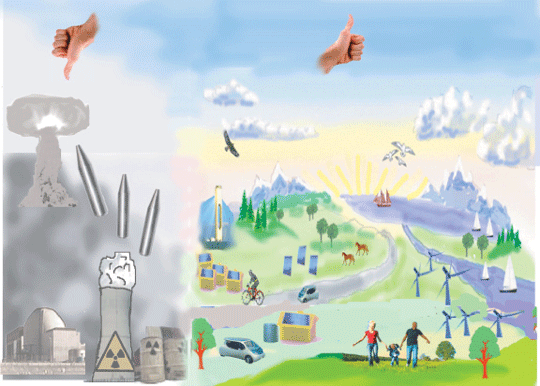 Renewables: The end for nuclear power? http://www.cnbc.com/id/101710759 Anmar Frangoul | Special to CNBC.com Friday, 30 May 2014 It took the Fukushima disaster to put the future of nuclear power in doubt – but could renewable energy mean the end for nuclear power?
In March 2011, disaster struck Japan. An immensely powerful earthquake and tsunami resulted in a catastrophic meltdown at the Fukushima Daiichi nuclear power plant. In the aftermath of the disaster, using atomic power to generate electricity came under intense scrutiny – resulting in both Japan and Germany deciding to phase out nuclear power.
With anti-nuclear sentiment strong in both countries, utility companies are coming under intense pressure, with profits being squeezed and their centralized business model facing an increasing challenge from renewables
It’s a complete destruction of the business model,” Dieter Heuskel, a Dusseldorf based senior partner at the Boston Consulting Group, told CNBC’s Energy Future. “They no longer run with the utilisation that they were planned to run, so there’s a huge destruction of not only revenue but also of profit pools, and they have to reinvent themselves completely,” he added.
Experts warn that the move to a focus on renewables could soon leave nuclear power redundant. “If you accelerate this revolution to a kind of power economy that is very different from what they [nuclear power utility companies] represent, well, you pull the rug even more out from under their feet,” Andrew DeWit, from Rikkyo University, told Energy Future. n April of this year, however, the Japanese government announced a reversal of its decision to phase out nuclear power, despite fierce public opposition.
This places Japan in stark contrast to Germany, where the government is pushing ahead with plans to have 35 percent of its electricity sourced from renewables by 2020, and 50 percent of its electricity from renewables by 2030.
This ambition has fostered an environment where innovation in clean energy is encouraged, giving German businesses specializing in renewables a competitive advantage.
The German government’s energy policies have also forced big utility companies to change the way they operate.
“We are focusing our business towards the more de-central and more renewable aspects,” Peter Terium, CEO of RWE AG, told Energy Future. “We can develop things like smart homes, smart grids – that’s needed in any kind of transition of society,” he added. s Japan, then, in danger of missing the boat when it comes to innovation in renewables? “Hitachi, Toshiba, Panasonic etcetera, they’re very deeply involved in smart city projects around the world,” DeWit said. “You’ve got all kinds of good things happening, and, if you do that very well, to a globally competitive extent, well then you’ve got an export industry.”
Support, however, for this sector is still needed, DeWit added. “Without a very visible effort co-ordinated by the central government, and particularly through the cabinet, investors face too much investor risk.”
1 This Month
Chernobyl: The Lost Tapes – A good documentary on Chernobyl on SBS available On Demand for the next 3 weeks– https://www.sbs.com.au/ondemand/tv-program/chernobyl-the-lost-tapes/2352741955560

of the week–London Campaign for Nuclear Disarmament

Tell the Ukrainian Government to Drop Prosecution of Peace Activist Yurii Sheliazhenko
To see nuclear-related stories in greater depth and intensity – go to https://nuclearinformation.wordpress.com
-
Archives
- April 2026 (152)
- March 2026 (251)
- February 2026 (268)
- January 2026 (308)
- December 2025 (358)
- November 2025 (359)
- October 2025 (376)
- September 2025 (257)
- August 2025 (319)
- July 2025 (230)
- June 2025 (348)
- May 2025 (261)
-
Categories
- 1
- 1 NUCLEAR ISSUES
- business and costs
- climate change
- culture and arts
- ENERGY
- environment
- health
- history
- indigenous issues
- Legal
- marketing of nuclear
- media
- opposition to nuclear
- PERSONAL STORIES
- politics
- politics international
- Religion and ethics
- safety
- secrets,lies and civil liberties
- spinbuster
- technology
- Uranium
- wastes
- weapons and war
- Women
- 2 WORLD
- ACTION
- AFRICA
- Atrocities
- AUSTRALIA
- Christina's notes
- Christina's themes
- culture and arts
- Events
- Fuk 2022
- Fuk 2023
- Fukushima 2017
- Fukushima 2018
- fukushima 2019
- Fukushima 2020
- Fukushima 2021
- general
- global warming
- Humour (God we need it)
- Nuclear
- RARE EARTHS
- Reference
- resources – print
- Resources -audiovicual
- Weekly Newsletter
- World
- World Nuclear
- YouTube
-
RSS
Entries RSS
Comments RSS
 nuclear-news