Fukushima’s spookily empty towns
Three years later, Fukushima radiation leaves towns eerily empty CBS News, Aug 29, 2014 EDTFUTABA, Japan – Every time Shuichi Saito goes home, he has to suit up to protect himself from radiation.
“We’re allowed in 15 times a year,” Saito told CBS News, on a trip back to his home near where a typhoon caused the Fukishima nuclear plant to leak dangerous amounts of radiation three years ago. “But, as my home and grounds deteriorate, as the weeds take over, it’s depressing.”
Aug 29, 2014 10:20 PM EDT
FUTABA, Japan – Every time Shuichi Saito goes home, he has to suit up to protect himself from radiation.
“We’re allowed in 15 times a year,” Saito told CBS News, on a trip back to his home near where a typhoon caused the Fukishima nuclear plant to leak dangerous amounts of radiation three years ago. “But, as my home and grounds deteriorate, as the weeds take over, it’s depressing.”
Japan still doesn’t have enough room to store the millions of tons of radioactive soil that has been scraped up. Today, bags of the toxic waste are stacked along roadways………http://www.cbsnews.com/news/three-years-later-fukushima-radiation-leaves-towns-eerily-empty/
Nuclear deal is not certain, between India and Japan

 Prime Minister Narendra Modi’s Japan visit may not seal civil nuclear deal Economic Times, Dipanjan Roy Chaudhury, ET Bureau Aug 30, 2014, NEW DELHI: The India-Japan civilian nuclear deal may not be sealed during Prime Minister Narendra Modi’s trip toJapan that begins on Saturday although discussions are on to bridge the core differences between the two sides over the proposed treaty, officials familiar with the matter told ET.
Negotiations are on over Japan’s insistence on tougher safeguards and “no nuclear test” clause in the bilateral agreement, said officials, who did not wish to be identified. Modi will give a personal assurance to his counterpart Shinzo Abe to assuage Japanese concerns, particularly over nuclear tests, and pave the way for a breakthrough in the near future, an official said. It was earlier hoped that the deal, negotiations for which were launched by the previous UPA government, would be clinched during Modi’s trip. However, it is not yet clear whether the logjam will be broken during this trip……..http://articles.economictimes.indiatimes.com/2014-08-30/news/53387773_1_india-and-japan-india-japan-japan-visit
India’s nuclear power programme – is it safe?
Doubts over India’€™s ability to handle nuclear power expansion, SMH, August 31, 2014 Jason Koutsoukis South Asia correspondent at The Age and The Sydney Morning Herald New Delhi: With an agreement to allow the sale of Australian uranium to India expected this week, Indian scientists are questioning India’s ability to manage a rapid expansion of its nuclear power industry.
“Nuclear security and safety is a pressing concern in this country,” said Happymon Jacob, who teaches arms control and disarmament at New Delhi’s Jawaharlal Nehru University.
“India insists that enough security is in place, but my argument is that we need to look deeper, and when you look deeper you see that the regulation of nuclear materials is in the hands of government – and not in the hands of a totally independent regulator,” Dr Jacob said.
With India’s nuclear capabilities hidden beneath layers of secrecy since its first successful nuclear tests in 1974 and a subsequent round of tests in 1998, Dr Jacob said, there have been several attempts to establish an independent regulator of the nuclear power industry……….
if we are going to learn the lessons of the nuclear accident in Fukushima, then we have to ensure there is a means for independent verification of what is occurring and of what could go wrong,” Dr Jacob said.
Prime Minister Tony Abbott will arrive in Mumbai on Thursday for his first bilateral meeting with India’s new Prime Minister Narendra Modi.
The meeting will take place the day after Mr Modi’s return from Japan where he is expected to a sign a massive $90 billion nuclear trade pact to allow Japanese nuclear power companies to build plants in India………http://www.smh.com.au/world/doubts-over-india128153s-ability-to-handle-nuclear-power-expansion-20140830-10aggo.html
Fukushima radiation is one part of process that is killing off ocean life
please keep an eye out for the upcoming book on Fukushima entitled: Fukushima: Dispossession or Denuclearization (2014). It should be published within the next month or so and is an anthology of articles by a wide variety of independent-minded journalists and scholars of unique talent written in order bring into sharper focus the implications of the Fukushima nuclear disaster. Some of the proceeds from the book will be donated to help children refugees who are still suffering in temporary housing situations in the Fukushima area.
How Badly Is Fukushima Radiation Damaging the Pacific Ocean? Richard Wilcox, PhD, 1 Sept 14
Although its heart is rich in pearls and ores
The Sea complains upon a thousand shores
– Alexander Smith (1)
I watched some wonderful movies over the summer with “ocean” themes and one was with Robert Redford calledAll is Lost. The entertainment value was good but it also made a statement about Man’s interference with Nature and how nature can strike back. I love films like All is Lost, Master and Commander, in which the imperial navy visits the Galapagos Islands and “Kon Tiki,” a story about a 4,000 mile trek across the ocean, because they show the unspeakable beauty and power of the world’s great oceans. Can humans actually destroy them?
Over the past year we’ve read many news stories about mass die-offs of marine species in the Pacific Ocean and other regions. One hypothesis in the alternative media is that the massive radiation released from the Fukushima nuclear disaster is the cause. Others blame over-fishing, pollution or climatic events.
My opinion is that if the die-offs are unusual and “man made” then it is a combination of factors, but Fukushima is probably one of them. The Earth is under many human threats — we are an industrious species — Fukushima is doing the ocean only harm, and following that logic, at a minimum the health of local species and perhaps wider ecosystems are being affected in a reverse synergy whereby organisms have surpassed the limits they can endure. …….
Protest building in Wales, against NATO militarism
‘No to NATO’: Hundreds march against militarism, nuclear weapons at Wales summit Rt.com August 30, 2014 Some 400 people have joined a protest camp in Newport to protest against NATO. The march comes ahead of next week’s military summit that will see 60 world leaders descend on the area and is already causing considerable disruption to locals.
“Nuclear NATO – no, thanks!” or “Iraq, Ukraine – no more wars” read the numerous placards as about 400 protesters took in a march on Saturday against the upcoming NATO summit. The Campaign for Nuclear Disarmament said that they expect Saturday’s march to be a “major demonstration” and local officials have said a number of roads will be affected by the march, which began at 2 pm local time.
The campaigners are organizing a week of marches and meetings against NATO as well as a “peace camp” and a Counter Summit to take place on the campsite on Sunday. The NATO summit is to run at the Celtic Manor resort on the outskirts of Newport on the 4th and 5th September. There will be representatives from a number of groups at the protests including “No to NATO,” the Campaign for Nuclear Disarmament (CND), the Stop the War Coalition and South West against Nuclear (SWAN).
More than 20,000 protesters from around the world are expected to attend the demonstrations in what is being billed as Wales’ biggest protest in a generation.
At least 20,000 protesters, who are gathering in Newport, objecting to everything NATO stands for have accumulated by Saturday, Harry Fear, RT’s correspondent at the scene, said.
Protesters here “associate NATO in their words with imperialism, warring, global in equality and austerity.”
He also said there is a huge policing “operation going on in South Wales to secure the NATO meetings and to facilitate these very significant demonstrations.”……..http://rt.com/uk/183940-nato-summit-protest-march/
Unwise for Japan to restart its nuclear reactors
Should Japan Restart Its Nuclear Reactors? TruthOut , 29 August 2014 10:51By Arnie Gundersen, The Mark News | Op-Ed Only luck and real courage at 14 nuclear reactors on Japan’s Pacific coast overcame the technical failures of nuclear power and prevented the nation from being destroyed by radiation.
The untold story of March 11, 2011 is how close Japan came to three more spent fuel pool fires at Fukushima Daiichi and four meltdowns at Fukushima Daini.
When the magnitude 9.0 earthquake off the Pacific coast caused a seismic shock wave that reverberated throughout northern Japan, the country’s nuclear plants shut down automatically, as planned, preventing any further nuclear chain reactions.
Therein lies nuclear power’s fatal flaw, because an automatic shutdown does not stop the ongoing heat generated inside each nuclear reactor……..http://www.truth-out.org/opinion/item/25882-should-japan-restart-its-nuclear-reactors
Japan’s “anti hate speech” rule could be used to target anti-nuclear protesters
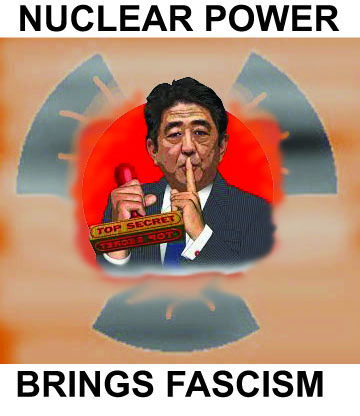 Anti-nuclear protesters fear that restrictions on hate speech will also target them August 31, 2014 THE ASAHI SHIMBUN As anti-nuclear demonstrators rallied in front of the Diet building on Aug. 30, many were troubled by the ruling Liberal Democratic Party’s discussions on restricting hate speech, fearing that a clampdown could also be used to silence their dissent.
“We do not interrupt traffic. We do not break through the cordon of police, either. Our demonstrations are different from just generating noise or making hate speeches. The government should hear the voices of the public,” said Tsuyoshi Mizuno, 67, a taxi driver from Matsudo, Chiba Prefecture.
Mizuno has participated in the weekly anti-nuclear demonstrations around the Diet building and the nearby prime minister’s office since the March 2011 accident at the Fukushima No. 1 nuclear power plant.
The protesters’ concerns apparently stemmed from the discussions held by a project team of the LDP on Aug. 28, which met for the first time.
The team was set up in response to a request from Prime Minister Shinzo Abe to consider possible measures to restrict hate speech, prompted byrecent demonstrations in Tokyo and Osaka and across the country where racial invectives were made against ethnic Koreans living in Japan……….http://ajw.asahi.com/article/behind_news/social_affairs/AJ201408310014
The Nuclear Regulatory Commission (NRC)’s “final rule” for waste storage – not a solution
NRC Final Rule: Nothing More Than a Patch for a Broken System, The Daily Signal, Jack Spencer / Katie Tubb / August 29, 2014 The Nuclear Regulatory Commission (NRC) voted to finalize its “continued storage” rule, establishing a general recognition that onsite storage of spent nuclear fuel is safe for the short, long, and indefinite terms.
In the short term, the NRC’s decision recognizes that spent fuel at reactors can be safely stored on site until a geologic repository is available. This allows the nuclear industry to move forward with licensing activities, which had been postponed due to a 2012 court decision requiring the NRC to perform a more thorough environmental assessment of nuclear waste storage beyond the licensed lifespan of the reactors. Thirteen existing power plants and two fuel storage facilities will now be able to renew licenses to operate, and another 15 new reactors can move forward to obtain final licensing approvals.
But in the long term, the NRC’s decision is little more than a temporary patch for a broken system and removes any incentive to fix the real problem. The nation ultimately needs a viable nuclear waste management system, and any solution begins with geologic storage.
Over 35 years ago, the courts required the NRC to provide “reasonable assurances”—or a Waste Confidence Determination—that offsite storage would be available for reactors when their licenses expired or that nuclear waste could be safely stored on site until that point. Not long after, Congress charged the Department of Energy with the responsibility to manage nuclear waste from commercial nuclear power plants. And that is where the problem started.
The resulting government monopoly over nuclear waste management has turned scientific and commercial questions about nuclear waste disposal into a political circus. …….
Labor dispute shuts Cameco’s uranium mine in Saskatchewan
Cameco to shut world’s largest uranium mine in labor dispute Wed Aug 27, 2014 By Rod Nickel (Reuters) – Canadian uranium miner Cameco Corp will shut the world’s biggest uranium mine at McArthur River, Saskatchewan on Saturday, barring a last-minute labor settlement, after the United Steelworkers union said workers would go on strike……
Cameco shares fell 2.8 percent in Toronto and 2.2 percent in New York in morning trading.
Uranium spot prices are near a nine-year low, as Japan, previously a major producer of nuclear-fueled electricity, has been slow to approve reactor re-starts after an earthquake and tsunami destroyed the Fukushima Daiichi nuclear power station in 2011……http://www.reuters.com/article/2014/08/27/cameco-strike-idUSL1N0QX0VF20140827
“Reliable” nuclear power? – sabotage, defects, aging all afflicting the industry
 Nuclear power: reliably unreliablehttp://www.greenpeace.org/international/en/news/Blogs/nuclear-reaction/nuclear-power-reliably-unreliable/blog/50384/
With wind power filling the energy gap left by shutdown nuclear reactors in the UK, and police investigating allegations of sabotage at a reactor in Belgium, the myth of “reliable” nuclear energy is being exposed like never before. The nuclear industry tells us that nuclear power is a reliable energy source, that it offers “energy security“. Tell that to Belgium and the UK who are seeing significant parts of their nuclear fleet shutdown.
It’s been confirmed that the major damage that shut down Belgium’s Doel 4 reactor was caused by sabotage. Meanwhile, cracks found in two other reactors – Tihange 2 and Doel 3 – means they may never reopen. The three reactors make up over half of the country’s nuclear power output.
(Worryingly, there are 22 other reactors around the world that share the same design as Tihange 2 and Doel 3.)
In the UK, four nuclear reactors – at Heysham and Hartlepool – are out of action while defects are investigated.
There have previously been issues with nuclear power plants being closed in EU and USA at times of drought because of water shortages.
What fills the energy gap while these “reliable” nuclear reactors are shut down?
Belgium is having to rely on electricity from its neighbours. So much for nuclear power giving the country energy security.
In the UK, things are much more optimistic. Renewable energy has come to the rescue. “Demand is low at this time of year, and a lot of wind power is being generated right now,” said the UK’s National Grid. Electricity supplies have been unaffected.
What lessons can we learn here?
Firstly, the idea that nuclear power is a reliable energy source that offers energy security is a myth, particularly in a world where aging nuclear reactors are coming to the end of their lives. Secondly, we see a reversal of the view that renewables need to be supported by nuclear power. Although nuclear and wind power do not have the same generation characteristics, nuclear reactors now needing to lean on renewables means the nuclear industry has a big problem.
More and more nuclear reactors will be closing in the coming years as they reach retirement age. The nuclear industry simply can’t build replacement reactors quickly or cheaply enough to fill the gap.
That’s a gap that renewables and energy efficiency can exploit safely and reliably. As the recently released 2014 World Nuclear Industry Status Report says…
[B]ig thermal plants running whenever they’re available are replaced by cheaper-to-run portfolios of renewables, mostly variable renewables, that add up to “virtual baseload” supply—collectively providing reliable electricity from a shifting mix of resources. This way of operating the grid is analogous to a symphony orchestra (as Rocky Mountain Institute’s Clay Stranger puts it): no instrument plays all the time, but with a good score and conductor, beautiful music is continuously produced. This approach is unfamiliar to traditional utilities, but it works.
The wind across the UK is playing some beautiful music right now.
Here we have yet more reasons to abandon nuclear power. It’s not reliable and does not guarantee energy security. It’s not your friend and is going to let you down sooner or later.
The Decline, but not quite yet Fall, of the global nuclear industry
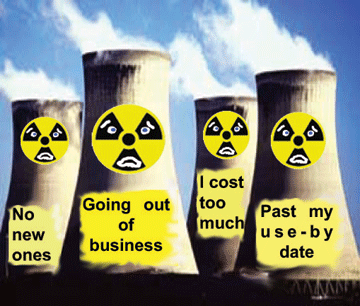 The nuclear industry today: declining, but not (yet) dying, Ecologist Jonathon Porritt 25th August 2014 The World Nuclear Industry Status Report provides an account of an industry in decline, writes Jonathon Porritt – with rising operating costs and an ever-shrinking share of world energy production, while the sector loses the race for investment and new generating capacity to fast growing renewable energy technologies.
Every year, theWorld Nuclear Industry Status Report reminds me why those in the Green movement who think nuclear has a major role to play in securing a low-carbon world are completely, dangerously off their collective trollies.
The Status Report is not an anti-nuclear polemic. Over the years, its authors (Mycle Schneider and Antony Froggatt) have assiduously built its reputation for dispassionate reporting on the state of the industry, presented as objectively and non-judgmentally as possible.
It uses a wide range of sources (academic, industry, avowedly pro-nuclear and avowedly anti-nuclear) to maintain longitudinal datasets going back over decades to tell it as it is – in contrast to all the froth of partisan propaganda. On both sides.
Let me just give you a taste from the newly-published 2014 Report:
Overview
“The nuclear share of the world’s power generation declined steadily from an historic peak of 17.6% in 1996 to 10.8% in 2013. Nuclear power’s share of global commercial primary energy production declined from the 2012 low of 4.5%, a level last seen in 1984, to a new low of 4.4%.”
“Twenty-eight years after the Chernobyl disaster, none of the next generation reactors (or so-called Generation III or III+) has entered service, with construction projects in Finland and France many years behind schedule.”
Construction…..delays
Certification delays…..
Operating cost increases….
Installed capacity – nuclear declining, wind increasing…
Nuclear’s installed capacity at the level of decades ago…..
As I worked my way through all this, page by page, it’s all but impossible for me to understand how any thoughtful, intelligent environmentalist could possibly suppose either that
- a so-called nuclear renaissance is ever going to happen; or
- even in the improbable circumstances that it did, how it could possibly deliver the kind of safe, secure, low-carbon energy the world needs so desperately.
And the longer they hang on to these fantasies, the more damage they do, sowing confusion and doubt, distracting attention from the business of driving forward with the renewables-efficiency-storage alternative.
All I can think is that these people never actually read up on the state of play in the nuclear industry. They should try it: it’s illuminating. http://www.theecologist.org/blogs_and_comments/commentators/2529402/the_nuclear_industry_today_declining_but_not_yet_dying.html
Scottish independence could mean the end for Britain’s Trident nuclear missile programme
 Britain’s Trident nuclear program at stake in Scottish independence vote WP, By Griff Witte August 24 HELENSBURGH, Scotland — For decades, Britain’s contribution to the threat of global Armageddon has found a home on the tranquil shores of Gare Loch, where soaring green mountains plunge into murky gray waters plied by sporty kayakers, weekend yachtsmen — and nuclear-armed submarines.
The subs slip past this garrison town as quietly as sea monsters. Their dark hulls breach the water’s surface on their way from base out to the deepest oceans, where British naval crews spend months poised to unleash the doomsday payload…….
Leaders of Scotland’s secessionist movement say their independent nation will be a nuclear-free zone within four years of breaking off from Great Britain. The vow is a popular one among the movement’s left-leaning voters, and the campaign has distributed fliers with instructions for “how to disarm a nuclear bomb” that begin and end with voting for independence……
with a substantial share of voters undecided, U.K. officials remain nervous that Scotland could bolt — and that the nuclear program could be a casualty. The possibility provides an uncomfortable backdrop for the NATO summit that Britain will host in Wales on Sept. 4 and 5.
With Britain’s entire arsenal of 160 deployed Trident missiles now based in Scotland, a “yes” vote would leave the remnants of the United Kingdom to find a new home for both the weapons and the four Vanguard-class submarines that can be used to launch them.
But no such home exists. Building suitable bases to house the missiles and dock the subs in England would take at least a decade, experts say, and cost billions of dollars that the government doesn’t have. O’Brien said it’s likely that Britain would decide to scrap its nuclear program rather than make painful cuts elsewhere……
for a town in which seemingly everyone has a link to the base, there’s a surprisingly large well of support for independence. The “yes” camp has festooned a headquarters in the heart of Helensburgh with its blue-and-white banners, and its volunteers are active in the streets.
For them, the end of Trident could be a new beginning for the town. Helensburgh, they say, has grown steadily apart from Faslane as the base has expanded to include vast residential compounds, soccer fields, meal halls and a shopping center — all wrapped in the multiple cordons of barbed wire and security cameras that one would expect of a nuclear weapons facility.
“The base may be in the community, but it’s not part of the community,” said Graeme McCormick, a white-maned “yes” activist and businessman…….http://www.washingtonpost.com/world/europe/britains-trident-nuclear-program-at-stake-in-scottish-independence-vote/2014/08/24/7a987b40-b41b-4edb-9ae8-064533b143b0_story.html
Michigan Senator prevented from speaking at hearing on Lake Huron nuclear waste dump plans
 Joint Review Panel on nuclear waste dump refuses to hear Pavlov’s testimony http://www.voicenews.com/articles/2014/08/14/news/doc53ed1501d6bf8967664942.txt?viewmode=3 By Jim Bloch Voice Reporter Jim Bloch is a freelance writer. Contact him at bloch.jim@gmail.com
Pavlov, who represents District 25, which includes St. Clair and Lapeer counties, has been spearheading a movement to derail the plans of Ontario Power Generation to construct a deep underground repository for low and medium nuclear waste near Kincardine, Ontario, within a mile of the Lake Huron.
Many of the wastes to be buried in the dump will remain radioactive for more than 100,000 years, 10 times longer than the lakes have been in existence. To date, every deep underground waste facility in the world has leaked radioactivity into the environment, including the Waste Isolation Pilot Project near Carlsbad, N.M., on Feb. 14, in which 22 workers were poisoned, said Fernandez when she spoke at Pavlov’s July 29 town hall in Port Huron on the dump. OPG cited the operation of WIPP as a sterling example of safe underground storage of nuclear waste.
Pavlov and Sen. Mike Green will host another town hall discussion on the proposed dump at 7 p.m. Aug. 26 in the Port Sanilac Waterside Gazebo, which is located at 7299 Cedar St. in Port Sanilac, in Green’s 31st District.
The Joint Review Panel took testimony on OPG’s environmental assessment for 22 days last fall. The panel meets again for an additional two weeks of testimony beginning Sept. 9 in Kincardine. Within three months of the close of the hearings, the panel will issue a report about the proposed waste dump to the Canadian federal cabinet, which is expected to make a decision about the dump in 2015.
Residents may sign either or both of two online petitions against the dump: ProtectLakeHuron.comand StopTheGreatLakesNuclearDump.com………
Story of one of the 21,000 soldiers exposed to Pacific atomic test radiation
‘The MoD’s nuclear test blinded me’ http://www.express.co.uk/news/uk/502624/EXCLUSIVE-Brian-Jones-BLINDED WHEN the bomb dropped Brian Jones was staring right at it, unaware of the danger nuclear weapons could pose to him and his family. By: Jaymi McCann, August 24, 2014 The 19-year-old sapper witnessed nine nuclear bomb tests while serving with the Royal Engineers on Christmas Island between 1957 and 1958. Continue reading
Nuclear weapons do not make us more secure: quite the opposite
Nuclear weapons do not make us saferhttp://www.washingtonpost.com/opinions/nuclear-weapons-do-not-make-us-safer/2014/08/22/185b4644-28ad-11e4-8b10-7db129976abb_story.html David Krieger, Santa Barbara, Calif.Are NATO-based nuclear weapons really an advantage in a dangerous world, as Brent Scowcroft, Stephen J. Hadley and Franklin Miller suggested in their Aug. 18 op-ed, “A dangerous proposition”? They are not. They make the world a far more dangerous place.
Nuclear deterrence is not a guarantee of security. Rather, it is a hypothesis about human behavior, a hypothesis that has come close to failing on many occasions. Additionally, nuclear weapons are not “political weapons,” as the writers asserted. They are weapons of mass extermination.
The United States and the other nuclear-armed countries are obligated under the terms of the Nuclear Non-Proliferation Treaty and/or customary international law to pursue negotiations in good faith for an end to the nuclear arms race and complete nuclear disarmament. This is the substance of the Nuclear Zero lawsuits brought by the Marshall Islands against the nine nuclear-armed countries at the International Court of Justice and in U.S. federal court. The United States continues to evade its obligations. Rather than continuing to posture with its nuclear weapons in Europe, the United States should be leading the way in convening negotiations to eliminate all nuclear weapons for its own security and that of all the world’s inhabitants. The writer is president of the Nuclear Age Peace Foundation.
1 This Month
Chernobyl: The Lost Tapes – A good documentary on Chernobyl on SBS available On Demand for the next 3 weeks– https://www.sbs.com.au/ondemand/tv-program/chernobyl-the-lost-tapes/2352741955560

of the week–London Campaign for Nuclear Disarmament

Tell the Ukrainian Government to Drop Prosecution of Peace Activist Yurii Sheliazhenko
To see nuclear-related stories in greater depth and intensity – go to https://nuclearinformation.wordpress.com
-
Archives
- April 2026 (152)
- March 2026 (251)
- February 2026 (268)
- January 2026 (308)
- December 2025 (358)
- November 2025 (359)
- October 2025 (376)
- September 2025 (257)
- August 2025 (319)
- July 2025 (230)
- June 2025 (348)
- May 2025 (261)
-
Categories
- 1
- 1 NUCLEAR ISSUES
- business and costs
- climate change
- culture and arts
- ENERGY
- environment
- health
- history
- indigenous issues
- Legal
- marketing of nuclear
- media
- opposition to nuclear
- PERSONAL STORIES
- politics
- politics international
- Religion and ethics
- safety
- secrets,lies and civil liberties
- spinbuster
- technology
- Uranium
- wastes
- weapons and war
- Women
- 2 WORLD
- ACTION
- AFRICA
- Atrocities
- AUSTRALIA
- Christina's notes
- Christina's themes
- culture and arts
- Events
- Fuk 2022
- Fuk 2023
- Fukushima 2017
- Fukushima 2018
- fukushima 2019
- Fukushima 2020
- Fukushima 2021
- general
- global warming
- Humour (God we need it)
- Nuclear
- RARE EARTHS
- Reference
- resources – print
- Resources -audiovicual
- Weekly Newsletter
- World
- World Nuclear
- YouTube
-
RSS
Entries RSS
Comments RSS
 nuclear-news