Tokyo doctor speaks out, warning parents about Fukushima radiation
A Tokyo doctor who has moved to western Japan urges fellow doctors to promote radiation protection: A message from Dr. Mita to his colleagues in Kodaira, Tokyo World Network for Saving Children From Radiation July 2014 Doctor MITA Shigeru, who recently moved to Okayama-city, Okayama prefecture, to open a new clinic there, wrote a short essay in the newsletter published by Association of Doctors in Kodaira, metropolitan Tokyo.
Although the target readers for this essay were not the general public, it has been cited in a weekly e-mail magazine published by journalist KINOSHITA Kouta, who has been organizing actions to urge people to leave radiation affected areas (including Tokyo) since 3.11, 2011.
On many occasions, public talks and gatherings, both Dr. Mita and Mr. Kinoshita have acknowledged the danger of radiation and they have called out for immediate action for radiation protection.
In November 2013, WNSCR translated an essay that Dr. Mita wrote for parents concerned about radiation: (Please read the article here). Despite the interests of many parents in Japan, there are very few doctors who show serious concern on the issues of radiation, and commenting on the issue publicly is even rarer.
It is the opinion of WNSCR that Dr. Mita’s views have significant meaning for the general public, especially for those who are interested in the health impact of radiation on the general population. We have permission to translate a new essay of Dr. Mita, through Mr. Kinoshita
Why did I leave Tokyo?
Shigeru Mita ( Mita clinic)
To my fellow doctors,…………http://www.save-children-from-radiation.org/2014/07/16/a-tokyo-doctor-who-has-moved-to-western-japan-urges-fellow-doctors-to-promote-radiation-protection-a-message-from-dr-mita-to-his-colleagues-in-kodaira-city-t/
100% off-grid renewable energy for German village of Feldheim
The hamlet near Berlin is Germany’s first to have left the national grid and switched to 100 per cent local, alternative energy, swearing off fossil fuels and nuclear power decades before the rest of the country plans to near the same goal.
Electricity now comes from a wind park towering over its gently rolling fields and reaches homes through Feldheim’s own mini smart grid.
More than 99 per cent of the wind power is sold into the national system, along with electricity from a solar park on a former Soviet military base.
As winter nears, people here will heat their homes from a biogas plant powered by local pig and cattle manure and shredded corn, while on the coldest days a woodchip plant will also burn forestry waste.
The villagers took bank loans and state subsidies to build the system, in partnership with green power company Energiequelle, but say it is paying off as electricity and heating bills have been slashed.
Feldheim no longer pays for 160,000 litres of heating oil a year, said Werner Frohwitter of the local energy co-operative.
“This money is no longer going to Arab sheiks or (Russian President) Vladimir Putin,” he said at the village 80km southwest of Berlin. “This money is now staying right here.”………
Both USA and Russia keen to promote nuclear industry, rather than public safety

 Why Are The US & Russia Blocking European Nuclear Safety Upgrades?, Simply Info October 24th, 2014 “……The core reasoning for the US and Russia to try to prevent new standards appears to be money. Better safety standards would be extremely costly for their older reactors to comply with. Currently the US has avoided mandating any substantial safety upgrades post Fukushima and has let the industry dictate changes (or the lack of) to the NRC.”…..http://www.fukuleaks.org/web/?p=13969
US Energy Information Administration’s (EIA) latest report contradicts myths about renewable energy
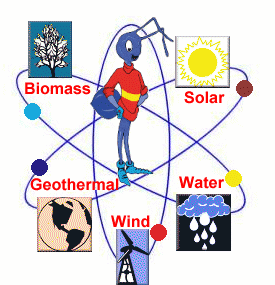 Examining the latest data from EIA and Fraunehofer ISE. The biggest news to come out of the US Energy Information Administration’s (EIA) report for August is that utility solar’s production of electricity is up 93.6% over last year. This is the principal reason that the renewable contribution is up 9.6%, and only half of the story. The EIA does not record production from rooftop solar (which means solar’s overall contribution is significantly higher) and production figures are down in every fossil fuel sector. This trend is also seen in the latest figures from Germany, where solar production is up 7.7%, wind 8%, and biomass 11% over last year. The latest data contradicts myths about renewable energy……….http://cleantechnica.com/2014/10/26/myths-about-renewable-energy/
Japanese prosecutors delay decision on charging 3 former TEPCO executives, about Fukushima nuclear disaster
3/11 charges for Tepco execs delayed by three months, Japan Times, REUTERS, KYODO OCT 25, 2014

Residents protest as nuclear dump site prepared in Miyagi

 Work begins on nuclear dump sites in Miyagi as residents protest, Japan Times, KYODO OCT 25, 2014 SENDAI/SAPPORO – As nuclear workers on Friday geared up to take soil samples at two locations selected to store radioactive waste, ignoring residents standing by in protest, work at a third site was stalled by demonstrations……….http://www.japantimes.co.jp/news/2014/10/25/national/work-begins-on-nuclear-dump-sites-in-miyagi-as-residents-protest/#.VExlBCLF8nk
Planning for Nuclear Security Summit (NSS) in 2016
 Stopping a Nuclear Nightmare: How We Can Secure Loose Nuclear Materials “Since the collapse of communism, there have been 664 reported incidents involving the theft or loss of nuclear and other radioactive materials…”
The National Interest, Kenneth N. Luongo
October 24, 2014 “……..The United States will host the fourth and likely final Nuclear Security Summit (NSS) in 2016, and later this month, representatives from over fifty nations will start planning the agenda. They need to overcome the prevailing complacency about the strength of the current security system and its ability to prevent a nuclear nightmare. The current system suffers from three fundamental weaknesses. It mostly relies on voluntary obligations that nations can take or leave. There are no mandatory international standards that would allow for effective evaluation of security consistency and competency across borders. And, there is no requirement for peer review or even communication among countries about their security strategy and practices. The result is an opaque global patchwork, with the weakest links offering tempting targets for increasingly emboldened terrorists………
Allison M. Macfarlane gives up the battle of being head of Nuclear Regulatory Commission
 Chief of Nuclear Regulatory Commission Will Leave Job That She Fought to Keep NYT By MATTHEW L. WALDOCT. 21, 2014 The chairwoman of the Nuclear Regulatory Commission announced Tuesday that she would leave the commission and return to academia at the end of the year, a little more than a year after she survived a cliffhanger fight with a California senator to keep her job.
The chairwoman, Allison M. Macfarlane, a geologist with a strong background in nuclear waste issues, said she would become the director of the Center for International Science and Technology Policy at George Washington University………http://www.nytimes.com/2014/10/22/us/chief-of-nuclear-regulatory-commission-will-leave-job-that-she-fought-to-keep.html?_r=0
Fukushima: what life there is like, today
(PHOTOS) What life is really like in Japan following the Fukushima nuclear disaster news.com.au OCTOBER 20, 2014
“They literally evacuated that day and were told they had to get out of town completely and since then they haven’t been able to go back,” she said.
“The kids themselves haven’t been back, adults have gone back on a daily pass to clear their house. Anyone that’s under 15 isn’t able to go on. So it’s pretty tough on them.”…….. 160,000 people have been forced from their homes after Japan’s environment ministry labelled 11 municipalities “no-go zones”. They’ve been forced to live in temporary housing while authorities painstakingly decontaminate the area in order for them to return home…….
Fukushima Update’s editor James Corbett, who lives 600 kilometres from the plant and started his website in an attempt to provide information on the disaster, said the situation is still a “huge problem” with no resolution in sight.
“The cores are still there and highly radioactive. The technology to approach the cores does not exist yet,” he told news.com.au.
“Just last week they had a typhoon and in the wake of that they found 10 times the radioactivity in the groundwater than in the week before.”
Since the disaster, Mr Corbett said clean-up operations have focused on containing groundwater that has become contaminated with radioactive material. But as more flows into the area each day from Japan’s mountains, it’s an ongoing problem that doesn’t come close to solving the real issue.
“There really isn’t the technology to even begin approaching the core of these reactors yet,’’ he said. “[They’re] the fundamental cause of the problem. That is going to go on for potentially years, potentially decades. At this stage it’s more damage control and trying to take care of things like the radioactive water.”………
There’s even a term — Genpatsu rikon — or “atomic divorce” coined to describe marriages ripped apart by the strain. Meanwhile there are plenty of tales of peoplebeing discriminated against by being banned from donating blood and asked to provide medical certificates on job applications, while farmers have had their livelihood threatened by stigma over produce.
“It’s taken a huge toll on residents of Fukushima and will probably continue for a long time to come,” Mr Corbett said.
“For generations survivors of Hiroshima and Nagasaki had a stigma attached to them. They were often treated differently if it was known they were from that area. I know even in my area of Japan … when I was working in school system there were students that had been evacuated. [It would be] interesting to see if they were treated differently.”
Despite this, effects of the disaster are often not openly discussed, as “expressing strong opinions, especially ones not seen as conducive to general harmony, is not seen as acceptable in public” in Japan, Mr Corbett said.
There is also a view that authorities are “basically trying to keep it out of the headlines” in the lead up to the Tokyo Olympics.
“Their number one project is trying to keep the situation under control in order to successfully conduct the Tokyo Olympics 2020,” he said……….http://www.news.com.au/technology/environment/what-life-is-really-like-in-japan-following-the-fukushima-nuclear-disaster/story-e6frflp0-1227096107865
Niigata governor says answers on Fukushima disaster needed before any nuclear restart in Japan
More answers about Fukushima disaster needed before reactor restarts, Niigata governor says, Japan Times, AP OCT 16, 2014 Niigata Gov. Hirohiko Izumida said Japan should not restart any nuclear plants until the cause of the Fukushima meltdowns is fully understood and nearby communities have emergency plans that can effectively respond to another major disaster.
Izumida, whose prefecture is home to Tokyo Electric Power Co.’s seven-reactor Kashiwazaki-Kariwa plant, said on Wednesday that regulators look at equipment but don’t evaluate local evacuation plans……….http://www.japantimes.co.jp/news/2014/10/16/national/niigata-governor-says-soon-reactor-restarts/#.VEMPZmddUnl
Al Gore praises companies for their renewable energy plans
 Al Gore lauds Salesforce.com, Google, Apple for renewable energy plans http://www.zdnet.com/al-gore-lauds-salesforce-com-google-apple-for-renewable-energy-plans-7000034604/
Summary: The former vice-president president of the United States advised Dreamforce attendees about the necessities (and business opportunities) presented by the “age of renewables.” AN FRANCISCO—Former Vice President Al Gore has many choice words about the ramifications hammering the environment, stemming from corporate influences on politicians and governments worldwide.
But the climate change advocate had a few bits of praise reserved for a select group of big tech corporations — specifically for Google, Apple, and Salesforce.com — while speaking at the close of the latter’s annual expo on Thursday.
“Everyone knows the way we got out of the Great Depression was mobilizing for World War II,” said Gore. “Wouldn’t it be nice if we had a huge project where we needed to mobilize people around the world for jobs that couldn’t be automated?”
With his talk, Gore hinted we have that major project.
Over the course of an hour, Gore fired off harrowing statistics about many recent natural disasters from China to Guatemala to Colorado over the last few years, followed up by some sobering predictions concerning ongoing droughts and continuously plummeting winter temperatures.
“We’ve got to take responsibility for consequences of our actions endangering the earth,” Gore retorted.
Nevertheless, Gore remained optimistic, insisting that many of these predictions can be curbed with immediate response and action.
“We need to recognize the age of renewables is beginning,” insisted Gore. He emphasized the business opportunities by renewable energy development and technology, asserting that “the private sector is going to finance most of renewable energy.”
Along with championing the aforementioned trio of Silicon Valley titans for their respective energy efficiency goals, Gore highlighted American business magnate and billionaire Warren Buffett as a prime example of an entrepreneur investing heavily in the renewable energy space.
“He’s not someone known for making dumb decisions,” Gore quipped. The Internet, Gore continued, is going to play a huge role in this shift as well. Projecting that the Internet will be more powerful (and influential) than television, Gore cited advertising dollars online surpassed those on the small screen last year.
As a further incentive to the keynote audience filled with sales executives and software developers, Gore observed that “we are always surprised” when technology costs drop dramatically, referencing the development of processors and Moore’s Law as examples. He theorized the same can be done with wind and solar power tech.
Gore concluded, “I’m optimistic about this, but we need to speed it up.”
Nuclear energy deal between South Africa and France

Paris and Pretoria have signed an agreement which could open the way for French nuclear giant Areva to bid to build eight nuclear reactors in South Africa worth up to $US50 billion ($A54.10 billion). French Foreign Minister Laurent Fabius and South African Tina Joematt Pettersson signed an intergovernmental agreement on co-operation in nuclear energy development which is necessary for any commercial deal……..http://www.theaustralian.com.au/business/latest/france-safrica-sign-nuclear-energy-deal/story-e6frg90f-1227093196986
Dr Caldicott talks with Harvey Wasserman, about Fukushima, and meeting Ronald Reagan
 Dr. Caldicott Tells of Fukushima’s Lethal Toll and Meeting Ronald Reagan Harvey Wasserman | EcoWatch 17 Oct 14 She tells us about what’s happening to the renewable industry in Australia, and why Dr. James Hansen needs to reassess his views on atomic energy. “Nuclear Power Plants are cancer factories and bomb factories … because any country that has a nuclear reactor makes 500 pounds of plutonium a year and you need 10 pounds to make an atomic bomb … so the nuclear power industry in this country in its wisdom and in Japan, Canada and elsewhere is selling nuclear reactors as fast as it can … and they will have enough plutonium to make enough atomic bombs for the next half a million years … cause that’s how long the plutonium lasts …,” said Dr. Caldicott.
Then she shared one of modern American history’s most critical episodes. In the early 1980s, during the global campaign for a nuclear freeze, Helen met Patty Davis, the daughter of Ronald and Nancy Reagan. Davis figured that Dr. Caldicott might be one of the few people who might reach her father about the dangers of nuclear war.
So she brought Helen to the White House. Dr. Caldicott quickly sized up the President and determined to treat him “like a patient.” He was already showing early signs of the Alzheimer’s disease that would eventually claim him … and much of his second term in office.
For more than an hour Dr. Caldicott talked with the world’s most powerful about what atomic war might do to the human race. It was, she said, a uniquely long meeting with our oldest president.
And, apparently, it did have an impact. Hear all about it on my Solartopia Green Power & Wellness show: http://prn.fm/green-power-wellness-dr-helen-caldicott-101414/
Research on risks pf depleted uranium weapons lags behind the military enthusiasm to use them
 and research 14 October 2014 – ICBUW
Understanding the civilian and environmental risks from weapons before using them is a key part of the legal review process for new weapons – even if the bar is not set particularly high. However, when it comes to the toxic constituents of weapons, this process can take far longer to complete, as scientific research struggles to catch up with military enthusiasm.
So it has proved with DU, where research was left behind in the rush to develop and deploy the weapons. Often factors relating to how the weapons are used in conflict and what, if anything, is done to reduce harm after they are used are not taken into account. Even decades on, significant uncertainties may still remain, for example the extent to which civilians have been, and continue to be, exposed to DU…..http://www.bandepleteduranium.org/en/shoot-first-ask-questions-later
Media panic on Ebola threat – media silence of Fukushima radiation threat
 Fukushima Radiation vs Ebola Outbreak http://warr-blog.blogspot.com.au/ , BY WARR LORD OCTOBER 12, 2014 The contrast between news coming out on the Fukushima nuclear meltdown and the ebola outbreak could not be more stark. The mainstream media is completely saturated with news of the ebola virus outbreak. The Obama Administration’s refusal to restrict air travel from Africa is already becoming an election issue in America. This is as it should be, because ebola is a very scary disease. It isoverwhelming west-central Africa and kills about 70% of its victims in short order. Now Europe and America are experiencing their first cases of ebola.
1 This Month
Chernobyl: The Lost Tapes – A good documentary on Chernobyl on SBS available On Demand for the next 3 weeks– https://www.sbs.com.au/ondemand/tv-program/chernobyl-the-lost-tapes/2352741955560

of the week–London Campaign for Nuclear Disarmament

Tell the Ukrainian Government to Drop Prosecution of Peace Activist Yurii Sheliazhenko
To see nuclear-related stories in greater depth and intensity – go to https://nuclearinformation.wordpress.com
-
Archives
- April 2026 (139)
- March 2026 (251)
- February 2026 (268)
- January 2026 (308)
- December 2025 (358)
- November 2025 (359)
- October 2025 (376)
- September 2025 (257)
- August 2025 (319)
- July 2025 (230)
- June 2025 (348)
- May 2025 (261)
-
Categories
- 1
- 1 NUCLEAR ISSUES
- business and costs
- climate change
- culture and arts
- ENERGY
- environment
- health
- history
- indigenous issues
- Legal
- marketing of nuclear
- media
- opposition to nuclear
- PERSONAL STORIES
- politics
- politics international
- Religion and ethics
- safety
- secrets,lies and civil liberties
- spinbuster
- technology
- Uranium
- wastes
- weapons and war
- Women
- 2 WORLD
- ACTION
- AFRICA
- Atrocities
- AUSTRALIA
- Christina's notes
- Christina's themes
- culture and arts
- Events
- Fuk 2022
- Fuk 2023
- Fukushima 2017
- Fukushima 2018
- fukushima 2019
- Fukushima 2020
- Fukushima 2021
- general
- global warming
- Humour (God we need it)
- Nuclear
- RARE EARTHS
- Reference
- resources – print
- Resources -audiovicual
- Weekly Newsletter
- World
- World Nuclear
- YouTube
-
RSS
Entries RSS
Comments RSS
 nuclear-news