Nuclear accidents are not like other accidents- massive and virtually permanent consequences
 The sixth horseman of the apocalypse http://www.thedailystar.net/op-ed/the-sixth-horseman-of-the-apocalypse-53226 Quamrul Haider December 04, 2014 BEFORE a highly complex technology is introduced into the public domain, it is rigorously tested for possible failure. The tests are conducted under real-life conditions without endangering the public and the environment. An exception is a nuclear reactor. The unforeseeable consequences that might arise from the malfunction or accident of a reactor cannot be tested under realistic conditions without jeopardising human lives.
As a substitute for real tests, computer simulations are done to gain more precise ideas about the possibility of reactor accidents and their effects on humans and their surroundings. The fraternity of nuclear scientists who so cheerfully play roulette with nuclear reactors defends the results of the simulations as evidence that reactors are a safe bet. They create the impression in the minds of laymen that their extremely risky projects have been carefully thought out in every detail and are inspired by the spirit of greatest responsibility.
A large section of the scientific community, on the other hand, believes that the predictions spitted out by a computer are “about as reliable as tomorrow’s weather forecast.” They argue that by building nuclear power plants in populated areas, the whole world becomes an experimental laboratory with human beings as guinea pigs.
History shows that even with all the safety features in place, there will be nuclear accidents, and although some may be small in scale, there is always the possibility of a major disaster.
The basic difference between nuclear and other industrial accidents lies in the long-range repercussions. After a foreseeable lapse of time, one could forget about the havoc wrought, for example, by the explosion of a gas pipeline or the breaching of a dam. The wounds and scars from these accidents albeit deep eventually heal in the course of time. But an accident in a nuclear power plant, such as a reactor getting out of control, is capable of doing more than immediate harm.
Examples of the deadly long-term effects of a reactor accident are Chernobyl and Fukushima. At Chernobyl, even 28 years after the accident, people are dying from radiation-related sickness. And almost four years after the disaster, highly radioactive water is leaking from the storage tanks at Fukushima.
Our amorphous fear of a reactor accident contains Hiroshima-like images of extraordinary destruction and grotesque form of collective dying. This fear is heightened by the invisibility of the added lethal component, the ionizing radiation, whose nerve-racking aftereffects will linger on for ages to haunt the future generations. Among the survivors there will be many cases of permanent sterility, increase of genetic mutation in our progenies, and a shortened life span as a result of cancer and other radiogenic diseases. The affected people will also carry a psychological burden that will undermine their creative processes as long as they live.
It is, therefore, irresponsible and misleading to suppress the consequences of radiation escaping from a reactor after an accident. Nevertheless, attempts are made by the roulette players to blind the people by equating nuclear accidents with more familiar hazards, such as an accident at a coal-fired power plant. By doing so, an unlimited risk is falsely portrayed as a limited one and glossed over in a manner that is not only unconscionable, but also unpardonable.
These deceptions are further camouflaged by the way in which they are presented to the public. By appealing to statistics, graphs, charts and diagrams, the far-reaching consequences of lethal radiation are overly simplified. In the post-Chernobyl and post-Fukushima era, these discombobulated data do not hold water.
Critics describe nuclear reactor as one of the most dangerous technological beasts that mankind has devised and nuclear accident as “A Nuclear War without a War.” The consequences of this war can assume dimensions that do not take second place to the consequences of earthquake and pestilence, and in a way actually exceeds them.
In the past, wars, plagues, famines and natural disasters were known as the four horsemen of the apocalypse. In the early twentieth century, they were joined by a fifth — industrial catastrophe. After Chernobyl and Fukushima, nuclear accidents can be added to the list as the sixth horseman of the apocalypse.
The writer is Professor of Physics at Fordham University, New York.
International conference in Vienna gives evidence of the humanitarian impact of nuclear weapons
 Humanitarian impact of nuclear weapons in focus, Times of Oman, BY SEBASTIAN KURZ | DECEMBER 07, 2014
In 1983, three years before I was born, a chilling television docudrama about the consequences of a nuclear war was broadcast around the world. The Day After, now cited as the highest-rated film in TV history, left then-US President Ronald Reagan “greatly depressed” and caused him to rethink his nuclear strategy. At their summit in Reykjavik in October 1986, he and Soviet President Mikhail Gorbachev came tantalizingly close to eliminating all nuclear weapons.
My generation has conveniently consigned such fears to history. Indeed, with the Cold War tensions of 1983 far in the past and the international order dramatically changed, many people nowadays ask why these memories should concern us at all.
But the premise of that question is both wrong and dangerous.
This week, Austria is providing the world an opportunity to rethink its complacency. Representatives from the governments of more than 150 countries, international organisations, and civil-society groups will meet in Vienna this week, to consider the humanitarian impact of nuclear weapons.
These weapons, which terrified people 30 years ago, still remain in countries’ arsenals and continue to pose a grave risk to human security and safety. Austria’s concern is that as long as nuclear weapons exist, the risk of their use exists, either by accident or design. An overwhelming majority of states share this view.
Consider how many nuclear weapons there are: an estimated 16,300 around the world, with 1,800 on high alert and ready for use on short notice.
Nearly 25 years after the Cold War’s end, we remain stuck with its strategic legacy: Nuclear weapons continue to underpin the international security policy of the world’s most powerful states.
There are too many risks — human error, technical flaws, negligence, cyber-attacks, and more — to believe that these weapons will never be used. Nor is there good reason to believe that adequate fail-safe mechanisms are in place.
The history of nuclear weapons since 1945 is studded with near misses — both before and after the Cuban missile crisis……….
the goal of Vienna conference is to provide the public with new and updated evidence of the impact of using nuclear weapons and the threat they pose.
The picture is even grimmer and the consequences more dire than we believed in 1983.
As long as nuclear weapons exist, it is irresponsible not to confront the implications of their use — implications for which there is no antidote or insurance policy.
They are not some deadly virus or long-term environmental threat.
They are the poisonous fruit of a technology that we created — and that we can and must control.
— Project Syndicate http://www.timesofoman.com/Columns/2502/Humanitarian-impact-of-nuclear-weapons-in-focus
Renewed rush for nuclear weaponry
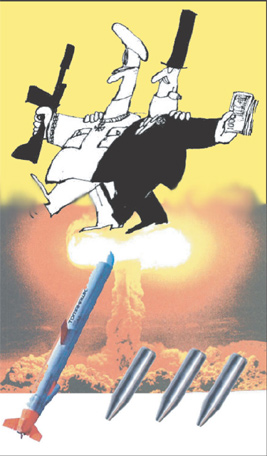 New nuclear arms race underway, World Socialist Website, By Mark Blackwood and Paul Mitchell 6 December 2014 Nearly five years ago, at the 2010 Nuclear Non-proliferation Treaty Review Conference, the nuclear powers restated their commitment to a “diminishing role for nuclear weapons in security policies to minimize the risk that these weapons ever be used and to facilitate the process of their total elimination.”
US President Barack Obama and then-Russian President Dmitry Medvedev signed the New START treaty, promising to reduce their stockpiles of nuclear missiles and launchers.
However, this year’s right-wing coup in Ukraine, organised by the US and European Union, followed by a campaign of sanctions and war threats against Russia, combined with the Obama administration’s “pivot to Asia” aimed at asserting US control over the Asia-Pacific, are provoking a new nuclear arms race.
According to Hugh Chalmers, an analyst at the London-based Royal United Services Institute, “All nuclear states are undergoing some form of nuclear modernization at the moment, or will very soon be going through that process… You can look around the world and see new missiles being developed, new submarines, new cruise missiles…”
Shortly before he was fired last week, US Defense Secretary Chuck Hagel used two separate Pentagon studies, arising out of the drugs and academic cheating scandal at nuclear bases, to authorise the US Department of Defense to request a further 10 percent increase in funding to upgrade its nuclear infrastructure every year for the next five years.
The nuclear arm of the military will be given a higher profile, with the commander of the US Air Force Global Strike Command promoted from a three-star to a four-star general, and the head of the service’s nuclear integration elevated from two-star to three-star rank………
Any belief that a nuclear war is impossible because modern governments would not risk catastrophe is disproved by the rapid modernisation of nuclear weapons and their delivery systems. Beset by mounting economic and social problems for which they have no progressive solution, the ruling elites are increasingly inclined to see war as a risk worth taking.https://www.wsws.org/en/articles/2014/12/06/nucl-d06.html
U.S. should shrink nuclear arsenal says Senator
Sen. Dianne Feinstein: Generals agree: U.S. should shrink nuclear arsenal DIANNE FEINSTEIN | U.S. senator, D- Calif. 4 Dec 14 During the Cold War, the United States and the Soviet Union were mired in an arms race. The antagonism led each side to stockpile more than 30,000 nuclear weapons to prevent the other from gaining an advantage.
Today, however, nuclear weapons are seen as a financial burden and a threat to global security. Furthermore, our nuclear stockpile is competing for limited defense spending, money that could be used to address more pressing challenges such as the fight against the Islamic State and defending against cyberattacks.
That’s why the amount the United States spends to maintain and modernize its nuclear arsenal is so staggering. Over the next decade, the Congressional Budget Office reports that the United States will spend $355 billion on nuclear weapons.
We’re holding far more nuclear weapons than are necessary, and the cost is undermining other national security priorities. It’s time we take a long look at how we can responsibly reduce our stockpile.
The United States currently maintains 4,804 nuclear weapons. If you include retired weapons that are awaiting dismantlement and the thousands of components in storage, the United States has the equivalent of around 10,000 weapons. When you consider that the weapons we maintain today are up to 100 times more destructive than the ones used in Hiroshima and Nagasaki, it becomes clear that the only value they offer is in deterring a nuclear attack.
Meanwhile, efforts to reduce the stockpile are faltering……………..http://host.madison.com/ct/news/opinion/column/sen-dianne-feinstein-generals-agree-u-s-should-shrink-nuclear/article_82872707-8514-5e1b-8e18-14ebc43ef9b9.html
Corporate power, and its religious belief in nuclear power
Nuclear power keeps the corporates in charge. No wonder it’s conservatives’ preferred solution to climate change, Guardian Tim Hollo, 2 Dec 14
Tony Abbott says he has ‘no theological objection’ to nuclear power. That’s fair – only blind faith could justify his belief in a power source that’s so costly and risky “I have no theological objection” to nuclear power, Tony Abbott said on 1 December, responding to Julie Bishop’s relaunch of the right’s preferred “solution” to global warming this week.
Abbott’s choice of words is fascinating. On the face of it he’s suggesting that opposing nuclear power is a faith-based, rather than rational, view. But it is the right’s consistent promotion of a technology that has been shown repeatedly to be too slow, too costly and too risky (see, for instance, here and here) that is underpinned by several right wing articles of faith. It’s worth unpacking this credo, because it reveals what’s really going on when nuclear power is raised……….
the “dominion mandate” dovetails so neatly with the modern industrial idea that humanity is separate from and dominant over nature that it has become a powerful aspect of the western materialist creation story.
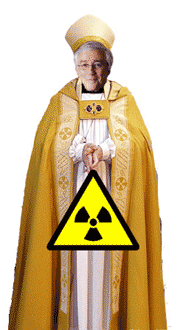 Nuclear power fits perfectly within a world view that sees splitting the atom as the apogee of human dominance over nature. Given its enormous and persistent waste problem, nuclear power is only acceptable if you believe that it is our right to pollute as we please.
………. the increasingly blind faith Abbott and his ilk invest in corporate capitalism has developed a distinctly theological aura. While it is reasonable to reject climate science, and acceptable to deny declining reef health, it is heresy to question whether handing ever more power to corporate interests will benefit the rest of us.
The privatisation of profit and socialisation of risk inherent in nuclear power only makes economic sense if you believe in the divine right of corporations. With multi-billion dollar cost blowouts in construction and decommissioning, the refusal of private insurance companies to cover risk, and a waste stream that will need to be managed for many times longer than our civilisation has so far existed, it’s basically a complex wealth transfer from citizens to corporations.
Nuclear power’s great attraction for those who subscribe to this particular faith is that it would maintain the corporate grip on energy infrastructure at a time when diversified and distributed renewable energy systems threaten to democratise energy supply……..
Support for nuclear power is based on a world-view, but it doesn’t have the benefit of also being backed by rational arguments. It is simply a fantasy of the right, a convenient prop they occasionally produce to pretend we can address climate change while changing nothing, and a weapon in their culture war. http://www.theguardian.com/commentisfree/2014/dec/01/nuclear-power-keeps-the-corporates-in-charge-no-wonder-its-conservatives-preferred-solution-to-climate-change
Uranium spot price plummets as buyers exit market
Uranium spot price plummets as buyers exit market Peter Koven | November 24, 2014 | http://business.financialpost.com/2014/11/24/uranium-spot-price-plummets-as-buyers-exit-market/?__lsa=3fae-7175
Nuclear talks with Iran extended for another 7 months
U.S. and Allies Extend Iran Nuclear Talks by 7 Months, NYT, By DAVID E. SANGER and MICHAEL R. GORDONNOV. 24, 2014 “…..Secretary of State John Kerry, trying to put the best face on it, told reporters that a series of “new ideas surfaced” in the last several days of talks. He added that “we would be fools to walk away,” because a temporary agreement curbing Iran’s program would remain in place while negotiations continued. Late Monday night Mr. Kerry’s negotiating partner, Mohammad Javad Zarif, was equally upbeat in a session with the news media, saying with a broad smile that he was optimistic that in the next few months a solution would be found. “We don’t need seven months,” he said……..http://www.nytimes.com/2014/11/25/world/middleeast/iran-nuclear-talks.html?_r=0
Nuclear power’s future gets gloomier
Nuclear power’s dark future Japan Times, 25 Nov 14 BY BRAHMA CHELLANEY Nuclear power constitutes the world’s most subsidy-fattened energy industry, yet it faces an increasingly uncertain future. The global nuclear power industry has enjoyed growing state subsidies over the years, even as it generates the most dangerous wastes whose safe disposal saddles future generations.
Despite the fat subsidies, new developments are highlighting the nuclear power industry’s growing travails. For example, France — the “poster child” of atomic power — is rethinking its love affair with nuclear energy. Its parliament voted last month to cut the country’s nuclear-generating capacity by a third by 2025 and focus instead on renewable sources by emulating neighboring countries like Germany and Spain.
As nuclear power becomes increasingly uneconomical at home because of skyrocketing costs, the U.S. and France are aggressively pushing exports, not just to India and China, but also to “nuclear newcomers,” such as the cash-laden oil sheikhdoms in the Persian Gulf. Such exports raise new challenges related to freshwater resources, nuclear safety and nuclear-weapons proliferation.

Still, the bulk of the reactors under construction or planned worldwide are in just four countries — China, Russia, South Korea and India.
Six decades after Lewis Strauss, the chairman of the U.S. Atomic Energy Commission, claimed that nuclear energy would become “too cheap to meter,” nuclear power confronts an increasingly uncertain future, largely because of unfavorable economics. The just-released International Energy Agency’s World Energy Outlook 2014 report states: “Uncertainties continue to cloud the future for nuclear — government policy, public confidence, financing in liberalized markets, competitiveness versus other sources of generation, and the looming retirement of a large fleet of older plants.”
The stock of the state-owned French nuclear technology giant Areva recently tumbled after it cited major delays in its reactor projects and a “lackluster” global atomic-energy market to warn of an uncertain outlook for its business………
Nuclear power has the energy sector’s highest capital and water intensity and longest plant-construction time frame, making it hardly attractive for private investors. The plant-construction time frame, with licensing approval, still averages about a decade, as underscored by the new reactors commissioned in the past decade. In fact, the World Nuclear Industry Status Report 2014 acknowledges that 49 of the 66 reactors currently under construction are plagued with delays and cost overruns. Commercial reactors have been in operation for more than half a century, yet the industry still cannot stand on its own feet without major state support. Instead of the cost of nuclear power declining with the technology’s maturation — as is the case with other sources of energy — the costs have escalated multiple times. Just in the past decade, average costs jumped from $1,000 per installed kilowatt to almost $8,000/kW.
In this light, nuclear power has inexorably been on a downward trajectory. The nuclear share of the world’s total electricity production reached its peak of 17 percent in the late 1980s. Since then, it has been falling, and is currently estimated at about 13 percent, even as new uranium discoveries have swelled global reserves. With proven reserves having grown by 12.5 percent since just 2008, there is enough uranium to meet current demand for more than 100 years. Yet the worldwide aggregate installed capacity of just three renewables — wind power, solar power and biomass — has surpassed installed nuclear-generating capacity. In India and China, wind power output alone exceeds nuclear-generated electricity…….— nuclear power is in no position to lead the world out of the fossil-fuel age.http://www.japantimes.co.jp/opinion/2014/11/25/commentary/world-commentary/nuclear-powers-dark-future/#.VHYvqNLF8nk
The only “new” thing about new thorium nuclear design is the marketing
The Atomic Weapons Establishment Funds almost Half of UK Universitieshttp://miningawareness.wordpress.com/2014/03/22/the-atomic-weapons-establishment-funds-almost-half-of-uk-universities/
Oak Ridge National Lab Discusses Relationship Between Molten Thorium Reactor And Weapons:
“By 1954, the Laboratory’s chemical technologists had completed a pilot plant demonstrating the ability of the THOREX process to separate thorium, protactinium, and uranium-233 from fission products and from each other. This process could isolate uranium-233 for weapons development and also for use as fuel in the proposed thorium breeder reactors.
…
Molten-salt reactor experiments continued at the Laboratory through the 1960s and into the early 1970s. In 1969, Keith Brown, David Crouse, Carlos Bamberger, and colleagues adapted molten-salt technology to the problem of breeding uranium-233 from thorium, which could be extracted from the virtually inexhaustible supply of granite rocks found throughout the earth’s crust. When bombarded by neutrons in the molten-salt reactor, thorium was converted to fissionable uranium-233, another nuclear fuel.
 In December 1960, the AEC directed the Oak Ridge Laboratory to “turn its attention to developing a molten-salt reactor and thorium breeder“.
http://web.ornl.gov/info/ornlreview/rev25-34/chapter4.shtml (Emphasis Added)
Further, as you can see, there is nothing really “new” about molten salt thorium reactors other than marketing. As in all fashion the same old stuff gets rehashed. We need new energy innovation and investment instead.
More Reading of Interest Regarding Thorium Reactors and Weapons Proliferation: http://wmdjunction.com/121031_thorium_reactors.htmhttps://www.princeton.edu/sgs/publications/sgs/pdf/9_1kang.pdf
Australia: Foreign Minister and other Ministers take aim at President Obama, over climate change

 Foreign Minister Julie Bishop chides Barack Obama over Great Barrier Reef climate change remarks ABC News 20 Nov 14 Foreign Minister Julie Bishop has criticised US president Barack Obama for a speech in Brisbane last weekend in which he claimed climate change threatened the Great Barrier Reef.
Speaking to 7.30 from New York, where she is attending a meeting of the United Nations Security Council, Ms Bishop said “there was an issue regarding [Mr Obama’s] statement” and she could “understand the Queensland Government’s concern”……..
Bishop latest Coalition politician to take aim at Obama
Ms Bishop is not the only Coalition politician to voice criticism of Mr Obama, with frontbenchers Joe Hockey and Jamie Briggs making comments in the wake of the Brisbane speech.
Mr Briggs labelled the address as a “massive, massive distraction” from the rest of the G20 summit, while the Treasurer said it would be difficult for Mr Obama to deliver on his stricter emissions standard pledge.……..
The Intergovernmental Panel on Climate Change has warned the Great Barrier Reef could be at risk if more is not done to reduce carbon emissions………The UN’s World Heritage Committee has deferred a decision on whether to list the Great Barrier Reef as “in danger” until next year. http://www.abc.net.au/news/2014-11-20/julie-bishop-chides-barack-obama-over-climate-change-remarks/5906570
Goldman Sachs getting out of uranium trading
Goldman to wind down uranium desk; may sell Colombian coal mines -reportThu Nov 20, 2014 Nov 19 (Reuters) – Goldman Sachs will wind down its small uranium trading business after failing to find a buyer and may sell its Colombian coal mine subsidiary, two of its most controversial commodity divisions, according to a Senate report released on Wednesday…….http://www.reuters.com/article/2014/11/20/commodities-banks-goldman-uranium-idUSL2N0T931M20141120
Nuclear power’s dimming future, as wind, solar and biomass power races ahead
False promise of nuclear power, THE HINDU, BRAHMA CHELLANEY 19 Nov 14 The need for costly upgrades post-Fukushima and for making the nuclear industry competitive, including by cutting back on generous government subsidies, underscore nuclear power’s dimming future.
New developments highlight the growing travails of the global nuclear-power industry. France — the “poster child” of atomic power — plans to cut its nuclear-generating capacity by a third by 2025 and focus instead on renewable sources, like its neighbours, Germany and Spain. As nuclear power becomes increasingly uneconomical at home because of skyrocketing costs, the U.S. and France are aggressively pushing exports, not just to India and China, but also to “nuclear newcomers,” such as the cash-laden oil sheikhdoms. Still, the bulk of the reactors under construction or planned worldwide are located in just four countries — China, Russia, South Korea and India.
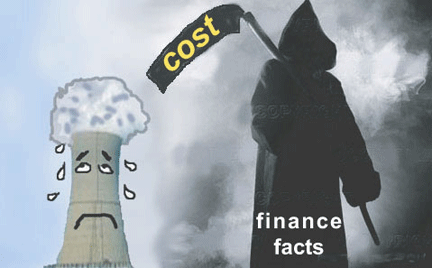 Six decades after Lewis Strauss, chairman of the U.S. Atomic Energy Commission, claimed that nuclear energy would become “too cheap to meter,” nuclear power confronts an increasingly uncertain future, largely because of unfavourable economics. The International Energy Agency’s World Energy Outlook 2014, released last week, states: “Uncertainties continue to cloud the future for nuclear — government policy, public confidence, financing in liberalized markets, competitiveness versus other sources of generation, and the looming retirement of a large fleet of older plants.”
Heavily subsidy reliant
Nuclear power has the energy sector’s highest capital and water intensity and longest plant-construction time frame, making it hardly attractive for private investors. Plant construction time frame, with licensing approval, still averages almost a decade, as underscored by the new reactors commissioned in the past decade. The key fact about nuclear power is that it is the world’s most subsidy-fattened energy industry, even as it generates the most dangerous wastes whose safe disposal saddles future generations. Commercial reactors have been in operation for more than half-a-century, yet the industry still cannot stand on its own feet without major state support. Instead of the cost of nuclear power declining with the technology’s maturation — as is the case with other sources of energy — the costs have escalated multiple times.
In this light, nuclear power has inexorably been on a downward trajectory. The nuclear share of the world’s total electricity production reached its peak of 17 per cent in the late 1980s. Since then, it has been falling, and is currently estimated at about 13 per cent, even as new uranium discoveries have swelled global reserves. With proven reserves having grown by 12.5 per cent since just 2008, there is enough uranium to meet current demand for more than 100 years.
Yet, the worldwide aggregate installed capacity of just three renewables — wind power, solar power and biomass — has surpassed installed nuclear-generating capacity. In India and China, wind power output alone exceeds nuclear-generated electricity……
New robots for decontaminating Fukushima Daiichi nuclear power plant
Fukushima Daiichi Updates From IRID Part 2; New Robots & Work SimplyInfo, November 18th, 2014 (Great diagrams and photos)
As part of reviewing IRID’s updates on work progress for Fukushima Daiichi, new information about robots to be used and their proposed work has been released.
First Floor Robots, Floor Decontamination……..
Overhead Robots For First Floor………
Robots For Upper Floors …….
Containment Inspection Robots………
Penetration Checking Robot…… http://www.fukuleaks.org/web/?p=14099
Iran nuclear talks – the state of plan

 Iran nuclear talks – the Guardian briefing Julian Borger andSaeed Kamali Dehghan Tuesday 18 November Iran and a six-nation negotiating group are trying to reach an agreement that could bring an end to 12 years of deadlock over Iran’s nuclear programme. Read a brief history of the standoff and find out why the outcome of the talks is still in the balance
What’s the story?
The international negotiations over the future of Iran’s nuclear programme are approaching a deadline of 24 November. A deal would curb the Iranian programme – to reassure the rest of the world that Tehran does not intend to build nuclear weapons – in return for sanctions relief. Success would diminish the threat of a new war in the Middle East and significantly improve US-Iranian relations after a 35-year freeze. That in turn could lead to better cooperation in Syria, Iraq, Afghanistan and beyond. Inside Iran, the lifting of sanctions would immeasurably strengthen the hand of pragmatists, led by the president, Hassan Rouhani, who want to re-engage with the west.
How did we get here?……..http://www.theguardian.com/world/2014/nov/18/-sp-iran-nuclear-talks-briefing
Chance of nuclear war too close for comfort
Historians of the Cold War have shown that mistakes and miscalculation have brought the world closer to accidental nuclear warfare more often than is commonly realised. A recent report by Britain’s Royal Institute of International Affairs, titled, ‘Too close for comfort’ documents several incidents. Some involved computer malfunctions that led either the US or the USSR to believe that they were under nuclear attack. As the report notes: “Individual decision making, often in disobedience of protocol and political guidance, has on several occasions saved the day.” Several of the most dangerous near-misses took place during periods of heightened political tension between Moscow and Washington. The most famous such incident was the Cuban Missile crisis of 1962. A more recent instance — with a stronger contemporary resonance — was the Able Archer incident of November 1983. In September of that year, the Soviet Union had shot down a Korean Air civilian airliner, killing 267 people. That tragedy, like the shooting down of a Malaysian Airlines flight over Ukraine this year, had significantly raised East-West tensions with the Russians, then as now, accusing America of militarism and plans for world domination.
Against this background, Nato staged a military exercise that acted out a western nuclear strike on the USSR. Operation Able Archer was so thorough and so realistic that many in Moscow interpreted it as preparation for a Nato first-strike. In response, the Russians readied their own nuclear weapons. It appears that intelligence services alerted the West to how Able Archer was being seen in Moscow, allowing for de-escalation.
One lesson of that episode is that the existence of a “hotline” between Moscow and Washington is no guarantee that the two sides will not blunder. Another is that any ambiguous move, involving nuclear weapons, can cause a dangerous panic.
My parents’ generation got grimly used to living in the shadow of the bomb. But for my generation, the very idea of nuclear warfare seems like something from science-fiction or even dark comedy, such as Dr Strangelove. But the world’s nuclear arsenals were not abolished after the Cold War. Sadly, we may now be returning to an era in which the threat of nuclear warfare can no longer be treated as the stuff of science fiction. http://gulfnews.com/opinions/columnists/the-nuclear-gun-is-back-on-the-table-1.1414436
1 This Month
Chernobyl: The Lost Tapes – A good documentary on Chernobyl on SBS available On Demand for the next 3 weeks– https://www.sbs.com.au/ondemand/tv-program/chernobyl-the-lost-tapes/2352741955560

of the week–London Campaign for Nuclear Disarmament

Tell the Ukrainian Government to Drop Prosecution of Peace Activist Yurii Sheliazhenko
To see nuclear-related stories in greater depth and intensity – go to https://nuclearinformation.wordpress.com
-
Archives
- April 2026 (139)
- March 2026 (251)
- February 2026 (268)
- January 2026 (308)
- December 2025 (358)
- November 2025 (359)
- October 2025 (376)
- September 2025 (257)
- August 2025 (319)
- July 2025 (230)
- June 2025 (348)
- May 2025 (261)
-
Categories
- 1
- 1 NUCLEAR ISSUES
- business and costs
- climate change
- culture and arts
- ENERGY
- environment
- health
- history
- indigenous issues
- Legal
- marketing of nuclear
- media
- opposition to nuclear
- PERSONAL STORIES
- politics
- politics international
- Religion and ethics
- safety
- secrets,lies and civil liberties
- spinbuster
- technology
- Uranium
- wastes
- weapons and war
- Women
- 2 WORLD
- ACTION
- AFRICA
- Atrocities
- AUSTRALIA
- Christina's notes
- Christina's themes
- culture and arts
- Events
- Fuk 2022
- Fuk 2023
- Fukushima 2017
- Fukushima 2018
- fukushima 2019
- Fukushima 2020
- Fukushima 2021
- general
- global warming
- Humour (God we need it)
- Nuclear
- RARE EARTHS
- Reference
- resources – print
- Resources -audiovicual
- Weekly Newsletter
- World
- World Nuclear
- YouTube
-
RSS
Entries RSS
Comments RSS
 nuclear-news