Loss of Arctic snow cover means that sea absorbs more solar heat
Sea absorbs more radiation as Arctic ice fades http://www.independent.co.uk/environment/climate-change/sea-absorbs-more-radiation-as-arctic-ice-fades-9953201.html 1 Jan 15 The dangers of melting Arctic sea ice have been laid bare after new research suggests that the loss of huge areas of the ocean’s snow cover have made a significant contribution to global warming in the past 15 years.
As increasing quantities of ice gives way to water during the summer months, the amount of the sun’s energy being absorbed by the sea has greatly increased, according to the report.
Scientists have calculated the impact of the melting Arctic ice for the first time and believe it is responsible for a 5 per cent increase since 2000 in the amount of solar radiation the ocean is absorbing during June, July and August – a finding that will fuel concerns about a ‘feedback loop’ of ever-greater rises in temperatures and snow thawing.
READ MORE: THE 2015 CLIMATE CHANGE TARGET
“While a 5 per cent increase may not seem like much, consider that the rate globally has remained essentially flat during that same time. No other region on Earth shows a trend of potential long-term change,” said Norman Loeb, of NASA’s Langley Research Centre in Hampton, Virginia.
Wind and solar power racing ahead: nuclear power dwindling
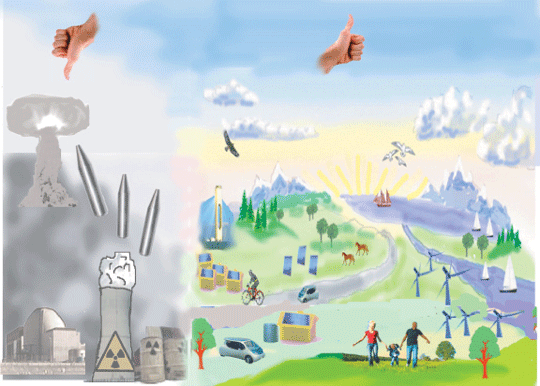 Nukes Fade As Wind and Solar Soar, Eco Watch Paul Brown, Climate News Network | December 30, 2014 With nuclear power falling ever further behind renewables as a global energy source, and as the price of oil and gas falls, the future of the industry in 2015 and beyond looks bleak. Renewables now supply 22 percent of global electricity and nuclear only 11 percent—a share that is gradually falling as old plants close and fewer new ones are commissioned.
New large-scale installations of wind and solar power arrays continue to surge across the world. Countries without full grids and power outages, such as India, increasingly find that wind and solar are quick and easy ways to bring electricity to people who have previously had no supply.
Developed countries, meanwhile, faced with reducing carbon dioxide emissions, find that the cost of both these renewable technologies is coming down substantially. Subsidies for wind and solar are being reduced and, in some cases, will disappear altogether in the next 10 years.
Speed of installation
The other advantage that renewables have is speed of installation. Solar panels, once manufactured, can be installed on a rooftop and be in operation in a single day. Wind turbines can be put up in a week.
Nuclear power, on the other hand, continues to get more expensive. In China and Russia, costs are not transparent, and even in democracies they hard to pin down. But it is clear that they are rising dramatically.
Building of the proposed twin European Pressurised Water reactors, called Hinkley Point C, in Britain’s West Country is due to start in 2015, but the price has risen several times already. Estimated construction costs have now jumped from £16 billion to £24 billion—before the first concrete has even been poured.
The other problem with nuclear is the time frame…………
Whether a small nuclear power station would be any more welcomed than a wind or solar farm to provide power in a neighbourhood is a question still to be tested.
Nuclear enthusiasts—and there are still many in the political and scientific world—continue to work on fast breeder reactors, fusion and thorium reactors, heavily supported by governments who still believe that one day the technology will be the source of cheap and unlimited power. But, so far, that remains a distant dream.
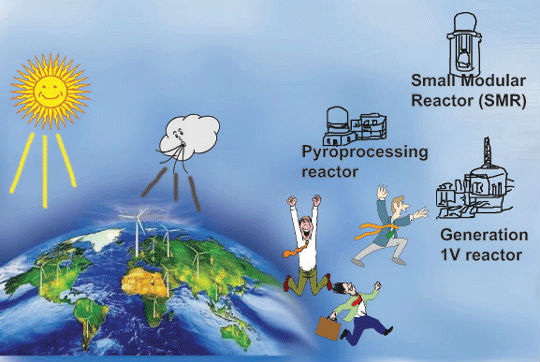
In the meantime, investors are increasingly sceptical about putting their money into nuclear—whereas renewables promise an increasingly rapid return on investment, and may get a further boost if the governments of the world finally take climate change seriously. http://ecowatch.com/2014/12/30/nukes-fade-wind-solar-soar/
Exponential improvement in efficiency, costs, and speed of solar power installations
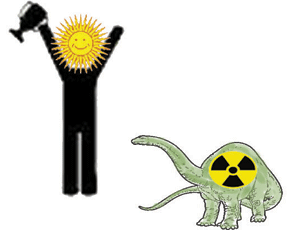 How Solar Power Could Slay the Fossil Fuel Empire by 2030 Motherboard, BY NAFEEZ AHMED
December 10, 2014 In just 15 years, the world as we know it will have transformed forever. The age of oil, gas, coal and nuclear will be over. A new age of clean power and smarter cars will fundamentally, totally, and permanently disrupt the existing fossil fuel-dependent industrial infrastructure in a way that even the most starry-eyed proponents of ‘green energy’ could never have imagined.
These are not the airy-fairy hopes of a tree-hugging hippy living off the land in an eco-commune. It’s the startling verdict of Tony Seba, a lecturer in business entrepreneurship, disruption and clean energy at Stanford University and a serial Silicon Valley entrepreneur. Continue reading
Iran could be a ‘successful regional power’ if it agrees to a nuclear deal – President Obama
Just weeks after announcing he was restoring diplomatic ties with Cuba following 50 years of estrangement, Mr Obama said he hoped a nuclear deal would lead to Iran eventually being “reintegrated into the international community”.
“If we can take that big first step, then my hope would be that that would serve as the basis for us trying to improve relations over time,” Mr Obama told National Public Radio.
Asked if he could imagine opening a US embassy in Tehran for the first time since the Iranian Revolution in 1979, the President said: “I never say never, butI think these things have to go in steps”……..
Iranian negotiators have been meeting with representatives of the P5+1 bloc in talks in Vienna for more than a year and face a July 1 deadline to reach a deal.
The talks were initially scheduled to end in November but were extended after no agreement could be reached.
A breakthrough that eventually leads to restored relations between the US and Iran would be generally welcomed in Europe. Britain announced in June that it was re-opening its embassy in Tehran……..http://www.telegraph.co.uk/news/worldnews/middleeast/iran/11316496/Barack-Obama-Iran-could-be-a-successful-regional-power-if-it-agrees-to-a-nuclear-deal.html
8 top events for renewable energy in 2014
 The 8 Best Things to Happen to Renewable Energy in 2014 , Solar Energy, Author: Katie Valentine, Dec 30 14
“…….World’s First Solar Road Opens In Netherlands…….
“We used commercial solar cells, but in a new way, so these efficiency improvements are readily accessible to the solar industry,” Mark Keevers, a UNSW solar scientist who managed the research project, said in a statement.
The highly efficient solar cells might be cheaper to produce than some other record-breaking cells, too. The researchers said that the solar design could be particularly useful for solar power towers currently being designed in Australia. If the test’s results are able to be replicated on a larger scale, those involved with the research project hope that the discovery can ultimately drive down the cost of solar.
Scotland Has An Amazing Month Of Wind Energy Production……
World’s Largest Solar Plant Comes Online…….
The World’s Largest Tidal Array Gets The Green Light………
World’s Largest and Most Powerful Wind Turbine Comes Online……….
Solar Car Hits Speed Record, Could Soon Hit The Streets…….. tinyurl.com/nsfwrsd
Westinghouse deal with Ukraine to supply nuclear fuel
Ukraine signs Westinghouse nuclear fuel deal Yahoo 7 News 30 Dec 14 Ukraine on Tuesday sealed an additional nuclear fuel supply deal with US giant Westinghouse in order to ease its energy dependence on Russia.
Westinghouse Electric Company said it signed a deal in Brussels with Ukraine’s Energoatom state nuclear power provider “to significantly increase fuel deliveries to Ukrainian nuclear power plants through 2020.”
No figures were immediately available for the value of a deal which Ukrainian Prime Minister Arseniy Yatsenyuk had said would take place.
Nor were there details on the quantities of fuel or number of reactors involved………https://au.finance.yahoo.com/news/ukraine-signs-westinghouse-nuclear-fuel-083256995.html
Renewable energy future bright for electric cars
 Tony Earley: PG&E supports electric vehicles and a green future By Tony Earley Mercury News12/30/2014 Of all history’s surprises in recent years, few have been as unexpected or as uplifting as the incredible about-face in our country’s energy outlook.
Tamil Nadu wants unallocated power from the Kudankulam Nuclear Power Plant (KNPP).
TN govt opposes allotment of KNPP power to Telangana Says the state should get unallocated power as it provided land, water BS Reporter | Chennai December 29, 2014
In a letter, Tamil Nadu chief minister O Pannerselvam brought to the notice of prime minister Narendra Modi the state’s memorandum of request in June 2014, urging the Centre to allocate the entire 15 per cent (150 Mw) unallocated power in KNPP Unit-I and Unit-II to the state.
“As you are aware, Tamil Nadu has come forth with all necessary inputs like land and water for the expeditious completion of the project, while neighbouring states had not been supportive. The deft handling of the issue by the state government ensured there was no disruption in commissioning and running of KNPP,” the chief minister highlighted in the letter.
The Centre has allotted 50 Mw from KNPP to Telangana, which again is a power deficit state in the south…….http://www.business-standard.com/article/current-affairs/tn-govt-opposes-allotment-of-knpp-power-to-telangana-114122900428_1.html
Distributed renewable energy and the smart grid
12 Utility Trends For 2015 Veracity Asset Management Group “ ….. Distributed renewables Distributed renewables are the spearhead of smart grid, shifting the power from utilities to utilities AND its “prosumers” (professional or proactive consumers). Solar panels, geothermal systems or small windmills enable consumers to have a better control over sources of energy, decreasing their dependency on energy providers………http://veracityamg.wordpress.com/2014/12/30/12-utility-trends-for-2015/
Continuing cyber attacks on South Korean nuclear power operator

 Cyber-attacks on South Korean nuclear power operator continue, Guardian Firm says nuclear power plants are operating safely and are secure from attack, and it has stepped up its cybersecurity South Korea’s nuclear power operator has said cyber-attacks on non-critical operations at its headquarters are continuing but the country’s nuclear power plants are operating safely and are secure from attack……since last Wednesday the operator and the government have had emergency teams on standby as a precaution, after a hacker demanded the shutdown of three reactors by last Thursday and in Twitter messages threatened “destruction” if the demand was not met. http://www.theguardian.com/world/2014/dec/28/cyber-attacks-south-korean-nuclear-power-operator
For climate change action, the switch to renewable energy is essential
When considering factors like the cost of ill health and environmental damage due to pollution, switching to renewable energy could save up to $740bn (£476bn) per year by 2030. If these costs were factored into energy prices, renewable energy and energy efficiency measures would be cheaper than fossil fuel alternatives.
 The switch to renewable power is a battle we cannot afford to lose Adnan Z Amin http://www.theguardian.com/environment/2014/dec/24/the-switch-to-renewable-power-is-a-battle-we-cannot-afford-to-lose
Since the final gavel fell at the Lima climate talks earlier this month, discussions have centred on one question: what did the talks actually accomplish?
After two weeks of intense negotiation, governments settled on a draft text that will hopefully lead to a successful global climate deal in Paris next December. While opinions vary regarding the success or failure of the outcome, there is another story emerging outside the negotiation room.
This year’s conference represented a highly-significant shift in the positive momentum to act on climate change. While negotiators engaged in contentious debates, businesses, non-governmental organisations and local authorities stepped forward to present their own climate initiatives and committed to more action on the ground.
In this shift, renewable energy took centre stage. Continue reading
Welcome to Year One of the climate revolution,
Let’s leave behind the age of fossil fuel. Welcome to Year One of the climate revolution, Guardian Rebecca Solnit column 24 Dec 14
“…………….This is the biggest of pictures, so find your role. Earlier this month, hundreds of Peruvian children formed the image of a tree on the beach to send a message to the world. It’s a start
 Just before that September climate march in New York, I began to contemplate how human beings a century from now will view those of us who lived in the era when climate change was recognized, and yet there was so much more that we could have done. They may feel utter contempt for us. They may regard us as the crew who squandered their inheritance, like drunkards gambling away a family fortune that, in this case, is everyone’s everywhere and everything. I’m talking, of course, about the natural world itself when it was in good working order. They will see us as people who fiddled while everything burned.
They will think we were insane to worry about celebrities and fleeting political scandals and whether we had nice bodies. They will think the newspapers should have had a gigantic black box above the fold of the front page every day saying “Here are some stories about other things, BUT CLIMATE IS STILL THE BIGGEST STORY OF ALL.”
They will think that we should have thrown our bodies in front of the engines of destruction everywhere, raised our voices to the heavens, halted everything until the devastation stopped. They will bless and praise the few and curse the many.
There have been heroic climate activists in nearly every country on the planet, and some remarkable things have already been achieved. The movement has grown in size, power, and sophistication, but it’s still nowhere near commensurate with what needs to be done. In the lead-up to the UN-sponsored conference to create a global climate treaty in Paris next December, this coming year will likely be decisive.
You are a citizen of this Earth and your responsibility is not private but public, not individual but social.
So this is the time to find your place in a growing movement, if you haven’t yet – as it is for climate organizers to do better at reaching out and offering everyone a part in the transformation, whether it’s the housebound person who writes letters or the 20-year-old who’s ready for direct action in remote places. This is the biggest of pictures, so there’s a role for everyone, and it should be everyone’s most important work right now, even though so many other important matters press on all of us. (As the Philippines’s charismatic former climate negotiator Yeb Sano notes, “Climate change impinges on almost all human rights. Human rights are at the core of this issue.”)

Many people believe that personal acts in private life are what matters in this crisis. They are good things, but not the key thing. It’s great to bicycle rather than drive, eat plants instead of animals, and put solar panels on your roof, but such gestures can also offer a false sense that you’re not part of the problem.
You are not just a consumer. You are a citizen of this Earth and your responsibility is not private but public, not individual but social. If you are a resident of a country that is a major carbon emitter, as is nearly everyone in the English-speaking world, you are part of the system, and nothing less than systemic change will save us.
The race is on. From an ecological standpoint, the scientists advise us that we still have a little bit of time in which it might be possible, by a swift, decisive move away from fossil fuels, to limit the damage we’re setting up for those who live in the future. From a political standpoint, we have a year until the Paris climate summit, at which, after endless foot-shuffling and evading and blocking and stalling and sighing, we could finally, decades in, get a meaningful climate deal between the world’s nations.
We actually have a chance, a friend who was at the Lima preliminary round earlier this month told me, if we all continue to push our governments ferociously. The real pressure for change globally comes more from within nations than from nations pressuring one another. Here in the United States, long the world’s biggest carbon-emitter (until China outstripped us, partly by becoming the manufacturer of a significant percentage of our products), we have a particular responsibility to push hard. Pressure works. The president is clearly feeling it, and it’s reflected in the recent US-China agreement on curtailing emissions – far from perfect or adequate, but a huge step forward.
be? No one knows, but we do know that we must keep moving in the direction of reduced carbon emissions, a transformed energy economy, an escape from the tyranny of fossil fuel, and a vision of a world in which everything is connected. The story of this coming year is ours to write and it could be a story of Year One in the climate revolution, of the watershed when popular resistance changed the fundamentals as much as the people of France changed their world (and ours) more than 200 ago.
Two hundred years hence, may someone somewhere hold in their hands a document from 2021, in wonder, because it was written during Year Six of the climate revolution, when all the old inevitabilities were finally being swept aside, when we seized hold of possibility and made it ours. “Any human power can be resisted and changed by human beings,” says Ursula K Le Guin. And she’s right, even if it’s the hardest work we could ever do.
Now, everything depends on it.
- This essay originally appeared at TomDispatch. http://www.theguardian.com/commentisfree/2014/dec/23/age-of-fossil-fuel-year-one-climate-revolution
Predictions of “Limits to Growth” now coming true
New study confirms ‘Limits to Growth’ prediction of imminent global collapse by Michelle Kennedy Hogan, 12/27/14 http://inhabitat.com/new-study-confirms-limits-to-growth-prediction-of-imminent-global-collapse/ When Limits of Growth was first published, it was almost impossible to believe that population growth and dire predictions of resource consumption could lead to the collapse of the planet. Researchers Donella and Dennis Meadows “built a computer model to track the world’s economy and environment,” according to The Guardian. The model was “cutting edge” and tracked industrialization, population, food, resource use, and pollution. Scenarios were generated out to the year 2100 and showed the inevitable collapse of the economy, the environment and the population if serious measures were not taken.
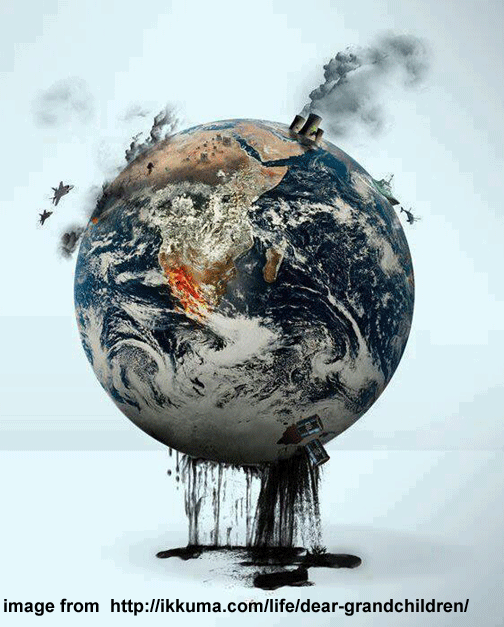
Now in 2014, data gathered by the University of Melbourne’s Melbourne Sustainable Society Institute shows that the projections made in Limits to Growth were dead on. Principal research fellow Graham Turner drew from a wide range of sources to confirm the projections – including the UN, the U.S National Oceanic and Atmospheric Administration, and BP.
In fact, the projections from 1972 through 2010 were in line with what has happened in every category – from the environment (including resources and pollution) to world population (including the birth and death rate) and the economy (including food, services and industrial output, per capita).
“As the MIT researchers explained in 1972, under the scenario, growing population and demands for material wealth would lead to more industrial output and pollution. The graphs show this is indeed happening. Resources are being used up at a rapid rate, pollution is rising, industrial output and food per capita is rising. The population is rising quickly,” according to the Guardian.
So now what?
If the book’s predictions are true, what will happen in the next 100 years – or less? Well, as we continue to use up resources they will become more expensive. As we use more capital to pull out more resources the “industrial output per capita starts to fall.” According to the book, this begins to happen in 2015. Once industrial output falls, a domino effect occurs through food production, and the resulting cutback in health and education. As health services fall, the death rate rises and the global population will start to fall by about “half a billion people per decade.” Living conditions will become similar to those in the early 1900′s.
While some of the blame can also be placed on climate change and carbon dioxide emissions, most of it is placed squarely on the shoulders of resource consumption. While the University of Melbourne could not find substantive proof of collapse, the book indicates that it will be more evident beginning in 2015. In fact, some believe the Global Financial Crisis of 2007-08 was caused by resource constraints as well as “The pursuit of material wealth contributed to unsustainable levels of debt, with suddenly higher prices for food and oil contributing to defaults – and the GFC.”
With oil production at its peak, other fossil fuels are being gobbled up quickly – and if they require too much capital to extract – the result could be devastating. Protecting ourselves and making serious changes will be necessary to survive, then, in the light of this growing crisis, according to Turner.

Faulty nuclear reactor shut down in Ukraine
Ukraine shuts down faulty nuclear power plant reactor Yahoo 7 28 Dec 14 Ukraine on Sunday shut down one of the six reactors in its most powerful nuclear power plant for the second time in a month due to an apparent electrical malfunction……https://au.finance.yahoo.com/news/ukraine-shuts-down-faulty-nuclear-004208027.html
“Profitganda” – a new way to sell nuclear power to the masses
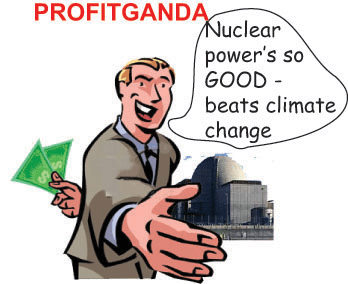 Capt D 27 Dec 14 The reality is that in Japan and many other “civilized” countries the nuclear “lobby” is so powerfully that they in essence control not only the Government but also what forms of energy are used by the people of that country.
I have coined the term “Energy Slavery” as describing how many people are forced to buy their “Energy” from a Utility that does not provide the types of generation that the ratepayers want because it would not benefit the Utilities shareholders as much.
This will become ever more prevalent as Solar (of all flavors) cost continues to decline while Nuclear generation continues to increase in cost. Most new reactors that will be built will result in generating very high cost energy, which local ratepayers will be forced to pay, thanks to agreements being forced upon ratepayers in order to get these same nuclear reactors built.
I predict that history will show that the Leaders supporting these BIG reactor projects will themselves be enriched by these ☢ Energy deals, in what I call Profitganda*
http://www.urbandictionary.com/define.php?term=Profitganda
Profitganda is the use of phony “feel good” information to sell an idea, product or concept to the masses.
1 This Month
Chernobyl: The Lost Tapes – A good documentary on Chernobyl on SBS available On Demand for the next 3 weeks– https://www.sbs.com.au/ondemand/tv-program/chernobyl-the-lost-tapes/2352741955560

of the week–London Campaign for Nuclear Disarmament

Tell the Ukrainian Government to Drop Prosecution of Peace Activist Yurii Sheliazhenko
To see nuclear-related stories in greater depth and intensity – go to https://nuclearinformation.wordpress.com
-
Archives
- April 2026 (139)
- March 2026 (251)
- February 2026 (268)
- January 2026 (308)
- December 2025 (358)
- November 2025 (359)
- October 2025 (376)
- September 2025 (257)
- August 2025 (319)
- July 2025 (230)
- June 2025 (348)
- May 2025 (261)
-
Categories
- 1
- 1 NUCLEAR ISSUES
- business and costs
- climate change
- culture and arts
- ENERGY
- environment
- health
- history
- indigenous issues
- Legal
- marketing of nuclear
- media
- opposition to nuclear
- PERSONAL STORIES
- politics
- politics international
- Religion and ethics
- safety
- secrets,lies and civil liberties
- spinbuster
- technology
- Uranium
- wastes
- weapons and war
- Women
- 2 WORLD
- ACTION
- AFRICA
- Atrocities
- AUSTRALIA
- Christina's notes
- Christina's themes
- culture and arts
- Events
- Fuk 2022
- Fuk 2023
- Fukushima 2017
- Fukushima 2018
- fukushima 2019
- Fukushima 2020
- Fukushima 2021
- general
- global warming
- Humour (God we need it)
- Nuclear
- RARE EARTHS
- Reference
- resources – print
- Resources -audiovicual
- Weekly Newsletter
- World
- World Nuclear
- YouTube
-
RSS
Entries RSS
Comments RSS
 nuclear-news