America’s federal govt to be fined by Idaho for not removing nuclear waste
 Idaho Plans to Fine Feds for Not Shipping Nuclear Waste Magic Valley.com 9 Jan 15, IDAHO FALLS (AP) | Idaho plans to fine the federal government $3,600 a day for missing a deadline to remove 900,000 gallons of liquid nuclear waste from tanks at a southeast Idaho nuclear facility, state officials said.
The state Department of Environmental Quality said it rejected a request for another extension from the U.S. Department of Energy to go past the Dec. 31 deadline to remove the radioactive waste at the Idaho National Laboratory.
Idaho officials tell the Post Register (http://bit.ly/1BE0XB8 ) that three 50-year-old tanks are no longer supposed to be used for storage under federal laws governing hazardous waste.
“Although DOE has had many years to complete this milestone, DOE has failed to initiate and complete treatment of the liquid wastes in the tanks or construct new tanks,” said DEQ’s Hazardous Waste Compliance Manager Natalie Clough in a letter Tuesday to Richard Provencher, manager of DOE’s Idaho Operations Office. “Completion of this work is a priority of the (DEQ), and further delays are of critical concern.”
The state said fines will increase to $6,000 a day if the waste isn’t gone by July 1.
Department of Energy spokeswoman Danielle Miller said the agency is reviewing the notice of violation it received. She declined to make additional comments…………http://magicvalley.com/news/local/update-idaho-plans-to-fine-feds-for-not-shipping-nuclear/article_521dd666-974e-11e4-b06c-9bc86f76baad.html
Australia stands out like a sore toe, in an otherwise progressive clean energy world
Finally Some Good News About Clean Energy Investment http://www.motherjones.com/environment/2015/01/finally-some-good-news-about-clean-energy-investment China continues to lead the world in green investment.—By James West| Fri Jan. 9, 2015 Clean energy investment around the world is rebounding after a three-year decline, according to new figures released today by Bloomberg New Energy Finance. Globally, the total amount of clean energy investment jumped 16 percent in 2014, to $310 billion. That number is just shy of the record amount of investment set in 2011.
BNEF produces quarterly reports that track how much money governments and the private sector are pouring into wind, solar, biofuels and other green energy projects. In 2014, the United States enjoyed its biggest investments since 2012, but it was China that once again drove the numbers. China’s clean energy spending shot up 32 percent to a record $89.5 billion, cementing its place as the world’s top market for green investment. (You can get a sense of just how impressive Chinese investment is by peaking inside the the world’s biggest solar manufacturing factory, which is run by Chinese company Yingli.)
Solar is getting the lion’s share of investment around the world, according to the figures. Almost half the money spent on clean energy this year—just shy of $150 billion—was in the solar industry. Wind investment also reached record levels—$19.4 billion globally—thanks in part to offshore projects in Europe.
 There was one darker patch in the numbers: Australia, where the government is trying to slash the country’s Renewable Energy Target, a policy that creates mandates for the amount of clean energy in the electricity mix. Bucking the global trend, investments there fell by 35 percent
World needs U.S. Congress to give diplomacy a real chance in Iran nuclear deal

 What’s Holding Up the Iran Nuclear Deal? The U.S. Congress must give diplomacy a real chance and not hinder nuclear negotiations with Iran. U.S. News By: Seyed Hossein Mousavian, Contributor for Al-Monitor 9 Jan 15
Iran and the P5+1 — the five permanent members of the UN Security Council plus Germany — failed to reach a final deal on Iran’s nuclear program before the Nov. 24, 2014, deadline. However, they agreed in Vienna to a new March 2015 deadline for a political agreement and a final agreement (inclusive of annexes) by July 1. The next round of talks is scheduled for mid-January.
Informed European sources told me that the negotiators were on the verge of announcing a political agreement in Vienna, but it was blocked for apparently unknown reasons. U.S. Secretary of State John Kerry said: “In recent weeks, we have seen new ideas surface, flexibility emerge, that could, I repeat, could help resolve some issues, that had been intractable.” Interestingly enough, just a few days after the November marathon talks, Israeli Prime Minister Benjamin Netanyahu acknowledged that “Israel had a critical role in stopping a deal with Iran.”………
The U.S. intelligence community has clearly stated in its National Intelligence Estimates over the past seven years that Iran has not made a decision to build a nuclear weapon. No one in Iran — and for that matter, anywhere — can stomach that a U.S. congressional leader would so openly follow the leadership of a foreign leader, in total neglect of the stated will and wish of his own president and national security bodies. It is unfortunate that such Israel-pleasing pronouncements by senior American statesmen only serve to further buttress the prevalent Iranian mistrust — including at the level of the supreme leader — of Washington’s serious interest in working out a mutually satisfactory deal with Iran.
Judging from my numerous recent exchanges with a wide range of informed, well-placed sources within the P5+1, I am confident that a comprehensive agreement is absolutely within reach, provided that the process is not torpedoed by the U.S. Congress and Netanyahu. The good news is that Iran and the world powers already have a common understanding on the major elements of a final deal, which would assure the maximum level of transparency and the verification of the International Atomic Energy Agency on the Iranian nuclear program (all key objective guarantees related to no breakout), lift the sanctions and respect Iran’s legitimate rights on enrichment under the Non-Proliferation Treaty.
A diplomatic resolution of the nuclear issue, as underlined by Ali Shamkhani, secretary of Iran’s Supreme National Security Council, would make it possible for Tehran and Washington “not to waste their energy against each other.” Without sounding unrealistically euphoric, it could be said that a nuclear deal would, in all probability, serve as the beginning of the end to decades of tension and hostility between the two estranged countries.
Obama’s recent remarks, including on the possibility of reopening of embassies, even if far-fetched at this moment, point to the direction that has to be taken, which, under the current circumstances, might take the form of quiet collaboration on fighting Salafist extremism and terrorism in the region. Such actual cooperation, preferably without fanfare, carries the potential for further expansion to include other regional hotspots and crises. It’s not an empty claim: Iran has been — and will be — an anchor of regional stability.
A diplomatic solution to the nuclear issue — the sooner the better — will remove the threat of any future military conflagration in the Middle East, already in tumult with the ongoing ugly violence in Syria, Yemen and Iraq. An ultimate failure of the nuclear negotiations, whether torpedoed by the Israel-U.S. Congress joint effort or other naysayers, would play in the hands of certain quarters in Iran to push for withdrawal from the Non-Proliferation Treaty — an eventuality that I presume few people would like to face after the North Korean affair.
With the stakes as high as they are, both with the nuclear dossier and the situation in the region, it is incumbent on the U.S. Congress to act in a way to give diplomacy a real chance and regional stability a real boost. The bottom line is clear: Both sides need each other. The United States without Iran would continue to see its problems in the region remain unresolved or even aggravated, and Iran without the United States would continue to suffer in other ways.
Ambassador Seyed Hossein Mousavian is a research scholar at Princeton’s Woodrow Wilson School and a former spokesman for Iran’s nuclear negotiators. His new book is titled “Iran and the United States: An Insider’s view on the Failed Past and the Road to Peace.” http://www.usnews.com/news/articles/2015/01/08/whats-holding-up-the-iran-nuclear-deal
US Secretary of State John Kerry to meet Iran’s Foreign Minister before next round of nuclear talks
Kerry to Meet Iranian Counterpart Next Week Before Nuclear Talks Resume NYT By MICHAEL R. GORDONJAN. 9, 2015 WASHINGTON — Secretary of State John Kerry plans to meet with his Iranian counterpart next week in Geneva to try to advance the negotiations over Iran’s nuclear program, the State Department said on Friday.
Mr. Kerry’s meeting with Mohammad Javad Zarif, Iran’s foreign minister, will take place on Wednesday, a day before the American negotiating team is scheduled to resume formal talks in Geneva with Iranian officials.
Mr. Kerry and Mr. Zarif will “provide guidance to their negotiating teams before their next round of discussions,” a senior State Department official said.
Mr. Kerry is leaving Friday night for a long-planned trip to India but plans to stop in Munich on Saturday to meet with Sultan Qaboos bin Said of Oman, who has served as a conduit to Iranian officials……..http://www.nytimes.com/2015/01/10/world/middleeast/kerry-to-meet-iranian-counterpart-next-week-before-nuclear-talks-resume.html?ref=world
Nuclear policy: the big divide in Japanese society
Consensus-building process needed for nuclear policy decisions The Asahi Shimbun, Jan. 6 “……………The No. 1 and No. 2 reactors at Kyushu Electric Power Co.’s Sendai nuclear power plant in Kagoshima Prefecture, which have passed the Nuclear Regulation Authority’s safety screenings in line with stricter regulations, are expected to resume operation as early as this spring. The nuclear safety watchdog has also given the green light to a plan to restart the No. 3 and No. 4 reactors at Kansai Electric Power Co.’s Takahama plant in Fukui Prefecture.
Applications for the NRA’s safety reviews have also been submitted for 17 other reactors at 12 nuclear power stations. These reactors are waiting in the wings for the NRA’s approval.
DIVIDED PUBLIC OPINION
To bring an offline reactor on stream again, the operator also needs to win the consent of the prefecture and municipalities where the reactor is located.
In the case of the Sendai plant, the local assemblies of Kagoshima Prefecture and the city of Satsuma-sendai voted last autumn to support the plan to restart the reactors. The Kagoshima governor and the mayor of the city have also decided to approve it. The will of the local communities concerned has been made clear according to formal procedures.
But the will of the nation as a whole concerning the issue is different.
In a survey The Asahi Shimbun conducted in November, 56 percent of the respondents expressed opposition to restarting reactors, against 28 percent who supported the move. We have been asking similar questions since our survey in June 2013, and all the polls showed that a majority of the people were cautious about the idea of bringing reactors back online.
The opinions of the local governments concerned represent the popular will, as do the results of opinion polls.
If the will of the people concerning other reactor restarts is represented in the same way as in the case of the Sendai plant, the desire of many Japanese to see an end to nuclear power generation in this nation could be ignored as the NRA accelerates its safety screenings of the reactors. Is that acceptable?…….
MANY ISSUES DEMAND BROAD CONSENSUS
The division of public opinion over nuclear energy is not limited to the one between the will of the nation as a whole versus the will of local governments concerned.
Since the Fukushima disaster, there have been disagreements among local governments over the scope of “local communities” that should be involved in the decision-making process on such issues as whether to approve construction of a nuclear power plant and a restart of an offline reactor.
In April last year, Hakodate, Hokkaido, sued the state and Electric Power Development Co., or J-Power, to halt construction of the Oma nuclear power plant in Oma, Aomori Prefecture, which is located across the Tsugaru Strait.
Hakodate is located within 30 kilometers of the plant, and its citizens would be exposed to serious threats to their health if a severe accident were to occur there.
Hakodate’s legal action is based on the notion that its vicinity to the nuclear plant should qualify it for involvement in decisions on whether to approve construction.
A heap of issues related to nuclear power generation should be settled through broad consensus and agreement. They include the program to provide state subsidies to local governments hosting nuclear plants, storage of spent nuclear fuel and disposal of radioactive waste.
Public opinion will be divided in various ways over all these issues. If there is no effective system to build consensus on such contentious issues by overcoming wide disagreements, the government will have to repeat the futile choice of either forcibly executing or postponing its decisions………
If the government is concerned that the traditional approach to policymaking may not work with this challenge, it should change the way it makes decisions now.
What is the best way to measure people’s views and opinions and integrate them into the decision-making process? The issue of nuclear power generation raises this fundamental question about the way policy decisions are made. http://ajw.asahi.com/article/views/editorial/AJ201501060058
Nuclear industry braces for an even tougher year in 2015
| 2015 maybe prove more difficult for US nuclear industry than 2014 /05 Jan 2015 Before the Fukushima Daiichi nuclear disaster in 2011 the nuclear energy industry in the United States was optimistic about the future. Nearly four years later, the industry is sinking from its own economic weight and more nuclear power plants risk getting shut down — not because of opposition from environmental organizations, but rather due to a combination of financial losses from diminished electricity demand, low market energy prices, stricter environmental standards and increased regulations that force licensees to make additional financial investments to remain in compliance.
It is difficult to imagine that there will be any significant or major expansion of nuclear energy in the United States, but the industry is struggling to ensure that it isn’t forced to undergo a major retraction…………http://enformable.com/2015/01/united-states-2015-maybe-prove-difficult-nuclear-industry-2014
|

.
Radiation spike at Ukraine’s Zaporizhzhya nuclear plant – facts not clear
 TV: Documents reveal radiation spike at world’s fifth largest nuclear plant — Reuters: Officials “could not comment” if documents are authentic; Report says radiation levels measured at 16 times gov’t limit after leak (VIDEO)http://enenews.com/tv-documents-reveal-radiation-leak-europes-largest-nuclear-plant-reuters-officials-could-comment-documents-authentic-claims-spike-radiation-days-exceeding-permitted-norms-16-times-video?utm_source=feedburner&utm_medium=email&utm_campaign=Feed%3A+ENENews+%28Energy+News%29
TeleSUR (TV network funded by Argentina, Bolivia, etc), Dec 30, 2014: Alleged Radioactive Leak at Biggest Nuclear Plant in Europe — Ukrainian authorities deny any increase radioactive levels… Reuters [has not] been able so far to independently verify the documents [which] stated that the radiation levels had significantly raised – over 16 times the permitted limit – one day after the incident… Another unit had also been switched off [at the] end November after a short circuit, leading to an intervention from the [IAEA]. Ukrainian authorities waited five days to disclose the information…Reuters, Dec 30, 2014: Ukraine denies radioactive leak on Zaporizhzhya nuclear plant — Ukrainian authorities denied on Tuesday a report in pro-Kremlin media… Life News newswire published documents which it said came from Ukraine’s emergencies ministry and showed that a leak at the power plant had led to a spike in radiation over the past two days exceeding permitted norms by 16 times… “there have been no accidents,” said an energy ministry official. The officials could not comment if documents published by Life News were authentic. Reuters was not able to verify the documents…
PressTV, Dec 31, 2014: A new report reveals that radiation from Ukraine’s Zaporozhye Nuclear Plant has exceeded the norm by 16 times. According to a leaked document by Ukraine’s State Service for Emergency Situations, Ukrainian nuclear scientists misinformed the public and the media about the real state of affairs.
PressTV, Dec 31, 2014: Radioactive leak alleged at Ukraine nuclear plant… amid an official denial. The leak at Ukraine’s Zaporozhye Power Plant was reported Tuesday by Russia-based LifeNews… a 24-hour television channel and news website.
Life News, Dec 30, 2014 (Google Translation): State Service for Emergency Situations… Dec 28… radiation background 4.90 mSv/yr… 16.3 times higher than the acceptable norm… Dec 29… 5.05 mSv/yr.
ZIK (Western Information Agency), Dec 31, 2014: Radiation leak at Zaporizhya NPP – another Moscow’s stunt… According to Putin’s docile mouthpiece, Lifenews Russia Today, the Ukrainian government is keeping the actual radiation level secret… Experts say the Moscow-generated stunt… was caused by the signing by Ukraine of a sales contract with Westinghouse…
TASS (Russian News Agency), Dec 30, 2014: Experts fear the sharp switch from Russian-to US-produced nuclear fuel as it… could threaten safety both at the domestic level and in Europe as well, the Russian Foreign Ministry said… “Consequences of possible accidents and meltdowns will be in the full responsibility of the Ukrainian authorities and US suppliers.”
Press Release, Dec 30, 2014: Westinghouse… agreed to significantly increase fuel deliveries to Ukrainian nuclear power plants… “secure nuclear fuel supplies for Ukraine’s reactor fleet.”
Uranium stocks are a ‘house of cards’
 Uranium stock price tanks http://www.mitchellrepublic.com/opinion/letters/3646366-letter-uranium-stock-price-tanks By Gena Parkhurst on Jan 2, 2015 For some time now, I’ve been reading in the Rapid City Journal about the ISL uranium mine that Azarga Uranium Corp. (formerly known as Powertech) proposes building at the Dewey-Burdock site between Custer and Edgemont. I wish it had been reported what a financial house-of-cards this penny stock really is. As a shareholder, I am very disappointed in the performance of the shares. Just over a year ago, I purchased shares at what appeared to be a bargain price of 10 cents. After all, previous investors paid as much as $4.45 per share. My “bargain” 10-cent shares are now worth almost 70 percent less than what I paid.
According to a recent Senate report, Goldman Sachs, the biggest trading firm on Wall Street, will wind down its uranium trading business. The South China Morning Post recently reported that the price of uranium is too low for new mines to begin operating, and that global supply will exceed demand well into the next decade.
Azarga’s CEO claims the company’s mine at Dewey-Burdock will be up and running by 2016. The old adage “buyer beware” may be applicable if you are considering buying this penny stock.
President Rouhani is preparing public opinion and hard-liners for a nuclear deal
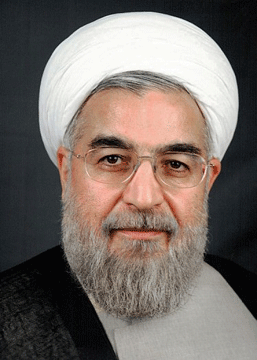 Iran’s president calls for end to isolation, urges nuclear deal By RAMIN MOSTAGHIM AND MOLLY HENNESSY-FISKE LA TIMES, 4 JAN 15 contact the reporter Iranian President Hassan Rouhani called international nuclear negotiations a matter of “heart” on Sunday, and said Iran needed to end its political isolation to allow its economy to grow.
Rouhani made his remarks to a conference of 1,500 economists in Tehran, Iran’s Fars news agency said. The speech, delivered before nuclear talks resume next week in Geneva, appeared to be an attempt to stave off criticism from hard-liners while demonstrating a willingness to work with international powers………
Anti-Western hawks in the Islamic Revolutionary Guard Corps who report to Supreme Leader Ayatollah Ali Khamenei lead companies that have benefited from sanctions and have been wary of nuclear negotiations.
With Sunday’s speech, Rouhani paved the way for a nuclear deal in coming months, raising the specter of referendums to head off criticism from conservatives, said Tehran political analyst Nader Karimi Juni.
“President Rouhani is preparing public opinion and hard-liners for the deal to happen,” Juni said, sending a signal that “the number of centrifuges and enrichment levels are not red lines for Iran.”…….http://www.latimes.com/world/middleeast/la-fg-iran-president-nuclear-deal-20150104-story.html
Call for Japan to play its part in nuclear disarmament process
Experts urge Japan to play greater role in nuclear disarmament process, Japan Times 4 Jan 15, JIJI WASHINGTON – Ahead of August’s 70th anniversaries of the U.S. atomic bombings of Hiroshima and Nagasaki, some experts are calling on Japan to play a greater role in the effort toward global nuclear disarmament.
“The Japanese government could be more supportive of reductions (of nuclear arms) than it is,” said Joseph Cirincione, president of the Ploughshares Fund, a U.S. group aiming to create a nuclear-free world.
Cirincione, also a member of U.S. Secretary of State John Kerry’s International Security Advisory Board, said U.S. government officials often stress that President Barack Obama needs support from U.S. allies in pushing his agenda of nuclear disarmament.
“If there was any ally who could play that role, it would be Japan,” Cirincione said. “And it would be in 2015,” he added, referring to a review conference on the Nonproliferation Treaty to be held in April and May, as well as the 70th anniversaries of the nuclear bombings……
Daryl Kimball, executive director at the Arms Control Association, a U.S. think tank, said that Japan and other U.S. allies “should be more vocal” about encouraging the U.S. and Russia to promote nuclear disarmament.
Kimball proposed a nuclear disarmament summit and said, “The year 2015 could be a very good year to start such a nuclear disarmament process,” citing the anniversaries of the atomic bombings. “Japan would be a very logical host country.” http://www.japantimes.co.jp/news/2015/01/04/national/politics-diplomacy/experts-urge-japan-play-greater-role-nuclear-disarmament-process/#.VKrhOdLF8nk
Nuclear industry bamboozling the Environmental Protection Agency: Nuclear is NOT clean
 Unclean Nuclear Energy, ttp://www.nytimes.com/2015/01/02/opinion/unclean-nuclear-energy.html ROGER JOHNSON The nuclear industry is bamboozling the Environmental Protection Agency into its agenda of promoting nuclear power as “clean” (“E.P.A. Wrestles With Role of Nuclear Plants in Carbon Emission Rules,” Business Day, Dec. 26). It is no secret that every nuclear power plant regularly emits low-level radiation into the environment. Why focus only on carbon emissions while ignoring iodine-129, plutonium-239, cesium-135 and other lethal radionuclides?
The nuclear industry wants us to focus narrowly on the fission process and to ignore the footprint of mining, milling, 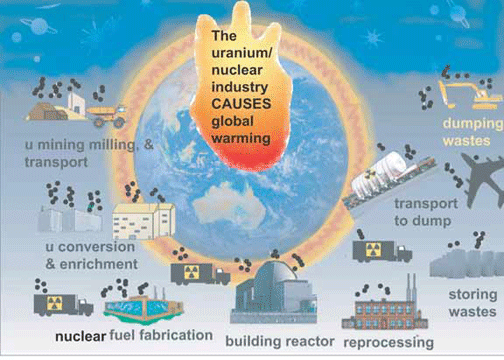 enrichment, processing and storing of nuclear fuel.
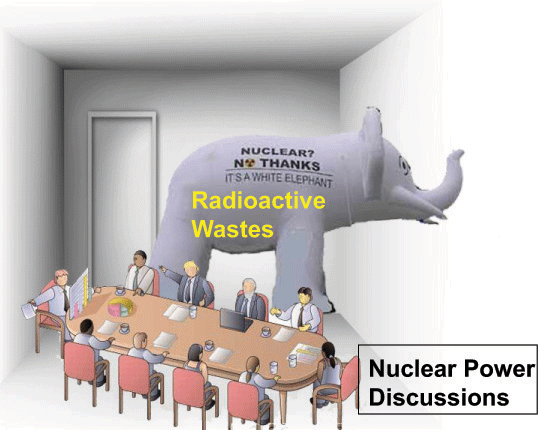 It also wants us to ignore the elephant in the room: its inability to rid the planet of high-level nuclear waste that accumulates every hour that any nuclear power plant is operating. The latest plan of the Nuclear Regulatory Commission in effect to turn every nuclear power plant in the country into a nuclear waste dump is shocking indeed.
The bottom line is very simple: Nuclear power is the most expensive, the most unreliable, the most dangerous and the most environmentally damaging of all forms of energy production.
14
David Attenborough’s warning to world leaders, to stop denying climate change
 David Attenborough: Leaders are in denial about climate change The Independent 1 Jan 15 Sir David Attenborough is calling on global leaders to step-up their actions to curb climate change, saying that they are in denial about the dangers it poses despite the overwhelming evidence about its risks.
The TV naturalist said those who wield power need to use it: “Wherever you look there are huge risks. The awful thing is that people in authority and power deny that, when the evidence is overwhelming and they deny it because it’s easier to deny it – much easier to deny it’s a problem and say ‘we don’t care’,” Sir David said.
In terms of climate change, “we won’t do enough and no one can do enough, because it’s a very major, serious problem facing humanity; but at the same time it would be silly to minimise the size of the problem,” he told Sky News.
Later this year a crucial UN climate summit will be held, at which world leaders have pledged to agree to tough cuts in their carbon emissions, to ensure the increase in global warming does not exceed 2°C – beyond which its consequences become increasingly devastating.
Although that meeting is not scheduled to take place until December, the scale of the task ahead is huge and world leaders are already working towards the summit.
However Sir David is concerned that, despite the increasingly obvious scale of the threat climate change poses, leaders are not taking the matter as seriously as they should. “Never in the history of humanity in the last 10 million years have all human beings got together to face one danger that threatens us – never.
“It’s a big ask, but the penalty of not taking any notice is huge,” he said.
Sir David’s comments come two days after a separate warning – on the dangers posed by the booming human population. “It’s desperately difficult, the dangers are apparent to anybody,” he told The Independent. We can’t go on increasing at the rate human beings are increasing forever, because the Earth is finite and you can’t put infinity into something that is finite.
“So if we don’t do something about it – the natural world that is – we will starve,” Sir David said…………..http://www.independent.co.uk/environment/climate-change/david-attenborough-leaders-are-in-denial-about-climate-change-9953302.html
AUDIO: Nuclear Hotseat interviews /IPPNW’S DR. ALEX ROSEN, RPHP’S JOSEPH MANGANO
INTERVIEWS:
- Dr. Alex Rosen of International Physicians for the Prevention of Nuclear War, who takes on and eviscerates the United Nations’UNSCEAR report that criminally underplays the radiation dangers from Fukushima; International Physicians for the Prevention of Nuclear War; www.ippnw.org
- Epidemiologist Joseph Mangano, executive director of Radiation and Public Health Project, who explains why TEPCO’s interpretation of radiation data is intentionally wrong as the company tries to undermine legitimate claims of damages to the health of the USS Ronald Reagan sailors, who were hit with catastrophic radiation while on an humanitarian aid mission in the immediate aftermath of Fukushima. www.Radiation.org.
LINKS TO IPPNW’S CRITICAL ANALYSIS OF UNSCEAR REPORT:
IPPNW – English: Link to downloadable PDF:http://www.fukushima-disaster.de/fileadmin/user_upload/pdf/english/Akzente_Unscear2014.pdf
IPPNW – Germany: www.ippnw.de
IPPNW Germany’s Fukushima Website w/link to downloadable PDF: www.fukushima-disaster.de
Japanese version of Critical Analysis of UNSCEAR report – WHO (世界保健機関)の「2011年東日本大地震津波後の原発事故がもたらす被曝線量の仮算定」フクシマ大災害リポート:アレックスローゼン博士による分析の 日本語版はこちらをクリックして下さい。:http://fukushimavoice2.blogspot.com/2014/06/psrippnw-unscear.html
Nuclear industry hampered by unsolved problem of radioactve wastes
 Another Reactor Closes, Punctuating New Reality for U.S. Nuclear Power As Vermont Yankee shuts down, the U.S. has yet to address industry issues that span decades Christina Nunez National Geographic JANUARY 1, 2015“……….Another pain point: The U.S. still has no federal repository for nuclear waste, a political football game seemingly longer than the half-life of uranium. The fight over plans to create such a repository under Yucca Mountain in Nevada has dragged on since the 1980s.
Instead, the waste is stored at the plants, where the owners are responsible for keeping it secure. Most of the decommissioning cost for Vermont Yankee after 2016 will go toward security measures and staff for the stored waste, Entergy’s Cohn said.
Meanwhile, new nuclear development is haltingly under way. In 2012, the NRC approved licenses for the first new reactor construction in decades, but the projects—Vogtle in Georgia and V.C. Summer in South Carolina—have suffered delays and ballooning costs.
In a final rule issued this year, the NRC said that spent fuel could be stored safely at nuclear sites for 60 years or more. Timothy Frazier, a senior adviser at the Bipartisan Policy Center, which advocates for a federal waste site, says that decision contributed to a lack of urgency in Washington to hammer out a long-term solution to the nation’s nuclear waste.
“It can sit for 60 years, or it can sit for 100 years,” says Frazier, noting that spent nuclear fuel has to be isolated for hundreds of thousands of years as a potential hazard to people and the environment. “That’s not the end of the problem.”
On Twitter: Follow Christina Nunez and get more environment and energy coverage at NatGeoGreen.
The story is part of a special series that explores energy issues. For more, visit The Great Energy Challenge. http://news.nationalgeographic.com/news/energy/2015/01/150101-vermont-yankee-shutdown-us-nuclear-issues/
Video shows time and cost of Decommissioning Nuclear Plant
 VIDEO: Decommissioning Nuclear Plant Lengthy, Costly Process https://hereandnow.wbur.org/2015/01/01/decommissioning-nuclear-plant The Vermont Yankee nuclear power plant stopped producing electricity this week for New England’s energy grid, but that doesn’t mean all operations at the plant will cease.
The plant now needs to be decommissioned — a process that is very expensive and can take decades.
Edwin Lyman, an expert on nuclear power safety and security and a senior scientist for theUnion of Concerned Scientists, tells Here & Now’s Peter O’Dowd what it takes to decommission a nuclear plant and why the future of nuclear power depends on economics.
1 This Month
Chernobyl: The Lost Tapes – A good documentary on Chernobyl on SBS available On Demand for the next 3 weeks– https://www.sbs.com.au/ondemand/tv-program/chernobyl-the-lost-tapes/2352741955560

of the week–London Campaign for Nuclear Disarmament

Tell the Ukrainian Government to Drop Prosecution of Peace Activist Yurii Sheliazhenko
To see nuclear-related stories in greater depth and intensity – go to https://nuclearinformation.wordpress.com
-
Archives
- April 2026 (139)
- March 2026 (251)
- February 2026 (268)
- January 2026 (308)
- December 2025 (358)
- November 2025 (359)
- October 2025 (376)
- September 2025 (257)
- August 2025 (319)
- July 2025 (230)
- June 2025 (348)
- May 2025 (261)
-
Categories
- 1
- 1 NUCLEAR ISSUES
- business and costs
- climate change
- culture and arts
- ENERGY
- environment
- health
- history
- indigenous issues
- Legal
- marketing of nuclear
- media
- opposition to nuclear
- PERSONAL STORIES
- politics
- politics international
- Religion and ethics
- safety
- secrets,lies and civil liberties
- spinbuster
- technology
- Uranium
- wastes
- weapons and war
- Women
- 2 WORLD
- ACTION
- AFRICA
- Atrocities
- AUSTRALIA
- Christina's notes
- Christina's themes
- culture and arts
- Events
- Fuk 2022
- Fuk 2023
- Fukushima 2017
- Fukushima 2018
- fukushima 2019
- Fukushima 2020
- Fukushima 2021
- general
- global warming
- Humour (God we need it)
- Nuclear
- RARE EARTHS
- Reference
- resources – print
- Resources -audiovicual
- Weekly Newsletter
- World
- World Nuclear
- YouTube
-
RSS
Entries RSS
Comments RSS
 nuclear-news