VIDEO: Nuclear refugees
VIDEO: Nuclear refugees http://www.dw.de/nuclear-refugees/av-18309870 This week Japan marked four years since a tsunami caused a nuclear disaster at Fukushima. The magnitude 9 earthquake which struck northeast Japan in March 2011 caused a humanitarian crisis and left thousands dead. But four years on, “nuclear refugees” from the surrounding villages are still living in temporary accommodation.
Situation at crippled Fukushima nuclear plant still dangerous – 4 years on
Fukushima plant still posing risks 4 years after nuclear meltdowns: regulator http://www.interaksyon.com/article/106741/fukushima-plant-still-posing-risks-4-years-after-nuclear-meltdowns-regulator By: Philippine News Agency | Kyodo March 11, 2015 InterAksyon.com The online news portal of TV5 TOKYO — The situation still remains risky at the crippled Fukushima Daiichi power plant four years after nuclear meltdowns occurred in 2011, the chairman of Japan’s nuclear regulator said Wednesday, vowing utmost efforts to avoid further trouble there.
“There have been quite a few accidents and problems at the Fukushima plant in the past year, and we need to face the reality that they are causing anxiety and anger among people in Fukushima,” Shunichi Tanaka told personnel at the Nuclear Regulation Authority on the fourth anniversary of a devastating earthquake and tsunami that led to the nuclear disaster.
Problems still occur regularly at the radiation-leaking complex in Fukushima Prefecture, where decommissioning work is continuing after the massive earthquake and tsunami that hit northeastern Japan on March 11, 2011, caused the loss of power to reactor cooling systems, leading to a series of explosions in ensuing days.
The impact of the Fukushima nuclear catastrophe continues
3 ways the Fukushima nuclear disaster is still having an impact today WP, By Rick Noack March 12 “…….In 2015, has the world forgotten the threat that was posed by Fukushima? Here are three ways the disaster is still having an impact today.
1. The Fukushima disaster itself is far from being over
Although about 6,000 employees have returned to the Daiichi power plant to work there daily, its ruins still pose a significant threat. Nuclear radiation remains dangerous in and around the destroyed reactors. Villages in its proximity will remain a no-go zone for inhabitants for an unpredictably long time.
The nuclear power plant itself is far from being secured: Its owner TEPCO has so far been unable to remove hundreds of fuel rods stored nearby because the 2011 earthquake destabilized or destroyed large parts of the buildings. Furthermore, radiation continues to contaminate underground water.
Despite the contamination of large swaths of land, agricultural products and water resources, Japan’s government remains convinced that nuclear energy will be an inevitable energy source for the country in the future.
According to some surveys, 70 percent of Japan’s population opposed a reliance on nuclear energy. However, the Japanese government under the leadership of Shinzō Abe has decided to restart many of the country’s troubled nuclear power plants…….the Japanese government seems to have put economic growth above nuclear safety…..
2. Fukushima has provided opponents of nuclear power with strong arguments……
3. Germany has decided to abandon nuclear energy…..the German government has worked on a long-term strategy to make it independent from nuclear energy as well as coal in the future……support for Merkel’s decision has always been high.http://www.washingtonpost.com/blogs/worldviews/wp/2015/03/12/3-ways-the-fukushima-nuclear-disaster-is-still-having-an-impact-today/
Thousands of German anti nuclear protestors mark Fukushima nuclear accident anniversary
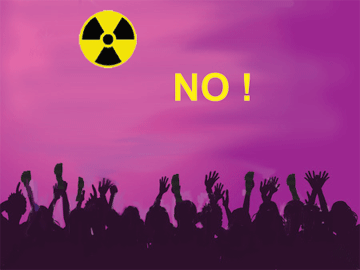
 German protesters call for end to nuclear power as they remember Fukushima EuroNews 11 Mar 15 Thousands of demonstrators have called for an end to nuclear energy during a rally in Neckarwestheim, in southern Germany.
They gathered in the town, home to a nuclear plant, to remember Japan’s Fukushima disaster four years ago.
Protesters chanted “switch off,” while holding banners reading “Fukushima out of control” and carrying mock coffins…….http://www.euronews.com/2015/03/08/german-protesters-call-for-end-to-nuclear-power-as-they-remember-fukushima/
17% of Japanese won’t buy foodstuffs from Fukushima
Nearly One in Five Japanese Reluctant to Buy Fukushima Food About 17% of Japanese consumers remain cautious about buying food produced in Fukushima prefecture, according to a twice-yearly survey carried out by the Consumer Affairs Agency following the Fukushima nuclear accident……http://blogs.wsj.com/japanrealtime/2015/03/11/nearly-one-in-five-japanese-reluctant-to-buy-fukushima-food/
2020 renewable energy goals already achieved in 3 European countries
Three European countries have already hit their 2020 renewable energy goals, Quartz 11 Mar 15 In 2010, the European Union set a goal of producing 20% of its total energy from renewable sources by 2020. The latest figures show that the union as a whole reached the 15% mark in 2013. But the combined figure includes some countries already exceeding their targets, while others lag far behind.Three out of the 28 EU member states have surpassed their 2020 goals. Sweden had one of the most ambitious goals, planning to produce 49% of its energy from renewable sources by 2020. It’s already gone further than that, with 52.1% from renewable sources in 2013. Bulgaria and Estonia also are producing more than they had been targeting, five years ahead of schedule.
Lithuainia has hit its 23% target, while Romania and Italy are within half a percentage point of theirs.Some countries, like Norway, have goals way above the collective 20%, and are getting close to achieving them. And some countries do particularly well in certain technologies, like wind power in Denmark……..http://qz.com/359415/three-european-countries-have-already-hit-their-2020-renewable-energy-goals/
Nestle wants ground-water because it is relatively free of nuclear-caused tritium contamination?
 From a Contributor, 9 March 15 The real reason Nestle wants in on this source is because all fresh surface water on this planet has become polluted with tritium (radioactive hydrogen) from nuclear explosions, and nuclear reactors which leak it all the time.
Nuclear facilities have no known method of containing and managing tritium Nuclear accidents like at Fukushima, Chernobyl, TMI etc are still poisoning the planet with escaping tritium. The do not know how to effectively contain it nor can our municipal water treatment plans filter tritium, now radioactive water, out of the water.
Nestle is looking to corner the ground water because it is relatively tritium free. I think it should be given free to all pregnant mothers everywhere because tritium is teratogenic.
Outrage boils over as B.C. government plans to sell groundwater for $2.25 per million litres BY DAN FUMANO, THE PROVINCE
More than 82,000 people have signed a petition against the government’s plans to sell B.C.’s water for $2.25 per million litres.
“It is outrageous,” says the online petition from SumOfUs.org, that corporations can buy water “for next to nothing.”
B.C.’s Water Sustainability Act (WSA), which comes into effect next January and replaces the province’s century-old water legislation, has been heralded as a major step forward. But politicians and experts are raising doubts over whether the newly announced water fees may be too low to cover the cost of the program, asking if the act simply won’t be implemented properly, or if taxpayers could end up picking up the bill.
Last month, the government unveiled the new water pricing structure, which will include, for the first time in B.C.’s history, groundwater being regulated and subject to fees and rentals.
Critics said that, while it’s a step in the right direction, the prices are still not close to capturing the resource’s value….
water rates for industrial users, which are a fraction of what some provinces charge, are “like a giveaway” to corporations, critics say……http://www.leaderpost.com/news/Outrage+boils+over+plans+sell+groundwater+million+litres/10865416/story.html
Former Japanese Prime Minister Naoto Kan talks to Green Cross in Paris
Former Japanese PM Naoto Kan in Paris for Green Cross nuclear debate , Green Cross 05/03/2015 The conference, “Four years after the Fukushima catastrophe: lessons learned”, was addressed by former Japanese Prime Minister Naoto Kan. Kan led his country through the terrible events that followed the earthquake and tsunami on 11 March, 2011 and has since become a committed anti-nuclear activist.
“Before the accident, my political position was favourable to the continued development of nuclear power, so long as the necessary precautions were taken – I even promoted the technology abroad,” said Kan. “But afterwards my thinking changed completely. For the rest of my mandate I committed to reducing Japan’s reliance on nuclear energy and developed laws to promote energy efficiency and renewable energy. Just like atomic bombs, nuclear energy is a technology we cannot entirely control. The experts tell us there is no such thing as a zero-risk nuclear power station. Effectively, natural disasters are always a possibility and should that risk be manifested all we can do is try to manage the consequences.”
Adam Koniuszewski, Chief Operating Officer of Green Cross International, put the discussion into the context of Green Cross’ work, starting in 1993, with the victims of such disasters as the Chernobyl meltdown.
“The founding president of Green Cross, Mikhail Gorbachev, and Prime Minister Naoto Kan share the sad experience of having both led their country through major nuclear disasters,” said Koniuszewski. “Our local presence and ongoing activities to help the communities impacted by radioactive contamination in Chernobyl and Fukushima gives us first-hand experience of the human and environmental consequences of nuclear disasters. This is why we are demanding more transparency and better governance around nuclear power and the risks involved, and a better assessment of its mounting costs. New plants are plagued with delays and cost overruns; the management of nuclear waste in increasingly burdensome and the cost of decommissioning plants is escalating. In the meantime renewable energy solutions are getting cheaper. Over the last five years the cost for utility scale solar has declined by 78 per cent, and by for wind by 58 per cent.”…….
Kan had some closing thoughts, encouraging France to take the upcoming opportunity provided by ParisClimat 2015 to start moving away from nuclear power. He also recommended a much more comprehensive, transparent and democratic approach to preparing for a possible nuclear catastrophe.
“Zero-risk does not exist, and cost-effectiveness is a meaningless concern when weighed against the trauma and impact of a nuclear disaster,” said Kan.
Furthermore, Japan’s experience shows that nuclear power is not nearly as indispensable as its supporters claim. Following the Fukushima disaster, all of Japan’s nuclear reactors – providing 25 per cent of the country’s electricity – were shut down. In response, Japan managed to reduce national consumption from 65GW to 50GW and, as systems are built back up, many people are looking much more seriously at the opportunity to switch to increasingly attractive and cost effective renewable solutions. So far, local communities have taken the lead in putting renewable power sources in place. http://www.gcint.org/news/former-japanese-pm-naoto-kan-paris-green-cross-nuclear-debate
South Carlina lawmakers want no more nuclear waste into the State
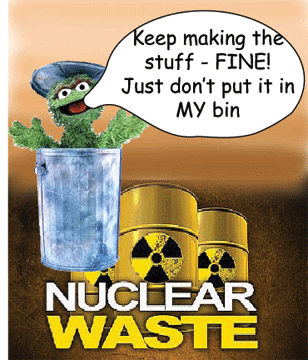 Courson, Lourie: SC has borne heavy burden on nation’s nuclear waste; no more, The State, South Carolina BY JOHN COURSON AND JOEL LOURIE March 8, 2015 COLUMBIA, SC — Barnwell County bore the burden of burying the nation’s low-level nuclear waste for decades. Beginning in 1971 as a modest 10-20 acre landfill, it was taking all of the nation’s radioactive, commercial waste eight years later.
To reduce South Carolina’s burden, Gov. Richard A. Riley brought eight states together in 1982 to form the Southeast Low Level Nuclear Waste Compact, and Barnwell was slated to close when North Carolina opened a successor site in 1992. When political pressure delayed North Carolina’s site selection, Gov. Carroll A. Campbell extended the closing to 1996.
When North Carolina again defaulted, a proviso was slipped in an appropriations bill to withdraw South Carolina from the compact and re-open Barnwell to the nation. Despite polls showing that 75 percent of the public wanted Barnwell closed, the waste stream increased, along with the dollars………
Barnwell’s limited remaining space should be preserved for South Carolina’s own future disposal needs and those of our compact partners. If revenues from reduced volumes of waste being buried are insufficient to operate the site, operating plans and disposal rates should be revised.
South Carolina has borne its fair share of waste, both nuclear and hazardous. The idea of changing the compact law to allow more dangerous nuclear material to be buried at Barnwell in order to increase revenues is short-sighted. With a modern site now opened in west Texas by Waste Control Specialists, it’s also unnecessary for the industry.
Given South Carolina’s unfortunate legacy at Pinewood, our job is to reduce South Carolina’s waste burden, not add to it. In our view, the Atlantic Compact is working. We understand that an effort will be made in the General Assembly to alter the compact to allow for all states to again have access to Barnwell for their low-level nuclear waste. As members of the Senate and original members of the 2000 Nuclear Waste Task Force, we will vigorously oppose such efforts. We never want South Carolina to again receive the dubious sobriquet of being the nation’s dumping ground for nuclear and hazardous waste.
Sen. Courson is a Columbia Republican, and Sen. Lourie is a Columbia Democrat; contact them atjoellourie@scsenate.gov or johncourson@scsenate.gov. http://www.thestate.com/2015/03/08/4031605/courson-lourie-sc-has-borne-heavy.html
US secretary of state reassuring Gulf States on Iran nuclear deal
Kerry in Riyadh to calm Gulf fears on Iran nuclear deal US secretary of state to brief Saudi king and GCC foreign ministers on latest talks and also discuss crisis in Yemen. Aljazeera, 05 Mar 2015 US Secretary of State John Kerry has arrived in Saudi Arabia in a bid to ease Gulf Arab concerns about an emerging nuclear deal with Iran and discuss ways to calm instability in troubled Yemen and other Mideast nations.
US officials said Kerry will reassure regional officials that a deal with Tehran will not allow Iran to produce a nuclear bomb and will not mean US complacency on broader security matters.
Kerry will see the new Saudi monarch, King Salman, and meet separately with the foreign ministers of the members of the Gulf Cooperation Council (GCC) – Bahrain, Kuwait, Oman, Qatar, Saudi Arabia and the United Arab Emirates…………..
Kerry will also discuss the deteriorating conditions in Syria and the fight against the Islamic State of Iraq and the Levant group there and in Iraq.
US officials said Kerry would stress that Washington does not see a military solution to the conflict in Syria, but also does not think a political solution is possible while Syrian President Bashar al-Assad remains in power. http://www.aljazeera.com/news/2015/03/kerry-riyadh-calm-gulf-fears-iran-nuclear-deal-150305063306644.html
An expensive waste of time – Thorium Nuclear Reactors
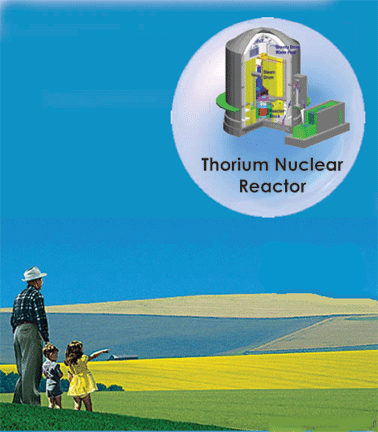 Why are we not using Thorium instead of Uranium for power? https://in.answers.yahoo.com/question/index?qid=20150303142722AA751rC “I have followed this technology for some years with interest. It has merits and one great demerit – it is very costly – at least twice the cost of most renewables. So why go this route? The so called renaissance of uranium reactors has become a fiasco. The Finnish project with Areva was to cost $2500 per Mwe for the first prototype,with $1200 per Mwe in the following standardized units.The reality is 3 years behind schedule, 77% over budget with no hope of completion at less than a 100% overrun, and standardized successors now priced at $5000 per Mwe, four times the hoped for cost.
There is no reason whatever to claim thorium based reactors will be any cheaper. We cannot afford to waste precious time and money on nuclear, but should have a crash implementation of commercializing renewables like wind and solar thermal electric.”
New batteries, clever engineering promote Britain’s renewable energy – leaving nuclear behind
 Renewable energy is conquering quirky nature of Britain’s climate, http://www.theguardian.com/news/2015/mar/02/weatherwatch-wind-solar-nuclear-renewable-energy Guardian, Paul Brown, 3 Mar 15
New solar farms will make a big difference to the energy mix
Britain’s energy supply is increasingly driven by the weather. As spring progresses, large numbers of new solar farms will make a noticeable difference to the energy mix. Wind farms on and offshore are also being brought on line.
At the same time the decision over whether to go ahead with Britain’s first new atomic plant in 30 years in Somerset has been put off again. Even if it is built the station is unlikely to be producing power before 2030. This leaves 15 years in which the electric output from renewables in their many forms will grow dramatically as costs fall. Solar, wind and small-scale hydropower are all now cheaper than new nuclear build and undersea turbines and even wave power are getting more competitive.
One big drawback to acceptance of renewables has been opponents drawing attention to the quixotic nature of British weather causing output to vary; but even that problem is being conquered. Individual solar systems for homes can now come with domestic water heating devices and batteries to run the house when the sun goes down. Much larger district batteries, storing energy from surplus wind and solar during the day, are providing power in the evening peak.
Energy policies seem to have lagged behind the exciting possibilities this holds out for Britain’s energy supply, contrasting sharply with enthusiasm for the stagnant nuclear industry. But clever engineering, smoothing out the peaks and troughs of renewable power, looks like making the nuclear industry redundant before a new station can be built.
Nuclear power? simply an unclean industry
 Unclean Nuclear Energy http://www.nytimes.com/2015/01/02/opinion/unclean-nuclear-energy.html?_r=0 ROGER JOHNSON 3 Mar 15 The nuclear industry is bamboozling the Environmental Protection Agency into its agenda of promoting nuclear power as “clean” (“E.P.A. Wrestles With Role of Nuclear Plants in Carbon Emission Rules,” Business Day, Dec. 26). It is no secret that every nuclear power plant regularly emits low-level radiation into the environment. Why focus only on carbon emissions while ignoring iodine-129, plutonium-239, cesium-135 and other lethal radionuclides?
The nuclear industry wants us to focus narrowly on the fission process and to ignore the footprint of mining, milling, enrichment, processing and storing of nuclear fuel.
It also wants us to ignore the elephant in the room: its inability to rid the planet of high-level nuclear waste that accumulates every hour that any nuclear power plant is operating. The latest plan of the Nuclear Regulatory Commission in effect to turn every nuclear power plant in the country into a nuclear waste dump is shocking indeed.
The bottom line is very simple: Nuclear power is the most expensive, the most unreliable, the most dangerous and the most environmentally damaging of all forms of energy production.
De3fect in pipe causes shutdown of France’s oldest nuclear plant at Fessenheim
The plant, which is near the Swiss and German borders, was closed on Saturday due to a flaw in a pipe in the machine room, which does not house nuclear material.
Activists have long campaigned for the plant’s permanent closure due to its age. The Fessenheim plant is made up of two 900 megawatt reactors and has been running since 1977, making its France’s oldest operating plant.
Greenpeace activists have voiced their complaints to French President François Hollande and German Chancellor Angela Merkel to push Europe towards a real energy transition, rather than depend on either nuclear power, as is the case in France or coal power, as in Germany.
Wind energy myths lead British public to over-estimate renewables costs
New industry-backed survey shows that the UK public think subsidies for wind power are more than 14 times higher than they actually are (subscribers only) http://www.businessgreen.com/bg/news/2397404/wind-energy-myths-lead-british-public-to-over-estimate-renewables-costs
1 This Month

of the week – Shut Down Drone Warfare!


Tell the Ukrainian Government to Drop Prosecution of Peace Activist Yurii Sheliazhenko

Petition to revoke the licensing of the Near Surface Nuclear Disposal Facility (NSDF) at Chalk River. https://www.ourcommons.ca/petitions/en/Petition/Details?Petition=e-7247
To see nuclear-related stories in greater depth and intensity – go to https://nuclearinformation.wordpress.com
-
Archives
- April 2026 (114)
- March 2026 (251)
- February 2026 (268)
- January 2026 (308)
- December 2025 (358)
- November 2025 (359)
- October 2025 (376)
- September 2025 (257)
- August 2025 (319)
- July 2025 (230)
- June 2025 (348)
- May 2025 (261)
-
Categories
- 1
- 1 NUCLEAR ISSUES
- business and costs
- climate change
- culture and arts
- ENERGY
- environment
- health
- history
- indigenous issues
- Legal
- marketing of nuclear
- media
- opposition to nuclear
- PERSONAL STORIES
- politics
- politics international
- Religion and ethics
- safety
- secrets,lies and civil liberties
- spinbuster
- technology
- Uranium
- wastes
- weapons and war
- Women
- 2 WORLD
- ACTION
- AFRICA
- Atrocities
- AUSTRALIA
- Christina's notes
- Christina's themes
- culture and arts
- Events
- Fuk 2022
- Fuk 2023
- Fukushima 2017
- Fukushima 2018
- fukushima 2019
- Fukushima 2020
- Fukushima 2021
- general
- global warming
- Humour (God we need it)
- Nuclear
- RARE EARTHS
- Reference
- resources – print
- Resources -audiovicual
- Weekly Newsletter
- World
- World Nuclear
- YouTube
-
RSS
Entries RSS
Comments RSS
 nuclear-news