Nuclear bombs enrich weapons manufacturers, endanger everyone
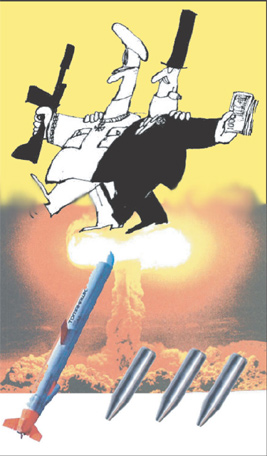 Ban nuclear weapons http://www.nwherald.com/2015/03/10/letter-ban-nuclear-weapons/ahb6avx/ Bernice Russell March 22, 2015 Austria and 40 nations met to ban nuclear weapons, but the U.S. and allies opposed banning.
U.S. military and the war industry want additional nuclear bombs and nuclear missiles (bombers) for delivering bombs – radioactive bombs stronger than the one dropped on Hiroshima, which killed thousands.
For 50 years, the Los Alamos Laboratory engineered profitable versions of nuclear bombs. The U.S. had 800 nuclear bombs and plans on producing 500 more of a new version at $20 million each, totaling $10 billion more in government military spending.
Only 300 are deployed at bases with nuclear missile capability. Two hundred bombs are at bases in Italy, Turkey, Netherlands, Germany. Ten million Germans would be killed in nuclear exchange. U.S. European command, former Defense Secretary Colin Powell, etc. find no military value in European nuclear bombs.
Regarding the new nuclear missile, or long-range bomber with government spending $80 billion, to target China possibly, the Congressional Research Service finds over 80 percent of crude oil supplies to Japan, South Korea and Taiwan flow through the South China Sea, and long-range bombers could check any potential adversary to threaten us and our allies “access to Asia commons” – i.e. oil, imports.
More nuclear bombs and nuclear missiles are unnecessary government military spending to profit war businesses.
Ban them and older nuclear weapons.
Britains aging nuclear veterans get a few crumbs from government
Mean-Spirited UK Finally Throws a Few Shared Crumbs at Elderly UK Atomic Veterans Mining Awareness, 22 Mar 15 The moral test of government is how it treats those who are in the dawn of life, the children; those who are in the twilight of life, the aged; and those in the shadows of life, the sick, the needy and the handicapped.”Hubert H. Humphrey [1]
Victims of British Nuclear Tests have fought for decades for some recognition of their illnesses, along with some financial compensation. The UK government has now offered money to be shared with all aging veterans. Why do veterans, especially the elderly ones, have to get the run around? The US also viciously gives the run around to elderly atomic veterans who have the wrong type of cancer. Why are they so mean-spirited? Just give the veterans their damn money! They were drafted and/or trying to serve their country. The UK and the US waste tons of money. Stop subsidizing the nuclear and petroleum industries for a start. Only a few days ago the UK proposed lower taxes for petroleum companies in the North Sea.
Some background. ……..https://miningawareness.wordpress.com/2015/03/21/mean-spirited-uk-finally-throws-a-few-shared-crumbs-at-elderly-uk-atomic-veterans/
Tepco doesn’t know whereabouts of the Fukishima nuclear reactor 1 fuel cores
Thousands of TEPCO Nuclear Bombs missing https://tekknorg.wordpress.com/2015/03/19/thousands-of-tepco-nuclear-bombs-missing/ March 19, 2015 by Mikkai No Meltdown!
Missing: The radioactivity of 1,000 uranium bombs and 40 plutonium bombs
Just in: TEPCO Reactor 1 EMPTY: “no fuel or water remaining in reactor core of Reactor 1″: http://fukushima-diary.com/2015/03/irid-saw-no-fuel-or-water-remaining-in-reactor-core-of-reactor-1/
A year before: “As a result, highly radioactive parts were found near the inert gas pipes, which were used to venting in 311″: http://fukushima-diary.com/2014/01/1-6-svh-on-the-first-floor-of-reactor1-highly-radioactive-source-is-in-the-vent-pipe/
Confirmation: http://www3.nhk.or.jp/lnews/fukushima/6053332341.html?t=1426771840904
“an average operating nuclear power reactor will have approximately 16 billioncuries in its reactor core. This is the equivalent long-lived radioactivity of at least 1,000 Hiroshima bombs.”http://www.nirs.org/factsheets/routineradioactivereleases.htm
Unit 2 also empty: NO MELTDOWN:https://tekknorg.wordpress.com/2015/03/12/the-nuclear-meltdown-lie/
Safety is unaffordable to the nuclear industry
Nuclear Industry CAN’T AFFORD SAFETY [good illustrations) https://tekknorg.wordpress.com/2015/03/19/nuclear-industry-cant-afford-safety/March 19, 2015 by Mikkai
Japan – March 12th 2015: Four utilities to decommission five aging nuclear reactors:http://ajw.asahi.com/article/0311disaster/fukushima/AJ201503120041
2012: Japan shuts down last working nuclear reactor:http://www.theguardian.com/world/2012/may/05/japan-shuts-down-last-nuclear-reactor
It is still the biggest success against the Nuke Industry in human history:
ALL Japanese reactors are down or exploded:
WHAT IS SAFETY in Nuclear Terms?
Japan’s govt aims to end nuclear power ban – but legal obstacles remain
 That date could be pushed back, however, if courts grant injunctions to prevent restarts of all the country’s nuclear power stations, thereby extending Japan’s longest stretch without nuclear power since the 1960s.
The NRA’s consent on Wednesday was the second in a three-step process that all reactors have to go through before they will be allowed to restart. A final inspection in advance of a restart is also required……..As many as two-thirds of the country’s reactors may never return to operation because of high costs, local opposition or seismic risks, a Reuters analysis showed last year.: http://sputniknews.com/news/20150319/1019700843.html#ixzz3Uro9hHAx
Flogging a dead horse – India’s government and the nuclear industry
More important than all this is the Indian policymakers’-and-shapers’ disconnect from reality and obsession with nuclear technology
Contrary to pet myths, nuclear power is rapidly shrinking worldwide.
India would commit a historic blunder by expanding nuclear power generation
Fukushima, the world’s worst-ever nuclear accident (http://gu.com/p/46fjj/sbl), has probably sounded the death-knell of the global nuclear industry. It brutally exposed the unaffordable nature of nuclear risks even in developed societies, and has made atomic power publicly unacceptable everywhere
Nuclear has nothing going for it—not when wind and solar energy annually grow worldwide at 25% and 40%-plus, when their generation costs fall to those of gas- or coal-based power, and their modularity and flexibility establish their unparalleled versatility.
Four years after Fukushima, India still flogs a nuclear dead 
 horse http://www.dnaindia.com/analysis/column-four-years-after-fukushima-india-still-
flogs-a-nuclear-dead-horse-2069971 Thursday, 19 March 2015 – It’s a telling comment on the state of the Indian media that most of it blacked out the fourth anniversary of the still-continuing Fukushima nuclear catastrophe, which fell on March 11. The same media reported breathlessly on the Indian government’s plans to triple domestic nuclear power-generation capacity by 2020-21, and on the “breakthrough” achieved on the nuclear liability issue during Barack Obama’s recent visit to India.
In reality, there was no breakthrough—only sleights-of-hand to substitute administrative memoranda for proper laws enacted after prolonged legislative debate. This trick, meant to please US nuclear suppliers at the expense of India’s public, falls foul of Parliament’s intent. But it still won’t work. Westinghouse and GE, now owned by Japanese capital, are unlikely to sell reactors to India so long as an element of liability exists.
As for the projected capacity tripling, it belongs to an established pattern of extravagant promises and poor performance: if the Department of Atomic Energy’s 1967 projection had materialised, India by 2000 would have had 43,500 MW in capacity; it had 2,700 MW! Tripling assumes that 19 reactors would be started and completed in six years, when average global construction time is 10 years. Eight reactors are to be imported, an unlikely prospect given that companies like “nuclear champion” Areva, for which the Jaitapur site is earmarked, are on bankruptcy’s verge. Continue reading
No good reasons to tie Saskatchewan’s future to nuclear power
 No to nuclear http://www.leaderpost.com/technology/nuclear/10895427/story.html THE LEADER-POST MARCH 17, 2015 Dale Dewar, Wynyard Re: “Prof says Sask. needs nuclear power” (March 7). Why hasn’t Saskatchewan gone nuclear?
1. Cost: No nuclear reactor has been built on budget (or even close to it) or on time. If it ever gets running, the energy produced has never been cost-efficient.
2. Water: No matter what the size of a nuclear power plant, it needs a lot of water. The water is returned to the rivers or lakes at a higher temperature.
3. Waste: No solution has been found. As for burying it in “solid rock”, once the rock has been disturbed to create the burial site, it is no longer solid. Two recently promising burial sites have leaked in less than two decades. One of the difficulties with problems underground is that when they occur, the tunnels are too dangerous for investigations.
4. Technology: The only time Canada has gone with unproven technology (which small modular reactors are) we were left with a government funded multi-million white elephant in the two Maple reactors near Ottawa. Need I remind people about the “new tech” reactor in Finland, still incomplete despite due date of 2012 and still uncertainty about it working?
There are no good reasons to tie our future to nuclear power. Promoting nuclear power as “green” is false – the only time it is green is the brief window during which it operates at full capacity (which is rare). And even then, its coolant water is warming the rivers. We have enough algae bloom already!
Dewar is a Saskatchewan physician, international human rights activist and author of From Hiroshima to Fukushima to You.
World peace in the balance as Iran nuclear talks reach deadline
 Deal or no deal? What happens next after Iran nuclear talks climax Guardian, Julian Borger and Chris Fenn, 19 Mar 15 This weekend marks the moment when negotiators attempt to finalise an accord that could launch a new era between Tehran and the west. It’s D-day for multinational talks on Iran’s atomic ambitions, as negotiators descend on Lausanne to try to finalise agreement on what nuclear technologyIran may pursue and what is beyond the pale.
The difference between success and failure could not be more stark. So what happens next if there’s a deal – and what would transpire if the talks failed?……. http://www.theguardian.com/world/2015/mar/19/what-happens-next-after-iran-nuclear-talks-climax
Japan’s Prime Minister Abe avoids Fukushima discussion, at U.N. conference on disaster risk
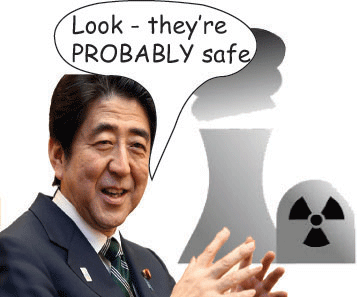 Abe mum on Fukushima at U.N. disaster risk confab, Japan Times KYODO, JIJI, STAFF REPORT MAR 15, 2015 SENDAI – Prime Minister Shinzo Abe had little to say on the tsunami-triggered core meltdowns in Fukushima as representatives from across the globe met at a U.N. conference on disaster risk reduction Sunday to underscore the urgent need to address climate change and reduce disaster impacts
On the second day of the U.N. World Conference on Disaster Risk Reduction in Sendai, French Minister of State for Development and Francophony Annick Girardin said climate change is responsible for over 80 percent of the damage caused by natural disasters.
The Sendai conference is “above all a call for lucidity, because it is no longer possible to ignore climate chaos” in the context of disaster risk mitigation, Girardin told the gathering, which began Saturday.
Meanwhile, in a speech Saturday at the conference, Prime Minister Shinzo Abe had few words on the triple core meltdown at the Fukushima No. 1 power plant. The disaster in Fukushima Prefecture erupted after a massive quake on March 11, 2011, spawned huge tsunami that took out the plant’s cooling systems.
Abe’s speech was strongly criticized by Tamotsu Baba, mayor of the town of Namie. “(Abe’s speech) was no good at all. He may not have wanted to give negative impressions (of Japan) because world leaders have gathered here,” Baba told reporters Saturday.
Namie is close to the plant, and about 21,000 of its residents were still living outside the town as of the end of February after losing their homes to radioactive fallout.
Speculation has been rife that Abe was attempting to avoid discussion about the Fukushima disaster because the No. 1 plant is plagued with radioactive water woes, including operator Tokyo Electric Power Co.’s failure to disclose the extent of the tainted water flowing into the Pacific……http://www.japantimes.co.jp/news/2015/03/15/national/abe-mum-on-fukushima-at-u-n-disaster-risk-confab/#.VQs8VtKUcnk
Japan’s old nuclear reactors to bite the dust
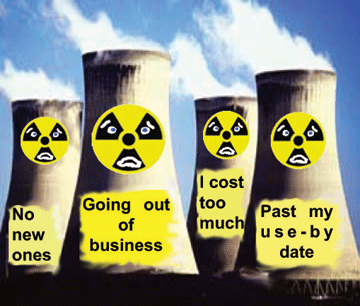
 Japan utilities set to scrap five aging nuclear reactors (Reuters) 17 Mar 15- Three aging nuclear reactors in Japan will be decommissioned due to the high cost of upgrading them in line with tougher safety standards set after the Fukushima disaster, their operators said on Tuesday.
Another two reactors were also likely to be scrapped, local media reports said, with announcements expected later in the week.
The moves are the first concrete sign that Japan’s nuclear industry is heeding a government request to shut down older reactors that are considered more vulnerable to natural disasters in the hope that it will ease public concerns about a restart of other reactors……..
It is the first time utilities have opted to close older reactors to comply with new safety standards set after the Fukushima disaster that limits a nuclear reactor’s lifespan to 40 years unless it can clear tough rules for a one-time extension. The deadline to apply for that extension is July 2015.
Japan’s trade ministry has been pushing nuclear operators for a quick decision on scrapping aging reactors that are too costly to upgrade, promising financial support for a smooth decommissioning.
Japan has revised accounting rules to allow utilities to spread the write-offs for reactor closures over 10 years and to pass on some of the cost to ratepayers. http://www.reuters.com/article/2015/03/17/us-japan-nuclear-decommission-idUSKBN0MD0WX20150317
Radioactivity detected in sample of tea from Japan
Hong Kong Finds Small Amount of Radioactivity in Sample of Japanese Tea NYT By KEITH BRADSHERMARCH 12, 2015HONG KONG — A sample of powdered tea imported from the Japanese prefecture of Chiba, just southeast of Tokyo, contained traces of radioactive cesium 137, the Hong Kong government announced late Thursday evening, but they were far below the legal maximum level.
The discovery was not the first of its kind. The government’s Center for Food Safety found three samples of vegetables from Japan with “unsatisfactory” levels of radioactive contaminants in March 2011, the month that nuclear reactors in Fukushima, northeast of Tokyo, suffered partial meltdowns following a powerful earthquake and tsunami.
Other samples of Japanese food have occasionally been found to have low levels of radiation since the Fukushima disaster, the Hong Kong food center said…….http://www.nytimes.com/2015/03/13/world/asia/hong-kong-finds-radioactive-contamination-in-sample-of-japanese-tea.html?_r=0
Nuclear power plants have no place in a modern Japan
Those who created the Fukushima Daiichi nuclear catastrophe know that their nuclear power plants have no place in a modern Japan. And they are fighting as hard as they can to stop clean energy progress and shore up their dirty-energy-based profits.
But, for the people of Japan, a majority of whom oppose any nuclear restart, there are massive opportunities on the horizon for a truly safe and clean future. And we, at Greenpeace, will stand with them – against the onslaught of the nuclear village – to ensure that the clean, renewable energy future becomes a reality.

A lesson from Fukushima: A safe, clean energy future will be nuclear-free, Greenpeace Kendra Ulrich – 11 March, 2015
“……Relying on nuclear to fulfill Japan’s climate obligations is betting the future of the planet and generations of people to come on a politician’s fantasy.
And, how “safe” and “clean” is this energy source, really? If we believe the nuke huggers, it is very safe – one catastrophic accident occurs only once every 250 years, they say.
However, it doesn’t take a nuclear scientist to tell you we’ve experienced a few more major accidents than that in the 70 years of nuclear programs, including the disaster at the Fukushima Daiichi power plant — with 3 reactors at the site experiencing core meltdowns; the catastrophic meltdown at Chernobyl; and the partial meltdowns at the Three Mile Island and Fermi 1 nuclear power plants in the US – just to name a few.
A logical person would look at this evidence, as well as the industry’s track record, and either revise their opinion or revise their prediction models. Probably both are in order.
Unfortunately, the industry, and many regulators, have continued to toe the “safety” line – while at the same time weakening reactor safety standards so that aging reactors can meet them. And the aging nuclear fleet in many parts of the world results in increased safety risks, as components degrade with time and wear.
If we are to discuss “safety” within the context of nuclear, it’s also important to broaden our perspective beyond a narrow focus on solely catastrophic accident risks at operating nuclear reactors, to major environmental and public safety risks imposed by the entire nuclear cycle. Continue reading
A safe, clean energy future will be nuclear-free
A lesson from Fukushima: A safe, clean energy future will be nuclear-free, Greenpeace Kendra Ulrich – 11 March, 2015 Today, the 11th of March 2015, marks the fourth year since beginning of one of the world’s worst nuclear disasters: the triple reactor core meltdowns and catastrophic containment building failures at the Fukushima Daiichi nuclear power plant. It’s a nuclear crisis that, unfortunately, continues to unfold.
The widespread environmental contamination largely remains. Decontamination efforts are, many times, missing the government’s targets. Massive amounts of highly radioactive water flow into the ocean from the reactor site every day. The location of molten reactor cores in Units 1-3 remains unknown – which is a problem that requires massive amounts of cooling water every day to minimize the risk of another major radiation release.
In spite of these ongoing problems and the fact that many of the over 120,000 displaced nuclear refugees are still living in difficult evacuation conditions four years later, the Abe government in Japan is pushing to restart the country’s idled nuclear fleet.
Prime Minister Abe has been touting nuclear as a necessary part of the energy mix, needed for the country to meet its climate commitments. In reality though, it is highly unlikely that Japan will ever reach the 15-20% nuclear electricity targets that have been currently floated by a special task force of the Ministry of Economy, Trade, and Environment………….http://www.greenpeace.org/international/en/news/Blogs/nuclear-reaction/ZeroNuclear-Fukushima/blog/52296/
Film “Merchants of Doubt” under attack from climate sceptics
But behind the scenes, Fred Singer has lobbied fellow climate deniers to try to block the film, Merchants of Doubt, and raised the prospect of legal action against the filmmaker.
“It’s exactly what we talk about in the film. It’s a product of a playbook which is to go after the messengers and attack and try and change the conversation, and try to intimidate, and it is very effective,” said Robert Kenner, the filmmaker.
Since the film’s release, Kenner, and Naomi Oreskes, a Harvard professor and co-author of the book on which the documentary is based, have come under attack in climate denier blogs, and in email chains.
The backlash appears to have been initiated by Singer, 90, a Princeton-trained physicist who has a cameo in the film……http://www.theguardian.com/environment/2015/mar/11/climate-sceptics-attempt-to-block-merchants-of-doubt-film
USA kids educating Republican Senators on climate change
 A Bunch of 12-Year-Olds Are Schooling Republican Senators on Climate Change http://www.newrepublic.com/article/121257/poll-90-percent-12-year-olds-accept-climate-changeA group of kids hope to teach Republicans politicians a lesson about climate change on Tuesday. In an event organized by the advocacy group Avaaz, they will visit a dozen offices to ask senators—including Mitch McConnell, Marco Rubio, Ted Cruz, Rand Paul—to take a simple elementary school quiz on climate change science. Many of those senators would probably fail it. In the past, in response to questions about climate change, McConnell and Rubio have both told the press they are “not scientists.”
The senators could learn something from the six students, who come from Georgia, Florida, Nebraska, and North Carolina. “When our world’s top scientists at NASA release information stating that humans are impacting the climate, I tend to believe them more,” said Jack Levy, an 18-year-old student from Ft. Lauderdale, Florida. “Scientists have noticed that this was a problem for a really long time, like, maybe 20 years ago? Longer than I’ve been alive,” said Nadia Sheppard, a 16-year-old from North Carolina.
Or, the lawmakers could turn to practically any 12-year-old for an explanation. Avaaz, which helped organize the People’s Climate March in New York City last September, commissioned a poll from Ipsos on how 12-year-olds view climate change. Out of 1,002 eighth-grade students surveyed, 90 percent responded that climate change is real and it’s “significantly” driven by human activity.
The Senate voted in January on a series of amendments over whether climate change is real and driven by human activity. Only 50 percent voted to approve a Democratic amendment asserting that climate change is real and is significantly caused by human activity, a number that rose to 59 percent for a similar amendment that dropped the word “significantly.”
1 This Month

of the week – Shut Down Drone Warfare!


Tell the Ukrainian Government to Drop Prosecution of Peace Activist Yurii Sheliazhenko

Petition to revoke the licensing of the Near Surface Nuclear Disposal Facility (NSDF) at Chalk River. https://www.ourcommons.ca/petitions/en/Petition/Details?Petition=e-7247
To see nuclear-related stories in greater depth and intensity – go to https://nuclearinformation.wordpress.com
-
Archives
- April 2026 (114)
- March 2026 (251)
- February 2026 (268)
- January 2026 (308)
- December 2025 (358)
- November 2025 (359)
- October 2025 (376)
- September 2025 (257)
- August 2025 (319)
- July 2025 (230)
- June 2025 (348)
- May 2025 (261)
-
Categories
- 1
- 1 NUCLEAR ISSUES
- business and costs
- climate change
- culture and arts
- ENERGY
- environment
- health
- history
- indigenous issues
- Legal
- marketing of nuclear
- media
- opposition to nuclear
- PERSONAL STORIES
- politics
- politics international
- Religion and ethics
- safety
- secrets,lies and civil liberties
- spinbuster
- technology
- Uranium
- wastes
- weapons and war
- Women
- 2 WORLD
- ACTION
- AFRICA
- Atrocities
- AUSTRALIA
- Christina's notes
- Christina's themes
- culture and arts
- Events
- Fuk 2022
- Fuk 2023
- Fukushima 2017
- Fukushima 2018
- fukushima 2019
- Fukushima 2020
- Fukushima 2021
- general
- global warming
- Humour (God we need it)
- Nuclear
- RARE EARTHS
- Reference
- resources – print
- Resources -audiovicual
- Weekly Newsletter
- World
- World Nuclear
- YouTube
-
RSS
Entries RSS
Comments RSS
 nuclear-news