New Zealand once again the leader in nuclear disarmament action
 NZer leads global wave goodbye to nuclear weapons Voxy.co.nz 22 April, 2015 A public action to ‘wave goodbye to nuclear weapons’ will sweep around the world on April 26-27 as governments gather at the United Nations in New York for four weeks of nuclear non-proliferation and disarmament deliberations.
Global Wave 2015, initiated by New Zealand peace activist Alyn Ware, will involve a simple public action in cities around the world undertaken in a timed fashion over 24 hours just before the Nuclear Non-Proliferation Treaty (NPT) Review Conference begins in New York. Representatives of the 188 States Parties to the nuclear Non-Proliferation Treaty (NPT), including most of the nuclear-armed States and their allies, will be meeting for the 5-yearly review of the treaty – and to make decisions on how best to implement the treaty goals to prevent nuclear proliferation and to achieve nuclear disarmament……..http://www.voxy.co.nz/politics/nzer-leads-global-wave-goodbye-nuclear-weapons/5/219371
Gradual progress in Iran nuclear negotiations
Iran says nuclear talks making gradual headway VIENNA (Reuters) 24 Apr 15, – Nuclear talks between Iran and six world powers are making good but slow progress as they work toward a June 30 deadline for a final deal, Tehran’s senior negotiator said on Friday.
Diplomats are negotiating to fill the gaps in an April 2 framework agreement that would curb Iran’s nuclear program, allaying Western fears it could develop an atomic bomb, in return for relief from international sanctions……..Bilateral meetings earlier this week with the European Union’s political director Helga Schmid and U.S. Under Secretary Wendy Sherman will be followed on Friday by meetings with Russian, Chinese, British, French and German envoys.
U.S. Secretary of State John Kerry and Iranian Foreign Minister Mohammad Javad Zarif are expected to meet next week.http://www.reuters.com/article/2015/04/24/us-iran-nuclear-talks-idUSKBN0NF17D20150424
Iran deal one good omen for nuclear disarmament talks
After Iran deal, world looks to jump-start nuclear disarmament, Yahoo 7 News AFP April 24, 2015 , United Nations (United States) (AFP) – Nuclear powers join non-nuclear nations on Monday to launch a conference on non-proliferation, buoyed by the Iran deal but alarmed by slow-moving US-Russian disarmament.
US Secretary of State John Kerry will address the conference that reviews the nuclear Non-Proliferation Treaty (NPT) and he may meet on the sidelines to discuss the hard-fought Iran deal with Foreign Minister Mohammad Javad Zarif.
Work on the framework Iran agreement must be completed by June 30 but it is already earning praise as a potential happy ending to one of the world’s most vexing nuclear disputes.
Despite applause for the Iran deal, delegates from more than 150 countries are heading into the month-long conference with a sense of gloom over the lack of progress on disarmament and the deadlocked plan for a nuclear weapons-free zone for the Middle East.
The United States and Russia have made little headway in cutting their nuclear stockpiles since 2011, and the crisis over Ukraine is stoking distrust, dimming prospects for future cooperation.
“We have a stalling in the path to a nuclear-free world,” Angela Kane, the UN high representative for disarmament affairs, said ahead of the gathering at UN headquarters in New York……..
Pessimism has also focused on Washington’s $1 trillion modernization plan for its nuclear forces that is compounding fears that the United States is not seriously working toward reducing its stockpile.
Another point of contention is a proposed nuclear weapons-free zone for the Middle East that has failed to materialize despite a plan at the last NPT conference to begin talks on the proposal in 2012.
Kane warned that the next five years will be crucial to ensure that the NPT “retains credibility.”
She suggested that there be a roadmap with targets that are “not far off in Never-Never-Land” to reassure non-nuclear states that they have signed on to a treaty that is “worthwhile.”
As a stark reminder of the horrors of a nuclear attack, a group of aging Hiroshima survivors are traveling to New York to attend the conference and make a personal appeal for action. https://au.news.yahoo.com/world/a/27325569/after-iran-deal-world-looks-to-jump-start-nuclear-disarmament/
Renewable energy research kept secret by BHP
PRESS: BP Accused Of Hiding Renewable Energy Research – Guardian Fri, 24th Apr 2015 LONDON (Alliance News) – BP PLC has come under fire for not releasing multi-billion pound research into renewable energy to the public despite the company formerly promising to do so, The Guardian reported on Friday. The archive is based next to the Modern Records Office at Warwick University, and critics, including the chief executive of charity Share Action, Catherine Howarth, challenged BP executives at its annual general meeting to open up the archives to the public and to be more transparent about the issue of climate change, the Guardian reported……..http://www.lse.co.uk/AllNews.asp?code=vi7apovs&headline=PRESS_BP_Accused_Of_Hiding_Renewable_Energy_Research__Guardian
¥3.57 trillion needed in next 5 years for “rebuilding” Fukushima
Fukushima reconstruction bill estimated at ¥3.57 trillion once intensive period ends JIJI APR 21, 2015 FUKUSHIMA – At least ¥3.57 trillion will be needed to rebuild Fukushima over a five-year period starting in fiscal 2016 after the “intensive period” for post-disaster reconstruction, set by the government, ends in fiscal 2015, the prefectural government said Tuesday. (registered readers only) http://www.japantimes.co.jp/news/2015/04/21/national/fukushima-reconstruction-bill-estimated-at-%C2%A53-57-trillion-once-intensive-period-ends/#.VTgfudKqpHw
Why South Asia is not likely to go for nuclear power in the long run
Why South Asia needs a non-nuclear future Risky nuclear energy can be replaced by safer and cheaper options in South Asia, writes Pervez Hoodbhoy. SciDev.net 22 Apr 15
Considered risky by increasing numbers of people, nuclear energy is now no longer the eagerly sought panacea to the world’s energy problems. From its all-time high of 17 per cent in 1995, its share of world production dwindled to 10 per cent in 2013. The Fukushima nuclear disaster, even more than Chernobyl, has left Japan and most western countries deeply worried and suspicious. Japan’s 48 reactors remain shut, about 120,000 people are homeless, and the three reactors that experienced core meltdowns are still in deep crisis. They will need another 30—40 years to fully decommission.
Some developing countries are also losing their former enthusiasm. Post-Fukushima, Indonesia’s civil society insisted that the country’s nuclear electricity programme be scaled back. Its demands were largely met. So, why has it been difficult for public opinion to compel any Pakistani or Indian government to similarly change course?
Opaque programmes
The reason is clear. Both countries used opaque civilian nuclear programmes to make nuclear weapons, which then became objects of national veneration and symbols of power. Shrouded in secrecy, nuclear establishments became a force in their own right. They were not subject to any significant scrutiny of safety aspects. Nor did they feel the need to reveal their plans for disaster management or prove their adequacy. While environmental impact mitigation schemes became legally necessary, these were not to be taken seriously. No attempts were made to educate populations near a reactor about radiation hazards.
India’s environmentalists India’s story is similar. Environmentalists have had some success in mobilising anti-nuclear protesters, notably on issues of land acquisition. The Fukushima disaster energised anti-nuclear groups like the Konkan Bachao Samiti and the Gandhian group known as the National Alliance of People’s Movements. But, though Indian activists may have mustered a few thousand protesters on occasion — most notably at the Kudankulam and Jaitapur nuclear reactor sites — they have gained no significant victories. ………
Safer energy options In spite of the enormous political clout of South Asia’s nuclear authorities and the hold they have in moulding public attitudes, in the long run the demise of nuclear fission power production globally is likely. A quiet revolution in manufacturing technology is leading to a massive surge in energy from both windmills and photovoltaics, and innovative storage mechanisms are being invented. The “levelised cost” (the total cost of installing a renewable-energy system divided by its expected energy output over its lifetime) of rooftop systems is now close to that of retail electricity prices in some countries.
With abundant sun and wind, South Asia has only begun its travel towards renewables. Cheaper by the day, small decentralised solar and wind units offer the best option for urban and village households. This will greatly decrease the pressure on gas, oil, and hydro generation and release energy for industry. Instead of chasing outmoded and dangerous 20thcentury technology, it is time for India and Pakistan to follow the world into a cleaner, safer 21st century.
Pervez Hoodbhoy holds a doctorate in nuclear physics and teaches in Lahore and Islamabad.
This article has been produced by SciDev.Net’s South Asia desk. http://www.scidev.net/index.cfm?originalUrl=south-asia/environment/opinion/why-south-asia-needs-a-non-nuclear-future.html
The Age of Wind and Solar is very nearly upon us
 The Age of Wind and Solar Is Closer Than You Think, Scientific American. Renewable energy, spurred by a crisis in climate, may usurp fossil fuels by mid-century April 22, 2015 |By Michael T. Klare “……..
there are good reasons to believe that the transition to renewables will occur much faster than previously assumed, pushing that percentage higher and higher. Indeed, recent increases in wind and solar installations have been running at nearly twice the rate of the IEA’s projections for long-term capacity growth, suggesting that its projections of renewables’ share of global energy are much too low………
Under ordinary circumstances, Smil’s forecast would no doubt prove accurate. But these are not ordinary times: Continue reading
Post Fukushima, cesium found in Vermont milk
Radiation Detected In Drinking Water In 13 More US Cities, Cesium-137 In Vermont Milk , Forbes, Jeff McMahon, 4/09/2011
• Unusual Reading At Chatanooga Nuclear Plant
• Milk Contamination At EPA Maximum
• Highest Levels Yet In Boise Rainwater
[UPDATED with FDA’s Derived Intervention Level, EPA’s MCL for Cesium-137]
Radiation from Japan has been detected in drinking water in 13 more American cities, and cesium-137 has been found in American milk—in Montpelier, Vermont—for the first time since the Japan nuclear disaster began, according to data released by the Environmental Protection Agency late Friday.
Milk samples from Phoenix and Los Angeles contained iodine-131 at levels roughly equal to the maximum contaminant level permitted by EPA in drinking water, the data shows. The Phoenix sample contained 3.2 picoCuries per liter of iodine-131. The Los Angeles sample contained 2.9. The EPA maximum contaminant level is 3.0, but this is a conservative standard designed to minimize exposure over a lifetime, so EPA does not consider these levels to pose a health threat. The FDA, not the EPA, regulates milk.
[UPDATE: The FDA’s Derived Intervention Level for iodine-131 in milk is much higher: 4700 picoCuries per liter. Read why.]
Radioactive isotopes accumulate in milk after they spread through the atmosphere, fall to earth in rain or dust, and settle on vegetation, where they are ingested by grazing cattle. Iodine-131 is known to accumulate in the thyroid gland, where it can cause cancer and other thyroid diseases. Cesium-137 accumulates in the body’s soft tissues, where it increases risk of cancer, according to EPA.
Airborne contamination continues to cross the western states, the new data shows, and Boise has seen the highest concentrations of radioactive isotopes in rain so far.
A rainwater sample collected in Boise on March 27 contained 390 picocures per liter of iodine-131, plus 41 of cesium-134 and 36 of cesium-137. EPA released this result for the first time yesterday. Typically several days pass between sample collection and data release because of the time required to collect, transport and analyze the samples.
In most of the data released Friday the levels of contaminants detected are far below the standards observed by EPA and other U.S. agencies.
But the EPA drinking-water data includes one outlier—an unusually, but not dangerously, high reading in a drinking water sample from Chatanooga, Tennessee………http://www.forbes.com/sites/jeffmcmahon/2011/04/09/radiation-detected-in-drinking-water-in-13-more-us-cities-cesium-137-in-vermont-milk/
USA Government subsidies to oil, gas and nuclear far exceed investments in renewables
Early Fossil Fuel & Nuclear Energy Subsidies Crush Early Renewable Energy Subsidies September 27th, 2011 by Stephen Lacey The political reaction to the Solyndra scandal has been laughably devoid of both short-term and long-term historical perspective. In an attempt to exploit a political opportunity, many House Republicans are railing against government investments in the renewable energy sector. However, those same politicians requested millions of dollars for cleantech projects in their own states just a year or two before.
This bad case of amnesia stretches far beyond the last two years. Apparently, many in Congress have forgotten about the last 100 years of government investments in oil, gas and nuclear — all of which have far outpaced investments in renewable energy like solar PV, solar thermal, geothermal and wind……..http://cleantechnica.com/2011/09/27/early-fossil-fuel-nuclear-energy-subsidies-crush-early-renewable-energy-subsidies/
Use of inappropriately high radiation still occurring in US medical centers
CT Radiation Doses Still Too High in Most US Centers, STONE Shows Pam Harrison April 21, 2015 TORONTO — Some patients presenting to the emergency department with suspected kidney stones receive inappropriately high doses of radiation when undergoing CT. This is despite longstanding recommendations to use low-dose protocols in such patients…….http://www.medscape.com/viewarticle/843510
Unnecessary costs of USA’s new nuclear strategy
How many nuclear options does a president need to deter or to attack? WP, By Walter Pincus Reporter April 20 At a time of tight defense budgets, why does the Air Force plan to spend billions of extra dollars so that a president 10 or more years from now can have two options if he or she wants to use bombers to attack an enemy with nuclear weapons?
There has been an irrationality attached to nuclear weapons strategy ever since the United States used the first two atomic bombs to end World War II almost 70 years ago. This is just the latest example. At last Wednesday’s House Armed Services strategic forces subcommittee meeting on the fiscal 2016 nuclear weapons budget, Air Force Maj. Gen. Garrett Harencak, assistant chief of staff for strategic deterrence, was asked why we need a nuclear-armed, long-range missile mounted on strike bombers if we also have a penetrating bomber and the B61 nuclear gravity bomb…….
future president would have the option to employ the planned, manned or perhaps unmanned long-range strike bomber (LRSB) to drop B61-12 nuclear bombs, both of which are now in development.
The proposed cost of 80 to 100 new LRSBs, at about $550 million each, could exceed $55 billion, although not all of it would be for the nuclear mission. The cost of development and production of a new B61 bomb is estimated at $10 billion, although some money would be allocated to fighter bombers attached to NATO.
That president’s other option would be to send new strike bombers — or the stealthy B-2A or older B-52s — but have them stay about 1,500 to 3,000 miles away from the target and fire new long-range standoff weapons (LRSOs) armed with the new W80-4 nuclear warheads, also now in development.
Unofficial estimates put the cost of producing the LRSO missiles and W80 warheads at $10 billion to $20 billion over the next 20 years.
How many nuclear options does that future president really need to deter a nuclear attack or respond to one?……..
On April 5, 2009, in Prague, President Obama set a goal of “a world without nuclear weapons” and got great applause. But then Obama added, “I’m not naive. This goal will not be reached quickly — perhaps not in my lifetime.”
The treaty may have been a step forward to Obama’s goal of a weapons-free world, but the price he paid has turned out to be two steps backward. http://www.washingtonpost.com/world/national-security/how-many-ways-does-the-air-force-need-to-deliver-a-nuclear-weapon/2015/04/20/c33eeb96-e5dc-11e4-81ea-0649268f729e_story.html
Delays and yet more delays – safety issues for £24.5bn Hinkley Point nuclear power project
-

 Nuclear power: UK ‘must learn’ from French reactor concerns BBC 18 April 2015 Lessons should be learned from problems with a French reactor that is very similar to one planned in the UK, says Britain’s nuclear safety regulator.


- French regulators have been informed of “manufacturing anomalies” in components “particularly important for safety” at Flamanville 3 power plant, in Normandy.
- The reactor is similar to one planned for Hinkley Point, in Somerset.
- EDF Energy – involved in both projects – said a new series of tests was under way and it was working with regulators.
- An investigation revealed potential weaknesses in the steel used to make a safety casing around the reactor at Flamanville, near Cherbourg……..
By Joe Lynam, BBC business correspondent
- These safety issues in France could lead to even further delays in the construction and completion of the proposed £24.5bn Hinkley Point nuclear power plant.
- It has already been delayed by months as the government negotiated a contract for EDF to supply electricity at a guaranteed price for 35 years.
- The final decision on the project is expected in the coming months but is also delayed by Britain not having a fully functioning government – something which could be exacerbated if talks on forming a government drag on after the election……..
- The components in question have not yet been fitted at Hinkley, but it would cost money and could delay the project if they had to be entirely re-made.
Republican lawmaker talks ‘nightmare scenario’ of nuclear dirty bomb
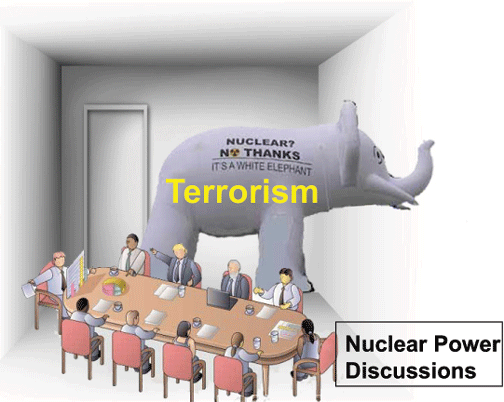 U.S. Rep. King talks ‘nightmare scenario’ of nuclear dirty bomb Boston Herald, April 19, 2015 By: Paul Bush While other Republicans were in Nashua for the party’s summit Friday morning, U.S. Rep. Peter King (R-N.Y.) was at Franklin Pierce University warning about the dangers the country faces from Islamic State fighters and from a possible nuclear “dirty bomb” attack.
King also cited his fears that future terrorists would make a crude bomb from nuclear materials that would create massive radioactive contamination.
“One nightmare scenario would be to have one or more dirty bombs put together 50 or 60 miles outside of a city and then brought into an urban area,” King said……
Nuclear Armageddon risk comes ever nearer- Noam Chomsky
Chomsky: World racing toward nuclear ‘precipice’ Leading American political analyst and philosopher Noam Chomsky says the world is racing toward a nuclear “precipice” and the United States poses the “greatest threat” in this regard. Press TV 19 Apr 15
Chomsky said in an interview with Euronews broadcast on Friday that “one [threat to humankind] is environmental catastrophe which is imminent and we don’t have a lot of time to deal with it and we are going the wrong way, and the other has been around for 70 years, the threat of nuclear war, which is in fact increasing. If you look at the record it is a miracle we have survived.”
He revealed that President Barack Obama has just “initiated a trillion dollar program of modernization of the US nuclear weapon system, which means expanding the nuclear weapon system.”
“That’s one the reasons why the famous doomsday clock, established by the Bulletin of Atomic Scientists has, just a couple of weeks ago, been pushed two minutes closer to midnight. Midnight is the end. It’s now three minutes from midnight. That’s the closest it’s been in thirty years. Since the early Regan years when there was a major war scare,” he added.
Chomsky said that “the US and Israel are the two major nuclear states in the world,” adding, “in international polls, run by US polling agencies, the United States is regarded as the greatest threat to world peace by an overwhelming margin”…….http://www.presstv.ir/Detail/2015/04/18/406819/World-racing-toward-nuclear-precipice
Call to Florida residents from mayors – fight against nuclear expansion project
Florida mayors call on residents to fight nuclear expansion project MIAMI | BY DAVID ADAMS (Reuters), 15 Apr 15 – A group of South Florida mayors are escalating their campaign against plans to expand a nuclear power plant near Miami that involves constructing 100-foot (30-meter) tall transmissions lines through some of the area’s toniest neighborhoods.
Florida Power & Light Co [NEEPWR.UL] is seeking federal approval from the Nuclear Regulatory Commission (NRC) to add nuclear reactors to its Turkey Point plant in south Florida. Public hearings are scheduled for next week.
Miami Mayor Tomás Regalado urged residents to speak against the project, which was approved by the Florida legislature last year.
“This plan should not be approved,” he said, arguing that the need for extra water for cooling ponds would shrink the area’s supply of fresh water.
Also rising sea levels due to climate change put the plant at risk of being flooded by salt water…..http://www.reuters.com/article/2015/04/15/us-usa-florida-nuclear-idUSKBN0N62JH20150415
1 This Month

of the week – Shut Down Drone Warfare!


Tell the Ukrainian Government to Drop Prosecution of Peace Activist Yurii Sheliazhenko

Petition to revoke the licensing of the Near Surface Nuclear Disposal Facility (NSDF) at Chalk River. https://www.ourcommons.ca/petitions/en/Petition/Details?Petition=e-7247
To see nuclear-related stories in greater depth and intensity – go to https://nuclearinformation.wordpress.com
-
Archives
- April 2026 (103)
- March 2026 (251)
- February 2026 (268)
- January 2026 (308)
- December 2025 (358)
- November 2025 (359)
- October 2025 (376)
- September 2025 (257)
- August 2025 (319)
- July 2025 (230)
- June 2025 (348)
- May 2025 (261)
-
Categories
- 1
- 1 NUCLEAR ISSUES
- business and costs
- climate change
- culture and arts
- ENERGY
- environment
- health
- history
- indigenous issues
- Legal
- marketing of nuclear
- media
- opposition to nuclear
- PERSONAL STORIES
- politics
- politics international
- Religion and ethics
- safety
- secrets,lies and civil liberties
- spinbuster
- technology
- Uranium
- wastes
- weapons and war
- Women
- 2 WORLD
- ACTION
- AFRICA
- Atrocities
- AUSTRALIA
- Christina's notes
- Christina's themes
- culture and arts
- Events
- Fuk 2022
- Fuk 2023
- Fukushima 2017
- Fukushima 2018
- fukushima 2019
- Fukushima 2020
- Fukushima 2021
- general
- global warming
- Humour (God we need it)
- Nuclear
- RARE EARTHS
- Reference
- resources – print
- Resources -audiovicual
- Weekly Newsletter
- World
- World Nuclear
- YouTube
-
RSS
Entries RSS
Comments RSS
 nuclear-news