5 March -Online – Reversing nuclearization:

Reversing nuclearization:
From nuclear weapons in Belarus and NATO host countries to a European-Nuclear-Weapon Free Zone
Online: Thursday March 5
11am-12:30pm Eastern Time USA / 5pm-6:30pm CET
Commemorating the anniversaries of the 1954 Bravo nuclear test (Nuclear Victims Remembrance Day) and of Belarus’s 2022 decision to rescind its nuclear-weapon-free status.
Event outline:
The risks of a nuclear war by accident, miscalculation or intent have increased with various escalatory actions, including the US-Israel attack on Iran, deployment by Russia of nuclear weapons to Belarus, announcement by the U.S. President of a possible resumption of nuclear testing, expiration of the New START agreement and various provocative statements regarding possible use of nuclear weapons in current conflicts including in the Russian invasion of Ukraine.
The Human Rights Committee affirmed in October 2018 that the threat or use of nuclear weapons is “incompatible with respect for the right to life” (under the UN Convention on Civil and Political Rights) and “may amount to a crime under international law”, and that “all States must refrain from developing, producing, testing, acquiring, stockpiling, selling, transferring and using nuclear weapons.”
This has opened the door to raising the issue of human rights and nuclear weapons policies of specific countries in the Human Rights Council. A number of submissions to the Council on this issue have proposed the establishment of regional nuclear-weapon free zones in the Arctic, Europe and North-East Asia as common security approaches to the issue. These include a submission on Belarus’ nuclear policies.
March 1 is the anniversary of the Bravo Test – the most destructive nuclear weapons test ever conducted by the United States (in 1954). February 27 is the anniversary of the date in 2022 that the Belarus government changed the constitution of Belarus, rescinding its status as a nuclear-weapon-free country.
The March 5 event marks these two days, and revives the proposal originally made by Belarus in 1990 for the establishment of a European Nuclear-Weapon-Free Zone. This was similar to other proposals for a European NWFZ (see A Nuclear Weapon-Free Zone in Europe Concept – Problems – Chances).
19 February – VIRTUAL EVENT-Decision Time: AI and Our Nuclear Arsenal
12:45 p.m. Central / 1:45 p.m. Eastern https://pages.thebulletin.org/ai-in-nuclear-command-and-control?utm_source=ActiveCampaign&utm_medium=email&utm_content=Can%20the%20%22ick%20factor%22%20stop%20alt%20meat%3F&utm_campaign=20260212%20Thursday%20Newsletter
Command and control of nuclear weapons is a delicate and complicated system, designed to prevent error while ensuring reliability under high-pressure conditions. In environments where vast amounts of data shape high-stakes outcomes, artificial intelligence has become a natural consideration.
The integration of a rapidly evolving technology raises fundamental questions about responsibility, data quality, and system reliability. When a single error could have irreversible consequences, how can confidence be built around the integration of machine learning into systems that have long relied on human judgment and oversight? What guardrails should be maintained? Where are there opportunities for international collaboration and consensus?
Join the Bulletin of the Atomic Scientists and the Outrider Foundation as a group of experts examine the current state of AI in nuclear command and control, identify where the greatest risks reside, and explore the policies that must be considered now to govern this technology in the years ahead.
12 February – Webinar The Big Push: New Nuclear Projects in Canada
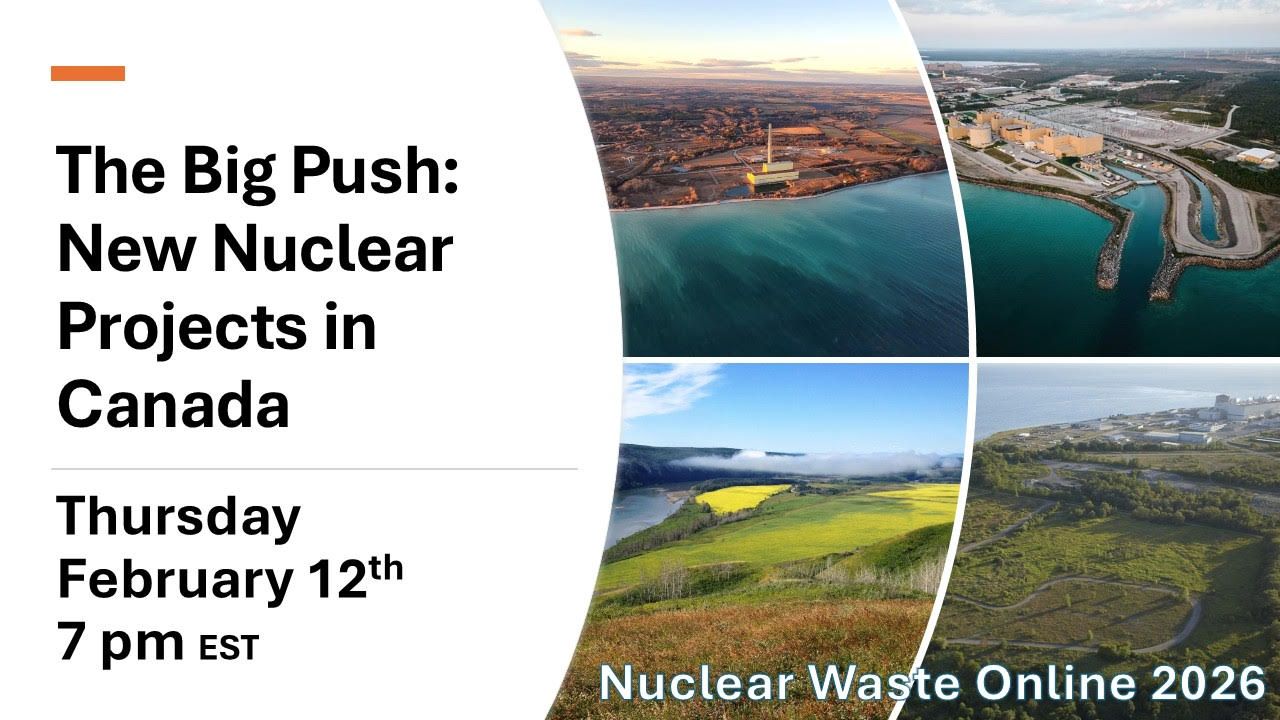
Thursday, February 12, 7 pm Eastern | 2nd of 4 sessions in the 2026 Nuclear Waste Online webinar series
Join a webinar on the push for new nuclear generation in Canada. Go to Northwatch.org to register or use the registration link https://us02web.zoom.us/webinar/register/WN_ZfWOf1GITqSRIZX8CB-A9w
From construction underway for not-so-small “Small Modular Reactors” at the Darlington site to plans for new mega-reactors at the Bruce Nuclear Generating Station, Peace River and now Wesleyville, the nuclear industry is running a seeming juggernaut nuclear expansion campaign and governments are on nuclear spending sprees. Join this session to hear about nuclear expansion plans in Canada, from New Brunswick to Alberta.
This is the second in a four part webinar series.Join every Thursday in February. Go to Northwatch.org to register and for details of all four sessions.
Mayors for Peace Joint Appeal

January 20, 2026, https://www.mayorsforpeace.org/wp-content/uploads/2026/file-2601-MfP_Joint-Appeal_January-2026_E.pdf
The milestone year of 2025—marking 80 years since the end of World War II and the atomic
bombings of Hiroshima and Nagasaki, the first use of nuclear weapons in human history—has come
to a close, and a new year, 2026, has begun. Over the past year, Mayors for Peace undertook a wide
range of peace initiatives. In particular, in August, the 11th General Conference of Mayors for Peace
was convened in Nagasaki City, where member cities from around the world engaged in extensive
discussions and renewed their shared determination to achieve a world without nuclear weapons.
Yet today, as power struggles over territory and economic influence initiated by nuclear-armed major
powers intensify, the global situation is growing ever more precarious. Distrust among states is
deepening, regional tensions are worsening in Europe, the Middle East, Latin America, and Asia, and
armed conflicts continue to spread, claiming the lives of countless innocent civilians. Moreover, as
the long-standing taboo against the use of nuclear weapons is being seriously eroded, momentum
toward nuclear disarmament and the abolition of nuclear weapons has stagnated.
Under these circumstances, the New Strategic Arms Reduction Treaty (New START Treaty)—the
only remaining nuclear disarmament and arms control treaty in force between the United States and
the Russian Federation—is set to expire in February 2026. We strongly urge both governments, which
together possess approximately 90 percent of the world’s nuclear warheads, to continue to honor the
limits of the treaty on an agreed basis and to demonstrate commendable leadership by advancing
nuclear disarmament. At the same time, we are gravely concerned that the collapse of this significant
arms control framework between the world’s nuclear superpowers could trigger an intensified global
arms race, including in nuclear weapons.
January 22 of this year marks five years since the Treaty on the Prohibition of Nuclear Weapons
entered into force in 2021. This treaty, a powerful international norm that prohibits the development,
testing, use, and threat of use of nuclear weapons, is a ray of hope amid the present depressing
situation. It was born from the heartfelt appeal of the hibakusha— “No one else should suffer as we
have.” We call upon all states to acknowledge the catastrophic and inhumane consequences of nuclear
weapons and to sign and ratify the treaty without delay.
Comprising local government leaders responsible for protecting the safety and security of their
citizens, Mayors for Peace now includes approximately 8,600 member cities in 166 countries and
regions worldwide and has worked for over 40 years toward the abolition of nuclear weapons. We
urge all policymakers to make every possible diplomatic effort to pursue the peaceful resolution of
conflicts through dialogue and to take concrete steps toward the realization of a peaceful world free from nuclear weapons.
MATSUI Kazumi , Mayor of Hiroshima , President of Mayors for Peace
SUZUKI Shiro
Vice President of Mayors for Peace
Mayor of Nagasaki
31st January – Challenging the War Machine – a DECLASSIFIED SUMMIT

DECLASSIFIED SUMMIT – https://secure.declassifieduk.org/page/180663/event/1?ea.tracking.id=496tbt7d&ea.url.id=8990610
Declassified UK will host its first ever summit, Challenging the War Machine, on Saturday 31 January 2026 at EartH in Dalston, London.
The one-day summit will bring together journalists, activists, academics, campaigners and members of the public to examine how the UK’s war machine operates and, crucially, how we challenge it.
Challenging the War Machine is open to anyone interested in understanding the structures and systems that underpin the drive to war, and how we challenge it. We will firstly assess the crisis we are in and thereafter we’ll be answering questions such as –
How do we challenge the drive to war? How do we challenge the propaganda machines of the legacy media & cultivate independent media? How do we challenge UK support for Israel? How do we build an active majority against war and militarism?
Challenging the War Machine marks a major milestone for Declassified UK, bringing its reporting off the page and into a shared physical space for dialogue.
The summit will feature Declassified UK journalists and contributors alongside a wide range of independent media organisations and movement groups, including:
Organisations – Action on Armed Violence, Alborada, CAAT – Campaign Against the Arms Trade, CND – Campaign for Nuclear Disarmament, Code Pink, Demilitarise Education, Drone Wars, Forces Watch, IMA – Independent Media Association, Irish Pages Press, Media Revolution, New Internationalist, PYM – Palestinian Youth Movement, Red Pepper Magazine, Shadow World Investigations, Stop The War, The Bristol Cable, The Canary.
Speakers – Ahmed Alnaouq, Alex Gordon, Andrew Feinstein, Anna Stavrianakis, Chris Kunzler, Dan Lambert, Des Freedman, Hamza Yusuf, Inès Khoury, Jason Hussein, Kate Hudson, Laura Webster, Lindsay German, Lowkey, Pablo Navarrete, Peter Oborne, Shahd Abusalama, Sophie Bolt.
The Declassified UK team – Mark Curtis, Laura Pidcock, Vicki Thomas, Phil Miller, John McEvoy, Dania Akkad, Martin Williams, Alex Morris and Hanna-Johara Dokal.
Join us – 9.15am-6pm | 31 January 2026 | EartH, Stoke Newington Rd, London N16 8BH
Low Cost
Unwaged/Low wage
£10
General Admission
Standard ticket price
£25
Solidarity
Pay for your ticket, plus help us provide a low cost ticket too
£35
No solutions for nuclear waste – no new nuclear power plants!
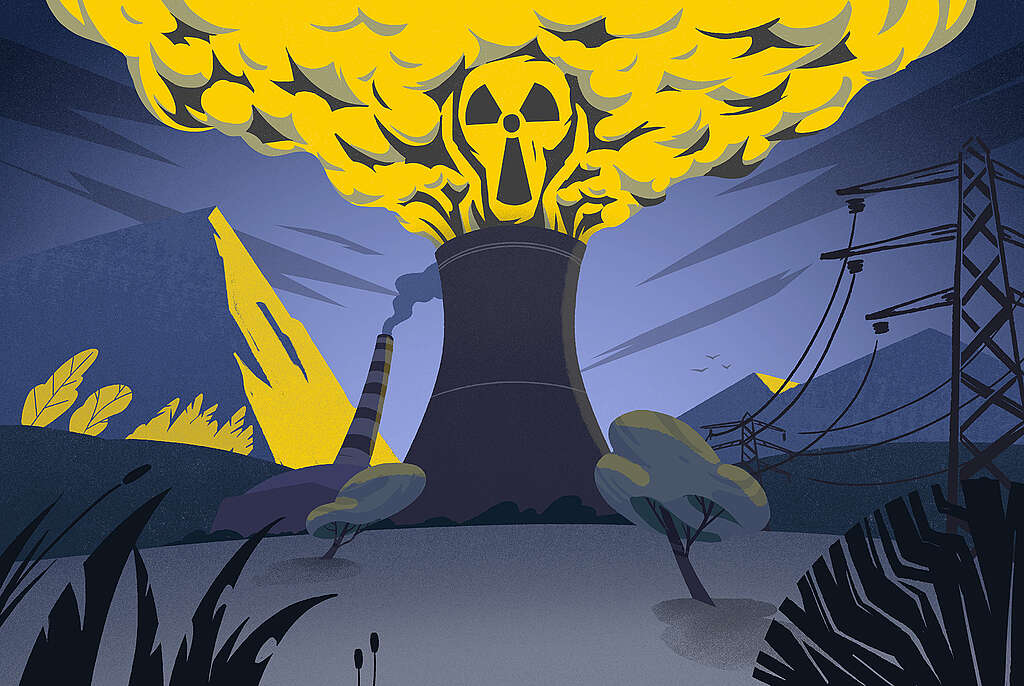
Greenpeace Switzerland, November 30, 2025
To date, there is no long-term safe solution for the storage of nuclear waste anywhere in the world. This is shown in a new study commissioned by Greenpeace Switzerland. It makes clear that the option planned in Switzerland—burying the nuclear waste in a clay layer north of the cantons of Zurich and Aargau—is fraught with numerous uncertainties.
Here are three reasons why Switzerland must phase out nuclear power as quickly as possible and reduce the production of highly radioactive waste.
1. Burying nuclear waste is not a solution
The Greenpeace study summarizes the findings of over 800 scientific papers on the deep geological disposal of highly radioactive nuclear waste from the last 15 years. It reveals several new problems that are still poorly understood even by experts. These include phenomena such as the mutual weakening of various safety barriers, as well as processes (such as heat and radiation exposure, colloids, cracks, etc.) that could accelerate the spread of radioactive materials in the soil and groundwater.
Overall, it is clear that none of the “solutions” discussed so far for the deep geological disposal of these highly radioactive materials – neither in clay nor in granite formations – can guarantee that the radioactivity will remain safely contained in the long term. This finding is particularly worrying given that the Federal Council is considering a return to nuclear energy.
2. Swiss deep geological repository does not meet safety requirements
The report questions the safety of the planned deep geological repository. The National Cooperative for the Disposal of Radioactive Waste (Nagra) intends to store the highly radioactive waste in thick-walled steel containers, which are to be embedded in an Opalinus Clay layer at a depth of approximately 900 meters. The repository is designed to contain the radioactivity for one million years.
However, the study shows that certain processes could undermine the safety of the repository after only 1,000 or 2,000 years. Given these uncertainties, the optimism of the project’s proponents seems disconcerting.
The Federal Council also seems keen to present the public with a final plan as quickly as possible – for political and financial reasons. In other words, the problem should be resolved as quickly as possible in order to revive nuclear energy in Switzerland.
This is dangerous: We must not make any hasty decisions.
3. The safest way: No new waste – therefore no nuclear power
The reality is that Switzerland currently lacks a safe solution for the long-term storage of high-level radioactive waste. Continuing to pursue the planned deep geological repository in the Northern Lägern region, despite so many doubts, is not a good idea.
Furthermore, there is no disposal strategy whatsoever for a potential new reactor – a point that neither the Federal Council nor the proponents of nuclear energy ever openly address.
Given this situation, we must stop the production of highly radioactive waste as quickly as possible and prevent the problem from worsening through new nuclear power plants. Therefore, please sign our petition: https://www.greenpeace.ch/de/handeln/atomkraft-nie-wieder/
Week of Protest sees 100 Actions Demanding No War with Venezuela.
Protest actions took place in 100 locations during the week of November 15 – 23. Protests occurring across the U.S. and Canada as well as in Australia, Britain, the Dominican Republic, Germany, Greece, Mexico, Napal and Pakistan. In the U.S., protesters also called for an end to federal troops in our streets and a number of protests also raised the issue of ending the genocide in Gaza and Sudan. Click here to see a list of the actions.
Holding the Memories Webinar

| Join us for our webinar co-hosted with Labrats, Holding the Memories: Communities Leading the Fight for Nuclear Archival Justice a panel presentation exploring barriers to accessing nuclear archives and expose the power of community-held memory. |
WHEN
NEW YORK Wednesday November 19, 4pm, EST
LONDON Wednesday November 19, 9pm, GMT
MELBOURNE Thursday, November 20, 8am, AEST
FIJI/MARSHALL ISLANDS Thursday 20 Nov – 9am FJT & MHT
For more timezones please view here
View or event on our new website and help us share the webinar out on Instagram, Facebook & Linkedin
REGISTER – https://events.humanitix.com/holding-the-memories
Featuring:
- Dimity Hawkins (Nuclear Truth Project, Australia)
- Alan Owen (LabRats International, UK)
- Karina Lester (Yankunytjatjara-Anangu community leader, Australia)
- Dr Chris Hill (University of South Wales, UK)
- Dr Jon Hogg (University of Liverpool, UK)
Building on the Nuclear Truth Project’s Challenging Nuclear Secrecy report (2025), this international collaboration brings together affected community members, nuclear justice advocates and organisations from the UK and Australia.
The webinar will explore barriers to accessing nuclear archives and expose the power of community-held memory.
Focusing on British nuclear weapons testing in Australia and the Pacific (1952–1963), the discussion will focus on archival access as a core part of nuclear justice, victim assistance, and environmental restoration.
How do communities impacted by nuclear weapons testing overcome systemic barriers to accessing official records of harm to Peoples and Country?
Join us to learn how memory is held — and fought for — by those most affected.
22 October – Event for UN Disarmament Week -The Scientific Future of Nuclear War
Wednesday October 22. 10am New York Time / 4pm Central Europe Time
Join Youth Fusion and Dr. Maria Cetto, esteemed Youth Fusion Elder and newly appointed expert to the UN Independent Scientific Panel on the Effects of Nuclear War. This critical initiative, announced by the UN Secretary-General, is currently working to assess the devastating global consequences of nuclear war and produce a report to guide international action.
We will explore how the risks of nuclear war and approaches to preventing it are perceived across generations and how scientific evidence and advocacy efforts intersect to inform public awareness and political action. Dr Cetto and Youth Fusion will be joined by Emilio Meryn, a young Cambridge physicist, and advocacy representatives, creating a cross-disciplinary and intergenerational exchange.
For more information contact Camilla Braito.
URGENT ACTION NEEDED to Help Protect the Defense Nuclear Facilities Safety Board!
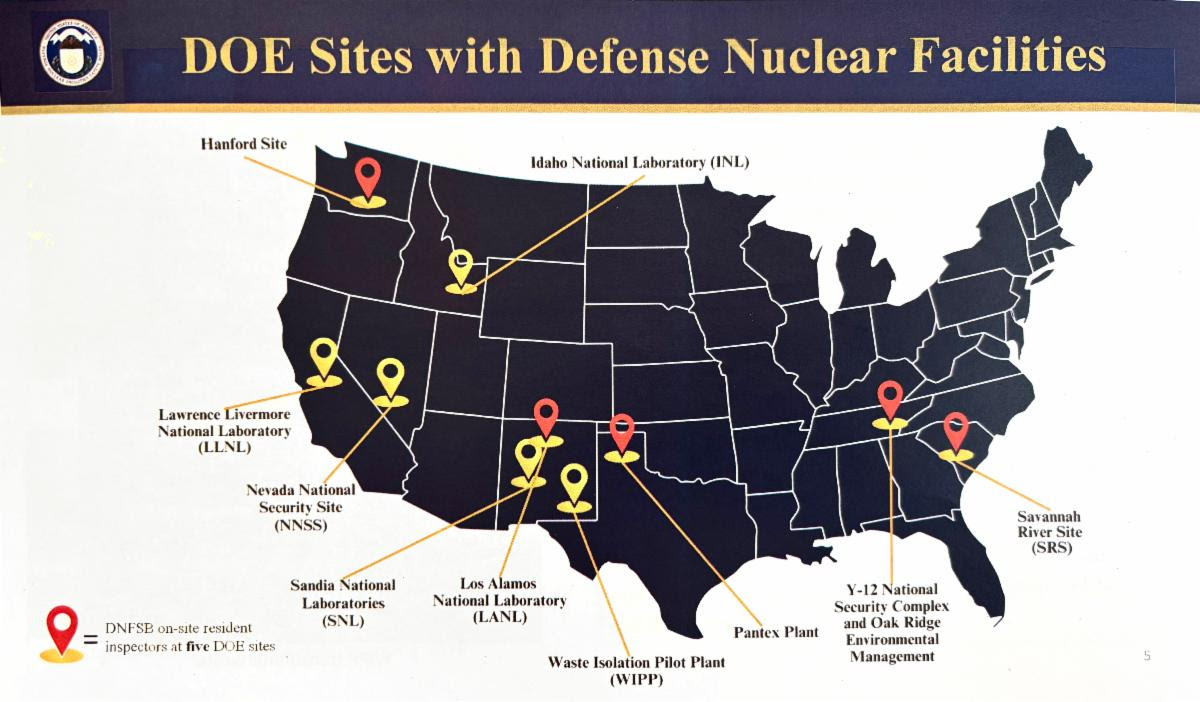
Nuclear Watch, Jay Coghlan, Executive Director, Scott Kovac, Research Director, Sophie Stroud, Digital Content Manager and Youth Specialist, 13 Oct 25
| The government is still shut down (unfortunately). But it does mean there’s still time to ask Congress to get a provision in the pending Continuing Resolution to keep the government running that will help save the Defense Nuclear Facilities Safety Board (DNFSB). |
Background: The Defense Nuclear Facilities Safety Board is an independent agency within the executive branch of the Federal Government. The DNFSB is chartered with the responsibility to provide recommendations and advice to the Secretary of Energy regarding public health and safety issues at Department of Energy (DOE) nuclear weapons facilities, including with the health and safety of employees, contractors, and nearby communities (for more see www.dnfsb.gov).
Congress established the Board in 1988 in response to increasing reports of nuclear safety risks impacting workers and the public. Since early this year, the Board has been reduced to just two Members out of five, with a temporary one-year statutory bridge to constitute a quorum that is drawing to a close. In addition, the current Acting Chairman’s term expires this October 18, ending the Board’s functioning quorum. Without it, the DNFSB cannot effectively carry out its critical nuclear safety oversight mission. The public would simply not know about the DOE’s chronic nuclear safety problems without the Board. This is critically important today given expanding production of nuclear weapons.
| Specific request: There should be a provision in any Continuing Resolution for FY 2026 that would temporarily extend the authority of the Defense Nuclear Facilities Safety Board by allowing the Acting Chair to serve until the end of January 2027. The overriding purpose is to enable the Safety Board to fully continue operations and provide more time for the President to nominate, and the Senate to confirm, new Safety Board Members. |
| Congress must take action to protect nuclear safety by preserving DNFSB’s quorum! |
Contact Senator Martin Heinrich through his official website, his Washington, D.C. office, or any of his New Mexico State offices:…………………………………………………………
Contact Senator Ben Ray Luján through his official website, his Washington, D.C. office, or any of his New Mexico State offices:………………………………………………….
Contact Senator John Thune through his official website, his Washington, D.C. office, or any of his South Dakota State offices:…………………………………………….
Contact Senator Chuck Schumer through his official website, his Washington, D.C. office, or any of his New York State offices:……………………………………………. https://nukewatch.org/action-item/urgent-action-needed-to-help-protect-the-defense-nuclear-facilities-safety-board/
The nuclear choice: a people’s economy or the bosses’ bomb?
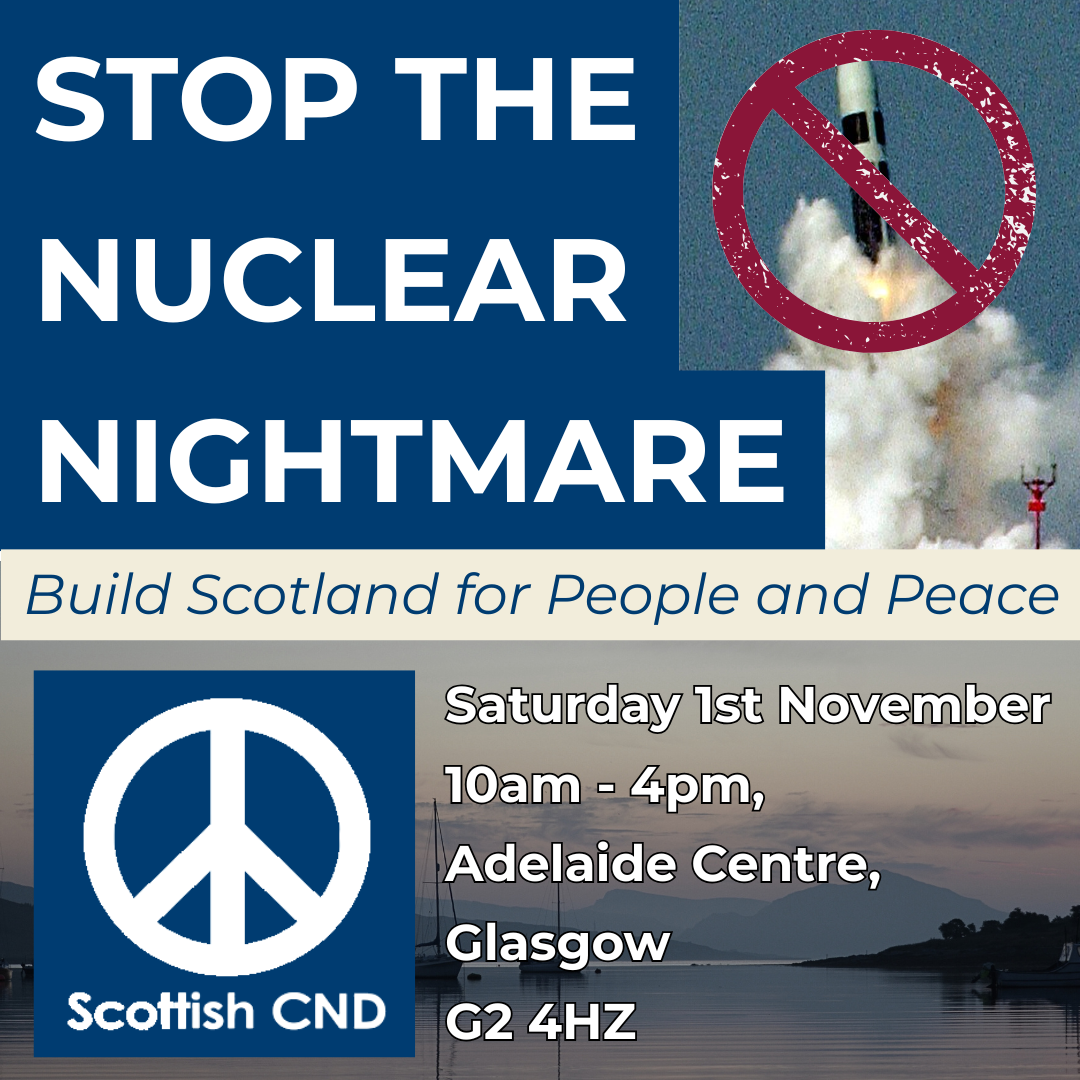
30 September 2025, https://www.morningstaronline.co.uk/article/nuclear-choice-peoples-economy-or-bosses-bomb
CND’s Stop the Nuclear Nightmare conference in Glasgow will be an important step towards destroying the false arguments that weapons and war spending will lead to job creation and prosperity, rather than bringing Armageddon closer, writes SIMON BARROW
N a month’s time, trade unionists, environmentalists, community organisations and political activists will gather in Glasgow to push back firmly against the British government’s drive towards rearmament and further investment in Britain’s dangerous and wasteful nuclear weapons programme.
The gathering, organised by Scottish CND, will bring together campaigners from across these islands. But the particular spectre of Trident submarines located just a few miles down the road at Faslane will not be lost on anyone attending in person or online.
Bluntly entitled Stop the Nuclear Nightmare, the aim of this timely event in the heart of Scotland’s largest city — a former shipbuilding and heavy industry powerhouse — is to make the direct connection between the threat nuclear weapons pose in an increasingly unstable world and the vast misdirection of economic resources they represent.
As large arms companies savour the prospect of many more billions being poured into military production across Europe, and as the Labour government powers ahead with an unstable, unreliable and unnecessary Trident replacement programme, the choices facing us become abundantly clear.
Will the AI-driven technological revolution of the coming decades lead to an unprecedented era of opportunity and possibility for the great majority, or will our needs and future be sacrificed to the remorseless drive for accumulation by a heavily armed few?
A major focus of Scottish CND’s mobilising conference will therefore be on the back-to-front economics of nuclear-fronted militarism, and the huge potential benefits in terms of jobs, prosperity and environment which a genuinely “just transition” way from both nuclear and fossil fuel dependence could represent.
At the centre of this debate is the political challenge of reframing the discourse about defence towards the concrete issues of human need and security arising from a continuing cost-of-living crisis and the political fragmentation which a lack of a clear vision around this worsens.
The spin from Prime Minister Keir Starmer and his defence secretary John Healey is that a massive expansion of military industry and capability is necessary to ensure Britain’s security and to guarantee jobs and prosperity for its people. Neither of these assertions is true.
As far as security goes, the reality is that the drive to rearmament will increase insecurity and deepen potential conflict, likely leading to a new and perilous wave of nuclear proliferation. But the grim lesson of modern history is that almost all arms races lead to war.
Nor is this expansion necessary. Britain’s military spending was among the highest in the world, well before the latest hike was proposed, and in real terms exceeded spending on defence at the height of the cold war in 1980.
Yet this Labour government has committed to vast increases in the arms bill, from 2.3 per cent of GDP currently (£66.3 billion) to 2.5 per cent by 2027/2028 (£80.5bn) and 3.5 per cent (£121.2bn based on the 2029/30 GDP forecast) by 2035.
Unsurprisingly, it is transnational arms companies themselves who are lobbying hard for all this. They smell profits and the chance to retool in a way which will create neither sustainable jobs nor socially beneficial production.
The promise of “military Keynesianism” (a big boost to civilian benefit from military investment) is a false one. A people’s economy is effectively being sacrificed for a bosses’ bomb.
That picture is reinforced by research coming from an unlikely source, the leading military think tank the Royal United Services Institute (RUSI).
“Framing defence spending as a path to prosperity ignores its poor economic returns, limited job creation, and the opportunity costs of not making alternative public investments,” argue Noah Sylvia and Khem Rogaly in their recent RUSI paper, The False Promise of Defence as Prosperity.
They continue: “Starmer’s government claims that the defence sector will become an ‘engine for growth,’ a route to ‘prosperity’ and a source of security for working people. These arguments are now lynchpins of the government’s narrative as it fails to deal with stagnation and real incomes are squeezed.”
Sylvia and Rogaly then proceed systematically to dismantle such claims, citing sobering arguments and data from the European Commission, the Rand Corporation and other eminently Establishment sources.
Trade unions are among those who are waking up fast to the spectre of a dangerous and damaging future unless we make the link between economic security and a major shift away from the old technologies of human and climate destruction.
Others are yet to be convinced. There is understandable concern about the future of jobs and livelihoods currently tied to the arms sector and nuclear weapons.
But unless we start to build pressure now, to counteract the new military-industrial complex rhetoric, we will find ourselves with fewer and fewer genuine choices.
The Stop the Nuclear Nightmare conference in Glasgow is a major opportunity to articulate a different vision, to mobilise for change, and to organise for a better and safer future.
Simon Barrow is a writer, trade union activist and consultant to Scottish CND on the Stop the Nuclear Nightmare conference at Adelaide Place, Glasgow, from 10am to 4:30pm on Saturday November 1. Full details at www.banthebomb.org.
10 October Peace Camp: Salir de Casa por Gaza
10 October – 8:00 am – 18 October – 5:00 pm
WILPF Spain is taking the lead in calling for a women’s camp in Brussels to demand action from the European Union against the genocide in Gaza.
The camp is scheduled for October 10 to 18 or 19, 2025, and it will end with a public demonstration in Brussels. The aim is to show our solidarity with Gaza and demand that the European Union—the Commission and the Parliament—urgently:
1. Act to ensure constant and sufficient humanitarian aid, managed by the United Nations, to the population of Gaza in accordance with the principles of international humanitarian law.
2. Exercise its influence to force Israel to agree to a permanent ceasefire and end the occupation.
3. Suspend the association agreement with the State of Israel in view of the violation of the clause on respect for human rights.
WILPF Spain calls on other women’s groups to join these demands by participating in and publicising this action.
Those interested in participating can register by completing this form and helping us to publicise this call.
Zoom Nuclear Waste Scholar Series: The Body is an Archive: Unearthing Hidden Histories of Radiation and Public Trust Through Baby Teeth

Date & Time
Oct 4, 2025 05:00 AM in Etc/GMT-10 https://us02web.zoom.us/webinar/register/WN_Fn65SAKXRkWuWzmUfA4FKw#/registration
Description
What can a child’s tooth reveal about history, risk, and trust in science? In his talk on Fri, October 3 at noon PT, Professor Jeffrey Sanders will trace how the St. Louis Baby Tooth Survey turned thousands of donated teeth into powerful evidence that Cold War nuclear fallout was entering children’s bones—evidence that helped secure the 1963 Nuclear Test Ban Treaty. He follows the surprising afterlives of this archive, from rediscovery in a New Jersey garage to cutting-edge research today that uses lasers to link early exposures to later health effects. Along the way, he asks enduring questions about science, activism, and public trust: Who gets to measure risk, control knowledge, and decide what stories our bodies can still tell?
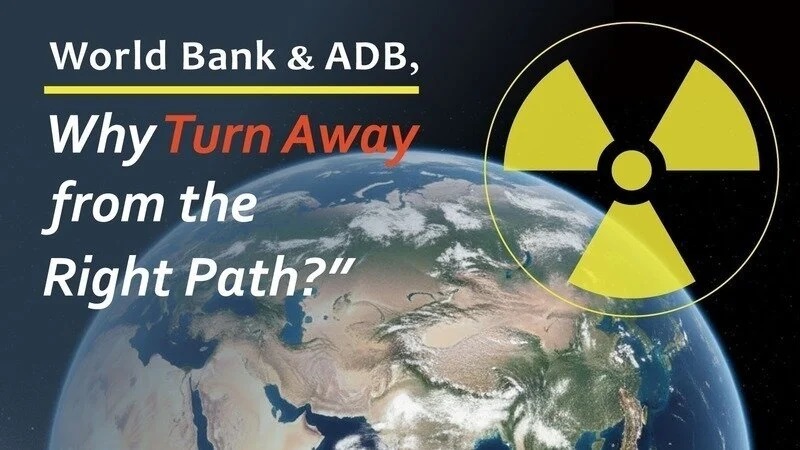
Say No to Nuclear Financing – World Bank and ADB, Why Turn Away from the Right Path?
Why this petition matters:
- The World Bank and the Asian Development Bank (ADB) are international financial institutions funded by governments to support economic development, poverty reduction, and infrastructure.
- Until now, both institutions have avoided supporting nuclear power projects for the following reasons:
nuclear proliferation risks- serious concerns over safety
- radioactive waste
- extremely high costs
- On June 10, the World Bank’s Board decided to lift its ban on financing nuclear projects.
- The ADB is currently reviewing its energy policy, and indications suggest it may also move to allow support for nuclear power.
- However, the problems of nuclear power — safety risks, radioactive waste, nuclear proliferation, and high costs — remain unresolved.
- Introducing nuclear power in developing countries would impose major risks and costs not only on today’s citizens but also on future generations.
For these reasons, we are preparing to send the following petition to both the World Bank and ADB. We ask for your support by adding your signature. We will submit all signatures and comments to the World Bank and ADB.
Let’s act together to prevent today’s decisions from burdening tomorrow’s generations.
International Petition: “Say No to Nuclear Financing – World Bank and ADB, Why Turn Away from the Right Path?”
To: Mr. Ajay Banga, President of the World Bank Group
To: Mr. Masato Kanda, President of the Asian Development Bank
We are deeply concerned that the World Bank Group and the Asian Development Bank (ADB) are moving toward lifting the ban on financing and supporting nuclear power projects.
The core reasons why the World Bank and the ADB have long refrained from supporting nuclear energy include inseparable risks of nuclear weapons proliferation and the unresolved problems of radioactive waste. These concerns remain unchanged today. Furthermore, Russia’s invasion of Ukraine has revealed that nuclear power plants can become military targets, adding another serious security threat.
As demonstrated by the Chernobyl and Fukushima Daiichi nuclear disasters, one accident can cause widespread, long-term contamination and serious social and economic disruption.
Even without accidents or attacks, nuclear energy releases radioactive substances into the environment at every stage of its lifecycle—mining, fuel production and processing, operation, decommissioning, and the disposal of spent nuclear fuel. Uranium mining, in particular, has often violated the rights of Indigenous peoples and harmed their health, lands and environment.
Nuclear waste generated from operating nuclear power plants remains hazardous for tens of thousands of years, requiring secure isolation from the biosphere for geological periods of time. Yet most countries still have no disposal site.
Due to “security” considerations, some information related to the planning and construction of nuclear power plants is kept secret. As a result, communities and NGOs often have limited access to crucial safety information. This lack of transparency conflicts with the safeguard policies of international financial institutions which emphasize openness, accountability, and stakeholder consultation.
In recent years, the cost of building nuclear power plants has soared, often reaching tens of billions of USD per unit and increasing several-fold beyond initial estimates. Private investors have shifted away from nuclear power and toward renewable energy, leading to the rapid growth of renewable energy technologies. The high costs of nuclear power – now the most expensive form of new electricity generation – and its requirement for large direct and indirect government subsidies have high opportunity costs, delaying and undermining the needed rapid scale-up of benign renewable energy.
Construction of nuclear power reactors typically takes well over a decade, often more than two, too slow for mitigating the accelerating climate crisis.
We must also recognize the vulnerabilities of nuclear power. As a large, centralized source of electricity, nuclear plants can have far-reaching impacts when they unexpectedly shut down due to accidents or technical problems. In recent years, heatwaves have raised seawater and river temperatures, making it impossible to obtain cooling water in some cases.
Small modular reactors (SMRs) also fail to address many of these concerns, especially those related to fissile material, radioactive wastes, nuclear weapons proliferation risks and economic viability.
Supporting the construction of nuclear power plants in developing countries would impose not only serious long-term dangers but also a massive economic burden on current and future generations in those nations.
We therefore call on the World Bank Group and the ADB to refrain from providing any form of support or financing for nuclear power.
Initial Endorsers:
11 march movement, Belgium
350.org Japan, Japan
Aktionsbündnis STOP Westcastor Jülich, Germany
AKW-nee-Gruppe Aachen, Germany
Alliance for Climate & Ecology, Korea
Australian Conservation Foundation (ACF), Australia
AYUS International Buddhist Cooperation Network/アーユス仏教国際協力ネットワーク, Japan
Belgische Coalitie Stop Uraniumwapens (Belgian part of the International Coalition for a Ban on Uraniumweapons), Belgium
Beyond Nuclear, United States
Bündnis für „Sichere Verwahrung von Atom-Müll, Germany
Centre for Financial Accountability(CFA), India
Citizen’s Eyes on Nuclear Regulation/原子力規制を監視する市民の会, Japan
Citizens’ Commission on Nuclear Energy (CCNE) /原子力市民委員会, Japan
Citizens’ Nuclear Information Center/原子力資料情報室, Japan
Climate Express11 march movement, Belgium
Corner House, United Kingdom
Ecodefense, Russia
Environmental Association “Za Zemiata” – Friends of the Earth Bulgaria, Bulgaria
European Environmental Bureau, Belgium
Forum for Protection of Public Interest (Pro Public) , Nepal
Friends of the Earth Australia, Australia
Friends of the Earth India, India
Friends of the Earth International, International
and so many more ………………………………………………….https://www.change.org/p/say-no-to-nuclear-financing-world-bank-and-adb-why-turn-away-from-the-right-path?recruiter=1386886086&recruited_by_id=c79f25d0-86d4-11f0-b695-9765954ef395&utm_source=share_petition&utm_campaign=petition_dashboard&utm_medium=copylink
23 September -Webinar -Meltdown of Democracy: Bringing Nukes Back Despite Statewide Vote Against Them.

REGISTER—Massachusetts Peace Action Zoom webinar, 7:00-8:30 PM ET, https://masspeaceaction.org/event/meltdown-of-democracy-bringing-nukes-back-despite-statewide-vote-against-them/ Tuesday, September 23.
Democratic State Governors across the country are selling us out to President Trump’s Executive Orders to revive “gold-plated nuclear power” to enrich the few, with nuclear waste and electrifying rate hikes for the rest. The people of Massachusetts are mobilizing to oppose Democratic Governor Maura Healey’s plan to repeal a 1982 Public Referendum requiring a statewide vote before new reactors and nuclear dumps can even be considered. But Democratic Governors Kathy Hochul (NY), Gretchen Whitmer (MI), Gavin Newsom (CA), Tony Evers (WI), Ned Lamont (CT), Josh Shapiro (PA), JB Pritzker (IL) and Wes Moore (MD) are unwittingly or otherwise joining Healey to rally under Trump’s authoritarian “Unleashing Atomic Power”!
1 This Month
10 March A LIVE WEBINAR THE REAL EFFECTS OF NUCLEAR POWER
What the Industry Isn’t Telling Us
1:00 PM Mountain, 2 pm Central, 3 pm Eastern. Live on the Keepers of the Water Facebook page



18 March Webinar @ 1 PM EST: An Assessment of SMR Projects: The Case of Canada
register for the zoom:
https://us02web.zoom.us/webinar/register/WN_o8BIIOUvQ2ONJR1nta65DQ#/registration


of the week – STOP SMALL MODULAR REACTORS IN CANADA
To see nuclear-related stories in greater depth and intensity – go to https://nuclearinformation.wordpress.com
-
Archives
- March 2026 (99)
- February 2026 (268)
- January 2026 (308)
- December 2025 (358)
- November 2025 (359)
- October 2025 (376)
- September 2025 (258)
- August 2025 (319)
- July 2025 (230)
- June 2025 (348)
- May 2025 (261)
- April 2025 (305)
-
Categories
- 1
- 1 NUCLEAR ISSUES
- business and costs
- climate change
- culture and arts
- ENERGY
- environment
- health
- history
- indigenous issues
- Legal
- marketing of nuclear
- media
- opposition to nuclear
- PERSONAL STORIES
- politics
- politics international
- Religion and ethics
- safety
- secrets,lies and civil liberties
- spinbuster
- technology
- Uranium
- wastes
- weapons and war
- Women
- 2 WORLD
- ACTION
- AFRICA
- Atrocities
- AUSTRALIA
- Christina's notes
- Christina's themes
- culture and arts
- Events
- Fuk 2022
- Fuk 2023
- Fukushima 2017
- Fukushima 2018
- fukushima 2019
- Fukushima 2020
- Fukushima 2021
- general
- global warming
- Humour (God we need it)
- Nuclear
- RARE EARTHS
- Reference
- resources – print
- Resources -audiovicual
- Weekly Newsletter
- World
- World Nuclear
- YouTube
-
RSS
Entries RSS
Comments RSS
 nuclear-news