Quiet, Piggy: How Calling a Female Reporter Livestock Became Just Another Tuesday in the Death of American Democracy (Part 2)

The rude one is Mary Bruce, for mentioning unpleasantness.
A female reporter asks about a child sex trafficker whose files implicate powerful men: “Quiet, piggy.”
A female reporter asks about a murdered journalist: “Don’t embarrass our guest.”
The rude one is Mary Bruce, for mentioning unpleasantness.
A female reporter asks about a child sex trafficker whose files implicate powerful men: “Quiet, piggy.”
A female reporter asks about a murdered journalist: “Don’t embarrass our guest.”
21 November 2025 David Tyler, https://theaimn.net/quiet-piggy-how-calling-a-female-reporter-livestock-became-just-another-tuesday-in-the-death-of-american-democracy-part-2/
Part Two: The Nine Year War on Women Who Dare to Speak
This is the second of a three part analysis examining how Donald Trump’s “quiet piggy” comment reveals the systematic dismantling of democratic norms. Part One explored how the flood the zone strategy and attention economy conspire to make outrages disappear. Part Two examines the nine year war on women who dare to speak. Part Three will map the global authoritarian playbook for destroying press freedom.
In Part One, we examined how the “quiet piggy” incident almost disappeared entirely, buried under an industrial scale production of amnesia. We watched journalists stand silent while their colleague was called livestock. We saw the system work as designed
But to understand why this moment matters, we need to zoom out. Because calling a female reporter a pig isn’t an isolated outburst. It’s the latest instalment in a nine year campaign to normalise contempt for women who dare to ask awkward questions.
This campaign has measurable effects. Rising violence. Shrinking rights. Women driven from public life. And it’s not happening in isolation. It’s part of a global pattern where authoritarian movements always target women first, testing how much cruelty a society will tolerate before expanding to other populations. Women who speak are the canaries in the coalmine of fascism. And right now, the canaries are copping it.
The Timeline: From ‘Pussy’ to ‘Piggy’
Let’s be clear about the progression. The pattern is clear when you step back far enough to see it whole.
Trump announced his first presidential campaign in June 2015 with a speech calling Mexican immigrants rapists and criminals. But it was October 2016 that marked the real watershed: the Access Hollywood tape.
“Grab ’em by the pussy. You can do anything.”
That was the beta test. The question wasn’t whether he’d said it, the tape was clear enough. The question was whether America would care.
The answer, delivered in November 2016, was a collective shrug and an electoral college victory.
That’s when the war on women went from guerrilla tactics to full mechanised assault.
The through line from “grab ‘em by the pussy” to “quiet piggy” isn’t a character flaw. It’s a deliberate, sustained campaign to normalise contempt for women, to make casual misogyny just another quirk of the national conversation.
And it’s worked beyond Trump’s wildest authoritarian fantasies.
The Downstream Effects Are Measurable
This isn’t abstract cultural commentary. The effects of normalising contempt for women are documented, measurable, and accelerating.
Since 2016, researchers have found:
- Violence: Spikes in domestic violence in counties that voted heavily for Trump. Increased reports of harassment and assault on college campuses following Trump rallies.
- Political Participation: Measurable decreases in women running for office in regions where Trump style misogyny is most normalised. Women candidates facing unprecedented levels of gendered harassment and threats.
- Youth Radicalisation: Teenage boys expressing increasingly hostile attitudes toward girls’ autonomy. The mainstreaming of incel ideology among young men who’ve come of age entirely during the Trump era.
- Media and Journalism: Female journalists specifically targeted for rape and death threats. Physical assaults at Trump rallies and events.
This isn’t happening because Trump occasionally says something crude. It’s happening because he’s made cruelty toward women a central feature of his political brand, and millions of people have adopted that brand as their identity.
Female Journalists as Specific, Systematic Targets
But women journalists face a particular kind of targeting that goes beyond general misogyny. They’re attacked not just for being women, but for being women who dare to ask questions.
The pattern is unmistakable:
Isolation: Female journalists who ask tough questions are cut off from access, singled out for crowd harassment. The message: step out of line and you’re on your own.
Delegitimisation: Female reporters are dismissed as biased, emotional, unprofessional. Their questions are framed as partisan attacks rather than legitimate journalism.
Sexualisation: Unlike male journalists who are merely called fake news, female journalists face explicitly sexual harassment. Rape threats. Fantasies about violence. Their bodies weaponised as tools of intimidation.
The combination is devastating. It’s not enough to be a good journalist. You have to be willing to endure systematic harassment, threats to your family’s safety, and the knowledge that your own colleagues might not defend you.
Family games
How many important questions don’t get asked because female journalists have calculated the cost and decided it’s too high?
The Pattern: Women Who Ask Are the Problem
Now let’s examine the specific context that made “quiet piggy” land so hard: the week in which Trump made clear that women asking questions about powerful men’s crimes would be treated as the problem, not the crimes themselves.
Catherine Lucey asked about the Epstein files. She got called a pig.
Mary Bruce from ABC asked Saudi crown prince Mohammed bin Salman about ordering Jamal Khashoggi’s murder. She got scolded for rudeness.
The combination reveals the structure perfectly.
The Epstein Files
Jeffrey Epstein ran a child sex trafficking operation that serviced wealthy, powerful men for decades. Trump fought to keep those files secret. When a reporter asked why, the response was hostility. The deflection is textbook: make the question the problem, not the answer.
The Khashoggi Murder
Jamal Khashoggi was murdered, dismembered with a bone saw, on the crown prince’s orders. But when Mary Bruce asked about it, Trump’s response wasn’t outrage at the murder. It was annoyance at the reporter for bringing it up.
“You’re mentioning somebody that was extremely controversial,” Trump said. “Whether you like him, or didn’t like him, things happen.”
Things happen.
A journalist gets murdered, and the President of the United States dismisses it with the fatalism of someone explaining a flat tyre.
Notice who’s rude in Trump’s telling. Not the crown prince who ordered a hit. Not the killers who wielded the saw.
The rude one is Mary Bruce, for mentioning unpleasantness.
Let’s be explicit about what these two incidents together reveal:
A female reporter asks about a child sex trafficker whose files implicate powerful men: “Quiet, piggy.”
A female reporter asks about a murdered journalist: “Don’t embarrass our guest.”
The crimes, raping children, murdering dissidents, barely register as problematic in Trump’s response. What registers as offensive is the impudence of women presuming they have the right to ask about them.
This is patriarchy in its purest form: women who speak are the problem, not the men who commit atrocities.
The Global Pattern: Women as Canaries in the Coal Mine
This isn’t just an American phenomenon. Scan the global authoritarian landscape and you’ll see the same pattern repeated with depressing consistency.
- Brazil’s Bolsonaro: Openly celebrated rape culture, joked about sexual assault. He won. The downstream effects included spiking violence against women.
- The Philippines’ Duterte: Made rape jokes about missionaries, threatened to shoot female rebels. He won. Press freedom collapsed.
- India’s Modi: Presides over epidemic levels of sexual violence while Hindu nationalist movements push women out of public life.
- Hungary’s Orbán: Dismantled reproductive rights, pushed “traditional family values” as cover for authoritarian consolidation.
- Afghanistan’s Taliban: Within months of retaking power, erased women from public existence. The logical endpoint of treating women as less than human.
- Tony Abbott stood in front of a banner calling Julia Gillard a witch and a bitch.
The pattern is universal: authoritarians always target women first. Always test the boundaries of acceptable cruelty against women before expanding to other populations.
Women, and specifically women who speak, women who question, women who refuse to be quiet, are the canaries in the coalmine of fascism.
When a society tolerates calling female reporters livestock, it’s not a gaffe. It’s a dress rehearsal for broader violence.
So far, not enough people have flinched.
The Cracks in the Edifice: Why He’s Scared Now
There’s a reason Trump’s lashing out with particular viciousness right now, and it’s not strength. It’s fear.
His air of invincibility is cracking:
- Democrats dominating off year elections in districts he won
- Forced to reverse course on Epstein files under public pressure
- Economic turbulence as tariffs and chaos spook markets
- His approval rating softening in key swing states
- Wounded authoritarians are more dangerous than confident ones. When bullies sense they’re losing, they don’t retreat gracefully. They escalate. They lash out harder, faster, more recklessly.
The “quiet piggy” outburst might be evidence of a man on the back foot, overreacting to a question he should have deflected with his usual blizzard of lies.
But don’t mistake fear for weakness. Cornered animals bite. Failing authoritarians would rather burn everything down than admit defeat.
And female journalists, already the most vulnerable, already the most systematically targeted, become the easiest targets when the lashing out intensifies.
Part Two Conclusion: The War Continues
So we’ve traced the nine year escalation from “grab ‘em by the pussy” to “quiet piggy.” We’ve documented the measurable downstream effects, rising violence, shrinking rights, women driven from public life.
We’ve watched this pattern repeat globally, from Brazil to the Philippines to Hungary to Afghanistan, with women always the first targets of authoritarian consolidation.
And we’ve recognised what this means: women who speak are canaries in the coalmine of fascism. When they’re silenced, everyone else is next.
The “quiet piggy” moment isn’t an isolated incident. It’s the latest chapter in a systematic campaign to make women, and particularly women who ask uncomfortable questions, afraid to speak.
And it’s working.
In Part Three, we’ll examine the authoritarian playbook for destroying press freedom: the four phase strategy that moves from delegitimisation through intimidation to isolation and violence. We’ll see how this playbook has succeeded globally and how it’s being deployed in America right now. And we’ll explore whether we have the courage to resist before silence becomes survival.
For now, understand this: the war on women who dare to speak is a war on democracy itself. When female journalists learn to be quiet, everyone learns to be quiet.
The only question is whether we’ll let that lesson stick.
The madness of Trump’s vision for America
The Trump administration has banned or cautioned against using at least 350 words or phrases, including “climate change” (with and without a hyphen), “evidence-based,” “chest-feed + person” (don’t ask), “wind power” and yes, even “women.”
17 October 2025, https://morningstaronline.co.uk/article/madness-trumps-vision-america
From terrifying the children of immigrants to pepper-spraying frogs, the US under Trump is rapidly descending into mayhem, writes Linda Pentz Gunter
N INFLATABLE frog has been pepper-sprayed, spawning (sorry) an army of affinity frogs and other creatures real and fictional, protesting at the often violent arrests of immigrants. A clarinettist in a brass band has been assaulted and arrested, abbreviations have been outlawed and naked bicycle riders are swarming our streets.
If it looks like the United States has gone mad, that’s because it probably has.
All of this happened in just one US city — Portland, Oregon — the hotbed of antifa, according to the Trump administration, which is trying to proscribe the “group” even though these days “antifa,” an abbreviation of “anti-fascist,” pretty much defines anyone who opposes Trump, and was never an actual organisation.
Also this week, the US Secretary of Defence, who, in the interests of achieving peace says he has renamed his purview the Department of War although no-one actually calls it that, announced this week that the United States had given the Qataris their own air force base in Idaho.
DoD Secretary Pete Hegseth’s bizarre declaration was quickly retracted after President Trump’s own “America First” base reacted with shock that a foreign power was being gifted its own military base on American soil. What Hegseth apparently meant, or what he now says he meant it to mean, is that the US will be hosting the Qatari military on a US base for training purposes, a not uncommon practice.
In another ominous move by the DoD, this time to shut down free speech, the department has ordered media outlets that cover the Pentagon to sign onto a new press policy that forbids defence reporters from soliciting, obtaining or using any information not already authorised by the DoD. All but one have refused to do so.
Meanwhile, as the Gaza ceasefire agreement was finally announced, Jared Kushner, the reprehensible son-in-law of the even more repulsive US president, floating in some parallel universe and with visions of beachfront real estate still dancing in his head, publicly pronounced Israel “exceptional” for refusing to replicate “the barbarism of the enemy.”
Kushner seems not only to have missed the two-year genocide in Gaza but also Israel’s cruel and inhumane treatment of Palestinians for the many decades prior.
He is not alone, of course. The US mainstream media has been awash in happy reunion stories of the returned Israeli hostages, which would be entirely understandable if they did not at the same time largely ignore the grimmer realties surrounding the simultaneous release of the Palestinian hostages (for such they are, not “prisoners,” since most have never committed a crime).
Some of the Palestinians just released were never reunited with their families at all but were instead immediately deported to Egypt. Others were left in the West Bank where the hostile and violent takeover of Palestinian lands and homes by illegal Israeli “settlers” continues.
Even those who could joyously reunite with their loved ones, in some cases after decades of separation, were not allowed to savour that moment without the spectre of the Israeli menace still literally hanging over their heads.
Instead of bombs falling from the skies, the Israelis rained down threats in the form of paper messages warning Palestinians that “We are watching you everywhere. If you show any support for a terrorist group, you will expose yourself to arrest and punishment.”
No-one should believe that this ceasefire signals any intent whatsoever by Israel to relinquish its control over the lives of Palestinians.
The obvious response to all this? Give Trump the Nobel Peace Prize! The past weeks have seen a non-stop sycophantic advocacy campaign by legions of leaders and political commentators who advocated for Trump with almost unprecedented zeal. That was before last Friday’s announcement of the decidedly problematic choice of Venezuelan opposition leader and “iron lady” Maria Corina Machado instead.
That is the paradigm we are now in: the belief that the Nobel Peace Prize should be awarded to those who enabled, funded, armed and participated in a genocide, once they themselves decided to halt their own war crimes.
Trump could have ended Israel’s genocide in Gaza on day one of his presidency with a single phone call to Israeli Prime Minister Benjamin Netanyahu. He chose not to. Like us, he watched the killings, bombings, and forced starvation along with the targeted assassinations of 1,700 doctors and more than 200 journalists, live-streamed on our screens for two years. We’ve been horrified. He did nothing. Worse still, at times he egged on Netanyahu to “finish the job.”
Back home, Trump continues with his quiet coup. Denied for now the possibility of sending troops into major US cities, he will continue testing this, with an eye to deploying them during the 2026 midterm elections that could see both the US House and Senate swing to the Democrats.
Federal agencies are being purged of dissenters and stacked with “yes men.” The Elon Chainsaw Massacre may be over now that billionaire Elon Musk, who ordered the early rounds of dismissals through the entity he invented — the Department of Government Efficiency — has fled the scene. But the maiming continues, as critical workers are fired, public institutions defunded and non-profits viewed as progressive or “woke” are blacklisted.
The barbarity of the Immigration and Customs Enforcement (ICE) activities has prompted citizen protests and sometimes even interventions in cities across the US. Portland has become the epicentre of street theatre protest.
The resistance began, as it often does, with a single individual, a man in an inflatable frog costume who goes by the name of Apollo Toad, staring down ICE (Immigration & Customs Enforcement) agents. Pretty soon, others rallied to his side, dressed as a variety of animals and cartoon characters, at once mocking the proceedings, but at the same time driving home the absurdity of Trump’s attempt to label them terrorists.
The Portland clarinettist, Oriana Korol, had been playing music with the Unpresidented Brass Band before she was knocked down according to eyewitnesses, then grabbed and taken to a jail in the neighbouring state of Washington to face charges of assaulting a federal agent, accusations her bandmates say are trump(et)ed up.
In Florida, far-right Governor and Trump acolyte Ron DeSantis is trying to get a Bill passed in his state’s legislature, HB 119, also known as the “No Sharia Act,” a fear-mongering attempt to “stigmatise Muslims by pretending that US courts could be ‘overruled’ by foreign or religious law,” the Council on American-Islamic Relations, a grassroots civil rights and advocacy group, said in a statement.
“In reality, American courts are already bound by the US Constitution’s Supremacy Clause, making HB 119 completely unnecessary and clearly unconstitutional,” the group said.
Black Hawk helicopters have descended on Chicago, frightening children out of their beds in the middle of the night, dragged naked and handcuffed with their families Gestapo-style out onto the street before being driven away in unmarked cars.
Ironically, one of the most banned books in America right now is A Clockwork Orange that features a dystopian, violence-filled future. It’s a black comedy, but the censors miss that. In the meantime, there were 44,000 gun deaths in the US in 2024, equivalent to wiping out an entire British town the size of Salisbury or Ashton-under-Lyne.
The Trump administration has banned or cautioned against using at least 350 words or phrases, including “climate change” (with and without a hyphen), “evidence-based,” “chest-feed + person” (don’t ask), “wind power” and yes, even “women.”
On the international front, Trump is bombing boats out of Venezuelan waters without a care as to who might be on them, leading to concerns of a war against Venezuela. He has announced he may send long-range Tomahawk cruise missiles to Ukraine, a clear provocation to Russia.
At home, renewable energy projects have been all but killed off. Trump has threatened 100 per cent tariffs against China. The price of eggs has become the least of our problems.
There are still 190 active lawsuits challenging Trump administration actions, down from more than 300 since Trump took office in January which already seems like a lifetime ago.
We are still clinging to the hope that our legal system will save us from autocracy and a descent into fascism, even though the US Supreme Court is stacked in Trump’s favour. Three of the nine justices were placed there by him alongside three other arch-conservatives. It was that court that declared last year that the president has widespread immunity from prosecution while in office.
The government is still shut down. Trump says he won’t go to heaven (in case anyone cares), for achieving the Gaza ceasefire. But he is determined to plunge the country he is supposed to be leading into a living hell.
“A House of Dynamite”: Battling a nuclear nightmare
CBS News, By David Martin, October 12, 2025
It’s a nightmare we’ve been living with all our lives. “I grew up in an era when we had to hide under our desks in the case of an atomic bomb,” said director Kathryn Bigelow, “so I suppose I was sort of imprinted early on with the prospect of nuclear war.”
In Bigelow’s new film, “A House of Dynamite,” the prospect of nuclear war suddenly becomes an insane reality. It tells of a single missile launched from an unknown location in the Pacific. At first it looks like a test, but it keeps on coming – with a trajectory estimated to be the continental United States.
With 19 minutes to impact, the president (played by Idris Elba) has to make an impossible decision.
Noah Oppenheim, a former president of NBC News, wrote the script, which dramatizes what he calls “the insanity that we would expect a single human being with limited preparation to decide in a matter of minutes the fate of all mankind.”
Bigelow, whose previous movies include “The Hurt Locker” (an all-too-real look at the war in Iraq) and “Zero Dark Thirty” (about the hunt for Osama Bin Laden) applied her trademark authenticity to the unthinkable. “It’s my responsibility as a filmmaker, if I’m presenting an environment that really exists, to be as authentic as possible,” she said.
Bigelow says she did not seek cooperation from the Pentagon for the film: “I felt that we needed to be more independent. But that being said, we had multiple tech advisors who have worked in the Pentagon. They were with me every day we shot.”
One military consultant was retired Lt. Gen. Dan Karbler. “Never in a million years would I have thought that I would have been in this position,” he said.
Karbler nailed his audition when he opened his first Zoom call with Bigelow like this: “‘This is the DDO from the Pentagon convening a strategic conference. This conference is Top Secret. Please bring the President into the conference.’ And I stopped there and clicked on my camera and I said, ‘Ladies and gentlemen, that’s how the worst day of America’s history will begin.'”
I noted, “That doesn’t sound like something you were ad-libbing?”
“I was not ad-libbing at all,” said Karbler. “That comes from a lot of practice.”………………………………………………………………………………………………..
So, what does screenwriter Noah Oppenheim want audiences to be thinking, once they’ve caught their breath? “I want people to be reminded that, even though the Cold War is long over, the nuclear era is not, and that we live, as the title says, in a house full of dynamite,” he said.
To which director Kathryn Bigelow added, “My question is how do we take the dynamite out of the walls … without tearing down the house?” https://www.cbsnews.com/news/a-house-of-dynamite-battling-a-nuclear-nightmare/
Power, control and symbolic masculinity: How Freud might diagnose the pro nuclear lobby
ReNewEconomy, Giles Parkinson, Dec 19, 2024
When faced with arguments for nuclear power in Australia, many in the energy industry scratch their heads and wonder where they are coming from – the fossil fuel lobby, political ideology and other vested interests are often cited as the reasons, along with a hatred of renewables.
On close inspection, nuclear – at least in Australia – makes no sense on an economic, climate or even grid engineering and management perspective.
But maybe the problem runs deeper than that. John Poljak, a founder at Keynumbers and something of a data nerd (it appears) pondered the question and decided to ask ChatGPT for an answer.
“Australia’s nuclear debate is as polarising as it gets, with two starkly opposed camps,” Poljak writes on LinkedIn. “Let’s be honest – facts alone aren’t likely to sway minds here. So why not take a different approach and explore the deeper psychological forces at play?
So he asked ChatGPT why people might prefer nuclear over renewables.
“For a balanced perspective, I’ve also asked ChatGPT to explore the reverse scenario: Why might the ‘patient’ prefer renewables over nuclear? The answer might surprise you!”
Or, may be – if you have met some nuclear boosters – the answer won’t surprise you at all. We decided we couldn’t do any better than simply reprint the answers, as published on LinkedIn by Poljak.
See what you think. Despite the positive prognosis, we’re not convinced the pro-nuclear lobby is going to sign up for the recommended treatment.
Oh, and if you are interested in pursuing the issue further, here is another musical perspective on the Coalition nuclear proposal, from a group that call themselves the NEMChat Singers, Stake it on the Atom.
The subject group demonstrates a pronounced preference for nuclear energy over cheaper renewable alternatives. From a Freudian psychoanalytic perspective, this preference may be interpreted as stemming from underlying unconscious drives, particularly those related to power, control, and symbolic masculinity.
- The Symbolism of Nuclear Power: Nuclear energy serves as a potent phallic symbol – a technological manifestation of potency, authority, and industrial mastery. The size, complexity, and centralization of nuclear facilities mirror the patriarchal ideals of dominance, precision, and order. For individuals navigating the existential anxieties of middle age – such as waning virility, diminishing career dominance, and an encroaching sense of societal irrelevance – nuclear power provides an unconscious projection of strength and continuity.
Fear of Fragmentation (Dispersed Renewables): Renewable energy, particularly solar and wind, is decentralized, diffuse, and perceived as inherently “feminine” in its relationship to nature, fluidity, and “soft power.” To the Freudian psyche, this challenges the hierarchical, centralized models of energy production that resonate with a paternal superego. Renewables may unconsciously symbolize a loss of control and traditional authority, evoking latent anxieties about societal shifts away from rigid masculinity.
- Latency of Childhood Influences: Many members of this cohort were raised during the Cold War era when nuclear technology was framed as an apex of human achievement. Early life exposure to narratives of nuclear power as an emblem of progress and invincibility may resurface as repressed nostalgic idealization, leading to its advocacy in adulthood.
Treatment Recommendation
- Confrontation of Symbolic Associations: A structured exploration of the symbolic meanings attributed to nuclear versus renewable energy may help subjects recognize their emotional attachments. Psychoeducation regarding the symbolic neutrality of energy sources could loosen the phallic projections onto nuclear power.
Embrace of Decentralized Power Structures: Group therapy focused on reimagining control and security within decentralized systems (e.g., community-owned solar power) could facilitate emotional acclimatization to renewables. Subjects may benefit from recognizing renewable energy as a cooperative expression of resilience rather than a threat to hierarchical order.
- Midlife Reorientation Therapy: Addressing unconscious fears surrounding aging and obsolescence through therapy targeting generativity (Erikson’s stage of psychosocial development) can channel these drives into productive societal advocacy. Renewable energy can be framed as a forward-looking, legacy-building effort rather than a diminishment of traditional ideals.
Prognosis
With appropriate intervention, prognosis is favorable. By fostering awareness of the unconscious biases at play, subjects can transition from rigidly defending nuclear power as a symbolic “bulwark” to embracing renewables as an adaptive, generative solution for the future. Such a shift may alleviate underlying anxieties, promoting psychological reconciliation between their self-image and societal change…………………………………………………………………………………………………………………………….. more https://reneweconomy.com.au/power-control-and-symbolic-masculinity-how-freud-might-diagnose-the-pro-nuclear-lobby/
Inside Project Esther, the right wing action plan to take down the Palestine movement
The Heritage Foundation’s “Project Esther” claims to combat antisemitism but in fact, aims to destroy the Palestine solidarity movement as a first step in a crusade against all domestic dissent in the U.S. https://www.youtube.com/watch?v=PPar-qf5FwY
By Mitchell Plitnick November 22, 2024 , https://mondoweiss.net/2024/11/inside-project-esther-the-right-wing-action-plan-to-take-down-the-palestine-movement/?ml_recipient=138796694236038510&ml_link=138796674607744710&utm_source=newsletter&utm_medium=email&utm_term=2024-11-23&utm_campaign=Daily+Headlines+RSS+Automation
Mitchell Plitnick is the president of ReThinking Foreign Policy. He is the co-author, with Marc Lamont Hill, of Except for Palestine: The Limits of Progressive Politics. Mitchell’s previous positions include vice president at the Foundation for Middle East Peace, Director of the US Office of B’Tselem, and Co-Director of Jewish Voice for Peace. You can find him on Twitter @MJPlitnick.
The Heritage Foundation got a lot of publicity during this election cycle for its infamous Project 2025. But that’s not the only project they intend to carry out now that Donald Trump is returning to the White House.
Project Esther is a new proposal from Heritage that claims to lay out a plan to combat antisemitism in the United States. In fact, it aims to destroy the Palestine solidarity movement as a first step in a crusade to, ultimately, restrict activism against American policy of all sorts, foreign and domestic. .
It’s not a new enterprise, of course. Disingenuous accusations of antisemitism have been weaponized by the Zionist movement and the State of Israel for a century or more but Project Esther means to unify and coordinate the cynical use of the fight against real antisemitism in order to completely destroy the movement for Palestinian rights.
But that is only its initial ambition. As the full plan makes clear, the people who produced this scheme see it as the key to devastating movements against both American imperialism abroad and white supremacy domestically.
What is Project Esther?
The Project Esther document describes its purpose this way: “Named after the historic Jewish heroine who saved the Jews from genocide in ancient Persia, Project Esther provides a blueprint to counter antisemitism in the United States and ensure the security and prosperity of all Americans.”
It should raise concerns right away that the document treats the story of Esther as historical. Most biblical scholars agree that the story is apocryphal, or at best allegorical. Only the most puritanically fundamentalist approach to the Book of Esther would treat it as history.
The key strategy Project Esther proposes is to identify the Palestine solidarity movement as the “Hamas Support Network,” and organizations in the movement as “Hamas Support Organizations.”
This strategy carries two key effects. One is to discredit the Palestine solidarity movement and all the organizations within it by associating it with Hamas, an organization most of the American public identifies as nothing but a terrorist organization, based on decades of misrepresentations of the group and its goals.
The second aim is to attack the ability of organizations to function by casting them as supporters of terrorism, and specifically of an organization that has been designated by the U.S. government as a terrorist organization. This would make it impossible for those organizations to legally raise money or complete legal business transactions.
Unsurprisingly, the “Hamas Support network” purportedly revolves around American Muslims for Palestine and prominently includes Students for Justice in Palestine and Jewish Voice for Peace. Completing the picture are funding organizations such as the Open Society Institute, Tides Foundation, and Rockefeller Brothers Fund.
This demonization of the movement combines with the conspiratorial thinking that permeates the entire world in 2025 to take aim at many common tactics of activism.
After laying out allegedly “sinister” exploitation of the “open society” the United States ostensibly has, Project Esther makes the mere use of press releases, social media posts, letters to and meetings with elected officials, and other common tools of activism sound illegitimate simply because Palestine solidarity activists are using them. Again, they do this simply by talking about these activities being conducted by “Hamas Supporting Organizations.”
After establishing this, they state, without evidence, “It should be obvious at this point even to the casual observer that there is an active cabal of Jew-haters, Israel-haters, and America-haters in Washington—all apparently aligned with the far left, progressive movement.”
A political witchhunt
Throughout the document, in addition to erasing the distinction between anti-Zionism and antisemitism, the writers attempt to paint the movement as a threat not only to Israeli apartheid—which, of course, it is—but also to democracy in the United States.
The conspiracy that Project Esther tries to paint also reaches into the United States government. The document names Rashida Tlaib, Ilhan Omar, Cori Bush, Jamaal Bowman, Summer Lee, Ayana Pressley, Alexandria Ocasio-Cortez, Greg Casar, Andre Carson, Hank Johnson, Jan Schakowsky, Mark Pocan, Pramila Jayapal, Bernie Sanders, Chris Van Hollen, and Elizabeth Warren as being part of or supporting the “Hamas Caucus.”
There is a lot to be read into who is on that list and who is not.
Anyone who follows Congress would immediately see that the range of Democrats listed is very wide. It includes some like Rashida Tlaib, Cori Bush, and Jamaal Bowman whose stances on Palestine have featured very prominently in their political images and stances.
But others on the list have been cautious about Palestine, sometimes standing for Palestinian rights, sometimes not, but even when they do, it has been with relatively little fanfare. That would include some like Jayapal and Casar, and even some like AOC and Pressley who have tried, on one hand to appease their left-wing base on Palestine but have generally been more cautious than Tlaib, Bowman, and Bush.
More telling though is the absence of any Republicans. Before Bernie Sanders’ current effort at passing a Joint Resolution of Disapproval on sales of certain arms to Israel, no senator has been more active in slowing, delaying, and questioning aid to Israel than Republican Senator Rand Paul of Kentucky.
In the House, Rep. Thomas Massie routinely breaks with his party to vote against military aid and other bills related to Israel. Yet neither his name nor Paul’s appear in the Project Esther document.
If, as the authors claim, votes against Israel in Congress are forms of antisemitism, and Project Esther is all about going after antisemitism in the guise of anti-Israel resolutions, where are Massie and Paul in this document?
Their absence clearly reveals the game. The document also attacks outgoing Senate Majority Leader Chuck Schumer, whom Project Esther says “called for Israeli Prime Minister Netanyahu’s ouster for no apparent reason other than Netanyahu’s being on Israel’s political right.”
Schumer did make such a call and did so because he believed that Netanyahu was leading Israel down a disastrous path with his attempt at a judicial coup that threatened to strip away Israel’s thin veneer of democracy even within its 1948 borders. It wasn’t ideological, or even political; it was Schumer trying to save the apartheid state from itself, as he demonstrated shortly thereafter by attending Netanyahu’s despicable address to Congress.
Project Esther’s selective criticism shows its fundamental aim is certainly not to protect Jewish safety, and is politically broader than just the Palestine solidarity movement it targets.
Return to McCarthyism
Project Esther wants to pull out all the stops in its attempt to destroy the Palestine solidarity movement.
Its initial focus is very squarely on the academy, where the document makes clear it hopes to establish a new standard in universities and lower-level schools that treat critical examination of both Israel and the United States as unacceptable. So most of its first tactics revolve around many of the efforts we’ve already seen in universities, twisting existing anti-discrimination laws to defend Israel, using “naming and shaming” and doxing tactics, lawfare, and, of course, congressional activism.
But Project Esther seeks to expand on this, and it goes to great lengths to try to equate the growing movement in support of Palestinian rights with the rise of pro-Nazi elements in the United States prior to World War II.
They note how, in response to the rise of the pro-Nazi Bund in the U.S., various elements came together to fight them. These included organized crime figures from the so-called “Jewish gangland,” as they note, “Jewish gangsters like Meyer Lansky, Benjamin “Bugsy” Siegel, Abner “Longy” Zwillman, and Meyer “Mickey” Cohen—sometimes at the behest of their rabbis—happily coordinated “less than kosher” activities, pro bono, to disrupt and thwart the Bund.” That partnership with organized crime echoes Donald Trump’s own association with vigilante racist groups like the Proud Boys.
They further cite the creation of the House Un-American Activities Committees (HUAC) as a key element in the fight against both support for Nazism and Communism. “New York Democratic Congressman Samuel Dickstein, a Lithuanian-born Jew, worked with Texas Congressman Martin Dies to establish the House of Representatives’ Special Committee on Un-American Activities, also known as the Dies Committee, charged with uncovering Nazi and Communist activities inside the United States.”
The Dies Committee became HUAC in 1945 when it became a standing House committee, and it went on to commit some of the worst violations against civil rights in the United States of the 20th century.
This is what Project Esther would re-create if given the opportunity. And they are well aware that they have the opportunity right now. Written with Joe Biden still in office, and with too many Democrats doing their part to help create fertile ground for this plot, Project Esther states, “Our hope is that this effort will represent an opportunity for public–private partnership when a willing Administration occupies the White House.” That willing administration will arrive on January 20.
It only starts with Palestine solidarity
Speaking with Zeteo, Professor Joseph Howley of Columbia University, an anti-Zionist Jew, said, “[F]ar-right Zionist hegemonists have wanted for years to make being an anti-Zionist or non-Zionist or Israel-critical Jew illegal. This year they’ve succeeded in getting universities to make it policy …. Now they want to make it federal law.”
Once that is accomplished though, the aim is clearly against all possible dissent.
Jewish Voice for Peace’s executive director Stefanie Fox told Zeteo, ““It has never been clearer that defending Palestinian solidarity organizing is one of the most critical frontlines of democracy defense today… this McCarthyite initiative is led by Christian Nationalists, who directly threaten the safety and freedom of all marginalized people, including BIPOC peoples, religious minorities, queer people and women.”
Fox is right, and it goes even further. Project Esther intends to destroy the Palestine solidarity movement as a first step toward crushing dissent of all kinds against white supremacy within the United States and American military and imperial hegemony internationally. There is a very narrow band of people who will be safe from this effort if it’s not stopped.
NFLA’s send ‘very best of luck’ to Peace Museum on reopening in historic Salts Mill

13th August 2024
https://www.nuclearpolicy.info/news/nflas-send-very-best-of-luck-to-peace-museum-on-reopening-in-historic-salts-mill/
Saltaire is a village in West Yorkshire that has much to commend it to visitors. It is a World Heritage Site, four miles north of Bradford, which was built by enlightened industrialist Sir Titus Salt in the 19th century. Now the village has one more attraction for the curious to experience – the UK’s only dedicated Peace Museum.
NFLA and Mayors for Peace Secretary Richard Outram was quick to send a note to the trustees, staff, and volunteers to wish them ‘the very best of luck for your reopening today (10 August) and for a successful future in your new premises…The Peace Museum does an incredible job in educating the public about the history of the peace movement and in raising their awareness of the importance of peace in their lives, in their communities, and between nations. That importance has become even more self-evident in recent days with race riots in many of our major towns and cities.’
The Peace Museum is unique in the UK in covering peace history, non-violence, and conflict resolution.
After a four year gap, the Peace Museum has moved from central Bradford to the third floor of the historic Salts Mill, eponymously named after the village’s employer and benefactor. The new home of the Peace Museum is fully-accessible and it can be reached by regular trains which stop at Saltaire Railway Station.
The renovated space will include a newly developed permanent exhibition which explores the often-untold stories of peace, peacemakers, social reform and peace movements. Visitors will be able to see objects from the Museum’s unique collection of 16,000 items, including banners that were originally used at Greenham Common Peace Camp and the Campaign for Nuclear Disarmament’s original drawings of the now well recognized peace symbol. It will also share personal stories of people’s motivations to campaign for peace and the impacts of conflict.
The new Museum will also have temporary exhibitions, an education space, research facilities and a shop.
This development, move, and re-opening have been made possible through the support of various funders, grants, and donations from supporters. The National Lottery Heritage Fund has enabled the creation of a new engaging and accessible exhibition and educational programmes. Generous capital funding has been received from Bradford 2025 and Bradford City Council, and other financial backers include the Key Fund, Art Fund, Association of Independent Museums, Pilgrim Trust, Museum Development North and Arts Council England.
The Peace Museum has a presence on Facebook – peacemuseum.org.uk – where it is possible to subscribe for a regular newsletter.
The Peace Museum is open Wednesday to Sunday, 10am to 4pm. Entry is free, but donations are gratefully received and encouraged.
War Culture Hates the Ethical Passion of the Young
18.05.24 – US, United States – Pressenza New York
In the Thrall of a Dominant Death Culture
Persisting in his support for an unpopular war, the Democrat in the White House has helped spark a rebellion close to home. Young people — least inclined to deference, most inclined to moral outrage — are leading public opposition to the ongoing slaughter in Gaza. The campus upheaval is a clash between accepting and resisting, while elites insist on doing maintenance work for the war machine.
By Norman Solomon
I wrote the above words recently, but I could have written very similar ones in the spring of 1968. (In fact, I did.) Joe Biden hasn’t sent U.S. troops to kill in Gaza, as President Lyndon Johnson did in Vietnam, but the current president has done all he can to provide massive quantities of weapons and ammunition to Israel — literally making the carnage in Gaza possible.
A familiar saying — “the more things change, the more they stay the same” — is both false and true. During the last several decades, the consolidation of corporate power and the rise of digital tech have brought about huge changes in politics and communications. Yet humans are still humans and certain crucial dynamics remain. Militarism demands conformity — and sometimes fails to get it.
When Columbia University and many other colleges erupted in antiwar protests during the late 1960s, the moral awakening was a human connection with people suffering horrifically in Vietnam. During recent weeks, the same has been true with people in Gaza. Both eras saw crackdowns by college administrators and the police — as well as much negativity toward protesters in the mainstream media — all reflecting key biases in this country’s power structure.
“What is needed is a realization that power without love is reckless and abusive, and that love without power is sentimental and anemic,” Martin Luther King, Jr., said in 1967. “Power at its best is love implementing the demands of justice, and justice at its best is love correcting everything that stands against love.”
Disrupting a Culture of Death
This spring, as students have risked arrest and jeopardized their college careers under banners like “Ceasefire Now,” “Free Palestine,” and “Divest from Israel,” they’ve rejected some key unwritten rules of a death culture. From Congress to the White House, war (and the military-industrial complex that goes with it) is crucial for the political business model. Meanwhile, college trustees and alumni megadonors often have investment ties to Wall Street and Silicon Valley, where war is a multibillion-dollar enterprise. Along the way, weapons sales to Israel and many other countries bring in gigantic profits.
The new campus uprisings are a shock to the war system. Managers of that system, constantly oiling its machinery, have no column for moral revulsion on their balance sheets. And the refusal of appreciable numbers of students to go along to get along doesn’t compute. For the economic and political establishment, it’s a control issue, potentially writ large.
As the killing, maiming, devastation, and increasing starvation in Gaza have continued, month after month, the U.S. role has become incomprehensible — without, at least, attributing to the president and the vast majority of Congressional representatives a level of immorality that had previously seemed unimaginable to most college students. Like many others in the United States, protesting students are now struggling with the realization that the people in control of the executive and legislative branches are directly supporting mass murder and genocide.
In late April, when overwhelming bipartisan votes in Congress approved — and President Biden eagerly signed — a bill sending $17 billion in military aid to Israel, the only way to miss the utter depravity of those atop the government was to not really look, or to remain in the thrall of a dominant death culture.
During his final years in office, with the Vietnam War going full tilt, President Lyndon Johnson was greeted with the chant: “Hey, hey, LBJ, how many kids did you kill today?” Such a chant could be directed at President Biden now. The number of Palestinian children killed so far by the U.S.-armed Israeli military is estimated to be almost 15,000, not counting the unknown number still buried in the rubble of Gaza. No wonder high-ranking Biden administration officials now risk being loudly denounced whenever they speak in venues open to the public.
Mirroring the Vietnam War era in another way, members of Congress continue to rubberstamp huge amounts of funding for mass killing. On April 20th, only 17% of House Democrats and only 9% of House Republicans voted against the new military aid package for Israel.
Higher learning is supposed to connect the theoretical with the actual, striving to understand our world as it truly is. However, a death culture — promoting college tranquility as well as mass murder in Gaza — thrives on disconnects. All the platitudes and pretenses of academia can divert attention from where U.S. weapons actually go and what they do.
Sadly, precepts readily cited as vital ideals prove all too easy to kick to the curb lest they squeeze big toes uncomfortably. So, when students take the humanities seriously enough to set up a protest encampment on campus and then billionaire donors demand that a college president put a stop to such disruption, a police raid is likely to follow.
A World of Doublethink and Tone Deafness
George Orwell’s explanation of “doublethink” in his famed novel 1984 is a good fit when it comes to the purported logic of so many commentators deploring the student protesters as they demand an end to complicity in the slaughter still underway in Gaza: “To know and not to know, to be conscious of complete truthfulness while telling carefully constructed lies, to hold simultaneously two opinions which cancelled out, knowing them to be contradictory and believing in both of them, to use logic against logic, to repudiate morality while laying claim to it.”
Laying claim to morality, the Anti-Defamation League (ADL) has, for instance, been busy firing media salvos at the student protesters. That organization’s CEO, Jonathan Greenblatt, is on record flatly declaring that “anti-Zionism is antisemitism” — no matter how many Jews declare themselves to be “anti-Zionist.” Four months ago, ADL issued a report categorizing pro-Palestinian rallies with “anti-Zionist chants and slogans” as antisemitic events. In late April, ADL used the “antisemitic” label to condemn protests by students at Columbia and elsewhere.
“We have a major, major, major generational problem,” Greenblatt warned in a leaked ADL strategy phone call last November. He added: “The issue in the United States’ support for Israel is not left and right; it is young and old… We really have a TikTok problem, a Gen-Z problem… The real game is the next generation.”
Along with thinly veiled condescension toward students, a frequent approach is to treat the mass killing of Palestinians as of minimal importance. And so, when New York Times columnist Ross Douthat wrote in late April about students protesting at Columbia, he merely described the Israeli government’s actions as “failings.” Perhaps if a government was bombing and killing Douthat’s loved ones, he would have used a different word.
A similar mentality, as I well remember, infused media coverage of the Vietnam War. For mainline news outlets, what was happening to Vietnamese people ranked far below so many other concerns, often to the point of invisibility. As media accounts gradually began bemoaning the “quagmire” of that war, the focus was on how the U.S. government’s leadership had gotten itself so stuck. Acknowledging that the American war effort amounted to a massive crime against humanity was rare. Then, as now, the moral bankruptcies of the political and media establishments fueled each other.
As a barometer of the prevailing political climate among elites, the editorial stances of daily newspapers indicate priorities in times of war. In early 1968, the Boston Globe conducted a survey of 39 major U.S. newspapers and found that not a single one had editorialized in favor of an American withdrawal from Vietnam. By then, tens of millions of Americans were in favor of such a pullout.
This spring, when the New York Times editorial board finally called for making U.S. arms shipments to Israel conditional — six months after the carnage began in Gaza — the editorial was tepid and displayed a deep ethnocentric bias. It declared that “the Hamas attack of October 7 was an atrocity,” but no word coming anywhere near “atrocity” was applied to the Israeli attacks occurring ever since.
The Times editorial lamented that “Mr. Netanyahu and the hard-liners in his government” had broken a “bond of trust” between the United States and Israel, adding that the Israeli prime minister “has been deaf to repeated demands from Mr. Biden and his national security team to do more to protect civilians in Gaza from being harmed by [American] armaments.” The Times editorial board was remarkably prone to understatement, as if someone overseeing the mass killing of civilians every day for six months was merely not doing enough “to protect civilians.”
Learning by Doing
The thousands of student protesters encountering the edicts of college administrations and the violence of the police have gotten a real education in the true priorities of American power structures. Of course, the authorities (on and off campuses) have wanted a return to the usual peaceful campus atmosphere………………………………………………… more https://www.pressenza.com/2024/05/war-culture-hates-the-ethical-passion-of-the-young/—
Decades of Dissent: Anti-Nuclear movement explored in LSE Library exhibition
ianVisits, London, 27 Mar 24
A “tube map” in the shape of a fighter jet is on display at the moment, as part of an exhibition looking at the two conflicting sides in the protests about the arms trade.
n the late 1950s, hundreds of thousands of people took part in demonstrations against Britain’s role in the nuclear arms race, sparking a movement that would continue until the present day. Over the decades, individuals from all backgrounds would be united in their support or rejection of nuclear disarmament. At times of great political division, these alliances evolved to incorporate debates over industrial relations, social policy and British identity as a whole.
The exhibition approaches this network primarily from the point of view of peace and anti-nuclear groups such as the Campaign for Nuclear Disarmament (CND) and the Campaign Against Arms Trade (CAAT). However, it invites you to consider how the interests and goals of any group can interact and intersect with one or more others.
Most of the exhibition looks at the different groups campaigning on various aspects of the arms trade, and some of the key people involved, with a lot of archive documents and newspapers on display.
Even setting aside the political message, the display also reminds us of the often grassroots style of printing in use at the time, with basic printed flyers contrasting with today’s online content………………………………………………
The exhibition is open every day until 15th September 2024 and is free to visit.
The exhibition is located next to the entrance at the LSE Library, just off Portugal Street, near Holborn. https://www.ianvisits.co.uk/articles/decades-of-dissent-anti-nuclear-movement-explored-in-lse-library-exhibition-71146/
Rebooting memories of life before the nuclear devastation of Hiroshima
20 March 2023Peace and Security https://news.un.org/en/story/2023/03/1134662
A Japanese initiative to colourize photos of Hiroshima survivors, taken before the war, has been hailed by the UN as a way to breathe new life into conversations about peace, and a world without nuclear weapons.
Only a few survivors of the World War Two Hiroshima and Nagasaki nuclear bombings are still alive to share their memories. Acutely aware that she is part of the last generation to be able to talk directly to the hibakusha – those who survived the Hiroshima nuclear bomb – Anju Niwata, a young Japanese peace activist born and raised in Hiroshima, launched a project called “Rebooting Memories”, which involves colourizing photos taken in the city before the war, featuring survivors, and the families and places lost in the bombing.
Ms. Niwata uses a combination of software and interviews with survivors to accurately bring colour to the black and white photos she borrows from the survivors. “The black and white photos may appear lifeless, static, and frozen to us”, she says.
“By colourizing the photos, however, the frozen time and memories of the peaceful lives before the bombing gradually advance and start breathing. It takes a long time, but I am always encouraged by the hibakusha’s joy at seeing the colour photos.
Her efforts have been warmly welcomed by the hibakusha, who played a big part in helping people around the world to understand the devastating impact of nuclear weapons, in the years following the Second World War.
Tokuso Hamai was evacuated from Hiroshima when he was two-years-old, before the bombing. All of his family members were killed. As part of Ms. Niwata’s project, he went with her to the site of the barber shop that his father used to run, in Hiroshima’s Nakajima district.
Today, any remains of the shop, and the buildings around it, have disappeared, buried under the Peace Park built to commemorate the tragic event, and remember the victims.
Standing at the site, and looking at the colour photographs, sparked Mr. Hamai’s memories of pre-War Hiroshima. “I recalled what I had forgotten”, he says. “If the photos were black and white, this would not have happened. What I recalled first was a green avenue of cedars. I remember picking cedar buds as bullets for a toy gun.”
Ms. Niwata’s aim of reviving awareness of the consequences of nuclear war is wholeheartedly supported by Izumi Nakamitsu, the UN Under-Secretary-General of Disarmament Affairs, who is herself Japanese.
“Disarmament is part of the DNA of the United Nations. The first General Assembly session took place in London, just a few months after Hiroshima and Nagasaki. The shock of the nuclear bombings made a huge impact on everyone in the world at the time.
“Since then, it’s been part of a priority agenda of the United Nations and it is even more important today because we are again in a dangerous world where conflicts and tensions are on the rise. There are some 13,000 nuclear weapons in the world’s arsenals, relations between nuclear weapons states are tense. This poses existential threats, and I think it’s important that people start to imagine the impact if they are ever used.
I think Ms. Niwata’s project will have an enormous impact. if you can visualize how things were, it enters your imagination more vividly, and will do something to your mind and then your heart.”
When she took part in the SDG Global Festival of Action, a UN event filled with dozens of inspiring speakers from around the world, Ms. Niwata was encouraged to see that she was far from the only young activist working towards peace, each using different methods to achieve the same goal. “It is my mission to continue spreading the thoughts and memories of the atomic bomb survivors into the future and realize a world free from nuclear weapons”.
- In 2019, a General Assembly resolution, “Youth, Disarmament, and Non-proliferation”, reaffirmed the important and positive contribution that young people can make in sustaining peace and security.
- That same year, the UN Office for Disarmament Affairs (UNODA) launched the #Youth4Disarmament outreach initiative, recognizing that young people like Ms. Niwata play a critical role in raising awareness and developing new ways to reduce threats from weapons of mass destruction and conventional arms.
- The initiative connects geographically diverse young people with experts to learn about current international security challenges, the work of the United Nations, and how to actively participate.
Nuclear-powered submarines a ‘terrible decision’ which will make Australia ‘less safe – Australian Greens

Nuclear-powered submarines a ‘terrible decision’ which will make Australia ‘less safe’
Greens leader Adam Bandt has raised concerns over Australia’s acquisition of technology for nuclear-powered submarines from the US and UK, calling it a “terrible decision” which will make “our country less safe”.
While there have been no serious incidences with the UK and US nuclear-powered submarines in their history, Mr Bandt pointed out New Zealand will not allow the nuclear vessels in their waters.
“Australia will be writing a blank cheque, we will be spending untold billions on a fleet of floating Chernobyls,” Mr Bandt told Sky News Australia.
Mr Bandt said Australia was buying “a nuclear reactor in a box” and noted if the US decides to change the technology or withhold support, “we are at their mercy”.
“It’s really concerning the Prime Minister is calling this ‘a forever partnership’, because it means if another Donald Trump comes back in the United States, we are now … a small arm of their nuclear capacity.” https://www.skynews.com.au/australia-news/defence-and-foreign-affairs/nuclearpowered-submarines-a-terrible-decision-which-will-make-australia-less-safe/video/bc91f5690c3
“Unqualified” —who is allowed to talk about nuclear power ?

Who is allowed to talk about nuclear power?
“Unqualified” — Beyond Nuclear International Nuclear trolls turn on the aggression as industry collapses around them
By Linda Pentz Gunter, 31 May 21, “My advice is to look out for engineers. They begin with sewing machines and end up with nuclear bombs.” Marcel Pagnol
My normal rule of thumb is to ignore the unrelenting pro-nuclear trolls who pepper our sites with incessant nay-saying and, occasionally ad hominem name-calling. After all, they have only one goal in mind — other than to get up one’s nose — which is to dominate and thereby control the narrative.
But recently, a recurring theme has emerged which needs addressing, because it speaks to who is allowed to talk about nuclear power.

In the view of the trolls, if you have no scientific credentials, you are unqualified to comment on nuclear power. In my case, because I have a degree in English literature, albeit garnered many decades ago, I have, according to the trolls, no authority to expound on the negatives of nuclear anything.
There are some rather obvious flaws in this argument, the first being that it pre-supposes the human brain is incapable of learning anything new after the age of 21.
But it also exemplifies the theme of a recent conference held virtually in Linz by three Austrian anti-nuclear groups which examined the “Atomic Lie.” How has this lie been perpetuated? Answer: by those who promote the nuclear power industry anointing themselves as the only authority deemed knowledgeable enough to either comment about it or make decisions on its use and safety.
What kind of a world we will end up with if, heaven forfend, we allow only engineers to decide what is in our best interest (with all due respect to my friends who are engineers and who, I suspect, would be the first to agree)? Hence the Pagnol quote at the top of this page.
This would mean, for example, that the Western Shoshone should have no say in the fate of the land in Nevada they steward, because nuclear engineers have decided it is perfectly alright to dig a big hole in the volcanic ground and bury nuclear waste there.
It would mean that Marshall Islanders should have nothing whatever to say about the generations of cancers and birth defects they have suffered as the unwilling guinea-pigs of atomic “testing,” because after all it was scientists who decided that it was perfectly alright to detonate 67 atomic bombs there and obliterate islands………..
This intent to dominate the narrative — in our case the nuclear power one — and silence critics, was aptly described by Arnie Gundersen in his presentation during the Linz conference. He talked about the origins of the nuclear cabal — under its alias, Atoms for Peace — in which its originator, President Dwight D. Eisenhower, described the program as solving “‘the fearful atomic dilemma’ by finding some way in which the ‘miraculous inventiveness of man’ ‘would not be dedicated to his death, but consecrated to his life’”.
Gundersen looked up the Oxford Dictionary definition of “consecrate” and found it to mean “to make sacred or declare sacred; dedicate formally to a religious or divine purpose.”

This nuclear priesthood into which believers were ordained did not welcome skeptics gladly, however. Quite the reverse. When Gundersen, a nuclear insider at the time, blew the whistle on a safety issue, he was told to his face that “in this business, you’re either with us or against us, and you just crossed the line.” He was not only fired but persecuted in further attempts to silence him.
Luckily for our movement, the nuclear inquisition was largely unsuccessful in this latter endeavor, but it came at a steep price for Gundersen and his family personally.
As evidenced by Gundersen’s experience, these attacks are by no means restricted to us “lay” advocates, but they have grown observably more vitriolic. This disturbing trend was flagged recently by Andy Stirling of the Science Policy Research Unit at the University of Sussex in the UK, responding to an aggressive critique of an article he co-authored in Nature Energy.
His detractor, Jeremy Gordon, “goes beyond pejorative labelling to actively ridicule any position not in-principle supportive of nuclear power,” Stirling wrote in a letter published in Nuclear Engineering International. “This is exemplified by Gordon’s intemperate ad hominem attack on my fellow author (the globally leading energy scholar Benjamin Sovacool).” Stirling concludes that it is “reasoned policy discourse that forms the lifeblood of democracy itself”.
We are a grand collective of experts. We do have scientists and engineers —Gundersen is one — to whom we can turn in order to unravel the deeper complexities of the workings of nuclear power plants or uranium mines or reprocessing facilities. But it is not the only dimension that matters. So we need Indigenous people, and writers, and lay advocates, and economists, and historians, and artists, and humanitarians to tell this story and set the agenda, too.
Even if it is rocket science, rocket scientists aren’t the only ones who count when decisions are made about whether to put missiles into space or send a nuclear-powered probe to Mars.
As Pagnol implied, when you leave it to the scientists and engineers, you get a Manhattan Project, where consciences pricked far too late. Imagine if humanitarian voices had held sway inside Los Alamos. Would things have turned out differently?
The Japanese mothers, evacuated from Fukushima, who shout on street corners through bullhorns about their experiences, warning Japan never to re-embrace nuclear power, don’t hold engineering degrees. But they know a lot more about the real, lived consequences of using nuclear power than any of the nuclear industry trolls.
Those voices of truth need to be heard, along with those who practice sound science and honest engineering and who are willing to call out the dangers, not control the lies.
It’s one thing to have command of the facts, which of course we must. But it’s another to accompany these with a hefty dose of integrity. And that’s what we are here for, even if we can quote Shakespeare while we are doing it.
Linda Pentz Gunter is the international specialist at Beyond Nuclear and writes for, curates and edits Beyond Nuclear International. https://beyondnuclearinternational.org/2021/05/30/unqualified/
The motivation of climate denial groups
Climate deniers want to protect the status quo that made them rich
Sceptics prefer to reject regulations to combat global warming and remain indifferent to the havoc it will wreak on future generations , Guardian, John Gibbons, 22 Sept 17 From my vantage point outside the glass doors, the sea of grey hair and balding pates had the appearance of a golf society event or an active retirement group. Instead, it was the inaugural meeting of Ireland’s first climate denial group, the self-styled Irish Climate Science Forum (ICSF) in Dublin in May. All media were barred from attending.
Its guest speaker was the retired physicist and noted US climate contrarian, Richard Lindzen. His jeremiad against the “narrative of hysteria” on climate change was lapped up by an audience largely composed of male engineers and meteorologists – mostly retired. This demographic profile of attendees at climate denier meetings has been replicated in London, Washington and elsewhere.
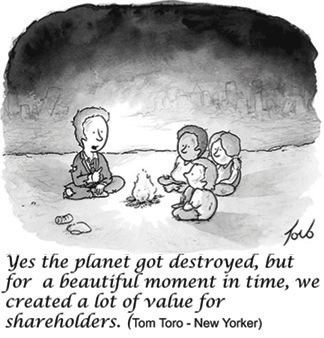 How many people in the room had children or indeed grandchildren, I wondered. Could an audience of experienced, intelligent people really be this blithely indifferent to the devastating impacts that unmitigated climate change will wreak on the world their progeny must inhabit? These same ageing contrarians doubtless insure their homes, put on their seatbelts, check smoke alarms and fret about cholesterol levels.
Why then, when it comes to assessing the greatest threat the world has ever faced and when presented with the most overwhelming scientific consensus on any issue in the modern era, does this caution desert them? Are they prepared quite literally to bet their children’s lives on the faux optimism being peddled by contrarians?
“We have been repeatedly asked: ‘Don’t you want to leave a better Earth for your grandchildren,’” quipped the comedian and talk show host John Oliver. “And we’ve all collectively responded: ‘Ah, fuck ’em!’” This would be a lot funnier were it not so close to the bone.
Climate Change (Abbreviated): Last Week Tonight with John Oliver (HBO)
Short-termism and self-interest is part of the answer. A 2012 study in Nature Climate Change presented evidence of “how remarkably well-equipped ordinary individuals are to discern which stances towards scientific information secure their personal interests”.
This is surely only half the explanation. A 2007 study by Kahan et al on risk perception identified “atypically high levels of technological and environmental risk acceptance among white males”. An earlier paper teased out a similar point: “Perhaps white males see less risk in the world because they create, manage, control and benefit from so much of it.” Others, who have not enjoyed such an armchair ride in life, report far higher levels of risk aversion…….
Facing up to climate change also means confronting the uncomfortable reality that the growth-based economic and political models on which we depend may be built on sand. In some, especially the “winners” in the current economic system, this realisation can trigger an angry backlash.
This at last began to make sense of these elderly engineers crowding into hotel rooms to engage in the pleasant and no doubt emotionally rewarding group delusion of imagining climate change to be some vast liberal hoax.
In truth, the arguments hawked around by elderly white male climate deniers like Fred Singer, William Happer and Nigel Lawson among others are intellectually threadbare, pockmarked with contradictions and offer little more than a cherry-picked parody of how science actually operates. Yet this is catnip for those who choose to be deceived.
It is, however, deeply unfair to tar all elderly white men as reckless and egotistical; notable exceptions include the celebrated naturalist David Attenborough……
A century after elderly military leaders cheerfully sent millions of young men from the trenches to their slaughter in the first world war, the defiant mood of today’s climate deniers is best captured by the stirring words of Blackadder’s General Melchett: “If nothing else works, a total pig-headed unwillingness to look facts in the face will see us through!” https://www.theguardian.com/environment/2017/sep/22/climate-deniers-protect-status-quo-that-made-them-rich
Hanford nuclear site – a rich source of comedy for John Oliver
Instead, Oliver pointed out that most nuclear plants around the country continue to store spent fuel rods even though those facilities were not designed to compile the nuclear waste.
“The most frightening example of this is the Hanford site in Washington state which created two-thirds of the plutonium in the U.S. arsenal and is currently storing 56 million gallons of highly toxic and nuclear waste underground,” Oliver said.
He then ripped a local news broadcast that called Hanford the most contaminated place in the Western Hemisphere.
“Oh it’s right here. We did it guys. Washington state,” Oliver said. “Home to the most contaminated place in the Western Hemisphere. Thousands of acres of apple orchards and several of Ted Bundy’s grisliest murders. We did it right here.”
Between the gibes, Oliver mentioned the continued health risks at Hanford, including a recent plutonium leak, and criticized officials for the design of a tunnel that collapsed on May 9. Some of the wooden timbers gave way in the tunnel, which exposed highly contaminated machinery…..
We’ve been saying that we were going to fix this for decades now and we seem to be no closer to a solution,” Oliver said. “We are dancing with trouble here. So if anyone says the government can just continue to wait, they are much like a house without a toilet, absolutely full of …”
The Associated Press contributed to this report. http://www.spokesman.com/stories/2017/aug/21/hanford-becomes-comical-punching-bag-for-hbos-oliv/
China’s culture, and the fear of speaking out on environmental concerns
Why Environmental Activists Are Afraid to Speak Out, http://www.sixthtone.com/news/why-environmental-activists-are-afraid-speak-out , Feng Yongfeng, Feb 21, 2017 In 2007, soon after I founded an organization called “Nature University,” I ran a program for those with an interest in conservation — both experts and amateurs alike. I took them walking along Beijing’s waterways every Saturday, and each time, we saw foul water pouring directly into the streams and rivers. “We are environmental activists,” some of our shocked volunteers said. “We shouldn’t just look on and do nothing.”
Nature University is a Beijing-based virtual community school for sharing information about environmental protection. We mainly target volunteers and nongovernmental organizations in our campaigns. Back in 2007, our big idea was to launch a photo event encouraging people to send in pictures of Beijing’s sewage outlets, which we would then forward on to the authorities to create a dialogue with them about water pollution.
Hardly anybody responded to our call for submissions. When the time for action arrived, I was left wondering where all the once-vocal critics had gone. In my opinion, they failed to overcome the deep-seated fear of speaking out — a fear passed down from generation to generation. People were afraid that if they reported severe pollution in the area, their families or friends might become targets for retribution by those responsible, such as factory bosses or owners.
Fear of playing a role in public affairs is rooted in many people’s upbringings. From a young age, Chinese parents constantly warn their children that only grave misfortune will come of stepping into the public domain and challenging the powers that be, citing examples from ancient history in which those who made enemies of such people were executed, their accomplices exiled, and their family and friends mistreated. This mindset leads many environmental activists to gag themselves. Activities like crowdfunding, agenda-sharing, photographing contamination sites, lodging official complaints, and speaking out on social media all suffer under this mentality.
Sometimes, activists treat all stakeholders in a pollution event — from coal mine owners to managers, from local officials to the most menial workers — as enemies to be held in the utmost contempt. As their fear turns to anger, they make themselves more foes than friends, and therefore find more problems than solutions. Everyone involved in the disaster becomes a symbol of the fear they feel, and thus everyone becomes an antagonist in the fight for real change. It is hardly surprising that many of the projects organized by environmental activists are stymied by infighting before they truly get off the ground.
Environmental activists are at war with pollution, but fear of the transgressors keeps us too daunted to act. Ingrained self-denial makes us reluctant to pursue meaningful endeavors and keeps us locked in constant equivocation. Therein lies China’s dilemma: Very few people are happy about pollution, but even fewer are willing to act decisively against it. The only way to publicly escalate the issue is to stay mentally strong and argue based on the facts we have. Blots on China’s environmental landscape cast shadows over a large portion of the population. It is in the public interest to fight pollution, but we are too worried about ramifications for individuals when we should be worried about the collective good.
We must exorcise our collective malaise if we are to save our environment. If you suspect that a factory is acting irresponsibly in limiting pollution, do something about it. Find out about what it produces, the technical details of its product, and the national laws requiring it to protect its surroundings. If you find inconsistencies in any of these areas, report them.
Make your voice heard through social media and crowdfunding. Be encouraged by small but meaningful signs of progress. Day by day, week by week, a concerted public effort can and will reshape the environment around us, provided we can muster a groundswell of support. With these tools, we can overcome fear. The only real thing we should fear is our own apathy and lack of ambition when it comes to social and environmental justice.
A workshop I attended at the prestigious Peking University last December convinced me of this. At the end of the event, a student asked, “What is the greatest challenge facing China’s environmentalist groups today?” I expected the answer to be something rather banal, like a shortage of funding, labor, or knowhow. Instead, the speaker — the secretary general of the China Biodiversity Conservation and Green Development Foundation, Zhou Jinfeng — gave a much more refreshing response: “Now is the best time for environmental groups to make their mark in China, because no other country in the world has more environmental disasters going unchecked. Environmental groups, activists, and volunteers will have an impact in China so long as they put their words into actions. So why are so many of you sitting around watching?”
Ingrained self-denial makes us reluctant to pursue meaningful endeavors and keeps us locked in constant equivocation. Therein lies China’s dilemma: Very few people are happy about pollution, but even fewer are willing to act decisively against it. The only way to publicly escalate the issue is to stay mentally strong and argue based on the facts we have. Blots on China’s environmental landscape cast shadows over a large portion of the population. It is in the public interest to fight pollution, but we are too worried about ramifications for individuals when we should be worried about the collective good.
Perpetrators of ecological disasters are far more vulnerable than most people think. From the moment when a pollution event occurs, those responsible for it live in fear of the judgment — both official and unofficial — against them. Yet to capitalize on this weakness in those who ravage the land, sea, and air, environmental crusaders must be brave. Even just a few soldiers fighting valiantly on the front lines can turn the tide of battle and inspire the public to put aside its fear of jumping into the fray.
Toxic debates like the hinkley nuclear one need social science input
 by opening up this kind of wider discussion, social science can undertake its trickiest – but arguably most useful – task in any controversy. The stakes in this particular case transcend nuclear debates alone – and raise questions about the overall health of British democracy.
Hinkley C shows the value of social science in the most toxic public debates
Social science can help explain why people disagree over controversial technologies and – most importantly – surface hidden assumptions, Guardian, Andy Stirling and Phil Johnstone, 24 Oct 16, t’s been another turbulent month in the long-running saga over the Hinkley Point C nuclear power station. Having looked as if she might be contemplating a rethink, Theresa May unveiled an apparently decisive approval just before the Conservative Party conference. But with longstanding issues still unaddressed– and new problems emerging even since the PM’s announcement – the debate over Hinkley is far from over…….
For powerful interests in any setting, social research can also play a useful role in helping to justify, present or implement favoured policies. Here, social science can be part of the closing down of debate – helpfully enabling political attention to move on.
But what if, on deeper reflection, powerfully-backed policies are a bad idea (perhaps as with the Hinkley decision? History is replete with examples – like asbestos, heavy metals, carcinogenic pesticides, chlorine bleaches, toxic solvents and ozone depleting chemicals – where it only emerged in retrospect that the pictures being given of “sound science” or the “evidence base” at the time were unduly shaped by vested interests or constrained imaginations.
It is here that social science can play a further crucial role: helping to open up policy debates where they are being prematurely “locked-in”. This focuses less on society as a target for policymaking, and more on the processes of policymaking themselves. The production and interpretation of evidence is, after all, as much a social phenomenon as public attitudes or political mobilisation.
It is a striking feature of the Hinkley example that even the government’s own evidence base is strikingly damning. The assessment of value for money itself acknowledges Hinkley C to be more expensive than other low carbon energy strategies. And the picture in other official sources is even more negative. With nuclear costs rising and renewable costs falling – and a worldwide turn towards wind and solar power – global trends compound the picture.
With the UK enjoying the best renewable energy resource in Europe and holding a competitive advantage in offshore industries, industrial policy arguments are also manifestly stronger for renewables. The same applies to prospective jobs. Compared to nuclear safety and security challenges, renewables are less vulnerable. And simplistic “baseload” arguments are shown by numerous official reports to be superseded by technology – and repudiated even by the National Grid. So the officially-stated reasons for nuclear enthusiasm simply don’t stack up………
our research suggests there is a further – seriously neglected – factor that may underlie the intense attachment of successive UK governments to civil nuclear power. This involves parallel UK commitments to maintain nuclear submarine capabilities. Without the cover provided by lower-tier contracts in civil nuclear construction, the diminished UK nuclear manufacturing sector would simply not be able to build these formidable technological artefacts. Nor could they easily be operated without civil infrastructures for nuclear research, design, training, maintenance and regulation.
So a consequence of withdrawing from nuclear power might also be very serious for a particular version of British identity – especially in the coming post-Brexit era. It is nuclear military prowess that supposedly allows the UK to “punch above its weight” on the world stage. Yet, although this rationale for continued UK nuclear commitments is clearly documented on the military side, it is unmentioned anywhere in official civil nuclear policy statements – and in energy debates more widely.
What this might mean for policy is a moot point. But by opening up this kind of wider discussion, social science can undertake its trickiest – but arguably most useful – task in any controversy. The stakes in this particular case transcend nuclear debates alone – and raise questions about the overall health of British democracy.
Phil Johnstone is a research fellow and Andy Stirling is a professor of science and technology policy at the Science Policy Research Unit (SPRU), University of Sussex. https://www.theguardian.com/science/political-science/2016/oct/24/hinkley-c-shows-the-value-of-social-science-in-the-most-toxic-public-debates
1 This Month


Petition to revoke the licensing of the Near Surface Nuclear Disposal Facility (NSDF) at Chalk River. https://www.ourcommons.ca/petitions/en/Petition/Details?Petition=e-7247


of the week – STOP SMALL MODULAR REACTORS IN CANADA
To see nuclear-related stories in greater depth and intensity – go to https://nuclearinformation.wordpress.com
-
Archives
- March 2026 (163)
- February 2026 (268)
- January 2026 (308)
- December 2025 (358)
- November 2025 (359)
- October 2025 (376)
- September 2025 (258)
- August 2025 (319)
- July 2025 (230)
- June 2025 (348)
- May 2025 (261)
- April 2025 (305)
-
Categories
- 1
- 1 NUCLEAR ISSUES
- business and costs
- climate change
- culture and arts
- ENERGY
- environment
- health
- history
- indigenous issues
- Legal
- marketing of nuclear
- media
- opposition to nuclear
- PERSONAL STORIES
- politics
- politics international
- Religion and ethics
- safety
- secrets,lies and civil liberties
- spinbuster
- technology
- Uranium
- wastes
- weapons and war
- Women
- 2 WORLD
- ACTION
- AFRICA
- Atrocities
- AUSTRALIA
- Christina's notes
- Christina's themes
- culture and arts
- Events
- Fuk 2022
- Fuk 2023
- Fukushima 2017
- Fukushima 2018
- fukushima 2019
- Fukushima 2020
- Fukushima 2021
- general
- global warming
- Humour (God we need it)
- Nuclear
- RARE EARTHS
- Reference
- resources – print
- Resources -audiovicual
- Weekly Newsletter
- World
- World Nuclear
- YouTube
-
RSS
Entries RSS
Comments RSS
 nuclear-news