Nuclear power and HEALTH – theme for April 2012
 The nuclear lobby will now tell you, proudly, that there are no deaths from Fukushima radiation – so really, it’s not all that bad for health. Indeed, they will claim that ‘low level’ radiation is even good for health.
They know well that radiation induced cancer takes decades to appear – so that first claim is a wicked deception.
The second claim is untrue. The truth is that the USA Department of Energy is funding research in many places, worldwide, aimed at trying to prove that “low level radiation is good for you” . No credible evidence exists for this distortion of the true situation.
The list below applies to USA veterans, who took part in nuclear weapons testing decades ago. The ‘low level radiation’ that they received is exactly the same kind of ‘low level radiation’ experienced by the Fukushima communities. The cancer outcomes will be the same. But, like the veterans, not just soon after the contamination.
 DISEASES ACKNOWLEDGED BY THE UNITED STATES GOVERNMENT TO BE CAUSED BY PARTICIPATION IN ATMOSPHERIC TESTING OF NUCLEAR WEAPONS, Leukaemia (other than chronic Iymphocytic leukaemia) – Cancer of the Thyroid – Cancer of the Breast – Cancer of the Pharynx – Cancer of the Oesophagus- Cancer of the Stomach – Cancer of the small intestine – Cancer of the Pancreas – Multiple Myeloma – Lymphomas (except Hodgkinís disease) – Cancer of the Bile Ducts – Cancer of the Gall Bladder – Cancer of the liver (except if cirrhosis or hepatitis indicated) – Cancer of the urinary tract, which also translates to the bladder and kidneys – Cancer of the salivary glands
Incorporated into public law 100-321, 20.5.88.
“This law gives US atomic exservicemen due recognition for the unusual service they rendered, and is an expression of gratitude of the American people toward their atomic veterans The law enables Veteran Affairs benefits to flow to US atomic veterans who are afflicted. The US government m relation to nuclear veterans considers the nature of service plus the development of any of the above diseases sufficient cause to quality for Veteran Benefits regardless of recorded dose rates received. All US nuclear test service personnel are officially Veterans.” http://nuclearhistory.wordpress.com/2011/12/31/diseases-acknowledged-by-the-united-states-government-to-be-caused-by-participation-in-atmospheric-testing-of-nuclear-weapons/
Nuclear power and HEALTH – theme for April 2012
What are the health effects of ionising radiation?

Very high doses of radiation: death within hours or days, due to damage to brain and nerves
High doses: death within weeks, due to damage to the gastrointestinal tract, to the bone marrow, where blood cells are formed.
Lower doses: less severe:radiation sickness (nausea, fatigue and vomiting). Sterility. Some years later – cancer, (especially of thyroid), diseases of digestive organs, bone, & muscle.
Genetic effects: cell damage passed on to later generations
US Nuclear Regulatory Commission Fact Sheet on Biological Effects of Radiation – Cancers associated with high dose exposure (greater than 50,000 mrem) include leukemia, breast, bladder, colon, liver, lung, esophagus, ovarian, multiple myeloma, and stomach cancers. Department of Health and Human Services literature also suggests a possible association between ionizing radiation exposure and prostate, nasal cavity/sinuses, pharyngeal and laryngeal, and pancreatic cancer.
Nuclear radiation and water pollution – theme for February 2012
 What you are not supposed to know:It doesn’t take an accident for a nuclear power plant to release radioactivity into our air, water and soil. All it takes is the plant’s everyday routine operation, and federal regulations permit these radioactive releases…
.Government regulations allow radioactive water to be released to the environment containing “permissible” levels of contamination. Permissible does not mean safe.Detectors at reactors are set to allow contaminated water to be released, unfiltered, if below “permissible” legal levels.
The Nuclear Regulatory Commission relies upon self-reporting and computer modeling from reactor operators to track radioactive releases and their projected dispersion. A significant portion of the environmental monitoring data is extrapolated – virtual, not real.Accurate accounting of all radioactive wastes released to the air, water and soil from the entire reactor fuel production system is simply not available. http://www.nirs.org/factsheets/routineradioactivereleases.htm
Nuclear disaster and fresh water : The risk of radioactive releases into fresh water water through a nuclear accident is an ever present danger. Drinking water for millions of people could be contaminated.
Sea water From Fukushima huge amounts of contaminated water accumulated during efforts to cool the reactors, with much of it reaching the sea, and radiation has been found in fish, seaweed and other seafood.
“At least 462 trillion becquerels of radioactive strontium have leaked to the Pacific Ocean since the March disaster at the Fukushima No. 1 nuclear power plant, making it one of the world’s most severe such cases of marine pollution, according to calculations by The Asahi Shimbun newspaper. http://www.examiner.com/human-rights-in-national/over-462-trillion-becquerels-fukushima-strontium-pacific-ocean-seafood-risk?CID=examiner_alerts_article
Nuclear power and WATER – theme for February 2012
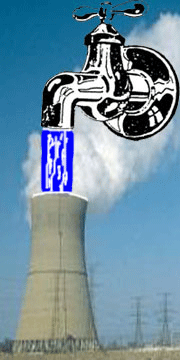 Effects of uranium mining and nuclear power on water.

Overuse of precious fresh water.One of the greatest dangers of the nuclear/uranium industry is in its use of water. Both uranium mining and nuclear reactors require enormous amounts of water. This is a threat to the world’s scarce resources of fresh water.
Pollution. Both uranium mining and nuclear reactors also pollute water. In uranium mining, water is often used to pour over radioactive dust tailings: radioactive water can leach down into groundwater. In the “in situ leach” process, radioactive water is disposed of into the aquifer.
Nuclear reactors use water for cooling – the resulting hot water is released into the source, river, or coastal sea, to thermally pollute the area, damaging plants and fish.
Effects of water scarcity, and hot water on nuclear reactors.. In heat waves, nuclear reactors often will need to be shut down, as their river sources of cooling water become too warm to function as a coolant.
As global warming brings about a rise in average temperatures and ocean levels, inland reactors will increasingly contribute to, and be affected by, water shortages. During the record-breaking 2003 heat wave in France, operations at 17 commercial nuclear reactors had to be scaled back or stopped because of rapidly rising temperatures in rivers and lake. Spain’s reactor at Santa María de Garoña was shut for a week in July 2006 after high temperatures were recorded in the Ebro River.
Paradoxically, then, the very conditions that made it impossible for the nuclear industry to deliver full power in Europe in 2003 and 2006 created peak demand for electricity, owing to the increased use of air conditioning. http://chellaney.net/2011/03/14/paradox-of-nuclear-power-water-guzzler-yet-vulnerable-to-water/
Seawater can be used to cool reactors, but it has to be purified. Corrosive elements in the seawater would otherwise ruin the reactors – so seawater is a last resort for cooling. As in the case of the Fukushima emergency – seawater was used, as ruining the reactors was preferable to a catastrophic nuclear meltdown.
Nuclear Power and The Tragedy of the Commons – theme for June
There’s not much “commons” left, in this so much privatised world. “Common land” is disappearing fast, and they haven’t yet found out how to privatise the air, the clouds, and the oceans. So, the air, the rain and the oceans are fair game- for exploiting, and for using as endless rubbish dumps.
 image from http://kirbyandfriends.files.wordpress.com/2011/03/underwater_light_and_bubbles_by_della_stock.jpg
With the continuing Fukushima nuclear disaster the focus at present is on the radioactive pollution of the seas.
Nuclear power and the commons of this beautiful world – theme for June
It’s time that human societies made the change – started taking real co-operative action to look after our commons, in this beautiful world. – land, fresh water, air, and oceans. Already, national leaders are under pressure from their people to protect our common interests, rather than the interests of polluting corporations.
If the Fukushima nuclear crisis is doing one good thing, it is making it clear that radioactive pollution is an international problem, not just a problem for Japan.
by photographer Edgar Moskopp http://acidcow.com/pics/14022-our-beautiful-planet-16-pics.html
Unhealthy employment – the nuclear industry – theme for April 2012
Renewable energy and energy efficiency provide a huge variety of jobs. On the whole, these are pretty safe and healthy jobs. Still the construction of wind turbines, solar power facilities, hydro power and so on do carry the risks associated with all construction jobs. And there are other hazards, too, for example, chemical hazards in some areas of work.
But these risks pale into insignificance when compared to the risks involved in the nuclear fuel cycle.
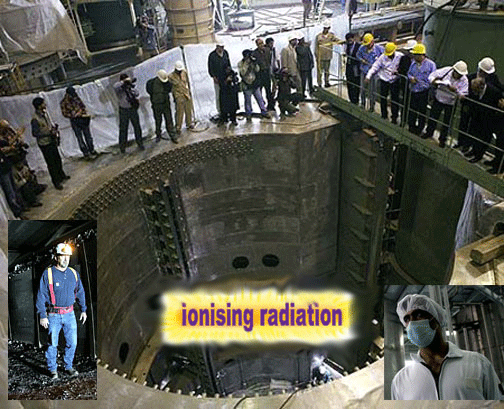
Workers also have the mental stress caused by their knowledge of underlying hazard to themselves and the community. There is the mental stress of their necessary strict surveillance and secrecy
BUSTING the NUCLEAR SPIN – theme for May 2011
Nuclear Spin has suddenly become critically important. The global nuclear industry was failing, anyway. But Fukushima could give it the final fatal blow.
The Nuclear Establishment is now in a panic – spinning furiously on many levels.
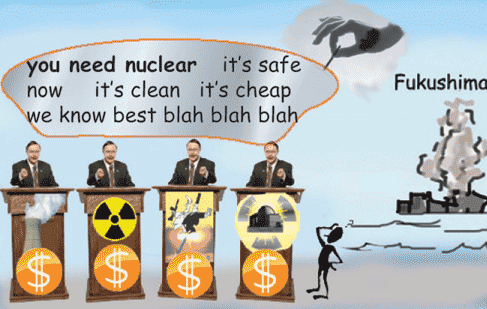
A main focus is on downplaying the health effects of ionising radiation. They will tell you that there have been “few deaths” from Chernobyl radiation. They’ll prove it – citing only thyroid cancer. The World Health Organisation, (WHO, hand in glove with the International Atomic Energy Agency, IAEA), counts only thyroid cancer as a result from Chernobyl – not leukaemia, other cancers, or birth defects
As cancer effects from the Chernobyl disaster can be expected around 25 years afterwards, the nuclear mafia point to the early death toll (after 1986) – not to 2011, 0r future years. From this, they then claim that the Fukushima disaster also has had a relatively small effect on health.
At the same time, the Nuclear Establishment works to weaken regulations on ionising radiation, and to push the false idea that low level radiation is benign, even beneficial to human health. Already the Japanese government is changing the rules,to permit higher radiation levels in children as “acceptable.
NUCLEAR POWER and CIVIL LIBERTIES – theme for February 2011
With uranium mining, nuclear power, nuclear wastes, and nuclear weapons, – civil liberties are increasingly eroded. They must be, even when all seems to be going smoothly. Nuclear reprocessing, with plutonium as fuel, would necessitate taking away even more civil liberties.
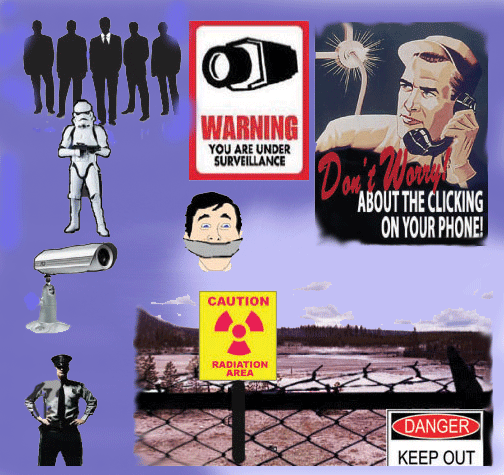
A police state would develop, even with “peaceful” nuclear reprocessing. But imagine how fast we would lose civil liberties, in the event of a nuclear mishap – theft of plutonium, terrorist strike, accident. For a start, the public would not even be informed, (for fear of public panic). Very quickly, that police state would be turned into a martial law state.
1 This Month

of the week – Shut Down Drone Warfare!


Tell the Ukrainian Government to Drop Prosecution of Peace Activist Yurii Sheliazhenko

Petition to revoke the licensing of the Near Surface Nuclear Disposal Facility (NSDF) at Chalk River. https://www.ourcommons.ca/petitions/en/Petition/Details?Petition=e-7247
To see nuclear-related stories in greater depth and intensity – go to https://nuclearinformation.wordpress.com
-
Archives
- March 2026 (244)
- February 2026 (268)
- January 2026 (308)
- December 2025 (358)
- November 2025 (359)
- October 2025 (376)
- September 2025 (257)
- August 2025 (319)
- July 2025 (230)
- June 2025 (348)
- May 2025 (261)
- April 2025 (305)
-
Categories
- 1
- 1 NUCLEAR ISSUES
- business and costs
- climate change
- culture and arts
- ENERGY
- environment
- health
- history
- indigenous issues
- Legal
- marketing of nuclear
- media
- opposition to nuclear
- PERSONAL STORIES
- politics
- politics international
- Religion and ethics
- safety
- secrets,lies and civil liberties
- spinbuster
- technology
- Uranium
- wastes
- weapons and war
- Women
- 2 WORLD
- ACTION
- AFRICA
- Atrocities
- AUSTRALIA
- Christina's notes
- Christina's themes
- culture and arts
- Events
- Fuk 2022
- Fuk 2023
- Fukushima 2017
- Fukushima 2018
- fukushima 2019
- Fukushima 2020
- Fukushima 2021
- general
- global warming
- Humour (God we need it)
- Nuclear
- RARE EARTHS
- Reference
- resources – print
- Resources -audiovicual
- Weekly Newsletter
- World
- World Nuclear
- YouTube
-
RSS
Entries RSS
Comments RSS
 nuclear-news