Nuclear scientists not so well aware of the risks – theme for April 2018
Research has found disturbing differences in the attitudes of scientists in different areas, to health and environmental risks of the nuclear industry.
It is even more disturbing that policy-makers and politicians prefer to support and value the opinions and work of the very scientists who are least informed and least interested in those risks.

Politics and Scientific Expertise: Scientists, Risk Perception, and Nuclear Waste Policy, Richard P. Barke Hank C. Jenkins‐Smith. – To study the homogeneity and influences on scientists’perspectives of environmental risks, we have examined similarities and differences in risk perceptions, particularly regarding nuclear wastes, and policy preferences among 1011 scientists and engineers. We found significant differences (p0.05)in the patterns of beliefs among scientists from different fields of research. In contrast to physicists, chemists, and engineers, life scientists tend to: (a)perceive the greatest risks from nuclear energy and nuclear waste management; (b)perceive higher levels of overall environmental risk; (c)strongly oppose imposing risks on unconsenting individuals; and (d)prefer stronger requirements for environmental management.
On some issues related to priorities among public problems and calls for government action, there are significant variations among life scientists or physical scientists. We also found that–independently of field of research–perceptions of risk and its correlates are significantly associated with the type of institution in which the scientist is employed. Scientists in universities or state and local governments tend to see the risks of nuclear energy and wastes as greater than scientists who work as business consultants, for federal organizations, or for private research laboratories. Significant differences also are found in priority given to environmental risks, the perceived proximity of environmental disaster, willingness to impose risks on an unconsenting population, and the necessity of accepting risks and sacrifices. more https://onlinelibrary.wiley.com/doi/abs/10.1111/j.1539-6924.1993.tb00743.x
The nuclear industry and science myths- theme for April 18
The nuclear lobby is more of a religious cult than a science body. It relies a lot on the prevailing myth about “hard” science being somehow better than “soft science”. The nuclear doctrine is that if you’re not an expert in the “hard”sciences, then you cannot have a valid opinion.
There were no biologists, geneticists, ecologists involved in the origin of nuclear weapons and nuclear power. It seems the same today, even though the most zealous nuclear lobbyists proclaim themselves as “environmentalists”. But their propaganda gives them away – shows their ignorance of those complex, nuanced sciences that are downgraded in the present global drive for unbridled technology development.

One hardly dares mention studies like sociology, anthropology, ethnic studies … even economics – these are dismissed, too, as “soft” .
But all these downgraded subjects are the ones we should be addressing, if the world is to be saved from the twin horrors of nuclear devastation and climate change.
The 21st Century’s Olympic-sized nuclear lie – FUKUSHIMA – theme for March 2018
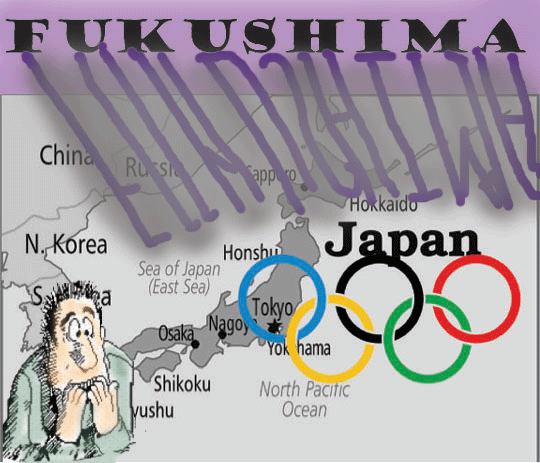 They are telling us that all is OK now in Fukushima, as enthusiasm rises for the 2020 Olympic Games in Japan.

This is indeed the lie of the century. And it is such an important lie. It carries the message that the nuclear industry is under control, and can continue through the century.
It is up to all fair minded people to look at this situation – and not to be misled by the clarion calls for “jobs” – “nuclear against climate change” – “the world’s desperate need for energy“. These are indeed a pack of lies: solar and wind create many more jobs, the nuclear fuel chain increases carbon emissions, the renewable energy revolution is under way, and so is energy efficiency.
What is the state of Fukushima today?
Radiation inside the plant continues to skyrocket to the point of causing even robots to malfunction.
And it’s not as if the danger is decreasing. In fact, it is quite the contrary. Radiation levels at the Fukushima plant recently were at their highest levels since the disaster began.
Cancer cases continue to crop up among children living in towns near Fukushima. The Japanese government is refusing to release accurate health data and is threatening to take away hospital privileges from doctors who diagnose radiation symptoms.
Radioactive water continues to run out of the mountain streams into the Pacific, so a thorough cleanup of the mountain ranges should begin right now, but that is a mammoth undertaking that may never succeed.
Both the Japanese government and the atomic power industry are trying to force almost all of the people who evacuated their homes in the wake of the Fukushima nuclear disaster to return “home” before the 2020 Tokyo Olympics. The government removes the subsidies to evacuees, forcing them back. The International Olympic Commission is working overtime to normalize the situation as well, even though conditions at Fukushima are anything but normal. Big banks and large electric utilities and energy companies are putting profit before public health.
Dr. Tadahiro Katsuta, an associate professor at Meiji University, Japan, an official member of the Nuclear Reactor Safety Examination Committee and the Nuclear Fuel Safety Examination Committee of the Nuclear Regulation Authority, said that the Fukushima evacuees are “extremely worried” that their plight will be overshadowed by the Olympics. He believes the Japanese government is using the Olympics to demonstrate to the world that Japan is now a “safe” country and that the Fukushima disaster “has been solved.”
“In Japan, the people are really forgetting the Fukushima accident as … the news of the Olympics increases,” he said. https://www.ecowatch.com/tokyo-olympics-fukushima-2460798164.html
Macho Madness – nuclear history – theme for February 18
The nuclear industry was born in macho madness – and has stayed that way ever since.
If women had equal say – had any say – things might have been different.

Nuclear Power and Space Exploration – theme for November 2017
Coinciding with the severe downturn in the nuclear industry, is the rush of enthusiasm for space exploration – and the goal of “putting a man on Mars”. The nuclear industry must be pleased, as the fuel for space rockets is their own product – PLUTONIUM! (Space travel might save their industry?)
 Plutonium is the most toxic of all the radioactive products of nuclear fission,
  as well as being the fuel for nuclear weapons. There have already been accidents with space rockets. The effects of a space craft crash on an Earth city are almost unimaginable, and certainly never properly considered by the space technocrats and nuclear enthusiasts. To them, this is an “acceptable risk”.
Then there’s the doom-laden future for astronauts to Mars. Quite simply, cosmic radiation would kill them. Even now, astronauts suffer extraordinary health ill effects, as related by Scott Kelly, in his new book “Endurance” . Not all these effects are caused by radiation – and this issue merges into the troubling ethical problems of sending people to Mars, or even, into space.
We are constantly being told of the benefits to come, in space travel. What benefits? Are they greater than the huge environmental and personal risks? And the financial costs – paid for by the tax-payer? That money could go to meet real human needs. There’s something wrong with our priorities when we mindlessly accept enthusiasm for technology, innovation etc – as better than healing the health of this planet, and its populations.
NUCLEAR LIES – theme for October 2017
The nuclear industry’s history of lies goes right back to its beginnings in the early 1940s.
I would say the that lying is the worst thing about the nuclear industry – and that’s saying plenty!
Of the current lies – it’s hard to pick which lie matters most.
Lately the nuclear lobby is touting the lie that “new nuclear” is essential for peace and nuclear non proliferation. That’s a beauty, isn’t it?
The truth is that the nuclear weapons industry needs the “peaceful” new nuclear industry – in which to grow its expertise for the nuclear killing factories – the $trillion dollars nuclear weapons makers. (Which is why governments are lending an ear to the otherwise completely futile “Generation IV” nuclear reactor lobbyists)

The economic disaster that is the nuclear industry – theme for February 2016

A bunch of American billionaires is trying to save the astronomically expensive nuclear industry – by getting taxpayers to pay for even more astronomically costly “little new nukes”.
Meanwhile in China, France UK, South Korea – and even in America, governments are desperately propping up the super costly “big old nukes’ .
In a world where charlatan Donald Trump can become USA President – the nuclear sales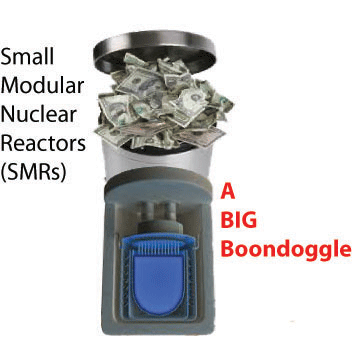 men might well think that any fraud can be perpetrated on the public.
But not for long.
The genuinely clean energy transition is under way world-wide, and becoming ever cheaper.
The “peaceful” nuclear industry is intrinsically linked to the multi $billion nuclear weapons industry. Yet even the nuclear weapons industry is under threat, with the coming UN nuclear disarmament conference.
Even if concern for the public good does not stop the toxic nuclear industry – the unaffordable economic costs eventually will
Nuclear Economic realities – theme for February2017
 The world is waking up to the unaffordable costs of the nuclear fuel chain.
Forget health, environment, safety, future generations, weapons proliferation – today’s killer of the nuclear industry is that good old reliable thing – the exorbitant MONEY that is required
Are “developing” countries really buying the nuclear lobby’s advertising drivel? Is China really on a nuclear build spree? Is Australia really going to “embrace” the nuclear fuel chain and become the planet’s nuclear toilet?
The nuclear lobby , like everyone else, knows that the game is over as soon as the next radioactive catastrophe occurs. That’s predicted as 50% probability before 2050. It could be this week. That’s a big reason why the nuclear lobby is in such a panic to lock in contracts to buy its toxic products – while the going’s good.
Only tax-payers will fund nuclear facilities, despite the drivel from democracies about private enterprise. Russia, China are more honest about it – the State owns the nuclear companies. And they’re all so keen to export the technology to other countries. Heck! Russia even pays for them to buy the stuff.
The nuke industry is in trouble – In USA the nuclear industry is a thing of the past. Investors flee Nordic nuclear company Vattenfall. Finland pulls out of building Olkiluoto 4 nuclear reactor. AREVA teeters on bankruptcy.
A small number of nuclear enthusiasts, with more money than common sense, now pay journalists to advertise “new nukes’, especially Small Modular Nuclear Reactors. Of course, their plan is for taxpayers to cough up – for fleets of even more expensive nuclear gimmicks.
Transition to renewable energy – theme for January 2017
This transition is well underway. Renewable energy is becoming ever cheaper. It is now the time to consider whether perhaps renewable energy should not be so cheap. This is the age-old debate between quantity and quality. Should the world have so much more renewable energy, or so much better renewable energy? But then perhaps it can have both.

The whole point of renewable energy is that it is clean. And, for sure, the major fuels – sun and wind – are undoubtedly clean. However, renewable energy does require some components – rare earths – that certainly have a dirty radioactive history, and may still have a dirty radioactive present.
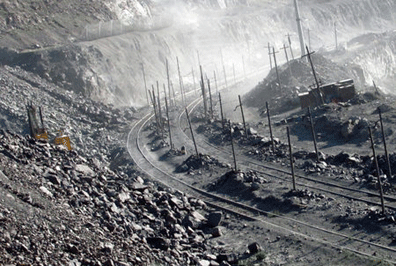 Two notorious historic examples of pollution from the production of rare earths are the Bukit Merah project in Malaysia , and China’s project in Inner Mongolia
China is now controlling rare earths’ production in a cleaner way. but it would be naïve and simplistic to assume that its pollution problems have completely gone away.
3 main approaches are being taken to this problem:
 Design for recycling. This is particularly appropriate for wind turbines.
Reduction in consumption of rare earths . This is not applicable to renewable energy, but rather to the rampant and wasteful consumption of modern electronic gadgets – often unnecessary, all too often a part of our throwaway culture. http://chinawaterrisk.org/resources/analysis-reviews/can-we-build-a-clean-smart-future-on-toxic-rare-earths/
Design for green technologies that don’t require rare earths
 Of course, like all modern industrial technologies, mining and manufacture and transport of renewables do mean environmental disturbance. But this is a balancing act, considering the environmental benefits of renewable energy.
The nuclear lobby pretends that renewable energy is environmentally dirty. In the 21st Century, it is vital that we acknowledge environmental problems, including that fact of radioactive waste from rare earths, and make sure that the production processes are clean, even if this adds to their cost.
The future belongs to clean renewable energy, not dirty nuclear power – theme for January 2017
Solar panels bring cheap energy to India
No wonder that the nuclear lobby is in a panic to spread its spin all over the world. Their lies, about curing climate change with Small Nuclear and Big Nuclear, remain lies, no matter how fervently the nuclear industry and its media acolytes repeat them.
The nuclear panic is on, because genuinely clean energy, (and energy conservation), are developing so fast, ever cheaper and more efficient, that it’s becoming evident that New Nuclear doesn’t stand a chance.
Renewable energy is inexorably becoming cheaper, even without subsidies. Wind energy is the cheapest form of new electricity generation available today. Solar power is on the way to beating even wind. Compared to nuclear, both forms are fast to set up, and provide many more and cleaner, jobs.
The media usually ignore decentralised renewable energy. Yet small solar and wind systems are already becoming the dominant form of new energy production. (It’s quite laughable to see the Small Modular Nuclear Reactor (SMR) lobby pushing their propaganda all over, while literally millions of solar rooftop panels go up every day. )
This month, this website will bring a focus onto the fast-growing renewable energy movement.
In 2017 the nuclear lobby lies should not prevail.
In a world where a jury acquitted O J Simpson of a double murder, and a nation elected Donald Trump for President, it is more important than ever, for lies and dishonest spin top be exposed.
Nuclear history from the archives – theme for December 2016
 The start was America’s Manhattan project – developing the atomic bomb. Then came the horror of the atomic bombing of Hiroshima and Nagasaki. Then came – the shock and guilt, and the attempt to turn the nuclear project into something good – “atoms for peace’ “electricity too cheap to meter”.
Of course the costing for “cheap” nuclear energy did not include the health and environmental toll of uranium mining, which, as always, was to be paid by indigenous people. Costing also did not include the virtually eternal toll of the cleaup of radioactive trash. And of course, there would be no accidents, (no Chalk River, Rocky Flats, Windscale, Mayak, Lenin icebreaker, Three Mile Island, Chernobyl, Tomsk, Hanford, Fukushima Daiichi)
Meanwhile, the military-industrial complex continued its production of nuclear weapons. Other countries adopted the “peaceful nuke”, so that they could develop nuclear weapons. The nuclear arms race was underway.

FROM THE ARCHIVES For this month, each week we’ll be posting an item from the past. Lest we forget.
The press release was drafted ahead of Operation Buffalo at Maralinga, during which troops were ordered to crawl through areas hit by fallout. It was not meant to be made public
Top secret document reveals British troops were knowingly exposed to radiation during nuclear fallout tests – mirror.co.uk, by Susie Boniface, 2 Jan 2011, British troops WERE knowingly exposed to radiation during nuclear fallout tests, a top-secret document has finally proved. Continue reading
From the archives – for December 16 – a look back at nuclear history
Today, journalism is in a sorry mess. Yet still, there are courageous examples of investigative journalism – such as the McClatchy report on nuclear workers’ health. All too often, revealing and informative reports on nuclear matters are forgotten, as celebrity sex scandals and sport dominate the mass media.
This month we will remember and refresh stories from our archives. It’s important that, while we look at current events, these events are illuminated by knowledge of their history. Especially today, as the nuclear industry struggles desperately to survive – and to portray itself as “clean, green and of course, peaceful”, the truth of its dirty history must be remembered.

Indigenous Fight Against Nuclear Colonialism – theme for July 16
Indigenous Fight Against Nuclear Colonialism
Indigenous people protest EPA’s nuclear plans
Indigenous people and the nuclear industry – theme for July 16
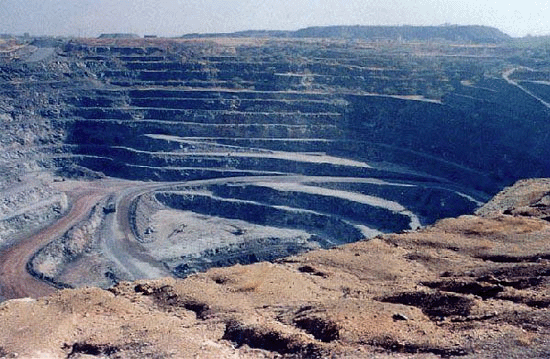 Indigenous people continue to bear the brunt of nuclear toxicity. It started with uranium mining – of course, on indigenous land in rural areas, in USA, Canada, Bulgaria, Australia, Germany , India, and of course to provide nuclear weapons material.
Then came the nuclear bomb tests – on remote rural indigenous lands and islands
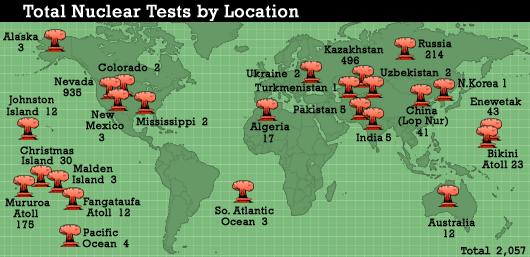
Indigenous peoples either stayed on their polluted lands, as uranium mining continued, or were removed from bomb tests sites, unable to return.
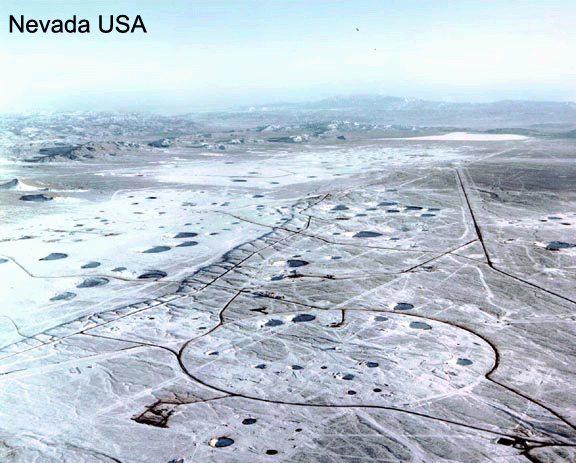

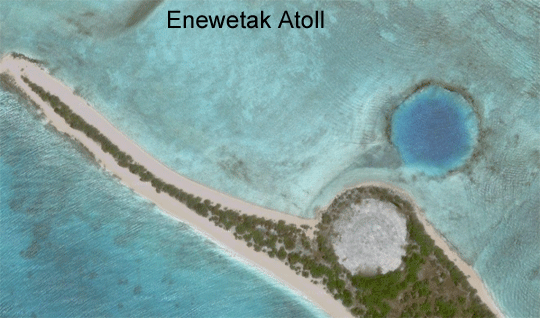

This Radioactive pollution remains today, from uranium mining in many countries – but always on or close to indigenous lands. The nuclear bomb test sites remain too radioactive for the indigenous people to return home.
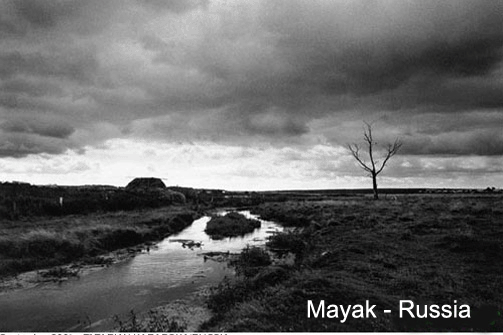
Uranium mining and milling, nuclear bomb tests and radioactive wastes ...
Russia is secretive about its nuclear wastes. They used to dump it in oceans, as did the French and others. Russia is notorious for its extremely polluted remote area at Mayak, where the rural people suffer the health legacy to this day
The “developed” world realises that something must be done with the growing amounts of radioactive trash.
Where to dump it? That’s a “developed society” no brainer – ON INDIGENOUS LAND, of course. There’s now a movement to export radioactive trash to remote rural areas, such as the Aboriginal lands of Australia
Next week we will look at the indigenous fight against the nuclear industry
Contradictions in the nuclear marketing frenzy – theme for June 2016
One contradiction is the increasing recognition that nuclear power is uneconomic, and could even bankrupt the sellers. It’s doubtful that the sellers will really make money out of it, especially Russia, funding so many other countries’ nuclear set ups. Still, we know why, really. It’s all part of the irrational battle to be Topp, to have that geopolitical presence and advantage in other countries.
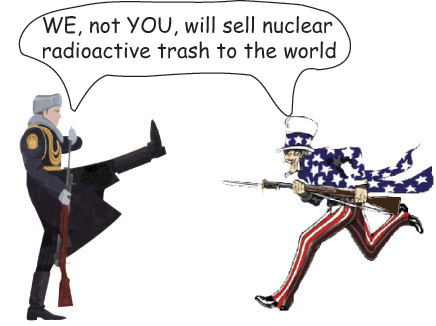
An obvious contradiction is the way in which both Russia and the West agonise about nuclear terrorism and nuclear weapons proliferation, while enthusiastically marketing nuclear technology to all and sundry. Never mind if it’s to an unstable Middle Eastern or East Asian regime, with a high risk of both terrorism and nuclear weapons development.
Another contradiction is the pretense going on that Big nuclear reactors and Small nuclear reactors are being happily promoted at the same time. The “conventional” big reactor companies. Toshiba Westinghouse, Rosatom, AREVA etc are determined to sell their stuff, and no way want to let the “new little” nuclear reactors take over the market. You can see this battle going on in Britain, with the “little nukes” lobbying away, and getting themselves set up as a “charity” for goodness’ sake!
How long will it be before the world recognises that the commercial nuclear empire is crumbling. We don’t need their toxic expensive product. Meanwhile renewable energy gets ever cheaper, fast to set up, versatile, and attractive to the public.
1 This Month

of the week – Shut Down Drone Warfare!


Tell the Ukrainian Government to Drop Prosecution of Peace Activist Yurii Sheliazhenko

Petition to revoke the licensing of the Near Surface Nuclear Disposal Facility (NSDF) at Chalk River. https://www.ourcommons.ca/petitions/en/Petition/Details?Petition=e-7247
To see nuclear-related stories in greater depth and intensity – go to https://nuclearinformation.wordpress.com
-
Archives
- March 2026 (237)
- February 2026 (268)
- January 2026 (308)
- December 2025 (358)
- November 2025 (359)
- October 2025 (376)
- September 2025 (257)
- August 2025 (319)
- July 2025 (230)
- June 2025 (348)
- May 2025 (261)
- April 2025 (305)
-
Categories
- 1
- 1 NUCLEAR ISSUES
- business and costs
- climate change
- culture and arts
- ENERGY
- environment
- health
- history
- indigenous issues
- Legal
- marketing of nuclear
- media
- opposition to nuclear
- PERSONAL STORIES
- politics
- politics international
- Religion and ethics
- safety
- secrets,lies and civil liberties
- spinbuster
- technology
- Uranium
- wastes
- weapons and war
- Women
- 2 WORLD
- ACTION
- AFRICA
- Atrocities
- AUSTRALIA
- Christina's notes
- Christina's themes
- culture and arts
- Events
- Fuk 2022
- Fuk 2023
- Fukushima 2017
- Fukushima 2018
- fukushima 2019
- Fukushima 2020
- Fukushima 2021
- general
- global warming
- Humour (God we need it)
- Nuclear
- RARE EARTHS
- Reference
- resources – print
- Resources -audiovicual
- Weekly Newsletter
- World
- World Nuclear
- YouTube
-
RSS
Entries RSS
Comments RSS
 nuclear-news