Titanic misconceptions that things will be OK
Last night I watched a terrific programme on SBS world television. It was all about the sinking of the Titanic, covering so many aspects never shown on TV before. I was struck by the atmosphere on the ship, in the early hours of the sinking, with many people, particularly the rich upper-class passengers, taking the whole process as something not really serious, rather fun even. Of course, not all of them saw it that way. But enough of them – to be able to have quite a good party on the upper deck lounge, and to regard the messenger calling them up on deck as rather a nuisance, an ignorant lower-class person. And indeed, some people just refused to leave their (temporarily comfortable) beds, on such a cold night.
And here was I, trying to get my mind away form the rather scary world news. I suppose I’d have been better watching some “reality” show, or that good old Australian standby – sport.
Anyway, the thing was – the Titanic story showed how people are inclined not to take a critical event seriously, not to worry about it, until it’s too late.
And lo and behold, the same sort of thing is happening now. Today DW reports Iran war: Israel hits Iranian heavy water nuclear reactor. The good old news.com.au writes ‘Worst case scenario’: Wall St craters, oil surges as nuclear sites hit’. The fascinating part of this coverage, as shown by that last headline, is that the financial aspect is the first priority.. Yeah, I know that the world economy is important, and it’s not a good thing to have Wall St stocks going down, and investors “mashing the panic button”. I’m not saying that this is a trivial matter. It’s just that drone or missile strikes on a nuclear facility could be a helluva lot more serious than a drop on the stock exchange.
We don’t need an actual nuclear bombing to create a massive environmental and health catastrophe, a drone strike can do that job.
Both articles focus on this economic crisis, paying barely lip service to the fearful physical danger of a nuclear site being exploded, or even just damaged. Israeli air strikes hit a nuclear research reactor in Iran’s Khondab region, and a uranium processing plant in Yazd in Central Iran. The reports hastened to tell us there was no release of radioactive material. How reassuring! We can focus on the main issue – the share prices.
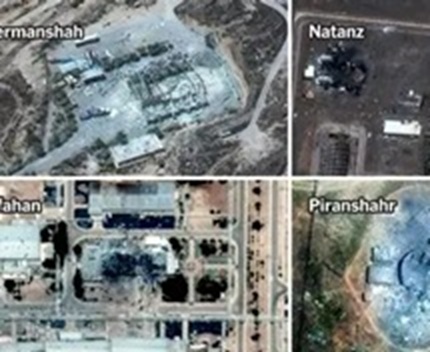
Questions come to mind. Will Iran retaliate by striking Israel’s Dimona reactor and other nuclear sites? How come it’s so terrible for Iran to have legally permitted nuclear research facilities, but apparently OK for Israel to have nuclear weapons. Estimates of Israel’s nuclear warheads range from 90 to 200, but Israel “does not confirm or deny” its nuclear weaponry numbers. So that’s apparently OK.
Yes, we’re all anxious about our petrol and diesel prices, and naturally so. But the possible ramifications of these Israeli strikes on nuclear facilities add up to something more horrendous. I don’t want to rave on here about the health, environmental, social toll that will ensue, if the warring states decide to use this very convenient weaponry – no need to have your own expensive nuclear bomb, just send a few cheap drones to attack your enemy’s nuclear sites.
As with those rich passengers on the Titanic, it’s time that world leaders woke up.
Me and the Pope – but is he the Antichrist?
19 March 2026 Noel Wauchope, https://theaimn.net/me-and-the-pope-but-is-he-the-antichrist/#google_vignette
Following my recovery from Catholicism, I never imagined that I would become a fan of the Pope. Perish the thought that I would ever sink back into believing those weird dogmas, and agreeing to Catholicism’s punishing rules about sexuality and abortion, and so forth.
Well, I haven’t sunk back that far – yet, but I just have to applaud Pope Leo. Under the guidance of Pope Leo, Catholic spokesmen have acknowledged that artificial intelligence is a useful tool, but warn against AI “overloading us with information to the point of paralysis.” Pope Leo XIV has given a tactful, but unmistakable warning against AI taking over control of our thinking. He recently advised the priests of Rome to use “their brains more” rather than AI when preparing homilies.
I feel that Leo’s predecessor, Pope Francis, set the course for this trend, in the condemnation of military attack as a way to resolve conflicts, and urging for human discussion and negotiation.
All good – you think? But is there something sinister about Pope Leo’s attitude to AI? Well the squillionaire Peter Thiel thinks so. He’s just given a series of lectures on Pope Leo’s doorstep in Rome. A critique of Peter Thiel’s ideas has been supplied, beautifully explained, in Australian Independent Media by Ricky Pann, also supplying this video:
It’s too much of a coincidence, that Mr Thiel has decided to make Rome the centre of his lecturing activities. The Pope has a huge worldwide influence, and his views on artificial intelligence have an impressive forcefulness and clarity. It’s pretty obvious that Thiel finds this a threat to the technological empire that he leads. And the Church recognises this – ‘Agent of chaos’ Peter Thiel is lecturing on the Antichrist at the Vatican’s doorstep.
You didn’t know that the technological geniuses who run our world can be not only so very scientifically knowledgeable, but also extremely religious. Scarily religious – I think. Thiel predicts a possible Caesar-Papist fusion, in which a tyrant – the Antichrist, joins up with government, in a sort of anti-science domination of the world. Thiel doesn’t actually see Pope Leo as the Antichrist (the Antichrist has to be young), but certainly worries about Pope Leo’s teachings.
Pope Leo is the first Pope with a formal degree in mathematics, and has called on mathematicians to be ”prophets of hope” and to integrate ethical responsibility into their technological advancements, particularly regarding artificial intelligence.
Oh dear, that’s very persuasive. Is Pope Leo indeed the Antichrist, the supporter of the facilitator of the coming Antichrist. Or is Peter Thiel a dangerous nutter?
Why should Trump get all the blame?

10 March 2026 Noel Wauchope, https://theaimn.net/why-should-trump-get-all-the-blame/
I’ve just read an article about planning nuclear power for a “post-Trump world” I’m wondering how many people are actually doing just that – planning for a “post Trump world.” Well, Donald Trump isn’t one of them. He’s got a pretty good plan for re-election in 2028. Never mind the fact that the USA Constitution forbids a President from having a third term in office. Heck, by 2028 there won’t be an American Constitution if Trump is still in office.
One way or another, I’d bet that Trump won’t be in office for that third term. By 2028, the apparently dim-witted American public might just not vote for Donald Trump, however colourful and entertaining he might be. Or the Republicans might have had enough, and somehow kicked him out in the meantime. Or some more dramatic events might have made him lose his grip on power – a nuclear war? He might even be in gaol – though I guess that’s a silly left-wing fantasy. Or even the seemingly immortally healthy Donald might get sick, or even die.
I just hope and pray that he is not assassinated. That would turn him into a martyr. A saint? As a recovered Catholic, I do think kindly of my old church. I just can’t imagine that current Catholicism could stomach the idea of Saint Donald Trump.
But anyway, I digress. And indeed this whole post is a digression. But to try to get to the point – what is wrong with the leaders of the Western world? It seems that only Spanish Prime Minister Pedro Sanchéz has denounced the USA/Israel’s illegal attack on Iran. Canada’s Prime Minister Mark Carney in January, briefly saw through Donald Trump, but by March, Carney had second thoughts, and fell into line in the conga dance behind him. The UK wavered and waffled, but ended up supporting the war. Confusion reigns in the EU. As for Australia – words fail me, as the ruling so-called Labor Party wriggles about, trying to deny that it supports the USA/Israel war. Twas so nice of Albanese to present Trump with a pretty little statue-thing of an AUKUS submarine.
It’s not just the war on Iran. It’s the support for Israel’s genocide. It’s the spectacle over two years, of politicians giving Trump standing ovations, smiling happily as they shake hands with this deranged, ignorant, sociopathic President of the USA. Surely they could manage mere politeness, and not a complete vision of fawning servility.
And when it all goes to shit, as it surely will, what will be their legacy? Will they be remembered as leaders of insight and integrity? Will they be remembered at all. Most likely, they’ll be gone and forgotten after the next election.
Let’s just remember, that pathetic lying confidence man, Trump, could not have done so much damage, so much harm, caused all that suffering, without their support.
The complex, long-form writers – but is anybody listening?

11 February 2026 Noel Wauchope, https://theaimn.net/the-complex-long-form-writers-but-is-anybody-listening/
I sympathise with readers who have a short attention span. I myself am one of those. And nowadays, well – that’s pretty much everybody.
And yet, people keep writing long, and very long, articles. Are they wasting their time? Who actually reads these articles?
I used to think that long articles were indeed a waste of time. And in a certain sense, I was right. I came from the angle of an antinuclear activist, and for a long time, the “nuclear debate” was run by highly – informed people, who made sure to use the absolutely correct technical language – no weak slips into ordinary talk. The anti-nuclear experts generally showed their opponents that they were right up there with the jargon that only experts understood. So the ordinary peasant, the general public, including many well-educated people, “dazzled by science” couldn’t really understand the long arguments. The result was that most people were intimidated, felt they could not understand it all. which was exactly the situation that the nuclear lobby wanted.
Then along came Dr Helen Caldicott, and mucked it all up. She understood all the technical stuff, and could write about that. But she also used ordinary, understandable language. And worse – heaven forfend – she sometimes was emotional. God, she even described some nuclear propagandists as “wicked”. Personally, I thought that the term was accurate. Anyway, Dr Caldicott copped a lot of flak, including even from the anti-nuclear lobby, with their obsession about being “respectable”. How dare she be so “hysterical”. But then she couldn’t help it, having the disability of being female.
But, Dr Caldicott, with her many books, public speaking, meeting world leaders, even influencing Ronald Reagan, got her message through to people, and the “debate, has never been the same since.
So, I rejoiced at this development, which did help journalists to loosen up, and cover nuclear issues in a more readable and human way. And in shorter articles.
But now the pendulum has swung too far in the direction of being short and easily digestible, especially with the communications monster of social media. It is a sad thing that probably only old people have the time and the inclination to read long articles.
And people are missing out, because often the full story on a subject is really covered only in long articles. I have a collection of these, on a variety of topics, and I had planned to reference a number of them here. Some are very densely written, full of facts, dates, events – and therefore really informative – but still a bit of hard work to read. And some show how very complex a situation can be – how there are two sides, and maybe more than two, to a story.
So, here are examples of very informative ones:
Planet Plastic: How Big Oil and Big Soda kept a global environmental calamity a secret for decades, by Tim Dickinson.
US military action in Iran risks igniting a regional and global nuclear cascade, by Farah N. Jan.
Cumulative effects of radioactivity from Fukushima on the abundance and biodiversity of birds, by Timothy A Mousseau
Securing the nuclear nation, by Kate Brown
Very interesting are the articles which cover something in depth, showing contradictory sides, and how very complex a subject can be:
Some examples-
Betrayed: How Liberals Supported Islamic Revolution in Iran in 1979 and Turned Against the Progressive Shah, by SL Kanthan,
The Long History Of Zionist Proposals To Ethnically Cleanse The Gaza Strip, by Mouin Rabbani.
And these can often be personal articles, about human conditions, character and integrity, leaving politics aside:
The heroes who saved the world from Chernobyl Two, by By Serhii Plokhy – also at The heroes who saved the world from Chernobyl Two.
Elon Musk’s Shadow Rule, by Ronan Farrow. Also at Elon Musk’s Shadow Rule, nuclear-news.
I hope that some people are reading long articles. Well, they must be, because some excellent movie documentaries and TV series often come up, and are derived from the written word. And perhaps many people are thus getting their longform stories in a different form. And perhaps some longform articles have a profound effect, even if it’s only on a relatively few readers.
Beware these dangerous writers in the world of journalism
Noel Wauchope, 3 Feb 26
I had in mind to look at Australia’s dangerous writers, in no particular hurry. But that’s changed. You see, the Australian Prime Minister, in his wisdom, decided to invite Isaac Herzog, the President of our great ally, Israel, on a state visit to Australia. After all, Herzog is not the real leader, not the Prime Minister of Israel. A United Nations commission of inquiry found Israel guilty of genocide. The International Criminal Court found Prime Minister Netanyahu guilty of war crimes. But even if you do take any notice of those radical organisations, probably President Isaac Herzog didn’t know anything about the alleged atrocities in Gaza.
Fortunately, the Australian press takes a moderate view of all this. P.M. Albanese’s invitation to Herzog is intended to unite Australians, and give comfort after the massacre of Jews at Bondi Beach. (What? The invitation was sent long before that massacre? There is no need to bring logic into this.)
Note .I wrote that the invitation had come before the Bondi massacre, and I was wrong in this. Nevertheless, it’s a tragic truth that the Bondi massacre has allowed the media to obscure the fact that the Australian government has been under continual pressure from the Zionist lobby.
In the circumstances, it’s important to avoid a trouble-making bunch of Australian writers who are likely to stir up criticism of Isaac Herzog, and let’s all be friends.
Now, you already know that Australia’s Cailtin Johnstone is an evil witch (and terribly rude, too). But there are plenty of other equally dangerous writers. I know, because even some of my family and friends have warned me about them, as have other very “reputable” people. There are so many evil ones like her. I don’t know where to begin.
A new threat is Michael West, and his string of collaborators:
Australians have been pretty well protected. The Adelaide Festival Board cancelled Dr Randa Abdel-Fattah‘s talk, planned for the Adelaide Writers Festival in March. Quite rightly and properly, as Dr Abdel-Fattah, though born in Australia, is of Palestinian heritage, and her books take an extremely pro-Muslim view, and advocate for Palestinian rights and identity.
Indeed, our government is pretty good at saving us from evil writers. And dedicated pressure groups can have a good influence on our media. So, for example, we have been protected from the wicked influence of Chris Hedges. The chief executive of Australia’s National Press Club, Maurice Reilly, cancelled Hedges’ scheduled talk on the Betrayal of Palestinian Journalists. The U.S. Press Club banned him, too. All very proper, as Hedges was insulting our friends, the Israeli government. But that’s not all. Chris Hedges is just so gloomy about everything – especially corporate coup, death of the liberal class, and the rise of fascism. We really should not tolerate such extreme bias and negativity. Why, Hedges even condemns the happiness industries. He’s so awful – hates everything that Western culture holds dear.
Rex Patrick is another Australian writer to be avoided, obviously unpatriotic as he trashes the idea of AUKUS submarines.
Australia’s boast is that “we are young and free”? Well, not exactly free, when it comes to press freedom, as we have no constitutional or explicit legal protection for press freedom. But that’s all to the good – keeping us focussed on our most respected traditional interests – sport, entertainment, celebrities, and food.On the international scene, there’s a spate of writing by extremists.You know straight away to avoid people like Jeffrey Sachs, with his wide-ranging way out views. Ralph Nader – a long time pest, obstructing progress. Eva Bartlett is particularly suspect, as she criticises both Israel and Ukraine. Juan Cole has extremist views on the Middle East. Craig Mokhiber is a complete ratbag, waffling on about human rights. Les Leopold is a ratbag on economics and workers’ rights. Koohan Paik-Mander is exceptionally dangerous, too, being Asian, and female.
Look, there’s lots more of them. I’ve barely scraped the surface. But my advice to you (especially right now, with the imminent arrival of our friend Isaac Herzog), is to be calm, be complacent, stick to the mainstream media, and avoid those awful journalists whose only aim is to upset you.
The brave journalists of the old-fashioned media.
21 January 2026, Noel Wauchope, https://theaimn.net/the-brave-journalists-of-the-old-fashioned-media/
It’s not easy being a journalist in a paid job in corporate print, TV or radio media. You have to toe the corporate line. It’s best to be writing on a specialised topic where you’re likely to not offend the powerful. Cooking, gardening, sport -are good, though even in them, hazardous aspects can arise – like race, religion, gender, sexuality.
But when it comes to environment, current affairs, politics, business – the prudent journalist needs to tread warily, lest he/she loses the job.
This is an awful pity. Although writers have always had to be careful about offending business owners and governments, It hasn’t always been as dangerous as it is now. And for us, the “consumers of media”, the advantages of “mainstream” media are great. There is funding to enable strong investigative journalism. There is fact-checking, meaning that the readers/viewers, listeners, can have confidence in the facts of the story. Heck! the editors even check grammar and spelling (well, mostly). And these are the reasons why I still like “mainstream” media.
And so, as I’m pondering on journalists and their contributions to society, I am very aware of those journalists who, still hanging on to their corporate-controlled jobs, manage to sneak in, or even state boldly, some unwelcome realities.
Nowhere is the media’s craven subservience to the powerful more obvious than in journalism’s coverage of the nuclear industry. Any day at all, if you bother to search “nuclear” on Google News, there will be a stream of articles describing the nuclear industry in positive terms, even with breathless enthusiasm.
I think that the nuclear lobby has done a fine job in teaching the world that no-one but nuclear industry experts can possibly understand nuclear issues – so journalists find it easiest and prudent to just regurgitate nuclear industry handouts. (Heaven forfend that we should fall for the message of a Dr Helen Caldicott – explaining that nuclear power is just an expensive way to boil water. Albert Einstein thought the same thing).
It’s not a Russia-China versus the West thing, as ALL these powerful governments are enthusiasts for nuclear power. So the critics of nuclear power are not “Left” or “Right”: they are simply critics of nuclear power.
So, in this climate of journalists playing safe, and not upsetting government or industry, I have to admire those who stay on in their media jobs, try not to offend, but communicate the facts, and manage to include some negative aspects of nuclear power.
Here’s one example, although he did not last long in his job in Russia. Vladimir Slivyak, a patriotic Russian, taught at the Moscow School of Economics. And that was alright for a while. But the coal and nuclear industries are highly treasured in Russia, and Slivyak wrote powerful articles, criticising them. You can’t get away with attacking Russian government policies for long, and the government eventually classified him as a foreign agent, and he had to emigrate to Germany. Silvyak is an unfailing critic of bad environmental policies of whatever government, so, now in the West, he continues to expose bad nuclear policies of the European countries, particularly France, and their continued dependence on Russian uranium.
It should be easier for writers in the West, with our famed “freedom of speech, freedom of the press”, but it’s not, really. Fearful not only of the disapproval of authorities, but also of showing their ignorance of matters nuclear, journalists find the publicity handouts and worthy utterances of nuclear experts to be the safest bet for informing the public. Hence, even if they do have their doubts, the vast majority of journalists practise self-censorship on those doubts.
Once a writer has become known as an opponent of the nuclear industry, he or she becomes not only unemployable in the mainstream media, but is widely disparaged as an eccentric, a ratbag, a communist tool, or like Dr Helen Caldicott: “hysterical” “crazy”. It doesn’t matter if, like Arnie Gunderson, they’re a nuclear engineer – they’re still a crank and not to be trusted.
So, the admirable skill, is to be able to write authoritatively on nuclear matters, and still sneak in those damning questions, those subtle criticisms. Physicist Dr Edwin Lyman managed this for a long time, actually advising the nuclear industry and USA Government on safety matters. But in more recent years, he’s gone a bit too definite in his views on nuclear unsafety:
“Be wary of new ‘smaller’ kinds of nuclear power plants“, with the result that nuclear expert Dr Al Scott and others have judged Lyman to be extreme in his views.
My favourite journalist within this narrow category of “staying inside media respectabilia” is a Canadian data journalist. I hesitate to name him – I’d hate to cast a gloom on his career. He writes for the Globe and Mail, and his articles are not anti-nuclear. They’re factual, but he’s inclined to point out things like:
“In a January report, the International Energy Agency said costs must come down; Small Modular Reactors need to reach US$4.5-million per megawatt by 2040 to enjoy rapid uptake, far less than Ontario Power Generation (OPG)’s estimated costs.”
“… the commissioners heard concerns from intervenors that GE-Hitachi hadn’t yet finished designing the reactor, raising questions about how its safety could be analyzed properly.”
His series on Canada’ s nuclear developments are detailed, and certainly not opposing the industry. It’s just that his facts on the need for taxpayer support, on fuel supply problems and costs, on the comparative economics of renewable energy – these facts are not encouraging for nuclear power.
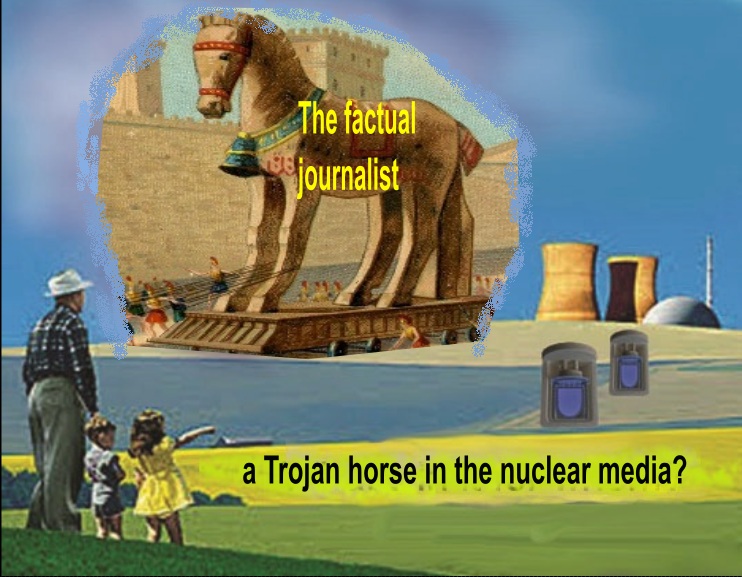
I ponder that these kinds of critics, just gnawing away at the edges of the nuclear industry’s gospel, might be more effective opponents of that industry than the many articulate and impressive anti-nuclear activists. A subtle “Trojan horse” style of journalism?
Raw, Rude, and Angry – in the new world of journalism

13 January 2026 Noel Wauchope, https://theaimn.net/raw-rude-and-angry-in-the-new-world-of-journalism/
Amongst the many types of new independent journalism, my favourite is Raw, Rude and Angry, a type that would never have got into conventional “mainstream” media, which keeps up the facade of respectability (even while often condoning immoral lies and pretensions). Now there are lots and lots of raw, rude, and angry articles, and “social media” messages. I certainly don’t like them all, even when I sometimes empathise with the feelings expressed.
Where I do like raw, rude and angry, is where I can see that there is a genuine, valid, feeling of outrage, and especially where there are facts discussed, and information and sources given, too. Where it is clear that the writer has done their homework. Now these types of articles are few and far between, but their authors become popular, as their message resonates with readers, who are fed up with mainstream media’s often bland and uncaring coverage of the atrocities going on in the world. And because they are an accurate commentary on what is happening.
Enter Caitlin Johnstone, who is the absolute star of this genre, if it is now a genre. Caitlin is an Australian, who describes herself as a “bogan socialist.” I won’t go here into just what “bogan” means – it is a sort of derogatory term, implying unsophistication – and yet – there’s a hint of natural wisdom, unspoilt by the mask of etiquette. In Caitlin’s work, where profanities pop up, there’s an uncanny atmosphere of a background of thorough research having been done, by a highly educated person.
I think that is why Caitlin has become a controversial figure, much criticised, and seen as very “left-wing.” I don’t know about you, but to me, the accusation of “left-wing” has very little meaning nowadays – and seems to be applied to anyone who has a compassionate, humanitarian outlook.
So, Caitlin Johnstone’s work is having an impact, one way or the other. Her up-to-date commentary on international politics, Gaza, Venezuela, Zionism, Iran – includes information on international law, history, and current events, and is sprinkled with her powerful and compassionate opinions. Her January 12th article, The Imperial Crosshairs Move To Cuba, outlines Trump’s policies for Latin America, and Other Notes:
“Now he’s advancing every CIA/neocon agenda known to man in the middle east and Latin America with the goal of global domination as life in the US gets worse and worse.”
Other Notes discuss Palestine, Iran, and our right to dissent:
“Fuck Israel, free Palestine. Say it loud and say it often, because you won’t have the right to say it much longer.”
Of course, people are offended at her language. But I suspect that they are more offended by the difficult truths that she is explaining in a complicated subject like the protest movement in Iran.
Caitlin Johnstone doesn’t pull any punches. For example, she makes the clearest and most trenchant criticism of Zionism – Israel And Its Supporters Deliberately Foment Hate And Division In Our Society:
“Yelling “Muslims bad!” does not magically erase Israel’s abuses or address the grievances of its critics”
I haven’t found many journalists who can manage this conjuring trick of being across current affairs while writing in an incisive, outrageous, style. Rare in alternative media, they’re of course rare in mainstream media. Meghan Mangrum of the Chattanooga Times Free Press showed the emotional views about the killing of George Flloyd – “Mistreated. Unappreciated. Hated. Scared.” I can’t, at present, find any writer who compares with Caitlin Johnstone.
It has usually been a general principle that journalists, especially reporters, should aim for just reporting facts, and avoid giving their opinions. In reality, that’s never been easy – the mere inclusion or exclusion of certain facts, or statements, can imply opinion. And there has been scholarly discussion on the merits or otherwise of emotion, in journalism, and even a case for how anger can help you produce better journalism.
Well, that was then, and this is now. I think that we have entered a new era of international politics with changes happening at disturbing speed. People are confused about what is going on and what to think about it, what judgment to make. The current upheaval in Iran is the most obvious example at the moment.
Writers like Caitlin Johnstone, whether one agrees with them or not, do clarify a point of view, and one that is different from the conformity imposed by the corporate media. They hold power to account in a way that is easier to understand, compared with the scholarly approach of some longform critics of Western governments. So, I think that raw, rude, angry writings have a valuable role in today’s journalism.
The new world of journalism

My first effort. This is my first foray into the new jungle. I have been examining different types of journalism, and noting which sorts get an interested response. I plan to evaluate the different types – for their interest and effectiveness.
12 January 2026 Noel Wauchope https://theaimn.net/the-new-world-of-journalism/
Journalism is in a mess, and it is changing so fast. Meanwhile the world is changing even faster, and we need good journalism more than ever.
The old world of journalism is dead. Long live the new!
I liked the old world of journalism. And it still exists – a bit. In that old world, facts were valued, rather than opinions. Of course opinions were still there, not always apparent, and sometimes more effective in selective reporting of the facts, with some facts carefully omitted. Still, the facts were meant to be paramount. I loved an ancient TV series, Dragnet, in which Sergeant Joe Friday expressed it perfectly “Just wanna get the facts, ma’am – just the facts.”
Still, the old journalism did undergo editorial scrutiny, do fact-checking, and even had grammar and spelling checked. And it does still exist today, when the Internet has nearly killed print journalism, and its funding from advertisers.
But – it’s limited. The new digital media has overwhelmed it. You get not just young teenagers gossiping, but also heads of state announcing things, via TikTok or Twitter, X or Facebook, Instagram, and many other platforms. And the message is above all – new, fast, short and visually arresting. No, I haven’t done the research, nor produced a PhD paper about this, but my observation is that longform journalism is read by the much older generations.
Still, forms other than text are doing well, and information and opinion are broadcast by podcast and YouTube journalists, so providing perhaps a more accessible form of longer journalism, though the fact-checking may be dodgy.
So, in place of the staid, somewhat reliable old journalism, what do we have? We still have the struggling print, radio and TV “mainstream media”, where journalists “mind their p’s and q’s”, because they don’t have the job security that used to be taken for granted. Of course, there are “safe” specialities like sport, cooking and gardening, but current affairs, politics, environment, climate and much else – these are dangerous territories for the mainstream journalist.
Self-censorship is rife.
Then there’s “alternative media” where brave souls have branched out with new journals, funding this work sometimes by community organisations, libraries, universities, or just by themselves, and trying to get funding from readers. I really don’t know how successful they are, financially. But for some writers, myself included, these new journals provide the opportunity for self-expression. For the public, they do provide a much-needed broader range of subject and opinion, than is available in the rather constipated traditional mainstream media.
So – where to – for the good journalism? And what is the good journalism? Well, back to good old Sergeant Joe Friday. For a start, we need to know that the writer’s facts are correct. Then there are those seemingly vague things, like authenticity and integrity. It’s a tortuous path to try and work this out. In Australia, the teaching of English does include awareness of logic, and of conflict of interest. These are aspects pretty much impossible to ascertain in the prevailing snappy digital media, but can be gauged in longer journalism.
Over many years, I’ve been studying articles from many sources – to find out what is effective, what is genuinely interesting and believable. I think that it’s time that those of us who appreciate integrity in writing should shout about it.
Just for a first shout – I’ll pick out a couple of shouts already made. Here I find examples of journalists who courageously identify mainstream media’s biased journalism. In FAIR (FAIRNESS & ACCURACY IN REPORTING) an experienced journalist, Ari Paul, takes on the enthusiastic coverage by The Wall Street Journal, the Washington Post, the New York Times, The Times, The Chicago Tribune of “Trump’s Doctrine in Venezuela.” Paul concludes:
“By kidnapping a foreign head of state, the Trump administration is saying that international law doesn’t apply to the United States. That’s a sentiment most American editorialists are all too ready to applaud – despite the danger it poses for Americans, and for the world.”
Elizabeth Smith, writing for the NTI – The Nuclear Threat Initiative – asks:
“What does it take to reveal truth in the face of censorship?”
She applies that principle in the media coverage of the 1945 atomic bombing, described in a new PBS documentary, “Bombshell.” She concludes:
”Bombshell lays bare the power of narratives – and counter narratives. It shows, with infuriating and heartbreaking precision, how misinformation about the bombings influenced public opinion.”
There are a lot of independent writers out there – some, like Ari Paul and Elizabeth Smith are highly qualified and experienced journalists, who go into their subject in some depth, and are not scared to rock the prevailing boat of safe complacency that increasingly pervades the self-censoring mainstream media. Others are less masterful in their use of language, and less qualified, but still get their message across in a compelling way.
Looking to 2026 in nuclear news
28 Dec 25 https://theaimn.net/looking-to-2026-in-nuclear-related-news/
There are really a lot of good things happening, involving a huge number of good people. My favourite is that very persistent, won’t-be-beat boat – the Golden Rule, with its crew and supporters – Veterans for Peace. They sail the world, but especially from port to port in the USA, with their message of hope.
Dozens of groups sailed with the crew—including Code Pink, the NorCal TPS Coalition, the People’s Arms Embargo, the Comfort Women’s Justice Coalition, the Task Force on the Americas, and the Cal Sailing Club.
But of course there are thousands of other groups working for compassion and good will, in every country, of whatever political style. There are millions of people aware of, and prepared to be active in getting action on global heating.

I think that there’s a revival beginning in the media, with the growth of so many truly independent and alternative journalism sites. Some get funding from their readers, some soldier on providing free news and information.
Even the corporate media, and some USA Republicans are appalled at the antics of the deranged American “President for Peace” – leading to the thought that he might not last that much longer as “leader of the free world”.
Still – a reality check – if Donald Trump does cease to be USA President – there could be worse to come, with another choice from his pack of greedy sycophants.
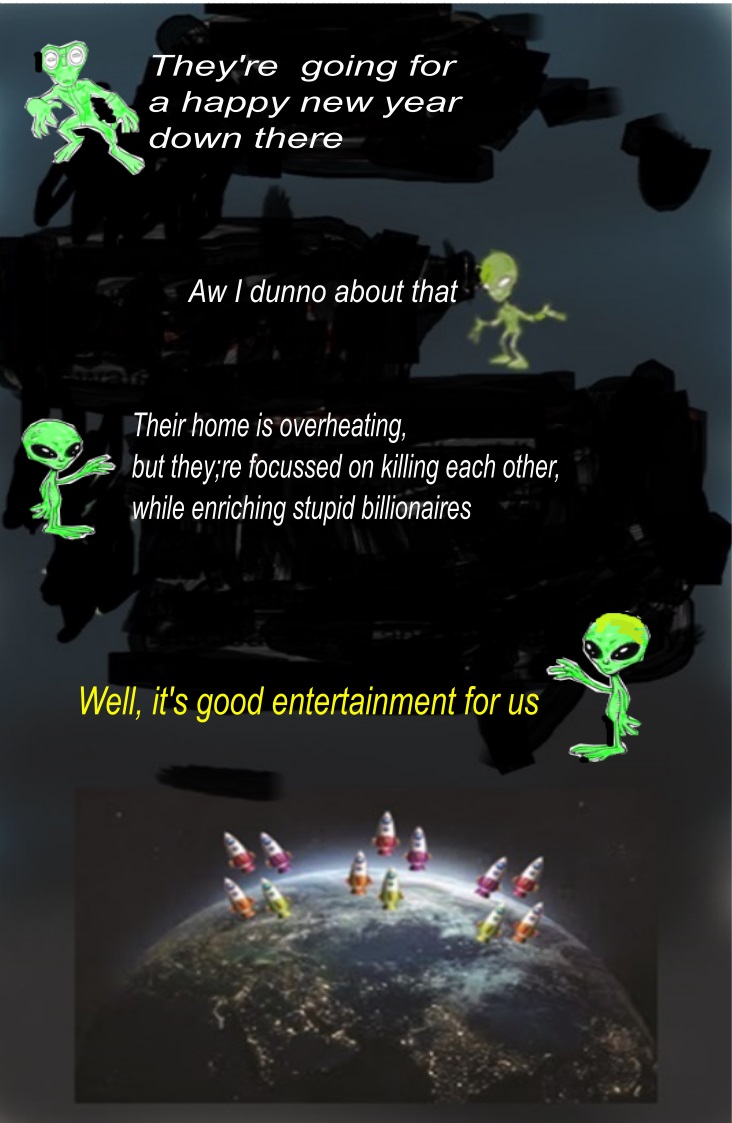
So – a reality check is needed. It’s not going to be a happy new year as things are going at present
– “If we make no effort to change direction, we will end up where we are heading.”
Giving up is not an option. A world run by emotionally-unintelligent squillionaire technocrats is not going to be sustainably viable. Addiction to super-profits and power, and absurd ideas of exceptionalism and superior race -these are not the characteristics of good leadership. Jesus said that ‘the meek shall inherit the earth“. But I’m rather hoping that some of the meek get into charge before then, before the current power-brokers wreck the place.
Meanwhile, we continue to try to shed light on the absurdities of our current ‘civilised’ culture. And there are many hazards to expose and to combat – the horror of Zionism (which is NOT the Jewish religion), booming militarism, climate denial, racism, injustice, suppression of civil rights, AI gone wild- to name only a few. Lots of work to do.
The past week has been a busy one in non-corporate nuclear and nuclear-related news. The detailed list is at https://antinuclear.net/2025/12/28/the-non-corporate-nuclear-news-week-to-27-december/
2025 in nuclear-related news
To be honest, the really big news for the planet, is the super-fast melting ice in the Arctic and Antarctica, but politicians and media don’t seem interested.
On the nuclear-related news, it’s not all gloomy. The heroism of Ahmed al Ahmed was widely recognised. There are tens of millions of people, especially in the USA, who are getting together to oppose nuclear weapons and nuclear war.
So much news is nuclear-related. The year began and ended with Israeli anger. Here in Australia, in December, that was justified, with the horror of the Bondi massacre of Jewish people celebrating Hanukkah. But it’s gone beyond anger, and has become uncannily like the 2023 referendum on the Aboriginal Voice to Parliament – with relentless, illogical, coverage on the theme of blaming Prime Minister Anthony Albanese.(The 2023 referendum was won by the negative, by blanketing the airwaves with one illogical cry “If you don’t know, vote No”.)
15 murders – a terrible thing, – also terrible -over 70,000 killed in Gaza
And why is it nuclear-related? Because Israel’s ruthless Zionist government has nuclear weapons, and Netanyahu would be prepared to use them, (if he can’t get America to do it for him).
Also nuclear-related, the endless dilemma of Ukraine, the pretense that Ukraine is winning, the carnage mounting, as Ursula von der Leyen and co. flail around, trying to get all of Western Europe to come up with billions of Euros to buy American weaponry for Ukraine (- Raytheon etc laughing all the way to the bank). War-mongering Europeans seem prepared to send drone/missile attacks deep inside Russia, despite the very real risk of nuclear retaliation from Russia.
Then there’s the chance of the “President of Peace” starting a war with Venezuela, or Iran, or Greenland, or anywhere else where he could commandeer oil, or other resources. Things could so easily go nuclear.
The arms race continues apace, even on the moon.
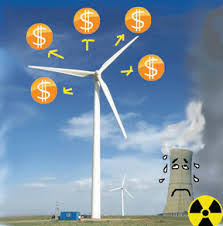
The propaganda for nuclear power roars on in the media, though just about everybody knows that it’s unaffordable, and small nuclear reactors exist pretty much only as optimistic designs. It’s tacitly recognised that the only genuine purpose for new nuclear power is to sustain the nuclear weapons industry. Renewable energy is known to be the cheapest energy form.
And of course – looming over it all, has been the promise and the threat of AI.
Those were the general themes for 2025. For the details on the past week – go to https://nuclear-news.net/2025/12/23/the-past-week-in-nuclear-related-news/
May you have happy holidays!
Ethics matter more than ever – even in Israel

19 December 25, https://theaimn.net/ethics-matter-more-than-ever-even-in-israel/
Who’d have thought, in this time of crisis, lies and propaganda, that it might be the Jerusalem Post that showed us an ethical direction?
And, on another matter of ethics – the Jerusalem Post, again.
I’m pretty used to the pro-Zionist propaganda that spills out from the Israeli media, the American media, and the Australian media.
I don’t know if it’s Hannukah, Christmas, or what, but in the usual cacophony of news and opinion, – that normally unfashionable subject of ethics is now standing out.

The Jerusalem Post spelt out its horror at the new, and murderous symbolism, of the lapel image now worn by ultranationalist Israeli politicians. Closely resembling the previous symbol, which called for the return of the Israeli hostages, their new symbol calls for continued killing of Palestinians, as the lapel image morphs from a ribbon into a noose.
A golden noose around Israel’s soul – says the paper – “The golden noose goes far beyond poor taste. It represents a theology of death, a reverence for vengeance that distorts the face of Judaism and deals a severe blow to Israeli society.”
“Jews around the world would be hard-pressed to defend and embrace the Jewish state.“
And indeed, this noose-wearing thing might backfire – as Jews in Israel and beyond reflect on the ethics of the Netanyahu government’s war on Palestinians.
Almost simultaneously, came the news of the massacre of Jews at Bondi Beach. The mainstream corporate news outlets have, predictably, latched on to this, to engender more vengefulness and hatred, and to blame Australia’s Prime Minister for his support of Palestinian state rights.
There is much coverage and genuine concern for the victims of this cruel outrage and their families. In amongst this, some sentimental coverage of the brave man who tackled an armed killer. As the ABC pointed out, media coverage treated this man as an oddity – as being a Muslim, one would not expect such decency. – a media attitude that is subtly Islamophobic.
” Ahmed al-Ahmed a 43-year-old Sydney fruit shop owner and father of two, moved toward the attacker, wrapped him from behind, wrestled away the long gun, and forced the shooter to retreat. He was shot and hospitalized, but his split-second decision is widely credited with preventing even greater carnage.”
And commented – “There is something profoundly Hanukkah about that moment.”
The Post goes on to reflect on those non-Jews of history, who risked everything to save Jews, – Raoul Wallenberg. Oskar Schindler. Chiune Sugihara and more
“These stories are not only about the Holocaust, but they are also about moral clarity under pressure, the choice to see a fellow human being and refuse to look away.”
This man’s courage and generosity of spirit has impressed people world-wide, and his actions have been praised in the media, cutting through the general tone of anger and hatred
The author, ZVIKA KLEIN, reminds that Hannukah means “a demand that human beings choose decency over cruelty“
Which is pretty much what Christmas is supposed to mean, too.
While the merchants of hate, revenge, and political opportunism hold sway in the corporate media, voices for compassion and decency are being heard too. These are hopes to cling to for the coming year, and bring some positive meaning to Hannukah and Christmas,
How long will the American Moronocracy last in the New Year?
Noel Wauchope, 15 Dec 25, https://theaimn.net/how-long-will-the-american-moronocracy-last-in-the-new-year/It’s hard to grab hold of the idea – of which of the morons in the USA administration will crack first?
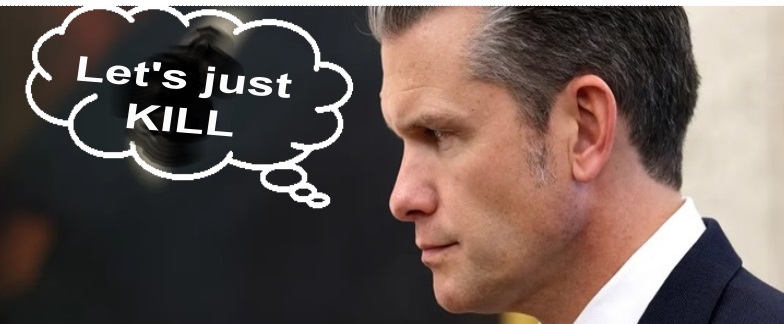
I think that it has to be Pete Hegseth, the Minister for War. Perhaps “crack” is not the appropriate word. “Be thrown under the bus” might be more accurate.
The immediate problem is the rather gripping thought – of the vision of injured fishermen hanging desperately onto the debris, the wreckage, of their bombed boat. And then getting bombed again, and killled. Now, apparently, there exists a video of this wretched event.
CBS reported on December 4th, that U.S. lawmakers met behind closed doors, and viewed a video of a second strike on the boat. Well we, the public, are not allowed to see this video. Democrat Rep. Jim Himes said:
“what I saw in that room was one of the most troubling things I’ve seen in my time in public service.“
“You have two individuals in clear distress without any means of locomotion, with a destroyed vessel, who are killed by the United States.”
Even without seeing the video, our imaginations are struck with the horror of this event. And if it was not so terrible, why the need to cover it up?
And it’s not just that picture which is covered up. There’s also the trail of denials, blames, contradictory statements about that attack, – an incident that clearly breached international law, in the Geneva Conventions , The International Covenant on Civil and Political Rights, and also the Defense Department’s Law of War Manual .
https://www.youtube.com/watch?v=np1dG7qjzZM
The Washington Post reported that Pete Hegseth had given the order to “kill everybody,” but this was later denied by Admiral Bradley, who was in charge of the operation, and also by Hegseth and the White house.
The family of Colombian fisherman Alejandro Carranza Medina, believed killed by the US military in a boat bombing in the Caribbean Sea on Sept. 15, has filed a formal complaint with the Inter-American Commission on Human Rights accusing US Secretary of Defense Pete Hegseth of murder over the unlawful attack. The complaint also notes that President Donald Trump the commander in chief of the US military, “ratified the conduct of Secretary Hegseth described herein”.
That legal initiative mightn’t get anywhere, but the entire chain of command could be held liable for killing the survivors of the boat strike. The United States clearly imposes a duty to refuse unlawful orders.
That thought must be striking a bit of terror in the minds of the military officers involved, – and indeed in any U.S. military officer who might one day be given a similar order.
Anyway, wriggle around as he might, Pete Hegseth is at the top of decision-making on the whole illegal bombing of civilian boats in international orders. Unless you count Donald Trump as the top decision-maker. Trump would like this issue to just fade away. But if it doesn’t – well, then, perhaps a head should roll.
In his first presidency, Trump made a record number of his associates’ heads roll. But here’s the difference – some of them were quite skilful, and capable.
Not these days. Some examples :
Notably RFK Jr, is totally unsuited for Secretary of Health and Human Services. Tulsi Gabbard , with no strong background in Intelligence, is Director of National Intelligence, Attorney General, Pam Bondi has a background in criminal law, but is most notable for unflinching dedication to Donald Trump, no matter what. Director of DOGE, Elon Musk – well, he had to go in the inevitable clash between two grandiose egos. Steve Witkoff’s background as real estate developer, gave him no expertise to qualify him as Special Envoy to the Middle East. Marco Rubio as Secretary of State does have experience in politics, but is notable for having a fanatical war-hawk’s hatred of Cuba and China,
What all Trump appointees do have in common is unswerving devotion to Donald Trump. And that’s not going to be enough to sort out the Trump administration’s messes, with more surely to come.
But now, to come back to Pete Hegseth. Yes, he does have university degrees in politics. But even with university degrees you can still behave moronically. And Pete Hegseth sure does. He has a history of alcoholism, and an accusation against him of sexual assault. Even his mother accused him of being an abuser of women (though she later retracted this).
Hegseth was forced out of two veterans groups, due to his alcoholism, and accusations of financial mismanagement. Colleagues at his former employment at Fox News reported his drinking problem there.
Apparently Hegseth promised to stop drinking if confirmed in the job as Defense Secretary. There are rumours that he hasn’t stopped. But anyway that’s not his only problem. There was his careless use of commercial messaging app Signal to talk about an impending operation in Yemen.
All this has got Republican law-makers worried. And the mid-term elections will be coming up. Trump might just have to start the head-rolling, if this boat-bombing issue doesn’t go away.
And Pete Hegseth is the obvious first candidate.
By the way, the Internet is awash with stuff about Trump being not only a deranged narcissistic megalomaniac (which we all knew anyway), but on top of that, claims that dementia is setting in on him. (How long will the moron-in-chief last, anyway)
Why my work is clearly biased
Today, I found myself posting on my website – an article which is vehemently anti -Western, and possibly just an angry version of pro Russian propaganda. I dithered about this. Is my pro-Russian slant just too much – a bridge too far?
After all, there is so much to deplore about Russia – the secret, brutal and murderous regime of Vladimir Putin, and the genocidal history of Stalin’s actions in Ukraine. And there’s plenty more to deplore, including more recent atrocities done to Ukrainians in the course of the current war.
So – why on earth should I, or anyone, stick up for Russia, which is anyway, the invader in this conflict?
I come back to just one answer. It is that rather vague concept of culture. It is that someone must address that “Western culture” in which we are immersed and perhaps drowning.
Western culture, supposedly based on “Christian values” – like equality, compassion, peace-making, is nevertheless now manifesting as fear and hatred of Russia and China.
The media laps this up, because really, diplomacy, compromise, quiet discussion between world leaders, is boring stuff, and anger, shock and conflict – that’s entertaining.
In the coverage of the war in Ukraine, so many important aspects are ignored. We don’t hear about , for example, the effect of Zelensky banning the Russian language in public life, when for so many Ukrainians Russian is their first language. We don’t hear about atrocities done by Ukrainian troops.
We don’t hear any details about negotiations in which the war could end, with concessions made by both sides. Consideration is never given to how NATO membership for Ukraine might affect Russia. I mean, how would Americans feel, if a hostile Canada could allow Russian military bases set up on the border of USA?
Instead, there is this narrative about Russia’s intention to attack European states, and then take over the world, crushing democracy. But where’s the evidence for this? And at the same time, we’re being assured that Russia is economically and militarily weakened, so of course, Ukraine can beat them
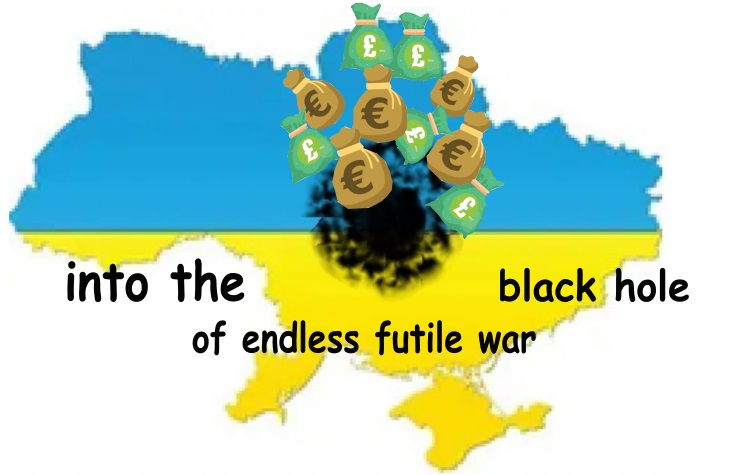
And, talking of economics – well – “follow the money” has always been a very important aspect in world affairs. I think that we could all agree that from the point of view of Trump’s USA – the simple goal is to enrich American businesses. So, for the USA now, the main thing is to sell weapons to Europe.
For Europe, this is expensive. It’s not as if all the member States are wealthy and united in their resolve to buy the weapons and make Ukraine win. They need the money. The plan suggests raising a total of nearly €300 billion.
One way is to expropriate frozen Russian sovereign assets. Sovereign assets have immunity from seizure under international law and bilateral treaties – the United Nations Convention on Jurisdictional Immunities of States and Their Property (2004) This method could have legal repercussions, and destabilise confidence in economic systems and investment, with political ill-effects for Europe.
Another way is to raise a Eurobond. This is problematic because the EU would be acting as if it were a sovereign state rather than an administrative body of a treaty-based union. Some States might object, and as Ukraine is not a member of the EU – that fact strengthens their objection. The Eurobond would result, for member States, in higher taxes, constrained public services, and renewed austerity.
The EU’s options for paying for continuing Ukraine’s fight are highly problematic. They are based on the belief that after Ukraine’s victory, European nations will get back the money from Russian reparations, and from returns from reconstruction of Russian-liberated territories. A dubious outcome.
These financial considerations might possibly bring the Western media, politicians, and public to take a more pragmatic view of the war in Ukraine, and calm down from the hysteria about Russia destroying democracy. (Indeed, to digress for a moment – the USA is now giving a good example of democracy destroying itself)
The culture is so imbued with those emotions of fear and hatred, and historic hostilities, that I doubt that we will come down to earth and look at the Ukraine situation more realistically. And our leaders seem obsessed with showing how tough they are, rather than how wise.
Democracy ‘s all about individual liberties, freedom, -we are told. But there are also other considerations – the need for food, water and shelter. A more collective view of society includes those considerations. In some ways, Russia and China are doing a better job in this.
So, after this long meandering, I conclude that I am OK with continuing with my biased stance. Yes, some of the stuff I put up IS Russian propaganda. I try to be sure that the facts are correct, even if the interpretation is biased. We are so constantly tsunamied with anti-Russia, anti-China stuff, it is necessary to try to bring in some balance.
Right wing- Left wing – on the nuclear issue it doesn’t matter.

30 October 2025 Noel Wauchope, https://theaimn.net/right-wing-left-wing-on-the-nuclear-issue-it-doesnt-matter/
The promotion of nuclear power is a right-wing thing- isn’t it?
Over the years, I’ve been following the propaganda of the climate-change denialists, among other liars and frauds. I found that the Koch bothers in America were the source of much successful barrage against the truth on our heating climate.
Alongside the fight for a sustainable, liveable planet, there’s the fight for freedom against the nuclear peril. I’ve concentrated on the latter, but find that the two are strangely embroiled.
How do you know whom to believe? Well, as with the issue of cigarettes causing cancer – I’ve always found that the genuine scientific organisations to be credible, as against the propaganda from tobacco corporations, coal, oil gas, nuclear an uranium companies -and their political lackies.
So – the promotion of nuclear power is a right-wing thing- isn’t it?
So, in my efforts for a nuclear-free world, I’ve assumed that the pro-nuclear push is a right-wing thing, like climate denial. All self-respecting activists will know of the notorious climate-denialist campaigns of the Koch Charles and David Koch from 1980 onwards.
In 1974, the Charles Koch Foundation was set up, and later its name was changed to the CATO Institute.
The CATO Institute is largely funded by the Koch Family, (Koch Industries family foundation ) and also numerous right-wing organisations and corporations. It is a gloriously right-wing organisation, and I suppose I should hate it.
So, it comes as a shock to me today, to find the most plausible, credible case against the nuclear industry – coming not from my beloved anti-nuclear movement , but in a very long article from the CATO Institute.
Author Steve Thomas does not denounce the nuclear industry. He just opens up the question – does it have any real hope of surviving, let alone thriving?
Thomas points out, in the later part of the article, that even for China and Russia, the countries now supposedly leading in nuclear development, the home demand is falling, and their hope is more to export nuclear technology. Meanwhile for the Western world, despite the brouhaha from policy-makers and the media , about new nuclear development, it’s just not really happening. Well, it is, a bit, but with the absolute imperative of tax-payer funding.
Thomas discusses all the publicity this century, about new nuclear reactors: the actual results have been dismal. In the USA there have been the abandoned V.C Summer project, and the A.W. Vogtle project, completed six or seven years behind schedule and at more than double the forecasted cost. There are now no proposals for additional large reactor projects in the United States.
In the UK, after years of “no government subsidy” for new nuclear, they still can’t get enough investors, even with government subsidy, and all sorts of perks about insulating insulate the reactors from competitive wholesale electricity markets. Hinkley Point C project is estimated now at £35 billion and rising. For the Sizewell project, France’s EDF has pulled out on financial grounds, and completion is not expected before 2040.
Thomas goes on to demolish the spin about Small Nuclear Reactors -showing that some are not even small, and all are not cheap, not so safe, not waste-free, and not happening, anyway, despite the hype.
He looks at the costs and feasibility of re-opening old closed reactors, and of life-extension of old ones still functioning:
“Life-extending a reactor by 20–40 years effectively means giving a whole new operating life to an old design that would not be considered if it were offered for a new reactor. In other words, life-extended nuclear power plants would not come close to meeting the standards required for new reactors. This raises several important safety questions“
The author concludes that the nuclear industry is just not going to revive.
And shock- horror !- this right-wing publication concludes that other power options are needed to face “serious risks from climate change”.
In other CATO publications, they have pushed for reducing America’s nuclear arsenal, and even for the USA to deal with the Ukraine crisis by diplomacy, not weaponry.
Yeah, I know CATO’s awful on health education etc – but it’s refreshing to find a right-wing institution explaining the nuclear industry so clearly. Do we have to do this right-wing left-wing fight all the time?
Vladimir Putin and a world without Russia
7 Oct Noel Wauchope, https://theaimn.net/vladimir-putin-and-a-world-without-russia/
He’s supposed to have said it as a joke.
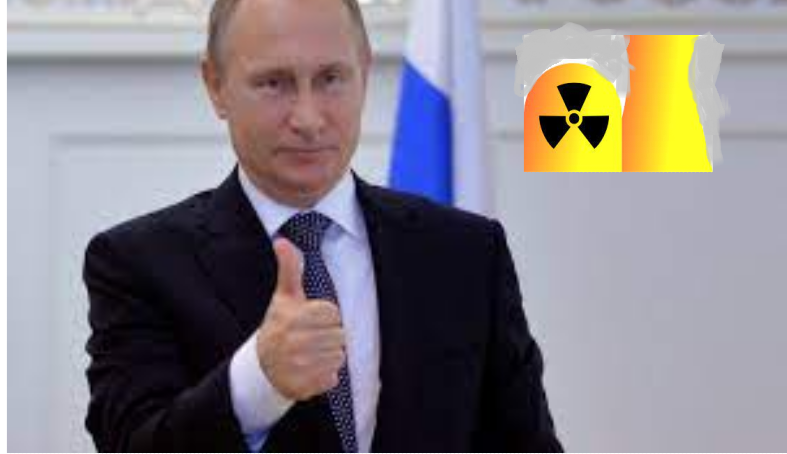
In a 2018 comment, Mr Putin talked about destroying the world in a nuclear holocaust because “what is a world without Russia good for?”
OK. perhaps it was a joke. But –many a true word is spoken in jest.
And here is where I run into trouble, because I am known to have a very sympathetic attitude towards Russia.
I think that Volodymyr Zelensky should have kept to the pledge on which he was elected as Ukrainian President in April 2019. Zelensky promised to honour the Minsk agreements of 2014-15 – to accept the Donbass having a limited autonomy within Ukraine, and to end the years of war between the Ukrainian government and the Donbass. But In an interview with the German daily Der Spiegel, published on February 9, 2023, Zelensky made it clear that he intentionally chose to sabotage Minsk.
Even in subsequent negotiations with Russia, in April 2022, Zelensky’s government came close to a peace agreement with Russia, acknowledging the Donbass autonomy, and rejecting Ukraine membership of NATO. Zelensky quickly scuttled that deal.
That is the background to Putin’s decision to start a Special Military Operation in support of the Donbass – ending the 8 years of civil war in Ukraine, but starting what soon became a full scale war against Ukraine. Some commentators see this as Putin having been provoked into war by the Russia-hating West. Others say that it is Putin’s first step to invading Europe.
Anyway, the Western politics and media have indeed swallowed wholesale the story that Putin wants to take over Europe into a grand Russian empire.
I don’t think that the facts on Russia’s economic and military power actually stack up on that interpretation. And I don’t think that Putin is stupid enough to bring the whole might of the USA and Europe down on Russia. It is more reasonable to consider that many NATO states are uncomfortably close to Russia, – indeed on Russia’s border. Ukraine is the largest European state on that border, and for Ukraine to join NATO would mean that Russia would be almost surrounded by hostile states. If the USA had Canada as a hostile state, that would make USA politicians anxious. So Putin’s resistance to Ukraine being a NATO state is understandable. It comes from fear, rather than part of a grand desire to take over Europe.
In a brief, but telling article, Walt Zlotow has argued that now, 80 years after Russia was our major ally, defeating Nazism in 1945, it is time to stop hating Russia. Zlotow also pointed out that “Russia had neither the desire nor the capability to attack America without suffering its utter destruction from an overwhelming American nuclear capability”.
That last point is an important one. Individual persons matter. Why we haven’t had nuclear war for all these decades, is partly because we haven’t had leaders who were willing to press the button for humanity’s annihilation. Not even the bravado of Kim Yong Un, the pomposity of a Macron, the dogged war-making of successive American presidents – has led to that fatal decision.
Vladimir Putin is intelligent, and he has, in my opinion anyway, some reason and logic in his initial attack on Ukraine, and in his conditions for peace, especially regarding NATO membership for Ukraine. Putin has consistently spoken clearly and reasonably about the possible terms for a peace settlement. Meanwhile Zelensky and the West seem implacably bound to the position of demanding unconditional surrender by Russia as their term for a peace agreement.
So the West is all go for “Whatever It Takes”. The problem that I see, is that despite Putin’s quite admirable diplomatic restraint, and clear argument, he is still the one leader who actually is prepared to launch Armageddon – “what is a world without Russia good for?”
I do put up pro-Russian arguments, mainly because somebody has to counter the prevailing Russiaphobia which swamps us all the time in the media. That does not mean that I think that Putin is a nice guy. I think he’s a ruthless tyrant. But he should be taken seriously, and treated reasonably- not just seen as an excuse to continue this mindless hatred of Russia. Putin is an exceptionally dangerous leader, and we may all pay the ultimate price for our stupidity.
1 This Month

of the week – Shut Down Drone Warfare!


Tell the Ukrainian Government to Drop Prosecution of Peace Activist Yurii Sheliazhenko

Petition to revoke the licensing of the Near Surface Nuclear Disposal Facility (NSDF) at Chalk River. https://www.ourcommons.ca/petitions/en/Petition/Details?Petition=e-7247
To see nuclear-related stories in greater depth and intensity – go to https://nuclearinformation.wordpress.com
-
Archives
- April 2026 (57)
- March 2026 (251)
- February 2026 (268)
- January 2026 (308)
- December 2025 (358)
- November 2025 (359)
- October 2025 (376)
- September 2025 (257)
- August 2025 (319)
- July 2025 (230)
- June 2025 (348)
- May 2025 (261)
-
Categories
- 1
- 1 NUCLEAR ISSUES
- business and costs
- climate change
- culture and arts
- ENERGY
- environment
- health
- history
- indigenous issues
- Legal
- marketing of nuclear
- media
- opposition to nuclear
- PERSONAL STORIES
- politics
- politics international
- Religion and ethics
- safety
- secrets,lies and civil liberties
- spinbuster
- technology
- Uranium
- wastes
- weapons and war
- Women
- 2 WORLD
- ACTION
- AFRICA
- Atrocities
- AUSTRALIA
- Christina's notes
- Christina's themes
- culture and arts
- Events
- Fuk 2022
- Fuk 2023
- Fukushima 2017
- Fukushima 2018
- fukushima 2019
- Fukushima 2020
- Fukushima 2021
- general
- global warming
- Humour (God we need it)
- Nuclear
- RARE EARTHS
- Reference
- resources – print
- Resources -audiovicual
- Weekly Newsletter
- World
- World Nuclear
- YouTube
-
RSS
Entries RSS
Comments RSS
 nuclear-news