Massive radioactive wastes for Malaysia, from Australian company Lynas
- the space for underground wastes storage cells is very limited due to the groundwater being extremely close to the surface;
- the ground is susceptible to subsidence as it is a former peat swamp area;
Lynas plant rushed ahead before radiation study malaysiaKini 23 May 11SM Mohamed Idris, president of Consumers Association of Penang and Sahabat Alam Malaysia
— The Lynas plant in Kuantan is unravelling into a nightmare. The lanthamide concentrates (rare earths) from Australia that Lynas will import into Malaysia contain thorium AND uranium, which suggests the processing in Kuantan will produce massive amount of radioactive wastes. Continue reading
Broadening spying on Julian Assange – Australian govt introduces new law
 Last week the government introduced legislation to define ASIO’s role more broadly to include collection of intelligence ”about the capabilities, intentions or activities of people or organisations outside Australia.”..
ASIO eye on WikiLeaks,The Age 23 May 11, “………declassified official briefings do not support Ms Gillard’s public assertion that Assange broke Australian law by publishing leaked US government secrets. Continue reading
Radioactive pollution dumping in Malaysia, by Australian company Lynas
Fuziah Salleh is critical of what she says are lower environmental standards in Malaysia and double standards from Lynas…SINGH: If it’s reasonably that good, why don’t they do the processing within Australia, why send it to Malaysia? it is a classic example of a polluting industry being exported to a developing country………
Demonstrators are planning to rally outside the Australian Embassy in Malaysia’s capital Kuala Lumpor on Friday. Radio Australia, 19 May 11, They’ll be protesting against the Australian mining company Lynas and its plans to process rare earths in Pahang state. Local communities and environmental groups have raised concerns over the management of radioactive waste. They say the waste product thorium will affect fishing, tourism and public health .. while the Malaysian government has also asked for more information.
Australian uranium company does some deceptive spinning about nuclear power
Any increase on safety or design regulations for reactors developed in response to Fukushima will of course increase the already enormous cost of new reactors, which typically require government subsidies or loan guarantees to fund the on-average nine year-long construction phase.
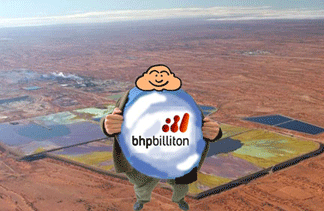
 BHP and the new maths of nuclear reactors, by Bernard Keane, Crikey,17 may 11, Yesterday Robert Gottliebsen of Business Spectator spruiked the glories of BHP’s Olympic Dam uranium mine, including BHP’s claim that within 20 years the number of nuclear reactors around the world would nearly double from 439 to 793. BHP got the 439 right. It’s 793 appears to be rather more mysterious. The number of operational reactors has actually fallen since 2002 Continue reading
World’s biggest uranium hole and mountain of radioactive wastes planned
“This Environmental Impact Statement shows the company has designed Olympic Dam to leak up to eight million litres of liquid radioactive waste per day. BHP Billiton plans to dump radioactive tailings on the surface and leave them there forever, rather than pay to isolate the toxic waste from the environment.”

 BHP Billiton has released a multi-phonebook-sized environmental impact statement to support its proposal to make Olympic Dam the world’s largest uranium project, but the EIS does not address the risks that go along with Australian uranium when it is used in nuclear reactors overseas.
The Australian Conservation Foundation has challenged the company to re-do its environmental assessment to take account of disasters like Fukushima. Continue reading
Australian uranium companies take heavy losses
Risk fallout hasn’t left uranium stock, May 13, 2011, SYDNEY (MarketWatch) — Australian-listed uranium firms are sporting heavy year-to-date losses after the recent disaster in Japan, and while investors appear to be slowly returning to some shares, analysts say the risks haven’t gone away.
Further afield, Canada’s Cameco Corp. has seen its stock fall 37.1% year-to-date, while Uranium One Inc. shares are down 19.8% in Toronto. Continue reading
Doctors, Public Health Agency, oppose Australian government nuclear waste dump plan
 Leading health organisations including MAPW and the Public Health Association have signed a statement calling for a comprehensive inquiry into the production of radioisotopes (including non-nuclear-reactor sources) and the disposal of nuclear medicine, before any action is taken to advance any national radioactive waste dump.
The Medical Association for Prevention of War (Australia) has called on the government to withdraw the National Radioactive Waste Management Bill , 13 May 11, Continue reading
Legal Challenge as Australian Govt Sneaks in Nuclear Waste Dump Plan
The Senate is due tomorrow to debate the National Radioactive Waste Management Bill, which if passed will open the way for the government to build the dump on Muckaty station, 120 kilometres north of Tennant Creek.Ownership of nuclear waste site disputed.
the government’s secret and divisive process to build the dump on Muckaty would be strongly resisted in Tennant Creek as well as nationally and internationally.

Ownership of nuclear waste site disputed, Lindsay Murdoch in Tennant Creek, Sydney Morning Herald, May 9, 2011 DOCUMENTS unearthed in the National Archives challenge the Gillard government’s push to build a nuclear waste dump on disputed Aboriginal land near Tennant Creek, lawyers say. Continue reading
World Heritage Kakadu parkland poisoned by Rio Tinto’s uranium wastes
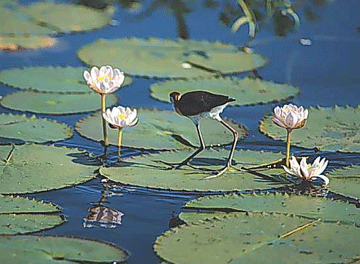 For 30 years about 100,000 litres of contaminated water a day has been leaking from the tailings dam into fissures beneath Kakadu
Radioactive water threatens Kakadu, The Age, Lindsay Murdoch, April 16, 2011 Radioactive water is in danger of spilling into an Aboriginal community and Kakadu’s World Heritage-listed wetlands if record rainfalls continue to deluge the vast Ranger uranium mine. Continue reading
Australian Aboriginal leader writes to UN about uranium mining
Yvonne Margarula’s letter to the UN expressing solidarity with the people of Fukushima , | Indymedia Australia, 16 Apr 2011 Below is a letter sent by Yvonne Margarula of the Mirrar people to Ban Ki Moon the Secretary General of the UN on the 6th of April 2011. The Mirrar are the traditional owners of the land that Ranger and Jabiluka Uranium mines are located on. These mines have been developed without the consent of the Mirrar people. The letter expresses solidarity with the people of Japan and sorrow that uraniun from the land of the Mirrar was used in the Fukushima plant. Continue reading
The stripping of Australian Aboriginal land for the nuclear industry
In May 2010, Ranger – a uranium mine in the Kakadu which local indigenous people resisted since the 1970s – released large quantities of radioactive water into ecologically sensitive wetlands. And in late 2010, controversy emerged over attempts by local officials and mining giant Rio Tinto Alcan to sideline independent indigenous voices during negotiations to re-sign leases for the Nabalco bauxite mine. (Irving, 2011)
Sound familiar? Anyone heard of Tar Creek? Closer to home (relatively), in Oklahoma, there exists an Environmental Protection Agency superfund site called Tar Creek. A terrifying documentary, directed by Matt Myers in 2007 , detailing an American history in which mining for lead (Pb) and zinc (Zn) had been allowed on Native American territory regardless of the Indigenous community’s consent and rightful concern (those in the Bureau of Indian Affairs who objected to the mining were overruled as incompetent and stripped of authority). Over a hundred years has passed and the exploitation had left both Indigenous and non-Indigenous communities marginalized and suffering from Pb and Zn poisoning and water pollution…….
non-governmental organizations , interested in Indigenous human rights, continue to present one example after another in which land tenure and native rights of forest peoples are being ignored.
As we moved forward into the 21st century, consuming our way through limited resources, we need to re-consider the cost of our fuel, our technology, our lifestyles; and I’m not talking about in the sense of pounds, euros or dollars. Your tank of gas, my computer’s electric consumption, is costing us our humanity. The price paid is the continual marginalization, oppression and dehumanization of the original inhabitants of colonized territories. They are losing their culture, their livelihoods, their country.
We can help. We can change. That’s the greatest part about being human: we’re quite resilient and adaptable. Start thinking about where things come from, support those who do it right and debunk those who don’t.
Debunk unjust mineral extraction propaganda that tells you that everything is all right: April Fools, it’s not. Support research that shows that Aboriginal land management equates to a healthy environment and truly see that Australia is amazing.
WIP Talk: Aboriginal Land Management Equates to a Healthy Environment
Coverup of Australia’s radiation fallout from atomic tests
British monitoring of water commenced in the 1950s. The records of this early monitoring are unavailable in Australia. As British nuclear weapons testing in Australia commenced in the early l950s, this data is of great importance.
Propaganda Paul Langley’s Nuclear History Blog, 13 April 11, IntroductionFrom 1957 to 1978 the Australian Government carried out dissections on the bodies of people who had died of illness or accident. These dissections were carried out to monitor the amount of Strontium 90, a radioactive element, absorbed by Australians. Strontium 90 was a component of the fallout deposited from nuclear tests conducted in Australia, the Pacific and China. Continue reading
Halt on food imports to Australia from Japan
Tests have revealed vastly elevated levels of radioactive iodine and caesium.
Imports of Japanese food halted, Sydney Morning Herald, 24 march 11, Australia’s food standards regulator has ordered a halt to Japanese food imports, such as sauces and seaweed, amid rising radiation concerns. Continue reading
Australian pro nuclear expert explains how Fukushima nuclear plant is safe
The plant is safe now and will stay safe……If you want to stay informed, please forget the usual media outlets [Does he include the International Atomic Energy Agency as an “usual media outlet” , I wonder?]
 Fukushima Nuclear Accident – a Simple and Accurate Explanation, Brave New Climate, Barry Brook, 13 March 2011, [Barry Brook quotes Josef Oehmen, a PhD Scientist, whose father has extensive experience in Germany’s nuclear industry.] Continue reading
Australia will get nuclear power, top nuclear scientist confident
“We will learn from the tragic Japanese experience how to build more robust reactors, how to ensure multiple layers of protection work properly, how to better contain radioactive gases.” – Ziggy
Ziggy Switkowski, nuclear physicist, and chief of Australian Nuclear Science and Technology Organisation, is confident that there will be only a short term halt in the nuclear renaissance.
Ziggy’s been explaining on Australian TV (Channel 10 News 14/3/11) and print media (THE AUSTRALIAN, 14/3/11), how Australia doesn’t need to worry about earthquakes and nuclear power, and does need nuclear energy. Indeed, Ziggy looks forward to the boost that nuclear power development will get, from studying the defects in the Japanese nuclear reactors. In this way, the nuclear renaissance will thrive again. Though I dunno that it was thriving even before the Japan disaster, now that I come to think of it. – Christina Macpherson
1 This Month
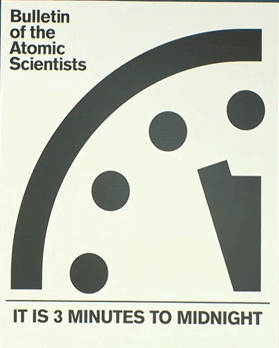
Watch the 2026 Doomsday Clock unveiling live here on January 27 at 10 a.m. EST
To see nuclear-related stories in greater depth and intensity – go to https://nuclearinformation.wordpress.com/

29 Jan. Thursday 7-8 p.m. Webinar – World’s Largest Nuclear Station in Port Hope, ON?


31st January – Challenging the War Machine – a DECLASSIFIED UK SUMMIT

Website of the Week
Now until to February 10, 2026 Radioactive waste storage in France: the debate is finally open! How to participate?
-
Archives
- January 2026 (277)
- December 2025 (358)
- November 2025 (359)
- October 2025 (376)
- September 2025 (258)
- August 2025 (319)
- July 2025 (230)
- June 2025 (348)
- May 2025 (261)
- April 2025 (305)
- March 2025 (319)
- February 2025 (234)
-
Categories
- 1
- 1 NUCLEAR ISSUES
- business and costs
- climate change
- culture and arts
- ENERGY
- environment
- health
- history
- indigenous issues
- Legal
- marketing of nuclear
- media
- opposition to nuclear
- PERSONAL STORIES
- politics
- politics international
- Religion and ethics
- safety
- secrets,lies and civil liberties
- spinbuster
- technology
- Uranium
- wastes
- weapons and war
- Women
- 2 WORLD
- ACTION
- AFRICA
- Atrocities
- AUSTRALIA
- Christina's notes
- Christina's themes
- culture and arts
- Events
- Fuk 2022
- Fuk 2023
- Fukushima 2017
- Fukushima 2018
- fukushima 2019
- Fukushima 2020
- Fukushima 2021
- general
- global warming
- Humour (God we need it)
- Nuclear
- RARE EARTHS
- Reference
- resources – print
- Resources -audiovicual
- Weekly Newsletter
- World
- World Nuclear
- YouTube
-
RSS
Entries RSS
Comments RSS
 nuclear-news