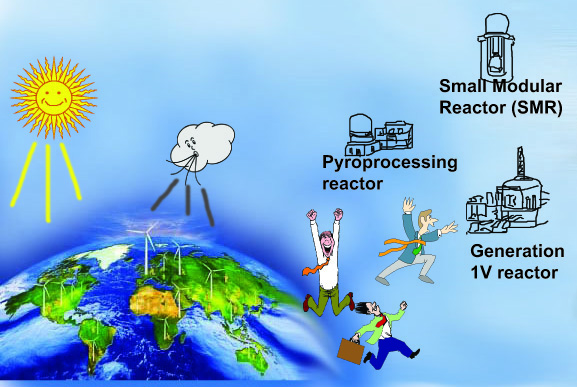
South Australian Aborigines strongly resist plans for international nuclear waste importing
18 Mar 16 Traditional Owners and members of the Aboriginal-led Australian Nuclear Free Alliance (ANFA) have today reaffirmed their opposition to the suggestion that South Australia should host a high level international nuclear waste dump. This announcement comes as the submission period closes for comments on the tentative findings of South Australian Nuclear Fuel Cycle Royal Commission
A major recommendation of the Commission to date has been that South Australia could host an international waste storage and disposal facility. This suggestion is strongly rejected by Aboriginal people across the state because of the risks posed to country and culture. Several Aboriginal communities throughout South Australia live with the negative impacts of the nuclear industry through uranium mining and nuclear weapons testing and are committed to resisting any further nuclear proposals.
“We have long memories; we remember the atomic weapons tests at Maralinga and Emu Fields and the ongoing denial around the lost lives and health impacts for Aboriginal people. We don’t want any nuclear projects here in South Australia and we won’t become the world’s nuclear waste dump,” said Arabunna elder and Australian Nuclear Free Alliance president Kevin Buzzacott.
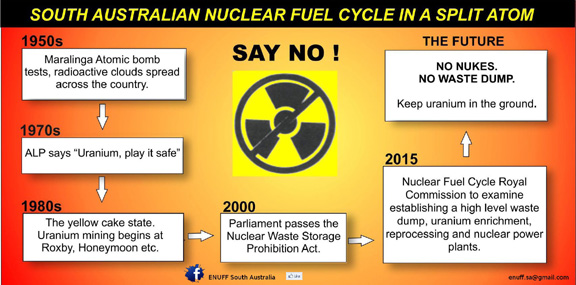
Enice Marsh, senior Adnyamathanha woman and Australian Nuclear Free Alliance member said:
“Any kind of radioactive waste dump would put our groundwater at risk. Groundwater is about survival; we don’t want to be faced with another huge risk like this.”
Sue Coleman-Haseldine is a Kokatha-Mula woman and co-chair of the Australian Nuclear Free Alliance. She has recently travelled to Vienna to share her family’s experience with the nuclear industry: “They’ve poisoned us once and there’s no way in the world they’re going to do it again.”
“This problem doesn’t stop at South Australia’s border, there is nowhere that should be designated an international waste dump,” Ms Coleman-Haseldine concluded.
Even South Australia’s pro nuclear Royal Commission admits the diseconomic s of the nuclear industry
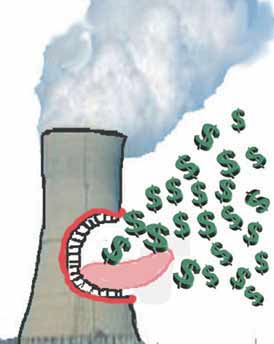
 The Nuclear Industry Prices Itself Out Of Market For New Power Plants, Climate Progress, BY JOE ROMM MAR 8, 2016 “….. in newly-released findings, South Australia’s nuclear royal commission found that the price of electricity from new nukes greatly exceeded not only business-as-usual projections for electricity prices but also prices in a “strong climate action” case. The Commission concluded “it would not be commercially viable to generate electricity from a nuclear power plant in South Australia in the foreseeable future.”
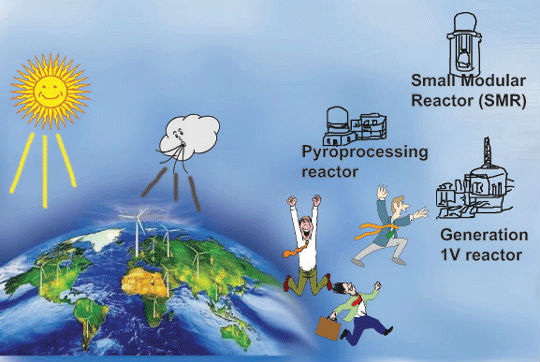
The Commission explicitly looked at plausible electricity prices for a new reactor in 2030 based on both current designs and possible fourth-generation ones, such as small modular reactors (SMRs). The Commission estimated the cost for the most viable nukes at US$7 billion for a typical large 1125-megawatt reactor and $2.8 billion for two 180-megawatt SMRs. The smaller SMRs would be providing electricity for a whopping US$0.17 a kilowatt-hour!
A study done for the Commission found that both large nukes and SMRs “consistently deliver strongly negative NPVs” (net present values) for both 2030 and 2050 — even for the strong climate action scenario. The Commission Chair noted that given how Australia’s National Electricity Market works, renewables are “the first energy that goes into the market” because they have the lowest costs.
The Commission’s findings are consistent with a 2014 Energy Policy study, “The cost of nuclear electricity: France after Fukushima.” Using cost data released by the French government after the Fukushima disaster, the study found the cost of French nuclear plants steadily escalated over the past four decades. Further, it projects “the future cost of nuclear power in France to be at least 76€/MWh (US$0.084/KWh) and possibly 117€/MWh (US$0.129/KWh),” which “compares unfavorably against alternative fuels,”……. such as wind.http://thinkprogress.org/climate/2016/03/08/3757281/nuclear-industry-prices/
Australian Aboriginal people oppose expansion of nuclear industry
 Traditional owners in the Flinders Ranges say nuclear waste dump threatens cultural heritage ABC NORTH AND WEST MICHAEL DULANEY Traditional owners in the Flinders Ranges say a Federal Government nuclear waste dump could destroy significant cultural heritage and countless sacred sites around a permanent spring. The lush vegetation and birdlife along Hookina Creek, 30 kilometres north of Hawker in South Australia, stands out even among the imposing space and scale of the central Flinders Ranges. Its permanent waters are fed by aquifers that bubble up to feed ‘an oasis’ of reeds and large eucalypts bursting from the dry heat and dust of the pastoral landscape.
It is an area integral to the lives of the Adnyamathanha people for generations and whose presence has left a rich cultural and archaeological record along the creek.
These waters are also just a few kilometres from Wallerberdina, a cattle station near Barndioota partly-owned by former Liberal senator Grant Chapman.
It is also one of six sites nominated to host Australia’s first nuclear waste dump.The Adnyamathanha people, who manage the Yappala Indigenous Protected Area which shares a boundary with Barndioota, said they were “shocked” by the prospect of storing Australia’s low and intermediate level nuclear waste so close to a significant cultural site.
Traditional owner Regina McKenzie said the facility would jeopardise their links to a place important for the present — a place where her children have learnt to swim and the family comes to camp — as well as the past, as seen in the tools, paintings and storylines that mark the area.
“The emotional stress we’re feeling is off the charts,” Ms McKenzie said. “We’re still the custodians here; we’ve always looked at it that way.”
The Adnyamathanha people are also worried about the risk from large floods known to hit the area, and elder Enice Marsh pointed out damage around the creek caused by the last flood a decade ago.
Ms Marsh said she feared the loss of her people’s heritage in the region if rising flood waters mixed with radioactive waste. “If we’re going to have that poison stuff here, even if it’s a low-level situation, it’s just absolute madness to put something like this near somewhere that’s so special,” she said.
“It’s everything; it’s a type of importance that you would never be able to describe. “The connection to this land for Adnyamathanha people is their culture, their customs; it’s their identity.”…….
With a final decision from the Government due by the end of the year, Ms McKenzie said the Adnyamathanha people would continue to oppose the expansion of the nuclear industry into their traditional lands.
“We’re feeling as though we’re being forced to do something we don’t want to do,” she said. http://www.abc.net.au/news/2016-02-24/traditional-owners-flinders-ranges-fears-on-nuclear-waste-dump/7195030
Summary of Australia’s Nuclear Fuel Chain Royal Commission Report
the waste-to-fuel fantasies of Senator Edwards and Ben Heard are dead and buried.
 [Wastes storage] timeframes – 150 years in the U.S. report and 120 years in the Royal Commission study – are nothing compared to the lifespan of nuclear waste. It takes 300,000 years for high level waste to decay to the level of the original uranium ore. The Royal Commission report notes that spent nuclear fuel (high level nuclear waste) “requires isolation from the environment for many hundreds of thousands of years.”
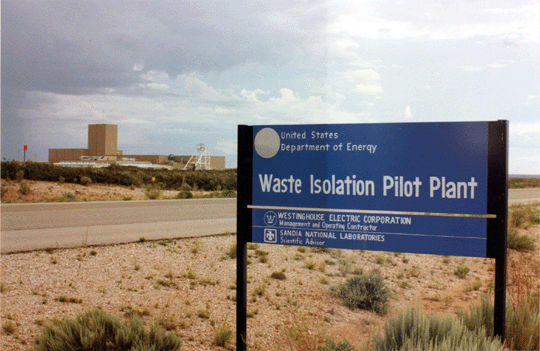 the Waste Isolation Pilot Plant (WIPP) in the U.S. state of New Mexico. WIPP was closed in 2014 because of a chemical explosion which ruptured a nuclear waste barrel and resulted in 23 workers being exposed to radiation. Before WIPP opened, the government estimated one radiation release accident every 200,000 years. But there has been one radiation release accident in the first 15 years of operation of WIPP.
 The Royal Commission’s report is silent about WIPP. It is silent about the Asse repository in Germany, where massive water infiltration has led to the decision to exhume 126,000 barrels of radioactive waste. The report is silent about the fire at a radioactive waste repository in the U.S. state of Nevada last year. And the report is silent about many other problems with the nuclear industry that it should have squarely addressed
Summary of ‘Tentative Findings’ of SA Nuclear Fuel Cycle Royal Commission Friends of the Earth Australia, by Jim Green, national nuclear campaigner, Friends of the Earth 20 Feb 16 What does the report say?
In a nutshell, the Royal Commission is negative about almost all of the proposals it is asked to consider – but positive about the proposal to import high-level nuclear waste from nuclear power plants for disposal in South Australia. Continue reading
Australian Senator’s Impossible Nuclear Dream – analysis by Australia Institute
The impossible dream Free electricity sounds too good to be true. It is. A plan to produce free electricity for South Australia by embracing nuclear waste sounds like a wonderful idea. But it won’t work. The Australia Institute Briefing paper Dan Gilchrist February 2016

Why the Nuclear Lobby and Australian Politicians want Australia as world’s radioactive trash dump
from CaptD 31 Jan 16 The first reason is MONEY and I mean BIG Money. Politicians are always gear for Nuclear  Payback*
* http://www.urbandictionary.com/define.php?term=Nuclear+payback
Those that support nuclear power because nuclear power somehow supports them; no matter what the health implications or other “costs” are for others.
The “other” reason is that the Nuclear Industry and their Utilities are desperate to create a radioactive waste dumping site for waste is that they are going to want to site Small Modular Reactors (SMRs) very soon, which companies like SD’s General Atomic are now working on. Since CA has a law that says no more nuclear reactors, until a waste site is developed, the lack of a disposal site is the biggest roadblock they face preventing them from deploying SMRs in CA.

I believe that most Utilities will want to phase out Nat. Gas fired Peaker plants and install SMR’s “because they don’t emit CO2.” That is, unless they are going to be making big money using nat. gas like SDG&E will be, since they already have a contract to import Nat. Gas from Mexico (which Sempra owns a share of, so they will be kind of buying Nat. Gas from themselves) for use in their two new state of the art Billion Dollar Peaker Plants that the CPUC just approved for them (despite the fact that the cost of Wind and Solar generation continues to drop almost monthly)!
SCE just had the CPUC decide against approving a Nat. Gas Peaker plant for them, so you can bet that they are now getting “very excited” about installing one or more SMR’s at San Onofre, since the grid wiring connection is already in place and they are going to be guarding that “nuclear waste” site for decades to come.
http://www.kpbs.org/news/2016/jan/08/oceanside-takes-stand-relocating-san-onofres-nucle/
BTW: All waste facilities should be run by the Government, that way they will always be responsible for it, since Big Waste Corp.’s can go out of business any time they want as as everybody knows Radiation is FOREVER since 50 or more than 100 years is forever to everyone living today.
Australian Aboriginal company to launch portable solar system, and storage
The products are being launched at Tandanya Aboriginal Cultural centre in Adelaide on Wednesday 2 September. Ms Oberon said Adelaide was chosen for the launch because of the council’s Sustainable City Incentive Scheme, which provides up to $5000 towards the cost in installing solar PV storage across the residential, business, education and community sectors. Funding for the program also has financial support from the South Australian government.
“We felt it was important to acknowledge the South Australian government and the City of Adelaide for such a forward-looking and innovative scheme,” Ms Oberon said.
The company is also hoping other state governments and councils will be encouraged to take up the idea of supporting the uptake of renewable energy storage.
The company’s core mission is based on the fundamental Aboriginal approach of stewardship of the earth and its resources. This means needing to shift out of high-emissions fossil-fuel derived energy.
Aboriginal-owned energy company one-upping Tesla By Willow Aliento, The Fifth Estate Friday 8 January 2016 The renewable energy storage game is about to be disrupted, with Australian Aboriginal-owned company AllGrid Energy announcing the launch of WattGrid, a new 10kWh solar energy storage system it says is around 30 per cent cheaper than the Tesla Powerwall.
Customers also don’t have to wait until 2016. Spokeswoman for AllGrid, Deborah Oberon, said the company expected to be making its first deliveries in the next two to three months.
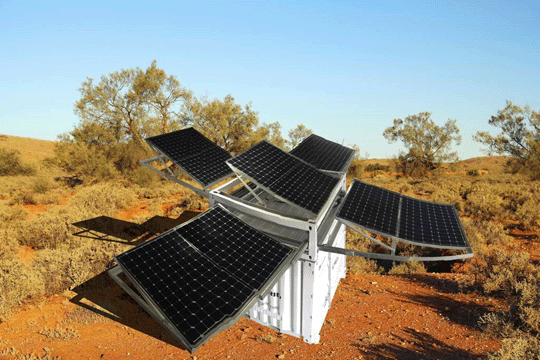
The $11,999 WattGrid unit comprises an aluminium cabinet containing tubular lead acid gel batteries, and a hybrid 5kW solar inverter with battery management system that has load share capability with the grid and uninterrupted power supply capability.
The unit is also accompanied by a software app, WattsHappening, that allows users to view real-time information and interface with the system.
Beta testing has shown the unit can help solar owners maintain an energy supply profile that can be matched to the demand profile, potentially rendering drawing grid power unnecessary.
The Queensland-based company is also releasing another product it has developed, the PortaGrid. This is an independent unit comprising solar panels, storage, UPS, inverter and outlets that is suitable for remote and off-grid locations, as well as emergency situations.
The units can be supplied with an inbuilt weather station that will automatically close up the panels in the event of a severe weather hazard such as a cyclone.
The AllGrid company is an alliance between two established firms, Consolidated Industrial Holdings, which operates across the energy efficiency, engineering design and technology sectors, and DICE Australia, an Aboriginal-owned and Aboriginal-operated company in the electrical contracting and general construction services sector………
The products are being launched at Tandanya Aboriginal Cultural centre in Adelaide on Wednesday 2 September. Ms Oberon said Adelaide was chosen for the launch because of the council’s Sustainable City Incentive Scheme, which provides up to $5000 towards the cost in installing solar PV storage across the residential, business, education and community sectors. Funding for the program also has financial support from the South Australian government.
“We felt it was important to acknowledge the South Australian government and the City of Adelaide for such a forward-looking and innovative scheme,” Ms Oberon said.
The company is also hoping other state governments and councils will be encouraged to take up the idea of supporting the uptake of renewable energy storage.
The company’s core mission is based on the fundamental Aboriginal approach of stewardship of the earth and its resources. This means needing to shift out of high-emissions fossil-fuel derived energy.
“It is so important for everyone to shift to renewable energy,” Ms Oberon said.
All the intellectual property involved in the products is owned by the AllGrid business.
Currently the company has one manufacturing facility established in Brisbane where the various parts, some of them manufactured offshore to AllGrid’s specifications, will be assembled by a predominantly Indigenous workforce.
Ms Oberon said if demand in South Australia was great enough, the company would also look to establish a plant in Adelaide.
The PortaGrid product is already attracting interest, she said, with the company in discussions with National Parks about supplying the units for remote sites that currently rely on diesel generators.
“The applicability worldwide of the technology is just enormous,” Ms Oberon said, “particularly in developing countries.”
Talks are underway with a number of groups that are currently running leadership programs with Indigenous people in other nations and setting up training programs in renewable energy for the local peoples.
The company is also investing heavily in research and development………
AllGrid has committed to directing a percentage of all company profits into creating and supporting training and employment programs for Indigenous Australian young people. http://www.eco-business.com/news/aboriginal-owned-energy-company-one-upping-tesla/
Melbourne, Australia, starts the wave of global climate marches
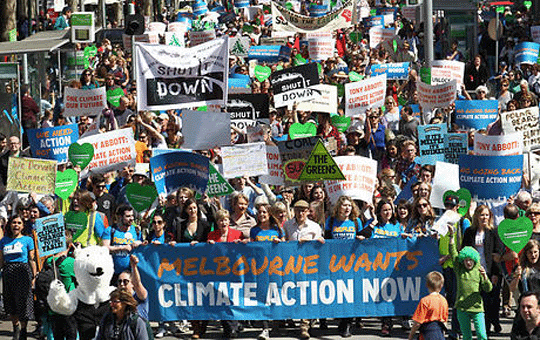 Thousands gather at Melbourne CBD rally ahead of Paris climate summit, The Age, [excellent photos and video] November 27, 2015 -Chloe Booker, Timna Jacks, With Tom Cowie and AAP
Tens of thousands of people have gathered in Melbourne’s CBD to demand world leaders take strong action to protect the planet at the Paris climate change conference.
The so-called People’s Climate March was one of hundreds of rallies being held around the world in the lead up to the crucial meeting. Members of The Cat Empire performed for the crowd, which included Opposition Leader Bill Shorten and Greens Senator Richard Di Natale.
A sea of placards stretched down Bourke Street from Spring Street to Swanston Street and along Swanston Street from Bourke Street to La Trobe Street. There was a stand-off between banked-up traffic and protesters at Exhibition Street as frustrated drivers honked their horns and the crowd erupted in cheers and shouts.
Stunned diners observed the march from outside Bourke Street cafes, and some heckled the demonstrators. Sections of the crowd were more like a party, with some dancing and clapping to a marching band dressed in green-glittered uniforms, while others swayed to the strumming of a guitar. ……..
Andy Parsons, an Environment Victoria volunteer who attended both rallies, said environmentalists supported the right of Aboriginal people to live independently.”The Aboriginal people lived sustainably for thousands of years. Us white people could learn a lot from them,” he said.
Aboriginal man Robbie Thorpe said he saw a parallel between the “genocide” of his people and what he called the “ecocide” of Australia’s natural environment. “We are the custodians of the land and the language. Only we know how to talk to our land. Without the Aboriginal people the land can’t survive and without the land, we can’t survive.” http://www.theage.com.au/victoria/thousands-expected-at-melbourne-cbd-rally-ahead-of-paris-climate-summit-20151127-gl9lz8.html
Indonesia will block its waters to nuclear waste ship travelling to Australia
 Indon to ‘block Aust-bound nuclear waste’ http://www.couriermail.com.au/news/breaking-news/indon-to-block-aust-bound-nuclear-waste/story-fnihsg6t-1227617732008 November 21, 2015 AAP
“WE will block the ship because nuclear waste is very dangerous,” sea security coordinating agenda head Vice Admiral Desi Albert Mamahit told The Jakarta Post newspaper.
“Our ships are on standby, although the ship is still far from Indonesia. We have information about the ship.”On October 16, the Australian Nuclear Science and Technology Organisation (ANSTO) confirmed a project to repatriate radioactive waste from France, where it was sent for reprocessing in the 1990s and early 2000s, and which will now be retained at ANSTO’s Lucas Heights, Sydney, facility.”Consistent with security requirements and practice established during nine previous export operations, ANSTO will not confirm the destination port, land route, or timing,” it said on its website.The Indonesians are concerned about a ship called the MV Trader, which was close to the African coast and expected to pass through the Malacca Strait, according to reports.
South Australia: the State to become radioactively poisoned yet again?
Freydenberg said the facility would ‘only’ house low and intermediate level waste. Perhaps he is unaware of the toxicity of this LLILW. Dr Green again: ‘When the spent fuel is removed from the reactor, it is high-level nuclear waste. After some months it cools down and falls below the heat criterion so is reclassified as LLILW.’
The farmer opponents of the Kimba sites are right to be concerned. The spent fuel reprocessing waste will be hazardous for thousands of years.
 South Australia’s nuclear threat continues http://www.eurekastreet.com.au/article.aspx?aeid=45708#.VkuCE9IrLGh Michele Madigan | 17 November 2015
Last Friday 13 November, the federal government released the shortlisted sites of the proposed national radioactive waste facility. No surprise that three are in South Australia, the ‘expendable state‘: Cortlinye and Pinkawillinie near Kimba on Eyre Peninsula, and Barndioota near Hawker, north of Port Augusta.
I wonder if South Australians aren’t beginning to feel like nuclear particles themselves, bombarded on all sides by the nuclear industry. This announcement from the federal government about its nuclear repository plans comes as the state government continues to consider, through its Royal Commission, whether, when and where South Australia will offer to host the world’s high-level nuclear waste.
The six names on the federal government shortlist (the remaining three being Sallys Flat in NSW, Hale in the Northern Territory and Oman Ama in Queensland) are taken from an original list of 28 properties that were offered by their landowners. It’s disturbing to find that the owner of the Cortilinye site, at least, has been misinformed,believing ‘It’s basically only a medical waste facility.’
In reality, only 10–20 per cent of the radioactive waste is medical in origin. And nuclear medicine is in no way affected by the lack of a national repository.
Resources and energy minister Josh Freydenberg’s Friday announcement included a masterly sentence of understatement: ‘Low level waste is those gloves or those goggles or the paper or the plastic that comes into contact with nuclear medicine, and intermediate waste could be, for example, those steel rods that are used in the reactor to actually create these particular products.’
It’s interesting to notice what’s different and what stays the same from the 1998–2004 ‘dump’ campaign in SA.Former science and energy minister Nick Minchin’s ultimately unsuccessful task back then was the imposition of a national dump on a South Australian community. His favourite low-level waste examples were watches that shine in the dark.
Senator Minchin however was not quite as casual as Freydenberg about what the intermediate waste ‘could be’. While Freydenberg seems to be casting around for an arbitrary ‘example’, the ‘steel rods’ he refers to, which are still travelling by sea from France back to Australia, are in fact long-lived intermediate level radioactive waste (LLILLW). As Dr Jim Green of Friends of the Earth explains:
‘Despite the name, spent fuel is orders of magnitude more radioactive than the original uranium ore. The spent fuel reprocessing waste returning from France will be stored at Lucas Heights, south of Sydney, and is then destined for ‘interim’ above-ground storage at one of the six sites.
‘Oddly, the government is making no effort to find a final disposal site for LLILW,’ he adds, even though ‘according to international standards, it should be subject to deep underground disposal, some hundreds of metres underground.’
Freydenberg said the facility would ‘only’ house low and intermediate level waste. Perhaps he is unaware of the toxicity of this LLILW. Dr Green again: ‘When the spent fuel is removed from the reactor, it is high-level nuclear waste. After some months it cools down and falls below the heat criterion so is reclassified as LLILW.’
The farmer opponents of the Kimba sites are right to be concerned. The spent fuel reprocessing waste will be hazardous for thousands of years.
All the while, the push for welcoming the world’s most dangerous material continues within SA — despite 40 per cent of SA’s electricity currently supplied by renewable energy.
It’s interesting how ethics enters the debate on the pro-nuclear side. With uranium just .02 per cent of the nation’s export dollars, Premier Weatherill has quoted ‘some’ who saw that because SA has 70 per cent of Australia’s uranium reserves ‘we’re duty bound to play our role in storing the waste’. In a signed letter to me earlier this month he was more direct.
The environmentalist refutation is more logical. The people do not choose to export uranium, but governments and companies do. If any government imports uranium then, just as with any other product, they import the responsibility of dealing with it.
As South Australia contemplates the renewed prospect of hosting both national and international radioactive waste sites, the stakes are high, especially for local Aboriginal populations whose collective memories include both the British mainland atomic tests of the 1950s and 1960s, and the successful campaign of 1998–2004 opposing a proposed national dump.
‘We live off the land,’ one young man from Coober Pedy wrote informally to the Royal Commission. ‘We go bush, we gather our food out there. We don’t want radioactive waste to destroy our land. It’s going to contaminate everything — our creeks, our water, our family.’
‘We don’t want the nuclear waste to be on our lands,’ Mima Smart, chairperson of Yalata, told me. Yalata is the place to which the people of the Maralinga Lands were removed to in 1952, a year prior to the first mainland explosion in the British nuclear test series.
‘Long ago our people didn’t have any rights and went through the bomb,’ she says. ‘That’s why we haven’t got Old People today. But these days we have our legal rights. How many more people do they want to die like what we seen?’
Nuclear medicine – the nuke industry’s big con job in Australia
 Medical radioactive wastes — the nuclear industry fig leaf, Independent Australia, 17 Nov 15 With modern developments in the non-nuclear production of medical isotopes, perhaps it’s also time to shut down the Lucas Heights nuclear reactor and stop producing dangerous radioactive trash, writes Noel Wauchope.
Watching the Australian media last week, you would be sure that the government’s hunt for a nuclear waste disposal site was solely to do with medical wastes. Rarely do they mention the real impetus for this hasty search, which is Australia’s current obligation to take back processed nuclear wastes from France. Later, we will have to receive similar wastes returning from UK. …..
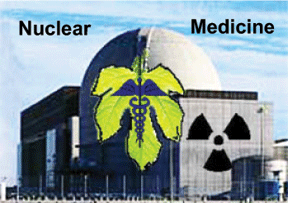
the vast majority of medical radioisotopes have very short half-lives, so there’s no need for them to be moved beyond the site of use…. The real problem is the returning intermediate level wastes from Australia’s used nuclear fuel rods reprocessed overseas….
it must be acknowledged that the medical radioisotopes produced at Lucas Heights do have their valuable uses in diagnostics and in the treatment of cancers.
However, it also must be recognised that all these radioisotopes can be produced without use of a nuclear reactor. This is happening increasingly and, rather like the distributed renewable energy boom, the world could be on the brink of a distributed medical radioisotope boom.
Canada and some in the USA certainly think so, judging by recent reports. The World Nuclear Association reports on University of British Columbia’s success in quadrupling the rate of production of medical radioisotopes using a (non-nuclear) cyclotron. Nova Scotia’s QEII Health Sciences Centre’s cyclotron was granted a Drug Establishment Licence (DEL) from Health Canada in June 2015
In USA, Niowave Inc, NorthStar Medical Radioisotopes and SHINE Medical Technologies, are competing in the market for medical isotopes, produced in a (non-nuclear) linear accelerator.
The non-nuclear production of medical isotopes has it all over the centralised production by nuclear reactor. This is not just because it eliminates the obvious dangers of nuclear wastes, weapons proliferation, terrorism risks, disastrous accident, and radiation emissions.
It’s because the greatest uses of medical radiopharmaceuticals involve very short-lived isotopes…….That makes them much better suited to localised production, in or near hospitals. The delivery of pharmaceuticals to patients is much more secure. In addition, the risk of transport accidents is close to zero……..
With all the fuss about finding a dump sites for ‘Olympic sized pools of medical radioactive waste‘, it is time for the government and media to fess up to the real purpose of this hunt. And with modern developments in the non-nuclear production of medical isotopes, perhaps it’s also time to shut down the Lucas Heights nuclear reactor and stop producing dangerous radioactive trash.https://independentaustralia.net/environment/environment-display/medical-radioactive-wastes–the-nuclear-industry-fig-leaf,8384
Australia should not become the world’s radioactive trash dump
 When nuclear reactors shut (as they are doing in USA) – where is the income stream to pay Australia for having all that radioactive trash?
 Proponents are talking up the billions that might be made by swallowing our pride and making Australia the world’s nuclear waste dump. But they have been silent about the costs.
And the waste would need to be monitored and problems addressed for millenia
Wasting Australia’s Future: Why We Shouldn’t Become The World’s Nuclear Waste Dump, New Matilda, By Dr Jim Green on November 9, 2015 There are many good reasons why Australia should not set its sights on becoming a dumping ground for nuclear waste. Dr Jim Green takes up the case.
While sceptical about the prospects for nuclear power in Australia, Prime Minister Malcolm Turnbull has given cautious support to the idea of a nuclear fuel leasing industry in Australia. Such an industry would involve uranium mining, conversion (to uranium hexafluouride), enrichment (increasing the ratio of uranium-235 to uranium-238), fuel fabrication, and disposal of the high-level nuclear waste produced by the use of nuclear fuel in power reactors overseas.
In the Prime Minister’s words: “We have got the uranium, we mine it, why don’t we process it, turn it into the fuel rods, lease it to people overseas, when they are done, we bring them back and we have got stable, very stable geology in remote locations and a stable political environment.”
Regardless of its merits, a nuclear leasing industry is an economic non-starter. That much is clear from the data provided in the latest edition of the International Atomic Energy Agency’s Nuclear Technology Review. Uranium miners could be compelled to participate in an Australian nuclear leasing industry. But try telling that to BHP Billiton. The company bluntly stated in its submission to the 2006 Switkowski Review: “BHP Billiton believes that there is neither a commercial nor a non-proliferation case for it to become involved in front-end processing or for mandating the development of fuel leasing services in Australia.”
And there’s no point appealing to the patriotic fervour of Australia’s uranium miners: they are majority foreign-owned. Continue reading
The ever increasing costs of new nuclear energy – Australia, USA, S Africa, China
You’ll never guess how much this Australian nuclear power plant will cost, http://www.bizjournals.com/pittsburgh/blog/energy/2015/11/youll-never-guess-how-much-this-australian-nuclear.html Matt Stroud, energy reporter for the Pittsburgh Business Times. Nov 6, 2015 A nuclear power plant has never been built in Australia before, but Westinghouse is putting a price tag on a new one they’re hoping to build there.
The price? About $12.3 billion.
 In testimony to Australia’s Nuclear Royal Commission — a body that’s investigating whether the
Australian state of South Australia should build the nation’s first nuclear power plant — Westinghouse executive Rita Bowser said that price was all inclusive, according to The Advertiser in Adelaide, South Australia. It would include land, environmental safeguards and construction.
Australia has zero nuclear power plants — and is known for being extremely averse to nuclear energy; it won’t even allow nuclear ships into its ports.
The historical aversion won’t affect the price much, apparently; the company’s guesstimate is in line with its current Vogtle project in Georgia, which has been plagued by cost overruns. It’s less than a comparable Chinese project, set to cost $24 billion. And it’s cheap in comparison to a project proposed in Johannesburg that could cost $100 billion.
The South Australia project’s future is fluid at the moment: the Nuclear Royal Commission hasn’t even decided whether it wants to recommend a nuclear facility.
That decision is set to come in May 2016. Tokyo-based Toshiba Corp. (TYO: 6502) owns 87 percent of the Cranberry-based Westinghouse Electric Co.
Radioactive trash ship on its way to Australia, despite safety concerns
 Ship carrying nuclear waste heads to Australia, West Australian CHERBOURG, AFP October 16, 2015 A ship carrying 25 tonnes of reprocessed nuclear waste is steaming to Australia despite protests from activists about an “environmental disaster waiting to happen”.
The BBC Shanghai left the northern French port of Cherbourg after approval from local officials, who carried out an inspection on Wednesday, and is due to arrive by the end of the year in NSW. It is laden with radioactive waste from spent nuclear fuel that Australia sent to France for reprocessing in four shipments in the 1990s and early 2000s, the Australian Nuclear Science and Technology Organisation says.
The reprocessing involves removing uranium, plutonium and other materials, with the remaining substances stabilised in glass and stored in a container…….
Greenpeace, French environmental campaign group Robin des Bois (Robin Hood) and a leading Greens MP have called for the shipment, sent by Areva, to be halted. “Areva, almost bankrupt, are using a dustbin ship to carry waste, without any serious inspection!” Denis Baupin a senior MP with the French green party, tweeted.
Greenpeace Australia Pacific said the ship, owned by German firm BBC Chartering, was an “environmental disaster waiting to happen”, claiming the Shanghai was “blacklisted by the United States because of its safety record”……
But Areva’s external relations director, Bernard Monnot, said the ship was “not banned from ports in the United States but banned from transporting material for the American government”.
Nathalie Geismar from Robin des Bois said other ports had found it had a “staggering number of flaws”……
ANSTO said the material would be kept at the Lucas Heights facility in southern Sydney until a nuclear waste dump site, which has yet to be chosen, is found and constructed……https://au.news.yahoo.com/thewest/a/29834316/ship-carrying-nuclear-waste-heads-to-australia/
Australian Aboriginal women renew their long hard fight against nuclear waste dumping
Aboriginal women reaffirm fight against nuclear waste dump in South Australia ABC Radio National, The World Today By Natalie Whiting 16 Oct 15 The first shipment of Australia’s nuclear waste to be returned from re-processing in France has now left a French port, and will arrive on our shores by the end of the year. The return of the 25 tonnes of nuclear waste is putting renewed pressure on the Federal Government to find a location for a permanent waste dump.
The shipment began its journey just a day after senior Aboriginal women gathered in Adelaide to mark their fight against a proposed dump in South Australia in the 1990s.
The women say they will fight against any new move to put the waste on their land…..
SA Aboriginal women remember waste dump victory A Federal Government plan to build a
 nuclear waste dump in the South Australian outback in 1998 attracted fierce opposition, especially among local Aboriginal people.
An event in Adelaide last night celebrated the work of a group of women called kupa piti kungka tjuta, who campaigned against the dump. Emily Austin from Coober Pedy was one of them. (centre in picture)
The women campaigned for six years until a Federal Court challenge from the South Australian government put an end to the dump. Ms Austin said she could remember the day the court found in South Australia’s favour.
“I was out in the bush hunting and I heard it on the radio in the Toyota. We were all screaming, ‘We won’.
“All the kungkas (women) were happy.”
While the Federal Government is in the midst of a voluntary process for finding a site for a dump, South Australia’s outback is still seen as an ideal location.
The South Australian Government’s attitude to the industry has been shifting.
It has launched a royal commission to investigate possible further involvement in the nuclear fuel cycle.The royal commission is looking at everything from mining uranium, processing, waste storage and nuclear power.
The organiser of last night’s event, Karina Lester, is the granddaughter of one of the women who campaigned and her father was blinded by the British nuclear tests at Maralinga half a century ago.
She said the Aboriginal people in South Australia’s north have a long and tortured history with the nuclear industry. “Maralinga’s had a huge impact because people speak from first-hand experience,” she said.
“People like the amazing kupa piti kungka tjuta, many of those old women who are no longer with us today, they were there the day the ground shook and the black mist rolled.
“It’s an industry that doesn’t sit comfortably with Anungu community.”
Ms Lester said it was good to see the royal commission consulting with people before a decision is made.”Credit to the royal commission that they’ve made an effort to engage with a broader community of Aboriginal communities,” she said.
“But how many of those Anangu are really understanding he technicality of this royal commission and what industry really means?” Ms Austin said she was ready to fight any future attempts to set up a waste dump in the region.
“Oh yeah, I’ve still got fight yet. They might stop yet, they might listen, I dunno,” she said. http://www.abc.net.au/news/2015-10-16/aboriginal-women-fight-against-nuclear-waste-dump-in-sa/6861012
1 This Month



26 September – International Day for the Total Elimination of Nuclear Weapons


PLEASE OPPOSE HR 8255 AND S.3639 – bills would accelerate satellite deployment, with no environmental review or safeguards – https://ncstd5li.quorum.us/campaign/169331/
To see nuclear-related stories in greater depth and intensity – go to https://nuclearinformation.wordpress.com
-
Archives
- September 2026 (245)
- August 2026 (330)
- July 2026 (355)
- June 2026 (287)
- May 2026 (306)
- April 2026 (356)
- March 2026 (251)
- February 2026 (267)
- January 2026 (308)
- December 2025 (358)
- November 2025 (359)
- October 2025 (375)
-
Categories
- 1
- 1 NUCLEAR ISSUES
- business and costs
- climate change
- culture and arts
- ENERGY
- environment
- health
- history
- indigenous issues
- Legal
- marketing of nuclear
- media
- opposition to nuclear
- PERSONAL STORIES
- politics
- politics international
- Religion and ethics
- safety
- secrets,lies and civil liberties
- spinbuster
- technology
- Uranium
- wastes
- weapons and war
- Women
- 2 WORLD
- ACTION
- AFRICA
- Atrocities
- AUSTRALIA
- Christina's notes
- Christina's themes
- culture and arts
- Events
- Fuk 2022
- Fuk 2023
- Fukushima 2017
- Fukushima 2018
- fukushima 2019
- Fukushima 2020
- Fukushima 2021
- general
- global warming
- Humour (God we need it)
- Nuclear
- RARE EARTHS
- Reference
- resources – print
- Resources -audiovicual
- Weekly Newsletter
- World
- World Nuclear
- YouTube
-
RSS
Entries RSS
Comments RSS
 nuclear-news