“The nuclear industry is in decline” – a report that upsets the industry
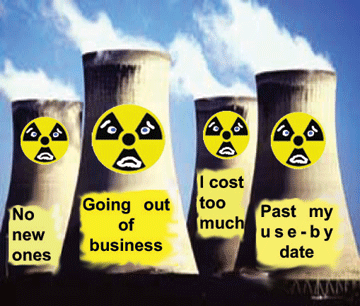 Nuclear’s fortunes on the wane THE AUSTRALIAN SEPTEMBER 29, 2014 Robin Bromby Business columnist
Sydney :……….now along comes some disquieting analysis of the nuclear electricity story. Normally, we would have seized on the annual report during the week fromManhattan Corp (MHC), which has the Ponton uranium project in Western Australia, and which coincided with yet another rise in the spot uranium price, up $US2.50 a pound to $US36.50/lb. Executive chairman Alan Eggers writes that the uranium sector has been dominated by “negative industry sentiment, falling supply and lacklustre demand among buyers of nuclear fuel”. He then outlines a reasonably cheerful outlook, and one to which Pure Speculation has been an adherent.
Until we read another report written by eight European and Japanese heavyweight thinkers in the field, headed by Paris-based Mycle Schneider. Their World Nuclear Industry Status Report 2014 has a stark and simple message: “The nuclear industry is in decline”.
There are 388 operating reactors around the world, 50 fewer than in 2002. Installed capacity is back to where it was 20 years ago.
The nuclear share of the world’s power generation declined from its peak of 19.6 per cent in 1996 to 10.8 per cent in 2013. In terms of revenue, nuclear now accounts for a lower percentage than in 1984.
In all, there are 67 “current” nuclear reactor projects, which sounds impressive until the report explains that eight of those reactors have been listed as “under construction” for more than 20 years; at least 49 have encountered construction delays, some for several years, and for the first time Chinese projects have also been delayed; for the remaining 18 reactors, either construction began within the past five years or the reactors have not yet reached projected start-up dates.
“Delays have occurred in the development of the nuclear programs for most of the more advanced newcomer countries, including Bangladesh, Jordan, Lithuania, Poland, Saudi Arabia, Turkey and Vietnam,” the report adds……..http://www.theaustralian.com.au/business/opinion/nuclears-fortunes-on-the-wane/story-fnciihm9-1227073165703
Australia most unpopular at Climate Change Summit
Australia’s climate stance savagely condemned at New York summit SMH September 27, 2014 Nick O’Malley US correspondent for Fairfax Media “…….in his address to the General Assembly, Leonardo DiCaprio sought to buttress his call for drastic and immediate action to reduce carbon emissions with a voice harder to challenge than his own.
it was Australia and to an extent Canada that were subject to most of the opprobrium, in part because they have already enjoyed the economic benefits of carbon emissions, in part because China is perceived to be on the brink of significant action.
One of the successes of Tuesday’s meeting was China’s announcement for the first time ever that it would set an emissions target, aiming to reduce its emissions of carbon per unit of GDP by 45 per cent by 2020, compared with levels in 2005.
“As a responsible major country, a major developing country, China will make even greater effort to address climate change,” Vice-Premier Zhang Gaoli said.
“All countries need to follow the path of green and low carbon development that suits their national conditions, [and] set forth post-2020 actions in light of actual circumstances.”
An adviser who attended a meeting of small island states that excoriated Australia’s inaction on climate said the group now viewed China’s commitments optimistically.
The reaction to Australia’s presence could not have been more different. Tony de Brum, the Foreign Minister of the Marshall Islands, told Fairfax that small islands states were frustrated and baffled by Australia’s stance, especially as they had regarded the nation as a “big brother down south” and advocated for its seat on the United Nations Security Council.
Asked if “betrayal” was too strong a word, he paused and said, “Now it is, maybe not soon.”
On Tuesday the Pulitzer Prize-winning climate change news website Inside Climate News published a story about the “Canada-Australia axis of carbon”. It suggested that not only were the two nations not willing to pull their weight, but that they were seeking to derail the binding agreement on emissions reductions at next year’s talks in Paris that many view as the world’s last best hope to prevent catastrophic climate change.
“Neither the prime ministers of Canada nor Australia will speak at the summit, and the subordinates they have sent will not be offering the kind of “bold” new steps that UN Secretary-General Ban Ki-moon is seeking on the way to a treaty in Paris late next year,” it reported.
“Instead, these two governments, with their energy-rich domains sprawling across opposite ends of the earth, will present strikingly similar defences against what much of the rest of the world is offering. And their stance is earning them opprobrium among advocates of strong and immediate action.”
The online magazine Slate published a story headlined, “The Saudi Arabia of the Pacific, How Australia became the dirtiest polluter in the developed world.”
It charted Australian climate politics since the last election – noting for an international audience Australia’s history as a leader in solar technology, the creation and then scrapping of a carbon trading scheme, the promotion of climate change sceptics to key advisory roles, the attacks on the solar industry, the scrapping of the mining tax, the failed bid to expand logging in Tasmanian wilderness.
“Let’s hope that the rapacious policies of the current government represent only a temporary bout of insanity,” Slate concluded. “If the Australian people cannot recover some of their earlier regard for their environment they may find in time that their great land is no longer merely apathetic toward their residence there but openly hostile.” http://www.smh.com.au/world/australias-climate-stance-savagely-condemned-at-new-york-summit-20140926-10mc0x.html#ixzz3Eac7HHfN
Kow towing to mining industry, Australia violates the Nuclear Non Proliferation Treaty (NPT)
 A BLATANT VIOLATION OF Nuclear Non Proliferation Treaty–SEPTEMBER 26, 2014 By Eurasia Review By Yusra MushtaqAmongst the various accords of Arms Control and Disarmament, the Nuclear Non Proliferation Treaty (NPT) has widely been adhered to by most of the countries, which gives testament to the worth of this treaty. Nevertheless, it also has been the fate of being violated again and again by its own signatory members — most recently by Australia which signed a uranium deal with India, ade-facto, but non-signatory state. Previously, the US a big proponent of NPT, paved the way for this kind of illegal nuclear cooperation with the non-NPT state of India by signing a deal back in 2005. The blatant violation of NPT left no room for India to sign this treaty because it already enjoys full benefits as if it were a NPT member state without any restricted conditions.
Largely based on the three pillars of Non-Proliferation, Disarmament and Peaceful Uses of Nuclear Energy, the NPT serves as a central bargain. “The NPT non-nuclear-weapon states agree never to acquire nuclear weapons and the NPT nuclear-weapon states in exchange agrees to share the benefits of peaceful nuclear technology and to pursue nuclear disarmament aimed at the ultimate elimination of their nuclear arsenals”. There are 190 states which have joined the NPT club. It is extended for indefinite period of time which reflects its obligatory status. In order to make Global Nuclear Non Proliferation and NPT particularly more fruitful, many substantive initiatives have been taken. They are dominated by export controls regime like Nuclear Suppliers Group and enhanced verification measures of IAEA Additional Protocols. The sole aim of all efforts is to end every possible mean to acquire nuclear weapons. Within this context, success becomes a far off cry as NPT is in a fix between global and national interests of respective states.
Australia signed a deal to sell uranium to India to coin the natural blessing of one third of world’s uranium reserves for the sake of national interests. It is the first non-NPT signatory nation with whom Australia has inked a nuclear deal. Australia is the tenth country in the world that has signed a nuclear deal with India. Both the states are joining hands happily while violating the norms of NPT so blatantly. There is a sheer absence of handwringing editorials at the international news desks. Between the celebrations of this so-called triumph, no one is talking of the sanctity of international arms treaties…….
an irony for the Global Non Proliferation Regime that there are high voices for NPT to be adhered to, but at the same time its own vocal members have optimized national interests over the security of the whole globe. All are quiet on the sheer violence on this international violation of a treaty because it’s a matter of great powers vested national interests with a de facto state. For this Lao Tzu, a Chinese philosopher stated; “The more laws and order are made prominent, the more thieves and robbers there will be.” Yusra Mushtaq is a scholar on the issues of defense and security. http://www.eurasiareview.com/26092014-blatant-violation-npt-oped/
Australian research shows the way to 50% renewable energy by 2050
 Australia Encouraged To Set 50% Renewable Energy Target By 2030 September 25th, 2014 by Giles Parkinson RenewEconomy. Imagine a world in 2050. Everyone drives an (electric) car, homes have all the gadgets, appliances and nick-nacks. The public transport system is emissions free. Mining work and transport is electrified, and diesel is dumped. Electrification has taken place in much of the steel industry. And it is all emissions free. It might be powered by 100 per cent renewables – the sun, wind, the sea, and geothermal, hydro and biomass. And the economy is still strong.
Welcome to the zero carbon world awaiting Australia and much of the rest of the world.
Major new analysis – Pathways to Deep Decarbonisation – produced by Australia’s ClimateWorks, along with ANU, shows that 15 of the world’s biggest economies can move to “net carbon zero” by 2050, and it need impose no extra costs over business as usual. In fact, electricity bills will be lower than what they are now. Economic growth will remain more or less the same, and the benefits, in terms of health and the environment, will be enormous.
The report is timed for the New York climate summit being hosted by the UN this week, and in the 12 months leading up to the Paris event that will hopefully result in a new climate treaty next year. It is designed to help change the political rhetoric around decarbonisaion. In Australia, only one party, the Greens, talks in terms of net carbon zero by 2050, and of higher renewable energy targets. Yet this report says not only is it necessary to meet climate goals, it is eminently doable.
Anna Skarbek, the executive director of ClimateWorks, says that Australia’s political rhetoric needs to change quickly. While the Abbott government is talking of the need to “cut” the renewable energy target down to a “real” 20 per cent, for “fear” that it might reach 25 or 26 per cent by 2020, Skarbek says that to achieve climate goals, Australia’s renewable energy target needs to be at least 50 per cent by 2030 – and then carbon free by 2050.
“There are many pathways for Australia to substantially reduce emissions, but all include greatly improved energy efficiency across the economy, a nearly carbon free power system and switching to low carbon energy sources in transport, buildings and industry,” Skarbek says.
“Taking the carbon out of our electricity system provides the largest reduction in emissions. Then we can use the carbon-free electricity to replace petrol in cars, and gas in buildings and some industrial processes.”
“The move to a low emissions electricity system can be developed with technologies that exist today. But we need to move faster – this report shows we’ll need at least 50 per cent renewable electricity by 2030 to achieve a decarbonised electricity system in the time we have left to stay within the carbon budget.”….in all scenarios, even those that hope for cost-competitive carbon capture and storage, renewable energy is the dominant technology, and solar provides at least 50 per cent of all generation.
By 2030, under the renewable scenario, coal is nearly eliminated, although it plays a greater role in the other scenarios because CCS will take a decade at least to bring into production (if it can ever deliver the costs, which many think it won’t), and nuclear will not have a presence before 2030.
Even then, it is assumed that nuclear would provide no more than one-quarter of generation – and this is based on the rather generous cost estimates of past government reviews, and does not reflect the significant cost declines that can be expected of solar. Note however, that the emissions per MWh is the renewables scenario is nearly half of that entertained in the CCS or nuclear scenario – that’s because coal generators get to pollute for many years longer in those scenarios……..
The ClimateWorks report was one of 15 prepared for the UN Deep Decarbonisation Pathways Project that involves modelling teams from 15 major emitters that also include Australia, Brazil, Canada, China, France, Germany, India, Indonesia, Japan, Mexico, Russia, South Africa, South Korea, the UK and the USA.
The findings are being presented to the UN this week by leading economist Jeffrey Sachs. It shows that these countries account for 70 per cent of the world’s greenhouse gas emissions. The interim results show that all 15 countries found ways to achieve near zero carbon electricity by 2050, while sustaining economic growth……http://cleantechnica.com/2014/09/25/australia-renewable-energy-target-50-2030/
India-Australia nuclear trade will destabilise the Asia Pacific region
Australia and uranium: the pusher of the Pacifichttps://overland.org.au/2014/09/australian-and-uranium-the-pusher-of-the-pacific/ ByAdam Broinowski 19.Sep.14 “……… The new demand from India will include uranium mined from Ben Lomond near Mt Isa which is likely to be shipped from Townsville Port, and coal mined from the gargantuan Galilee Basin and shipped from Abbott Point, passing through the dredged Great Barrier Reef, or freighted by road to Darwin or Adelaide ports (which hold uranium licenses). The Australia-India uranium agreement supports this concerted and accelerated push.
In cementing a nuclear deal with India, the Abbott government has committed to selling uranium to a nation-state that barely conceals its intentions to expand its nuclear weapons arsenal and that rejects the NPT and Comprehensive Test Ban Treaty (CTBT)………..
First, the Australia-India uranium trade agreement is unsafe. If Japan’s nuclear industry and government have proven unable to properly contain the potential for serious nuclear accidents at its domestic nuclear power plants, then India’s nuclear industry, which is much less reliable and possibly even more corrupt, poses even higher risks of mismanagement.
Internally, India is also unstable, as the government fights an embedded insurgency. It maintains a violently repressive approach to imposing nuclear installations and uranium operations (such as Gorakhpur, Koodankulam, Jaitapur, Jagudoga) upon vulnerable communities, and against the wishes of civil protesters, five of whom have been killed since 2010. While guaranteed only intermittent electricity supply, such communities are experiencing higher rates of disease, congenital malformations and early deaths. In Jagudoga, Jharkhand (19,500 people), those living near the central uranium mine operated by Uranium Corp. of India Ltd. (UCIL), have suffered disproportionately high health problems……….
Second, while Tony Abbott reiterated that ‘suitable safeguards’ were in place to ensure that Australian uranium would be used for ‘peaceful purposes’ and for ‘civilian use only’, such ambiguous terms create false impressions. Nuclear technologies are inherently dual-use (both for civil energy production and military use), and it is disingenuous to claim that a water-tight separation can be ensured. In fact, ten of India’s twenty nuclear facilities do not fall under International Atomic Energy Agency (IAEA) supervisional authority, and India only selectively recognises IAEA safeguards for specific foreign supplied reactors and facilities. With no mechanism to inspect this nuclear technology to ensure that the fuel is not diverted into nuclear weapons production, safety cannot be guaranteed.
Even if the diverted fuel was discovered, neither Australia nor the IAEA could force compliance. An influx of imported foreign uranium will simply make it easier for India to reserve some of its indigenous uranium for enrichment and/or reprocessing weapons-grade plutonium, or for some of Australia’s uranium to be ‘misallocated’ toward military facilities.
In effect, Tony Abbott’s policy to treat India as the exception undermines the IAEA standards within the disarmament regime, and breaches Australia’s obligations to the Rarotonga Treaty for the South Pacific Nuclear Free Zone.
Third, and perhaps most significant, the deal will upset the ‘balance’ between India-Pakistan and in the South Asian region so as to aggravate rivalries and intensify tensions between the two nations, as well as others such as China and Bangladesh………
While leaders such as Abe, Abbott and Modi downplay the reality confronting people affected by radiation exposures from the Fukushima Daiichi nuclear power plant, we should remember that this contamination came, in part, from Australian uranium.
The refusal of executive leaders to acknowledge the dangers of the uranium trade reflects the centrality of nuclear power to the US-led security regime that seeks to dominate non-compliant nations such as China or Russia………
Dr Adam Broinowski is an ARC postdoctoral research fellow at the College of Asia and the Pacific, the Australian National University.
Australia’s blatant violation of Non Proliferation Treaty, in selling uranium to India
Australia blatantly violates the NPT, Iran held to different standard http://www.iranaffairs.com/iran_affairs/2014/09/australia-blatantly-violates-the-npt-iran-held-to-different-standard.html
As if we needed any more proof that the “Iranian nuclear threat” is just a cooked-up pretextwhich is unrelated to any actual nuclear threat, Australia (which holds about 1/3rd of the world’s uranium reserves) has decided to sell uranium to India. That such a deal violates the terms of the Nuclear Nonproliferation Treaty, doesn’t seem to be an issue to anyone. Note the absence of handwringing editorials at the Washington Post and NY Times about the sanctity of international arms treaties etc.
And why should it be a problem, considering that a few years ago the US agreed to violate the same NPT by sharing nuclear technology with India in exchange for buying India’s vote against Iran at the IAEA Board (which sent Iran’s file to the UN Security Council even though Iran had not breached the NPT?)
On the eve of his visit to New Delhi, US Under Secretary of State Nicholas Burns has said that with India voting in favour of the IAEA [International Atomic Energy Agency] resolution on Iran’s nuclear programme, Congressional opposition to the Indo-US nuclear agreement has disappeared and both sides would meet their commitments before President George W. Bush visits India next year.
Of course the US and Australia claim that this stuff is going to non-military use in India but all that means is that the deal would free-up India’s other resources to be used for non-civilian use. There’s nothing in the NPT which allows signatories to make such exceptions anyway.
Now in the meantime, while the US (and Australia) are blatantly violating their own obligations under the NPT, they’re demanding that Iran apply even greater restrictions on its nuclear program than the NPT requires, by for example giving up uranium enrichment. These excessive demands that violate Iran’s legal rights are clearly intended to scuttle the talks, and to keep the “crisis” alive. The US has no intention of peacefully resolving the nuclear dispute with Iran, no matter what.
Australia’s nuclear guinea pigs at Maralinga
 AUDIO: Maralinga: Australia’s experience of nuclear testing http://www.abc.net.au/pm/content/2014/s4082110.htm ABC Radio p.m Mark Colvin reported this story on Friday, September 5, 2014 DAVID MARK: It happened in the 1950s. But the truth about a series of nuclear tests in which Britain let off atomic bombs at Maralinga in the South Australian desert only started to emerge in the ’70s.
Even now, there are still survivors demanding justice. Many are now dead, but there are still fears about the effects of the big doses of radiation they absorbed having on their children and even their grandchildren.
The journalist Frank Walker has written a book about Maralinga and he told Mark Colvin about what Australian servicemen actually experienced at the test site. …………
British scientists came over in their white overcoats and the helmets and the oxygen tanks – the whole thing – while the RAAF blokes stood there in their regular flying gear wondering what the hell was going on…….
FRANK WALKER: The British scientists wouldn’t do a lot of things that they said the Australian servicemen had to do, such as drive the heavy vehicles into the red hot zone and pick up the scientific equipment and bring it back to them.
What the British wanted to know was could a nation survive an atomic war? In other words, if Britain was caught in an atomic war, they – obviously bombs would fall on London, Manchester, all the big industrial cities – but what would – could Britain survive? Could they grow food? Could the people survive? Would the children grow up to be adults?
This was what they wanted to know and this was why the instructions were to have men positioned at certain distances from the blast to see whether they could function afterwards.
MARK COLVIN: Now we’ve talked a bit about the servicemen, but we haven’t talked about the traditional owners of the land. What happened to them? FRANK WALKER: They were treated absolutely abominably. First of all, they were just totally disregarded. They had no knowledge of whether Aborigines used Maralinga as a traditional hunting area and when it turned out they did, that this was actually a – many songlines went through this territory, that they would walk through this territory from waterhole to waterhole. They knew this land very well. They were – they tried to keep them out.
They had one sort of patrol bloke who knew the outback very well. He was a bushman, a bloke by the name of MacDougall, very interesting character. He had a job of trying to keep Aborigines out of an area that’s about a million square kilometres.
MARK COLVIN: One bloke.
FRANK WALKER: One bloke.
MARK COLVIN: So, we will probably never know if any Aborigines were killed in the actual blast?
FRANK WALKER: I believe they were. I believe – there were several accounts that came up before the atomic royal commission in the 1980s where soldiers, where lower ranks described finding corpses in the Maralinga area. Certainly we know that some did come through the area and were found alive and they tried to decontaminate them and so on.
But the accounts of corpses being found in some of the craters and in trails near the test sites were – could not be proven. It ended up being the junior blokes, junior ranks would say, “We saw it. We saw them bulldoze the bodies.” The senior ranks would come along and say, “No, it never happened.”…..FRANK WALKER: I think both governments are extremely liable. The Australian Government at the time, at the very best, turned a blind eye to what was going on. The British Government was running the show and they were quite content in they treated Australia as though it were just do whatever they wanted and, under Menzies, the government did………
Australia breaks international Treaty, in selling uranium to India
Seen from the perspective of adherence to non-proliferation norms and commitments If Australia exports uranium to India, Australia would violate its obligations of the Treaty of Rarotonga, which binds it from not indulging in such trade. Article 4 of the Rarotonga Treaty requires India to comply with safeguards requirements of Article III(1) of the Nuclear Nonproliferation Treaty (NPT). Article III(1) of the NPT is about reaching a comprehensive safeguards agreement with IAEA. Instead, India has only acknowledged safeguards on certain foreign-supplied reactors and facilities. India’s safeguards agreement is based upon the IAEA’s ‘facility specific’ safeguards.
Australian uranium sale to India will be subjected to weak monitoring safeguards or ‘facility specific’ of IAEA, contrary to nuclear deals Australia has with other countries
AUSTRALIAN PROSPECTIVE NUCLEAR TRADE WITH INDIA – THE CONTROVERSYhttp://www.eurasiareview.com/21082014-australian-prospective-nuclear-trade-india-controversy/AUGUST 21, 2014 EURASIA REVIEW BY HASAN EHTISHAM
These protests have been a regular feature in Koodankulam (Tamil Nadu), Jaitapur (Maharashtra) and Gorakhpur (Haryana) and at least five activists have lost their lives since 2010 in their struggle against the Indian government’s decision without taking the affected parties on board. Radioactive waste from uranium mining in the country’s east is reportedly affecting adjacent communities. Thousands of Indians suffer from the effects of uranium mining as related to poor technical and management practices.
Australia controls the planet’s largest known uranium reserves. Uranium is a controversial and debatable subject in Canberra, because it can be used both for civil and military purposes. Australia had previously cancelled plans to sell uranium to India as it is not a signatory to the Nuclear Non-Proliferation Treaty, but it was Indo- US nuclear deal which paved the way for the ban’s lifting.
The move of lifting the ban came despite a parliamentary report on nuclear safety regulation in India had emphasized grave nuclear safety concerns and organizational flaws comparable international norms. India’s auditor general in this report has designated the country’s nuclear industry as insecure, disordered and in many cases, unregulated. The report underlined the fact that there is no national policy on nuclear and radiation safety after almost 30 years and is not much ardent to adopt world standards and best practices.
It is an unpredictable and unjustified security situation into which Australia is selling uranium. Australian government’s idea to sell uranium to India was strongly criticized by the Australians but the government seems inclined to disregard it. Analysts in Australia are opposing the Uranium sale without preconditions and any meaningful concessions from India, like Indian ratification of the Comprehensive Test Ban Treaty and stopping the production of nuclear bomb making material.
Seen from the perspective of adherence to non-proliferation norms and commitments If Australia exports uranium to India, Australia would violate its obligations of the Treaty of Rarotonga, which binds it from not indulging in such trade. Article 4 of the Rarotonga Treaty requires India to comply with safeguards requirements of Article III(1) of the Nuclear Nonproliferation Treaty (NPT). Article III(1) of the NPT is about reaching a comprehensive safeguards agreement with IAEA. Instead, India has only acknowledged safeguards on certain foreign-supplied reactors and facilities. India’s safeguards agreement is based upon the IAEA’s ‘facility specific’ safeguards.
Australian uranium sale to India will be subjected to weak monitoring safeguards or ‘facility specific’ of IAEA, contrary to nuclear deals Australia has with other countries.Andrew Davies from the Australian Strategic Policy Institute highlighted IAEA’s inability to screen exactly where uranium sent to India from Australia if comprehensive monitoring safeguards are not applied. “For example, if 100 tones go into a civilian nuclear program and 90 tons of products come out, they don’t know where the missing product was diverted from,” he convincingly argues.
A defense research group, IHS Jane’s has revealed that India is increasing its uranium facility that could support the expansion of nuclear weapons. India is trying to buy foreign sources of uranium so she can use its domestic reserves for a nuclear arms race with Pakistan. India is expanding its nuclear power programme to use its own uranium for the production of more nuclear weapons. Adding Australian uranium into India’s energy mix would have serious fall outs on prevailing strained relations between India and its nuclear-armed neighbors. Can Australia trust India to not use Australian uranium for weapons manufacture?
Non-proliferation is a top agenda item when it comes to Pakistan, Iran or North Korea, but it is an inoperable standard when it is India or Israel. The commencement of nuclear trade with India – first by Washington in 2008 and currently by Canberra – has immense repercussions. It will profoundly upset the proliferation equation for other countries in the region. India-Australia nuclear deal will aggravate India-Pakistan nuclear rivalry and exacerbate Pakistan’s security dilemma. Both countries have nuclear weapons, so this commitment by Aussies will no doubt intensify the India-Pakistan tensions. Nuclear trade with India will profoundly upset strategic stability of the South Asian region.
Australia now seen by China as a military threat – due to pact with USA
China Declares Australia a Military Threat Over US Pact http://www.therealnewsmatters.com/2014/08/china-declares-australia-military.html By Joshua Philipp, Epoch Times , 17 Aug 14 China’s state-run media have declared Australia a threat to its national security, after Australia finalized a 25-year military pact with the United States.
The United States currently has 1,200 troops from the Marine Corps and Air Force training with Australian troops for humanitarian and disaster relief. The defense agreement will increase the number of U.S. troops at Darwin in northern Australia to 2,500.
The Chinese regime is none too pleased about the agreement, however.
Li Jie, rear admiral of China’s People’s Liberation Army Navy, told Want China Times that Australia could pressure China’s supply lines in the Strait of Malacca in a conflict over the South China Sea.
“Australia is therefore likely to become a threat to China’s national security,” it states.
Global Times reported that if a war broke out between China and Vietnam or the Philippines, the United States could deploy submarines and aircraft from Australia….
http://www.theepochtimes.com/n3/877760-china-declares-australia-a-military-threat-over-u-s-pact/
Fukushima children having an holiday in Australia
The Rainbow Stay Project is designed to give the children a chance to do things they can no longer do at home, due to the fear of radiation poisoning……..The group of children, aged between ten and sixteen, are here on a charity-sponsored trip.
It is world away from the ongoing fear of radiation which affects their daily lives back home………..
Kazuki says the threat of radiation still affects her life in many ways.
“I was really sad because everything was polluted by radioactive material. I couldn’t swim in the sea anymore and my mum told me to stay inside and not touch the soil.”
There have been several trips like this since 2011, thanks to a Japanese woman living in Sydney.
Yukiko Hirano set up a Rainbow Stay Project with the aim of giving the children new hope.
” I tried to invite the Fukushima children to come over to Sydney. Beautiful environment, and no fear of radiation earthquake. They can enjoy entire holiday, without fearing those kind of things.”……..Andrew Vickers is from the Construction, Forestry, Mining and Energy Union which helped make the trip a reality.
“They can’t eat fish from the sea, they can’t pick up plants and flowers, they can’t touch any wild animals for fear of further radiation poisoning – so it’s not just coming to another country, it’s a totally new experience” http://www.sbs.com.au/news/article/2014/08/01/fukushima-children-visit-australia
Australia’s much hyped Silex uranium enrichment technology bites the dust

| GLE suspends Silex laser treatment of uranium as market bites, Optics.org Matthew Peach |
| 29 Jul 2014 |
| Focus switches to reduced US program after Japanese shutdown narrows market; Silex hopes for resumption when conditions pick up. Silex Systems, an Australian high-tech company developing energy and materials technologies, has announced that the Licensee for Silex’s Uranium Enrichment Technology,GE-Hitachi Global Laser Enrichment, is reducing its funding and commercialisation program of the laser treatment technology in response to “current adverse market conditions” – with the result that related operations in Australia are stopping. GLE will consolidate its efforts on the technology development activities to its Wilmington facility in North Carolina, USA. The Silex annoncement said, “most contractor-based work on the project will be suspended, with the project facility near Oak Ridge, Tennessee to be placed in a safe storage mode, and GLE-funded activities at the laser development facility at Lucas Heights, Sydney, to cease.”……… Dr Michael Goldsworthy, Silex CEO and Managing Director, said, “the global nuclear industry is still suffering the impacts of the Fukushima event and the shutdown of the entire Japanese nuclear power plant fleet in 2011. Demand for uranium has been slower to recover than expected and enrichment services are in significant oversupply.”…….. Media speculationJust two days before the GLE announcement, Australian daily newspaper the Sydney Morning Herald suggested that “With a share price down 65 per cent in the past year, [Silex] is one of the best intelligent speculations on the ASX (Australian Stock Exchange)”, adding, “The enrichment market is expected to be worth US$10 billion by 2019.”http://optics.org/news/5/7/48 |
Global warming bringing extreme weather to Australia – droughts and floods
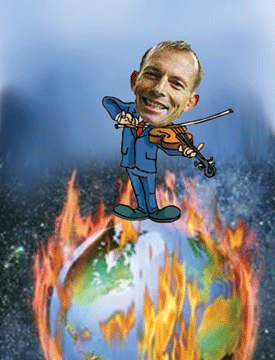 Australia’s drought – yes, it’s climate change http://www.theecologist.org/News/news_round_up/2483139/australias_drought_yes_its_climate_change.html Tim Radford 18th July 2014 Australia’s prime minister thinks climate change is ‘crap’ and has just abolished his country’s carbon-pricing system. But scientists say that it’s rising levels of CO2 that are leaving the south of the country parched and sweltering – and it’s only going to get worse.
American scientists have just confirmed that parts of Australia are being slowly parched because of greenhouse gas emissions.
A report in Nature Geoscience shows that the long-term decline in rainfall over south and south-west Australia is a consequence of fossil fuel burning and depletion of the ozone layer by human activity. Such a finding is significant for two reasons. One remains contentious: it is one thing to make generalised predictions about the consequences overall of greenhouse gas levels, but it is quite another to pin a measured regional climatic shift directly on human causes, rather than some possible as-yet-unidentified natural cycle of climatic change.
The other is contentiously political.
Australia’s prime minister, Tony Abbott, has in the past dismissed climate science as “crap”, and more recently has cut back on Australian research spending.
Bush fires and catastrophic flooding
Australia has already experienced a pattern of heat waves and drought – punctuated by catastrophic flooding – and even now, in the Australian winter, New South Wales is being hit by bush fires.
Tom Delworth, a research scientist at the US National Oceanic and Atmospheric Administration, reports in Nature Geoscience that he and a colleague conducted a series of long-term climate simulations to study changes in rainfall across the globe.
One striking pattern of change emerged in Australia, where winter and autumn rainfall patterns are increasingly a cause of distress for farmers and growers in two states.
The simulation showed that the decline in rainfall was primarily a response to man-made increases in greenhouse gases, as well as to a thinning of the stratospheric ozone layer in response to emissions of destructive gases by human sources.
The computer simulations tested a series of possible causes for this decline, such as volcanic eruptions and changes in solar radiation. But the only cause that made sense of the observed data was the greenhouse explanation.
It began in 1970, and it hasn’t stopped yet
South Australia has never been conspicuously lush and wet, but decline in precipitation set in around 1970, and this decline has increased in the last four decades.
The simulations predict that the decline will go on, and that average rainfall will drop by 40% over south-west Australia later this century.
Dr Delworth described his model as “a major step forward in our effort to improve the prediction of regional climate change”.
In May, scientists proposed that greenhouse gas emissions were responsible for a change in Southern Ocean wind patterns, which in turn resets the thermostat for the world’s largest island.
Australian scientists report in Geophysical Research Letters that they, too, have been using climate models to examine Antarctic wind patterns and their possible consequences for the rest of the planet.
Another consequence: accelerated ice sheet melt
“When we included projected Antarctic wind shifts in a detailed global ocean model, we found water up to 4°C warmer than current temperatures rose up to meet the base of the Antarctic ice shelves”, said Paul Spence, a researcher at Australian Research Council’s Centre of Excellence for Climate System Science. This temperature rise is twice previous estimates.
“This relatively warm water provides a huge reservoir of melt potential right near the grounding lines of ice shelves around Antarctica. It could lead to a massive increase in the rate of ice sheet melt, with direct consequences for global sea level rise.”
Since the West Antarctic ice sheet holds enough water to raise sea levels by 3.3 metres, the consequences would indeed be considerable.
“When we first saw the results it was quite a shock”, said Dr Spence. “It was one of the few cases where I hoped the science was wrong.”
Anti science, climate denialism, championed by electing Australia’s Tony Abbott
History will condemn climate change denialists Robert Manne theguardian.com, Wednesday 16 July 2014 Tony Abbott was elected by the right-wing of his party for a single purpose: to destroy any meaningful action in Australia against the threat of climate change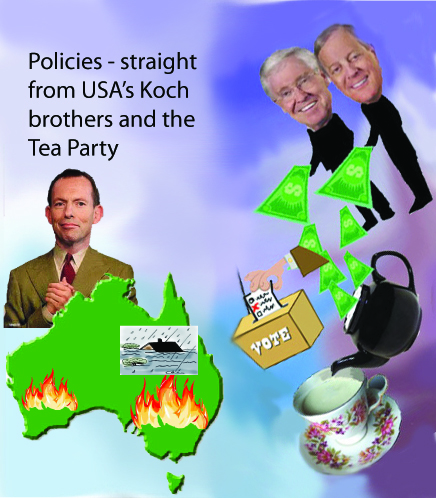
The argument for radical action on climate change– which Australia will soon at least temporarily reject with the shameful decision to repeal the carbon tax – is embarrassingly simple.
For the past 200 years, western culture has granted science pre-eminent cultural authority. A quarter century ago, a consensus formed among contemporary scientists specialising in the study of the climate. The consensus comprised one principal idea: the primary source of energy on which industrial civilisation relied – the burning of fossil fuels – was dangerously increasing the temperature of the earth.
Thousands upon thousands of scientific studies have been conducted estimating the impact of this warming. Hundreds of outstanding books have been published making the conclusions of the scientists available to the general public. To anyone willing to listen, these scientists have explained that unless human beings derive their energy from sources other than fossil fuels, the future that we face over the next decades and centuries involves the rendering of large parts of the earth uninhabitable to humans and other species – through the melting of the ice caps and glaciers and thus steadily rising sea levels, the acidification of the oceans, the destruction of forests and coral reefs, and the increase in the prevalence and intensity of famines, insect-borne diseases, droughts, bush fires, floods, hurricanes and heat-waves.
Climate scientists also explained that radical action on climate change could not be delayed. …….
As global emissions increased, something surpassingly strange occurred in the realm of politics in the US – something without parallel in the history of the post-Enlightenment west since the Darwinian controversy. The emergence of a broad-based movement of thought challenging the sovereignty of science in one specialised field.
Anti-science climate change denialism began with money cynically and strategically supplied by the massive American fossil fuel corporations. From there it spread to the powerful US network of neo-liberal “think-tanks” whose purpose was to produce the ideas helping to make the world safe for the wealthiest members of the society – the so-called 1%. And from the think-tanks climate change denialism steadily spread downwards to American society more generally, thanks to rabid right wing media like Fox News, until it was powerful enough to capture, almost in its entirety, one of America’s traditional political parties, the republicans.
As a consequence of the spread of climate change denialism, tens of millions of American citizens now base their opinions on the kind of pseudo-knowledge manufactured by the climate change denialist blogs and disseminated daily by the right-wing media. They have come to treat the questions of whether the earth is warming, and if so why, as political matters concerning which those without any genuine scientific understanding or training are as qualified to form an opinion as professors who have devoted their lives to one of the disciplines of climate science.
Climate change denialism soon spread beyond the US, especially to the countries of the English-speaking world. As Australia is a country extremely sensitive to the cultural winds blowing in from the US, reliant on the export and consumption of coal, and where the denialist Murdoch newspapers exercise enormous unhealthy influence, it is hardly surprising that over the past decade climate change denialism quickly sunk deep roots here.,,,,,
The right-wing denialists, now dominant within the Coalition, often call themselves conservatives. They are not. At the heart of true conservatism is the belief that each new generation forms the vital bridge between past and future, and is charged with the responsibility of passing the earth and its cultural treasures to their children and grandchildren in sound order. History will condemn the climate change denialists, here and elsewhere, for their contribution to the coming catastrophe that their cupidity, their arrogance, their myopia and their selfishness have bequeathed to the young and the generations still unborn. http://www.theguardian.com/commentisfree/2014/jul/16/history-will-condemn-climate-change-denialists
USA Tea Party types created Tony Abbott the world’s new warrior on behalf of the fossil fuel industries
How Rupert Murdoch created the world’s newest climate change villain, Salon Australia was once a leader on climate action. Thanks to American conservative powerhouses, that’s no longer true ALEXANDER WHITE 21 June 14, Australia, the sunburned country, is uniquely vulnerable to the dangers and risks of global warming. Whether it is the severe effects of flooding, unseasonal heat waves, devastating bush fires or decade-long droughts, Australia’s people, economy and natural environment have all keenly felt the impact of extreme weather and climate change.
Australia’s national scientific organizations have been raising the alarm for more than a decade, and the previous government accepted that scientific consensus and enacted a cap-and-trade scheme in 2012. But after a divisive election last year — one that saw native-born Rupert Murdoch exercise his considerable influence in Australian media markets to disastrous effect — the country is now governed by a deeply unpopular Liberal-National government, crafted in the image of the most climate-denying elements of the Tea Party. And its position on climate change has significant impacts on global efforts to reduce carbon emissions: Australia is not only the chair of the G-20 group of nations, but also holds a place on the U.N. Security Council.
The rest of the world saw this ideology on full, embarrassing display with the recent visit by Prime Minister Tony Abbott to Canada and the United States. Continue reading
Australia special: Aborigines win out against nuclear waste dump plan

Christina Macpherson’s websites & blogs
Well, for a few weeks, the Australian media has been happily occupied titillating us all with matters legal – the court cases of Oscar Pistorius and of Rolf Harris.
Meanwhile barely noted by the media, a 7 year legal battle was over this week – one that has far more significance for all Australians. And especially for indigenous Australians.
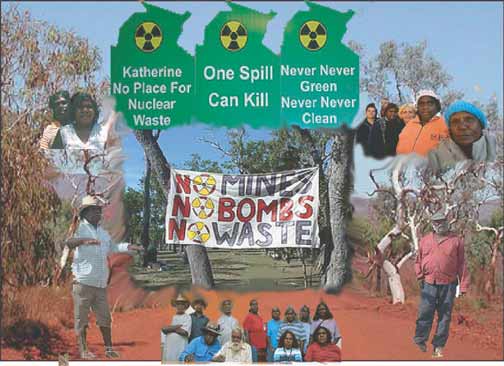
The Aboriginal Traditional Landowners of the Muckaty station area, (Northern Territory) fought against nuclear waste dumping on their land, and following the last weeks of this case, that plan has been scrapped. It has been a very unequal fight, yet those proud indigenous people have won out, against the legal forces of the Australian Government, and the Northern Land Council, which first signed up to the dump plan.
Background. The global nuclear lobby is happy to have a research reactor at Lucas Heights, in Sydney. This reactor was envisaged, way back, after World War 2 as part of a push to get a nuclear bomb. It remains there as a way in for the nuclear industry in Australia. The medical isotope production was tacked on later – to make the reactor look more respectable, but medical isotopes can be made in alternative ways. Australia sent the high level nuclear reactor wastes overseas is legally bound to take them back.
2004 The Australian government first attempted to site a nuclear waste dump in South Australia, but South Australia resisted this and won. A Territory has less power and that is why the Government targeted the Northern Territory. The Northern Territory Government passed the Nuclear Waste Transport , Storage and Disposal Prohibition Act 2004
2005 . A government expert team investigated and selected 3 sites suitable for burial of the returned high level nuclear wastes. All of these sites were on Commonwealth land. The Muckaty area, which is seismically risky, as well as being on Aboriginal land, was not selected. Nevertheless, the Howard Liberal government passed a draconian Commonwealth Radioactive Waste Management Act 2005 , over-riding environmental and Aboriginal heritage laws, and State and Territory laws and selecting Muckaty for the site
2010. The Labor government repealed that Act in 2010, and promptly replaced it with an equally draconion Radioactive Waste Management Act 2010.
The medical waste deception. The argument that a Northern Territory waste dump is needed for medical wastes is disingenuous. “Waste from nuclear medicine procedures, the majority of which is for diagnostic services rather than treatment, is low level and short term waste can be stored on site and safely disposed of locally. The small amount of higher level waste from nuclear medicine can also be stored locally, as it is currently” –Public Health Association of Australia,
The future. The relatively small amount of high level waste from the Lucas Heights reactor could be stored at Lucas Heights, and the reactor could be shut down, to stop further toxic production. The Australian government, lik ethe rest of the world, does not know where to put the ever accumulating collection of radioactive trash.
My bet is that our not very bright, and totally unethical government will try it on Aboriginal people again – with blackmail or bribes – ‘whatever it takes’.
1 This Month
To see nuclear-related stories in greater depth and intensity – go to https://nuclearinformation.wordpress.com/

29 Jan. Thursday 7-8 p.m. Webinar – World’s Largest Nuclear Station in Port Hope, ON?


31st January – Challenging the War Machine – a DECLASSIFIED UK SUMMIT


Website of the Week
Now until to February 10, 2026 Radioactive waste storage in France: the debate is finally open! How to participate?
-
Archives
- January 2026 (271)
- December 2025 (358)
- November 2025 (359)
- October 2025 (376)
- September 2025 (258)
- August 2025 (319)
- July 2025 (230)
- June 2025 (348)
- May 2025 (261)
- April 2025 (305)
- March 2025 (319)
- February 2025 (234)
-
Categories
- 1
- 1 NUCLEAR ISSUES
- business and costs
- climate change
- culture and arts
- ENERGY
- environment
- health
- history
- indigenous issues
- Legal
- marketing of nuclear
- media
- opposition to nuclear
- PERSONAL STORIES
- politics
- politics international
- Religion and ethics
- safety
- secrets,lies and civil liberties
- spinbuster
- technology
- Uranium
- wastes
- weapons and war
- Women
- 2 WORLD
- ACTION
- AFRICA
- Atrocities
- AUSTRALIA
- Christina's notes
- Christina's themes
- culture and arts
- Events
- Fuk 2022
- Fuk 2023
- Fukushima 2017
- Fukushima 2018
- fukushima 2019
- Fukushima 2020
- Fukushima 2021
- general
- global warming
- Humour (God we need it)
- Nuclear
- RARE EARTHS
- Reference
- resources – print
- Resources -audiovicual
- Weekly Newsletter
- World
- World Nuclear
- YouTube
-
RSS
Entries RSS
Comments RSS
 nuclear-news