Australia: Bushfires, Climate Change, and Nuclear Sites
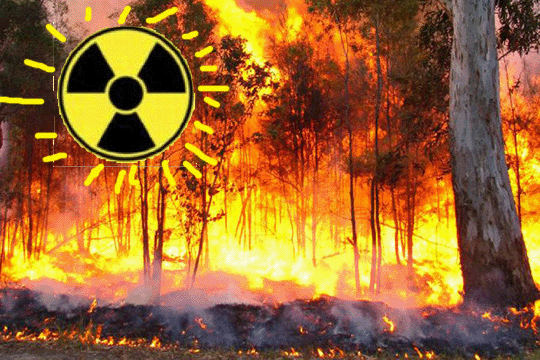
Bushfires in Queensland have ushered in the “new normal” of superfires in Australia. California has already experienced this new normal. It means that these fires are now catastrophic. They encroach on human habitation. Fire behaviour has changed. Their intensity is greater. Their severity is greater: their flames are higher. Fires last longer, and come with increasing frequency. They spread at higher rates, and jump gaps such as roads, rivers and fire breaks. .
These fires now do long -term damage to the ecosystem. The earth underneath is affected, habitat destroyed, killing all the normal bacteria and inhabitants of the soil. Many are fires that are impossible to put out.
The background to these new superfires is climate change. Climate change has brought higher temperatures and drought – resulting in drier trees and other vegetation – meaning that tinder-dry fuel is ready for ignition.
Australia is uniquely vulnerable, as the driest continent, with its prevailing eucalypt forests.
In California, the authorities are trying hard to cover up the reality that the wildfires started at an abandoned and still radioactively contaminated, nuclear facility . The fire would undoubtedly have caused radioactive ash to be blown about. (The fact that it’s not measured doesn’t mean that it is non existent)
Australia is vulnerable to a similar radioactive threat. Last year, bushfires went uncomfortably close to the Lucas Heights nuclear reactor. Plans to transport Lucas Height nuclear waste 1700 km across Australia to Flinders Ranges area mean that this radioactive trash would be at risk of accident, and one of the worst risks would be bushfires.
Australia must face up to the climate change threats – floods (as more water vapour, due to heat, will come down as flooding) , sea level rise, and super bushfires. Lucas Heights nuclear reactor should be closed, and ANSTO’s nuclear dream prevented from becoming Australia’s climate-nuclear nightmare.
The Age of Super Fires
Australia’s Great Barrier Reef – its plight pretty much ignored by government
 Portrait of a planet on the verge of climate catastrophe As the UN sits down for its annual climate conference this week, many experts believe we have passed the point of no return, Guardian, by Robin McKie, 2 Dec 18 “…………Great Barrier Reef Coral reefs cover a mere 0.1% of the world’s ocean floor but they support about 25% of all marine species. They also provide nature with some of its most beautiful vistas. For good measure, coral reefs protect shorelines from storms, support the livelihoods of 500 million people and help generate almost £25bn of income. Permitting their destruction would put the planet in trouble – which is precisely what humanity is doing.
Rising sea temperatures are already causing irreparable bleaching of reefs, while rising sea levels threaten to engulf reefs at a faster rate than they can grow upwards. Few scientists believe coral reefs – which are made of simple invertebrates related to sea anemones – can survive for more than a few decades.
Yet those who have sounded clear warnings about our reefs have received little reward. Professor Terry Hughes, a coral expert at James Cook University in Queensland, Australia, recently studied the impact of El Niño warmings in 2016 and 2017 on Australia’s Great Barrier Reef, the world’s largest coral reef and its largest living entity – and wept when he saw the damage.
“The 2016 event killed 30% of corals, the one a year later killed another 20%. Very close to half the corals have died in the past three years,” he said recently.
For his pains, Hughes has faced demands from tourist firms for his funding to be halted because he was ruining their business. “The Australian government is still promoting new developments of coal mines and fracking for gas,” Hughes said, after being named joint recipient of the John Maddox prize, given to those who champion science in the face of hostility and legal threats. “If we want to save the Great Barrier Reef, these outdated ambitions need to be abandoned. Yet Australia’s greenhouse gas emissions are rising, not falling. It’s a national disgrace.”
This grim picture is summed up by the ethnographer Irus Braverman in her book Coral Whisperers: “The Barrier Reef has changed for ever. The largest living structure in the world has become the largest dying structure in the world.” https://www.theguardian.com/environment/2018/dec/02/world-verge-climate-catastophe
Australian schoolkids go out on strike in order to push for climate action
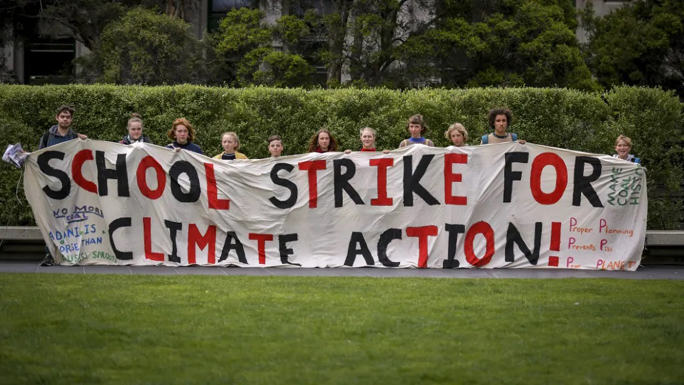
 Why aren’t they doing anything?: Students strike to give climate lesson, Brisbane Times, By Peter Hannam, 24 November 2018 This Friday, November 30, thousands of Australian students will go on strike, demanding their politicians start taking serious action on climate change.The movement, School Strike 4 Climate Action, has been inspired by a 15-year-old Swedish student, Greta Thunberg, who started boycotting classes before parliamentary elections in her nation on September 9, and continues to skip school every Friday. She also has a particular message for Australia.
Students in each state capital and across 20 regional Australian centres will walk out of their classrooms this week to tell politicians that more of the same climate inaction is not good enough.
Here are some of the lessons they hope to teach.
‘If we really want a better planet Earth’…….. https://www.brisbanetimes.com.au/environment/climate-change/why-aren-t-they-doing-anything-students-strike-to-give-climate-lesson-20181123-p50hvu.html
Australian population – the guinea pigs for British nuclear scientists in the 1950s
British scientists secretly used Australian population to test for radiation contamination after nuclear tests at Maralinga,

|
the agency said it had detected varying levels of Strontium-90 in all Australian capital cities.
|
|
Australian commercial TV station now selling its soul to the nuclear industry?
 The 60 Minutes Fukushima nuclear infomercial, Independent
  Australia Noel Wauchope 23 October 2018 A FEW YEARS AGO, Australian Channel 9’s 60 Minutes did an excellent investigation of the Fukushima nuclear accident.
This Fukushima investigation was compered by Liz Hayes. I recall that, at the time, the program was a much more thorough, serious and well-resourced presentation than anything put forward by even the ABC or SBS.
However, I was pretty appalled at the latest 60 Minutes coverage of the Fukushima issue, which screened on Sunday (21 October) titled, Is nuclear power the solution to our energy crisis?
The main message of this program is a call to scrap Australia’s legislation against establishing the nuclear industry. The argument given is that we need nuclear power because it is supposedly cheap and dependable. We also need it because it is supposedly essential to combat climate change.
This time, the reporter is not Liz Hayes. It’s Tom Steinfort, who is described as a “seasoned Channel 9 star”. Does a seasoned Channel 9 star just accept without question the claims made in this episode?
Among claims made:
- that the evacuation of the Fukushima prefecture was unnecessary — which implies that the Japanese Government and scientists acted stupidly;
- that there were no deaths and will not be any deaths resulting from the radiation from the meltdown, a point on which many experts disagree;
- that nuclear power is essential to tackle climate change, despite recent research which doubts its usefulness.
- that cancer deaths from the Chernobyl nuclear disaster will amount to only 40-160, despite a comprehensive Russian-UK investigation estimating over a million deaths; and
- the downgrading of renewable energies, which the latest research recommends for Australia.
So, what do we make of this latest offering about Fukushima, from 60 Minutes? It must have taken a lot of money and a lot of negotiation to get a 60 Minutes camera team inside the Fukushima nuclear station. I assume that the negotiations were largely arranged by Ben Heard, who has influential nuclear contacts overseas — particularly in Russia and South Africa, where he has been a prominent nuclear spokesperson. In Russia, Heard launched Rosatom National Geographic — a nuclear soft sell environmental program.
I think that we can be sure of one thing. As Japan plans for the 2020 Olympics – some sections of which are to take place in Fukushima Prefecture – the Japanese Government is not likely to permit a team with any anti-nuclear perspective access to the crippled nuclear power plant.
The 60 Minutes media team would have had to have the Japanese authorities on side. I would bet, some companies keen to set up the nuclear industry in Australia would also be on side and keen to assist.
There have been rumblings, too, of yet another resurgence for nuclear energy in Australia, with Prime Minister Scott Morrison declaring that he is ‘open to the idea of nuclear power’ and that ‘the source of Australia’s energy doesn’t bother him and he isn’t interested in an ideological debate’.
Is it too much to hope that Channel 9 might do something to correct this nuclear infomercial and give us a different, more comprehensive view, rather than one blessed by Japanese authorities and the nuclear power lobby? https://independentaustralia.net/business/business-display/the-60-minutes-fukushima-nuclear-infomercial,12023
Australian company Berkeley Energia’s bid to open uranium mine is knocked back by Spain
 Spain to block Berkeley uranium mine project – sources, CNBC , Belén Carreño, 16 Oct 2018 The Spanish government has decided not to deliver the permits necessary to open the European Union’s only open-cast uranium mine near Salamanca, dealing a serious blow to Australian mining company Berkeley Energia’s plans.
65 years later, the toxic legacy continues – of British nuclear bomb tests in Australia
Menzies “immediately agreed to the proposal,” without consulting any of his cabinet colleagues or the Australian parliament. Indeed, until weeks before the first test was carried out, only three government ministers knew about it.
The most devastating effects were suffered by two groups: Australian and British soldiers working on the tests themselves, and the Indigenous populations local to Emu Field and the later testing site of Maralinga.
One prominent member of the testing team, Sir Ernest Titterton, later said that if Indigenous people had a problem with the government, they should vote it out, ignoring that Indigenous Australians did not have full political rights until 1967.
an Australian defense ministry report was leaked to the press, warning that large amounts of plutonium left at Maralinga could potentially be a target of terrorists.
|
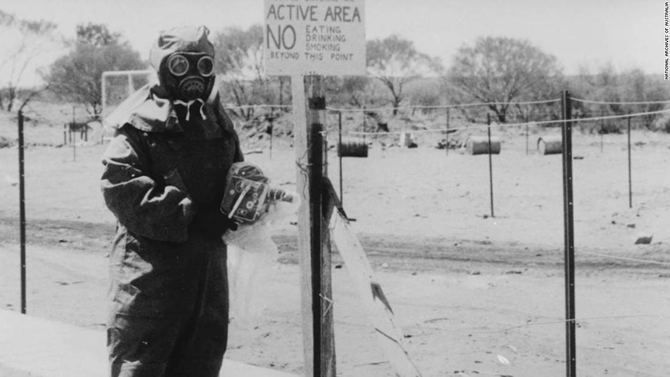
Australia is still dealing with the legacy of the UK’s nuclear bomb tests, 65 years on https://edition.cnn.com/2018/10/14/australia/australia-uk-nuclear-tests-anniversary-intl/index.html By James Griffiths, CNN October 15, 2018 (
Yami Lester was 12 years old when the black mist came to Walatinna.
Early on the morning of October 15, 1953, Lester heard a “big bang” in the distance. This was followed by a dark, ominous-looking cloud which drifted low over the ground like a slow-moving dust storm, bringing with it an unpleasant smell.
A tiny speck in the vast South Australian outback, the area around Walatinna was regarded as “depressingly inhospitable to Europeans” by early colonizers, few of whom settled there. But Indigenous people had a long history in the region, including Lester’s tribe.
As the dark cloud settled over the Walatinna camp, the tribal elders attempted to ward it off, thinking it was a malevolent spirit. In many ways they were right.
As those exposed to it later told investigators, the black mist caused their eyes to sting and their skin to break out in rashes. Others vomited and suffered from diarrhea.
It took almost three decades until the cause of the mist was acknowledged as the Totem I nuclear bomb test, as Indigenous people had been claiming for years.
That test was one of a number conducted in the 1950s and ’60s, not by the Australian government, but by its former colonial master, the UK. Today, 65 years after the Totem I test, the effects are still being felt in South Australia and beyond.
British bombAustralia was not the UK’s first choice of nuclear testing site. British scientists had been intimately involved in the Manhattan Project during World War II, and fully expected to be able to follow the US in testing their own nuclear weapon on American soil.
“Ultimately, they settled on Australia, which had many benefits,” said Elizabeth Tynan, author of “Atomic Thunder: The Maralinga story,” a book about the tests. These includes a sympathetic, compliant government under the recently elected Anglophile Prime Minister Robert Menzies, and wide open spaces in which to carry out the detonations themselves.
In September 1950, British leader Clement Attlee sent Menzies a secret message asking whether his government “would be prepared in principle to agree that the first United Kingdom atomic weapon should be tested in Australian territory.”
According to a later Australian Royal Commission investigation, Menzies “immediately agreed to the proposal,” without consulting any of his cabinet colleagues or the Australian parliament. Indeed, until weeks before the first test was carried out, only three government ministers knew about it.
Menzies’ enthusiasm for the British bomb “wasn’t all sycophantism, it wasn’t all sucking up to his colonial masters,” said Tynan, though this was definitely a factor. The Australian leader also saw in the atomic age an advantage for his country, which was one of the few to have large stocks of uranium, a previously largely unwanted material.
The UK’s first atomic bomb was detonated in the waters off the Montebello Islands, a small archipelago in north western Australia, in the early hours of October 3, 1952, officially making London the third member of the nuclear club, after the US and the Soviet Union.
Emu FieldWhile the Montebello Islands were used for the first test, British planners were never totally happy with the location, and even before the bomb was set off they began looking for a site on the Australian mainland where they could be granted greater secrecy and autonomy.
They settled on a location in the Great Victoria Desert, about 480 kilometers (300 miles) from the nearest town, Woomera, which they named Emu Field.
Plans were soon set in motion for a second test, and on October 15, 1953, the first of the Totem devices was detonated.
Unlike the Montebello test, which went off largely as planned, the 9.1 kiloton Totem I sent a cloud of debris and smoke some 15,000 feet (4,500 meters) into the air, spreading fallout far higher and farther than originally expected.
The Royal Commission later found the test was carried out in inappropriate wind conditions and without proper consideration for people living nearby, examples of the often staggering lack of care taken by British officials overseeing the nuclear program, who frequently ignored or did not bother to seek out vital information about the potential effects of their tests on the host country.
Black mistThe most devastating effects were suffered by two groups: Australian and British soldiers working on the tests themselves, and the Indigenous populations local to Emu Field and the later testing site of Maralinga.
While some concern was paid to their safety during the tests, it was often cursory at best. A single “native patrol officer” given the thankless task of having to try and inform Indigenous residents of the potential dangers had a 100,000 square kilometer (38,610 square mile) region to cover.
Nor did the British much seem to care. One prominent member of the testing team, Sir Ernest Titterton, later said that if Indigenous people had a problem with the government, they should vote it out, ignoring that Indigenous Australians did not have full political rights until 1967.
Another senior official, in a letter to his superiors, complained that W. B. MacDougall, the man with the dubious task of trying to protect the local Indigenous populations, was “placing the affairs of a handful of natives above those of the British Commonwealth of Nations.”
“The harm done to the Aboriginal people is one of the most shameful aspects (of the tests),” Tynan said. “Nowhere in the British records is there a sign of even the slightest concern for the Aboriginal people.”
This lack of concern is likely what led to the situation at Walatinna. Around 40 people were in the camp when the Totem I blast sent clouds of radiated material miles into the sky.
“It rumbled, the ground shook, it was frightening,” Lalli Lennon told investigators. Some time later, a large black cloud passed low over the settlement. Her husband Stan described it as “sort of hazy, like a fog or something.” Lalli and her children developed fevers, headaches, vomiting and diarrhea, and two of them suffered rashes and sore eyes from the smoke.
But just as they had paid little attention to the wellbeing of Indigenous people prior to the test, the British and Australian authorities did not concern themselves with such matters afterwards.
This was reflected by and large by Australian public opinion, which Tynan said was initially “quite jubilant” about the tests, and remained broadly supportive until the 1970s and ’80s, when a host of revelations about the British nuclear program exposed its lackluster safety procedures — even by the standards of the time — and the disdain of those overseeing it for Australian democratic oversight.
Maralinga messThis shift began when an Australian defense ministry report was leaked to the press, warning that large amounts of plutonium left at Maralinga could potentially be a target of terrorists.
This ran contrary to a 1968 report prepared by British official Noah Pearce which assured the Australian government the plutonium had been properly buried and did not present a significant risk.
Indeed, that year the Australians agreed to release the UK from nearly all “liabilities and responsibilities” regarding the tests, in the belief the British had “completed decontamination and debris clearance … to the satisfaction of the Australian government.”
When Canberra finally carried out its own survey of the site, scientists were shocked by what they found.
“They still thought the Pearce Report was accurate until their geiger counter went crazy,” said Tynan, who has interviewed several of the inspectors. “They weren’t wearing protective gear (and) were kicking plutonium soaked rocks with their boots.”
The Royal Commission report said later that there were between “25,000 and 50,000 plutonium- contaminated fragments in the (Maralinga) area, although the number might need to be doubled if missed and buried fragments were included.” Emu Field and the Montebello Islands were also found to be more dangerous than expected.
“In addition to British scientific and military personnel, thousands of Australians were exposed to radiation produced by the tests,” according to a report by the Australian Institute of Criminology. “These included not only those involved in supporting the British testing program, but also Aboriginal people living downwind of the test sites, and other Australians more distant who came into contact with airborne radioactivity.”
Final hearingThe Royal Commission hearings marked the end to any lingering approval of the tests among the Australian public, exposing fully the ongoing harm done to the local environment, Indigenous people, and the soldiers who worked on the tests.
While many disorders are difficult to link directly to the nuclear tests, veterans of the program have complained of numerous cancers, autoimmune diseases, and other ailments — including among their children — which they put down to their lack of protective clothing and other precautions at the time.
Last year, the Australian government expanded medical benefits for members of the nuclear testing program, but most are now in their late 80s and one told the ABC the move was “too bloody late.”
The harm done to Indigenous people has also been recognized in the decades since the Royal Commission, including by the black mist — which a British official once said investigating would be a “complete waste of money and time.”
In 1993, the British agreed to pay the Australian government and the traditional owners of the Maralinga lands around 46 million AUD ($30 million). The Australian authorities also paid Indigenous Maralinga communities a settlement of 13.5 million AUD ($9 million).
“Everyone became friends again after that,” said Tynan, adding that the issue, which had dominated Australian media and public attention for years, slowly slipped away, becoming a “great Australian secret.”
Today, she said she often meets young Australians who are unaware of the tests, and even many people who were alive at the time of the Royal Commission who only have a hazy idea of the issues.
“It was one of those things that, because it was not really written into the history books … just dropped off the radar,” she said, even as veterans and Indigenous people affected by the tests continue to suffer health repercussions and shortened lifespans because of their exposure to radiation.
Yami Lester died on July 21, 2017. He was remembered in parliament by then Prime Minister Malcolm Turnbull as a “man of wonderful intelligence and insight, as an elder of great standing and as a champion of Aboriginal rights and dignity.”
“He will be revered for rising from personal tragedy to serve his community and to lead his people to ensure that they were recognized and their wrongs addressed,” Turnbull added.
But as Tynan and others have pointed out, those wrongs have not been fully addressed. Health problems stemming from the tests continue for those still living, and while the veracity of Lester and other victims’ stories has been acknowledged, what exactly happened to them remains unclear, the details of the nuclear test still kept top secret.
“To this day we don’t know what Totem I did, those records are still classified by the British,” Tynan said. “It remains one of the great mysteries.”
|
Nuclear lobby spreads confusion as it touts “SMRs” – nuclear fantasy research
Small Modular Reactors don’t exist yet, and the picture below shows that the size of these speculative reactors are far from “small” (red arrow points to tiny human figure). Yet Barry Brook continues to receive funding from the “Australian Research Council” to investigate all things nuclear, including putting these reactors on small islands. How much money has gone to funding pro-nuclear fantasy research?
https://www.facebook.com/groups/1021186047913052/

Noel Wauchope they are now referred to by IAEA as small and medium reactors (SMRs)…..A subcategory of very small reactors – vSMRs – is proposed for units under about 15 MWe, especially for remote communities……..Note that many of the designs described are not yet actually taking shape. ……. There’s a bewildering array of reactor designs, listed in MWe (MegaWatts electic) -not in physical size.
Many UNPAID Australians speak out against nuclear plans of the PAID few nuclear industry proponents
 I am always struck by the fact that opponents of the nuclear industry are very many unpaid people. Just people who care. Some are highly educated academically. Many are not – but then they take the trouble to find out, and speak with the authority of both their local knowledge and wider information.
As for nuclear proponents they’re a small number of paid individuals, with another small number of hangers-on who expect financial benefits from the nuclear industry.
ABC Radio Adelaide Evenings with Peter Goer. Talkback 4 Oct 18. This show was inundated with hundreds of South Australians phoning in and texting about the proposed nuclear waste dump. ALL SAID NO! Are you listening Department of Industry Innovation and Science and Australian Nuclear Science and Technology Organisation !!!??…. IT’S A BIG NO FROM SOUTH AUSTRALIA!!!
Yet again, Australia sets out to wreck international climate talks

 Australia gets out the wrecking ball, again, in international climate talks https://reneweconomy.com.au/australia-gets-out-the-wrecking-ball-again-in-international-climate-talks-17099/
Following Trump, Canada and Australia go backwards on climate change action

The Global Rightward Shift on Climate Change, President Trump may be leading the rich, English-speaking world to scale back environmental policies. The Atlantic , ROBINSON MEYER, AUG 28, 2018 Last Thursday, Malcolm Turnbull was the prime minister of Australia. By the end of this week, he’ll be just another guy in Sydney.
Pacific island nations critical of climate sceptics, call on Australia to act on climate change, and to help them
Key points:
- Mr Sailele says “greater ambition” is needed to stop impact of climate change
- He warns geostrategic competition is creating uncertainty for small Pacific countries
- Australia, New Zealand and the US have been scrambling to reassert influence in the Pacific
Mr Sailele told the Lowy Institute in Sydney that climate change posed an “existential challenge” to low lying islands in the Pacific, and developed countries needed to reduce pollution in order to curb rising temperatures and sea levels.
“We all know the problem, we all know the solutions, and all that is left would be some political courage, some political guts, to tell people of your country there is a certainty of disaster,” Mr Sailele said.
The Prime Minister’s intervention came as some Coalition MPs press the new Prime Minister Scott Morrison to abandon Australia’s promise to cut carbon emissions under the Paris agreement.
New Foreign Minister Marise Payne is also expected to face questions about Australia’s climate change policies at the Pacific Islands Forum leader’s meeting in Nauru next week.
Senator Payne and Pacific leaders are set to sign the “Biketawa Plus” security agreement, which declares that climate change remains the “single greatest threat to the livelihoods, security and wellbeing of the peoples of the Pacific”.
Several other leaders — including Fiji’s Prime Minster Frank Bainimarama and the Marshall Island’s President Hilda Heine — have also called on Australia to do more to cut emissions.
Mr Sailele told the audience that “greater ambition” was needed to stop the destructive impact of climate change.
“While climate change may be considered a slow onset threat by some in the region, its adverse impacts are already being felt by Island communities,” he said……… http://www.abc.net.au/news/2018-08-31/samoan-prime-minister-hits-out-at-climate-change-sceptics/10185142
 |
ReplyForward
|
Aboriginal group’s unwavering struggle against uranium mining in Western Australia
 Fighting for life in the “place of death”https://beyondnuclearinternational.org/2018/08/27/fighting-for-life-in-the-place-of-death/ August 27, 2018
Traditional owners won’t give up 40-year opposition to Yeelirrie uranium mine, By Linda Pentz Gunter
In the local Aboriginal language, the name Yeelirrie means to weep or mourn. It is referred to as a “place of death.” Yeelirrie is on Tjiwarl Native Title lands in Western Australia, where it has long been faithfully protected by Aboriginal traditional owners. The Seven Sisters Dreaming songline is there. It is home to many important cultural sites. And for 40 years, due to resolute indigenous opposition, and thousands of community submissions of protest, it had been spared plans by the Canadian mining company, Cameco, to plunder it for uranium.
The earth guardians know that such a desecration would cause the extinction of multiple species of subterranean fauna. It would release death. It would destroy Yeelirrie.
Now the fate of those tiny creatures hangs in the balance, their future in the hands of three brave women, backed by environmental organizations, after the outgoing Western Australian government decided to allow the Yeelirrie uranium mine project to go forward.
That decision was made in January 2017, despite the fact that, in August 2016, the Western Australia Environmental Protection Agency (WAEPA) had recommended that the Yeelirrie project be rejected.
The Conservation Council of Western Australia (CCWA), which is engaged in contesting the uranium mining permit for Yeelirrie, said the WAEPA had rejected the Yeelirrie mine plan “on the grounds that the project is inconsistent with three of the objectives of the Environmental Protection Act — the Precautionary Principle, the Principle of conservation of biological diversity, and the Principle of intergenerational equity. The EPA decision was based on the overwhelming evidence that the project would make several species of subterranean fauna extinct.”
But former Minister for Environment, Albert Jacob, threw all that aside to approve the Yeelirrie mine in the waning days of Western Australia’s Liberal government, now replaced by Labor, which came in on a mandate to end uranium mining that it now may not be able to enforce.
In February 2018, CCWA and three members of the Tjiwarl community initiated proceedings in the Western Australia Supreme Court in an attempt to invalidate the approval decision made by Jacob. The case was dismissed by the court, a decision said CCWA executive director, Piers Verstegen, that shows that “our environmental laws are deeply inadequate,” and “confines species to extinction with the stroke of a pen.”
However, while the decision was a set-back, Verstegen said, “it’s absolutely not the end of the road for Yeelirrie or the other uranium mines that are being strongly contested here in Western Australia.”
Accordingly, CCWA and the three Tjiwarl women — Shirley Wonyabong, Elizabeth Wonyabong, and Vicky Abdullah (pictured left to right above the headline) vow to fight on, and have begun proceedings in the WA Court of Appeal to review the Supreme Court decision.
“I grew up here, my ancestors were Traditional Owners of country, and I don’t want a toxic legacy here for my grandchildren,” Abdullah told Western Australia Today in an August 2017 article.
“We have no choice but to defend our country, our culture, and the environment from the threat of uranium mining — not just for us but for everyone.”
Yeelirrie is one of four uranium mines proposed for Western Australia. The other three are Vimy’s Mulga Rock project, Toro Energy’s Wiluna project, and Cameco’s and Mitsubishi’s Kintyre project. Each of them is home to precious species, but Yeelirrie got special attention from the WAEPA because the proposed mine there would cause actual extinctions of 11 species, mostly tiny underground creatures that few people ever see.
According to a new animated short film, produced by the Western Australia Nuclear-Free Alliance, all four of these proposed mines could irreparably damage wildlife, habitat and the health of the landscape and the people and animals who depend on it. The film highlights Yeelirrie, but also describes the other three proposed uranium mines and the threats they pose.
At Mulga Rock, in the Queen Victoria Desert, the site is home to the Sandhill Dunnart, the Marsupial Mole, the Mulgara and the Rainbow Bee Eater, according to the film.
Wiluna, a unique desert lake system, could see uranium mining across two salt lakes that would leave 50 million tonnes of radioactive mine waste on the shores of Lake Way, which is prone to flooding.
The Kintyre uranium deposit was excluded from the protection of the Karlamilyi National Park within which it sits so that uranium could be mined there. It is a fragile desert ecosystem where 28 threatened species would be put at risk, including the Northern Quoll, Greater Bilby, Crest Tailed Mulgara, Marsupial Mole and Rock Wallaby.
At Yeelirrie, says the CCWA, “Cameco plans to construct a 9km open mine pit and uranium processing plant. The project would destroy 2,421 hectares of native vegetation and generate 36 million tonnes of radioactive mine waste to be stored in open pits.”
The mine would likely operate for 22 years and use 8.7 million litres of water a day.
Under Australian laws, ‘nuclear actions’ like the Yeelirrie proposal also require approval by the Federal Environment Minister. CCWA and Nuclear-Free Western Australia, have launched a campaign directed at Federal Environment Minister, Josh Frydenberg, calling for a halt to the Yeelirrie mine, given the immense risk it poses to “unique subterranean fauna that have been found nowhere else on the planet.” They point out that the Minister has the opportunity to “protect these unique species from becoming extinct.
“Species have a right to life no matter how great or small,” they wrote. “One extinction can massively disrupt an entire ecosystem. No one should have the right to knowingly eliminate an entire species from our planet forever.”
Black Mist Burnt Country: art under the nuclear cloud of Maralinga
https://www.smh.com.au/entertainment/art-and-design/black-mist-burnt-country-art-under-the-nuclear-cloud-of-maralinga-20180823-p4zz7i.html, By Karen Hardy 24 August 2018 On September 27, 1956, the British exploded an atomic bomb on Pitjantjatjara land in South Australia. The place would become known as Maralinga, which means “thunder” in the now-extinct Garik Aboriginal language.
Black Mist Burnt Country tells the stories of the atomic tests in Australia in the 1950s and ’60s, revisiting the events and locations through the artworks of Indigenous and non-Indigenous contemporary artists across the mediums of painting, print-making, sculpture, photography, video and new media.
Now showing at the National Museum of Australia, it has been touring with great success since September 2016, opening then to commemorate the 60th anniversary of the first test at Maralinga.
Curator JD Mittman, from the Burrinja Dandenong Ranges Cultural Centre, grew up “under the nuclear cloud” in Germany during the 1980s and when he came to Australia he was surprised to learn there had been atomic tests here.
In the collection of the small community arts centre he found a large canvas work by Jonathan Kumintjarra Brown entitled Maralinga Before the Atomic Test.
The question for me was what did ‘after’ look like?”
When he began his research he was surprised to find so many works concerning Australia’s place in the nuclear race.
Artist Arthur Boyd participated in anti-nuclear demonstrations in the 1960s and his Jonah on the Shoalhaven – Outside the City (1976), features a tiny mushroom cloud, blending biblical imagery with contemporary landscape and personal symbolism.
Sidney Nolan’s Central Desert: Atomic Test (1952-57) is part of a classic series of desert landscapes Nolan began in the late 1940s. He added a mushroom cloud on the horizon at a later date.
“Every generation has taken a different approach.”
There are large canvases by Kumintjarra Brown, one Frogmen, shows three men in masks and protective suits, another Black Rain tells the tragic story of a group of Anangu people who were found huddled together, dead, in a crater near the bomb site.
Mittman says it’s important for Australians, particularly generations who may not have even heard of the testing, let alone those of us to whom Maralinga is a familiar word but were unaware of such details as then prime minister Robert Menzies did not even consult cabinet when he gave permission to begin the testing.
“There is great concern among the indigenous community, and I don’t want to speak on their behalf, about the ongoing repercussions of the testing on country.
“And it’s even more than that, the multi-media work from Linda Dement and Jessie Boylan builds a bridge between the past and the present. “There are 15,000 warheads in the world at present, many of them on planes, in submarines, ready to strike within minutes.
He says it’s somewhat fitting that the exhibition opens in Canberra in the same week the International Campaign to Abolish Nuclear Weapons protest arrives in Canberra heading to parliament to urge politicians to ratify the nuclear weapon ban treaty.
Black Mist Burnt Country at the National Museum of Australia until November 18.
1 This Month



26 September – International Day for the Total Elimination of Nuclear Weapons


PLEASE OPPOSE HR 8255 AND S.3639 – bills would accelerate satellite deployment, with no environmental review or safeguards – https://ncstd5li.quorum.us/campaign/169331/
To see nuclear-related stories in greater depth and intensity – go to https://nuclearinformation.wordpress.com
-
Archives
- September 2026 (245)
- August 2026 (330)
- July 2026 (355)
- June 2026 (287)
- May 2026 (306)
- April 2026 (356)
- March 2026 (251)
- February 2026 (267)
- January 2026 (308)
- December 2025 (358)
- November 2025 (359)
- October 2025 (375)
-
Categories
- 1
- 1 NUCLEAR ISSUES
- business and costs
- climate change
- culture and arts
- ENERGY
- environment
- health
- history
- indigenous issues
- Legal
- marketing of nuclear
- media
- opposition to nuclear
- PERSONAL STORIES
- politics
- politics international
- Religion and ethics
- safety
- secrets,lies and civil liberties
- spinbuster
- technology
- Uranium
- wastes
- weapons and war
- Women
- 2 WORLD
- ACTION
- AFRICA
- Atrocities
- AUSTRALIA
- Christina's notes
- Christina's themes
- culture and arts
- Events
- Fuk 2022
- Fuk 2023
- Fukushima 2017
- Fukushima 2018
- fukushima 2019
- Fukushima 2020
- Fukushima 2021
- general
- global warming
- Humour (God we need it)
- Nuclear
- RARE EARTHS
- Reference
- resources – print
- Resources -audiovicual
- Weekly Newsletter
- World
- World Nuclear
- YouTube
-
RSS
Entries RSS
Comments RSS
 nuclear-news