First of all, I find it very strange that this agreement has been signed up to in advance, not by any elected representative of the Australian Parliament, but by Dr Adi Patterson CEO of the Australia Nuclear Science and Technology Organisation, apparently pre-empting the results of this Inquiry!
I find it disturbing that this Inquiry is being held without any public information or discussion. Are we to assume that the decision to join this “Charter” is being taken without prior public knowledge?
It is a pretty momentous decision. According to the World Nuclear Association the 2005 Framework agreement “formally commits them (signatories) to participate in the development of one or more Generation IV systems selected by GIF for further R&D.”
The Environment Protection and Biodiversity Conservation Act 1999 currently prohibits the development of nuclear power in Australia. Nuclear power cannot be approved under either the EPBC Act or the Australian Radiation Protection and Nuclear Safety Act 1998. These prohibitions are, as I understand it, supported by all major parties in Australia?
This would be an extraordinary step for Australia to take, especially in the light of the recent South Australian Nuclear Fuel Cycle Royal Commission (NFCRC) pro-nuclear Royal Commission, which, while recommending South Australia for an international nuclear waste dump, nevertheless stated that
“The recent conclusion of the Generation IV International Forum (GIF), which issued updated projections for fast reactor and innovative systems in January 2014, suggests the most advanced system will start a demonstration phase (which involves completing the detailed design of a prototype system and undertaking its licensing, construction and operation) in about 2021. The demonstration phase is expected to last at least 10 years and each system demonstrated will require funding of several billion US dollars. As a result, the earliest possible date for the commercial operation of fast reactor and other innovative reactor designs is 2031. This timeframe is subject to significant project, technical and funding risk. It extends by six years a similar assessment undertaken by GIF in 2002. This means that such designs could not realistically be ready for commercial deployment in South Australia or elsewhere before the late 2030s, and possibly later.”
This was hardly a ringing endorsement of Generation IV nuclear reactors.
The South Australian Citizens Jury, Community Consultations, numerous economists, and the S.A. Liberal Party all rejected that nuclear waste plan, as not economically viable. A huge amount of preparation was done by the NFCRC in investigating the phases of the nuclear Fuel Cycle (more accurately Chain) to arrive at their rather negative view of Generation IV nuclear reactors.
That makes it all the more extraordinary that the Australian government would be willing to sign up so quickly to ANSTO’s request that Australia put resources into these untested, and so far, non-existent nuclear technologies.
I hope that the Committee is aware of the present financial troubles of the giant nuclear corporations, such as AREVA, Toshiba, and Westinghouse Electric. Nuclear power is turning out to be a financial liability wherever it is not funded by the tax-payer, (as in China and Russia). (1)
The World Nuclear Association describes the Generation IV International Forum (GIF)as countries for whom nuclear energy is significant now or seen as vital in the future. Australia’s situation in no way fits these criteria.
Nuclear energy is not significant now in Australia, and even the NRCRC nuclear proponents do not see it as vital for Australia’s future. It is almost laughable, that right now, renewable energy systems are taking off in Australia – both as large solar and wind farms, and as a huge increase in small decentralised systems such as home and business solar panel installations.
That’s where Australia should be putting its resources of human energy, talent, and funding.
The claims made by the nuclear lobby, ANSTO and some politicians, notably Christopher Pyne and Julie Bishop, about Generation Iv nuclear reactors, do not stand up to scrutiny:
Non proliferation “- Furthering Australia’s non-proliferation and nuclear safety objectives.” The well-known claim that a “conventional” nuclear bomb cannot be made from these new types of reactor, might be true, to a certain extent. However, IFRs and other plutonium-based nuclear power concepts fail the WMD proliferation test, i.e. they can too easily be used to produce fissile material for nuclear weapons. The use of thorium as a nuclear fuel doesn’t solve the WMD proliferation problem. Irradiation of thorium (indirectly) produces uranium-233, a fissile material which can be used in nuclear weapons. These materials can be used to make a “dirty bomb” – irradiating a city or other target. They would require the same expensive security measures that apply with conventional nuclear reactors.
If the purpose in joining the GIF is to strengthen non-proliferation and safety – why is ANSTO the implementing agent not the Australia Safeguards and Non-Proliferation Office?
Solving nuclear waste problem? Claims that these new nuclear reactors will solve the problem of nuclear wastes are turning out to be spurious. For example, Nuclear energy startup Transatomic Power has backed away from bold claims for its advanced reactor technology after an informal review by MIT professors highlighted serious errors in the company’s calculations. (2) Even at the best of times, the “new nuclear” lobby admits that their Gen IV reactors will produce highly toxic radioactive wastes, requiring security for up to 300 years.
The Integral Fast Reactor is called “integral” because it would process used reactor fuel on-site, separating plutonium (a weapons explosive) and other long-lived radioactive isotopes from the used fuel, to be fed back into the reactor. It essentially converts long-lived waste into shorter lived waste. This waste would still remain dangerous for a minimum of 200 years (provided it is not contaminated with high level waste products), so we are still left with a waste problem that spans generations. (3)
Climate change. The claim that new nuclear power will solve climate change is spurious. This ignores life-cycle CO2 emissions
Nuclear energy is not zero carbon.
Emissions from nuclear will increase significantly over the next few decades as high grade ore is depleted, and increasing amounts of fossil fuels are required to access, mine and mill low-grade ore.
To stay below the 2 degrees of global warming that climate scientists widely agree is necessary to avert catastrophic consequences for humans and physical systems, we need to significantly reduce our emissions by 2050, and to do this we need to start this decade. Nuclear is a slow technology:
The “Generation IV” demonstration plants projected for 2030-2040 will be too late, and there is no guarantee the pilots will be successful.
Nuclear Economics. For “a time when significant expansion in nuclear power production is underway” – this is a laughable falsehood. In reality, nuclear power economics are in a state of crisis, most notably in America, but it is a world-wide slowdown. (4)
The vagueness of the Generation IV International Forum (GIF)agreement is a worry. Australia is to formally commit to participate in the development of one or more Generation IV systems selected by GIF for further R&D. Surely Australia is not going to sign up to this, without any detail on what kind of research, what kind of reactor, what amount of funding we would be committing to the GIF.
Overcoming the military-industrial complex: nuclear has always been a centralized industry, with just a few firms that have very close contacts to the government. And keeping nuclear skills for military purposes seems to be a driver in the UK’s push for new nuclear.
The US (and Australian) nuclear camp critiques studies for 100% renewables. Without reading them. Energy Transition ,by Craig Morris, 15 May 2017
Over the past year, the Anglo world has become interested in nuclear as a complement for wind and solar towards “deep decarbonization,” or a (nearly) 100% carbon-free supply of energy or possibly just electricity. Today, Craig Morris reviews a few papers by Americans and Australians and advises them to tackle the best European studies for 100% renewables head-on, not ignore them.
The first paper is by Stephen Brick and Samuel Thernstrom. Thernstrom has been calling nuclear “an essential part of the puzzle” since at least 2010. The paper is peer-reviewed; unfortunately, none of the reviewers noticed the oversights I found. But let’s start off with a contention the authors state in the introduction:
“In seeking to demonstrate that renewables can by themselves replace all fossil fuels and nuclear energy, these studies run the risk of treating renewables as a societal end in itself, instead of just one among a suite of technologies that could be used to achieve the combined goals of environmental protection, cost-containment, and electric system reliability.”
Why shouldn’t renewables be an end in themselves? Assuming nuclear power (plus whatever) is the cheapest low-carbon option, might other impacts society dislikes relativize the low price? To name just a few examples (and we’ll leave out whatever nuclear risks may or may not exist):
Overcoming the military-industrial complex: nuclear has always been a centralized industry, with just a few firms that have very close contacts to the government. And keeping nuclear skills for military purposes seems to be a driver in the UK’s push for new nuclear.
Stronger economic growth in communities, especially rural ones: if communities can make their own energy, why would they want to pay some out-of-town corporation, even if the energy is slightly cheaper? People simply are willing to pay more for quality, and local jobs are a quality (not to mention being energy-independent). The price is relative when you pay it back to your community…….
the real problem here is that lower consumption does not jibe with nuclear historically. Nuclear originally promised nearly unlimited electricity, and the technology’s supporters say more energy is needed, not less, especially in developing countries. Here is one pro-nuclear group attacking, for instance, renewables advocate Amory Lovins’ call for efficiency. Nuclear proponents often depict the efficiency aims (= lower consumption) called for by renewables proponents as unrealistic.
In contrast, the renewables camp sees efficiency as crucial because, for instance, we don’t have enough sustainable biomass to support our wasteful habits today. In addition to efficient devices, “sufficiency” – changing lifestyles to make do with what Mother Nature gives us – is therefore crucial. Switching to an electric car is not enough; we will need to walk and cycle more, both of which require compact neighborhoods (a societal, not technical, issue)………
The overlooked update
What’s worse, in their 2017 paper Heard at al. discuss Mathiesen’s 2009 paper on a 100% renewable Denmark as though nothing had happened since. The six-page summary (PDF in English) of the follow-up 2014 scenario is admittedly sparse on details, but we can see a plan taking shape. In 2015, Mathiesen, not unknown to my readers, and his team then fleshed everything out in a 159-page PDF (in English), including a new scenario called the IDA Energy Vision. As you can see below, [table on original] biomass is still based as much as possible on waste, and the rest is mainly wind power. This is what a 100% scenario looks like when you do the footwork for a given country. It would look much different in, say, Saudi Arabia, with very little wind but ample solar. It would also look different in countries with lots of hydropower. One conclusion is thus that investigating 100% renewables is hard without saying where.
In the end, we are left with a discussion in the English-speaking world held by nuclear advocates about 100% renewable energy, in which too little notice is taken of the main studies in two leading countries investigating “deep decarbonization” without nuclear or CCS: Denmark and Germany. What’s worse, not a single journalist covering these papers, including Vox.com’s David Roberts (one of the best) pointed out the oversight. America’s best minds write about 100% renewables, and no one notices the gaps. As President Trump might say: sad. https://energytransition.org/2017/05/the-us-nuclear-camp-critiques-studies-for-100-renewables-without-reading-them/
Dahr Jamail | Coral Reefs Could All Die Off by 2050, May 15, 2017, By Dahr Jamail, Truthout | Report“…… over the last two years, the Great Barrier Reef, which is so dear to Miller and countless others who revel in the beauty and mysteries of the oceans, has been dying off at an unprecedented rate due primarily to warming ocean waters.
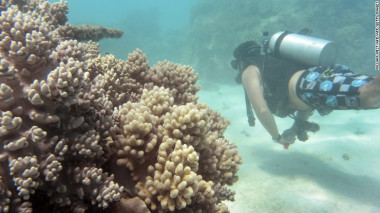
Coral bleaching occurs when corals become stressed by warmer-than-normal water, causing them to expel symbiotic algae that live in their tissues, from which they get their energy. Coral turns completely white when it bleaches. If it remains bleached long enough, it dies.
One scientist has already gone so far as to declare the Great Barrier Reef is now in a “terminal stage.” Most of those studying the reef agree that what is happening is unprecedented. This is because, at a minimum, two-thirds of the 1,400-mile long reef bleached out last year, which led to 22 percent of it dying. Now another bleaching event has resulted in at least two-thirds of the reef bleached again.
“The bleaching this year has moved much farther south and has taken scientists by surprise in its severity and extent,” Miller said. And he fears the state of the reef could be even worse than scientists realize, since only aerial surveys have been conducted to assess the damage and no research vessel is currently active on the reef to provide finer details.
With ocean temperatures rising across the globe as anthropogenic climate disruption (ACD) continues to pick up speed, the Great Barrier Reef, the largest coral ecosystem on Earth, may well be an example of what is happening to all of the coral on the planet.
“This Is New for All of Us”……..
Miller is equally stunned by what he is seeing along the Great Barrier Reef, which is eerily similar to what Burdick is seeing on Guam.
“Parts of the reef that didn’t bleach last year are now under immense pressure, and this is totally different because this is back-to-back bleaching,” Miller explained. “The system was already stressed, and this is a new stress event. We are seeing much mortality on reefs in our area…. What didn’t die last year is dying this year.”
In addition to the new bleaching in this year’s event, southern portions of the reef that are typically in cooler waters are now also bleaching out.
“It’s heartbreaking to see,” Miller added. “Seventy thousand direct tourism-related jobs and a $6 billion tourism industry are all at risk, especially on top of the recent damage from Cyclone Debbie.”
A study published this March in the journal Nature found that last year’s bleaching of the Great Barrier Reef was so severe that there was no similar analog in the thousands of years of ancient coral cores scientists use to study past climates.
Another study published in Nature projected that by the year 2050, more than 98 percent of global coral reefs will be afflicted by “bleaching-level thermal stress” every single year.
However, the prognosis could be even worse: The scientists involved in the study from this March speculated that the era of never-ending global coral bleaching may have already arrived, albeit several decades earlier than was predicted even just last year. They explained that the Great Barrier Reef needs 10 to 15 years between bleaching events in order to fully recover, and that recovery time period is “no longer realistic.”
“We Don’t Even Know What We Are Losing”……..
A report by the UN’s Food and Agriculture Organization shows that coral reefs are responsible for producing 17 percent of all globally consumed protein, with that ratio being 70 percent or greater in island and coastal countries like those of Micronesia.
At the time of this writing, Earth has lost nearly half of its coral, and oceanic warming only continues to accelerate.
“We are finding that reefs living under anthropogenic stresses for many years have already lost their more sensitive coral species, and the ones that are there now are already the tough bastards,” Raymundo said. “And when reefs have lower diversity, there is less ecological redundancy; hence, they are more likely to collapse.”
A Future Without Coral?
A 2012 study revealed that half of the Great Barrier Reef had already vanished in just the previous 27 years. Two years later, the world’s most qualified coral reef experts released a report showing that, without dramatic intervention, the Great Barrier Reef would disappear completely by 2030.
Furthermore, a study published and released by NOAA in 2011 warned that, “unless action is taken now to reduce the threats,” 90 percent of all reefs will be “threatened” by 2030, and all of Earth’s coral reefs could be completely gone by 2050. The study, “Reefs at Risk Revisited,” listed human-caused climate disruption, warmer water temperatures, ocean acidification, shipping, overfishing, coastal development and agricultural runoff as the contributing factors.
While that might sound extreme, Miller told Truthout he thought the report actually didn’t go far enough.
“I think it’s too conservative,” he explained. “Corals need many years to adjust to the warmer ocean waters, and we don’t have that kind of time anymore. The warming we are seeing now is happening far too fast to allow for evolution…. So what we’re seeing now is death. That’s what bleaching is.”……..
Back in Australia, Miller is dismayed by the fact that his government is doing very little, if anything, to mitigate the crisis.
Truthout asked Miller what steps the Australian government is taking to save the Great Barrier Reef.
“From what I can tell, virtually nothing,” he answered. “They are not focussed on this at all, but rather are pushing for the Adani Coal Mine to go ahead. We here in Australia can hardly believe it, to be honest. In fact, the government has had almost no comment on the bleaching at all.”
The coal mine he referred to is looking like it is going to move forward, which will, according to Miller, bring an additional 500 ships carrying coal across the Great Barrier Reef every single year.
Truthout interviewed Miller’s colleague, John Rumney, the managing director of Great Barrier Reef Legacy in February, when this year’s bleaching event began.
“This coral is in big trouble,” Rumney said at the time. Like Miller, Burdick and Raymundo, Rumney warned of the extreme loss of biodiversity that comes with the disappearance of reefs.
“When all that coral goes, all that diversity of fish that depends on it goes,” Rumney told Truthout. “The entire food chain is in big trouble.”
Miller concurred, saying, “We might see ecosystem collapse as we know it.” The need for independent research on the Great Barrier Reef during this second mass-bleaching event is needed more than ever, according to Miller. His and Rumney’s organization is striving to get more scientists out to the reef as quickly as possible.
Our country will vanish’: Pacific islanders bring desperate message to Australia,Guardian, 14 May 17, Kiribati and other low-lying countries are under threat from climate change, and while their people would rather stay behind, they may be left with no choice “……… i-Kiribati man Erietera Aram is in Australia delivering his message about the reality of climate change in his country, and of its immediacy. Each discussion, he says, is like a drop of water, adding to the one before it, slowly building understanding of the existential threat to his people and place.
“Climate change is not something off in the future, it’s not a problem for later. We are living it now,” he says.
The archipelago of Kiribati – 33 tiny coral atolls spanning 3.5m square kilometres of ocean – is the world’s lowest-lying country, with an average height above sea level of just two metres.
Most of the 113,000 i-Kiribati live crammed on to Tarawa, the administrative centre, a chain of islets that curve in a horseshoe shape around a lagoon.
“My place is very small,” Aram says. “If you stand in the middle, you can see water on both sides. We are vulnerable. One tsunami, one tsunami and our whole country will disappear.”
Already, there is less and less of Kiribati for its inhabitants. The coastline is regularly being lost to king tides and to creeping sea levels, and in a very real sense, there is nowhere to go.
The loss of land is causing conflict – Tarawa is growing ever more densely crowded, as families living on the coastline are forced inwards, infringing on another’s claim.
The next round of multinational climate talks in November – COP 23 – will be chaired by Fiji, and is expected to swing particular focus of the global climate debate to the Pacific, where comparatively minuscule amounts of carbon are produced, but the effects of climate change have been felt first, and most acutely.
Today, I am taking the unusual step of publishing an entire submission. That’s because it is so good. The nuclear lobby pulled a swifty on Australians, by having government and media very quietly do what is sure to be a “rubber stamp” job on Australia joining up to the Framework Agreement for Generation IV Nuclear Energy Systems.
They very quietly allowed a very short time for submissions to the Parliamentary Inquiry. The nuke lobby must have been in the know, as they put in 11, whereas there were only 3, (one mine) critical of the plan.
Fortunately the critical ones contain compelling information. So, here, in full, is the:
Submission from Friends of the Earth Australia and the Australian Conservation Foundation .
Contacts:
• Jim Green (Friends of the Earth, Australia) jim.green@foe.org.au, 0417 318 368
• Dave Sweeney (Australian Conservation Foundation) dave.sweeney@acf.org.au, 0408 317 812
Contents
1. Introduction and Response to National Interest Analysis
INTRODUCTION AND RESPONSE TO NATIONAL INTEREST ANALYSIS Friends of the Earth Australia and the Australian Conservation Foundation welcome the opportunity to make a submission to this inquiry and would welcome the opportunity to appear before a hearing of the Committee.
The Committee will likely receive submissions promoting the construction of Generation IV reactors in Australia and it is therefore worth noting comments by the SA Nuclear Fuel Cycle Royal Commission in its May 2016 Final Report: “[A]dvanced fast reactors and other innovative reactor designs are unlikely to be feasible or viable in the foreseeable future. The development of such a first-of-a-kind project in South Australia would have high commercial and technical risk. Although prototype and demonstration reactors are operating, there is no licensed, commercially proven design. Development to that point would require substantial capital investment. Moreover, electricity generated from such reactors has not been demonstrated to be cost competitive with current light water reactor designs.”1
Here we provide brief responses to a number of comments in the National Interest Analysis (NIA).2
The NIA asserts that participation in the Generation IV International Forum (GIF) will further Australia’s non-proliferation and nuclear safety objectives. No evidence is supplied to justify the tenuous assertion. There is much else that Australia could do ‒ but is not doing ‒ that would demonstrably further non-proliferation objectives, e.g. a ban on reprocessing Australian Obligated Nuclear Materials (AONM); a reversal of the decision to permit uranium sales to countries that have not signed or ratified the NPT; or refusing uranium sales to countries that refuse to sign or ratify the Comprehensive Test Ban Treaty. There is much else that Australia could do ‒ but is not doing ‒ that would demonstrably further safety objectives, e.g. revisiting the decision to sell uranium to Ukraine in light of the ongoing conflict in that country, refusing to supply uranium to nuclear weapon states that are not fulfilling their NPT obligations, insisting that uranium customer countries establish a strong, independent regulatory regime (as opposed to the inadequate regulation in a number of customer countries, e.g. China, India, Russia, Ukraine and others).
Nuclear non-proliferation would also be far better realised by active Australian engagement in the current UN process around the development of a nuclear weapons ban treaty. Instead Australia has spurned this pivotally important initiative and is refusing to participate. If Australia is serious about its international standing, our representatives would be at the table in New York.
The NIA states that ongoing participation in GIF will help Australia maintain its permanent position on the IAEA’s 35-member Board of Governors. ANSTO routinely makes such arguments ‒ in support of the construction of the OPAL reactor, in support of the development of nuclear power in Australia, and now in support of Australian participation in GIF. Australia has held a permanent position on the IAEA’s Board of Governors for decades and there is no reason to believe that participation or non-participation in GIF will change that situation.
The NIA asserts that accession to the Agreement and participation in GIF will have important economic benefits. No evidence is supplied to justify that tenuous assertion. There are no demonstrated economic benefits from participation in GIF ‒ however there are clear costs.
The NIA states that the “costs of participation in the System Arrangements will be borne by ANSTO from existing funds.” ANSTO should be required to provide a detailed account of past expenditure relating to this Agreement and anticipated future expenditure.
The NIA states that ongoing participation in GIF “will improve the Australian Government’s awareness and understanding of nuclear energy developments throughout the region and around the world, and contribute to the ability of the Australian Nuclear Science and Technology Organisation (ANSTO) to continue to provide timely and comprehensive advice on nuclear issues.” Those arguments are tenuous, especially given that little about GIF is secret.
The NIA states that “Generation IV designs will use fuel more efficiently, reduce waste production, be economically competitive, and meet stringent standards of safety and proliferation resistance.” Those false claims are rebuked in later sections of this submission.
The NIA states that the success of Australia’s bid for membership of GIF was based in part on ANSTO’s “world-class capabilities and expertise” in the “development of nuclear safety cases.” ANSTO should be asked to justify that assertion. ANSTO could also be asked whether, based on its “world-class” expertise in nuclear safety, whether it considers it is appropriate for Australia to sell uranium to countries with demonstrably inadequate nuclear regulatory regimes, e.g. China, India, Russia, Ukraine and others.
The NIA asserts that “a significant expansion in nuclear power production is underway or under consideration by a number of countries, including several in the Asia Pacific region.” In fact:
Globally, nuclear power has been stagnant for the past 20 years.
For the foreseeable future, there is zero likelihood of a “significant” nuclear expansion of nuclear power and there will be an overall decline unless growth in China matches the decline elsewhere. Declines can be predicted with great confidence in North America, across all EU countries combined, in Japan, and in numerous other countries and regions ‒ and a very large majority of the world’s countries (about five out of six) are nuclear-free and plan to stay that way.
No country in the Asia Pacific or South East Asia is seriously planning to introduce nuclear power. The only country that was seriously planning to introduce nuclear power in the region ‒ Vietnam ‒ abandoned those plans last year.
The NIA states that Australia’s participation in GIF falls within the existing functions of ANSTO under Section 5 of the Australian Nuclear Science and Technology Organisation Act 1987. The Joint Standing Committee on Treaties should assess whether Australia’s participation in GIF is consistent with legislation banning nuclear power in Australia (the EPBC and ARPANS Acts). 2.
Atomic veterans to be recognised after 61 years, Mandurah Mail, 8 May 17,The service of veterans exposed to British atomic testing off the coast of Western Australia in the 1950s is to be recognised in the federal budget on Tuesday.
On Sunday Canning MP Andrew Hastie announced $133 million would be spent giving the men who served in the Montebello Islands, where three nuclear weapons tests took place in 1952 and 1956, access to Department of Veterans Affairs gold cards.
Mr Hastie said the gold cards, which entitled the veterans to free public and private health care, were an acknowledgment the men had served in dangerous circumstances.
“It says to them that the Australian government, on behalf of the Australian people, care about them and are going to see their responsibility to care for them through,” he said.
“For these men it is recognition they did serve in hazardous conditions, that they were exposed to nuclear radiation after atomic testing, so for them it means a lot, especially since quite a few of them have suffered from cancer.”
Only 51 of the 89 servicemen who were conscripted to assist with the atomic tests are still alive.
Half of those who have since died succumbed to cancer……..
Many of the veterans said they had not been told of the dangers of nuclear radiation and were not issued protective gear.
“We got up there and didn’t even know what was happening, all we knew is that something big was happening so we got out on the upper deck and the count down came down,” Australian Ex-Services Atomic Survivors Association secretary Jim Marlow said.
“We were told to turn our backs, so we turned our backs and there was a blinding flash and a push of wind and a whole lot of noise and we turned back again and saw the smoke going up.”
Mr Marlow said he was back working in the ship 10 minutes after the blast.
North Korea highlights 1250 US marines in Darwin to claim America is preparing for nuclear war, SMH, Kirsty Needham and James Massola, 25 Apr 17, North Korea’s state newspaper has singled out the United States’ deployment of 1250 marines to Darwin to claim America is preparing for nuclear war.
And as regional tensions escalate and a US carrier strike group approaches the Korean peninsula, Australian Foreign Minister Julie Bishop said the secretive regime “must be stopped” as it represented a threat to the region and, potentially, globally.
Pusan National University associate professor Robert Kelly told Fairfax Media North Korea’s missiles might have the range to reach northern Australia, but played down the threat as “the question is guidance, not range”.
Rodong Sinmun, the official paper of the Worker’s Party of North Korea, highlighted the US marines’ arrival in northern Australia on April 18. The marines will be joined by 12 military helicopters including five Cobra helicopters and four Osprey carriers.
“This is the largest scale US military presence in Australia after World War 2,” the newspaper reported on Monday. “America is fanatically, crazily trying to optimise its nuclear war readiness,” it claimed.
The story, on page six of the North Korean newspaper, was headlined: America prepares for nuclear war in different overseas military deployments. Darwin was the only city named…….
Australia-based defence experts believe it is unlikely North Korea has the capacity to strike Australia yet, though they may do within the next three years. The nation’s most recent missile test, earlier this month, failed just seconds after launch…….
The deployment of 1250 marines is the largest to Darwin since the former prime minister Julia Gillard and former president Barack Obama struck a deal back in 2011 to undertake the yearly rotation of troops.
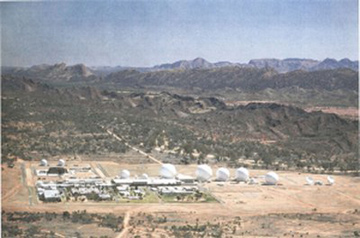
Pine Gap is more than a giant electronic vacuum cleaner. The facility is also involved in tactical warfare, through programs like “The Red Dot Express”.
More controversial is Pine Gap’s role in drone strikes.
Instead of trying to pump up hysteria over a non-existent North Korean missile strike, The Turnbull Government should take a hard look at the very real threat that Pine Gap and Northwest Cape pose to Australia.
Pine Gap is still there — bigger and badder than ever, Independent AustraliaNorm Sanders25 April 2017With Donald Trump putting a blowtorch to the Cold War, it is time to take another look at all the U.S. bases in Australia, including Pine Gap, writes Dr Norm Sanders.
PINE GAP, Northwest Cape and Nurrungar were the focus of the Australian Peace Movement in the 1980’s. Then the Bulletin of Atomic Scientists Doomsday Clock crept slowly away from midnight and the removal of the bases didn’t seem so urgent. The clamour to close the bases died down………
I actually knew quite a bit about what Pine Gap was up to at the time, but it was child’s play compared to what they are doing at present. A simple place to start is Pine Gap’s assumption of the function of Nurrungar in 1999. Nurrungar was located at Island Lagoon, Woomera and was crucial to America’s defenses during the Cold War. Nurrungar furnished “Launch on Warning” surveillance of ICBM or other rocket launches anywhere on the globe. Analysts regarded it as one of the USSR’s top ten targets.
Now, Pine Gap has probably surpassed Nurrungar in the rankings. It is one of the largest satellite ground stations in the world, with over 33 satellite antennas. Pine Gap houses a number of U.S. Government agencies, such as the National Reconnaissance Office (spy satellites,) the National Security Agency, the CIA, and the Geospatial-intelligence Agency. In addition, all branches of the U.S. Military are represented.
Pine Gap is a major element of ECHELON, a signals intelligence collection and analysis network. Echelon can eavesdrop on faxes, computers and telephones, and can even scan bank accounts. It can actually pick up enemy combat forces talking to each other in the field. The U.S. Government says Echelon doesn’t exist and never did. In fact, it may have now merged with XKeyscore, another system at Pine Gap. It is run by the National Security Agency and shares data with the Australian Signals Directorate.
In an interview with a German TV station in 2014, Snowden answered the question of what he could do with XKeyscore by saying:
You could read anyone’s email in the world, anybody you’ve got an email address for. Any website: You can watch traffic to and from it. Any computer that an individual sits at: You can watch it. Any laptop that you’re tracking: you can follow it as it moves from place to place throughout the world. It’s a one-stop-shop for access to the NSA’s information.
…You can tag individuals… Let’s say you work at a major German corporation and I want access to that network, I can track your username on a website on a form somewhere, I can track your real name, I can track associations with your friends and I can build what’s called a fingerprint, which is network activity unique to you, which means anywhere you go in the world, anywhere you try to sort of hide your online presence, your identity.
No wonder Snowden has to stay in Russia!
But Pine Gap is more than a giant electronic vacuum cleaner. The facility is also involved in tactical warfare, through programs like “The Red Dot Express”.
Red Dot uses a plethora of imaging techniques, signal intercepts and other sources to identify IED’s (Improvised Explosive Devices) by their electronic emissions. All this data passes through Pine Gap, gets analysed and, ultimately, is displayed as a red dot on a Humvee computer as a warning that there is a possible IED just ahead on an Afghan road.
More controversial is Pine Gap’s role in drone strikes. This prompted the late Des Ball, a leading ANU intelligence expert, to criticise the Pine Gap facility which he formerly supported.
On the 7:30 Report, broadcast 13/08/2014, he said:
“I’ve reached the point now where I can no longer stand up and provide the verbal, conceptual justification for the facility that I was able to do in the past. We’re now linked in to this global network where intelligence and operations have become essentially fused and Pine Gap is a key node in that whole network, that war machine, if you want to use that term, which is doing things which are very, very difficult, I think, as an Australian, to justify.”………
The base is six kilometres north of the town of Exmouth, Western Australia. Exmouth itself was built to support the base and be a home to dependent families of the U.S. Navy personnel.
The station is a key link in the communication capability with U.S. Navy and Australian ships in a vast area of the Western Pacific and Eastern Indian Ocean. It transmits on VLF (very low frequency,) at 19.8 kHz with a power of 1 million watts, which makes it the most powerful transmitter in the Southern Hemisphere. For comparison, commercial TV transmitters have about 1⁄10 the power.
The powerful transmitter has been linked to two incidents in which Qantas airliners had equipment failures while flying in the area. Qantas Flight 72 had to make an emergency landing at Learmouth, near Exmouth, after uncontrolled pitch-downs which caused fractures, lacerations and spinal injuries to passengers and crew.
In order to transmit this massive power, Northwest Cape has a huge spiderweb array of antennas supported by 13 towers, each almost 400 meters high. Buried underneath the antenna is 386 kilometres of bare copper mat as a ground plane.
The combination of the very low fequency and immense power means that Northwest Cape can communicate with nuclear armed submarines while they are submerged to at least 20 meters to avoid detection. The orders to launch nuclear missiles in time of war in the region would be sent through the base. It is this function which makes Northwest Cape an obvious prime nuclear target.
North Korea issues nuclear warning to Australia, Camden Narellan Advertiser ,Kirsty Needham, 23 Apr 2017 Beijing:North Korea’s foreign ministry has lashed out at Foreign Minister Julie Bishop and warned Australia was “coming within the range of the nuclear strike”. The threats were reported by the North Korean state news agency KCNA as being made on Friday, in response to a radio interview given by Ms Bishop.
According to a translation of the KCNA report, which was dated Friday, the same day US Vice-President Mike Pence arrived in Australia, Ms Bishop had said in the radio interview that North Korea seriously threatens regional peace and she supports the US policy that “all options are on the table”.
A spokesman for the Foreign Ministry of North Korea – officially the Democratic People’s Republic of Korea (DPRK) – was quoted as saying: “The present government of Australia is blindly and zealously toeing the US line. It is hard to expect good words from the foreign minister of such government.”….
“If Australia persists in following the US moves to isolate and stifle the DPRK and remains a shock brigade of the US master, this will be a suicidal act of coming within the range of the nuclear strike of the strategic force of the DPRK.”….
The KCNA report continued: “The Australian foreign minister had better think twice about the consequences to be entailed by her reckless tongue-lashing before flattering the US.”
Prime Minister Malcolm Turnbull on Saturday pledged support for the US policy on North Korea and again urged China to do more to place economic pressure on North Korea.
China has turned back coal shipments to North Korea in recent weeks, one of the regime’s few sources of funding. Chinese media have speculated the Chinese government is also considering cutting oil supplies.
There are renewed concerns that North Korea may conduct its sixth nuclear test on Tuesday, the 85th anniversary of its military, and China said this week it was “gravely concerned”.
UN nuclear treaty: Australia plays deputy as US ‘sheriff’ baulks at ban Daniel Flitton, The Age, 29 Mar 17 Nikki Haley marched in on her first day as Donald Trump’s ambassador to the United Nations with a blunt warning to the world: “For those who don’t have our backs, we’re taking names.”
Australia has now gone to extraordinary lengths to make sure its name stays off Trump’s naughty list. With negotiations for a new treaty to outlaw nuclear weapons kicking off on Monday (New York time), Haley called an extraordinary press conference outside the UN to declare the US opposition to the talks.
And there, at her heels, was Australia.
At the very moment representatives from more than 120 countries were starting their negotiations inside, Australia stood with Trump’s appointee and a group widely known as the “weasel countries” who are opposed to banning the bomb.
According to anti-nuclear campaigners, 21 countries joined Haley’s protest. They included Albania, Turkey, Croatia, Romania, Poland, Estonia, Slovenia, Hungary and South Korea. Britain and France, both nuclear armed, also spoke against a ban. Other NATO allies joined in, although not all……
Back in January, Haley had made plain the attitude the Trump administration would take to the world body. “Our goal … is to show value at the UN, and the way to show value is to show our strength, show our full voice,” she declared. “Have the backs of our allies and make sure our allies have our backs as well.
“For those who don’t have our backs, we’re taking names, and we will make points to respond to that accordingly.”
On Monday, after the protest at the UN, she told a key lobby group for Israel in Washington: “For anyone who says you can’t get anything done at the UN, they need to know there’s a new sheriff in town.”
And she made the nuclear issue personal…….
Tilman Ruff, of the International Campaign to Abolish Nuclear Weapons, told Fairfax Media from New York that the US action was alarming and Australia was “aligning itself with the extremes of the Trump administration”.
It takes a very special person to label the photographed, documented, filmed and studied phenomenon of mass coral bleaching on the Great Barrier Reef“fake news”. You need lashings of chutzpah, blinkers the size of Donald Trump’s hairspray bill and more hubris than you can shake a branch of dead coral at.
It also helps if you can hide inside the bubble of the hyper-partisan Breitbart media outlet, whose former boss is the US president’s chief strategist.
So our special person is the British journalist James Delingpole who, when he’s not denying the impacts of coral bleaching, is denying the science of human-caused climate change, which he says is “the biggest scam in the history of the world”.
Delingpole was offended this week by an editorial in the Washington Post that read: “Humans are killing the Great Barrier Reef, one of the world’s greatest natural wonders, and there’s nothing Australians on their own can do about it. We are all responsible.”
Like the thriving polar bear, like the recovering ice caps, like the doing-just-fine Pacific islands, the Great Barrier Reef has become a totem for the liberal-left not because it’s in any kind of danger but because it’s big and famous and photogenic and lots and lots of people would be really sad if it disappeared. But it’s not going to disappear. That’s just a #fakenews lie designed to promote the climate alarmist agenda.
Now before we go on, let’s deal with some language here.
When we talk about the reef dying, what we are talking about are the corals that form the reef’s structure – the things that when in a good state of health can be splendorous enough to support about 69,000 jobs in Queensland and add about $6bn to Australia’s economy every year.
The Great Barrier Reef has suffered mass coral bleaching three times – in 1998, 2002 and 2016 – with a fourth episode now unfolding. The cause is increasing ocean temperatures.
CORAL BLEACHING
“Is the Great Barrier Reef dying due to climate change caused by man’s selfishness and greed?” asks Delingpole, before giving a long list of people and groups who he thinks will answer yes, including “the Guardian” and “any marine biologist”.
“Have they been out there personally – as I have – to check. No of course not,” says Delingpole.
Yes. James Delingpole has been out there “personally” to check, but all those other people haven’t. He doesn’t say when he went but he has written about one trip before. It was back in late April 2012. Everything was fine, he said, based on that one visit. I can’t find any times when he has mentioned another trip since.
So here’s the rhetorical question – one that I can barely believe I’m asking, even rhetorically.
I mean, come on? Why can those two things – Delingpole making a boat trip with mates and a coordinated and exhaustive scientific monitoring and data-gathering exercise – not be the same?
So it seems we are now at a stage where absolutely nothing is real unless you have seen it for yourself, so you can dismiss all of the photographs and video footage of bleached and dead coral, the testimony of countless marine biologists (who, we apparently also have to point out, have been to the reef ) and the observations made by the government agency that manages the reef.
Senator Pauline Hanson and her One Nation climate science-denying colleagues tried to pull a similar stunt last year by taking a dive on a part of the reef that had escaped bleaching and then claiming this as proof that everything was OK everywhere else…….
Government ministers at federal and state levels, of both political stripes, claim they want to protect the reef.
Two Australian states are ramping up energy storage to address rising electricity costs and rolling blackouts, according to media reports.
In South Australia, the government says it will hold a competitive solicitation for a 100 MW battery storage installation and construct a 250 MW gas plant, according to Energy Storage News reports.
The state of Victoria is also investing $20 million in an effort to boost energy storage to 100 MW by the end of next year, ABC News reports.
Dive Insight:The government announcements come days after Tesla told South Australia officials that it could install a 100 MW battery system in 100 days that would solve the state’s power problems.South Australia has been suffering from rolling blackouts brought about by high heat and a lack of baseload power. The situation has attracted developers like ZEN Energy and Tesla, who say that battery storage could go a long way toward integrating renewables into the state’s grid and solving grid instability problems.
South Australia officials also announced plans for a 250 MW gas-fired generator to act as backup for intermittent renewables.
Officials said the gas plant would be turned on only when power shortfalls are forecasted, according to ABC. A bill is reportedly in the works to give the state energy minister more control over power dispatch, after criticisms of the Australian grid operator stemming from the power outages.
Victoria, meanwhile, is looking at a range of energy storage solutions, including batteries, pumped hydro storage and solar thermal technology. The $20 million investment will come on top of a separate $5 million solicitation for a 20 MW energy storage system issued last month.
It is extraordinary that some French wine producers are accompanying the Australian and French nuclear promoters spruiking the benefits of nuclear waste dumping to the community in the Barndioota region of South Australia. Not only are many vital questions unanswered as ENuFF SA (Everyone for a Nuclear Free Future SA) has shown, but this propaganda campaign completely ignores both the opposition to nuclear waste dumping, in France and the radioactive danger to France’s Champagne vineyards
“The Champagne producers are facing two nuclear timebombs – one already leaking at Soulaine, and one planned at Bure. The wine producers in the Rhone region stood up to the nuclear state in France and won. The Champagne region needs to act fast before it’s too late,” said Fred Marillier of Greenpeace France. “The French Government must stop this madness. The new facility must not accept any more waste, and an immediate investigation launched into how to stop further contamination of ground water.”
Radioactive waste leaking into Champagne Water Supply, Levels set to rise warns Greenpeace, Greenpeace 30 May, 2006 Greenpeace today revealed that France’s iconic sparkling wine, Champagne, is threatened by radioactive contamination leaking from a nuclear waste dumpsite in the region. Low levels of radioactivity have already been found in underground water less than 10 km from the famous Champagne vineyards.
Problems at the dumpsite, including water migration leading to fissures in the storage cells have been reported to French nuclear safety agency in recent weeks (1). Greenpeace has written to the Comita des Producteur de Champagne to warn them that their production risks contamination, as experienced by dairy farmers in la Hague, Normandy.
The waste dump, Centre Stockage l’Aube (CSA) in Soulaine eastern France, contains mostly waste from Electricite de France (EdF) and AREVA, but also includes foreign nuclear waste disposed of illegally under French law (2). Every week nuclear waste is trucked across France to the Champagne site. Once full, the dumpsite will be one of the world’s largest with over 1 million cubic meters of waste, including plutonium and other radionuclides.
ANDRA, the national nuclear waste agency operating the site, stated that it would not release any radioactivity into the environment when given permission for the dumpsite in the late 1980’s. Greenpeace research released last week showed levels of radioactivity leaking from another dumpsite run by ANDRA in Normandy were up to 90 times above European safety limits in underground water used by farmers, and that the contamination was spreading into the countryside (3). The Champagne site will receive a total of 4 thousand terabequerels of tritium; more than three times the amount of tritium waste as the dumpsite in Normandy.
“We have been told for decades that nuclear dumpsites will not leak and that the best standards are being applied. In reality the dumpsite in Normandy is a disaster, and radioactivity is already leaking from the dumpsite in Champagne,” said Shaun Burnie nuclear campaigner at Greenpeace International. “The authorities know they have a problem in Champagne already, with mistakes in the design. This is only the beginning of the problem, the bigger picture is that France has a nuclear waste crisis out of control that is threatening not only the environment and public health but also the economy of the Champagne region.”
In addition to the problems with the waste stores at the site, Greenpeace has learnt recently that French nuclear safety agency DGSNR has written to AREVA seeking clarification of the type of waste being disposed of at the Champagne site (4).
In addition to the low and intermediate waste site, a new high-level waste dumpsite is being planned in Bure also in the Champagne region, in which the most radioactive material in France would be deposited. Plans to build a high level waste facility in the Rhone Valley were scrapped a few years ago after strong opposition by the wine producers due to the threat to their vines and wine production.
“The Champagne producers are facing two nuclear timebombs – one already leaking at Soulaine, and one planned at Bure. The wine producers in the Rhone region stood up to the nuclear state in France and won. The Champagne region needs to act fast before it’s too late,” said Fred Marillier of Greenpeace France. “The French Government must stop this madness. The new facility must not accept any more waste, and an immediate investigation launched into how to stop further contamination of ground water.”……http://www.greenpeace.org/international/en/press/releases/radioactive-waste-leaking-into/
VICTORIA ENGAGING WITH SMES ON RESOURCE EFFICIENCYhttps://www.theclimategroup.org/news/victoria-engaging-smes-resource-efficiency
New case study shows how the Australian state is supporting businesses on energy and materials efficiency by Virginia Bagnoli24 January 2017 LONDON: The Climate Group has published a new case study, showing how the Australian state of Victoria is engaging small and medium sized enterprises (SMEs) to support them in improving energy and materials efficiency.
The new study demonstrates how SMEs can significantly reduce greenhouse gas (GHG) emissions while substantially improving energy efficiency by applying sustainable resource management and energy efficient production processes.
The state of Victoria identified these gaps and designed a new program tailored to SMEs to help them change inefficient practices, save money and increase productivity through energy and materials efficiency measures.
VICTORIA’S APPROACH
SMEs have historically been difficult to reach and engage with on environmental programs due to company priorities and a traditional focus on shorter-term business requirements. Victoria understood that the program needed to align with fundamental business needs and provide multiple points of entry to make participation accessible.
Victoria’s program is also being viewed as particularly innovative due to its multi-faceted approach to addressing the challenges of information, understanding the business case and accessing capital. This approach was delivered by assessing and understanding the barriers for SMEs, communicating effectively to channel the multiple benefits associated with energy and materials savings, and leveraging existing policies and programs.
The program components targeted businesses at different stages of ‘readiness’ – ranging from businesses at an exploratory stage wanting to determine how they could benefit from energy and/or materials efficiency, through to businesses ready to implement specific projects.
Eligible businesses could apply for a grant to partly cover the cost of a materials efficiency or energy efficiency assessment. A competitive, merit‑based application process provided three rounds of grants of up to A$50,000 to support businesses in managing the costs of implementing materials efficiency projects. Grants of up to A$25,000 were available for energy efficiency projects (with businesses contributing at least half the cost of the project).
MAKING THE BUSINESS CASE FOR ENERGY EFFICIENCY
The program ran from 2012 to 2016 and since its launch it has achieved tangible results: three rounds of grants over the past two years have provided A$3.8 million in funding to over 140 projects and these businesses are expected to save a combined A$4.74 million a year.
Recruiting businesses to the program was the greatest challenge encountered. According to the Victorian government, SMEs typically have little time to devote to what is not seen as a strategic priority for them. The key solution to this has been to convince businesses that energy and materials efficiency will help with business-critical issues and to provide financial support in order to create efficiency change and transform business performance.
Through the program, Victoria has implemented an effective method of approaching businesses and making the program attractive to them; a considerable challenge giving that materials efficiency in particular is a new concept to most businesses and service providers.
Using what was learned from the program, Victoria also recently embarked on a new initiative for SMEs, SV Business – Boosting Productivity, which will work with an additional 1,000 SMEs.
Download the Victoria case study here and find all the Policy Innovation program case studies here.
The Climate Group supports state and regional governments in developing effective climate change and clean energy policies through its Policy Innovation program. State and regional governments around the world are developing a new generation of innovative climate and energy policies and our Policy Innovation program showcases and explores these emerging models, working closely with governments for them to scale globally.
US ‘threatens to involve Australia in war with China’: Paul Keating condemns US secretary of state nominee’s comments, The Age, Fergus Hunter, 14 Jan 17
Former prime minister Paul Keating has rounded on President-elect Donald Trump’s secretary of state nominee, accusing him of threatening to bring on war with China and making “ludicrous” comments on the tense South China Sea dispute.
In a statement released on Friday, Mr Keating warned the Australian government to reject Rex Tillerson’s declaration this week that a “signal” needed to be sent to Beijing that the construction of artificial islands in the contested region must stop and “access to those islands also is not going to be allowed”. The remarks from the former chief of Exxon Mobil, in which he also called for regional allies “to show backup”, have set the stage for sharply increased tensions between the US and China as the Asian superpower builds up its military presence on the islands to defend against competing territorial claims from neighbouring countries.
According to Mr Keating, Mr Tillerson’s testimony to his US Senate confirmation hearing “threatens to involve Australia in war with China”. And he has urged the Australian people to “take note” and recommended the government tell the Trump administration, which will take over on January 20, “that Australia will not be part of such adventurism, just as we should have done in Iraq 15 years ago”. “That means no naval commitment to joint operations in the South China Sea and no enhanced US military facilitation of such operations,” the former Labor prime minister said.











 nuclear-news