Australia’s bushfires and their danger to nuclear waste transport
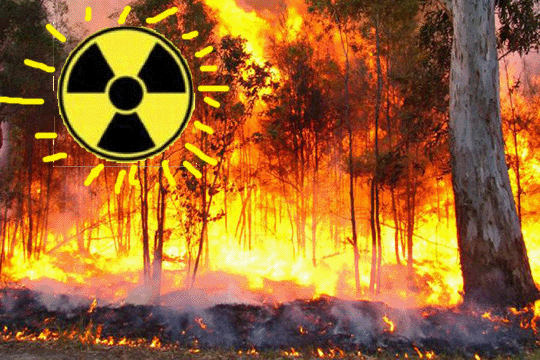
In all the propaganda for a nuclear waste dump in Kimba, South Australia,  there was no mention of bushfire risks. An extraordinary omission, don’t you think?
 The whole bizarre plan to trek the Lucas Heights nuclear reactor wastes some 1700km by land, or even longer by sea, would entail trucking highly radioactive (they call it intermediate) wastes through forest areas, towns, ports, to what used to be an agricultural area.
The nuclear industry touts itself as the cure for climate change. In reality,it is the other way around. For Australia especially, climate change, bushfires, water shortages – make every aspect of the nuclear industry ever more dangerous.
The Lucas Heights nuclear reactor itself is uncomfortably close to the bushfires. But nobody’s talking about that. That reactor shoud be shutdown, and no more wastes produced.
Dangerous climate is now upon Australia- Michael Mann
 Australia, your country is burning – dangerous climate change is here with you now , Guardian, Michael Mann 1 Jan 2020, I am a climate scientist on holiday in the Blue Mountains, watching climate change in action,
After years studying the climate, my work has brought me to Sydney where I’m studying the linkages between climate change and extreme weather events.
Prior to beginning my sabbatical stay in Sydney, I took the opportunity this holiday season to vacation in Australia with my family. We went to see the Great Barrier Reef – one of the great wonders of this planet – while we still can. Subject to the twin assaults of warming-caused bleaching and ocean acidification, it will be gone in a matter of decades in the absence of a dramatic reduction in global carbon emissions.
We also travelled to the Blue Mountains, another of Australia’s natural wonders, known for its lush temperate rainforests, majestic cliffs and rock formations and panoramic vistas that challenge any the world has to offer. It too is now threatened by climate change.
I witnessed this firsthand.
I did not see vast expanses of rainforest framed by distant blue-tinged mountain ranges. Instead I looked out into smoke-filled valleys, with only the faintest ghosts of distant ridges and peaks in the background. The iconic blue tint (which derives from a haze formed from “terpenes” emitted by the Eucalyptus trees that are so plentiful here) was replaced by a brown haze. The blue sky, too, had been replaced by that brown haze. ……
The brown skies I observed in the Blue Mountains this week are a product of human-caused climate change. Take record heat, combine it with unprecedented drought in already dry regions and you get unprecedented bushfires like the ones engulfing the Blue Mountains and spreading across the continent. It’s not complicated.
The warming of our planet – and the changes in climate associated with it – are due to the fossil fuels we’re burning: oil, whether at midnight or any other hour of the day, natural gas, and the biggest culprit of all, coal. That’s not complicated either.
When we mine for coal, like the controversial planned Adani coalmine, which would more than double Australia’s coal-based carbon emissions, we are literally mining away at our blue skies. The Adani coalmine could rightly be renamed the Blue Sky mine.
In Australia, beds are burning. So are entire towns, irreplaceable forests and endangered and precious animal species such as the koala (arguably the world’s only living plush toy) are perishing in massive numbers due to the unprecedented bushfires.
The continent of Australia is figuratively – and in some sense literally – on fire.
Yet the prime minister, Scott Morrison, appears remarkably indifferent to the climate emergency Australia is suffering through, having chosen to vacation in Hawaii as Australians are left to contend with unprecedented heat and bushfires.
Morrison has shown himself to be beholden to coal interests and his administration is considered to have conspired with a small number of petrostates to sabotage the recent UN climate conference in Madrid (“COP25”), seen as a last ditch effort to keep planetary warming below a level (1.5C) considered by many to constitute “dangerous” planetary warming.
But Australians need only wake up in the morning, turn on the television, read the newspaper or look out the window to see what is increasingly obvious to many – for Australia, dangerous climate change is already here. It’s simply a matter of how much worse we’re willing to allow it to get.
Australia is experiencing a climate emergency. It is literally burning. It needs leadership that is able to recognise that and act. And it needs voters to hold politicians accountable at the ballot box.
Australians must vote out fossil-fuelled politicians who have chosen to be part of the problem and vote in climate champions who are willing to solve it.
- Michael E Mann is distinguished professor of atmospheric science at Pennsylvania State University. His most recent book, with Tom Toles, is The Madhouse Effect: How Climate Change Denial Is Threatening Our Planet, Destroying Our Politics, and Driving Us Crazy (Columbia University Press, 2016).https://www.theguardian.com/commentisfree/2020/jan/02/australia-your-country-is-burning-dangerous-climate-change-is-here-with-you-now
Australian Parliamentary Report uses dodgy and incorrect nuclear information
House Of Reps Report Supports Nuclear – But Only If Everyone Is Into It https://www.solarquotes.com.au/blog/nuclear-energy-australia/ December 19, 2019 by Ronald Brakels Last Friday the House Of Representatives released a report on nuclear energy in Australia. They said it’s a good idea — provided everyone is cool with it.Australia. They said it’s a good idea — provided everyone is cool with it.
The report is called:
“Not without your approval: a way forward for nuclear technology in Australia”
It gives the country three recommendations :
- Consider using nuclear power.
- Gather information to support the future use of nuclear power.
- End or partially lift the moratorium that prohibits building nuclear reactors.
- \While nuclear is a low-emissions source of energy, .I don’t agree with these recommendations because:
- There is no point considering nuclear power here until one of the countries that have been using it for decades gets it right and starts building reactors that supply energy at a lower cost than renewables.
- There is no point paying people to study nuclear energy until other countries with existing nuclear industries show it can make economic sense. If it never manages to pay for itself, the research will be a waste. If it does pay for itself then the cost effective reactors may be very different from existing ones and the effort will, again, have been wasted.
- We live in a country where the government is always going to require you to get permission before you can build a nuclear reactor, so saying the magic words, “The moratorium is lifted!” makes no practical difference. But I figure we may as well say the magic words just to make it clear the reason we don’t have nuclear power isn’t because they haven’t been uttered.
The problem with this report is not that the House of Representatives committee and I have a difference of opinion. The problem is, only someone who has been whacked on the head with a graphite rod could look at the problems new nuclear power is experiencing around the world today and recommend Australia go ahead with it.
The problems have nothing to do with safety, nuclear waste, or security. These issues are irrelevant because nuclear power can not pay for itself. If it can’t do that, there is no point in worrying about the other issues and it is painfully clear new nuclear power makes no economic sense when renewables are now cheaper than coal power and continuing to fall in cost.
In the United Kingdom — the nuclear power possessing nation that is, embarrassingly, most similar to our own — they will pay 22 cents per kilowatt-hour for electrical energy from the under-construction Hinkley C reactors. That’s three times its average cost in the Australian National Electricity Market this year and fives times its average price in 2015.
While Australia’s wholesale electricity prices are unusually high at the moment, they are not going to get three miles high on this island. Thanks to the decreasing cost of renewable energy they are expected to trend downwards from their current high of one-third the cost of new nuclear energy in the UK.
Britain’s not the only place where new nuclear power is extremely expensive. A similar price is required for it to be constructed in the US. There have also been huge cost overruns building reactors in other countries, which include France and Finn’s land. Because Australia doesn’t have an existing nuclear power industry it could be even more expensive here and, last time I checked, we didn’t have any magic pixie dust we could sprinkle on nuclear energy projects to make them cheaper or on our politicians to make them smarter.
To me, it seems this report is an expensive face-saving measure by Parliamentary supporters of nuclear power. It makes no sense for this country given the current and decreasing cost of renewable energy, but they’re not willing to admit that. They instead want to pretend nuclear power is a great idea for us but the reason it’s not going ahead is because it’s unpopular. Hence the title, “Not without your approval”. In other words, they are saying the Australian people aren’t smart enough to know a good thing when they see it and that’s the only reason why we’re not building nuclear reactors.
Well, I say screw you House of Representatives Standing Committee on Energy and the Environment and the plutonium powered pony you rode in on. I felt that looking into nuclear power once again was a waste of time, but if you had investigated it and said
“Nuclear power is far too expensive to make sense for Australia. If this changes and new reactors overseas produce electricity at a lower cost than renewables we can look into it again, but until that happens, forget about it.”
Then at least we’d know the system works. We would be able to see that Parliamentary committees are able to look at the bleeding obvious and interpret it correctly. But instead, they only looked at information they liked while avoiding asking the obvious question of — are modern reactors making enough money to cover the cost of their construction and operation? Rather than do this, they took bits and pieces they picked from around the obvious question, turned them this way and that, and squinted until they were able to announce that it looked good — but the punters wouldn’t appreciate it and they’re the reason why we can’t have nice things.
They did this rather than admit what has been obvious for years now, that new nuclear will not pay for itself in Australia and, given the decreasing cost of renewable energy, it looks impossible for current nuclear designs to ever pay for themselves here.
By choosing to protect their egos rather than admit they were wrong, the nuclear energy supporters have sullied Parliament’s good… well, they’ve sullied Parliament’s name. I don’t expect anything run by humans to be perfect, but I really think we need a turn around in the ratio of sullying to pride inducing Parliamentary moments.
It’s A Long Report
The report is 214 pages. It could have been a lot shorter. I could have gotten it down to something like:
“Given that:
- The UK will be pay around 22 cents per kilowatt-hour in today’s money for electricity from the Hinkley C nuclear power plant, and…
- In the United States new nuclear capacity requires a similar price to proceed and nuclear plants have been abandoned while under construction because it became clear they would never pay for themselves.
- Australia has no advantages in building nuclear power stations while having the disadvantage of no existing nuclear power industry.
It is therefore not reasonable to believe we can build nuclear generating capacity for less than what it costs in the UK or USA. Until reactors are built overseas that produce electricity at a cost that is competitive in Australia, the subject does not merit further consideration.
Additionally, given that:
- New reactors under construction in France and Finland have had long delays and are far over budget, indicating the high cost of new nuclear capacity is not confined to English speaking countries, and…
- No organization is offering to or wants to build a nuclear power station in Australia at a price we would find anywhere close to acceptable.The idea of nuclear power in Australia should be abandoned and only reviewed if there are major improvements in its economic viability.”That’s under 214 words while having the advantage of being correct. The House of Representatives committee used 214 pages to come to the wrong conclusion. But arriving at the right conclusion can’t be easy if you have no ability to smell bullshit in your own research.
-
One Solar Panel Does Not Cause 0.8 Tonnes Of CO2 Emissions
Take a look at this table included in the report, taken from a publication that advocates nuclear power:


Casually looking at that you might think CO2 emissions for both nuclear energy and solar PV are pretty low. But if we stop for one minute and use basic mathematical ability that’s available to anyone who doesn’t have to take their socks off to count to 20, then we can see that a Parliamentary committee saw fit to include a table in an official report that gives ridiculous results.
Looking at their minimum figure for Solar PV (Utility scale), I see they are claiming a large solar farm will result in at least 18 grams of CO2 emissions per kilowatt-hour generated. While generating electricity from PV doesn’t result in any emissions, they are involved in the manufacture of solar panels, so they aren’t completely emissions-free. However, they are a lot bloody closer to emission free than this table suggests.
These days a typical standard sized solar panel is around 300 watts. In a solar farm in Australia on a fixed mount it will generate around 12,300 kilowatt-hours over 25 years. This means they are saying the solar panel will result in a minimum of 222 kilograms of CO2 emissions. If we use their maximum figure it will result in 2.22 tonnes of CO2, all for a panel that weighs about 18 kilograms. So they are saying manufacturing and installing one solar panel results in emissions equal to burning 80-800 or more kilograms of coal.
Jinko Solar, the world’s largest solar panel manufacturer, has a figure from 2017 of just 2.19 grams of CO2 per kilowatt-hour generated by a solar farm. As this has been decreasing year by year it will be even lower now. However, this is just for the solar panel and doesn’t include emissions from the construction of its ground mount or inverter, so I’ll double it to 4.4 grams. This means the actual emissions per kilowatt-hour are probably less than the best figure on the table and more than 40 times less than the worst figure. Even if we triple the Jinko figure it still comes to less than their median emissions for nuclear energy and less than 4% of their maximum figure for PV.
It’s clear the committee had no ability to detect figures that were bullshit — or they simply didn’t care.
Renewable Energy Increases The Cost Of Nuclear
Here is section 1.50 of the report:
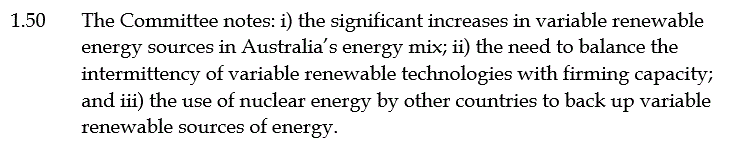
I note the committee has failed to understand the economics of nuclear power if they think it works well with solar and wind energy. This is because if a nuclear power station produces half the energy its capable of, it almost doubles the cost of that energy. This is due to nuclear fuel being very cheap1 per kilowatt-hour, so very little money is saved by ramping down, while nearly all other costs remain the same.
This means nuclear power, which is already too expensive when operated in the most economical way — almost continuously at full normal power — becomes even more expensive when used in a grid with a significant amount of solar energy and/or wind power capacity. Australia already has more than enough to adversely affect the economics of nuclear energy and, even if we approve and build a nuclear power station in one quarter the average time it has taken overseas this century, things will be much worse for its economics by the time it’s complete.
They Don’t Even Know Who Buys Our Coal
The report suggests South Korea could build nuclear power plants for us at low cost. It’s a very strange conclusion because South Korea is the third largest importer of Australian coal. You’d think if they could build nuclear reactors cheaply they wouldn’t get nearly three times as much energy from flammable rocks:
If you try breathing the air in South Korea you’ll soon wish they could build nuclear reactors at a lower cost than coal power, but unfortunately they can’t, and — as I’ve probably mentioned in other articles — Australia can build renewable generating capacity that supplies electricity at a lower cost than new coal power. This includes the cost of firming the renewable energy so supply is always available.
It is amazing we have a Parliament dominated by a party obsessed with coal, but this committee can’t even get their head around the fact that the country that imports more of our coal per capita than any other nation isn’t likely to be in possession of the secret of cheaper than coal nuclear power.
Smaller Is Not Cheaper
Small Modular Reactors (SMRs) are suggested in the report as a way of making nuclear power economically viable. The problem with this is they cost more per kilowatt than large ones. This fact should not be a surprise to anyone. The engineers who designed the large nuclear reactors in the world today are not idiots who are currently slapping their foreheads, saying, “I’m so stupid! If only I had thought of making them smaller instead of bigger!” Modern reactors are very large to keep their cost per kilowatt down. Going small has the opposite effect.
That small reactors are not cheap is made obvious by the fact Britain, which has the longest history of nuclear power generation of any country, decided to power their new aircraft carriers with kerosene and diesel rather than small nuclear reactors because of they are so expensive. This is despite the alternative being expensive oil products rather than much cheaper solar and wind energy.
An advantage given for SMRs is they will supposedly suffer from fewer cost overruns. But that sales pitch is not enough to make nuclear energy economically attractive — pay for a more expensive product so you’ll have less of a chance of unpleasant surprise expenses down the line.2
They Want Money Wasted On More Reports
The report suggests we get people to write another report on how much nuclear power will cost here:

But I have a different suggestion. A much cheaper one. We just wait for another country to build and operate a nuclear power plant at a low enough cost that would be competitive in Australia. Then we can look into it.
Better yet, to make sure they aren’t exaggerating how cheap their nuclear power is, we say:
“Hey, budget nuclear energy guys, how would you like to build a nuclear power station in Australia? We give you nothing, but you get the market price for whatever electricity you sell.”
If they say, “nyet” or “bu shi” or “piss off” then we can suspect it’s not as cheap as they’re making it out to be.
If they say, “yes” then we can talk about how they’ll be required to insure it for a reasonable amount based on the costs of nuclear accidents that have occurred in the past. While nuclear power is very safe, there must have been at least one or two minor little upsets.
Everyone Has To Love Nuclear Energy
The report says that social acceptance of nuclear power is necessary for it to go ahead. So it’s not going to go ahead because that’s not going to happen. Nuclear energy has turned out to be an economic disaster overseas, we have much cheaper alternatives, and now that I think about it there have been one or two major nuclear accidents overseas that have left a bad impression.
There was a problem with a nuclear power station in Fukushima, Japan. The Japanese Government estimated the cost at around $270 billion dollars. As our government is currently willing to spend around $4.5 million to save an Australian life through public health and safety measures, if we lost that amount of money it would represent around 60,000 Australian lives that potentially could have been saved with it.
Since nuclear power — at the costs we see overseas — is only going to increase electricity bills, and we have far cheaper ways to reduce emissions that are quicker to deploy, and because Australians aren’t in love with a very very small chance of a nuclear accident that has a very high cost, there will never be acceptance for nuclear power in this country. Not in its current form. But be sure to let me know when a DeLorean compatible Mr Fusion becomes available.
I’m guessing the entire section on social acceptance is only in the report so when nuclear power doesn’t get built, its supporters can say, “It’s the fault of normal Australians for not believing in the nuclear economic viability fairy hard enough”, rather than admit they themselves were wrong.
The Moratorium Means Nothing
Currently there is a moratorium on nuclear power in Australia. This means you’re not allowed to build it without special permission from the government. Well, guess what? In this country you are never going to be allowed to build a nuclear reactor without permission from the government. That’s just the way it is. I know it’s a terrible infringement of our right to build nuclear reactors in our backyards and squash courts. But on the other hand, it does support our right not to live next door to someone who’s building a nuclear reactor in their backyard, so I could go either way on this one.
The report suggests scrapping the moratorium or partially lifting it. I’m not sure what partially lifting it means. Maybe you have to ask for permission but you don’t have to say pretty please or maybe it just means they won’t be too worried if you have an eye patch, a cool scar, and introduce yourself as “The Jackal”.
Because the moratorium doesn’t really mean anything, there may not be any harm in lifting it and shutting up a few idiots who think the only reason nuclear power isn’t currently under construction in this country is because the government hasn’t muttered the magic words, “The moratorium is lifted!” So they may as well say moratorium leviosa and be done with it.
It’s not as if nuclear power is going to be built in this country one way or the other. Supporters will soon discover no one’s lining up to build reactors even with our current high wholesale electricity prices. The only way they will get built is with very substantial subsidies and the government is too busy trying to keep coal power afloat while Australia burns to waste its energy subsidising nuclear.
Catastrophic weather in Australia does not influence its climate denialist government
Time is running out for a climate adaptation plan, Independent Australia
THE POSSIBILITY that the effects of climate change could be more extreme and materialise much sooner than expected was never hypothetical. At the end of the last ice age, it is estimated that temperatures in some regions of the world spiked between five and 15 degrees celsius in just a few decades.
Catastrophic climate conditions have already arrived in Australia. With a growing sense that the events of the last few weeks could be the new normal, dealing with the immediate effects of climate change may take increasing priority over historically unsuccessful emissions reduction efforts.
It is striking that Australia has no unified climate adaptation plan.
Our bushfires are escalating in number and intensity. Given this reality, leaving individuals to enact their own bushfire survival plans again and again seems inadequate. In light of successive governments upholding policies designed to discourage asylum seekers from risking their lives at sea, where is the plan to permanently move residents out of areas surrounded by highly flammable material? …..
These are just a few matters of relevance, before we even get to responses to heat stress (cooler living spaces), or the erratic intensity of droughts (innovative measures to ensure food and water security), storms (systematic storm-proofing of property) and floods (moving communities to higher ground where necessary).
All of this will require a great deal of resources and coordination. While governments, both State and Federal, have been much too slow to act, politicians interested in keeping their jobs could conceivably be motivated to do so by increasingly engaged voters.
At the same time, the market has failed to respond anywhere near adequately and it is hard to see it doing so. The private sector-led installation of the flood-proofing infrastructure Brisbane needs is nowhere to be seen.
When warmer temperatures melt arctic ice, sun-reflecting white layers on that ice disappear, causing more heat to be absorbed by darker surfaces, a further rise in temperature and a further melting of ice. A number of chain reactions operate like this in the climate system. There could be many more that have not yet been discovered and that could behave in unanticipated ways.
Under some scenarios, changes could be so rapid that even attempts to adapt could become impractical. We haven’t a moment to lose. https://independentaustralia.net/politics/politics-display/time-is-running-out-for-a-climate-adaptation-plan,13365
Sir David Attenborough shocked at Australian government’s disdain for climate action
Sir David Attenborough hits out at the federal government over climate position,
https://www.sbs.com.au/news/sir-david-attenborough-hits-out-at-the-federal-government-over-climate-position Sir David Attenborough has taken another swipe at the Australian government’s climate policies, expressing his shock at the government’s hesitation to link recent extreme weather with global warming.
Former Australian PM Kevin Rudd says Assange faces ‘unacceptable’ and ‘disproportionate’ punishment
Rudd says Assange faces ‘unacceptable’ and ‘disproportionate’ punishment https://www.theage.com.au/politics/federal/rudd-says-assange-faces-unacceptable-and-disproportionate-punishment-20191125-p53duj.html By Rob Harris, Kevin Rudd says Julian Assange would pay an “unacceptable” and “disproportionate” price if he is extradited to the United States, arguing the WikiLeaks founder should not take the fall for Washington’s failures to secure its own classified documents.
In a significant intervention into Mr Assange’s extradition fight, the former Australian prime minister said US prosecutors had not made any specific allegations that anyone was seriously harmed as a consequence of the release of highly classified documents relating to the Iraq and Afghanistan wars in 2010.
The Morrison government is resisting a rising tide of demands to intervene in the case of the 48-year-old Australian citizen, as his supporters grow increasingly concerned over his deteriorating health in a British prison.
Mr Rudd, himself targeted in WikiLeaks’ publication of more than 250,000 leaked diplomatic cables nine years ago, said while he had “serious reservations” about Mr Assange’s character and conduct, he did not believe he should be extradited to face an “effective life sentence” in the US.
In a letter to the Bring Julian Assange Home Queensland Network, seen by The Age and The Sydney Morning Herald, Mr Rudd said he could not see the difference between Mr Assange and the editors of many American media outlets that reported the material he had provided them.
“If [the US prosecutors’] case is essentially that Mr Assange broke the law by obtaining and disclosing secret information, then I struggle to see what separates him from any journalist who solicits, obtains and publishes such information,” Mr Rudd wrote.
“In other words, why should Mr Assange be tried, convicted and incarcerated while those who publicly released the information are afforded protection under provisions of the US constitution concerning press freedom?”
The group was briefed by barrister Jen Robinson, a member of Mr Assange’s London legal team, as well as Greg Barns from the Australian Assange Campaign and human rights and due process advocate Aloysia Brooks.
Mr Rudd said he was “deeply opposed” to the leaking of classified diplomatic or intelligence communications, which needed to be protected to maintain Australia’s national security interests and that of its allies.
“Ultimate responsibility for keeping sensitive information secure rests with governments. The United States government demonstrably failed to effectively secure the classified documents relevant to this case,” he wrote.
“The result was the mass leaking of sensitive diplomatic cables, including some that caused me some political discomfort at the time. However, an effective life sentence is an unacceptable and disproportionate price to pay. I would therefore oppose his extradition.”
More than 60 doctors from the United Kingdom, Australia, Europe and Sri Lanka, wrote to British Home Secretary Priti Patel on Monday asserting that Mr Assange urgently needs medical treatment at a university hospital.
The doctors said in a letter, distributed by WikiLeaks on Monday, that he was suffering from psychological problems including depression as well as dental issues and a serious shoulder ailment.
Mr Barns welcomed Mr Rudd’s intervention saying his comments, like his former colleague Bob Carr, rightly pointed to the threat to freedom of the media.
“The Australian government and all MPs we hope will place pressure on the US to make it understand that the treatment of an Australian citizen this way is not something that should happen,” Mr Barns said.
“Mr Rudd and Mr Carr could never be described as anti-Washington but they clearly understand the need for Canberra to take action to prevent this gross injustice.”
Mr Assange will return to court briefly next month before a full hearing of a US extradition request in which he faces a 175-year jail sentence if found guilty on 18 charges relating to computer fraud and obtaining and disclosing national defence information.
Appeal from former political prisoner to Australia’s Prime Minister to help Julian Assange
“This is how diplomacy works,” “You can pick up the phone, Mr Morrison, and  speak with whoever the United Kingdom’s next prime minister is; requesting that Julian Assange not be extradited to the United States to face the very real possibility, if not the certainty, that he will die in prison.” at right, Prime Minister Morrison
 Former political prisoner pleads for Scott Morrison to not let Assange ‘die in jail’, The Age By Rob Harris, Filmmaker James Ricketson, who spent 15 months as a political prisoner in a Cambodian jail, has implored Prime Minister Scott Morrison to “pick up the phone” to his British counterpart to ensure Julian Assange does not die in prison.
There are growing fears for the psychical and mental health of the 48-year-old WikiLeaks founder, who is in a London prison fighting an extradition request to the United States, where he faces espionage charges relating to the release of classified files on the Iraq and Afghanistan wars.
In an open letter to Mr Morrison, Mr Ricketson has joined a “rising tide of voices” in support of Australian government intervention to bring Mr Assange back to Australia before full extradition proceedings in February.
“The evidence that Julian Assange is not being ‘treated fairly’ in accordance with UK law is now overwhelming, as is evidence of the psychological torture he is being subjected to in Belmarsh Prison,” Mr Ricketson writes.
“If Julian Assange does die in prison, will you, with a clear Christian conscience, be able to inform the Australian public, in all honesty, that you did all within your power (and more) to protect Assange’s legal and human rights.”
Mr Ricketson was arrested and charged with espionage in June 2017 for flying a drone over an anti-government rally in Phnom Penh. He was held in the notoriously overcrowded Prey Sar prison for 15 months until he was pardoned by Cambodian authorities.
The filmmaker said it was former prime minister Malcolm Turnbull who intervened to secure his release, despite the Department of Foreign Affairs and Trade’s insistence that it could not interfere with another country’s legal proceedings.
“This is how diplomacy works,” he writes. “You can pick up the phone, Mr Morrison, and speak with whoever the United Kingdom’s next prime minister is; requesting that Julian Assange not be extradited to the United States to face the very real possibility, if not the certainty, that he will die in prison.”
A newly formed federal cross-party parliamentary group, comprising 11 MPs dedicated to advocating for the return of Mr Assange, will meet formally for the first time on Monday in Canberra. ….
Mr Morrison and Foreign Minister Marise Payne have repeatedly ruled out any intervention in the case, with the PM saying last month he believed Mr Assange should “face the music” in court.
The former Australian high commissioner to Britain earlier this month mocked the idea of Mr Morrison acting on calls from Mr Assange’s supporters to do all he could to bring him home from Belmarsh Prison, where he has been held since his April 11 arrest at the Ecuadorian embassy, which gave him asylum for almost seven years. https://www.theage.com.au/politics/federal/former-political-prisoner-pleads-for-scott-morrison-to-not-let-assange-die-in-jail-20191124-p53dks.html
Desperate times for the nuclear industry – could Australia be its saviour?
the number one goal of the nuclear lobby is to remove Australia’s national and state laws that prohibit the nuclear industry.
the campaign by the global nuclear industry, particularly the American industry, to kickstart another “nuclear renaissance”, before it’s too late.

Australia is the great ‘white’ hope for the global nuclear industry, Independent Australia, By Noel Wauchope | 19 November 2019, The global nuclear industry is in crisis but that doesn’t stop the pro-nuclear lobby from peddling exorbitantly expensive nuclear as a “green alternative”. Noel Wauchope reports.
The global nuclear industry is in crisis. Well, in the Western world, anyway. It is hard to get a clear picture of Russia and China, who appear to be happy putting developing nations into debt, as they market their nuclear reactors overseas with very generous loans — it helps to have stte-owned companies funding this effort.
But when it comes to Western democracies, where the industry is supposed to be commercially viable, there’s trouble. The latest news from S&P Global Ratings has made it plain: nuclear power can survive only with massive tax-payer support. Existing large nuclear reactors need subsidies to continue, while the expense of building new ones has scared off investors.
So, for the nuclear lobby, ultimate survival seems to depend on developing and mass marketing “Generation IV” small and medium reactors (SMRs). …..
for the U.S. marketers, Australia, as a politically stable English-speaking ally, is a particularly desirable target. Australia’s geographic situation has advantages. One is the possibility of making Australia a hub for taking in radioactive wastes from South-East Asian countries. That’s a long-term goal of the global nuclear lobby. …..
In particular, small nuclear reactors are marketed for submarines. That’s especially important now, as a new type of non-nuclear submarine – the Air Independent Propulsion (AIP) submarine, faster and much cheaper – could be making nuclear submarines obsolete. The Australian nuclear lobby is very keen on nuclear submarines: they are now promoting SMRs with propagandists such as Heiko Timmers, from Australian National University. This is an additional reason why Australia is the great white hope.
I use the word “white” advisedly here because Australia has a remarkable history of distrust and opposition to this industry form Indigenous Australians…..
The hunt for a national waste dump site is one problematic side of the nuclear lobby’s push for Australia. While accepted international policy on nuclear waste storage is that the site should be as near as possible to the point of production, the Australian Government’s plan is to set up a temporary site for nuclear waste, some 1700 km from its production at Lucas Heights. The other equally problematic issue is how to gain political and public support for the industry, which is currently banned by both Federal and state laws. SMR companies like NuScale are loath to spend money on winning hearts and minds in Australia while nuclear prohibition laws remain.
 Ziggy Switkowski, a long-time promoter of the nuclear industry, has now renewed this campaign — although he covers himself well, in case it all goes bad, noting that nuclear energy for Australia could be a “catastrophic failure“. ……
his submission (No. 41) to the current Federal Inquiry into nuclear power sets out only one aim, that
‘… all obstacles … be removed to the consideration of nuclear power as part of the national energy strategy debate.’
So the Environmental Protection and Biodiversity Conservation Act (EPBC Act) should be changed, according to Switkowski. In an article in The Australian, NSW State Liberal MP Taylor Martin suggested that the Federal and state laws be changed to prohibit existing forms of nuclear power technology but to allow small modular reactors.
Switkowski makes it clear that the number one goal of the nuclear lobby is to remove Australia’s national and state laws that prohibit the nuclear industry. And, from reading many pro-nuclear submissions to the Federal Inquiry, this emerges as their most significant aim.
It does not appear that the Australian public is currently all agog about nuclear power. So, it does seem a great coincidence that so many of their representatives in parliaments – Federal, Victorian, New South Wales, South Australia and members of a new party in Western Australia – are now advocating nuclear inquiries, leading to the repeal of nuclear prohibition laws.
We can only conclude that this new, seemingly coincidental push to overturn Australia’s nuclear prohibition laws, is in concert with the push for a national nuclear waste dump in rural South Australia — part of the campaign by the global nuclear industry, particularly the American industry, to kickstart another “nuclear renaissance”, before it’s too late.
Despite its relatively small population, Australia does “punch above its weight” in terms of its international reputation and as a commercial market. The repeal of Australia’s laws banning the nuclear industry would be a very significant symbol for much-needed new credibility for the pro-nuclear lobby. It would open the door for a clever publicity drive, no doubt using “action on climate change” as the rationale for developing nuclear power.
In the meantime, Australia has abundant natural resources for sun, wind and wave energy, and could become a leader in the South-East Asian region for developing and exporting renewable energy — a much quicker and more credible way to combat global warming. https://independentaustralia.net/politics/politics-display/australia-is-the-great-white-hope-for-the-global-nuclear-industry,13326
Australia’s bushfires could stay out of control for months
 Australia fires could be out of control for months, says fire chief, Concern grows over wind changes and high temperatures forecast for later this week, Guardian, Ben Doherty in Sydney @bendohertycorro
Wed 13 Nov 2019 It could be months before eastern Australia has more than a million hectares of bushfires under control, the New South Wales fire chief has warned, as the country faces one of its worst bushfire outbreaks.After relief that no further lives were lost on Tuesday, concern was growing over unpredictable winds worsening fires in the neighbouring state of Queensland on Wednesday, with much hotter temperatures also predicted for the Sydney area in the coming days.
Gusty winds changing direction are predicted to fan flames in new directions and widen “catastrophic” fire fronts in Queensland and northern NSW, where more than 100 fires – one more than 150,000 hectares (370,000 acres) in size – are burning.
Forecasters warned that “dry lightning” strikes could ignite new blazes, with fires worsening when hotter temperatures arrive over the weekend. Temperatures in Queensland are currently up to 8C higher than average.
Shane Fitzsimmons, the commissioner of the NSW rural fire services, said: “The real challenge is we have an enormous amount of country that is still alight. They won’t have this out for days, weeks, months. Unfortunately the forecast is nothing but above-average temperatures and below-average rainfall over the next few months and we’ve still got summer around the corner.”
The current fires in NSW cover four times the land area that burned during the whole of 2018, according to Fitzsimmons. There are also fires in Western Australia, South Australia and the Northern Territory.
While the extent of the bushfires is less than those in New South Wales in 1974-75 , which destroyed 4.5m hectares (11m acres), forecasters and fire chiefs are concerned that so many fires are already under way before high summer………
Bushfires are a regular occurrence during Australian summers, but the intensity of this year’s fires, and how early in the season they have arrived, have unleashed an acute political debate over the impact of climate change in exacerbating Australia’s fire vulnerability.
The prime minister, Scott Morrison, whose conservative coalition government has been consistently criticised over its support for coal-mining and power plants, inaction on climate change, and Australia’s rising carbon emissions, has refused to answers questions on climate change worsening fires………
In one of the largest peacetime mobilisations of Australian forces, the defence minister, Linda Reynolds, is preparing to send army, navy and air force reserve forces – the equivalent of the UK’s Army Reserve – into the fire zone to assist with evacuations and logistics.
The military intervention might even include an unprecedented compulsory call-up of reserve forces, such is the scale of the fire damage. https://www.theguardian.com/australia-news/2019/nov/12/australia-fires-rage-out-of-control-catastrophic-day
Australia’s media on a campaign for freedom of press, but not when it comes to Julian Assange
Mainstream Media Fights for Own Freedom, But Not for Assange’s, Sydney Criminal Lawyers, 02/11/2019 BY PAUL GREGOIRE Major Australian mainstream media outlets joined forces a fortnight ago to launched the Right to Know campaign. It aims to see public interest journalism decriminalised, and safeguards for whistleblowers enhanced.This unprecedented display of unity has seen The Guardian, the ABC, Nine, News Corp, SBS and the MEAA join forces in calling on the government to enact reforms. And this is rather significant, considering some of these organisations have been much criticised for towing the party line.
The Right to Know has six demands: exceptions so journalists can’t be prosecuted under national security laws, freedom of information reform, defamation law reform, a narrowing of the information classified as secret, protections for whistleblowers and the right to contest warrants.
Of course, the campaign was sparked by the June AFP press raids, which saw agents rifle through the house of a News Corp journalist, as well as the offices of the national broadcaster, in what was understood by many to be a warning to the media and whistleblowers to keep quiet.
However, a glaring campaign omission is the case of an Australian publisher who’s currently being remanded in the UK over charges that apply in the US, which relate precisely to public interest journalism. Yet, the Australian media has all but forgotten their colleague, Julian Assange.
Silenced by association
“The Right to Know campaign drives to the heart of the matter more than many journalists realise,” remarked Ian Rose, a member of the Support Assange and Wikileaks Coalition.
“While on the one hand, they’re right to finally be calling out the creeping incursions and restrictions into media freedoms,” he told Sydney Criminal Lawyers. “On the other, they don’t have the inner fortitude to stand up for Assange.”
According to Rose, there are two reasons that the Australian media has abandoned the Walkley award-winning journalist. One is that he’s “an egalitarian”, which “frightens the hell out of the ruling class”, as most of the work of WikiLeaks has been all about exposing their lies.
The second reason behind the silence is that the “oligarchs” are the “journalists’ paymasters”. And for this reason – which is underscored by the justifiable fear of losing their lives – journalists have refrained from “calling these people out”.
An excuse for silencing
Attorney general Christian Porter spoke out against the Right to Know campaign, claiming that by providing the media with the right to contest warrants could hinder criminal investigations. And he also asserted that the campaign demands could lead to national security threats.
As an example of how the media could become such a threat, Porter pointed to Assange having published leaked classified documents on WikiLeaks. The top lawmaker further set out that while this act of publication was widely condemned, the local industry still awarded Assange a Walkley……..
Neglecting an ally
And as for what the Australian media should be doing about one of its own locked away in isolation in circumstances that undermine the rule of law, Mr Rose says that it “ought to get over its jealousy and unite to support Assange”.
Indeed, the Right to Know campaign should embrace Assange’s cause, as it’s the quintessential example of the concerted crackdown on journalists that’s currently taking place across the western world. And there’s a clear correlation between his silencing and the local AFP raids.
“The way Assange is being treated is the way journalists are starting to be treated, and the way all of society will be treated if we don’t collectively call for a stop to the new dictatorial world order,” Rose warned.
And as an example of how this silencing of dissent is spreading beyond the media, Rose pointed to the recent assault on nonviolent climate activists, which has seen the application of ongoing arrests, draconian bail conditions, intimidatory procedures and the passing of restrictive laws……..https://www.sydneycriminallawyers.com.au/blog/mainstream-media-fights-for-own-freedom-but-not-for-assanges/
Australia’s out of control bushfires (all along the region where the nuclear lobby wants to put reactors!)
‘Uncharted territory’: Dozens of out of control bushfires burn across  New South Wales and Queensland, https://www.sbs.com.au/news/uncharted-territory-dozens-of-out-of-control-bushfires-burn-across-new-south-wales-and-queensland Hot, windy conditions are wreaking havoc across New South Wales and Queensland.
Australian firefighters warned they were in “uncharted territory” as they struggled to contain dozens of out-of-control bushfires across the east of the country on Friday.
Around a hundred blazes pockmarked the New South Wales and Queensland countryside, around 19 of them dangerous and uncontained.
“We have never seen this many fires concurrently at emergency warning level,” New South Wales Rural Fire Service Commissioner Shane Fitzsimmons told the ABC. “We are in uncharted territory.”The RFS said on Friday afternoon it received multiple reports of people being trapped in their homes at several locations.
Homes have also been destroyed, the RFS added.
A mayor on New South Wales’ mid-north coast said on Friday the bushfires ripping through the region were “horrifying and horrendous beasts”.
MidCoast Council mayor David West said a fire near Forster threatened a council building on Thursday night.
“It was literally a wall of yellow, horrible, beastly, tormenting flames,” the mayor said.
The mayor was particularly concerned about an out-of-control fire burning near Hillville south of Taree.
Australia’s bushfire risks – threat to planned 1700 km transport of nuclear wastes

“The Fire Brigade Union contradicted this view stating that everything burns under the right conditions and that an accident, particularly with a fuel tanker, could generate enough heat to burn concrete and steel containers and vaporise the waste. This would transform the waste into a form in which it presents the greatest risk to human health.
“Concrete burns, it spalls, it expands and it explodes. That is what happens to it if it is subject to fire for long enough. You can put it in concrete and you can have steel mesh holding the whole thing together, but when you apply heat, the granules grow and things start spalling, just throwing out bits of itself everywhere until, in the end, that concrete or the integrity of the structure that encases it is broken.
Suppression of media freedom in Australia

‘It is all part of the same disease’: media and other key institutions under threat, https://www.theage.com.au/politics/federal/it-is-all-part-of-the-same-disease-media-and-other-key-institutions-under-threat-20191028-p534z6.html, By Nick O’Malley, October 28, 2019 —The prosecution of journalists, cuts to the ABC budget and the appointment of “dud” politically connected officials to roles in key agencies present an unprecedented threat to democracy in Australia.“Media provides crucial accountability and transparency functions,” said a report by the Centre for Public Integrity, due to be released this week. “Investigative journalists often unearth wrongdoing long before any public integrity agencies investigate, for example the recent Crown Casino investigation by Nick McKenzie at The Age [and The Sydney Morning Herald], and the Four Corners investigation of police corruption in Queensland that triggered the Fitzgerald Inquiry.
“Media outlets have faced attacks in the form of centralisation of private ownership, funding cuts to public broadcasters, and potential prosecution of journalists, including News Corp journalist Annika Smethurst.”
One of the report’s authors, Geoffrey Watson, SC, former counsel assisting the Independent Commission Against Corruption, said he had been shocked by how quickly the brutal type of politics that evolved in the United States and the United Kingdom, and partly led to the ascendancy of Donald Trump and Boris Johnson, had taken root in Australia.
“One day you see the judiciary attacked and the next someone in the media,” said Mr Watson, who is a director of the Centre for Public Integrity. “On the third day it might be the CSIRO, they even attack our scientists. Some people don’t recognise it as the same problem, but it is all part of the same disease.”
He said the effectiveness of the media in Australia as a watchdog was not only threatened by personal and legal attacks by the government, but by regulations that had allowed ownership of newspapers to be reduced to an effective duopoly.
The report, entitled “Protecting the Integrity of Accountability Institutions”, said that a range of institutions – including the judiciary and the Administrative Appeals Tribunal, the public service, integrity commissions such as the ICAC, statutory authorities such as the Human Rights Commission and the Fair Work Commission, and the CSIRO – had all been targeted in recent years by interested parties seeking to undermine their independence and public trust.
“These institutions are important not only because they ensure actual accountability, transparency and good governance but because they build confidence and trust within the Australian community,” it said. “When this confidence and trust is diminished, divisiveness and conflict increase. This impacts social cohesiveness and the economy, and the welfare of all Australians suffers. Ultimately, as international experience has shown, it is a threat to democracy itself.”
It cited as examples of interference attempts by federal ministers to influence the Victorian Court of Appeal in 2017 terrorism cases, sustained funding cuts and personal attacks on the ABC, and the de-skilling of the public service through the outsourcing of up to 50 per cent of government departments to contractors.
The report listed a series of principles that needed to be respected in order to protect the independence of the threatened institutions. They include protection from political retribution, secure and sufficient funding, secure tenure of senior officials and public access to advice to the government from accountability institutions, as well as the creation of an effective federal integrity watchdog.
The Centre for Public Integrity, a independently funded think tank, was formed earlier this year in part to champion the case for a such a body. The report comes in the midst of a campaign by Australian media, including the Herald and The Age, to defend the public right to information in the face of increasing attempts by government and government agencies to suppress information, prosecute whistleblowers and criminalise legitimate public interest journalism.
Prominent Australians, including politicians, call on their government to save Julian Assange from extradition to USA
Growing calls for Australian government to defend Julian Assange https://www.wsws.org/en/articles/2019/10/19/assa-o19.html?fbclid=IwAR2smK6ChQzsIB7Ndld4N_No68RpVViDz5V-RH7qTiYfWmFWFdqkThOA-DQ
By Oscar Grenfell, 19 October 2019 Over the past week, several prominent public figures, including federal members of parliament, have called on the Australian government to fulfil its obligations to defend WikiLeaks’ publisher Julian Assange, including by taking steps to prevent his extradition from Britain to the US.
The statements come in the lead-up to British extradition hearings in February, that will decide whether Assange is dispatched to the US. He faces a maximum sentence of 175 years in an American prison for exposing US war crimes and diplomatic intrigues.
There are concerns within the Australian political and media establishment that the refusal of successive governments to defend Assange, an Australian citizen and journalist, has generated widespread anger and opposition. The fear in ruling circles is that if Assange is extradited, or if his parlous health continues to deteriorate, the latent support for him will coalesce into a political movement against the entire official set-up.
In a statement to the House of Representatives on Wednesday, independent MP Andrew Wilkie declared that Assange is “an Australian citizen and must be treated like any other Australian. He was not in the US when he provided evidence of US war crimes in Iraq. He can’t possibly have broken their laws.”
Wilkie said that if Assange is extradited to the US, he “faces serious human rights violations including exposure to torture and a dodgy trial. And this has serious implications for freedom of speech and freedom of the press here in Australia, because if we allow a foreign country to charge an Australian citizen for revealing war crimes, then no Australian journalist or publisher can ever be confident that the same thing won’t happen to them.”
He concluded by stating: “Put simply, he must be allowed to return to Australia.”
Wilkie, a former intelligence agent who resigned to speak out against “weapons of mass destruction” lies used to justify the illegal 2003 invasion of Iraq, has previously condemned the assault on democratic rights. In 2010 and 2011, he made statements and spoke at public events in defence of Assange. Alongside the Greens and a host of civil liberties organisations, however, Wilkie has largely remained silent about the WikiLeaks founder’s plight for a number of years and has boycotted all actions taken in his defence.
Wilkie said that if Assange is extradited to the US, he “faces serious human rights violations including exposure to torture and a dodgy trial. And this has serious implications for freedom of speech and freedom of the press here in Australia, because if we allow a foreign country to charge an Australian citizen for revealing war crimes, then no Australian journalist or publisher can ever be confident that the same thing won’t happen to them.”
He concluded by stating: “Put simply, he must be allowed to return to Australia.”
Wilkie, a former intelligence agent who resigned to speak out against “weapons of mass destruction” lies used to justify the illegal 2003 invasion of Iraq, has previously condemned the assault on democratic rights. In 2010 and 2011, he made statements and spoke at public events in defence of Assange. Alongside the Greens and a host of civil liberties organisations, however, Wilkie has largely remained silent about the WikiLeaks founder’s plight for a number of years and has boycotted all actions taken in his defence.
Joyce, a populist who has sought to build a base of support in rural areas, was well aware of the sentiments in favour of Hicks among workers in regional centres and country towns. He played a role in the sordid agreement brokered by Howard, which saw Hicks returned to Australia in 2007. Hicks was forced to serve out a bogus prison sentence in Australia and was banned for a year from speaking to the media.
In comments to the media on Monday, former Labor foreign minister Bob Carr hinted at the concerns animating the comments in defence of Assange by such figures from within the political establishment.
Carr told the Sydney Morning Herald that ordinary people would be “deeply uneasy” about the prospect of an Australian citizen being handed over to the “living hell of a lifetime sentence in an American penitentiary.” He criticised current Foreign Minister Marise Payne over her claim that she made “friendly” representations on behalf of Assange to US Secretary of State Mike Pompeo. Pompeo has denounced Assange as a “demon” who is not entitled to any democratic rights and labelled WikiLeaks as a “non-state hostile intelligence service.”
Carr stated: “I think the issue will gather pace, and in the ultimate trial there will be a high level of Australian public concern, among conservative voters as much as any others.”
In his strongest comments in defence of Assange yet, Carr declared: “We have an absolute right to know about American war crimes in a conflict that the Australian government of the day strongly supported. We wouldn’t know about them except for Assange.”
Carr is no political innocent. During his decades in the Labor Party, he functioned as a secret informant for the US embassy, beginning in the 1970s. He was a leading minister in the Gillard Labor government which refused to defend the WikiLeaks founder and instead pledged to assist the US campaign against him.
That Carr has spoken out now is a measure of the fears within the ruling elite that the defence of Assange will animate millions of workers, students and young people in the coming period.
In keeping with the central role of Labor in the US-led pursuit of Assange, no prominent current figure in the party has joined the calls for him to be defended. When the WikiLeaks’ founder was illegally expelled from the Ecuadorian embassy and arrested by the British police in April, Labor MP Tanya Plibersek shared a Tweet denouncing his supporters as “cultists.”
Julian Hill, a little-known federal backbencher representing a working-class electorate in outer Melbourne, is the only Labor MP to have spoken out. He told the Guardian on Thursday that Assange is “an Australian and, at the very least, we must be vigorously consistent in opposing extradition to countries where he might face the death penalty.”
Prime Minister Scott Morrison responded this week by blandly declaring that Assange must “face the music” in the US. Senior government ministers have previously maligned Assange, repeating the lies concocted by the US intelligence agencies to discredit him.
Liberal Senator James Paterson attempted to provide a more sophisticated argument for the government’s refusal to defend Assange, telling the Sydney Morning Herald last week that both Britain and the US were “rule-of-law countries.”
Paterson piously stated: “This is not the case in many other countries in the world. Sadly, we know there are Australian citizens detained right now in China and Iran who are not facing free and fair legal systems … and the Australian government does have a greater obligation to assist those citizens.”
The suggestion that the Australian government has a responsibility to defend its citizens in some jurisdictions, but not in others, is a legal fiction that has no basis in Australian or international legislation.
Paterson’s statements, moreover, fly in the face of repeated warnings by United Nations officials and human rights organisations that Assange’s legal and democratic rights have been trampled upon by the British and US authorities.
Paterson’s comments point to the real reason why successive Australian governments, Labor and Liberal-National alike, have joined the US-led vendetta against Assange. Their participation in the attacks against him has gone hand in hand with unconditional backing for the US alliance and support for Washington’s military build-up in the Asia-Pacific region, in preparation for war against China.
The record demonstrates that no faith can be placed in any section of the political or media establishment to defend Assange or any democratic rights. All the official parties and institutions in Australia are implicated in the persecution of the WikiLeaks founder. They will take action only to the extent that they fear the political consequences if they do not.
Workers, students and young people must be mobilised as part of an international movement demanding the immediate freedom of Assange and all class war prisoners. This is the only way that an Australian government will be forced to uphold its responsibility to prevent Assange’s extradition to the US and allow him to unconditionally return to Australia.
USA’s “outrageous” claim to “universal jurisdiction over every person on earth”- plea from Australia to save Julian Assange
|
The campaign for the Morrison government to intervene gathered momentum on Monday after former deputy prime minister Barnaby Joyce lent his support to the WikiLeaks founder’s cause. Independent MP Andrew Wilkie also revealed that a multi-party parliamentary group to “agitate” for Mr Assange to be brought home to Australia would be launched in the coming weeks and would include some members of the Coalition government. In April, Mr Smith voiced concerns to Washington’s man in Canberra that Mr Assange could be charged under an “outrageous” US claim to “universal jurisdiction over every person on earth”. “Australians, like Americans, may have mixed opinions on Julian Assange, however, I believe the tide will turn if it appears an Aussie is being made a scapegoat for a security failure of the US intelligence services,” Mr Smith wrote in the letter seen by The Age and The Sydney Morning Herald. “I can assure you that many Australians will not readily accept that Mr Assange is being held responsible for such a serious security failure, as embarrassing as it may be.” He said it was “imperative to maintain the good relations” between Australia and the US, but Washington would “jeopardise” the relationship by asking its courts to “criminalise journalistic endeavours”. “I believe this will damage the reputation of the United States as an upholder of freedom of speech and a defender of human rights, and result in untold damage to the good relations between Australia and the American people.” Treasurer Josh Frydenberg said the government would not intervene in attempts by the US to have the 48-year-old Australian stand trial, where he faces a sentence of 175 years if found guilty of computer fraud and obtaining and disclosing national defence information……. Confidential government briefing notes, inadvertently released on email by the Prime Minister’s Office on Monday, gave “talking points” to MPs if they were asked about Mr Assange and his fight against extradition from Britain to the US. …. https://www.theage.com.au/politics/federal/dick-smith-lobbied-us-to-drop-julian-assange-extradition-request-20191014-p530lf.html |
|
1 This Month

of the week – Shut Down Drone Warfare!


Tell the Ukrainian Government to Drop Prosecution of Peace Activist Yurii Sheliazhenko

Petition to revoke the licensing of the Near Surface Nuclear Disposal Facility (NSDF) at Chalk River. https://www.ourcommons.ca/petitions/en/Petition/Details?Petition=e-7247
To see nuclear-related stories in greater depth and intensity – go to https://nuclearinformation.wordpress.com
-
Archives
- April 2026 (57)
- March 2026 (251)
- February 2026 (268)
- January 2026 (308)
- December 2025 (358)
- November 2025 (359)
- October 2025 (376)
- September 2025 (257)
- August 2025 (319)
- July 2025 (230)
- June 2025 (348)
- May 2025 (261)
-
Categories
- 1
- 1 NUCLEAR ISSUES
- business and costs
- climate change
- culture and arts
- ENERGY
- environment
- health
- history
- indigenous issues
- Legal
- marketing of nuclear
- media
- opposition to nuclear
- PERSONAL STORIES
- politics
- politics international
- Religion and ethics
- safety
- secrets,lies and civil liberties
- spinbuster
- technology
- Uranium
- wastes
- weapons and war
- Women
- 2 WORLD
- ACTION
- AFRICA
- Atrocities
- AUSTRALIA
- Christina's notes
- Christina's themes
- culture and arts
- Events
- Fuk 2022
- Fuk 2023
- Fukushima 2017
- Fukushima 2018
- fukushima 2019
- Fukushima 2020
- Fukushima 2021
- general
- global warming
- Humour (God we need it)
- Nuclear
- RARE EARTHS
- Reference
- resources – print
- Resources -audiovicual
- Weekly Newsletter
- World
- World Nuclear
- YouTube
-
RSS
Entries RSS
Comments RSS
 nuclear-news