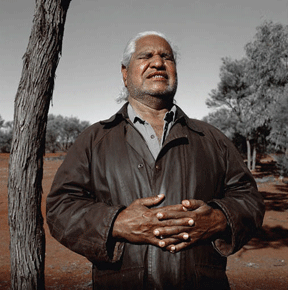
Karina Lester knows the fallout nuclear weapons can cause.
Her father, the late Yami Lester, went blind as a young man after the British tested atomic weapons in Emu Field.
“The scars are still felt on our Country,” said Ms Lester, a Yankunytjatjara Anangu woman from north-west South Australia.
“And the scars are still evident on our people.”
A group of Australian atomic survivors and relatives visited Canberra on Wednesday to speak with government decision-makers about their experiences of the British nuclear testing program in WA and SA.
They are calling on Prime Minister Anthony Albanese to sign the Treaty on the Prohibition of Nuclear Weapons.
In 1953 the British initiated a program of nuclear testing in Australia at the Montebello Islands, off the coast of WA and in Emu Field in South Australia.
Two years later, the British government announced a larger site for the tests at Maralinga.
Ms Lester carries her family’s stories about the impacts of the tests on her people.
“I had a grandmother of mine needing to dig a grave to bury her parents because soon after the radiation fallout, the elderly people started to suffer and die,” she said.
“My father never saw me or my children.
“It’s all because of a decision by governments of the day to say ‘That is no man’s country, go and test your bombs’.
“It’s been a huge, painful journey for us but it’s such an important story that needs to be told.”
Maxine Goodwin is the daughter of an Australian nuclear veteran who became ill as a result of his involvement in the first atomic test in WA.
“Signing the Treaty on the Prohibition of Nuclear Weapons is a significant step towards addressing the harm experienced by individuals and communities,” she said.
In October 1953 when the British detonated the Totem I and II nuclear bombs at Emu Field, Yankunytjatjara, Antikarinya and Pitjantjatjara woman June Lennon was only a few months old.
Her family witnessed the tests and have suffered from ill-health since.
“The government didn’t tell the truth about the nuclear testing program,” she said.
“There were so many lies. They didn’t tell people what they were doing.”
International Campaign to Abolish Nuclear Weapons Australia director Gem Romuld said it was important for policy makers to hear stories firsthand.
“Nuclear survivors are experts on the devastating humanitarian impacts of nuclear weapons,” she said.
“Australia’s experience with nuclear weapons testing is a powerful motivation to join the nuclear weapon ban treaty.”
The delegation will be in Canberra on Wednesday and Thursday to meet parliamentarians, including Foreign Minister Penny Wong and speak at an event hosted by the Parliamentary Friends of the Treaty on the Prohibition of Nuclear Weapons.
Nuclear waste on Aboriginal land ?- and the Voice to Parliament?
The Australian government is in the process of holding a referendum that would give the indigenous people a Voice to Parliament. Imposing nuclear waste on Aboriginal land is not a good look, is it?
This morning, I heard Professor Ian Lowe, talking to a English journalist, about yesterday’s court decision, which supported the Barngarla people’s opposition to nuclear waste dumping on their land.
Prof Lowe eloquently summarised the importance of this legal decision:
-the Aboriginal people were not consulted when the Morrison Liberal Coalition decided to make a nuclear waste dump on their traditional land.
– this raises problems for the Australian government in selecting any land in this country for nuclear waste dumping
-this has international implications – about any country where the rulers want to impose a nuclear waste dump on indigenous land
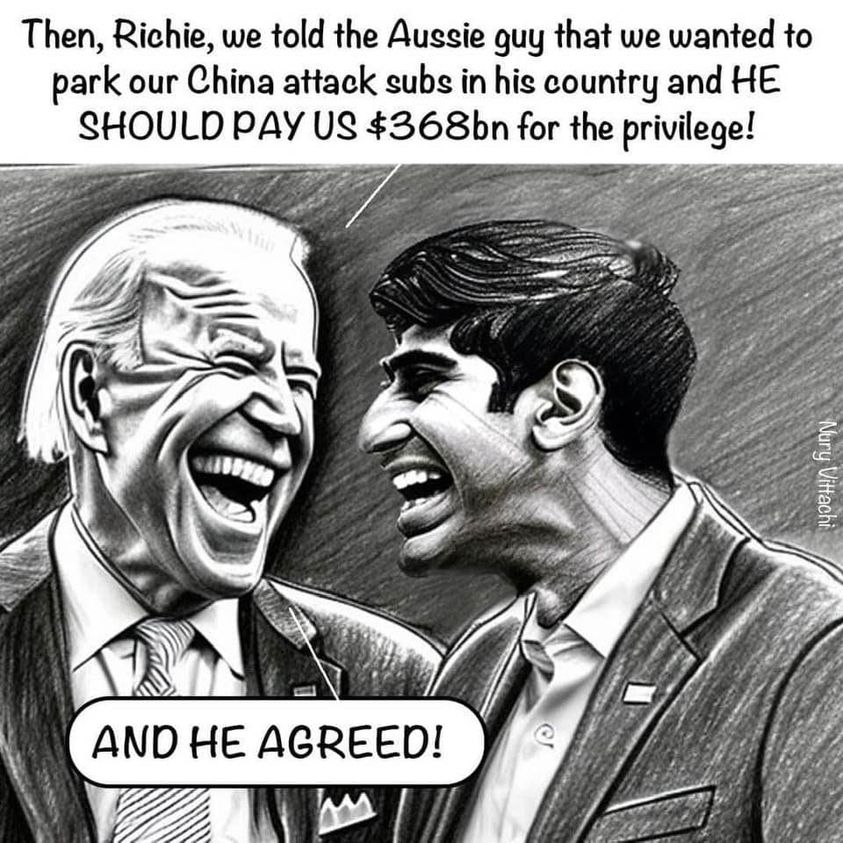
-this has implications for the ill-advised (corrupt firm PWC was the advisor) AUKUS decision by the Albanese government to buy U.S nuclear submarines at $369billion. That decision included Australia taking responsibility for the high level radioactive trash from the nuclear submarines. Where to dump that trash?
Of course, the Australian government does have the power to impose the nuclear waste dump anyway, against indigenous wishes, even against South Australian State government wishes,
The Australian government is in the process of holding a referendum that would give the indigenous people a Voice to Parliament. Imposing nuclear waste on Aboriginal land is not a good look, is it?
I have yet to meet an Australian voter willing to go to war over Taiwan. Further, I haven’t heard of any Australian military leader with a clear idea of Australia’s role in a showdown between China and the US.
Earlier this year, NASA’s survey satellite discovered an Earth-sized world within the habitable zone of a distant star. If it hosts life, its creatures may be listening to our conversations. They are likely amazed that earthlings seem to be sleepwalking towards their first war between nuclear powers.
At the heart of the conflict is the political system that prevails on an island of 23.5 million people because of sovereignty issues left over from two Sino-Japanese wars. These far-off observers might be even more curious if they knew about the availability of a tested formula that for 50 years kept peace in one part of the small blue planet.
I have yet to meet an Australian voter willing to go to war over Taiwan. Further, I haven’t heard of any Australian military leader with a clear idea of Australia’s role in a showdown between China and the US. On the contrary, I’m told their consensus is that our naval assets would be unprotected against ocean-hugging hypersonic missiles.
One former Defence Department official told me if we sent submarines, “we’d better make sure that our submariners had their wills made out”. I’m told one now-deceased former general was fond of saying about our role in the Taiwan Strait: “We’d last three minutes.”
……………………………..The loose war talk over Taiwan led the former US secretary of state , Henry Kissinger to make a solemn warning back in May that we are facing great-power conflict like that which preceded World War I. He used the noun “catastrophe”.
Kissinger had negotiated the 1972 Shanghai Communique, which offers the diplomatic formula that preserved the peace and can go on preserving it until overtaken by any new political and economic reality 100 years off. The communique allows the world to “acknowledge” the Chinese claim that Taiwan is its province without “endorsing” the Chinese claim. And, quickly following, is the principle that “reunification” would not involve an act of war.
For its part, Taiwan steers away from a declaration of independence. Only 13 of the world’s nations see Taiwan as independent. But it has enjoyed self-government with a contestable political system and a prosperous economy. This strategic ambiguity has served us.
A Taiwan that resembles Hong Kong is not desirable. I said in my recent interview with Mark Bouris, it would be preferable to a nuclear war…………………………………….
Any hard-nosed assessment of our national interest would have us redouble – then redouble again – our commitment to guardrails and off-ramps to stop the descent into conflict. There are subtle suggestions that both the US and China have pulled back to earlier red lines, and with the support of the Taiwanese leadership. In that spirit, House Speaker Kevin McCarthy in April met the President of Taiwan, Tsai Ing-wen, on American soil and not in Taipei. The Chinese response was comparatively subdued.
In this month’s Australian Foreign Affairs, Sam Roggeveen of the Lowy Institute delicately etched how recent Canberra decisions had rendered Australian sites more likely nuclear targets. It includes having B52s fly out of RAAF Tindall near Darwin, assumedly with the mission of striking China’s nuclear infrastructure. It may include Submarine Rotational Force-West in the planned nuclear submarine base at HMAS Stirling, and Port Kembla on the east coast.
Roggeveen concludes that in a future crisis, Australia’s profile is going to be much higher in the eyes of Chinese military planners.
Elysee Palace official claimed that Paris is against NATO expansion beyond the North Atlantic. “NATO means North Atlantic Treaty Organization,” the French presidential staffer reportedly emphasized.
Paul Keating has argued that the military bloc should remain confined to Europe and the Atlantic and not try to expand into Asia
NATO has no place in Asia and should stick to its original focus, that is the security of the Transatlantic region, former Australian Prime Minister Paul Keating has argued. The Labour politician, who served in office from 1991 to 1996, also warned against attempts to “circumscribe” China.
In his statement published on Sunday, Keating appeared to refer to a recent report in Politico, which claimed French President Emmanuel Macron had blocked NATO’s plans to establish a liaison office in Japan.
The former premier lauded the French head of state for “doing the world a service” by apparently emphasizing the military bloc’s focus on Europe and the Atlantic.
According to Keating, the alliance’s very existence past the end of the Cold War “has already denied peaceful unity to the broader Europe.”
Exporting such “malicious poison to Asia would be akin to Asia welcoming the plague upon itself,” he insisted. The former prime minister warned that NATO’s presence on the continent would negate most of the region’s recent advances.
Keating went on to describe NATO Secretary General Jens Stoltenberg as the “supreme fool” on the international stage who is conducting himself like an “American agent.”
He cited a comment Stoltenberg made back in February when he called for the West not to repeat the “mistake” it had made with regard to Russia, suggesting it should work to contain China.
The former Australian leader noted that the NATO chief conveniently ignored the fact that “China represents twenty per cent of humanity and now possesses the largest economy in the world.” He added that Beijing, unlike Washington, “has no record of attacking other states.”
Over the weekend, Politico cited an anonymous Elysee Palace official who claimed that Paris is against NATO expansion beyond the North Atlantic. “NATO means North Atlantic Treaty Organization,” the French presidential staffer reportedly emphasized.
Back in May, the Japanese ambassador to the US, Koji Tomita, revealed that his country was working toward opening a NATO liaison office in Tokyo, which would become the bloc’s first in Asia. Prime Minister Fumio Kishida confirmed the plans to Japanese lawmakers, noting that Tokyo did not intend to join the US-led organization.
Commenting on the news, Chinese Foreign Ministry spokesperson Mao Ning advised NATO against “extending its geopolitical reach.” The diplomat pointed out that the “Asia-Pacific does not welcome bloc confrontation or military blocs.”
The mainstream media continues to beat the drums of war while voices of truth and reason are being silenced, writes Dr William Briggs.
JOHN PILGER, in highlighting the manipulation of our media, called on people to ‘speak up’.
The drive to war and the demonisation of China have seen many people speak up and speak out. That same manipulated media has muffled those voices and pushed dissent to the margins. Journals and websites like this one are increasingly becoming almost samizdat publications. The mainstream media has played an important role, not only in silencing dissident voices but in convincing the public that there is little effective opposition.
A glance at the anti-AUKUS website shows that over 1,000 individuals and more than 200 organisations have thus far lent their support for a rational and sane response to the rising threat of war with China and obscene military spending.
There are many important voices among the signatories but their voices are not regularly heard in our media. Their words do not appear in the major daily newspapers, regardless of how well-credentialed they might be. Our former Prime Minister, Paul Keating, has effectively been relegated to the sidelines for voicing a position that does not fit with the official line.
And, while the collective wisdom of so many is ignored, the war-mongers of the Australian Strategic Policy Institute (ASPI) are given free rein.
‘In so many ways, the product of ASPI is critically important, not only in informing the Australian public, but those of us in government who seek to play a role in this space.’
Marles states that the Australian public must be informed. He recognises this to be ‘critically important’ but there is an unhealthy degree of censorship that is impossible to ignore. The information that the public is allowed to see, hear and read is the information that is filtered. There is a strong sense of creeping authoritarianism in all of this………………………………………..
The intellectuals, essayists, poets and novelists that might speak up and speak out remain, either silent or silenced by the mainstream media. It is not that they are not there. It is not that many thousands of ordinary people do not share the view that things are terribly wrong. The media has played and is playing a bad role. It is media in name only. It has abandoned any semblance of independence. It is so hard to speak out if you are kept captive; if ideas are filtered and disinformation passes for truth.
Pilger rightly calls on those with a conscience to speak out. What needs to be remembered is that the marketplace for ideas has shrunk……………………..Truth has become the property of those who control the media.
Pilger has been sidelined. Film-maker David Bradbury, twice nominated for an Academy Award, is now touring his latest documentary, The Road to War, screening it wherever an audience can be found. Even so, its circulation and therefore its audience remains limited.
American vengefulness would see WikiLeaks founder Julian Assange die in prison. Successive Australian governments have behaved equally badly, but the USA calls the shots. Assange’s crime? To report the truth. The truth, however, is not what Richard Marles is thinking of when he talks of the ‘critical importance’ of informing the public.
…………………………John Pilger’s call, for us all to speak up, has never had more urgency. The decades since the end of WWII and the proclamation of the U.S.-inspired rules-based order have seen millions die in American-led wars.
AUKUS dinner guests at the Cosmos Club, Washington: US Secretary for Navy, Carlos Del Toro; Republican Congressman Rob Wittman; Labor MP Meryl Swanson; Australian ambassador, Kevin Rudd; Liberal senator James Paterson; ex-Minister for Defence, lobbyist Christopher Pyne. (Photo: Pyne & Partners)
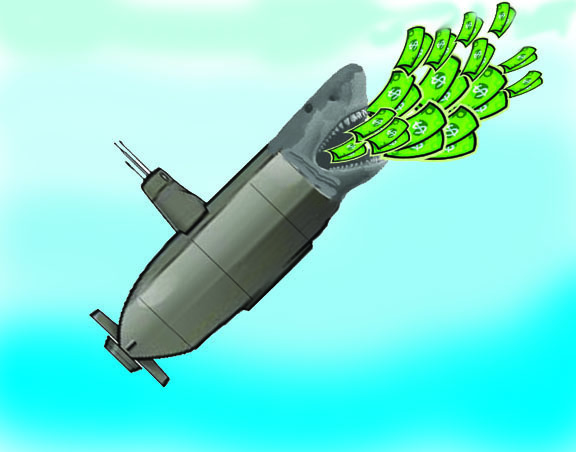
Declassified Australia reveals the feast for lobbyists, US defence contractors and hangers-on which is the AUKUS $370bn submarines deal, Kelly Tranter reports.
The defence lobbying firm Pyne & Partners – chaired by the former Australian Defence Minister Christopher Pyne – co-hosted an AUKUS reception and dinner in Washington at the swanky Cosmos Club on Embassy Row, with Northrop Grumman Corporation, on 3 April 2023.
Northrop Grumman is one of the largest defence companies in the world, and is the parent company to spin-off Huntington Ingalls, the US’s largest naval shipbuilder and one of the builders of the Virginia-class submarines destined to come to Australia.
The meeting was ‘private’ even though it concerned Australian defence contracts and arrangements and was attended by the Australian Ambassador and two Australian MPs, and senior US defence officials. Without public disclosure of what happened at the gathering, the Australian public once again is left in the dark.
However, Declassified Australia has been able to prise open the locked shutters on the private event to shine in some needed light. With hundreds of billions of dollars at stake through the AUKUS submarine deal, what calibre of people could be expected to attend such an event and what could possibly be their interest?
Documents produced pursuant to Freedom of Information (FOI) laws, by this writer, confirm that Australia’s Ambassador to the USA, Kevin Rudd, was invited to provide a speech, the contents of which journalists had previously reported to be ‘off the record’.
Declassified Australia has obtained the Ambassador’s briefing notes – though somewhat redacted due to national security considerations, ‘for the security of the Commonwealth’ and to avoid ‘damage to the defence, or international relations, of the Commonwealth’.
Rudd’s address was scheduled to follow those of the US Secretary for Navy, Carlos Del Toro, and Congressional Representative Rob Wittman. Rudd was allowed a period of five minutes for his remarks, ‘in between the main course and dessert’.
Congressman Wittman was among a bipartisan group of members of the US House of Representatives who in January sent a letter to President Joe Biden expressing support for the AUKUS deal. He unsurprisingly welcomed the huge AUKUS submarine spend as ‘a unique opportunity to leverage the support and resources possible under AUKUS to grow our industrial base to support both US and Australian submarine construction’.
In January he also was suggesting sending a jointly operated US submarine to Australia, saying, “I think it would be dual-crewed. I think too, that the command of the submarine would be a dual command”. These remarks, of course, raise sovereign control issues.
Another claim to fame of Representative Wittman was being named in a September 2022 analysis by The New York Times as one of at least 97 members of Congress who bought or sold stock, bonds or other financial assets that intersected with their congressional work or reported similar transactions by their spouse or a dependent child.
Rob the insider trader
Although the Times noted that U.S. lawmakers are not banned from investing in any company, including those that could be affected by their decisions, the report confirmed that Congressman Wittman traded shares of three defence contractors while he was a member of the House Armed Services Committee, which incidentally included the AUKUS event co-sponsor, Northrop Grumman
The Congressman’s response to the media revelation was to say: “I have consistently believed members of Congress should not improperly benefit from their role, and I support measures to avoid conflicts of interest.” He went on to say, “This is why I relinquish all control of my investment decisions to my financial adviser to use third-party investment managers who implement trades at their own discretion without my consultation or input,” which, he noted, is allowed under House ethics rules.
The new FOI documents confirm that Congressman Wittman is currently the Vice Chair of the US House Committee on Armed Services, Chair of the Tactical Air and Land Forces Committee and Seapower and Projection Forces Subcommittee, is on the House Select Committee on Strategic Competition between the US and the Chinese Communist Party (sic), and is on the Energy and Mineral Resources Subcommittee of the US Congress.
The FOI documents reference that, ‘Rep Rob Wittman was first elected to serve the first congressional district of Virginia in December 2007. His district is adjacent to Naval Base Norfolk as well as the major shipbuilding facilities in Newport News, Virginia – including one of the shipyards that builds Virginia-class attack submarines (Huntington Ingalls). Many of his constituents are employed either by the shipyards themselves, or by the supporting industry in the region.’
So it’s all just hunky-dory that through his investment advisor he can invest to profit from the success of defence contractors.
As to Secretary of the Navy, The Hon Carlos Del Toro, the FOI document suggests under the sub-heading, ‘Industrial collaboration’, that Ambassador Rudd was specifically tasked to ‘seek Toro’s ongoing support and endorsement’, and to recognise that ‘we continue to work with the US government agencies to overcome barriers to industrial base, supply chain and technology collaboration’.
China’s military modernisation program and its operation of nuclear-powered submarines, including both nuclear and conventionally armed, are mentioned in Ambassador Rudd’s ‘briefing notes’ obtained under FOI, along with this acknowledgement:
‘We do not oppose any nation’s right to invest in and develop defence capabilities. However, a lack of transparency around military capabilities can fuel insecurity.’
Transparency debacle
The stated concern about lack of transparency is at odds with the Australian government’s own lack of transparency to Australian citizens in relation to the entire AUKUS deal. They have yet to make signed copy of the agreement publicly available.
As to the effect of AUKUS on Australia’s defence sovereignty, Rudd’s briefing notes confirm Australia’s generous desire to ‘ease pressure on the US supply chains’ and provide the US submarines with their long-desired Indian Ocean naval base:
‘Australia will build new maintenance and repair capabilities that will directly benefit US submarines rotating through HMAS Stirling [naval base near Perth]’.
The language of the FOI document – ‘aligning national priorities’, ‘collective strength’, ‘mutual strategic benefit’, ‘deeper cooperation’ – all seems to be geared towards a fully integrated strategic and industrial base with little room for Australia’s sovereign defence issues.
And what does it say when a private Australian defence lobbyist funds eight-day international trips for the attendance of two Australian ‘non-Defence’ politicians to a private Washington event it is co-hosting with one of the largest defence companies in the world? And what does it say when the lobbyist invites a US guest speaker who trades in defence company stocks while holding political defence offices? And what does it say when input by senior US military officials and by our own ambassador to the US, until this FOI application, we’re not even permitted to see?
Transparency and integrity of decision-making in relation to AUKUS ought not be shrouded in lavish invitation-only discussions where private interests eye-off the billions in potential profits — and where Australia’s future is on the table.
This story was first published by Declassified Australia
The US seems to be getting cold feet over giving Australia one of its most secret weapons, with a new report revealing eight critical, unanswered questions.
The first USS Virginia-class submarine entered service in 2004. Since then, another 37 have been built or ordered. And an unknown number of those completed before 2017 incorporate low-grade steel supplied under a quality-control corruption scandal.
The document, issued late last week, specifies eight critical unanswered questions of concern.
• When will the deal be authorised?
• Will it approve the sale of two, or “some other number” of US submarines?
• When will these submarines be removed from the US Navy?
• Will they be old submarines? Newly-built submarines? Or a mix of both?
• How much will Australia pay? And how much will it subsidise the upgrade of US shipyards?
• Can the US meet its own submarine needs as well as those of Australia?
• Will the project make any difference in deterring China?
• What are the risks versus the benefits of giving Australia such immensely secret nuclear and submarine technology?
“Selling three to five Virginia-class boats to Australia would reduce the size of the US Navy’s SSN force by three to five boats,” the report states.
Seller’s remorse?
The report says sceptics of the deal believe “it could weaken deterrence of potential Chinese aggression if China were to find reason to believe, correctly or not, that Australia might use the transferred Virginia-class boats less effectively than the US Navy would”.
That’s not just a matter of the skills and training of Australian submariners.
It’s also an admission of concern that this may effectively mean the US had lost two to five submarines if Canberra doesn’t automatically participate in US conflicts.
“Australia might not involve its military, including its Virginia-class boats, in US-China crises or conflicts that Australia viewed as not engaging important Australian interests,” the report warns.
Defence Minister Richard Marles said as much in March when he revealed Australia had “absolutely not” promised to do Washington’s bidding when it came to Taiwan.
And that would diminish US Naval fleet numbers even further, unless the Australian submarines were replaced.
Sceptics of the SSN AUKUS pathway might argue that it would be more cost-effective for US SSNs to perform both US and Australian SSN missions while Australia invests in other types of military forces, so as to create a capacity for performing other military missions for both Australia and the United States.”
But behind the debate is a simple equation of supply and demand.
“In a nutshell, the challenge for the industrial base – both shipyards and supplier firms – is to ramp up production from one ‘regular’ Virginia-class boat’s work per year … to the equivalent of about five ‘regular’ Virginia-class boats’ work per year.”
It adds that no such additional purchase orders have yet been made and that doubts surround the ability of US naval yards to meet the extra demand. The US has only two shipyards capable of building nuclear-powered submarines.
The report warns that – even under pre-AUKUS plans – the US Navy’s desire to sustain a minimum of 66 nuclear attack submarines is likely to be unachievable.
The current number of 49 is expected to fall to 46 by 2028, with existing building programs only lifting this number to 60 by 2052.
Buyer beware?
The first USS Virginia-class submarine entered service in 2004. Since then, another 37 have been built or ordered. And an unknown number of those completed before 2017 incorporate low-grade steel supplied under a quality-control corruption scandal.
But the US Navy has since shifted production towards a bigger version of the submarine. A 25m-long hull section will be added to carry four large vertical launch tubes. This allows the design to carry extra Tomahawk cruise missiles or drones.
The Congressional report puts the cost of these at $US4.3 billion ($6.5 billion) each.
And the US Navy has this year requested another modified version of the submarine.
Designated the “Modified VIRGINIA Class Subsea and Seabed Warfare (Mod VA SSW) configuration”, this design is no longer optimised for the attack submarine role.
Instead, it will be equipped to conduct seabed sabotage operations against infrastructure such as undersea internet cables.
This version will cost about $US5.4 billion ($8.1 billion).
Australia may offset some of the cost of buying US submarines and upgrading US submarine facilities by providing a new base for US and UK operations.
London and Washington hope to begin basing nuclear attack submarines at HMAS Stirling, near Perth, in 2027.
This “Submarine Rotational Forces – West” facility will play host to year-long visits from both nations to provide training for ADF personnel and a support base for operations in the Indian Ocean, Andaman Sea and South China Sea.
“This rotational force will help build Australia’s stewardship,” a senior Biden administration official said earlier this month.
“It will also bolster deterrence with more US and UK submarines forward in the Indo-Pacific.”
High stakes game
The Beijing-controlled South China Morning Post news service has released previously secret details of a submarine incident in January 2021.
Quoting a Chinese military research paper, it says three US surveillance planes had engaged in a “hunt” for People’s Liberation Army submarines.
One of the aircraft, it claims, was met with a “significant” military response when it closed to within 150km of Hong Kong.
“The PLA, which was conducting a naval exercise in the area, responded swiftly by sending out a counter force, the size and nature of which remains classified,” the Post states.
“The two forces were so close that the US military ‘self-destroyed’ its floating sonars to prevent the sensitive devices from falling into China’s hands.”
US Indo-Pacific Command told The War Zone that one of its P-8A Poseidon patrol aircraft had been intercepted in the South China Sea. It denied it had breached any international boundaries.
“The US P-8A that flew on 5 Jan 2021 was intercepted twice in international airspace between Woody Island and Hainan Island roughly 500km from Hong Kong,” a statement reads.
“US and allied aircraft routinely fly in international airspace to maintain situational awareness and reinforce international norms.”
Hainan Island houses one of China’s main naval bases. This includes piers and dry-docks suited to its new aircraft carriers. And tunnels have been dug into the side of a rocky peninsula to house submarines.
Military analysts regard China’s submarine technology as being “decades” behind that of the US and Russia.
But Moscow’s precarious international position after its invasion of Ukraine has raised fears it may be willing to swap the technology with Beijing for material support.
And China’s newest diesel-electric “Yuan” class submarines reportedly demonstrate new levels of quietness, carry advanced sonars and “might be actually pretty good at anti-submarine warfare,” says Hudson Institute Center for Defence Concepts and Technology senior fellow Bryan Clark.
The whistleblower noted the comments of Australian Labor Party Prime Minister Anthony Albanese, who has made extremely tepid statements expressing “concern” over Assange’s plight. Albanese has said that “enough is enough” in relation to the Assange case. He claims to have made private representations to the US and British governments on behalf of Assange, but has stopped far short of any public demand for the Australian journalist’s freedom.
Albanese has recently hinted at the prospect of a plea deal in the Assange case. Kenny forcefully rejected this course. “Is there a Hicks solution? Why should there be? He has not committed any crime. He should not be forced to plead to anything. We need our prime minister to stand up, not just say ‘enough is enough.’”
Some 800 people attended a protest in Sydney yesterday morning demanding the immediate freedom of imprisoned WikiLeaks publisher Julian Assange. People came from across New South Wales and from around the country to attend the rally, which was one of the largest demanding Assange’s freedom yet, despite being held on a weekday.
Speaking at the demonstration, Stella Assange, Julian’s wife, declared that the protesters were “at the forefront of a global movement for justice. A global movement that converges on one man, but the meaning of which goes far beyond Julian’s freedom. It’s not just Julian who has lost his freedom, but all of us. Because in order to keep Julian in prison, they have had to corrupt their own rules and their own principles.”
Stella, visiting Australia for the first time, noted that her tour had initially been planned to coincide with a scheduled visit of US President Joe Biden. He had been set down to attend a summit of the warmongering and anti-China Quadrilateral Strategic Dialogue this week in Sydney.
Biden cancelled, however Stella proceeded with the visit. She explained the crucial importance of the fight within Australia to securing her husband’s freedom. Assange is detained in Britain and faces extradition to the US, where he would be tried on Espionage Act charges carrying 175 years imprisonment for exposing American war crimes.
Assange is an Australian citizen. Stella explained: “Julian’s case is a case of global importance. But you guys are at the centre of it because Julian is an Australian, he’s a country boy, and he’s from this country. That means that the key to securing Julian’s release lies with you.”
Assange’s supporters in Australia were part of a “global movement” involving millions of people all over the world, she said. There is a growing recognition, internationally, that “he’s in prison because he exposed the crimes of others. No decent human being will ever tolerate that. The only people whose interest remains Julian’s imprisonment, are the ones who are guilty and implicated in those crimes.”
Within Australia, there had been a “sea change.” Only a few years ago, there had been “radio silence” on Assange’s case. But increasingly it was being discussed in the media, as well as by official politicians. This, Stella stressed, was a consequence of the demands made by ordinary people and a protracted grassroots campaign.
This fight had to be deepened, she said. “You guys need to shout louder, fight harder, put the pressure on each of your representatives, make Julian’s situation visible everywhere, every day, on your cars, on your shirts. Every day you tell all your friends, you talk about it with your family… Make sure Julian remains top priority until he steps out of that prison. I think we’re near, we can achieve this together.”
Stella noted that it was her first time in Australia, but it would not be her last. “I will come back here, home with Julian, and our kids who are Australian citizens will come home too.”
John Shipton, Assange’s father, placed the persecution of Assange within a broader context. Brown University, in the United States, had recently published a report showing that there had been 4.5 million deaths in the Middle East following the 2003 invasion of Iraq. An earlier document, from the same institution, estimated that the predatory US-led wars in the region had displaced 38 million people.
Speaking of those US interventions Shipton condemned a “hegemon standing in a river of blood.” He emphasised the striving of ordinary people for “justice” and “humanity,” which would ultimately be victorious. Assange’s case and the fight for his freedom were integral to this broader struggle.
Gabriel Shipton, Assange’s brother, said: “If anything is to be taken from Julian’s persecution, it is that it has mobilised people all around the world… The fight gives meaning to Julian’s work. It has brought us all together here to fight for something that is so important to our Western democracies and that’s a free press. How can we make decisions about what our governments do in our name if we don’t know? It’s not possible.”
David McBride addressed the protest. A former Australian army lawyer, he faces life behind bars for blowing the whistle on Australian war crimes in Afghanistan. They included verified murders of civilians and prisoners and other violations of international law. For these offenses, McBride, the man who exposed them, is the first to face court proceedings.
“There’s a good chance that even though I reported murders and cover-ups, that I’m going to go to jail for the rest of my life… It’s not something I hang my head about. It’s something I’m proud of… We need to stand up, the future of the planet depends on it.”
The whistleblower noted the comments of Australian Labor Party Prime Minister Anthony Albanese, who has made extremely tepid statements expressing “concern” over Assange’s plight. Albanese has said that “enough is enough” in relation to the Assange case. He claims to have made private representations to the US and British governments on behalf of Assange, but has stopped far short of any public demand for the Australian journalist’s freedom.
McBride responded: “I say this to Anthony Albanese. Enough of you saying ‘enough is enough.’ It means nothing. Imagine if I had witnessed war crimes in Afghanistan, witnessed murder and cover-up… and all I said to them is ‘enough is enough.’ It’s not enough.” McBride called for Albanese to “step up to the plate” and secure Assange’s unconditional freedom.
Stephen Kenny, Assange’s Australian lawyer, issued the same demand. Kenny represented Australian citizen David Hicks, who was rendered to the American military prison in Guantánamo Bay as part of the “war on terror.” Hicks was eventually freed and returned to Australia, as the result of a powerful campaign led by his father Terry Hicks. David Hicks had been compelled to sign a plea deal, despite having committed no crime.
Kenny noted the parallels. “Like David Hicks, Julian Assange has not committed any crime at all. So why is he in jail?” The editors of other major publications, who were involved in WikiLeaks’ 2010 and 2011 releases, for which Assange is being prosecuted, remain at liberty. This, Kenny explained, made clear that the case against Assange was political and required a political solution.
He outlined some of the abuses of the British judiciary. This included placing Assange in a glass box at the back of his courtroom during the first extradition proceedings, denying him the right to participate in his own case. Assange’s lawyers, moreover, had filed their latest appeal in November. The British judges merely need to determine whether he has an arguable case, a process which Kenny said should take several days or at most a week. But six months on and this task has not been completed.
Albanese has recently hinted at the prospect of a plea deal in the Assange case. Kenny forcefully rejected this course. “Is there a Hicks solution? Why should there be? He has not committed any crime. He should not be forced to plead to anything. We need our prime minister to stand up, not just say ‘enough is enough.’”
The rally raised several political issues. Many of the speakers, importantly, emphasised the decisive role of mobilising ordinary people in the fight to free Assange.
Inevitably, the statements of Albanese and other Labor representatives have generated some hope within the Assange camp. But there is no indication, whatsoever, that Albanese is fighting for Assange’s freedom, behind closed doors or anywhere else. This week he refused to even meet with Stella Assange. Albanese was part of the Gillard Labor government, which in 2010 and 2011, played a central role in the initial stages of the persecution of Assange…….. https://www.wsws.org/en/articles/2023/05/25/rgzp-m25.html?fbclid=IwAR1yfKnxx-_FuaTf0qdcSzFjaiYawdDU8YzVOUBFX5GT0RrBI6gj61xvWCE
We the undersigned are scholars of the humanities and social sciences and other disciplines with expertise in the following issues. We write this open letter to express our concerns regarding the Australia, United Kingdom, United States (AUKUS) trilateral security agreement. Specifically, our concerns relate to pillar one of the agreement, the joint development with the US and the UK of a nuclear-powered submarine (SSN) capability for Australia.
The underlying strategic rationale behind the AUKUS decision has not been adequately explained to the Australian public. Even if it is argued that the SSNs may provide certain capability advantages, the government has not made clear how AUKUS will translate into a safer Australia.
AUKUS will come at a huge financial cost and with great uncertainty of its success. It is likely to compound Australia’s strategic risks, heighten geopolitical tensions, and undermine efforts at nuclear non-proliferation. It puts Australia at odds with our closest neighbours in the region, distracts us from addressing climate change, and risks increasing the threat of nuclear war. Australia’s defence autonomy will only be further eroded because of AUKUS. All of this will be done to support the primacy of an ally whose position in Asia is more fragile than commonly assumed, and whose domestic politics is increasingly unstable
There is no question that a submarine capability is critical for Australia’s defence, particularly for undertaking surveillance and protecting our maritime approaches. The central and critical question, however, is does defending Australia require the offensive long-range power-projection capabilities provided by SSNs?
The answer provided by Defence, and successive Australian governments, has until recently been consistently in the negative. The procurement of French-designed diesel-electric powered submarines, initially sought to replace the ageing Collins-class boats, would be, it was promised, ‘regionally superior’. Now, we are told, it is only the superior attributes of SSNs that fulfil Australia’s defence requirements.
Perhaps this is the case. But Australia should not proceed based solely on these publicly untested assumptions. Peter Varghese, former head of the Office of National Assessments and the Department of Foreign Affairs and Trade, makes the salient point that AUKUS is too momentous a decision to be left to the ‘echo chamber’ of classified discussions. It demands a yet to be had ‘proper and forensic public discussion about other options and their underlying rationale’.
SSNs, it has been proclaimed, are superior vessels when compared to conventionally-powered submarines in terms of stealth, speed, manoeuvrability, endurance, and survivability. This is correct in some respects, but only to an extent, and with important qualifications. Many of the apparent advantages of SSNs are conditional on the specific operational environment, and technological developments may render them less stealthy and effective than defence officials assume.
More importantly, possible superior capabilities alone do not translate into direct defence benefits, and many of the claims made in favour of SSNs enhancing Australia’s security do not survive scrutiny. For example, it’s been argued that the superior speed and endurance of SSNs provides advantages for protecting Australia’s vital shipping routes. However, the volume of our seaborne trade is much too large to patrol effectively, and that which passes through the South China Sea goes mainly to China.
Similarly, the argument that SSNs are required to protect Australia’s undersea communications infrastructure is overstated. Spread across a large geographic area, undersea cables are difficult to protect militarily, vulnerable to attack not only by submarines but also by relatively unsophisticated and cheap underwater technologies.
Significantly, there has been no compelling strategic argument made for why a small number of expensive nuclear-powered submarines confers greater defence advantages rather than a much larger number of cheaper conventionally powered ones.
Whatever the tally of defence benefits that SSNs might offer Australia, they must be carefully weighed against the costs and risks.
With an official estimate of up to $368 billion, almost certain to rise to even greater heights, AUKUS constitutes the most expensive defence procurement in Australian history by a wide margin. Equally importantly, the significant and ongoing opportunity costs and trade-offs this presents for defence and broader social spending are not easily dismissed.
Constructing SSNs will be one of the biggest engineering feats Australia has ever undertaken. There are immense execution risks involved in this effort to build, operate, maintain, and crew eight SSNs, and two types of boat simultaneously – the existing American Virginia-class and the yet to be designed AUKUS-class – with no experience in the management of nuclear-propulsion technology.
The political uncertainly inherent across all three nations, over a period of 10 terms of the Australian government, also raises the risk profile. It seems imprudent to hitch Australia’s most expensive and lethal defence capability to an increasingly uncertain ally that is in relative decline, politically unstable, and exhibiting troubling signs of sliding into an illiberal democracy.
Australia’s future nuclear naval reactors, fuelled by weapons-grade uranium, will not be subject to routine International Atomic Energy Agency (IAEA) safeguards on the grounds of protecting sensitive American military information. Although Australia is in negotiations with the IAEA to develop alternative safeguards, this establishes a troubling precedent for other non-nuclear armed states to exploit, and risks undermining international controls to prevent nuclear proliferation.
Australia’s degree of dependence on the United States to safely operate the SSNs is likely be high and risks the possibility of a US veto over their operation. It may not be wholly unusual for Australia to have limited operational sovereignty of its defence assets, but as former prime minister Malcolm Turnbull has remarked, AUKUS takes this dependency to new heights. The pressure to submit this capability to American strategic interests will be almost impossible to resist.
Still, the most significant risks are strategic. The tripartite enterprise risks incorporating Australia into the more offensive-oriented aspects of our American ally’s military strategy in East Asia, most worryingly with respect to nuclear warfare. AUKUS will equip Australia with a potent capability to strike Chinese naval forces close to their home ports and, in coalition with the US, play a frontline role in hunting China’s nuclear-armed submarine force and its second-strike nuclear deterrent capability. ‘For this reason alone’, warns the Australia Institute’s International and Security Affairs head, Allan Behm, ‘China will view Australia’s decision as a wilful contribution to an existential nuclear threat to China’.
Many of our closest neighbours in Southeast Asia and the Southwest Pacific have expressed concerns that the agreement will heighten geopolitical tensions, contribute to a regional arms race, and undermine nuclear non-proliferation. Such criticism reflects that AUKUS is at odds with regional desires to achieve a peaceful and balanced strategic order, and with the deep antinuclear sentiment that is an especially central element of Pacific regionalism.
Pacific island states have made clear that their primary and immediate security concern is climate change, and expressed the view that AUKUS indicates a lack of serious commitment from Australia in helping them to deal with that risk. Pacific voices should remind us that we too are facing a first-order strategic threat from climate change, and AUKUS serves as a distraction from addressing that critical threat to our security.
Put simply, the public case for AUKUS has yet to be made with any degree of rigour or reliability. The government must justify how the agreement will make Australia safer and at an acceptable cost. We the undersigned call on the government not to proceed with pillar one of AUKUS until and unless the questions and issues raised in this letter are adequately explained and addressed.
Signatories (as of 23 May 2023): (There’s a lot of them – here
one of the possible strategic implications of the AUKUS submarine project is that it may set a dangerous new nuclear precedent for nuclear proliferation, eroding the international norms and institutions that currently safeguard against proliferation.
AUKUS drops the nuclear proliferation gauntlet
Accelerated plans to base nuclear subs in Western Australia by 2027 will significantly erode prevailing nuclear proliferation safeguards
The United States, United Kingdom and Australia have announced plans to base nuclear-powered submarines in Western Australia, using the Down Under area as an alternative to strategic bases in Guam while potentially sidestepping nuclear proliferation concerns.
The Insider reported this month that the Biden administration has established Submarine Rotational Forces–West (SRF-West), which are believed to consist of four US Virginia-class nuclear attack submarines (SSN) and one UK Astute-class SSN, and will operate out of HMAS Stirling at the western Australian city of Perth as early as 2027.
The Biden administration stated last month that SRF-West would “help build Australia’s stewardship. It will also bolster deterrence with more US and UK submarines forward in the Indo-Pacific.”
The Insider notes that the establishment of SRF-West comes at a time when US near-peer rivals China and Russia are expanding their submarine fleets, with Russia’s Yasen-class SSNs operating in the Atlantic and Pacific Oceans, and China’s nuclear-powered ballistic missile submarines (SSBNs) constantly patrolling the contested South China Sea.
Sidharth Kaushal notes in a March 2023 Royal United Services Institute (RUSI) article that Australian naval facilities that can base Virginia-class and Astute-class SSNs are relatively out of range from potential missile attacks, providing backup for Guam in case the latter is crippled by Chinese or North Korean “Guam Killer” missiles such as the DF-26 and Hwasong 14/15.
Kaushal notes that US overreliance on Guam has made US naval operations in the Pacific particularly vulnerable, with Guam’s possible loss in a conflict scenario substantially limiting the tempo of US submarine operations in the region and forcing US SSNs to travel longer distances for resupply.
Asia Times this month noted the various strategic challenges of defending Guam against missile attacks. Guam faces the perfect air and missile defense problem, as disjointed US missile defense systems on or near the island may not be effective against a saturation attack involving drones, ballistic missiles, cruise missiles and hypersonic weapons.
These unlinked missile defense systems consisting of the Terminal High Altitude Air Defense (THAAD) and Aegis-equipped nearby warships may fail first contact with advanced missiles, with the sheer number of missiles fired in a saturation attack demanding sensor fusion across various domains such as space and cyber to defeat hypersonic threats.
However, one of the possible strategic implications of the AUKUS submarine project is that it may set a dangerous new nuclear precedent for nuclear proliferation, eroding the international norms and institutions that currently safeguard against proliferation.
In a September 2021 article for Carnegie Endowment for Regional Peace, James Acton notes that AUKUS demonstrates a US double-standard regarding nuclear technology. In the context of AUKUS, Acton says that the bloc can make Australia the first non-nuclear armed state to remove nuclear material from the IAEA inspection system, setting a damaging new precedent for non-proliferation.
Acton mentions that while the Non-Proliferation Treaty (NPT) does not prohibit non-nuclear weapon states from building nuclear-powered ships, the IAEA cannot safeguard naval nuclear reactors, especially those on submarines, due to their secret locations and inaccessibility while submerged.
He also says that the IAEA Comprehensive Safeguards Agreement permits non-nuclear states to withdraw nuclear material for “non-proscribed military activity” such as naval reactors. That, Acton suggests, may set a precedent for other potential nuclear proliferators to exploit the IAEA’s loophole.
He notes that much of the world may see the US’s tacit consent for Australia to use the nuclear propulsion loophole while criticizing and punishing its adversaries for doing the same as a double standard, weakening the deterrent value of IAEA safeguards and making nuclear proliferation more likely.
South Korea in particular may take notice of the naval propulsion loophole to build its undersea nuclear deterrent, raising tensions with North Korea in an already volatile regional security environment.
Asia Times noted in June 2022 that the US and South Korea have agreed to share small modular reactor (SMR) technology, which can pave the way for the latter’s construction of nuclear submarines………………………………………………
Joel Ivre points out in a September 2021 Asia-Pacific Leadership Network article that AUKUS weakens South Korea’s commitment to nuclear non-proliferation, as nuclear-powered submarines present a much lower threshold for nuclear proliferation compared to a full nuclear weapons program………………………..
Other latent nuclear powers in Asia that may take notice of this weakening of proliferation safeguards are Japan and Taiwan, both of which have nuclear power programs and the likely resources, technology and know-how to assemble a nuclear weapon quickly should the perceived need arise. https://asiatimes.com/2023/05/aukus-drops-the-nuclear-proliferation-gauntlet/
Australians are particularly vulnerable to propaganda because Australia has the most concentrated media ownership in the western world, dominated by a powerful duopoly of Nine Entertainment (who airs 60 Minutes) and the Murdoch-owned News Corp. This vulnerability is being fully exploited as the time comes for the western empire to beat the war drums against China.
“It might sound like twisted logic, but military forces everywhere argue that the greater the firepower they possess, the greater the chance of maintaining peace,” opens 60 Minutes Australia’s Amelia Adams. “In other words, massive weaponry is the best deterrent to war. Right now the theory is being tested like never before, and much of it is happening in Australia’s backyard, the Indo-Pacific region. The United States wants the world, and more particularly China, to know of its increasing presence there, and to do that it’s putting on a spectacular show.”
What follows is 19 minutes of overproduced footage displaying this “massive weaponry” while Adams oohs and ahhs and gives slobberingly sycophantic interviews to US military officials.
“There’s something utterly mesmerising about the F-35 jet,” Adams moans. “The sound, the heat, and the power put this supersonic stealth fighter in a league of its own.”
“Colonel these are some very impressive machines you’re in charge of!” she gushes to an officer on an aircraft carrier.
“Yes ma’am,” the colonel replies.
Jesus lady, do your orgasming off camera.
Contrast this glowing ecstatic revelry with Adams’ open hostility later in the segment toward a Chinese think tanker named Henry Wang, claiming that he was trying to “rewrite history” for dismissing panic about a Chinese military buildup by pointing out (100 percent correctly) that China is spending a lower percentage of its GDP on its military than western nations.
“Every command, every maneuver, is being fine-tuned on this vast blue stage, where China has proven to be a bad actor, playing a long game of intimidating Pacific nations,” Adams proclaims over helicopter footage of US war ships. “But the US and its allies aren’t having it, bolstering their defenses — and it’s an impressive display.”
I defy you to find me footage more brazenly propagandistic than this, from any point in history. This is supposed to be a news show, run by people who purport to be journalists, yet they’re engaging in propaganda that looks like it came from a Sacha Baron Cohen spoof of a third world dictatorship.
As I never tire of pointing out, the claim that the US has been militarily encircling its number one geopolitical rival defensively is the single dumbest thing the empire asks us to believe these days. The US is surrounding China with war machinery in ways that it would consider an outrageously aggressive provocation if the same thing were done in its neck of the woods, which means the US is plainly the aggressor in this standoff, and China is plainly reacting defensively to those aggressions.
While the first segment unquestioningly regurgitates Pentagon narratives and gives supportive interviews to military officials, the second segment unquestioningly regurgitates talking points from the western intelligence cartel and gives supportive interviews to Five Eyes spooks.
“Showing off deadly weaponry in massive war games is a tactic China and the United States both use to try to avoid full-on combat,” says 60 Minutes Australia’s Nick McKenzie in introduction. “But the truth is the two countries, as well as other nations including Australia, are already battling it out in an invisible war. There are no frontline soldiers but there are significant skirmishes. Until now these conflicts have been kept quiet, but key members of a secretive alliance of top cops from Australia, the United States, the United Kingdom, Canada and New Zealand are about to change that.”
“Their group is called the Five Eyes, and tonight they want you to know what they see,” says McKenzie, which is the same as saying “We’re telling you what the Five Eyes intelligence agencies told us to tell you.”
McKenzie literally just assembles a bunch of Five Eyes officials to tell Australians that China is bad and dangerous, and then disguises the western intelligence cartel advancing its own information interests as a real news story.
“There is one threat that alarms our partners more than any other,” McKenzie says over dramatic music, asking “Which state actor is the key threat to democracy in Australia and amongst the Five Eyes partners?” and presenting a montage of western intelligence operatives answering (you guessed it) China.
“The Americans describe a growing menace on our doorstep flowing from China’s increasing influence in the region,” McKenzie says, before asking an American official, “Do you see the Chinese state preying on Pacific island nations?”
“I believe so, yes,” the official responds.
Western journalism, ladies and gents.
Australians are particularly vulnerable to propaganda because Australia has the most concentrated media ownership in the western world, dominated by a powerful duopoly of Nine Entertainment (who airs 60 Minutes) and the Murdoch-owned News Corp. This vulnerability is being fully exploited as the time comes for the western empire to beat the war drums against China.
We keep being hammered by this narrative that “massive weaponry is the best deterrent to war,” when all facts in evidence say the exact opposite is true. It was the military encroachment against Russia and the conversion of Ukraine into a NATO military asset which provoked Putin to invade Ukraine, and all the militarization against China that we are seeing is only inflaming tensions and making war more likely.
And, I mean, of course it is; even a casual glance at the Cuban Missile Crisis reveals that powerful nations don’t take kindly to having menacing forces placed near their borders. So much of the propaganda indoctrination we’re subjected to in the 2020s revolves around convincing people to believe that Russia and China should react completely differently than the way the US would react if foreign proxy forces were being amassed along its borders.
So yes, Amelia Adams, claiming that aggression and militarism is the best path toward peace is absolutely “twisted logic”. It is as twisted as it gets. Because it is false. This is obvious to anyone who hasn’t yet been successfully indoctrinated into this omnicidal belief system.
We need to do everything we can to fight against this indoctrination now, because if we wait until the war actually starts it will likely be too late to resist.
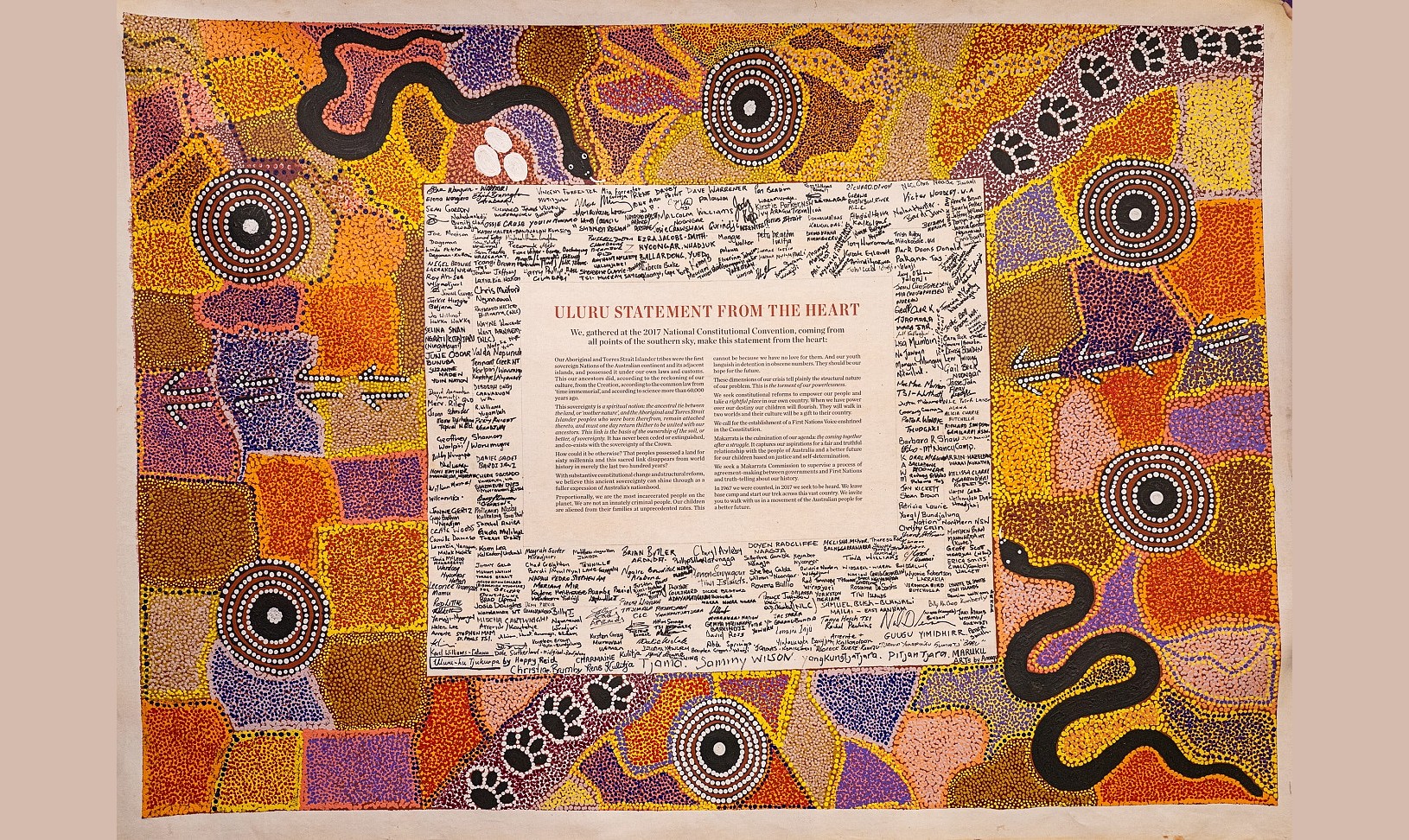
there is no question Defence would require the free, prior and informed consent of Indigenous people before a high-level nuclear waste facility could proceed on their land. …. in those circumstances the government must provide a veto right, because the project would eliminate future access to traditional Indigenous land.
If Plibersek knew about the radioactive waste facility and its intended siting in remote Australia at the time AUKUS was announced she has kept quiet about it.
A far more substantial inequality of power now exists between the Indigenous groups to be consulted about the site of the radioactive waste facility and the Defence Department. The facility has solid bipartisan support. In addition, it is essential to the AUKUS submarine deal, meaning Defence embodies the combined wishes of the Australian, British and United States governments.
Bipartisan secrecy and Defence’s poor record with Indigenous groups at Woomera are red flags for the consultation over AUKUS high-level nuclear waste facility.
The federal government had no public mandate for any of the AUKUS decisions: no mandate to enter the agreement, none to acquire eight nuclear-powered submarines for up to $368 billion, and none to establish a high-level radioactive waste facility. On this last, in fact, it had long term evidence to suggest Australians would likely oppose the proposition.
Perhaps this is why both major political parties concealed for 18 months, a period including the federal election, their shared knowledge that AUKUS requires a high-level radioactive waste facility to be built.
The AUKUS agreement was revealed on 15 September 2021. On 14 March 2023, deputy prime minister and defence minister, Richard Marles, announced the nuclear waste facility. Next day, opposition leader Peter Dutton said: ‘The Labor Party signed up to AUKUS knowing they would have to deal with the waste, and now that they’re in government they know that’s a part of the deal.’ The government has not denied Dutton’s claim.
Furthermore, Marles stated as a fait accompli that the waste facility will be built at a ‘remote’ site – code for Indigenous land – despite the fact that Indigenous people have repeatedly objected, and still are, to radioactive waste being stored on their land.
Meanwhile, the Albanese government continues its work to establish an Indigenous Voice to Parliament. Just nine days after the prime minister was in San Diego announcing the AUKUS submarine deal and his deputy Marles came clean about the radioactive waste facility, Anthony Albanese released the proposed Voice wording. The prime minister noted in his speech the importance of consultation, ‘it’s common courtesy and decency to ask people before you take a decision that will have an impact on them’.
Governments have been trying for decades to put a radioactive waste dump in outback Australia. They have been rebuffed time and time again. Yet the Albanese government is trying once more.
Legal experts have pointed out the international legal requirement to obtain the free, prior and informed consent of Indigenous peoples before making significant decisions that affect them. This process includes giving Indigenous peoples full information about a development in advance and respecting their choice to give or withhold consent.
The UN Declaration on the Rights of Indigenous Peoples, which Australia has pledged to support ‘in both word and deed’, says: ‘[No] storage or disposal of hazardous materials shall take place in the lands or territories of indigenous peoples without their free, prior and informed consent.’
As to whether the government can claim ‘national security’ as a reason to avoid these obligations and dictate a radioactive waste site, international human rights law expert John Podgorelec says: ‘States may not derogate from their responsibilities on the basis of national security unless a “state of emergency” has been formally invoked.’
He adds, ‘A lesson to come out of the Iraq calamity is that manufactured or undisclosed national security intelligence cannot be used to subvert democracy.’
Unfortunately, the Defence Department’s fact sheet on nuclear stewardship and waste is light on detail. It does not mention free, prior and informed consent. Defence commits only to ‘consultation and engagement’ – a lesser standard – and adds that it will also consider ‘wider social license and economic implications’. Globally, the ‘economic implications’ of significant projects habitually undermine human rights, particularly those of Indigenous peoples.
Furthermore, Defence has a poor track record of engagement with Indigenous people in one of its key locations, South Australia’s Woomera Prohibited Area (explored further in part two).
Woomera is used by Australian and foreign military forces, in close partnership with multinational weapons corporations, for extensive weapons testing and military training activities.
‘When militaries around the world need a place to test their weapons and fly their new fighter jets, there’s nowhere better than the rugged expanses of South Australia,’ enthused US weapons giant Raytheon in 2016, talking up ‘a further expansion of US-Australian cooperation’.
The Woomera weapons testing range covers one-eighth of South Australia, occupying more than 122,000km2. Before Defence took over, less than a century ago, Indigenous people had inhabited the region for tens of thousands of years.
Despite the international outcry at the destruction of Juukan Gorge, the Defence Department has not changed its behaviour. For example, it continues to use a registered Indigenous heritage site in Woomera as a target zone for high explosive weapons tests. (I visited this and other sites inside Woomera last year at the invitation of Andrew and Bob Starkey, senior Kokatha lawmen and traditional owners.)
Defence is aware of the site’s significance, just as Rio Tinto was aware of the significance of Juukan Gorge. Defence’s heritage management plan, relevant sections of which I have seen, says the site has a ‘high level of Aboriginal heritage value’ and is a place of ‘sensitive cultural significance that can be easily impacted’. The public might wonder how Defence can know this yet still decide it’s acceptable to direct high explosive munitions onto the site.
‘The Commonwealth cannot give with one hand and take with the other,’ says Podgorelec, who acts for the Starkeys, on the tensions between federal commitments to Indigenous heritage protection and to AUKUS. He says there is no question Defence would require the free, prior and informed consent of Indigenous people before a high-level nuclear waste facility could proceed on their land. He also says in those circumstances the government must provide a veto right, because the project would eliminate future access to traditional Indigenous land.
Australia is not alone in being unable to find a radioactive waste solution. The UK has failed for decades to make meaningful progress on dismantling decommissioned nuclear submarines – it currently has 21 of them floating in dockyards awaiting disposal, mirroring its wider failure to resolve its nuclear waste problems. The US has also failed in this regard: spent fuel from its nuclear submarines remains in temporary storage. Griffith University’s Emeritus Professor Ian Lowe has written that the nuclear waste from US military and civilian reactors ‘is just piling up with no long-term solution in sight’.
Defence does not mention this pertinent information in its brief positive account of US and UK nuclear stewardship.
The federal government gave its response to the Juukan Gorge inquiry report in November 2022. Minister Tanya Plibersek, whose Environment portfolio encompasses Indigenous heritage protection, said:
[T]hese are thorough and considerate reports… the recommendations speak to the principles and priorities that will shape our [heritage protection] legislation. Free, prior, and informed consent.
If Plibersek knew about the radioactive waste facility and its intended siting in remote Australia at the time AUKUS was announced she has kept quiet about it.
Free, prior and informed consent requires that intimidation and coercion be avoided. Plibersek is well aware of the possibility of abuses of power in high stakes developments. In her speech, she noted partnership agreements were signed under ‘gross inequalities of power’ between the traditional owners of Juukan Gorge and Rio Tinto.
A far more substantial inequality of power now exists between the Indigenous groups to be consulted about the site of the radioactive waste facility and the Defence Department. The facility has solid bipartisan support. In addition, it is essential to the AUKUS submarine deal, meaning Defence embodies the combined wishes of the Australian, British and United States governments.
Podgorelec is adamant. ‘Australia cannot enact domestic laws that undermine its international legal obligations. If a project will take away Indigenous cultural connection to land forever – as a high-level nuclear waste facility will do – then the government is obliged to give a right of veto.’
Note: The legal basis for free, prior and informed consent was explained by John Podgorelec as lead author of Adelaide University’s submission to the 2015 SA Nuclear Fuel Cycle Royal Commission. Unfortunately, having been available until recently, the Royal Commission’s website is presently inaccessible. Email us if you would like a copy of the submission: undueinfluence@protonmail.com
retired U.S. military figure” generally means someone who used to be paid by the U.S. government to advance the interests of the U.S. empire, and is now paid by corporations and/or foreign governments to advance the interests of the U.S. empire.
Among the American swamp monsters hired by Canberra is the Obama administration’s spy chief, who has an established track record of lying and manipulating to advance the interests of the U.S. empire.
Australia has been paying insiders of the U.S. war machine for consultation on how to run the nation’s military, a massive conflict of interest given that Washington has been grooming Australia for a role in its war agendas against China.
For those who don’t speak imperialist, “retired U.S. military figure” generally means someone who used to be paid by the U.S. government to advance the interests of the U.S. empire, and is now paid by corporations and/or foreign governments to advance the interests of the U.S. empire.
These corrupt warmongers rotate in and out of the revolving door of the D.C. swamp, from government to war-industry jobs to punditry gigs to influential think tanks and then back again into government, advancing the interests of the U.S. empire the entire time and growing wealthy in the process.
This dynamic allows a permanent constellation of reliable empire managers to continually exert influence around the world in support of the U.S. empire, regardless of who gets voted into or out of office in the performative display of electoral politics. It’s a big part of why U.S. foreign policy remains the same regardless of who’s officially running the elected government in Washington, and it’s a big part of why the media and arms industry which support the U.S. war machine keep playing the same tune as well.
Among the American swamp monsters Australia paid for consulting work is the Obama administration’s spy chief James Clapper, who has an established track record of lying and manipulating to advance the interests of the U.S. empire:
In 2013 Clapper committed perjury by telling the U.S. Senate under oath that the NSA does not knowingly collect data on millions of Americans, only to have that lie exposed by the Edward Snowden leaks a few months later.
In 2016 Clapper played a foundational role in fomenting public hysteria about Russia with the flimsy ODNI report on alleged Russian election interference, which remainsriddled with massiveplot holes. He would later go on to repeatedly voice the opinion that Russians are “almost genetically driven” toward nefarious and subversive behavior.
In 2020 Clapper signed the infamous and now fully discredited letter from former intelligence insiders saying the Hunter Biden laptop story was likely a Russian disinfo op, falsely telling CNN that the story was “textbook Soviet Russian tradecraft at work” and that the emails on the laptop had “no metadata” on them.
Also among the American military consultants paid by Australia is a man we just discussed the other day, William Hilarides, who will be telling Australia how to reconfigure its navy because apparently no Australians are available for that job. We now know that according to the released Pentagon documents Canberra has already paid Hilarides almost $2.5 million since 2016 for his consulting work.
This information was originally reported by The Washington Post’s Craig Whitlock and Nate Jones, who last year also broke the remarkable story that a former U.S. navy admiral named Stephen Johnson had actually served as Australia’s deputy navy secretary, a position which needless to say is not normally open to foreigners.
……………………………………… Australia has always seemed like a fairly irrelevant player on the world stage because of its impotent subservience to Washington. But it’s becoming clear it is exactly because of Australia’s blind subservience to Washington that Australia is worth paying attention to, since that relationship may well end up giving the nation a front-row seat to World War Three.
Australians are going to have to wake up to what’s being done and the abominable agendas the nation is being exploited to advance. Australians are being groomed for a military confrontation of unimaginable horror, one which absolutely does not need to take place, all in the name of something as trivial as securing U.S. planetary hegemony. Australians have got to start saying no to this, starting right now.
The Greens party, which commissioned the analysis by the Parliamentary Budget Office, said it showed the “huge” uncertainty over the project.
U.S. President Joe Biden, Australia Prime Minister Anthony Albanese and British Prime Minister Rishi Sunak unveiled details in March of a plan to provide Australia with nuclear-powered attack submarines, a major step to counter China’s ambitions in the Indo-Pacific.
Under the deal, the United States intends to sell Australia three U.S. Virginia class nuclear-powered submarines, which are built by General Dynamics, in the early 2030s, with an option for two more.
In a second phase, Australia and Britain will build an AUKUS class submarine, with Australia receiving its first submarine in the early 2040s. The vessels will be built by BAE Systems and Rolls-Royce.
Australia’s Parliamentary Budget Office has reported the cost estimate over three decades includes a contingency of A$123 billion. A contingency is a future cost not currently known due to delays, budget overruns and other factors.
Greens Senator David Shoebridge said in a statement the scale of the contingency fund was “unprecedented” and highlighted “the huge level of uncertainty in the AUKUS submarine deal”.
Defence Minister Richard Marles said the plan to build a nuclear powered submarine in Australia by the early 2040s was a “massive challenge for the country” and the government was “prudently budgeting here for the unexpected”
“We have sought to be as upfront and transparent as we possibly can be,” he told ABC radio.
The Department of Defence did not release the sale price of the U.S. Virginia Class submarines that Australia will initially purchase, the budget office said.
The report showed most of the cost of the submarine programme will be incurred in the two decades from 2033.
The federal government is paying retired senior American military officials up to $7500 a day for advice on major defence projects such as the AUKUS nuclear-powered submarine pact.
The government this week announced that, following its sweeping defence strategic review, retired United States Navy vice admiral William Hilarides would be hired to lead a snap review of the Royal Australian Navy’s surface fleet.
The review, to be handed to the government later this year, will examine whether planned fleets of Australian-made frigates and patrol vessels should be cut to free up money for smaller and more nimble vessels.
Hilarides has previously charged the Australian government US$4000 ($6000) a day for his consulting services, according to US Navy documents first reported by The Washington Post.
Hilarides has won naval consulting contracts from the federal government worth up to $1.6 million ($2.4 million) since 2016, according to figures from the Department of Defence.
Hilarides serves as chair of the Australian naval shipbuilding expert advisory panel and advised the government over the past 18 months while it finalised the deal with the United States and Britain to build a fleet of nuclear-powered submarines.
Defence Industry Minister Pat Conroy defended Hilarides’ appointment to the new navy fleet review this week, saying he had “a long association with Australia” and would do a good job.
In an investigation published last yearThe Post described Hilarides, a career submariner, as part of a large group of former senior US officials that Australia had relied upon heavily to guide its naval policies.
“To an extraordinary degree in recent years, Australia has relied on high-priced American consultants to decide which ships and submarines to buy and how to manage strategic acquisition projects,” The Post said.
Retired admiral John Richardson, who headed the United States Navy from 2015 to 2019, has received US$5000 ($7570) a day as a part-time consultant to the federal, according to documents released by the Pentagon to the US Congress.
Richardson was hired by the Department of Defence last November to provide advice on the best pathway for Australia to acquire a fleet of nuclear-powered submarines.
According to the documents, Richardson receives travel and lodging expenses to complete his work in Australia.
Richardson, the former US navy chief, told The Post: “I spent most of my life helping to keep America and our allies and partners safe and secure.
It’s a privilege to be invited to be able to use my experience, and help where I can to continue that work.”
Defence Minister Richard Marles on Thursday said outside advice was crucial to ensuring the government makes the correct decisions about significant defence policies.
“When we seek expert advice in relation to critical issues and challenges that we face, we have a global perspective in terms of where we seek that advice from and that’s really important because we want the very best advice,” he said.
“We make no apology for that because the kinds of challenges and decisions we’re making are profoundly important for the future of our country and where we have sought advice from those former officials in the US Navy that has been on issues of profound importance for our nation’s future.”
Greens defence spokesman David Shoebridge said he was shocked that Australia could seemingly not find local experts available to do these jobs.
“If that is true then it’s a pretty extraordinary failure on the part of the government and the ADF,” he said.
“You can only really explain this by Defence’s ongoing dependence on, and deference to, the US.”
He said it was remarkable that the US government had been more transparent than Australian government contracts than the federal government.









 nuclear-news