Richard Marles and Jonathan Mead babble on about nuclear submarines, (adding to the confusion)

Australia will have ‘unequivocal’ control over nuclear-powered submarines, insists chief adviser
‘When we take command of our first boat, we will have sovereign capability’, says Vice Admiral Jonathan Mead,
Daniel Hurst Guardian, 14 Feb 23,
The head of Australia’s nuclear-powered submarine taskforce insists Australia will retain full operational control over the submarines, while potentially having US or British engineers on board to provide technical advice.
The comments follow renewed debate in recent weeks over whether the flagship project of the Aukus pact – which relies on support from the US and the UK – will lead to an erosion of Australian sovereignty.
The former prime minister Malcolm Turnbull has been calling on the government to answer whether the submarines could be “operated, sustained and maintained by Australia without the support or supervision of the US navy”, and whether that effectively meant “sovereignty would be shared with the US”.
But the head of the taskforce advising the Australian government on the acquisition of at least eight submarines, Vice Admiral Jonathan Mead, used an interview with ABC TV on Monday evening to assert Australian control.
“When we take command of our first boat, we will have sovereign capability,” he told the 7.30 program.
“We will be commanding and controlling, under the Australian government direction, that nuclear-powered submarine.”…………………………….
Like the defence minister, Richard Marles, Mead expressed confidence that the plan to be announced soon would ensure there was no capability gap between the retirement of Australia’s existing Collins class diesel-electric submarines and the entry into service of nuclear-powered boats. But he did not provide specifics.
Mead also described the purpose of nuclear-powered submarines as being to “put the greatest question of doubt in the enemy’s mind” and “if necessary, respond with massive firepower”.
Marles used a speech to parliament last week to declare that acquiring nuclear-powered submarines would “dramatically enhance” Australia’s sovereignty, rather than undermine it………
Marles said Australia would “always make sovereign, independent decisions on how our capabilities are employed”.
In the wake of that speech, Turnbull tweeted that it was “quite a different thing to have a major platform that cannot be operated without the supervision/support of another country”
Turnbull said on Monday evening: “I think the question which has not been answered is: could the submarines be operated if US technical advice/support were withdrawn? The entire resources of the Australian news media have been unable to pin the government or the navy down on that.”
Paul Keating, the former Labor prime minister has previously raised concerns about increased reliance on US support and suggested Australia’s sovereignty was being “wilfully suborned”. https://www.theguardian.com/australia-news/2023/feb/13/australia-will-have-unequivocal-control-over-nuclear-powered-submarines-insists-chief-advisor
Nuclear zealot Jonathan Mead touts nuclear-powered submarines- Australia to have “full control” – (oh yeah?)

Australian commanders to have complete control over nuclear-powered submarines and reactors
ABC 7.30 / By Sarah Ferguson and James Elton, 13 Feb 23
Australian Navy commanders will have full operational control over their submarines and the powerful nuclear reactors onboard, despite the potential presence of US or UK engineers.
Key points:
- US or UK personnel may go to sea on Australian nuclear submarines
- Australian technicians will understand “every detail” of how the reactors work
- Construction in Adelaide shipyards may begin by end of 2020s
Vice Admiral Jonathan Mead, chief of the AUKUS submarine taskforce, has rejected criticisms that the nuclear propulsion program, based on US technology, would undermine Australian sovereignty.
“When we take command of our first boat, we will have sovereign capability,” he told 7.30‘s Sarah Ferguson in an exclusive interview.
Details of extensive plans to build a fleet of eight boats powered with weapons-grade uranium will be revealed next month.
Vice Admiral Mead was asked what would happen onboard in the event of any dispute over the nuclear reactor, including following an accident, between a US or UK engineer and the boat’s Australian commander.
“We would expect anyone, be it a foreign engineer or an Australian engineer, to provide advice,” he said.
But the commanding officer of that submarine, the Australian, would have “command and control over the reactor, over the submarine – unequivocal”.
Australians will understand ‘every detail’ of welded-shut nuclear reactors
The defining feature of the submarine deal is that the highly enriched uranium reactors that power the boats will be supplied by either the US or UK, and “welded shut”.
The use of weapons-grade fuel means the reactors do not need to be opened for refuelling over the 30-plus-year life of the boat. Reactors that run on low-enriched uranium, like those used by the French and Chinese navies, do require refuelling.
This also means Australia will not need to manufacture nuclear fuel – one of the commitments the country has made to the International Atomic Energy Agency.
Vice Admiral Mead said Australia would, however, be sending people to US “design facilities” so we would understand “every element of detail of that reactor”.
No Australian reactors … for now
Asked if Australia is considering building its own nuclear reactors in the future, Vice Admiral Mead said: “We are not envisioning that at the moment, we haven’t gone into that at the moment.”
The senior Navy official has spoken previously about the need for the AUKUS program to have public support.
Asked what would happen to an Australian nuclear-propelled submarine that was hit by a missile, Vice Admiral Mead said he could not reveal the technical details but that “nuclear-powered submarines are designed for exacting standards”.
He also said that submariners receive only minimal doses of radiation onboard – less than an ordinary person walking the streets of a capital city.
UK or US-designed boat, and when will we see them?
Addressing the scale of the program, Vice Admiral Mead said if Australia wanted to begin construction of new boats in Adelaide “towards the end of this decade” the government would need to quickly finalise the construction of a revamped shipyard.
He also described the extraordinary staffing requirements of the project, requiring nuclear physicists, chemists and engineers, as well as specialist tradesmen.
One of the biggest questions around AUKUS is whether Australia would be left without a functioning submarine force before the new boats are launched, as the ageing Collins fleet approaches retirement.
Vice Admiral Mead said unequivocally there would be no gap, but would not be drawn on the Navy’s specific plans.
The UK defence secretary, Ben Wallace, recently suggested a new submarine design the three countries could share was under consideration.
Asked whether that strategy would further delay the delivery of new submarines, Vice Admiral Mead reaffirmed there would be no gap in Australia’s capability.
China is the motivation
Vice Admiral Mead said rapid changes in the Indo Pacific had sharpened strategic competition.
“We’ve also seen in recent years a significant modernisation in the Chinese military, particularly the Navy,” he said.
Australia’s current fleet of Collins class submarines run on diesel-electric engines that are extremely quiet when running off the battery.
Nuclear submarines have massive range and the stealth advantage of not needing to resurface, but they do have reactor components that can’t be easily switched off to “go quiet”.
The pros and cons of nuclear and conventional submarines have led defence analysts to suggest a new generation of diesel submarines should be considered as well, particularly to operate closer to the Australian coastline – while the nuclear boats could be prioritised for operations further away from the mainland.
But Vice Admiral Mead said the nuclear submarines would be a good option in both theatres.
“Nuclear-powered submarines provide a capability to deploy away from the home shore, or to deploy close to home shore,” he said.
Pressed on whether conventional submarines would be quieter for closer operations, Vice Admiral Mead said under some circumstances nuclear submarines could be “just as quiet”.
“It’s often more to do with the age and the technology of the submarine that we are dealing with,” he said.
Vice Admiral Mead said the purpose of nuclear-powered submarines was to “put the greatest question of doubt in the enemy’s mind” and “if necessary, respond with massive firepower”.
This type of game-changing capability, he said, would change Australia’s “strategic personality”. https://www.abc.net.au/news/2023-02-13/australian-commanders-complete-control-over-nuclear-submarines/101965182
Aukus fallout: as US-China tensions grow, Australians reveal mixed feelings about nuclear submarine pact
- Surveys reveal concerns that Aukus won’t make Australia safer, while fears grow of ‘secretive policymaking and little government accountability’
- Some observers have also questioned the high cost of Aukus to taxpayers, suggesting there are other, less expensive ways to ‘deter China’
Su-Lin Tan in Singapore, 12 Feb, 2023
s Australia becoming “more dependent” on the United States following the signing of the Aukus pact, or will the alliance make the country a safer place?
The results of different surveys about the trilateral partnership have revealed a complex set of sentiments among Australians about the country’s current geopolitical climate, as US-China tensions grow………… [Subscribers only] more https://www.scmp.com/week-asia/politics/article/3209821/aukus-fallout-us-china-tensions-grow-australians-reveal-mixed-feelings-about-nuclear-submarine-pact?module=perpetual_scroll_0&pgtype=article&campaign=3209821
Australia safest country to survive nuclear apocalypse – except for it being a military target

However, they also said that Australia does have one major factor working against it – its relatively close military ties with the United Kingdom and the United States make it more likely to become a target in a nuclear war.
In this area, New Zealand displayed some advantages because of its longstanding nuclear-free status, the researchers wrote
Scientists Reveal Safest Countries To Survive Nuclear Apocalypse, NDTV, Bhavya Sukheja February 10, 2023
Scientists have recently revealed that Australia and New Zealand are best placed to survive a nuclear apocalypse and help reboot collapsed human civilisation.
The study, published in the journal Risk Analysis, has found that there are just a few island nations that could continue to produce enough food to feed their population after an “abrupt sunlight-reducing catastrophe” such as a nuclear war, super volcano or asteroid strike. These countries include not just Australia and New Zealand, but also Iceland, the Solomon Islands and Vanuatu.
There would “likely be pockets of survivors around the planet in even the most severe” scenario, the researchers wrote in the study. They compared 38 island countries on 13 factors which they said would predict which ones stood the best chance of surviving in a post-apocalyptic world.
The authors of the study found that Australia and New Zealand – both robust agricultural producers and tucked away from the likely sites of northern hemisphere nuclear fallout – topped the tables, with Australia performing best overall………..
However, they also said that Australia does have one major factor working against it – its relatively close military ties with the United Kingdom and the United States make it more likely to become a target in a nuclear war. In this area, New Zealand displayed some advantages because of its longstanding nuclear-free status, the researchers wrote. …………………………….
The study also predicted that in an event of a nuclear apocalypse, China, Russia and the US could see food production fall up to 97 percent under nuclear winter models and would be forced to rely on new food production technologies. https://www.ndtv.com/feature/australia-new-zealand-among-best-placed-to-survive-nuclear-apocalypse-study-finds-3771867
Australia’s Taiwan nightmare

As one stands back from all of this, it become very clear that Canberra has completely ignored Malcolm Fraser’s vital warning that, “Giving America the power to say when Australia goes to war is the most dangerous position that Australia can bear”.
Any shooting war with China will very likely be a war that has ultimately been provoked by Washington to serve US interests. It is equally likely that the US will deafen us all with a propaganda onslaught
By Richard Cullen, Feb 6, 2023 https://johnmenadue.com/how-australia-created-the-taiwan-nightmare-for-itself/?fbclid=IwAR30kyoG_TGvb9CXqA4TW5uUl-Rhskpz9OIXbeAxc66AqzW7nirLr6v6IWo
Australia has been persuaded, enticed and strongarmed into taking gravely dangerous decisions. But Australia is a sovereign state and its fingerprints are, ultimately, all over the formation of its terrible abdication of national independence.
We need to pay particular attention to a definitive insight advanced by Paul Keating: Taiwan is not a vital Australian interest. In fact, it is an entity that could help unravel decades of remarkable, positive development in Australia, if we allow this to happen.
We know that the US is now a deeply disturbed super-power. Last year, the respected American commentator, Tom Plate, writing in the South China Morning Post, emphasised the “unseemly primal lust” with which the US jumped into the Ukraine war converting a “regional crisis into an increasingly global one”. Plate added that only the US had been able to parlay “its exceptional brand of American exceptionalism into a preposterous permanent innocence”.
The profound dangers arising from Australia’s far too close association with Washington’s global-control agenda have been stressed for over 50 years, first by Gough Whitlam, as he became Prime Minister in 1972, and even more emphatically by his once arch-rival, (former Prime Minister) Malcolm Fraser, who published a lengthy book in 2014 arguing that, “[G]iving America the power to say when Australia goes to war is the most dangerous position that Australia can bear.” He added that, “If America [unilaterally] uses forces deployed out of Australia, how can an Australian Prime Minister say we are not involved?”
Sensing the rising risk of grave danger, former Prime Minister, Paul Keating, around two years ago, argued with customary clarity that: “Taiwan is not a vital Australian interest. We have no alliance with Taipei”.
The former US Secretary of State, Colin Powell said, in 2004, that: “Taiwan is not independent. It does not enjoy sovereignty as a nation”. Almost 20 years later, Taipei enjoys dwindling recognition, now in the low-teens, from a handful of smaller states. Beijing is recognised as the sole, ultimate sovereign of China (including Taiwan) by the vast majority of nation-states, some 170 of whom recently reaffirmed their commitment to this centrally important One China principle.
Keating stressed that Australia should not be drawn into a military engagement over Taiwan, “US-sponsored or otherwise”, and said Taiwan was “fundamentally a civil matter” for China. These comments, predictably, were not well received in Taipei. If anything, the distressed nature of this response implicitly confirmed the position Keating outlined. Taiwan has been an intrinsic part of China for over 300 years, at least, since well before the French Revolution and the creation of the US and long before Australia was first settled by Europeans.
As for Japan’s leaders, Keating calls them the Bourbons of the Pacific – they have learned nothing and forgotten nothing, we’re still trying to find our security from Asia rather than in Asia. Furthermore, Professor Ravina, from the University of Texas, reminded us last year that, “Japan looks a lot like a one-party state” adding that, “the Liberal Democratic Party (LDP) has governed Japan almost exclusively since the end of World War II”. Declassified CIA documents, Ravina says, have confirmed that the LDP was covertly supported by the US “with millions of dollars” after it was established.
Japan is now avidly re-militarising at great expense, with a malevolent eye fixed on China yet again. Canberra has recklessly adopted Japan as a new primary military ally, despite the active veneration of Japan’s military history – which embodies an almost unparalleled record of military barbarism – by certain influential elite-factions.
Meanwhile, the current Democratic Progressive Party (DPP) leadership in Taiwan refuses to endorse the One China principle (unlike the main opposition Kuomintang Party (KMT)) and it keeps testing how far it can push a pro-independence stance short of moving audaciously in that direction. This is combined with much mutual cross-strait political glaring – even as the economic coupling continues to deliver outstanding reciprocal benefits, year after year. Within the DPP, the more extreme faction is anxious to keep pushing the independence project. Any sort of candid negotiations with Beijing over this fraught relationship are simply off the agenda for the DPP. There is at least an even-chance that the DPP will retain power, at the expense of the KMT, at the next Presidential Election in January, 2024.
Although the US ritually claims it still supports the One China principle it does so within the context of persistent, Taiwan-separatist dog-whistling. This was highlighted in a recent Common Dreams article by the prominent peace activist, Joseph Gerson, who insisted that the US should “cease encouraging Taiwanese independence”.
Malcolm Fraser told the ABC, in 2014, that he saw no difference between the Abbott Coalition Government in Australia and the Labor Governments led by Rudd and Gillard in their misguided, excessively pro-Washington policy setting, when he criticised the way Gillard had put American troops into Darwin. Fraser also forcefully highlighted the acute danger posed to Australia by the presence of US spy-bases in Australia in his book – especially Pine Gap.
In 2018, Prime Minster Turnbull, flicked the switch to serious China-thumping over Huawei (without any “smoking gun” evidence, in Turnbull’s later, own words). Since then, we have witnessed the desperately ill-conceived, uncertain and hugely expensive AUKUS nuclear submarine decision and the latest agreement to station nuclear-capable US bombers near Darwin. Very recently, the new Labor Government in Canberra has eagerly announced a plan to acquire an expensive set of the latest mobile missiles from the US.
Arguably worst of all, is the shocking Force Posture Agreement (FPA), signed with the US in 2014 by Foreign Minister Julie Bishop, which provides the legal basis for, as Bevan Ramsden recently revealed, “the comprehensive US militarisation of Australia, especially the Northern Territory, thus setting up Australia as a US forward base from which to launch its next war”.
Meanwhile, Australia and its mainstream media outlets have happily played host to diplomatically disgraceful, ongoing levels of China-threat war-drumming from the Japanese Ambassador in Canberra. John Menadue recently told us that, “The Japanese Embassy in Canberra is leading the anti-China campaign in Australia.” While Allan Behm wonders if this particular Ambassador, who describes himself a former spymaster, aspires “to be a legend in his own lunchtime”. One can be forgiven for wondering if this Canberra-based, Japanese campaign may be part of a wider US-shaped project to guard against any back-sliding on China-glaring, following the change of government last year in Australia.
Then there is the Australian Strategic Policy Institute (ASPI), which maintains a constant focus on advancing the grand China Threat narrative. John Queripel recently argued persuasively that, when you follow the money you discover that ASPI is a “front for US propaganda”.
As one stands back from all of this, it become very clear that Canberra has completely ignored Malcolm Fraser’s vital warning that, “Giving America the power to say when Australia goes to war is the most dangerous position that Australia can bear”. And, in the course of doing so, they have made the severe geopolitical risk faced by Australia far worse. Canberra has now placed the essence of the decision on when Australia may go to war against China into the hands of the three least trustworthy, triggering-parties one can imagine: Washington, Tokyo and Taipei. In all three places, reckless Anti-Beijing elements enjoy inordinate influence.
What a catalogue of cringe-making, very expensive, immature belligerence Australia has racked-up. And let’s not forget that all of this, piled-on, antagonistic military activity and expenditure is primarily directed at Australia’s leading current and best-ever, long-term trading partner. It takes one’s breath away.
Any shooting war with China will very likely be a war that has ultimately been provoked by Washington to serve US interests. It is equally likely that the US will deafen us all with a propaganda onslaught claiming that any Beijing military action responding to provocations was unprovoked – and don’t dare think otherwise. Any such war will almost certainly visit extreme harm on the global economy and surely prove to be catastrophic for the Australian political-economy and devastating for Taiwan, just for starters. US arms suppliers can be expected to power onwards and upwards, however.
Australia has certainly been persuaded, enticed and strongarmed into taking the gravely dangerous decisions outlined above. But Australia is a sovereign state. It has agency. Australia’s fingerprints are, ultimately, all over the formation of this terrible abdication of national independence.
If matters are ever to be put right, we first must not forget that America is, as Professor Adam Tooze argues, addicted to greatness and haunted by its loss and it has crafted “an extraordinarily aggressive techno-military objective” to champion its superiority over China.
Next, we have to remember how, once-upon-a-time, 50 years ago, we began growing up as a sovereign state within Asia. We must recollect what we have been told so clearly by Whitlam and Fraser and avow that Australia’s national interest is our paramount concern. We can be entirely sure that Washington, Tokyo and Taipei are never going to tell us this: they will each work to advance their own dangerously tilted agendas.
Finally, we have to pay particular attention to the conclusive insight provided by Paul Keating: Taiwan is not a vital Australian interest. In fact, it is an entity that could very much help unravel decades of remarkable, positive development in Australia, if we allow this to happen.
Growing signs Australia’s new nuclear submarine will be British design
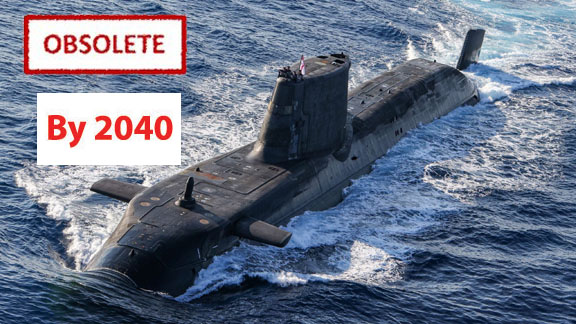
Breaking Defense , (Sponsored by Northrop Grumman) By COLIN CLARK and TIM MARTIN February 10, 2023
SYDNEY and BELFAST — With the formal announcement of Australia’s path to obtain nuclear attack submarines expected to happen in Washington next month, speculation about the likely solution AUKUS is beginning to leak out.
The most intriguing hints center on a British boat — but not the Astute-class — based in part on rare public comments by Australian Defense Minister Richard Marles and his British counterpart, UK Defence Secretary Ben Wallace……………………………………
From the first announcement of the AUKUS effort, Australia has said it intends to build boats at home. However, developing the nuclear expertise from a tiny pool of a few dozen individuals to potentially thousands of people will take time, as will development of the highly skilled welders and other technical experts needed to build and maintain nuclear powered boats. Developing a new design and building a new shipyard to produce it seems unrealistic, given the lack of domestic expertise — especially if the goal is to deploy nuclear attack submarines before the conventionally powered Collins-class attack subs are retired.
That has prompted talk of America supplying Australia with refitted Los Angeles-class boats or providing Virginia-class boats that would be crewed by Australians, but both options pose many obstacles. America doesn’t seem able to build nuclear attack boats quickly enough to meet its stated requirement of 66, which prompted two top defense lawmakers in the Senate to caution President Joe Biden against committing the US to supplying Australia with nuclear boats.
Given the concerns about personnel and Marles’ comments, there is reason to think Britain’s next-generation sub, which will require a much smaller crew than do any of the American boats are in play……………….
“Among the ‘straws in the wind’ are the UK’s ambitions to rebuild its own submarine fleet. The Royal Navy would like to see a rise from the planned seven Astute-class attack submarines to perhaps 12 boats in the long term.
In a speech in December 2022, the UK chief of the defence staff, Admiral Sir Tony Radakin, said of AUKUS that ‘if we have the courage to do this properly’ it could help grow the UK’s own submarine numbers in the decades to come, clearly assisted in part by potential economies of scale under AUKUS.”
Jonathan Mead
Back in November 2021, the man who led the day-today work on the AUKUS boats in Australia, Vice Adm. Jonathan Mead, told an Australian Senate committee that his country intended to select a “mature design” for its nuclear submarine. “It is our intention,” Mead said then, “that when we start the build program, the design will be mature and there will be a production run already in existence.” That would appear to make the British offering a candidate…………………
Sidharth Kaushal, a sea power expert at the Royal United Services Institute think tank, told Breaking Defense:
“The point of friction that introduces with the UK [revolves around] the Australians operating with the US Navy primarily in the Indo-Pacific and their preference for things like prompt strike capabilities, including cruise missiles and potentially hypersonic missiles. The [US Navy] Virginia-class payload module can host those weapons but the [Royal Navy’s] Astute-class can torpedo launch cruise missiles but doesn’t necessarily offer prompt strike capabilities.”
All seven Astute-class submarines are due to be in service with the Royal Navy by 2026, each with a life cycle of 25 years. …………….
“There’s much more work to be done when you look at areas of joint production…but for the initial project of delivering a new Australian submarine there’s going to be some compromises,” Kaushal said. “For the US, this works out quite nicely but their big challenge of course remains, that their production lines are struggling to meet US Navy requirements.”
Should the Virginia-class be selected for the Australian requirement, the US would also benefit from new basing facilities for the future submarines, he added.
“It would effectively give the US an additional SSN base separate to Guam, which is of course an inherently vulnerable location and will be more so going forward,” Kaushal explained.
Operationally, how the future Australian submarines operate in the Indo-Pacific looks to be particularly difficult to assess in light of China formidable ASW capabilities, like Type 56 Corvettes and Y-8 maritime patrol aircraft, combined with the often shallow waters of the South China Sea which can make nuclear submarine missions more difficult.
“China is investing in a pretty substantial sensor network in the South China Sea that includes under sea hydrophones, large unmanned underwater vehicles all linked up to artificial islands they have built,” Kaushal said. ………………………………. https://breakingdefense.com/2023/02/growing-signs-australias-new-nuclear-sub-will-be-british-design/
Solar’s stunning journey from lab curiosity to global juggernaut wiping out fossil fuels
One of the four Australian solar researchers who have won the world’s most
prestigious engineering prize says it won’t be long before solar is at a
cost level across the world where it will “wipe fossil fuels out of the
global economy.
Renew Economy 10th Feb 2023
The US is preparing Australia to fight its war against China

The United States is not preparing to go to war against China. The United States is preparing Australia to go to war against China.
Defence and military weapons manufacturing industries in Australia are now largely owned by US weapons corporations – Lockheed Martin, Raytheon, Boeing, Thales, NorthropGrumman. The deep integration of Australia’s defence industries and economy into the US military-industrial complex greatly influences Australia’s foreign/defence policies.
The Threat. All these preparations are justified by the false premise that China presents a military threat. China has not invaded anywhere. It has never proposed use of force against other countries. It has enshrined in its Constitution the ‘Three No’s – No military alliances; No military bases; No use, or threat to use, military force. China has, however, reserved the right to use force to prevent secession by Taiwan.
Guardian, By John Lander, Feb 1, 2023 Edited transcript of a speech to the Committee for the Republic, Salon, 18 January 2023.
The ANZUS Treaty
A look at the ANZUS Treaty and the way it has been manipulated over time will explain why I have come to this conclusion.
Originally defensive in concept, the ANZUS Treaty was seen by Australia from its very beginning as a means to “achieve the acceptance by the USA of responsibility in SE Asia” (Percy Spender) to shield Australia from perceived antagonistic forces in its region. It has, however, developed into an instrument for the furtherance of US ability to prosecute war globally – previously in Iraq and Afghanistan, currently against Russia and potentially against China.
The ANZUS Treaty, usually referred to in reverential tones as “The Alliance”, has been elevated to an almost religious article of faith, against which any demur is treated as heresy amounting to treachery. Out of anxiety to cement the US into protection of Australia, the Alliance has been invoked as justification for Australia’s participation in almost every American military adventure – or misadventure – since WW II.
Unlike NATO or the Defence Treaty with Japan, the ANZUS treaty actually provides no guarantee of protection, merely assurances to consult on appropriated means of support in the event that Australia should come under attack.
On the other hand, the Alliance has facilitated the steady growth of American presence in Australia, to the point that it pervades every aspect of Australian political, economic, financial, social and cultural life. Australians fret about China “buying up the country”, but American investment is ten times the size.
They are unaware or uncaring that almost every major Australian company across the resources, food, retail, mass media, entertainment, banking and finance sectors has majority American ownership. Right now US corporations eclipse everyone else in their ability to influence our politics through their investment in Australian stocks.

The transfer of Australian assets to American ownership has continued unabated: In the second half of 2021 then Treasurer Josh Frydenberg approved the transfer of $130 billion of Australian assets to foreign private equity funds, benefiting Goldman Sachs who facilitated the transactions, by multimillions of dollars. Josh Frydenberg now is employed by Goldman Sachs:
- Sydney Airport – Macquarie Bank led by a NY investment banker
- AusNet (electricity infrastructure) $18 billion takeover by Brookfield – NY via Canada
- SparkInfrastructure (electricity) $5.2 billion takeover by American interests
- AfterPay financial transaction system $39 billion takeover
- Healthscope, second-biggest private hospitals group (72 Hospitals) taken over by Brookfield and now controlled in the Cayman Islands.
The USA and the UK between them represent nearly half of all foreign investment. China plus Hong Kong represents 4.2%. The 4 big “Aussie” banks are dependent on foreign capital which dictate local banks’ policies and operations.
Defence and military weapons manufacturing industries in Australia are now largely owned by US weapons corporations – Lockheed Martin, Raytheon, Boeing, Thales, NorthropGrumman. The deep integration of Australia’s defence industries and economy into the US military-industrial complex greatly influences Australia’s foreign/defence policies.
That, plus US capture of Australia’s intelligence and policy apparatus through the “Five Eyes” network and ASPI (which has lobbyists from American arms manufacturers on a Board headed by an operative trained by the CIA) means that the US is able to swing Australian policy to support America in almost all its endeavours.
Despite the fact that it contains no guarantee of US protection of Australia, the Treaty and further arrangements under its auspices, such as the 2014 Force Posture Agreement and now AUKUS, have greatly facilitated US war preparation in Australia. This has accelerated exponentially in the past few years. The US now describes Australia as the most important base for the projection of US power in the Indo-Pacific.
Indicators of war preparations
* 2,500 US marines stationed in Darwin practicing for war with the Australian Defence Forces, soon to include the Japanese Defence Forces
* Establishment of a regional HQ for the U.S. Indo-Pacific Command in Darwin
* Lengthening the RAAF aircraft runways in Northern Territory at our expense for servicing US fighters and bombers
* Proposed stationing of 6 nuclear weapons-capable B52 Bombers at RAAF Tindal in NT
* Construction of massive fuel and maintenance facilities in Darwin NT for US aircraft
* Proposed acquisition of eight nuclear-propelled submarines at the cost of $170 billion for hunter-killer operations in the Taiwan Strait
* Construction, at the cost of $10 billion, of a deep water port on Australia’s east coast for US and UK nuclear powered and nuclear missile-carrying submarines
* The long-established satellite communications station known as Pine Gap in central Australia has recently, and is still being, expanded and upgraded. It is key to the command and control of US forces in the Indo-Pacific (and even as far afield as Ukraine)
The Government and right wing anti-China analysts and commentators, whose opinions dominate main stream media, accept the Defence Minister’s contention that this militarisation enhances Australia’s sovereignty by strengthening the range and lethality of Australia’s high-end war-fighting capability to provide a credible deterrent to a potential aggressor.
Many analysts and commentators outside the governing elite, including myself, argue that these arrangements effectively cede Australian sovereignty to America. This is especially because of the provisions of the Force Posture Agreement of 2014, entered into under the auspices of ANZUS.
I understand that a paper has been circulated to the Committee, expounding the details of the FPA, so in summary, it gives unimpeded access, exclusive control and use of agreed facilities and areas to US personnel, aircraft, ships and vehicles and gives Australia absolutely no say at all in how, when where and why they are to be used.
All Australian analysts, whether sympathetic or antipathetic to China, agree on one point. That is, that if the US goes to war against China over the status of Taiwan, or any other issue of contention, Australia will inevitably be involved.
The Threat
All these preparations are justified by the false premise that China presents a military threat. China has not invaded anywhere. It has never proposed use of force against other countries. It has enshrined in its Constitution the ‘Three No’s – No military alliances; No military bases; No use, or threat to use, military force. China has, however, reserved the right to use force to prevent secession by Taiwan.
It has recently rapidly increased its defence capability in response to the fearsome US naval presence and war-fighting exercises just off its coastline. Its defence budget is one third that of the US and the bases that it has constructed in the South China Sea pale into insignificance compared to the hundreds of bases that the US has ranged all around China.
So, if China is not a military threat, why is it designated as the primary systemic threat of the collective West, led by the US? The answer lies in the word “systemic”. China has expressed a determination to revamp the global financial system to make it fairer for developing countries. Kissinger is reputed to have said: “If you control money, you control the world”. The US currently controls world finance and China (with Russia) is out to change that.
The US, which played the leading part in the establishment of the post-World War II institutions, has become a leading revisionist, abandoning the UN for “coalitions of the willing”. The US has declined to join important Conventions like those on the Law of the Sea and on Climate. It has refused to accept the jurisdiction of the International Court of Justice and the International Criminal Court, and has exempted itself from the Genocide Convention. It has played a leading part in the weakening of the World Trade Organisation by imposing trade restrictions on other countries, while not agreeing to new appointments to the WTO’s appellate tribunal, so preventing that body from functioning.
China is the second-largest (or by some calculations, the largest) economy in the world. It is the major trading partner of over 100 countries, mainly in the global south, but including Australia and a number of other Western countries. Hence China has the clout to undermine the “international rules-based order” set up by, and for the benefit of, the West.
China has already established an alternative to the Anglo-American international financial transaction system: – the Cross-border Interbank Payments System CIPS, (in which, ironically a number of Western banks are shareholders). In collaboration with Russia and within the BRICS (Brazil, Russia, India, China & South Africa) China is creating an alternative to the almighty dollar as the preferred currency for trade and for national reserve holdings.
It seems that the US has concluded that, since it can’t constrain China economically, it will have to get it bogged down in a long-drawn-out war to hinder its economic growth and hamper its infrastructure development cooperation with other countries. On 25 March 2021 President Biden vowed to prevent China from overtaking the US as the most powerful country in the world – “not on my watch” he said.
Nevertheless, the latest CSIS computer modelling, like previous modelling by the Rand Corporation, indicates that all involved in a Sino-US war would lose.
Proxy War
All of these analyses overlook one significant point. US determination to pursue the Wolfowitz doctrine of preventing the rise of any power that could challenge US global supremacy (neither Russia, nor Europe, nor China) has not diminished, but has morphed into a strategy of fighting its adversaries by proxy.
This has been clearly demonstrated by the war in Ukraine. A White House press briefing on 25 January 2022, before the Russian intervention, stated that “the US, in concert with its European partners, will weaken Russia to the point where it can exercise no influence on the international stage”.
Political leaders from Biden, through Pelosi and on to Members of Congress have told Ukraine that “your war is our war and we are in it for as long as it takes”. Congressman Adam Schiff put it bluntly that “we support Ukraine… to fight Russia over there, so that we don’t have to fight it over here”.
In the case of China, defined in the NDS as the principal threat to the US, the proxy of choice is clearly Taiwan. The strategy envisages:
• a world-wide media campaign (going on for several years already) to portray China as the aggressor;
• goading China into taking military action to prevent Taiwan’s secession;
• leaving Taiwan to conduct its own defence, with constant resupply of arms and equipment from the US, at great profit to the military/industrial complex;
• sustaining Taiwan sufficiently to keep China ‘bogged down’, thus hampering its economic development and its infrastructure cooperation with other countries;
• avoiding direct military engagement, in order to maintain the full capacity of US forces, while China’s would be significantly depleted; Although Biden has publicly re-affirmed adherence to the ‘One China’ principle, the US has been goading China by;
• stationing the bulk its naval power off the coast of China;
• ‘freedom of navigation’ and combat exercises in the South China Sea and Taiwan Straits;
• visits by senior US officials using US military aircraft;
• creation of a putative ‘Air Defence Identification Zone’ (ADIZ) extending well over mainland territory and then alleging Chinese violation of it;
• secretly providing military training personnel (whilst denying it);
• including Taiwan in the Summit for Democracy (9-10 December 2021), implying it is a separate country;
Many Australian politicians, (although not the present government), joined in goading China, by encouraging Taiwan to consider the possibility of declaring independence, which would trigger military action by China.
If Australia were to make good on its promise to ‘save Taiwan’, it would be devastated:
• The Australian navy would be obliterated, given the disparity between China’s and Australia’s forces;
* command/control centres (and possibly cities) in Australia could be wiped out by Chinese missiles. Australia has no anti-missile defence;
• To preserve its own assets, and to forestall the descent into nuclear conflict, the US would not engage directly in defence of Australia;
• US ‘support’ would be through massive arms sales to replace our losses – just as in Ukraine – at further profit to the US military/industrial complex;
• ASEAN is unlikely to support Australia. It has renewed and up-graded its Comprehensive Strategic Partnership with China. Each member country has infrastructure projects under China’s BRI, which they would not want to jeopardise in a ‘no-win war’;
Support from India is unlikely, despite its membership of the Quad – which is nothing more than a consultative dialogue. India has security commitments to China under the SCO and gets its arms from Russia, which has a “better than treaty” relationship with China.
• Australia relies heavily on China for many daily necessities. In a war, deliveries from China would be severely disrupted.
The increasing size of China’s economic (and, by extension military) strength, to which Australia contributes important resources and from which it derives so much benefit, is portrayed as a threat to Australia’s security. This has Australia trapped in the absurd policy paradox of preparing to go to war against China to protect Australia’s trade with China.
Recent developments in Taiwan, particularly the county and municipal elections, which caused the President, Tsai Ingwen, to resign her leadership of the pro-Independence Party, suggest that Taiwan prefers the status quo and is unwilling to be the proxy of the US in a war with Beijing.
Australia thus becomes the potential proxy.
In the name of the Alliance, American service personnel (active and retired) are now embedded in Australian defence policy making institutions and in command and control positions within the ADF. All of the American military assets installed in Australia under the Alliance and the AUKUS deal, are now “interchangeable” with the ADF, making it possible to use them as putative Australian forces against China, while the US stands aside and maintains the same pretence of “no engagement”, as it is doing in Ukraine.
This is why I said at the beginning that the US is preparing to send Australia to war against China.
Whilst these are the dangers that the ANZUS Alliance poses for Australia if the US instigates a war against China, there are risks for the US also.
1. There would be crippling expense that further exacerbates the US wealth divide and related domestic political breakdown. Supplying the weaponry and everything else required for a proxy war with China would be a bigger drain on the US budget than the Ukraine conflict. The expenditure would flow back to the military industrial complex, constituting a further massive transfer of wealth from the ordinary taxpayer to the plutocrat billionaires. It would blow out the already unsustainable national debt, and either take away from expenditure on essential services and infrastructure, or, if they print money, further blow out inflation. The political and social breakdown that the US is already suffering as a consequence of its real economic decline and widening wealth gap could only intensify to breaking point.
2. The slide into a direct war would probably be inevitable. Planning a proxy war is all very well as an academic exercise, but sticking with those plans when the fighting starts will be very difficult. There are already lunatic politicians and “experts” in the US who think America can win a direct war, so when China starts bombing Australia, and good old Aussie “mates” are dying in massive numbers, the voices of those in the US advocating direct engagement will be amplified. Combined with the already extreme polarisation of US politics in which ONLY war is bipartisan, the risk that extremists will take the US into direct conflict, and a nuclear showdown with China, is very serious.
3. The folding in of Japan into the AUKUS arrangements will increase the risk that Japan would be obliged to assist Australia in any military conflict with China. The US, because of its Defence Treaty with Japan, would then be obliged to join in the fighting, vitiating its plan to avoid direct military engagement.
A point of historical irony:
I’ll wind up with a bit of historical irony, in which I was personally involved:
In the early 70’s, we had been kept completely in the dark about the secret Kissinger visits to China, until the plan for Nixon to visit was announced. Feeling blindsided by a momentous change in US policy towards China, we produced Policy Planning Paper QP11/71 of 21 July 1971.
It recognised.. “political disadvantage resulting from the manner in which the United States conducts its global policies” and argued that this would mean that. “The American alliance, in a changing power balance, will mean less to us than it has in the past.”
It went on:
“If anything, this argument has been strengthened by recent United States actions and America’s failure to consult us on issues of primary importance to Australia. Accordingly, we shall need, now more than ever, to formulate independent policies, based on Australian national interests and those of our near neighbours…”
This is even more true today than it was in the 1970’s. For example, Australia was not consulted in the precipitate US withdrawal from Afghanistan, despite our role as ‘loyal’ supporter of the US in that ill-advised conflict. Our indignant protestations were met with Biden’s statement that “America acts only in its own interests”.
Our present predicament is due largely to the failure of a succession of Australian Governments to take this analysis to heart and act upon it. Prime Minister Fraser, who replaced Whitlam, ironically came to a very similar view towards the end of his life, which he set forth in detail in his book ‘Dangerous Allies’, but too late to do anything about it. He identified the paradox that Australia needs the US for its defence, but it only needs defending because of the US.
A couple of pertinent quotes, first from the late Jim Molan:
“Our forces were not designed to have any significant independent strategic impact. They were purely designed to provide niche components of larger American missions.”
We were, in his view, abdicating our own defence and cultivating complete dependence on the Americans.
And from Chris Hedges:
“Finally, the neo-cons who have led the U.S. into the serial debacles of Afghanistan, Iraq, and now Ukraine, costing the country tens of trillions of dollars and even greater amounts of destroyed reputational capital, will claim their customary immunity from any accountability for their savage failures and cheerily move on to their next calamity. We need to be on the lookout for their next gambit to pillage the treasury and advance their own private interests above those of the nation. It will surely come.”
An (incomplete) list of some of the commentators from whom I have drawn:
John Menadue – former secretary PM&C
Richard Tanter – military analyst, Nautilus Foundation
Brian Toohey – author (political and historical analysis)
Mike Scrafton was a senior Defence executive, and ministerial adviser to the minister for defence
Paul Keating was the prime minister of Australia from 1991 to 1996.
Geoff Raby AO was Australia’s ambassador to China (2007–11); He was awarded the Order of Australia for services to Australia–China relations and to international trade.
Gregory Clark began his diplomatic career with postings to Hong Kong and Moscow. He is emeritus president of Tama University in Tokyo and vice-president of the pioneering Akita International University.
Dr Mike Gilligan worked for 20 years in defence policy and evaluating military proposals for development, including time in the Pentagon on military balances in Asia.
Jocelyn Chey AM is Visiting Professor at the University of Sydney and Adjunct Professor at Western Sydney University and UTS. She formerly held diplomatic posts in China and Hong Kong. She is a Fellow of the Australian Institute of International Affairs.
Joseph Camilleri is Emeritus Professor at La Trobe University in Melbourne, a Fellow of the Australian Academy of Social Sciences, and President of Conversation at the Crossroads
David S G Goodman is the Director, China Studies Centre, University of Sydney.
Geoff Miller was Director-General, Office of National Assessments, deputy secretary, Department of Foreign Affairs, Ambassador to Japan and the Republic of Korea, and High Commissioner to New Zealand.
Cavan Hogue was Ambassador to USSR and Russia. He also worked at ANU and Macquarie universities.
Australia’s Defence Minister insists nuclear submarine deal will not damage Australia’s sovereignty

By Richard Wood • Senior Journalist 9 News, Feb 9, 2023
Defence Minister Richard Marles is hitting back at claims the AUKUS military alliance will undermine the future of Australia’s military sovereignty.
In a speech to Parliament today, he will seek to ease worries that the defence pact between Australia, Britain and the US poses any risk.
Former prime ministers Paul Keating and Malcolm Turnbull have critcised AUKUS, saying it makes Australia too dependent on the US…………
Marles’ speech to MPs comes ahead of next month’s announcement about the type of nuclear-propelled submarine technology Australia will obtain. https://www.9news.com.au/national/aukus-submarine-pact-will-not-compromise-australian-sovereignty-defence-minister-says/906cf0bc-0c2f-426b-9720-0acaae9ad5c8
‘We need a plan B’: Australian Unions have ‘deep concerns’ about AUKUS pact

The shipbuilding federation – which represents unions including the AMWU, Electrical Trades Union and the Australian Workers Union – is urging the government to build an additional six conventionally powered submarines in Australia before the arrival of a fleet of nuclear-powered submarines.
The shipbuilding federation – which represents unions including the AMWU, Electrical Trades Union and the Australian Workers Union – is urging the government to build an additional six conventionally powered submarines in Australia before the arrival of a fleet of nuclear-powered submarines.
Matthew Knott, February 7, 2023 https://www.theage.com.au/politics/federal/we-need-a-plan-b-unions-have-deep-concerns-about-aukus-pact-20230206-p5ciaf.html
Labor’s traditional union allies say they harbour deep concerns about Australia’s plan to acquire a fleet of nuclear-powered submarines and fear the AUKUS pact will not deliver the promised bonanza of Australian manufacturing jobs.
The federal government is preparing to announce the details of its nuclear-powered submarine plan in March, with preparation under way for Prime Minister Anthony Albanese to travel to Washington for a possible joint press conference with US President Joe Biden and British Prime Minister Rishi Sunak
During a visit to Washington over the weekend, Defence Minister Richard Marles said AUKUS would create “thousands” of new local jobs and expressed confidence Australia would not be left with a capability gap between the retirement of the current Collins class fleet and the arrival of nuclear-powered vessels.
Despite Marles’ assurances, Australian Shipbuilding Federation of Unions national convener Glenn Thompson said he remained “apprehensive” about a possible capability gap and urged the government to develop a backup plan in case AUKUS falls over.
“It’s one thing to say that this is going to create thousands of jobs, but you actually have to be able to build something well in advance of whatever AUKUS comes up with,” said Thompson, an assistant national secretary of the Australian Manufacturing Workers Union (AMWU).
“It’s of great concern to us about where the workforce is coming from and how are we addressing the issue of Australia’s sovereignty.”
Thompson noted there had been no pledge from the government that AUKUS would create as many local jobs as the 5000 positions promised under the cancelled contract with French company Naval Group.
The shipbuilding federation – which represents unions including the AMWU, Electrical Trades Union and the Australian Workers Union – is urging the government to build an additional six conventionally powered submarines in Australia before the arrival of a fleet of nuclear-powered submarines.
Marles last week stated definitively that the government “has no plans for any conventionally powered interim submarine capability, as we move towards gaining the nuclear-powered submarine capability”. Senior defence figures, including in the Navy, have fiercely resisted the idea of an interim conventional submarine.
“There’s a whole lot of uncertainties,” Thompson said of the AUKUS pact. “I just think from a capability perspective the country needs to have a plan B.”
Thompson said he feared local construction of the nuclear-powered submarines would not begin until the late 2040s or early 2050s, a decade after the Collins-class vessels begin being decommissioned.
“It’s very rare that these defence projects deliver on time,” he said. “By the mid-2040s you could have two-thirds of the existing fleet retired, so there could be a substantial capability gap.”
Marles told The Sydney Morning Herald and The Age last month that AUKUS would be “a genuine three-country collaboration”, raising expectations Australia will acquire a joint next-generation submarine model combining American and British technology.
While not specifying what proportion of the submarines would be built in Australia, Marles said the Osborne Naval Shipyard in Adelaide would play a major role in the project.
“We must develop an industrial capability in Australia,” he said. “That’s the only way this can work, and that’s what will be expected of us by both the UK and the US.”
Marles told parliament on Monday the government was “on track” to make its AUKUS announcement in the very near future.
He said while there had been a “very real potential of a capability gap opening up with our submarines, I am confident that the pathway we announced will provide a solution to this”.
The US shooting down a Chinese spy balloon is a risk for Australia
Michael West Media, by Rex Patrick | Feb 6, 2023 |
For many Australians watching the events over the past week, where the United States Air Force tracked a Chinese balloon overflying US territory and then shot it down, might seem to be of indirect significance to our security. Former senator and submariner, Rex Patrick suggests that it is of direct significance to Australia, increasing the risk we might be drawn into war in South East Asia.
Over the weekend the US Air Force shot down a Chinese balloon. The United States have said that the balloon was carrying out intelligence gathering. The Chinese Government has said it wasn’t. They claim it was just a wandering weather balloon. That’s important for reasons I’ll come back to, but I first need to provide some background – not about balloons, but about another surveillance platform.
What submarines do
Submarines can perform a whole range of different tasks in time of war……………………….
In preparing for war they train, they engage in tactical development and they conduct intelligence gathering. It is the latter which is their most important and challenging tasks………………….
Balloons and ballast tanks
…. Imagine a South Korean, Japanese or Australian submarine operating very close to (or perhaps inside) China’s territorial waters conducting intelligence gathering. China might now be inclined to treat that submarine the same way the United States treated a balloon purported to be conducting intelligence collection.
If detected, even if just outside of their territorial waters, the Chinese will just say they were inside their waters when, or in the minutes before, they were engaged. We’ll say, just as the US has for the balloon, that we weren’t spying and they’ll say we were.
And getting detected in our newest Australian submarine, the 20 year old HMAS Rankin, is far more likely than is the case for South Korea’s newest submarine, the 1 year old ROKS Dosan Ahn Changho, or Japan’s newest submarine, the 1 year old Tōryū.
The stakes are greater for us because Australian governments of various political flavours have left us with ageing Collins Class submarines to carry out this most serious and complex of peace time tasks.
One option would be to eventually withdraw our ageing Collins class submarines from surveillance operations anywhere close to Chinese waters, but that’s unlikely. Our Navy and our government will be anxious to continue to do all they can to assist the United States Navy in the Northern Pacific, in the Sea of Japan and the South China Sea.
Alliances are not just pieces of paper, they are dynamic relationships in which there’s a strong obligation to contribute and share risk.
The China risk
The risks are likely to increase in the years ahead, as China continues to ramp up military tensions in an effort to coerce Taiwan into some form of political subordination to Beijing.
The possibility that China will choose a vessel of a US ally to make an example of cannot be dismissed.
And that risk will be disproportionately carried by our Navy as it operates a submarine force with decreasing relative capability across the next two decades or longer. Thanks to government spending $170bn pursuing a distant nuclear-powered capability, our submariners will be at greater risk in less capable vessels than our so-called ‘great and powerful’ friend.
For a long time, we’ve been able to see Defence procurement failures and kick ourselves on account of cost to the taxpayer. Now, as the balloon goes up in the South China Sea, the lack of capability may well cost us many lives.
It’s not just about a war before the arrival of new submarines in 2040, its all the peace time intelligence operations between now and then. https://michaelwest.com.au/the-us-shooting-down-a-chinese-spy-balloon-is-a-risk-for-australias-tired-submarine-fleet/—
‘Save the only planet we have’: Tony Abbott joins climate-sceptic think tank
The former Australian PM says he has joined the Global Warming Policy Foundation, a UK think tank founded by a ‘climate denier-in-chief’.
Former prime minister Tony Abbott, who once compared taking action on climate change with killing goats “to appease volcano gods”, has joined the board of a UK climate-sceptic think tank founded by a politician dubbed “the climate denier-in-chief”.
Abbott said he was pleased to join the Global Warming Policy Foundation (GWPF), which “consistently injected a note of realism into the climate debate”, despite the charity spearheading the backlash against the UK government’s net-zero goal.
“All of us want to save the only planet we have, but this should not be by means which impoverish poorer people in richer countries and hold poorer countries back,” Abbott said of his appointment.
“Right now, in countries like Australia, the impact of climate policy is to make electricity less affordable and less reliable rather than perceptibly to cool the planet.
“We need more genuine science and less groupthink in this debate. That’s where the GWPF has been a commendably consistent if lonely voice.”
The GWPF was founded in 2009 by Thatcher-era chancellor Nigel Lawson, who reportedly resigned from the House of Lords last month. Described by UK Green Party co-leader Adrian Ramsay as the “climate denier-in-chief”, Lawson claimed that “global warming is not a problem” in a 2021 article written for The Spectator during the COP26 in Glasgow.
The foundation’s director, Benny Peiser, also made headlines for spurious statements, including that he found it “extraordinary that anyone should think there is a climate crisis” and that climate “alarmism” was driven by “scientists’ computer modelling rather than observational evidence”.
Despite Lawson’s apparent departure from politics, his foundation continues to cause a headache for UK Prime Minister Rishi Sunak. There has been outrage after a UK register of interests disclosure revealed Conservative MP Steve Baker accepted a £10,000 (A$17,464) donation from the chair of GWPF’s Net Zero Watch.
The campaign arm has urged the UK government to recommit to fossil fuels, commission a fleet of coal-fired power plants, and wind down wind and solar completely, while its alleged breaches of charity law were the subject of a complaint from three British MPs in October.
This isn’t Abbott’s first brush with the foundation. In 2017 he delivered an eyebrow-raising annual lecture that suggested climate change was “probably doing good; or at least, more good than harm”.
Abbott also claimed that photos from his electorate showed the sea level hadn’t risen. (The Bureau of Meteorology found last year that the rates of sea level rise to the north and south-east of Australia have been “significantly higher” than the global average for the past 30 years.)
“Contrary to the breathless assertions that climate change is behind every weather event, in Australia the floods are not bigger, the bushfires are not worse, the droughts are not deeper or longer, and the cyclones are not more severe than they were in the 1800s,” Abbott said at the time.
In an echo of Lawson’s claim that rising temperatures are “no bad thing: many more people die each year from cold-related illnesses than from heat-related ones”, Abbott suggested in 2017 that sweltering heatwaves are good, actually.
“There’s the evidence that higher concentrations of carbon dioxide (which is a plant food after all) are actually greening the planet and helping to lift agricultural yields,” he said. “In most countries, far more people die in cold snaps than in heatwaves, so a gradual lift in global temperatures, especially if it’s accompanied by more prosperity and more capacity to adapt to change, might even be beneficial.”
Heat is the biggest natural killer in Australia (and in the US) and has been for the past 200 years, with fatalities outstripping all other natural killers including bushfires, cyclones and floods. Research has found there were 36,000 deaths associated with heat in Australia between 2006 and 2017.
The American Colony of Australia
19 Feb 2021Western media portrays Australia as a beautiful nation with independent people and a close ally of the United States. But the American Empire has no allies, only vassal states. Australia became a colony of the American empire in 1975 after an Anglo-American coup. Australians noticed nothing since Australia had been an British colony since its inception and dispatches military forces when ordered to fight empire wars.
Missing radioactive capsule found in Western Australia
Authorities in Australia say they have found a tiny radioactive capsule
which went missing last week. Emergency services had “literally found the
needle in the haystack”, authorities in Western Australia said. A huge
search was triggered when the object was lost while being transported along
a 1,400km (870-mile) route across the state.
Mining giant Rio Tinto
apologised for losing the device, which could have posed a serious danger
if handled. The capsule – which is 6mm (0.24 inches) in diameter and 8mm
long – contains a small quantity of Caesium-137, which could cause skin
damage, burns or radiation sickness.
Emergency services used specialised
equipment including radiation detectors during their hunt. Announcing their
find on Wednesday, the state emergency services paid tribute to
“inter-agency teamwork in the face of seemingly insurmountable odds”. The
capsule was found when a vehicle equipped with specialist equipment, which
was travelling at 70 km/h, detected radiation, officials said. Portable
detection equipment was then used to locate the capsule, which was found
about 2 metres from the side of the road, they added.
BBC 1st Feb 2023
https://www.bbc.co.uk/news/world-australia-64481317
Times 1st Feb 2023
https://www.thetimes.co.uk/article/missing-radioactive-capsule-found-australia-search-vk5crqk03
Australian Radiation Protection and Nuclear Safety Agency (ARPANSA) sends specialist team to Western Australia in search for missing radioactive capsule
Nuclear safety agency joins radioactive capsule hunt
By Michael Ramsey, January 31 2023 https://www.canberratimes.com.au/story/8067912/nuclear-safety-agency-joins-radioactive-capsule-hunt/
Federal authorities are set to join the massive search for a dangerous radioactive capsule missing in Western Australia.
The 8mm by 6mm item fell out of a density gauge while being trucked from a Rio Tinto mine in the Pilbara to Perth.
Emergency services are searching a 1400km route amid warnings the Caesium-137 in the capsule could cause radiation burns or sickness if handled and potentially dangerous levels of radiation with prolonged exposure.
The Australian Radiation Protection and Nuclear Safety Agency (ARPANSA) on Tuesday said it had sent a deployment team with specialised car-mounted and portable detection equipment to join the search.
Led by WA’s Department of Fire and Emergency Services, the hunt is expected to take five days with vehicles travelling at 50km/h.
Radiation services specialists and detection and imaging equipment are also being sent to WA by the Australian Nuclear Science and Technology Organisation.
Rio Tinto has apologised and ordered an investigation into what went wrong during the haul, which was carried out by a contractor.
Emergency Services Minister Stephen Dawson flagged the WA government was likely to also probe the incident.
“How these are transported does need to be looked at,” he told ABC radio.
“It does puzzle me how such a thing can fall off the back of a truck.”
Rio said a bolt that secured the capsule within the gauge appeared to have sheared off, creating a hole just big enough for the item to escape.
The truck arrived in the Perth suburb of Malaga on January 16 but it wasn’t until nine days later that a technician realised the capsule was missing.
The capsule is smaller than a 10 cent coin but the amount of radiation it emits is equivalent to receiving 10 X-rays in an hour.
Drivers have been warned it could have become lodged in their car’s tyres.
1 This Month

of the week – Shut Down Drone Warfare!


Tell the Ukrainian Government to Drop Prosecution of Peace Activist Yurii Sheliazhenko

Petition to revoke the licensing of the Near Surface Nuclear Disposal Facility (NSDF) at Chalk River. https://www.ourcommons.ca/petitions/en/Petition/Details?Petition=e-7247
To see nuclear-related stories in greater depth and intensity – go to https://nuclearinformation.wordpress.com
-
Archives
- March 2026 (251)
- February 2026 (268)
- January 2026 (308)
- December 2025 (358)
- November 2025 (359)
- October 2025 (376)
- September 2025 (257)
- August 2025 (319)
- July 2025 (230)
- June 2025 (348)
- May 2025 (261)
- April 2025 (305)
-
Categories
- 1
- 1 NUCLEAR ISSUES
- business and costs
- climate change
- culture and arts
- ENERGY
- environment
- health
- history
- indigenous issues
- Legal
- marketing of nuclear
- media
- opposition to nuclear
- PERSONAL STORIES
- politics
- politics international
- Religion and ethics
- safety
- secrets,lies and civil liberties
- spinbuster
- technology
- Uranium
- wastes
- weapons and war
- Women
- 2 WORLD
- ACTION
- AFRICA
- Atrocities
- AUSTRALIA
- Christina's notes
- Christina's themes
- culture and arts
- Events
- Fuk 2022
- Fuk 2023
- Fukushima 2017
- Fukushima 2018
- fukushima 2019
- Fukushima 2020
- Fukushima 2021
- general
- global warming
- Humour (God we need it)
- Nuclear
- RARE EARTHS
- Reference
- resources – print
- Resources -audiovicual
- Weekly Newsletter
- World
- World Nuclear
- YouTube
-
RSS
Entries RSS
Comments RSS
 nuclear-news