one of the possible strategic implications of the AUKUS submarine project is that it may set a dangerous new nuclear precedent for nuclear proliferation, eroding the international norms and institutions that currently safeguard against proliferation.
AUKUS drops the nuclear proliferation gauntlet
Accelerated plans to base nuclear subs in Western Australia by 2027 will significantly erode prevailing nuclear proliferation safeguards
The United States, United Kingdom and Australia have announced plans to base nuclear-powered submarines in Western Australia, using the Down Under area as an alternative to strategic bases in Guam while potentially sidestepping nuclear proliferation concerns.
The Insider reported this month that the Biden administration has established Submarine Rotational Forces–West (SRF-West), which are believed to consist of four US Virginia-class nuclear attack submarines (SSN) and one UK Astute-class SSN, and will operate out of HMAS Stirling at the western Australian city of Perth as early as 2027.
The Biden administration stated last month that SRF-West would “help build Australia’s stewardship. It will also bolster deterrence with more US and UK submarines forward in the Indo-Pacific.”
The Insider notes that the establishment of SRF-West comes at a time when US near-peer rivals China and Russia are expanding their submarine fleets, with Russia’s Yasen-class SSNs operating in the Atlantic and Pacific Oceans, and China’s nuclear-powered ballistic missile submarines (SSBNs) constantly patrolling the contested South China Sea.
Sidharth Kaushal notes in a March 2023 Royal United Services Institute (RUSI) article that Australian naval facilities that can base Virginia-class and Astute-class SSNs are relatively out of range from potential missile attacks, providing backup for Guam in case the latter is crippled by Chinese or North Korean “Guam Killer” missiles such as the DF-26 and Hwasong 14/15.
Kaushal notes that US overreliance on Guam has made US naval operations in the Pacific particularly vulnerable, with Guam’s possible loss in a conflict scenario substantially limiting the tempo of US submarine operations in the region and forcing US SSNs to travel longer distances for resupply.
Asia Times this month noted the various strategic challenges of defending Guam against missile attacks. Guam faces the perfect air and missile defense problem, as disjointed US missile defense systems on or near the island may not be effective against a saturation attack involving drones, ballistic missiles, cruise missiles and hypersonic weapons.
These unlinked missile defense systems consisting of the Terminal High Altitude Air Defense (THAAD) and Aegis-equipped nearby warships may fail first contact with advanced missiles, with the sheer number of missiles fired in a saturation attack demanding sensor fusion across various domains such as space and cyber to defeat hypersonic threats.
However, one of the possible strategic implications of the AUKUS submarine project is that it may set a dangerous new nuclear precedent for nuclear proliferation, eroding the international norms and institutions that currently safeguard against proliferation.
In a September 2021 article for Carnegie Endowment for Regional Peace, James Acton notes that AUKUS demonstrates a US double-standard regarding nuclear technology. In the context of AUKUS, Acton says that the bloc can make Australia the first non-nuclear armed state to remove nuclear material from the IAEA inspection system, setting a damaging new precedent for non-proliferation.
Acton mentions that while the Non-Proliferation Treaty (NPT) does not prohibit non-nuclear weapon states from building nuclear-powered ships, the IAEA cannot safeguard naval nuclear reactors, especially those on submarines, due to their secret locations and inaccessibility while submerged.
He also says that the IAEA Comprehensive Safeguards Agreement permits non-nuclear states to withdraw nuclear material for “non-proscribed military activity” such as naval reactors. That, Acton suggests, may set a precedent for other potential nuclear proliferators to exploit the IAEA’s loophole.
He notes that much of the world may see the US’s tacit consent for Australia to use the nuclear propulsion loophole while criticizing and punishing its adversaries for doing the same as a double standard, weakening the deterrent value of IAEA safeguards and making nuclear proliferation more likely.
South Korea in particular may take notice of the naval propulsion loophole to build its undersea nuclear deterrent, raising tensions with North Korea in an already volatile regional security environment.
Asia Times noted in June 2022 that the US and South Korea have agreed to share small modular reactor (SMR) technology, which can pave the way for the latter’s construction of nuclear submarines………………………………………………
Joel Ivre points out in a September 2021 Asia-Pacific Leadership Network article that AUKUS weakens South Korea’s commitment to nuclear non-proliferation, as nuclear-powered submarines present a much lower threshold for nuclear proliferation compared to a full nuclear weapons program………………………..
Other latent nuclear powers in Asia that may take notice of this weakening of proliferation safeguards are Japan and Taiwan, both of which have nuclear power programs and the likely resources, technology and know-how to assemble a nuclear weapon quickly should the perceived need arise. https://asiatimes.com/2023/05/aukus-drops-the-nuclear-proliferation-gauntlet/
Australians are particularly vulnerable to propaganda because Australia has the most concentrated media ownership in the western world, dominated by a powerful duopoly of Nine Entertainment (who airs 60 Minutes) and the Murdoch-owned News Corp. This vulnerability is being fully exploited as the time comes for the western empire to beat the war drums against China.
“It might sound like twisted logic, but military forces everywhere argue that the greater the firepower they possess, the greater the chance of maintaining peace,” opens 60 Minutes Australia’s Amelia Adams. “In other words, massive weaponry is the best deterrent to war. Right now the theory is being tested like never before, and much of it is happening in Australia’s backyard, the Indo-Pacific region. The United States wants the world, and more particularly China, to know of its increasing presence there, and to do that it’s putting on a spectacular show.”
What follows is 19 minutes of overproduced footage displaying this “massive weaponry” while Adams oohs and ahhs and gives slobberingly sycophantic interviews to US military officials.
“There’s something utterly mesmerising about the F-35 jet,” Adams moans. “The sound, the heat, and the power put this supersonic stealth fighter in a league of its own.”
“Colonel these are some very impressive machines you’re in charge of!” she gushes to an officer on an aircraft carrier.
“Yes ma’am,” the colonel replies.
Jesus lady, do your orgasming off camera.
Contrast this glowing ecstatic revelry with Adams’ open hostility later in the segment toward a Chinese think tanker named Henry Wang, claiming that he was trying to “rewrite history” for dismissing panic about a Chinese military buildup by pointing out (100 percent correctly) that China is spending a lower percentage of its GDP on its military than western nations.
“Every command, every maneuver, is being fine-tuned on this vast blue stage, where China has proven to be a bad actor, playing a long game of intimidating Pacific nations,” Adams proclaims over helicopter footage of US war ships. “But the US and its allies aren’t having it, bolstering their defenses — and it’s an impressive display.”
I defy you to find me footage more brazenly propagandistic than this, from any point in history. This is supposed to be a news show, run by people who purport to be journalists, yet they’re engaging in propaganda that looks like it came from a Sacha Baron Cohen spoof of a third world dictatorship.
As I never tire of pointing out, the claim that the US has been militarily encircling its number one geopolitical rival defensively is the single dumbest thing the empire asks us to believe these days. The US is surrounding China with war machinery in ways that it would consider an outrageously aggressive provocation if the same thing were done in its neck of the woods, which means the US is plainly the aggressor in this standoff, and China is plainly reacting defensively to those aggressions.
While the first segment unquestioningly regurgitates Pentagon narratives and gives supportive interviews to military officials, the second segment unquestioningly regurgitates talking points from the western intelligence cartel and gives supportive interviews to Five Eyes spooks.
“Showing off deadly weaponry in massive war games is a tactic China and the United States both use to try to avoid full-on combat,” says 60 Minutes Australia’s Nick McKenzie in introduction. “But the truth is the two countries, as well as other nations including Australia, are already battling it out in an invisible war. There are no frontline soldiers but there are significant skirmishes. Until now these conflicts have been kept quiet, but key members of a secretive alliance of top cops from Australia, the United States, the United Kingdom, Canada and New Zealand are about to change that.”
“Their group is called the Five Eyes, and tonight they want you to know what they see,” says McKenzie, which is the same as saying “We’re telling you what the Five Eyes intelligence agencies told us to tell you.”
McKenzie literally just assembles a bunch of Five Eyes officials to tell Australians that China is bad and dangerous, and then disguises the western intelligence cartel advancing its own information interests as a real news story.
“There is one threat that alarms our partners more than any other,” McKenzie says over dramatic music, asking “Which state actor is the key threat to democracy in Australia and amongst the Five Eyes partners?” and presenting a montage of western intelligence operatives answering (you guessed it) China.
“The Americans describe a growing menace on our doorstep flowing from China’s increasing influence in the region,” McKenzie says, before asking an American official, “Do you see the Chinese state preying on Pacific island nations?”
“I believe so, yes,” the official responds.
Western journalism, ladies and gents.
Australians are particularly vulnerable to propaganda because Australia has the most concentrated media ownership in the western world, dominated by a powerful duopoly of Nine Entertainment (who airs 60 Minutes) and the Murdoch-owned News Corp. This vulnerability is being fully exploited as the time comes for the western empire to beat the war drums against China.
We keep being hammered by this narrative that “massive weaponry is the best deterrent to war,” when all facts in evidence say the exact opposite is true. It was the military encroachment against Russia and the conversion of Ukraine into a NATO military asset which provoked Putin to invade Ukraine, and all the militarization against China that we are seeing is only inflaming tensions and making war more likely.
And, I mean, of course it is; even a casual glance at the Cuban Missile Crisis reveals that powerful nations don’t take kindly to having menacing forces placed near their borders. So much of the propaganda indoctrination we’re subjected to in the 2020s revolves around convincing people to believe that Russia and China should react completely differently than the way the US would react if foreign proxy forces were being amassed along its borders.
So yes, Amelia Adams, claiming that aggression and militarism is the best path toward peace is absolutely “twisted logic”. It is as twisted as it gets. Because it is false. This is obvious to anyone who hasn’t yet been successfully indoctrinated into this omnicidal belief system.
We need to do everything we can to fight against this indoctrination now, because if we wait until the war actually starts it will likely be too late to resist.
there is no question Defence would require the free, prior and informed consent of Indigenous people before a high-level nuclear waste facility could proceed on their land. …. in those circumstances the government must provide a veto right, because the project would eliminate future access to traditional Indigenous land.
If Plibersek knew about the radioactive waste facility and its intended siting in remote Australia at the time AUKUS was announced she has kept quiet about it.
A far more substantial inequality of power now exists between the Indigenous groups to be consulted about the site of the radioactive waste facility and the Defence Department. The facility has solid bipartisan support. In addition, it is essential to the AUKUS submarine deal, meaning Defence embodies the combined wishes of the Australian, British and United States governments.
Bipartisan secrecy and Defence’s poor record with Indigenous groups at Woomera are red flags for the consultation over AUKUS high-level nuclear waste facility.
The federal government had no public mandate for any of the AUKUS decisions: no mandate to enter the agreement, none to acquire eight nuclear-powered submarines for up to $368 billion, and none to establish a high-level radioactive waste facility. On this last, in fact, it had long term evidence to suggest Australians would likely oppose the proposition.
Perhaps this is why both major political parties concealed for 18 months, a period including the federal election, their shared knowledge that AUKUS requires a high-level radioactive waste facility to be built.
The AUKUS agreement was revealed on 15 September 2021. On 14 March 2023, deputy prime minister and defence minister, Richard Marles, announced the nuclear waste facility. Next day, opposition leader Peter Dutton said: ‘The Labor Party signed up to AUKUS knowing they would have to deal with the waste, and now that they’re in government they know that’s a part of the deal.’ The government has not denied Dutton’s claim.
Furthermore, Marles stated as a fait accompli that the waste facility will be built at a ‘remote’ site – code for Indigenous land – despite the fact that Indigenous people have repeatedly objected, and still are, to radioactive waste being stored on their land.
Meanwhile, the Albanese government continues its work to establish an Indigenous Voice to Parliament. Just nine days after the prime minister was in San Diego announcing the AUKUS submarine deal and his deputy Marles came clean about the radioactive waste facility, Anthony Albanese released the proposed Voice wording. The prime minister noted in his speech the importance of consultation, ‘it’s common courtesy and decency to ask people before you take a decision that will have an impact on them’.
Governments have been trying for decades to put a radioactive waste dump in outback Australia. They have been rebuffed time and time again. Yet the Albanese government is trying once more.
Legal experts have pointed out the international legal requirement to obtain the free, prior and informed consent of Indigenous peoples before making significant decisions that affect them. This process includes giving Indigenous peoples full information about a development in advance and respecting their choice to give or withhold consent.
The UN Declaration on the Rights of Indigenous Peoples, which Australia has pledged to support ‘in both word and deed’, says: ‘[No] storage or disposal of hazardous materials shall take place in the lands or territories of indigenous peoples without their free, prior and informed consent.’
As to whether the government can claim ‘national security’ as a reason to avoid these obligations and dictate a radioactive waste site, international human rights law expert John Podgorelec says: ‘States may not derogate from their responsibilities on the basis of national security unless a “state of emergency” has been formally invoked.’
He adds, ‘A lesson to come out of the Iraq calamity is that manufactured or undisclosed national security intelligence cannot be used to subvert democracy.’
Unfortunately, the Defence Department’s fact sheet on nuclear stewardship and waste is light on detail. It does not mention free, prior and informed consent. Defence commits only to ‘consultation and engagement’ – a lesser standard – and adds that it will also consider ‘wider social license and economic implications’. Globally, the ‘economic implications’ of significant projects habitually undermine human rights, particularly those of Indigenous peoples.
Furthermore, Defence has a poor track record of engagement with Indigenous people in one of its key locations, South Australia’s Woomera Prohibited Area (explored further in part two).
Woomera is used by Australian and foreign military forces, in close partnership with multinational weapons corporations, for extensive weapons testing and military training activities.
‘When militaries around the world need a place to test their weapons and fly their new fighter jets, there’s nowhere better than the rugged expanses of South Australia,’ enthused US weapons giant Raytheon in 2016, talking up ‘a further expansion of US-Australian cooperation’.
The Woomera weapons testing range covers one-eighth of South Australia, occupying more than 122,000km2. Before Defence took over, less than a century ago, Indigenous people had inhabited the region for tens of thousands of years.
Despite the international outcry at the destruction of Juukan Gorge, the Defence Department has not changed its behaviour. For example, it continues to use a registered Indigenous heritage site in Woomera as a target zone for high explosive weapons tests. (I visited this and other sites inside Woomera last year at the invitation of Andrew and Bob Starkey, senior Kokatha lawmen and traditional owners.)
Defence is aware of the site’s significance, just as Rio Tinto was aware of the significance of Juukan Gorge. Defence’s heritage management plan, relevant sections of which I have seen, says the site has a ‘high level of Aboriginal heritage value’ and is a place of ‘sensitive cultural significance that can be easily impacted’. The public might wonder how Defence can know this yet still decide it’s acceptable to direct high explosive munitions onto the site.
‘The Commonwealth cannot give with one hand and take with the other,’ says Podgorelec, who acts for the Starkeys, on the tensions between federal commitments to Indigenous heritage protection and to AUKUS. He says there is no question Defence would require the free, prior and informed consent of Indigenous people before a high-level nuclear waste facility could proceed on their land. He also says in those circumstances the government must provide a veto right, because the project would eliminate future access to traditional Indigenous land.
Australia is not alone in being unable to find a radioactive waste solution. The UK has failed for decades to make meaningful progress on dismantling decommissioned nuclear submarines – it currently has 21 of them floating in dockyards awaiting disposal, mirroring its wider failure to resolve its nuclear waste problems. The US has also failed in this regard: spent fuel from its nuclear submarines remains in temporary storage. Griffith University’s Emeritus Professor Ian Lowe has written that the nuclear waste from US military and civilian reactors ‘is just piling up with no long-term solution in sight’.
Defence does not mention this pertinent information in its brief positive account of US and UK nuclear stewardship.
The federal government gave its response to the Juukan Gorge inquiry report in November 2022. Minister Tanya Plibersek, whose Environment portfolio encompasses Indigenous heritage protection, said:
[T]hese are thorough and considerate reports… the recommendations speak to the principles and priorities that will shape our [heritage protection] legislation. Free, prior, and informed consent.
If Plibersek knew about the radioactive waste facility and its intended siting in remote Australia at the time AUKUS was announced she has kept quiet about it.
Free, prior and informed consent requires that intimidation and coercion be avoided. Plibersek is well aware of the possibility of abuses of power in high stakes developments. In her speech, she noted partnership agreements were signed under ‘gross inequalities of power’ between the traditional owners of Juukan Gorge and Rio Tinto.
A far more substantial inequality of power now exists between the Indigenous groups to be consulted about the site of the radioactive waste facility and the Defence Department. The facility has solid bipartisan support. In addition, it is essential to the AUKUS submarine deal, meaning Defence embodies the combined wishes of the Australian, British and United States governments.
Podgorelec is adamant. ‘Australia cannot enact domestic laws that undermine its international legal obligations. If a project will take away Indigenous cultural connection to land forever – as a high-level nuclear waste facility will do – then the government is obliged to give a right of veto.’
Note: The legal basis for free, prior and informed consent was explained by John Podgorelec as lead author of Adelaide University’s submission to the 2015 SA Nuclear Fuel Cycle Royal Commission. Unfortunately, having been available until recently, the Royal Commission’s website is presently inaccessible. Email us if you would like a copy of the submission: undueinfluence@protonmail.com
retired U.S. military figure” generally means someone who used to be paid by the U.S. government to advance the interests of the U.S. empire, and is now paid by corporations and/or foreign governments to advance the interests of the U.S. empire.
Among the American swamp monsters hired by Canberra is the Obama administration’s spy chief, who has an established track record of lying and manipulating to advance the interests of the U.S. empire.
Australia has been paying insiders of the U.S. war machine for consultation on how to run the nation’s military, a massive conflict of interest given that Washington has been grooming Australia for a role in its war agendas against China.
For those who don’t speak imperialist, “retired U.S. military figure” generally means someone who used to be paid by the U.S. government to advance the interests of the U.S. empire, and is now paid by corporations and/or foreign governments to advance the interests of the U.S. empire.
These corrupt warmongers rotate in and out of the revolving door of the D.C. swamp, from government to war-industry jobs to punditry gigs to influential think tanks and then back again into government, advancing the interests of the U.S. empire the entire time and growing wealthy in the process.
This dynamic allows a permanent constellation of reliable empire managers to continually exert influence around the world in support of the U.S. empire, regardless of who gets voted into or out of office in the performative display of electoral politics. It’s a big part of why U.S. foreign policy remains the same regardless of who’s officially running the elected government in Washington, and it’s a big part of why the media and arms industry which support the U.S. war machine keep playing the same tune as well.
Among the American swamp monsters Australia paid for consulting work is the Obama administration’s spy chief James Clapper, who has an established track record of lying and manipulating to advance the interests of the U.S. empire:
In 2013 Clapper committed perjury by telling the U.S. Senate under oath that the NSA does not knowingly collect data on millions of Americans, only to have that lie exposed by the Edward Snowden leaks a few months later.
In 2016 Clapper played a foundational role in fomenting public hysteria about Russia with the flimsy ODNI report on alleged Russian election interference, which remainsriddled with massiveplot holes. He would later go on to repeatedly voice the opinion that Russians are “almost genetically driven” toward nefarious and subversive behavior.
In 2020 Clapper signed the infamous and now fully discredited letter from former intelligence insiders saying the Hunter Biden laptop story was likely a Russian disinfo op, falsely telling CNN that the story was “textbook Soviet Russian tradecraft at work” and that the emails on the laptop had “no metadata” on them.
Also among the American military consultants paid by Australia is a man we just discussed the other day, William Hilarides, who will be telling Australia how to reconfigure its navy because apparently no Australians are available for that job. We now know that according to the released Pentagon documents Canberra has already paid Hilarides almost $2.5 million since 2016 for his consulting work.
This information was originally reported by The Washington Post’s Craig Whitlock and Nate Jones, who last year also broke the remarkable story that a former U.S. navy admiral named Stephen Johnson had actually served as Australia’s deputy navy secretary, a position which needless to say is not normally open to foreigners.
……………………………………… Australia has always seemed like a fairly irrelevant player on the world stage because of its impotent subservience to Washington. But it’s becoming clear it is exactly because of Australia’s blind subservience to Washington that Australia is worth paying attention to, since that relationship may well end up giving the nation a front-row seat to World War Three.
Australians are going to have to wake up to what’s being done and the abominable agendas the nation is being exploited to advance. Australians are being groomed for a military confrontation of unimaginable horror, one which absolutely does not need to take place, all in the name of something as trivial as securing U.S. planetary hegemony. Australians have got to start saying no to this, starting right now.
The Greens party, which commissioned the analysis by the Parliamentary Budget Office, said it showed the “huge” uncertainty over the project.
U.S. President Joe Biden, Australia Prime Minister Anthony Albanese and British Prime Minister Rishi Sunak unveiled details in March of a plan to provide Australia with nuclear-powered attack submarines, a major step to counter China’s ambitions in the Indo-Pacific.
Under the deal, the United States intends to sell Australia three U.S. Virginia class nuclear-powered submarines, which are built by General Dynamics, in the early 2030s, with an option for two more.
In a second phase, Australia and Britain will build an AUKUS class submarine, with Australia receiving its first submarine in the early 2040s. The vessels will be built by BAE Systems and Rolls-Royce.
Australia’s Parliamentary Budget Office has reported the cost estimate over three decades includes a contingency of A$123 billion. A contingency is a future cost not currently known due to delays, budget overruns and other factors.
Greens Senator David Shoebridge said in a statement the scale of the contingency fund was “unprecedented” and highlighted “the huge level of uncertainty in the AUKUS submarine deal”.
Defence Minister Richard Marles said the plan to build a nuclear powered submarine in Australia by the early 2040s was a “massive challenge for the country” and the government was “prudently budgeting here for the unexpected”
“We have sought to be as upfront and transparent as we possibly can be,” he told ABC radio.
The Department of Defence did not release the sale price of the U.S. Virginia Class submarines that Australia will initially purchase, the budget office said.
The report showed most of the cost of the submarine programme will be incurred in the two decades from 2033.
The federal government is paying retired senior American military officials up to $7500 a day for advice on major defence projects such as the AUKUS nuclear-powered submarine pact.
The government this week announced that, following its sweeping defence strategic review, retired United States Navy vice admiral William Hilarides would be hired to lead a snap review of the Royal Australian Navy’s surface fleet.
The review, to be handed to the government later this year, will examine whether planned fleets of Australian-made frigates and patrol vessels should be cut to free up money for smaller and more nimble vessels.
Hilarides has previously charged the Australian government US$4000 ($6000) a day for his consulting services, according to US Navy documents first reported by The Washington Post.
Hilarides has won naval consulting contracts from the federal government worth up to $1.6 million ($2.4 million) since 2016, according to figures from the Department of Defence.
Hilarides serves as chair of the Australian naval shipbuilding expert advisory panel and advised the government over the past 18 months while it finalised the deal with the United States and Britain to build a fleet of nuclear-powered submarines.
Defence Industry Minister Pat Conroy defended Hilarides’ appointment to the new navy fleet review this week, saying he had “a long association with Australia” and would do a good job.
In an investigation published last yearThe Post described Hilarides, a career submariner, as part of a large group of former senior US officials that Australia had relied upon heavily to guide its naval policies.
“To an extraordinary degree in recent years, Australia has relied on high-priced American consultants to decide which ships and submarines to buy and how to manage strategic acquisition projects,” The Post said.
Retired admiral John Richardson, who headed the United States Navy from 2015 to 2019, has received US$5000 ($7570) a day as a part-time consultant to the federal, according to documents released by the Pentagon to the US Congress.
Richardson was hired by the Department of Defence last November to provide advice on the best pathway for Australia to acquire a fleet of nuclear-powered submarines.
According to the documents, Richardson receives travel and lodging expenses to complete his work in Australia.
Richardson, the former US navy chief, told The Post: “I spent most of my life helping to keep America and our allies and partners safe and secure.
It’s a privilege to be invited to be able to use my experience, and help where I can to continue that work.”
Defence Minister Richard Marles on Thursday said outside advice was crucial to ensuring the government makes the correct decisions about significant defence policies.
“When we seek expert advice in relation to critical issues and challenges that we face, we have a global perspective in terms of where we seek that advice from and that’s really important because we want the very best advice,” he said.
“We make no apology for that because the kinds of challenges and decisions we’re making are profoundly important for the future of our country and where we have sought advice from those former officials in the US Navy that has been on issues of profound importance for our nation’s future.”
Greens defence spokesman David Shoebridge said he was shocked that Australia could seemingly not find local experts available to do these jobs.
“If that is true then it’s a pretty extraordinary failure on the part of the government and the ADF,” he said.
“You can only really explain this by Defence’s ongoing dependence on, and deference to, the US.”
He said it was remarkable that the US government had been more transparent than Australian government contracts than the federal government.
So to recap, Australia’s foreign policy is being shaped “for decades to come” by an “independent” strategic review that (A) was authored by someone who is compromised by US funding, (B) is being implemented in part by an American former military official, (C) calls for greater and greater cooperation with the United States across the board, and (D) focuses primarily on targeting a nation that just so happens to be the number one geopolitical rival of the United States.
The Australian government has released the declassified version of its highly anticipated 2023 Defence Strategic Review (DSR), and the war propagandists are delighted.
Here are the first few paragraphs to give you a sense of the squealing glee these swamp monsters are experiencing right now:
Angus Houston and Stephen Smith have delivered a blaring wake-up call to any Australians who think they still live in a sanctuary of safety at the southern edge of the Earth: you’re living in the past.
To those inside and outside the Australian Defence Force who think business-as-usual will cut it in the future: you’re delusional.
Their message to anyone confused about the biggest threat to Australia’s national security is similarly blunt: it is our largest trading partner, China.
Like a pair of doctors delivering confronting news to an ill patient, the two men tasked with reshaping Australia’s military for the 21st century have opted for admirable candour in their defence strategic review.
Rejecting vague language about rising tensions in the Indo-Pacific, the former defence chief and defence minister call out just one nation – China – for threatening Australia’s core interests.
“Like a pair of doctors.” That’s the kind of third-rate propaganda we get in the nation with the most consolidated media ownership in the western world.
The “defence” review focuses not on defending the shores of the continent of Australia, but instead over and over again makes mention of the need to protect the “rules-based order” in Australia’s “region” — the so-called “Indo-Pacific” — which includes China. It is for the most part 110 pages of mental contortions explaining why “defending” the nation of Australia is going to have to look a whole lot like preparing to pick a fight with an Asian nation thousands of kilometers away.
The public DSR actually only mentions China by name eight times, though by Knott’s ecstatic revelry you’d assume that was the only word it contains. In contrast, the document mentions the United States no fewer than 38 times, with the United Kingdom getting two mentions, New Zealand getting only one, and Australia’s neighbors like Papua New Guinea and Indonesia not mentioned by name at all.
“Our Alliance with the United States will remain central to Australia’s security and strategy,” the review reads. “The United States will become even more important in the coming decades. Defence should pursue greater advanced scientific, technological and industrial cooperation in the Alliance, as well as increased United States rotational force posture in Australia, including with submarines.”
The overshadowing presence of the United States in a document that is ostensibly about Australian security interests would be confusing to you if you did not know that Australia has for generations served as a US military and intelligence asset, where our nation’s interests are so subordinated to Washington’s that we’re not even allowed to know if the US is bringing nuclear weapons into our country.
In a foreshadowing of the DSR’s pledge to pursue even greater cooperation with the US, last year Australia’s Secretary of Defence Richard Marles said that the Australian Defence Force is moving “beyond interoperability to interchangeability” with the US military so they can “operate seamlessly together, at speed.” Which is a fancy way of saying that any meaningful separation between the Australian military and the American military has been effectively dissolved.
Marles, who is currently facing scrutiny in Australia for being illicitly secretive about the nature of a free golf trip he went on in his last visit to the United States, has said that the DSR “will underpin our Defence policy for decades to come.”
Even some of the implementation of the DSR’s findings will be overseen by an American, not an Australian. ABC reports that “a major component to determine the future shape of Australia’s naval fleet will be decided later this year in a ‘short, sharp’ review to be led by US Navy Vice Admiral William H Hilarides.”
The review itself has been tainted with severe conflicts of interest with regard to US influence. As Mack Williams noted in Pearls And Irritations earlier this month, the senior advisor and principal author behind the review is a man named Peter Dean, a professor and Director of Foreign Policy and Defence at the United States Studies Centre (USSC) at the University of Sydney. The USSC receives funding from the US government, and Dean’s own CV boasts that he “currently leads two US State Department-funded public diplomacy programs on the US-Australia Alliance.”
So to recap, Australia’s foreign policy is being shaped “for decades to come” by an “independent” strategic review that (A) was authored by someone who is compromised by US funding, (B) is being implemented in part by an American former military official, (C) calls for greater and greater cooperation with the United States across the board, and (D) focuses primarily on targeting a nation that just so happens to be the number one geopolitical rival of the United States.
It is hilarious, then, that Prime Minister Anthony Albanese announced the release of the DSR by proclaiming that “At its core, all of this is making Australia more self-reliant, more prepared and more secure in the years ahead.” It is funnier still that he concluded that same speech with an Anzac Day acknowledgement of Australian troops who who have died in wars “to defend our sovereignty and our freedom.”
It doesn’t get any less self-reliant and sovereign than just handing over your nation’s military to a more powerful nation with a “There ya go mate, use it however you reckon’s fair.” You really could not come up with a more egregious abdication of national sovereignty if you tried. And yet our prime minister babbles about sovereignty and self-reliance while doing exactly that.
Just annex us and make us the 51st state already. At least that way we’d get a pretend vote in America’s fake elections.
“Our Alliance with the United States will remain central to Australia’s security and strategy,” the review reads. “The United States will become even more important in the coming decades. Defence should pursue greater advanced scientific, technological and industrial cooperation in the Alliance, as well as increased United States rotational force posture in Australia, including with submarines.”
The overshadowing presence of the United States in a document that is ostensibly about Australian security interests would be confusing to you if you did not know that Australia has for generations served as a US military and intelligence asset, where our nation’s interests are so subordinated to Washington’s that we’re not even allowed to know if the US is bringing nuclear weapons into our country.
In a foreshadowing of the DSR’s pledge to pursue even greater cooperation with the US, last year Australia’s Secretary of Defence Richard Marles said that the Australian Defence Force is moving “beyond interoperability to interchangeability” with the US military so they can “operate seamlessly together, at speed.” Which is a fancy way of saying that any meaningful separation between the Australian military and the American military has been effectively dissolved.
Marles, who is currently facing scrutiny in Australia for being illicitly secretive about the nature of a free golf trip he went on in his last visit to the United States, has said that the DSR “will underpin our Defence policy for decades to come.”
Even some of the implementation of the DSR’s findings will be overseen by an American, not an Australian. ABC reports that “a major component to determine the future shape of Australia’s naval fleet will be decided later this year in a ‘short, sharp’ review to be led by US Navy Vice Admiral William H Hilarides.”
The review itself has been tainted with severe conflicts of interest with regard to US influence. As Mack Williams noted in Pearls And Irritations earlier this month, the senior advisor and principal author behind the review is a man named Peter Dean, a professor and Director of Foreign Policy and Defence at the United States Studies Centre (USSC) at the University of Sydney. The USSC receives funding from the US government, and Dean’s own CV boasts that he “currently leads two US State Department-funded public diplomacy programs on the US-Australia Alliance.”
So to recap, Australia’s foreign policy is being shaped “for decades to come” by an “independent” strategic review that (A) was authored by someone who is compromised by US funding, (B) is being implemented in part by an American former military official, (C) calls for greater and greater cooperation with the United States across the board, and (D) focuses primarily on targeting a nation that just so happens to be the number one geopolitical rival of the United States.
It is hilarious, then, that Prime Minister Anthony Albanese announced the release of the DSR by proclaiming that “At its core, all of this is making Australia more self-reliant, more prepared and more secure in the years ahead.” It is funnier still that he concluded that same speech with an Anzac Day acknowledgement of Australian troops who who have died in wars “to defend our sovereignty and our freedom.”
It doesn’t get any less self-reliant and sovereign than just handing over your nation’s military to a more powerful nation with a “There ya go mate, use it however you reckon’s fair.” You really could not come up with a more egregious abdication of national sovereignty if you tried. And yet our prime minister babbles about sovereignty and self-reliance while doing exactly that.
Just annex us and make us the 51st state already. At least that way we’d get a pretend vote in America’s fake elections.
China is not a military threat to either the US or Australia. The military threat is trumped up by the US and its acolytes with their own agenda.
There is one critical and urgent thing the Australian Government should do, and that is to make it clear to the US that we will not be involved in any way with a war between China and the US over Taiwan and that none of our facilities can be used for that purpose – Pine Gap, Darwin or Tindal.
The US must be told that we will not be involved in any way in a war with China over Taiwan.
After Vietnam, Iraq and Afghanistan the signs of our entrapment again in US war planning are everywhere.
The 2014 Force Posture Agreement with the US cedes control of certain military operations from our territory to the US eg Marines in Darwin and US B52’s in Tindal.
The 2021 AUSMIN ministerial meeting endorsed :
Enhanced air cooperation through the rotational deployment of U.S. aircraft of all types in Australia and appropriate aircraft training and exercises.
Enhanced maritime cooperation by increasing logistics and sustainment capabilities of U.S. surface and subsurface vessels in Australia.
Enhanced land cooperation by conducting more complex and more integrated exercises and greater combined engagement with Allies and Partners in the region.
Establishment of a combined logistics, sustainment, and maintenance enterprise to support high end warfighting and combined military operations in the region.
The 2021 AUKUS agreement was a clear sign to our region that instead of building bridges to our region we have decided to be a spear carrier for the US and UK- the Anglosphere. AUKUS is not to defend Australia but to support US operations against China in the South China Sea.
Our Defence Strategic Review (DSR)released this week has been’ authored’ by the United States Studies Centre(USSC), an arm of the US government. It is a tainted review. Have we no national pride in letting this happen!
Our Washington centric media don’t seem to think that it is unusual or even outrageous for a foreign agency to author an Australian defence review!!
Our seduction by the US is assisted by our Department of Defence with its close links to the Pentagon. It secretly employs US Admirals to advise on submarines. And if that is not enough we are now going to have a retired US Admiral heading the coming Naval Review. What is wrong with our Navy that an Australian can’t do the job? Has integration gone so far that we don’t have a Navy of our own that is worth the name.
And don’t think for one moment in this humiliation that Albanese and Marles thought up this US Admiral. They would have been put up to it by our defence establishment in lock step with the Pentagon.
The ADF has become a unit of the US military machine.
There is more.
The Government has rejected the Australian War Powers Reform proposal that Parliament approve any commitment to war. This is essential because we have an awful history of rushing to war. In 1914, we decided to send troops to WWI before Britain declared war. Menzies committed Australia to war in Vietnam before we even received a request. Howard committed us to the illegal war in Iraq based on false intelligence. Now the Labor Party has committed us to AUKUS in less than 24 hours despite the enormous implications. Albanese says he is proud of how quickly he agreed with Morrison!
Changes to our Defence Act are also being considered which would allow the ADF inter alia to conduct operations below the threshold of war, known as ‘grey zone’ operations. These amendments could have far reaching consequences.
At our universities, Peace Studies are run down in favour of ‘Strategic Studies’ with their US loyalists regularly appearing on our media. Think Tanks like the Australian Strategic Policy Institute are fronts for US defence interests.
Entrapment of our minds in the anti China hysteria is the work in progress of our Main Stream Media. Our fourth estate has been captured and imbedded in the US propaganda machine. The US cultural and media domination is everywhere. Alternative views are shunned. The White Man’s Media is on full display.
The disgraceful ‘Red Alert’ is the tip of a giant iceberg. The anti China propaganda is an every day event in our media including the ABC and SBS .
In the past, the ALP said NO on Vietnam and Iraq even though it was difficult at the time. As Paul Keating put it at the National Press Club recently ‘Labor has invariably got the big international (decisions) right’. But today the ALP has gone AWOL. Concerns about entrapment by the US and loss of sovereignty are brushed aside. What many of us thought were Labor policies and values count for little.
Penny Wong suggests that Keating has not kept up to date and has not had the benefit of Intelligence briefings!! But the reverse is true. The Labor Government is reverting to our colonial past, our colonial cringe – Five Eyes, AUKUS and the Anglosphere.
Wong plays with words to avoid asking or knowing whether B52’s in Tindal will be nuclear armed against China. She tells us that US forces are ‘rotated’ though Darwin and Tindal and not ‘based’ there.
The US is persistently goading China into war over Taiwan. This is consistent with US behaviour over centuries. It is driven by its self righteous belief in its ‘exceptionalism’ and the pressure of its military/industrial/security complex for endless wars. It expects other major powers like China to behave as aggressively as it has. China has no Monroe Doctrine which Americans believe gives them the God given right to interfere in other country’s affairs.
Australia has a sorry history of fighting other empires wars, first with the British and now with the US. The great risk and problem for us is that imperial powers are almost always at war.
Since its founding in 1776, the US has been at war 93% of the time. Since the end of WWI, the US has launched 201 armed conflicts around the world. During the Cold War it tried to change governments 72 times. It assassinated foreign leaders and still assassinates with drones guided from Pine Gap. It has 800 bases around the world, many of them in Japan and ROK directed at China. With our cooperation, US fleets cruise and sight see up and down the Chinese coast. At the same time as criticising China, the US refuses to ratify the UN Convention on the Law of the Sea. The US would have national convulsions if Chinese vessels patrolled off the Californian coast or China established military bases in Mexico!
The US is the most aggressive and violent country in the world . It lurches from one war to another. That violence abroad is mirrored in its violent gun culture at home. There is a pervasive sickness and it is not just Trump!
When we tagged behind imperial powers in the past there was little military risk to Australia. But that is not so today, with the reckless US goading of China over Taiwan. If we were involved in support of the US against China over Taiwan the results could be catastrophic for us.
China is certainly growing in influence and confidence. That is not surprising after over a century of western and Japanese invasion and humiliation. But China is not a military threat to either the US or Australia. The military threat is trumped up by the US and its acolytes with their own agenda.
In brazen mendacity Marles highlights the rapid increase in China’s military spending. But he failed to tell us that the US spends more on defence than the next nine countries combined. The US spends 3.5% of its GDP on defence. China spends 1.6%.
The Stockholm International Peace Institute only a few days ago put military spending in perspective – The United States remains by far the world’s biggest military spender. US military spending reached $877 billion in 2022, which was 39 per cent of total global military spending and three times more than the amount spent by China, the world’s second largest spender.
Surrounded by numerous US bases and the US Fleet -an itinerant naval power in the SCS as described by Paul Keating-it is not surprising that China is increasing its defence spending.
But China is a challenge to US hegemony and the US empire around the globe. The US is unwilling to come to terms with China’s success and share power and responsibility. The US insists on its own rules and domination across the globe. Empires are like that.
How do we break out of the US entrapment, the FPA, AUKUS, AUSMIN and a lot more? How can we cut through this maze of entrapment.
Peter Dutton has warned us that is ‘inconceivable that Australia would not join the US to defend Taiwan’.
There is one critical and urgent thing the Australian Government should do, and that is to make it clear to the US that we will not be involved in any way with a war between China and the US over Taiwan and that none of our facilities can be used for that purpose – Pine Gap, Darwin or Tindal.
For decades we have maintained that Taiwan is part of China.
Paul Keating has said many times that ‘Taiwan is not a vital Australian interest’. Even Defence Minister Marles, ever so close to the US, told ABC Insiders last month that ‘Australia has absolutely not given the US any commitment as part of the AUKUS negotiations that it would join (the US) in a potential war over the status of Taiwan’.
But we need to tell the US explicitly and well in advance of any possible conflict over Taiwan that we will not support the US. In a crisis it will be too late to assert our sovereignty.
the nuclear industry. It is the option you choose when you have trouble moving on and you embrace absurd self-destruction and the visiting of farce and misery on others.
[ED. I’m not attempting here to reproduce this entire scholarly and well-referenced article, or even to summarise it. I recommend the whole article – but here are extracts, including ones that particularly refer to Australia]
The World Nuclear Industry Status Report (WNISR) is an annual update charting what is in effect the demise of the nuclear industry. The WNISR (2022) shows that nuclear power’s global share of commercial gross electricity generation peaked at 17.5% in 1996, but by the end of 2021 had dropped to 9.8%. Reactor construction starts peaked in 1979 at 234, but forty-eight of those were later abandoned. Thus 1979 was also a year of peak-abandonment. The number of operating reactors peaked in 2005 at 440. Net operating capacity peaked in 1990 at 312GW and has held roughly steady at 312-381GW until the present; it is what can be called a stagnant industry.
………………………….The false claim of mastery of technological destiny is a key part of the tragedy of nuclear power. A tragedy is not just an unhappy ending, but a story of an imperfect and flawed hero occasioning his or her own downfall. In many Greek tragedies, that flaw was hubris, and hubris characterized the development of the nuclear industry.
While Dwight D. Eisenhower’s ‘Atoms for Peace‘ speech in December 1953 promised to solve the atomic dilemma by turning that power from death to life, that hope was immediately translated into hubristic over-promising.
…………….The over-confidence of the nuclear industry is illustrated by its failed projections. …………..
The nuclear industry has always tried to distance itself from its parent, the atomic bomb, but in the 1950’s and 60’s the legacy of weapons testing was a litany of environmental, political, and social injustices. British weapons testing in Australia is a case in point. ……………
Nuclear power is also an extractive industry, and uranium mining is a story of environmental degradation, contamination, and health inequalities visited upon vulnerable communities…………………………
The closing of the nuclear fuel cycle is similarly problematic, with waste disposal programs encountering persistent technical and social obstacles. My own volume, Nuclear Waste Management in Canada: Critical Issues, Critical Perspectives, co-edited with Genevieve Fuji-Johnson, shows how public participation initiatives nevertheless retain a scientistic framing of the issue. Only the public’s knowledge was problematized, as either emotively irrational or too diverse to constitute a coherent political demand. …………………….
IS NUCLEAR POWER NECESSARY FOR DECARBONIZATION?
………………… the GenCost 2022 report by Australia’s Commonwealth Scientific and Industrial Research Organisation (CSIRO), in conjunction with the Australian Energy Market Operator (AEMO), found renewables vastly cheaper than nuclear even after factoring in integration costs such as storage and transmission.
Dumbfounded by such cost comparisons, those new to the nuclear vs renewables debate wonder how nuclear survives as a financial idea at all. Martin Cohen and Andrew McKillop, in The Doomsday Machine: The High Price of Nuclear Energy, provide some clues, revealing an array of nuclear industry accounting tricks and a strategy that amounts to a nuclear asset bubble…………………….Independent energy analysts concluded power from Vogtle 3 & 4 will be five times as expensive as Georgia Power having acquired the same amounts of energy and capacity from renewables plus storage.
A POOR FIT FOR AUSTRALIA
…………………………. The trend is clear: nuclear is being replaced as a source of electricity. The first replacement was by natural gas and the second by non-hydro renewables. Renewables advocates point to such trends as indicators that nuclear power is not necessary for decarbonization.
Australia, which operates an Open-pool lightwater 20MW research reactor at Lucas Heights in New South Wales, has no commercial nuclear power reactors, and is thus an interesting test-case for the ‘nuclear is necessary’ claim.
South Australia is the model for an all-renewables grid, having already had extended runs (10+ days) in which wind and solar accounted for 100% of local demand. Moreover, AEMO’s Quarterly Energy Dynamics report (for 2022) depicts a north/south divide. Northern States (Queensland and New South Wales) are reliant on unreliable coal plants and suffer price spikes, while the southern States (Victoria and South Australia) saw a surge in renewables penetration into the grid, driving prices down. Renewables directly replace coal and lower prices.
Nuclear power is not deemed necessary for decarbonization in the Australian context. AEMO’s Integrated System Plan of 2022 modelled a step-change scenario, regarding it both most likely and compatible with net-zero emissions, in which renewables generate 98% of national electricity market energy by 2050 (including 10GW gas and 26GW dispatchable storage). Successive GenCost reports by AEMO, up to the latest in 2022, have deemed nuclear power in general too costly compared to renewables.
AEMO also skewers Small Modular Reactors (SMR), which are the modern nuclear industry fantasy. AEMO argues that SMR cost estimates are hopelessly biased and unreliable and that evidence of a positive learning rate (capacity to lower costs and build time when scaling up) is absent……..
THE MEANINGS OF NUCLEAR POWER
The Australian example suggests nuclear power is not a solution to climate concerns, but a potentially costly and burdensome engineering redundancy. ……………………………
The World Nuclear Association (WNA_ presents the nuclear industry as the victim of a renewables-biased investment and electricity market and an over-zealous regulatory environment. Calling for a more level playing field, nuclear power here is ‘victimized nuclear power’.
TECHNOLOGICAL DRAMAS
………………………… The far-right are straight climate deniers, yet fans of nuclear power. In Australia, see Pauline Hanson and Craig Kelly. In Europe, see the AfD (Germany), SvP (Sweden), Nye Borgerlige (Denmark), Fdl (Italy), Vlaams Belang (Belgium) and RN (France). Lukewarmer ecomodernists agree on anthropogenic warming but minimize the climate problem, criticize environmentalism for being alarmist, and support nuclear power on scientistic grounds Some craft their messages in a way that climate deniers and/or advocates for fossil fuels always (just so happen to) find them acceptable. ……………….
GO BIG OR GO HOME
The nuclear renaissance has been offered as a magical and flexible antidote to concerns that we cannot power our way through to decarbonization……..
Chief among the conjuring tricks is a conflation of abundant and minimum power. The World Nuclear Association depicts the future as a big energy world, where electricity demand will rise substantially, engorged by urbanisation and the electrification of end-uses, and outpace total final energy demand. Simultaneously we are told that renewables are intermittent and only nuclear power can supply baseload power (minimum power required to supply average electricity demand). We are told that only baseload (nuclear) gives us reliable power. ‘Reliable’ is made to stand for both abundant and minimum. Unpacking each of those elements is part of demystifying the potential role of nuclear power.
Forecasts of electricity demand vary greatly. Amory Lovins predicts soft energy paths can protect both climate and economy at the same time as curtailing rampant consumption………….
‘Baseload is required for reliable power’ is a myth. Baseload power is more an economic than a technical concept, because baseload power supplies average electricity demand: it is the minimum power a power plant can produce without being switched off. When your car is idling at a traffic light, it is at baseload power. Practical experience and modelling confirm that variable renewables can be balanced by dispatchable (supply on demand) energy sources…………………………………..
THE NUCLEAR RENAISSANCE
………….. Is nuclear power there when you need it, as renaissance rhetoric suggests? France has a fleet of fifty-six reactors supplying 70 per cent of its electricity, but as gas shortages hit Europe in 2022 in the wake of Russia’s invasion of Ukraine, the Électricité de France fleet suffered an annus horribilis. Over half of the fleet was shut down for repair, maintenance, and cracking and corrosion issues, resulting in record unplanned outages and nuclear output at a thirty-year low.
Consider the Japanese nuclear fleet post- Fukushima. Gross electricity generation dropped from 275 TWh in 2011 to about 50 TWh as of July 2022…………..Neither reliable nor resilient, nuclear is often not there when you need it.
Can nuclear be there if we want it? …………………………… In 2019–2021 the mean construction time for reactors connected to the grid was 8.2 years, exceeding ‘expected’ estimates, which are usually quoted in the range of 4–5 years. Moreover, a host of Generation III+ reactor projects, touted as resolving engineering and project management issues that contributed to cost and construction blowouts, have all experienced cost and construction blowouts.
Prime examples are Olkiluoto-3 in Finland (expected 2009 become 2023, costs quadrupled), Flamanville-3 in France (expected 2012, still building, and costs increased fivefold), and Vogtle 3 & 4 in the USA (expected 2016-17, still building, and costs increased fivefold). The nuclear power industry has a negative, almost forgetting by doing, learning curve, rather than a positive learning curve. Even the IAEA admitted investors were being scared off nuclear power by repeated failure to live up to promises…………….
Can nuclear power change? Advocates often pin their hopes on Small Modular Reactors (SMR), defined as sub-300MWe, designed for either serial construction or as sub-15MWe reactors for remote uses. Yet SMR’s are framed by the same kinds of utopian rhetorical visions we saw in the industry development stage, such as SMR’s as risk-free (extreme reliability and perfect safety), vehicles for indigenous autonomy (remote, portable or infrastructure-lite), and environmental saviours (waste and carbon free).
Meanwhile material reality reveals the would-be emperor already has excessively expensive clothes. As documented by independent energy analysts at the Institute for Energy Economics and Financial Analysis, the NuScale SMR-plant proposal offered to Utah in the USA has already seen a reduction in units and a 53% jump in costs that render it even less cost-competitive with renewables than its originally uncompetitive offer.
SMRs do more than inherit farcical versions of the nuclear industry’s past over-promising. SMR proponents also push the technology in a way that would be a hindrance to decarbonisation……………..
………………… We should be suspicious about breezy nuclear industry claims that nuclear power and renewables can co-exist. In fact, research on resource allocation between nuclear and renewables finds evidence for the ‘crowding-out hypothesis’: that countries with greater attachment to nuclear will tend to have lesser attachment to renewables and vice versa). Any talk of SMRs should be interrogated for signs of material commitments, such as opposing grid upgrades, that would in fact mitigate against renewables, thus casting doubt on claims of ‘all of the above’ and on lip service paid to renewables as parts of decarbonisation pathways.
NUCLEAR AFTERLIFE
Some will respond to this analysis by suggesting my anti-nuclear stance is anti-technology or anti-science………..
An apt metaphor for nuclear power might thus be that of the afterlife: not the religious one – rather the Netflix series After Life, a dark comedy written and produced by Ricky Gervais. The central character Tony, played by Gervais, has lost his wife and, in his grief, decides he is just going to punish himself and the world by being a complete jerk. That is the nuclear industry. It is the option you choose when you have trouble moving on and you embrace absurd self-destruction and the visiting of farce and misery on others.
The AUKUS agreement attempts developments that will shift Australia into a zone that will threaten the existence of Australia itself.
I am not merely thinking of the militarisation of Australia, although that is definitely one likely outcome. I also have in mind our way of life that, while still set in settler-colonial assumptions that give First Nations people no substantial value in Australian society, is relatively relaxed when compared with the way of life of people in the United States. Australia has not experienced the focus upon security that high-powered militarisation associated with nuclear weapons brings. This is the world our leaders are leading us towards.
I want to take up two lines of inquiry into Aukus in this brief article. Firstly AUKUS brings together three Anglo-settled countries – two examples of settler-colonial domination that date back two centuries and more. plus of course the original Anglo-source nation, the United Kingdom. This may seem like an insignificant reference to an aspect of European colonialism that has shaped the whole world for centuries. However, Anglo colonialism has a particular complexion. Here I am drawing in part on the book by James Belich, Replenishing the Earth, about the history of Anglo colonialism. It is well-known these days in anti-colonialism circles that the Anglo slavery pursued in the Caribbean by England was the worst form of slavery, with cruelty on a scale that makes slavery in the United States seem enlightened. Anglo colonialism is typified by relations of difference that deal with colonised peoples with a vengeance. It is noteworthy that Anglo-settled countries like Australia have not at all come to terms with the cultures that pre-existed them. All invading cultures find this difficult, but Anglo-based cultures, as Belich shows, are a special case. It is no coincidence that Adolf Hitler looked with admiration to the United States for its ‘handling’ of its First Nations ‘problem’—a form of extermination of the Native American population—in how to think about the treatment of Jews and Slavs in Europe. Anglo cultures’ commitment to freedom and democracy has a repellent underbelly of racism and cultural suppression, not to mention genocidal elimination.
Significant cultural reform is always difficult but clearly the Anglo-powers have made the decision, at a time when in many respects their backs are up against the wall, to stand and fight—not for their own territory, but against the emergence of China, which was itself on the humiliating receiving end of Anglo colonialism in the nineteenth century. AUKUS in a strong sense is a thumbing of the West’s nose at all the emerging powers in Asia—on racial grounds. They must toe the line.
This is surely a crisis for an Australia seeking in the first half of the twenty-first century to survive in our region. To survive here Australia has to change its spots profoundly. It needs a form of cultural regeneration, in significant combination with Australian First Peoples, to justify its presence outside of the strategies of colonial power. While cultural change is always slow and complex, it is Australia’s only hope of both flourishing and being accepted in this region. It is also crucial because our allies are, in any case falling apart.
While I think the Voice could be the first step towards a significant and substantial change, only a weak version of the Voice, suitable for photo opportunities and feel-good policy, will survive the reassertions of this new Anglo alliance. Australia combines an especially empty form of recognition of First Nations with the arrogance of a superior colonial presence, coloured only a little by multiculturalism, and all this in a region where it has no basic right to exist.
The AUKUS alliance represents an incapacity to flexibly adjust to an emerging situation in which a new world power has emerged, one that will not go away. It is deeply ironic that the United States has fostered this emergence by its global development strategies, just as it fostered its opponents in Afghanistan at an earlier time.
That China is a new superpower is a reality—not that being a superpower is good for China or for us. Like large bureaucracies, superpowers develop self-oriented agendas related to their size, and are not to be trusted. But linking up with the remnants of the old powers to resist emergence means that Australia has resorted to a last gasp Anglo-cultural alliance rather than enter a serious process of rethinking its social composition and its place in the world.
The second line of comment is about nuclear submarines, drawing on a piece that appears in Arena Quarterly, just publishe
I want to take up two lines of inquiry into Aukus in this brief article. Firstly AUKUS brings together three Anglo-settled countries – two examples of settler-colonial domination that date back two centuries and more. plus of course the original Anglo-source nation, the United Kingdom. This may seem like an insignificant reference to an aspect of European colonialism that has shaped the whole world for centuries. However, Anglo colonialism has a particular complexion. Here I am drawing in part on the book by James Belich, Replenishing the Earth, about the history of Anglo colonialism. It is well-known these days in anti-colonialism circles that the Anglo slavery pursued in the Caribbean by England was the worst form of slavery, with cruelty on a scale that makes slavery in the United States seem enlightened. Anglo colonialism is typified by relations of difference that deal with colonised peoples with a vengeance. It is noteworthy that Anglo-settled countries like Australia have not at all come to terms with the cultures that pre-existed them. All invading cultures find this difficult, but Anglo-based cultures, as Belich shows, are a special case. It is no coincidence that Adolf Hitler looked with admiration to the United States for its ‘handling’ of its First Nations ‘problem’—a form of extermination of the Native American population—in how to think about the treatment of Jews and Slavs in Europe. Anglo cultures’ commitment to freedom and democracy has a repellent underbelly of racism and cultural suppression, not to mention genocidal elimination.
Significant cultural reform is always difficult but clearly the Anglo-powers have made the decision, at a time when in many respects their backs are up against the wall, to stand and fight—not for their own territory, but against the emergence of China, which was itself on the humiliating receiving end of Anglo colonialism in the nineteenth century. AUKUS in a strong sense is a thumbing of the West’s nose at all the emerging powers in Asia—on racial grounds. They must toe the line.
This is surely a crisis for an Australia seeking in the first half of the twenty-first century to survive in our region. To survive here Australia has to change its spots profoundly. It needs a form of cultural regeneration, in significant combination with Australian First Peoples, to justify its presence outside of the strategies of colonial power. While cultural change is always slow and complex, it is Australia’s only hope of both flourishing and being accepted in this region. It is also crucial because our allies are, in any case falling apart.
While I think the Voice could be the first step towards a significant and substantial change, only a weak version of the Voice, suitable for photo opportunities and feel-good policy, will survive the reassertions of this new Anglo alliance. Australia combines an especially empty form of recognition of First Nations with the arrogance of a superior colonial presence, coloured only a little by multiculturalism, and all this in a region where it has no basic right to exist.
The AUKUS alliance represents an incapacity to flexibly adjust to an emerging situation in which a new world power has emerged, one that will not go away. It is deeply ironic that the United States has fostered this emergence by its global development strategies, just as it fostered its opponents in Afghanistan at an earlier time.
That China is a new superpower is a reality—not that being a superpower is good for China or for us. Like large bureaucracies, superpowers develop self-oriented agendas related to their size, and are not to be trusted. But linking up with the remnants of the old powers to resist emergence means that Australia has resorted to a last gasp Anglo-cultural alliance rather than enter a serious process of rethinking its social composition and its place in the world.
The second line of comment is about nuclear submarines, drawing on a piece that appears in Arena Quarterly, just published.
The AUKUS strategy seeks to assert massive power, especially surveillance in the Pacific, surrounding China. Nuclear submarines combined with surveillance are the main focus of this attempt to cripple what actually, as I see it, cannot be stopped, in a way similar to Paul Keating’s argument. AUKUS shifts the whole emphasis away from how we protect our independence to what is needed to contain China. For Australia this seems to mean we have to achieve interoperability with US weaponary and systems, with nuclear submarines a key aspect of this. It means Australia must take a first step into adopting nuclear technology, and its consequences. We should not be assured by those who claim that it will be the last step.
Much has been written about the dangers of nuclear power and weapons over the years, to the point where it seems many in the community are now blasé about it—unless radiation waste is to be placed next door to you. Part of what the nuclear industry and its supporters have done is to launch smaller scale tactical nuclear weapons and also small-scale nuclear power plants because both large-scale nuclear weapons and large-scale power plants have unmanageable consequences and poor public acceptance, either because of non-human-scale destruction or ridiculous costs, which only keep escalating.
No one, with the exception of some military strategists, favours nuclear war. The reasons are obvious. The level of destruction of atomic bombs steps beyond our capacity to comprehend: it steps into another realm, a post-human one. Even the seemingly more mundane questions associated with nuclear waste are on another scale because they cannot be effectively disposed. All around the world nuclear waste is piling up around nuclear power stations as well as ‘storage’ of used nuclear submarines components because the waste is not of this world. There is no solution to the waste question. Nuclear waste is killing us on an increasing scale, as exposed by Kate Brown in her book A Manual for Survival. Contrary to the findings of mainstream Western science, she argues that low-level radiation is a mass killer and a general source of ill health As one Russian scientist she quotes puts it: ‘Chronic radiation is a crime’, and chronic radiation is a process that Australia has just signed up for with its nuclear submarines, adding its contribution to the systemic decline of the Earth’s environment, at least one that is suitable for human habitation.
We need to give some focus to this because it is an embarrassment to the nuclear lobby, which they handle and largely get away with by resorting to silence. But nuclear waste is a contradiction that will not go away. All attempts at solutions have failed in every part of the world. This cannot be emphasised enough.
What sort of contradiction is this?
Like nuclear technology, nuclear waste is usually simply regarded as a special category of danger. But its special effects arise out of a social process that is usually ignored. And this is a disaster because that social process is transforming our world in unprecedented ways.
This new world first burst upon us in 1945, with the practical scientific triumph of the atomic bomb. It was not merely novel. It was a consequence of the practical/conceptual reconstructions in the early twentieth century we associate with Albert Einstein and his associates. It was not merely a new theory. It was a combination of abstract academic theory with practical technology in the real world that gave birth to technoscientific society and culture, most importantly through its systematic approach to the transformation of nature. As such, academic theory entered the world of production, as an alternative or supplement to the transformations performed by the working classes, in a way that has expanded exponentially ever since. For better or worse, our world has become increasingly composed socially of the intellectually-trained.
The novelty of nuclear technology is contained within this social approach. Scientific intellectuals now uncover deep levels of the natural world, levels never before encountered by human societies that turn out to be mysterious and unmanageable. Nuclear is not the only example but it is a key one that destroys whatever it touches.
This is the world we are now entering, and doing so with great enthusiasm. It is not only a question of nuclear war. It is just as much one of the levels of security needed when dealing with what we do not know how to control. Nuclear weapons have been ‘controlled’ by such monstrosities as the Cold War and MAD (Mutually Assured Destruction) strategies that give reason a bad name. And low-level radiation has been controlled by denial of any major effects, while the environment of Planet Earth deteriorates. As Brown remarks, ‘Western researchers are discovering, like Soviet scientists before them, that radioactive decay at low doses changes the way cells behave in subtle and life-changing ways’, laying the basis for ‘chronic radiation syndrome’.
AUKUS is a strategy that pursues these outcomes systematically, our leaders planning to leave submarine waste in the desert, once again to be dealt with by First Nations people, now to be permitted by the WA Labor government. Among other things, the crime of chronic radiation poisoning needs to be sheeted home to the powers that be, and in particular now, the Albanese government.
China has fired off a frightening warning to Australia over its nuclear submarines deal with the US and the UK, declaring it may trigger an unpredictable global arms race.
The Chinese foreign ministry said on Thursday that once a Pandora’s box is opened, the “regional strategic balance will be disrupted and regional security will be seriously threatened”.
The United States, Australia and UK this month unveiled details of a plan to provide Australia with nuclear-powered attack submarines from the early 2030s to counter China’s ambitions in the Indo-Pacific.
“China firmly opposes the establishment of the so-called ‘trilateral security partnership’ between the United States, the United Kingdom and Australia,” said Tan Kefei, a spokesman at the Chinese defence ministry, during a regular press briefing.
“This small circle dominated by Cold War mentality is useless and extremely harmful.”
Mr Tan added such co-operation was an extension of the nuclear deterrence policy of individual countries, a game tool for building an “Asia-Pacific version of NATO” and seriously affected peace and stability in the Asia-Pacific region………………………………………………………….
Richard Dunley, a naval and diplomatic historian, said the deal “looks best from Washington – they get major wins in terms of basing, maintenance support and recapitalisation in their yards”.
He noted the Australian perspective was “less clear”.
“The cost is astronomical,” he wrote on Twitter.
Huge but still unknown amounts will be paid to the US in subsidies and then to buy the Virginias. This capability will only realise materialise mid-next decade, and is only a stopgap.”
One of the many, many signs that Australia is nothing more than a US military and intelligence asset is the way its government has consistently refused to intervene to protect Australian citizen Julian Assange from political persecution at the hands of the US empire.
In a new article titled “Penny Wong moves to dampen expectation of breakthrough in Julian Assange case,” The Guardian quotes Australia’s foreign minister as saying, “We are doing what we can, between government and government, but there are limits to what that diplomacy can achieve.” Wong said this when asked if Prime Minister Anthony Albanese discussed the world’s most famous press freedom case with the US president and British prime minister when he met with them together two weeks ago.
Wong refused to say whether her government’s leader had raised the issue with his supposed US and UK counterparts, repeating instead the same line she’s been bleating since Labor took over: that the Assange case “has dragged on long enough and should be brought to a close.” Which if you listen carefully isn’t actually a statement in favor of releasing the WikiLeaks founder or blocking extradition — it’s just saying the case should be concluded hastily, one way or another.
These statements came in response to questions from Greens Senator David Shoebridge, who took a jab at the Labor government’s “quiet diplomacy” approach to the Assange case.
“The idea that quiet diplomacy must be so silent that the government can’t tell the public or the parliament if the PM even spoke to the president is bizarre,” Shoebridge said.
Wong told Shoebridge that Australia is powerless to intervene to protect the acclaimed Australian journalist, saying, “We are not able as an Australian government to intervene in another country’s legal or court processes.”
While it is true that Australia can’t force the US to end the political imprisonment and persecution of Assange for exposing US war crimes, it obviously can conduct diplomacy with its supposed ally in order to protect an Australian citizen. Even nations with whom Australia has no form of alliance are vocally confronted by Canberra when they imprison Australian citizens, like the statement Wong released yesterday regarding China’s detention of Chinese-Australian journalist Cheng Lei in which the foreign minister explicitly and unequivocally calls for “Ms Cheng to be reunited with her family.”
Just yesterday alone Wong tweeted to demand justice for Cheng and for American journalist Evan Gershkovich, who has been arrested in Russia on espionage charges.
“It is one year since Australian citizen Cheng Lei faced a closed trial in Beijing on national security charges,” tweeted Wong. “She is yet to learn the outcome. Our thoughts are with Ms Cheng and her loved ones. Australia will continue to advocate for her to be reunited with her children.”
“Australia is deeply concerned by Russia’s detention of Wall Street Journal Moscow correspondent Evan Gershkovich. We call on Russia to ensure access to consular and legal assistance,” Wong tweeted a few hours later.
Now guess how many times Penny Wong has tweeted the word “Assange”?
What is the basis for this discrepancy? Why has Australia’s foreign minister been publicly demanding that China release Cheng Lei and return her to her children, without making the same demands of the US for Julian Assange? Assange has children too, and he has been imprisoned for four times longer than Cheng — more than ten times longer if you count the period of his arbitrary detention in the Ecuadorian embassy in London before his arrest. Why are we seeing more action from the Australian government to defend an Australian journalist in China than to defend an Australian journalist fighting extradition to a nation we’re supposedly allied with which upholds itself as the leader of the rules-based international order?
The answer is that Australia is not a real country. It’s an American colony. It’s a giant US military base with kangaroos.
That’s why the Albanese government’s “quiet diplomacy” to free Assange is so quiet that it can’t actually be said to exist.
Regular readers may recall that the last time we discussed an interaction between Senators Wong and Shoebridge was when the former condescendingly dismissed the latter’s efforts to find out if the Australian government is allowing the US military to bring nuclear weapons into the country. Wong angrily told Shoebridge that the US has a standing “neither confirm nor deny” position with regard to where it keeps its nuclear weapons, and that the Australian government understands and respects that position.
We’re so far under Washington’s thumb that we’re not even allowed to know if there are American nukes in our country, and our own government can’t even advocate in defense of its own citizen when he’s being persecuted for the crime of good journalism.
Which would be bad enough if these bastards weren’t pushing us to play a front-and-center role in World War Three. We’ve got to start fighting against our enslavement to the US empire and against the Pentagon puppets in our own government like our lives depend on it, because they very clearly do.
“NATO exists to manage the risks created by its existence,” Professor Richard Sakwa once wrote in an attempt to articulate the absurdity of the military alliance’s provocative nature on the world stage. At some point Australians must wake up to the fact that this is equally true of AUKUS: we’re told the military alliance exists for our protection, but its very existence makes us less safe.
As former prime minister Paul Keating recently observed in the Australian Financial Review, this government’s justification for the AUKUS alliance and the obscenely expensive nuclear submarine deal that goes with it has been all over the map, first claiming that it’s to protect our own shores from a Chinese attack, then pivoting to claiming it’s to protect sea lanes from being blocked off by China after Keating dismantled the first claim at the National Press Club two weeks ago.
One thing Canberra has struggled to do is to explain exactly why China would launch an unprovoked attack on Australia or its shipping routes; the former couldn’t yield any benefit that would outweigh the immense cost even if it succeeded, and the latter is absurd because open trade routes are what makes China an economic superpower in the first place.
Luckily for us, the Pentagon pets cited in the Australian media’s recent propaganda blitz to promote war with China explained precisely what the argument is on Canberra’s behalf. They say Australia would be at risk of being attacked by China because the US wants to use Australia to attack China.
…………………………………………………… In their haste to make the case for more militarism and brinkmanship, these war propagandists admit what’s long been obvious to anyone paying attention: that the only thing putting Australia in danger from China is its alliances and agreements with the United States. The difference between them and normal human beings is that they see no problem with this.
Other empire lackeys have been making similar admissions. In a recent article by Foreign Policy, Lowy Institute think tanker Sam Roggeveen is quoted as saying the AUKUS nuclear submarine deal will make it “almost impossible” for Australia to avoid getting entangled in a war between the US and China:………………
The only way China attacks Australia is if Australia’s role as a US military asset makes us a target when the US attacks China
…………………………………………………AUKUS has nothing to do with “defence”. You don’t need long-range submarines to defend Australia’s easily-defended shores, you need long-range submarines to attack China. Australia’s “defence posture” is an attack posture.
………………
AUKUS is not a defence partnership because it’s got nothing to do with defence, and it’s also not a defence partnership because it is not a “partnership”. It’s the US empire driving Australia to its doom, to nobody’s benefit but the US empire.
AUKUS exists to manage the risks created by its existence, and the same is true of ANZUS and all the other ways our nation has become knit into the workings of the US war machine. If we’re being told that our entanglements with the US war machine will make it almost impossible for us to avoid entering into a horrific war that will destroy our country, then the obvious conclusion is that we must disentangle ourselves from it immediately.
The problem is not that Australia’s corrupt media are saying our nation will have to follow the US into war with China, the problem is that they’re almost certainly correct.
The Australian media aren’t criminal in telling us the US is going to drag us into a war of unimaginable horror; that’s just telling the truth. No, the Australian media are criminal for telling us that we just need to accept that and get comfortable with the idea.
News yesterday that our Collins Class submarines will get fitted with Tomahawks reveals a serious lack of understanding about the tactical use of land attack missiles on submarines. Exposing the blithe war enthusiasts of the Murdoch press, former submariner Rex Patrick explains why Tomahawks on a Collins is a dumb idea.
Richard Marles is behaving like a drunken sailor as he spends your money. Drunken sailors, most of whom are happy souls, buy things like several rounds for everyone in the bar, pink Hawaiian t-shirts for themselves and their families, or tattoos of the name of the girl they met the night before. Upon sobering up they realise that what they had purchased was a hole in their wallets.
And that’s what Mr Marles will discover in time. The Tomahawk missiles he’s purportedly buying for our Collins Class submarines, as reported in The Australian yesterday, are not a good match.
Let me explain why.
Submarines and Tomahawk Missiles
Just after noon on 19 January 1991, during operation “Desert Storm”, USS Louisville became the first submarine to launch a land attack missile in anger, when she fired eight missiles at targets in Iraq. She did this operating from the Red Sea. Shortly afterwards, USS Pittsburgh became the second submarine to launch Tomahawks when she fired four more missiles from the Mediterranean Sea.
Submarines have subsequently fired land attack missiles in a number of other operations.
USS Miami fired some into Iraq In 1998 at the start of “Desert Fox” (the 4 day bombing operation undertaken in response to Iraq’s failure to comply with UN Security Council resolutions). USS Albuquerque, USS Miami and HMS Splendid fired some into Kosovo a year later as part of “Allied Force” during the Balkan war. HMS Trafalgar and HMSTriumph fired them into Afghanistan. In 2001 as part of operation “Enduring Freedom,” and in 2003, 12 US Navy submarines and the Royal Navy submarines HMS Splendid and HMS Turbulent attacked land targets in Iraq as part of “Iraqi Freedom”.
Finally, in March 2011 guided missile submarines USS Florida, and nuclear attack submarines USS Providence, USS Scranton and HMS Triumph fired some into Libya as part of operation “Odyssey Dawn”.
The role of land attack from submarines is clearly established.
Why land-strikes from submarines?
A submarine’s endurance, autonomy and relative impunity to detection allow pre-strike positioning to occur several weeks or months prior to the commencement of hostilities. This can occur without the “presence” of a force that might otherwise negatively influence diplomatic efforts to resolve an issue. The submarine can also conduct intelligence, surveillance and reconnaissance until such time as the land strike capability is needed. The submarine can be discreetly withdrawn if offensive action is not required.
The submarine also allows a land strike capability to be deployed into an area of operation where there is a lack of sea or air control, with the aim of attacking enemy defences to make the area safer for other more vulnerable units to enter. This includes ships with larger missile magazines and aircraft who can return the next day to launch more missiles.
Finally, when the strike order is given, having an undetected submarine very close to shore provides an advantage when striking the most sensitive of military targets or executing the most time critical attacks. Launch surprise maximises targeting effectiveness and minimises the chance of the weapons being intercepted. Close-to-shore submarines can also reach targets that are further inland.
Collins submarines’ limitations
Almost all submarines fitted with Tomahawks have nuclear propulsion, The Spanish S-80 submarines are the exception.
That’s because conventional submarines have their limitations………………………………………………………………………………………
Defence of Australia or like a tattoo?
There’s hardly a case to argue that our Collins class submarine’s need land attack cruise missiles to help defend Australia.
They would only be acquired to assist in a conflict with China, where we’re acting as part of a coalition. But even then, the issues associated with conventional submarines armed with Tomahawks are highly challenging and make the choice highly questionable.
So is Richard Marles behaving like a drunken sailor? Yes. But with some difference. Mr Marles seems loose with the money, but can’t really bring himself to look back on his commitment to spend.
The Aukus scheme announced on Monday in San Diego represents the first time a loophole in the 1968 Nuclear Non-Proliferation Treaty (NPT) has been used to transfer fissile material and nuclear technology from a nuclear weapons state to a non-weapons state.
The loophole is paragraph 14, and it allows fissile material utilised for non-explosive military use, like naval propulsion, to be exempt from inspections and monitoring by the UN nuclear watchdog, the International Atomic Energy Agency (IAEA). It makes arms controls experts nervous because it sets a precedent that could be used by others to hide highly enriched uranium, or plutonium, the core of a nuclear weapon, from international oversight.



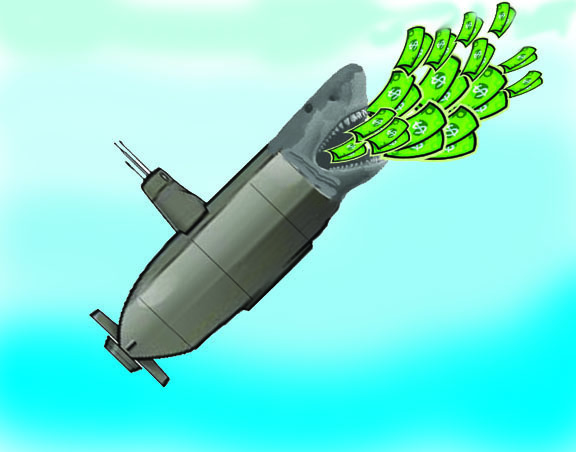
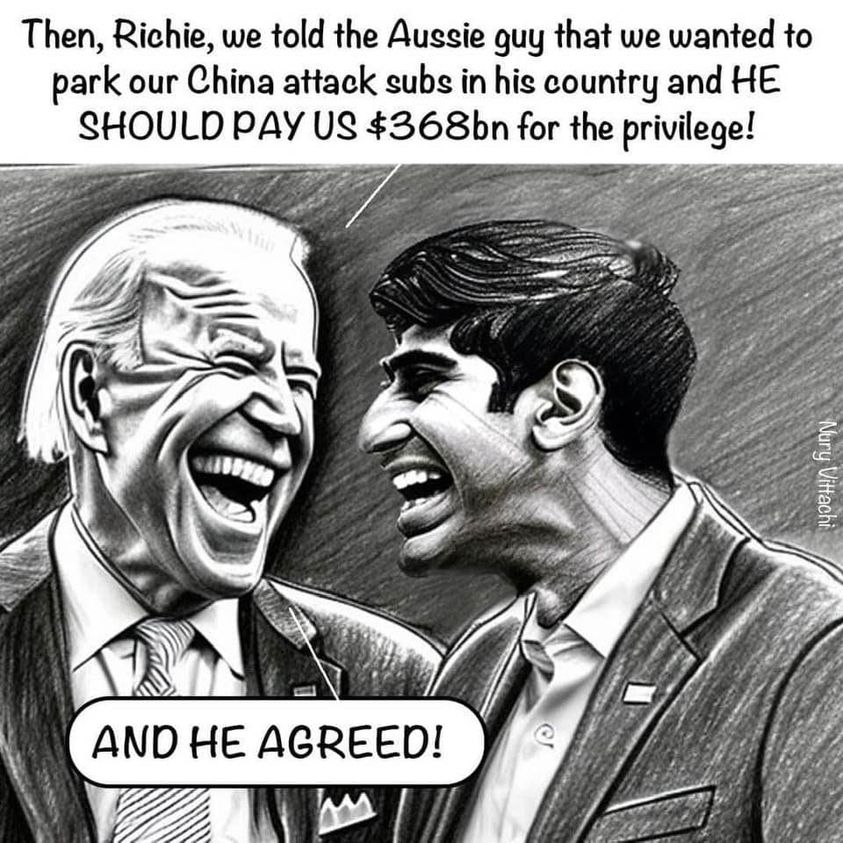


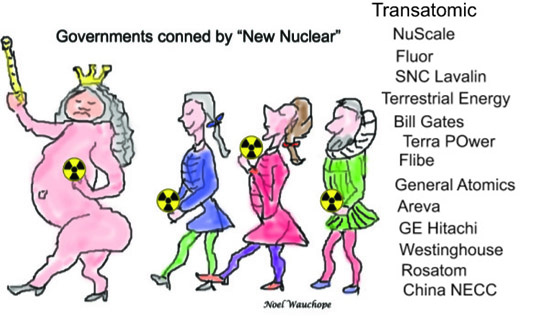







 nuclear-news