‘Cottage industry’: Gurus say nuclear no match for solar energy

Hans van Leeuwen https://www.afr.com/companies/energy/cottage-industry-gurus-say-nuclear-no-match-for-solar-energy-20231013-p5ebxp
Hans van Leeuwen covers British and European politics, economics and business from London. He has worked as a reporter, editor and policy adviser in Sydney, Canberra, Hanoi and London. Connect with Hans on Twitter. Email Hans at hans.vanleeuwen@afr.com
London | The debate on nuclear power is a distraction from solar, which is about to tip into exponential growth that will sweep aside all other energy sources, say Australia’s much-garlanded pair of leading solar inventors.
Andrew Blakers and Martin Green, often dubbed the “fathers of photovoltaics”, described nuclear energy as “a cottage industry”, with no chance of reaching economies of scale in any useful timeframe.
Solar, though, “is going to take over energy it is in a way that will be utterly astonishing for most people”, Professor Blakers said.
“It is going to do it as fast as we went from film photography to digital photography. In the space of 20 years, basically we’re going to flip from solar being a few per cent to solar being everything but a few per cent. It really is the fastest energy change in all of history by a large margin,” he said.
The two men were in London to collect the latest in a string of prizes for their work on PERC solar photovoltaic technology, which has brought down the cost of solar panels by 80 per cent in the past decade.
At Buckingham Palace on Thursday (Friday AEDT), the King awarded them and their colleagues Aihua Wang and Jianhua Zhao with the Queen Elizabeth Prize for Engineering.
Professor Green described nuclear as “pie in the sky” – including the small modular reactor technologies that have enthused the British government and the opposition in Australia as countries race to transition to green energy.
“They are going to have a few prototypes up by 2030, but it really needs the economy of volume to get the prices down to where they’re projecting,” he said. “So you need to be selling hundreds of these things, not just a few sample ones.”
He also said that the history of power generation had been about reducing costs by making things bigger. “It’s going against historical trend, I think, imagining that you can do things cheaply by making a lot of [smaller ones].”
Professor Blakers said nuclear was simply not in the net-zero race. “This year, it looks like the world will do about 500 gigawatts of solar and wind – maybe 400 gigawatts of solar, 100 gigawatts of wind. Hydro will do about 20 gigawatts, nuclear will do approximately one, gas and coal maybe 50,” he said.
“Solar has been growing at 20 per cent a year for a long time. If it continues to grow at this level, we will completely decarbonise the world by the early 2040s. This is how fast it’s happening. It’s so cheap compared with anything else.”
Nuclear, meanwhile, had not increased its capacity in the past 13 years, he said, adding no more than a gigawatt a year.
“You cannot grow an industry from one to multi-thousand gigawatts, which is what you’d need per year, in any reasonable timeframe. It’s impossible unless you put it on a war footing,” he said.
“You just don’t have enough engineers, scientists, raw materials, the factories, the factories to build the factories, the factories to build the factories to build the factories – it just doesn’t happen.”
Grids: the big hurdle
Both men were convinced that battery technologies and costs would continue to fall, driving increasingly rapid growth. The one big obstacle in Australia was transmission.
“Basically, you need a lot of new transmission to bring the new solar and wind into cities. And we’re not building it,” Professor Blakers said.
“Transmission only becomes important once you get up to 30, 40 per cent solar-wind. We’re currently 33 per cent solar-wind, and we will be 75 per cent by 2030. We don’t have a transmission problem yet. But in two years’ time, we’ll have a major one, and everyone can see that.”
He said initiatives to increase compensation to land owners should overcome the remaining community resistance.
Professor Green said the growth of solar energy use would not unseat China’s dominance of the supply chain for solar panels.
“Solar is basically going to demolish the market for coal and gas. And the geopolitical question is whether India, Europe and the US would tolerate having 80 or 90 per cent of the global solar industry coming out of China,” he said.
“It’s very hard to see other countries competing with China. The momentum they’ve got.”
He said India might become a major manufacturer, but its industry’s development would not be as co-ordinated and co-operative as China’s had been.
China, though, would have to address the demand of its customers for higher environmental and social standards – creating an opportunity for Australia to become a player in providing green-friendly metallurgical-grade silicon. #nuclear #antinuclear #NuclearFree #NoNukes #NuclearPlants
Australia might be better off to cancel the nuclear submarine plan

How many nuclear-powered submarines for Australia?
The Strategist, 12 Oct 2023|Peter Briggs
“………………………………………………………………………………..It takes three to four submarines to guarantee having one available for deployment. The ‘rule of three’ was validated by the Coles review, but that doesn’t include any spare capacity to cope with unexpected defects…………………………………………
Australia is planning on a three-year interval between delivery of submarines, driven by the time it will take to generate a crew from our small submarine personnel base and limited sea training capacity in operational Collins-class and US and UK submarines.
Construction time doesn’t determine the drumbeat for delivery; rather, construction starts in sufficient time to achieve the delivery drumbeat.
Three years is a slow drumbeat industrially. Shorter would be more efficient but is currently not feasible because of personnel limitations. The personnel training limitation should ease once Australia has at least six SSNs at sea. The drumbeat could then be shortened. A slow drumbeat is more expensive due to idle production but is also likely to contribute to a loss of skilled workers; witness the UK’s experience at Barrow in Furness because of the slow Astute drumbeat.
A construction program building eight submarines at a three-year drumbeat would take 21 years. Submarines typically have a hull life of 25–30 years. Thus, this production line would have nothing to build for four to nine years, and would then be then back into stop–start shipbuilding.
A force of 10 SSNs at a three-year drumbeat with a planned 27-year life is the minimum to provide a continuous-build program, avoiding the stop–start situation. A force of 12 could achieve a shorter drumbeat in the later stages when the personnel restrictions are not so severe.
Decisions on the final size of the force must be made now, at the program’s inception. They drive industrial issues such as the size of facilities, production-line technology, the supply chains supporting the force and the ordering of long lead items such as the reactor. The decision cannot responsibly be left for a future government.
My study of British, French and US submarine-crewing policies, summarised in my 2018 ASPI report, concluded that a force of 10 SSNs with 10 crews was essential to generate the minimum critical mass of experienced personnel. A smaller force will not generate sufficient highly experienced personnel to oversee the safe technical and operational aspects of the program. That calculation assumed one base and one submarine squadron. Two-ocean basing with an additional 200 highly experienced squadron staff, a key link in the operational and safety chain, would require at least 12 SSNs.
Britain’s Royal Navy has six or seven SSNs and four SSBNs operating from one base in a single squadron. Its personnel situation is dire. High wastage rates and shortfalls in many critical categories have reportedly necessitated drafting non-volunteers to submarine training and cannibalising parts and crew to get even one submarine to sea. At times, the RN is unable to achieve even one. Is that where Australia is heading?
The issues are undoubtedly more complex than simply the size of the force, but it reinforces the point that a force of eight SSNs requiring six to seven crews is below critical mass, vulnerable to personnel shortfalls, will struggle to sustain two SSNs deployed, and won’t be able to sustain two-ocean basing.
Even more problematic is whether Australia can achieve an operational, sustainable and deployable SSN capability from eight boats made up of a mix of Virginia and AUKUS designs. The mix of classes adds to the complexity, cost and risk because it entails two supply chains and differing major onboard equipment, spares, and training systems and simulators.
Australia requires at least 12 SSNs to sustain two-ocean basing with two deployable on each coast in the good times. A force of 18—nine on each coast—would be more resilient, reliably providing two deployable SSNs, with three available in the good times.
Eight is plainly insufficient on all counts.
Leaving the decision for a later government will mean greater expense and increase the risk that the program doesn’t produce the needed strategic capability, while stripping funds from other key defence capabilities. A lack of decision, along with Australia’s failure to join the AUKUS SSN initial design effort, indicates inadequate commitment.
A ‘damn the torpedoes’ transition to SSNs could leave us with no submarine capability.
If Australia is not prepared to, or cannot, invest the resources to achieve a viable SSN force, we are better off not continuing down this path.
AUTHOR
Peter Briggs is a retired submarine specialist and a past president of the Submarine Institute of Australia. https://www.aspistrategist.org.au/how-many-nuclear-powered-submarines-for-australia/ #nuclear #antinuclear #NuclearFree #NoNukes #NuclearPlants
Australian government funds pro nuclear propaganda in schools – (even making it “fun”)

Education project focused on engaging next-generation nuclear science professionals in Australia and Japan.
ANSTO 11th October 2023 by ANSTO Staff
ANSTO has recently concluded up a successful cross-cultural nuclear science education project between Australia and Japan.
In collaboration with the Japan Atomic Energy Agency (JAEA) and the University of Tokyo, the project brought together 200 university students, 180 secondary school students and 40 schoolteachers across the two countries.
Participants learned about the history, cultural perspectives, career opportunities and applications of nuclear science in Australia and Japan in interactive presentations, demonstrations and discussions.
Engaging next-generation nuclear science professionals in Australia and Japan was funded by the Australian Department of Foreign Affairs and Trade’s 2022-23 Australia-Japan Foundation grant.
Dr Bridget Murphy, Education Manager (Secondary) at the Discovery Centre, was the ANSTO lead on the project.
“University students from both Australia and Japan were very interested in future career opportunities in nuclear science. They also had a broad range of questions about communicating science to the public effectively, radiation safety, the use of nuclear energy in combating climate change, and international collaboration in nuclear,” Dr Murphy said………….
Teachers from both Australia and Japan valued a cross-cultural perspective on the methods for teaching this subject in the classroom, using videos, hands-on and data-based approaches to instruction in nuclear science.
Professor Takeshi Iimoto of the University of Tokyo emphasised the role of project-based learning and suggested that even humour can make nuclear more understandable for school students.
ANSTO is pleased to continue professional development with teachers in Asia, building on past experience working with teachers internationally through the International Atomic Energy Agency (IAEA)………. https://www.ansto.gov.au/news/education-project-focused-on-engaging-next-generation-nuclear-science-professionals-australia #nuclear #antinuclear #NuclearFree #NoNukes #NuclearPlants #Australia
The case of Yaroslav Hunka, and its echoes in Australia’s history
Jayne Persian 9 Oct 23 https://overland.org.au/2023/10/the-case-of-yaroslav-hunka-and-its-echoes-in-australias-history/?fbclid=IwAR3fq-DqIxk7y61nKGzy77tlYkYp9vU9JaywMHQdzsQEcC6nrbU5dzrIrFk
Dr Jayne Persian is a Senior Lecturer at the University of Southern Queensland and the author of Fascists in Exile: Post-War Displaced Persons in Australia, forthcoming with Routledge Studies in Fascism and the Far Right.
On 22 September, during a visit to the Canadian Parliament by Ukrainian President Volodymyr Zelenskyy, Speaker Anthony Rota publicly introduced ninety-eight-year-old Yaroslav Hunka as a constituent ‘who fought for Ukrainian independence against the Russians’ as part of the First Ukrainian Division during the Second World War. He was ‘a Ukrainian hero, a Canadian hero, and we thank him for all his service.’ Hunka received a standing ovation from all present.
This scene was reported two days later by an antifascist site on Twitter, who pointed out that the First Ukrainian Division was also known as the Waffen-SS Galizien Division. Canadian academic Ivan Katchanovski linked to a veterans’ webpage in which Hunka wrote that he had been a volunteer recruit to the Galizien Division in 1943. Hunka had also uploaded photographs showing him in uniform with the ‘boys’.
The Kremlin immediately reacted, with spokesman Dmitry Peskov arguing that ‘such sloppiness of memory is outrageous.’ Opposition Leader, Pierre Poilevre, described this incident as the worst diplomatic embarrassment in Canada’s history. Rota resigned, and Prime Minister Justin Trudeau was forced to apologise unreservedly.
These embarrassing episodes continue to occur in countries that resettled the post-war displaced persons of Central and Eastern Europe. This mass of around one million people had refused to return to homes that were under Soviet control. As well as concentration camp inmates and forced labourers, these political refugees included soldiers who had fought in German military units, as well as civilian collaborators. Security screening was difficult and there was also some sympathy from the Allied military authorities for veterans on the losing side. Whole cohorts were resettled in Britain, including 8,000 Ukrainian members of the Waffen-SS Galizien Division. Ukrainian nationalist declarations were also treated seriously. While all Ukrainian displaced persons held either Polish or Soviet Union citizenship, they were treated as a separate group quite quickly.
Many of these men should have been charged with war crimes. The German-led Holocaust had relied on the firepower and administrative skill of non-German Central and Eastern Europeans, including Ukrainians. Ukrainian anti-Soviet and anti-Polish nationalists were initially involved in individual and group paramilitary acts, including voluntary local pogroms and/or acts of murder before or beside the German occupation. One of the pogroms, which involved the massacre of 12,000 Jews, was named Aktion Petliura after the Ukrainian nationalist leader Symon Petliura, who had been assassinated by a Ukrainian Jew (this assassination itself framed as retaliation for earlier pogroms) in 1926.
After the initial wave of pogroms, Ukrainians became progressively involved with an institutionalised German genocidal machinery. Ukrainians joined a Ukrainian Auxiliary Police Force (Schutzmannschaft), the German security police (Sicherheitspolizei, SiPo) and the intelligence agency (Sicherheitsdienst des Reichsführers-SS, SD). Others hunted Jews in their forest warden jobs. Local policemen were empowered to kill anyone the Germans defined as enemies of the state, including Jews; indeed, the Germans relied on the dramatically increased numbers of local forces to do the dirty work of the Holocaust, including the shooting of children. Between 1941 and 1944, 1.6 million Jews had been murdered in Ukraine. In 1943, 100,000 of these men volunteered to join the Waffen-SS Galizien Division. In this capacity, they have been accused of murdering Polish civilians.
The United Nations’ International Refugee Organisation resettled the displaced persons in the United States, Australia, Canada, and the United Kingdom. The western world was eager to use the labour of these healthy, white, and stridently anti-communistic young men. Australia resettled 170,700 displaced persons including Poles, ‘Balts’ (Estonians, Latvians and Lithuanians), Yugoslavs, Ukrainians and Hungarians. There was immediate criticism by Jewish groups and sections of the press that the new migrants included war criminals but these were roundly dismissed as Soviet communist propaganda.
Decades later, all four of the main resettlement countries instituted judicial processes against the alleged perpetrators of the Holocaust who were now resident in their countries. In Australia, such men were guaranteed a fair criminal trial: the evidence, for crimes that occurred over forty-five years before, had to include documentary and material evidence and, ideally, eyewitnesses to the alleged individual perpetrator carrying out a war crime. Of course, the nature of the Holocaust was such that very few eyewitnesses to genocide survived in order to testify against individual killers.
After a flawed investigative process, only three men were charged. All three were Ukrainians who had resettled in Adelaide. Ukrainian auxiliary policeman Mikolay Berezowsky was accused of being party to a mass murder of 102 Jewish villagers. Henry Wagner, an ethnic German liaison officer between the German and Ukranian auxiliary police force, was charged with being party to two mass murders, including the shooting of nineteen part-Jewish children. Forest warden Ivan Polyukhovich was accused of hunting and killing Jews under the German occupation, and in taking part in a mass shooting. However, the evidence bar was so high that there were no convictions.
Immediately after the unsuccessful war crimes trials, Ukrainians again attracted attention with an award-winning novel by Helen Demidenko, purporting to be written by a Ukrainian-Australian and based on the life story a member of that community. To the great embarrassment of the Australian literati, Demidenko was soon unmasked as English-Australian Helen Darville, who had attended the Polyukhovich trial with a young man who was noticed to be repeatedly muttering ‘Jews’.
Many responses to Ivan Katchanovski’s tweets shedding light on this unsavoury history — one that Canada and Australia share — claimed that this was not the time to be critiquing Ukraine or Ukrainian nationalists. Ukraine was, of course, invaded by Russia in 2022 and that war is ongoing. Most in the West sympathise with, and support, Ukraine’s fight. And Russia has attempted to smear all Ukrainians with accusations of Nazism, which is simply not true. Dismissing inconvenient histories and the problematic pasts of individual migrants to both Canada and Australia, however, is not useful.
The complicity of the West in assisting perpetrators to escape justice should be acknowledged, and we must be wary of any attempt to normalise fascist views and actions in the public sphere. #Ukraine
Is #nuclear energy feasible in Australia (and how much would it cost)?

What problem is nuclear trying to provide a solution for, asks Ernst & Young climate change and sustainability partner Emma Herd. “If it’s cost of living, it’s expensive. If there are challenges with social licence for renewables then nuclear has got 10 times more social licence problems. If it is the need to rapidly deploy low-emissions energy technology to replace coal then nuclear takes a long time to get approval for, let alone to build, let alone to get up and operating. If it’s the need for rapid decarbonisation, again, it’s too slow.”
Debate has erupted over nuclear energy’s role in Australia’s shift from fossil fuels. Could it work? And why is it so controversial?
SMH, By Mike Foley, OCTOBER 7, 2023
Australia is in the middle of an unprecedented energy revolution, switching from the fossil fuel-powered electricity grid that’s been the bedrock of the nation’s economy for decades to clean energy, through a rush of renewables as wind and solar farms spring up across the country.
The shift is being driven by Australia’s commitment to help tackle climate change by cutting damaging greenhouse emissions.

But a fiery political debate has erupted over the future of Australia’s energy supply in recent months, with federal Opposition Leader Peter Dutton demanding the Albanese government remove the nation’s longstanding ban and deploy what he claims is clean, cheap and reliable nuclear power…………..
What would be the costs? And how does nuclear power work?

………………………………………………………………………… This atomic fission also creates zero greenhouse gases, [ed. note: in the reactor operation, but not in the entire fuel cycle] which is a key benefit cited by nuclear energy advocates, but its opponents point to the dangers associated with storing the radioactive waste and the potential for spent fuel from nuclear reactors to be used to make nuclear weapons.
Past accidents have undermined public confidence……………………………..

…………………………………. In Australia, a national ban on nuclear energy was put in place by the Howard government in 1999, after horse-trading with the Australian Democrats over the government’s signature green reform, the Environment Protection and Biodiversity Conservation Act, which stated that the relevant minister could not approve a nuclear power plant.
Seven years later, the Howard government asked Telstra chief executive and trained nuclear physicist Ziggy Switkowski to investigate the merits of nuclear power in Australia. That report delivered a hammer blow to the industry. Switkowski found that nuclear power could compete economically with coal power only if a politically contentious carbon tax was imposed.
In 2019, Switkowski also told a parliamentary inquiry there was little prospect for Australia to develop a nuclear energy industry because the “window for large gigawatts to go in nuclear generators has now closed for Australia”. He said a nuclear industry would take too long to establish and be too costly to build compared to alternative infrastructure. He also said it was unlikely the industry could establish enough support to gain a social licence to operate.
“Given that the investment in a power station, particularly a big one, would begin at $US10 billion and go up from there, and it would take around 15 years to make it work, you can’t progress without strong community support and bipartisanship at the federal level, and there is not too much evidence of that,” he said.
But now the federal Coalition is calling for the nuclear energy ban to be abolished.
……………………………. Nuclear energy proponents argue nuclear should replace coal. Those advocates include the Minerals Council, prominent Nationals including leader David Littleproud and former leader Barnaby Joyce, and some Liberal MPs including Dutton and his climate change and energy spokesman, Ted O’Brien.
……………………………….Renewable energy advocates point out that investors are flocking to large-scale wind and solar projects, which are pumping cheaper energy into the grid and outcompeting coal. The Australian Energy Market Operator (AEMO), which manages the electricity grid, says a grid based on renewables will be just as reliable as a system centred on baseload power.
Could we get a nuclear industry happening in time?
Speed is of the essence, say climate scientists. Global emissions are on track to exceed the goal of the Paris Agreement to limit global warming to less than 2 degrees, a level that would avoid the worst damages from climate change. While renewables are available now, and cheaply, it would likely take decades to establish a nuclear energy industry in Australia.
Australia’s former chief scientist, Alan Finkel, told this masthead in August it was highly unlikely Australia could open a nuclear power plant before the early 2040s, pointing out the autocratic United Arab Emirates took more than 15 years to complete its first nuclear plan using established technology.
What problem is nuclear trying to provide a solution for, asks Ernst & Young climate change and sustainability partner Emma Herd. “If it’s cost of living, it’s expensive. If there are challenges with social licence for renewables then nuclear has got 10 times more social licence problems. If it is the need to rapidly deploy low-emissions energy technology to replace coal then nuclear takes a long time to get approval for, let alone to build, let alone to get up and operating. If it’s the need for rapid decarbonisation, again, it’s too slow.”
Herd says it would take decades of investment in enabling services for the nuclear energy value chain before a new plant could be built, on top of the likely 20 years needed to plan, gain approval for and build a plant.
“Nuclear has got not just a 20-year timeframe to build something, it’s actually probably more a 30- to 50-year timeframe to build an industry,” she says. This includes either educating or importing a generation of nuclear experts to design and operate facilities, capability to construct the complex facilities, creating a bureaucracy to administer the industry and writing the laws to govern it.
Could nuclear energy solve the power line ‘problem’?
A key sticking point in the Opposition’s criticism of renewable energy is the Albanese government’s push to build some 10,000 kilometres of power lines to link the plethora of renewable energy projects springing up across the country with major cities. AEMO has forecast that could cost around $13 billion by 2030. Nuclear energy advocates say those costs could be avoided by building nuclear plants on the sites of existing coal plants, where existing transmission lines converge.
In fact, even if there were no renewable energy expansion, expensive new transmission lines are still needed to upgrade the grid and increase its capacity in line with population growth, but they have been delayed. Energy experts are increasingly worried that time is running out, risking Australia’s ability to compensate for the looming closures of coal-fired power plants.
A major factor in the delays is community backlash against transmission lines, with farmers denying land access to private companies. Littleproud is leading the charge against the renewable energy rollout and backing farm groups in their protest. Backed by Dutton, he has accused the government of running a “reckless race” to renewables and is calling for a halt to privately run transmission projects, for a Senate inquiry or summit into renewable energy and for a national discussion on removing Australia’s moratorium on nuclear power.
Isn’t there a new type of nuclear technology now?

With Dutton heading the push for a plan to replace Australia’s existing fleet of coal plants with nuclear, Littleproud has declared he is open to having a plant in his Queensland electorate. The Coalition says Australia could deploy the next-generation of nuclear technology called small modular reactors, which are based on the energy units in nuclear submarines.
Finkel has said that, from a “purely engineering” perspective, nuclear technology is appealing, with zero emissions, a continuous supply of baseload power and a small mining footprint for fuel. But he has said that small modular reactors are not currently viable technology. “There’s no operating small modular reactor in Canada, America or the UK, or any country in Europe.”
Finkel noted that private company Nuscale is aiming to commission 12 small modular reactors starting from 2029, but he said it would take at least a decade to follow suit in Australia.
Is nuclear cheaper?
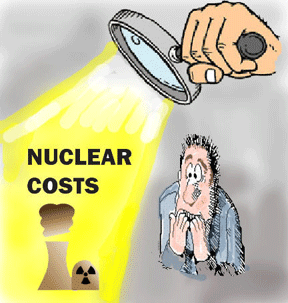
A joint study by the CSIRO and AEMO, the GenCost report, calculated the future cost of energy generation for a range of technologies. It found that solar and wind energy generation would cost between $60 and $100 per megawatt hour by 2030, including back-up power from either batteries, pumped hydro or gas plants. (This figure also includes CSIRO and AEMO-termed “sunk costs” of new transmission lines.)
GenCost forecast that one megawatt hour of power from a small modular reactor in 2030 would cost between $200 and $350 per megawatt hour.
Another energy advisory, Lazard from the US, calculated the levelised cost of nuclear and renewables – which means the average net present cost of electricity generation for a generator over its lifetime. It found that one megawatt hour from solar power, including back-up storage, costs between $72 to $160 per megawatt hour, while a traditional nuclear plant costs from $220 to $347.
Why is the politics of nuclear toxic?
Even if the Albanese government wanted to open a debate over the future of nuclear power in Australia, the party’s official policy platform that is formed by rank and file members states Labor will “prohibit the establishment of nuclear power plants and all other stages of the nuclear fuel cycle in Australia”.
While it’s not impossible for politicians to ignore the policy platform, it is extremely challenging.
In any case, the government has come out swinging against the opposition’s call for nuclear power in Australia. Bowen……………………. https://www.smh.com.au/politics/federal/is-nuclear-energy-feasible-in-australia-and-how-much-would-it-cost-20231004-p5e9qc.html
Australian Defence Minister slammed for exorbitant secret travel costs for nuclear submarine deal

Jacqui Lambie’s nuclear response to secret flights for submarine project. Independent Senator Jacqui Lambie has slammed the decision to slug taxpayers $630,000 a month in “secret” travel costs.
Samantha Maiden, news.com.au 7 Oct 23 #nuclear #antinuclear #nuclear-free #NoNukes
Independent Senator Jacqui Lambie has slammed the decision to slug taxpayers $630,000 a month in “secret” travel costs for bureaucrats working on Australia’s nuclear submarine project.
Despite the fact that the first submarine won’t be delivered to Australia under the deal until 2040, new documents reveal scheme has already blown up $15 million in travel costs alone in two years.
But bizarrely, the Defence Department has redacted the commercial airline departure times “for security reasons” suggesting it might reveal patterns of travel and put bureaucrats lives and safety at risk…………………………………………………………
It’s the same reason the defence department is refusing to reveal details of Defence Minister Richard Marles’ VIP flights suggesting it could put his safety in danger.
Australia plans to acquire a total of eight nuclear powered submarines (SSNs) under the $368bn deal.
But at least three of the subs and up to five of the eight will be Virginia-class submarines it will buy from the United States.
New data revealed under freedom of information laws reveal that Vice Admiral Jonathan Dallas Mead, the navy’s nuclear-powered submarine taskforce chief, has spent $197,000 on 8 overseas trips alone.
That’s contributing to the $15 million in global travel costs, a figure that adds up to $633,000 per month.
Defence representatives travelled to the United States and United Kingdom, and our AUKUS partners travelled to Australia, as part of the 18-month consultation period.
“Fifteen million bucks is a shocking amount to spend on travel, that‘s a bill of $633,000 a month for the Australian tax payer,” Senator Lambie said.
Defence personnel don’t get frequent flyer points – but do get status points.
“Admiral Mead alone has spent $197,000 on eight overseas trips, I bet his status points are looking good,” she said.
“It‘s not a submarine – it’s a gravy boat! And why all this secrecy?
“The government says the flights have been redacted because it‘s a national security matter, what a load of rubbish, these flights are in the past, there’s no national security issue.”
“Australia seems to be footing most of the bill for the AUKUS submarines, what is the UK and the US paying?.”
“This government campaigned on transparency and yet they are failing Australians when it comes to public scrutiny.“
Senator Lambie asked the Department of Defence how much had actually been spent out of the $300 million that was allocated to the task force in the financial year of 2022-23.
In response, the department confirmed that Defence representatives travelled to the United States and United Kingdom, and AUKUS partners travelled to Australia, as part of the 18-month consultation period.
The total expenditure for the Nuclear Powered Submarine Taskforce over the 18-month consultation period (16 September 2021 to 31 March 2023) was $139.2m.
A breakdown of class of travel is not held…….. https://www.news.com.au/national/politics/jacqui-lambies-nuclear-response-to-secret-flights-for-submarine-project/news-story/0bb81fa011f5c3128e9caa7361a7ef2d
Trump blabbed nuclear sub secrets to Australian billionaire member of Mar-a-Lago club, report claims
Andrew Feinberg, Fri, October 6, 2023 https://www.yahoo.com/news/trump-blabbed-nuclear-sub-secrets-211203147.html?guccounter=1
Former president Donald Trump allegedly revealed highly classified information about American nuclear-powered submarines to a wealthy Australian who regularly paid large sums to one of his companies, according to a report from ABC News.
Mr Trump reportedly disclosed the extremely sensitive information to a billionaire member of his Mar-a-Lago social club, which is housed at the location where he allegedly hoarded hundreds of classified documents for more than a year after his term as president — and his authorisation to possess such documents — had come to an end.
Citing sources familiar with the matter, ABC reported that the Aussie high-roller in question allegedly shared the information about US nuclear-powered submarines with “scores” of other people not authorised to have it, including “more than a dozen foreign officials” and journalists of unknown nationality.
Department of Justice investigators working under the supervision of Special Counsel Jack Smith learned of the potential breach as they were investigating Mr Trump’s alleged unlawful retention of national defence information.
Both prosecutors and special agents with the Federal Bureau of Investigation have reportedly spoken to the Mar-a-Lago member, packaging magnate Anthony Pratt, on at least two occasions this year.
Mr Pratt reportedly told investigators that the ex-president told him two pieces of information about the submarines: How many nuclear warheads are carried by American Ohio class ballistic missile submarines, and how close to such vessels a Russian submarine must get to detect them.
Both of those figures are among the US Navy’s most closely guarded secrets. But sources reportedly told ABC that Mr Pratt described what Mr Trump had said to at least 45 other people, including 10 Australian officials and a trio of former prime ministers.
Who Is Anthony Pratt, the Australian Billionaire Trump Allegedly Shared Nuclear Secrets With?
Bloomberg, By Andrew Heathcote, October 6, 2023 #nuclear #antinuclear #nuclear-free #NoNukes
Australian billionaire Anthony Pratt has been hurled into the spotlight after US press reports alleged that former President Donald Trump spilled secrets about US nuclear subs to the businessman.
ABC News first reported that Trump discussed the potentially sensitive information with Pratt — who’s a member of his Mar-a-Lago Club — shortly after leaving office. The report alleges that the businessman then went on to share that information with several others, following the revelations at Trump’s private club.
Here’s a quick rundown of what you need to know about Australia’s ‘cardboard king’…………………………………………..
He’s worth $9.2 billion, according to the Bloomberg Billionaires Index. That makes him the world’s 213th richest person, the data show……………………………
Former Australian prime minister Scott Morrison joined Trump and Pratt on their paper plant tour in 2020. Pratt also has a relationship with President Joe Biden having invited the then vice president to dinner during his Australian visit in 2016. Back in 2013, during the Obama administration he appointed a former US ambassador to his advisory board…………………..
What did Pratt do after Trump’s alleged revelations?
After Trump allegedly shared details on the submarines — reported to be the number of nuclear warheads they carry and how close they can get to Russian subs — Pratt went on to disclose the potentially-sensitive information to “scores of others,” including foreign officials, journalists and employees, according to ABC. He has since been interviewed by US law enforcement agencies, the network reported…………… more https://www.bloomberg.com/news/articles/2023-10-06/who-is-anthony-pratt-the-billionaire-trump-is-accused-of-revealing-secrets-to?leadSource=uverify%20wall
Australian towns battle fire and flood back-to-back
Hours after they were threatened by fire, several Australian towns are
preparing for floods. Bushfires have been burning in Victoria’s Gippsland
region and New South Wales’ South Coast this week – both areas were hit
hard by Australia’s Black Summer bushfires four years ago. Rain is now
offering some reprieve, but it has also triggered flood warnings. The
country has reeled from disaster to disaster in recent years, as it feels
the effects of climate change.
BBC 4th Oct 2023
France attempts to pressure Australia to stop engaging with UN nuclear weapons ban treaty

https://www.icanw.org/france_pressures_australia_to_stop_engaging_with_un_nuclear_weapons_ban_treaty 2 Oct 23 #nuclear #anti-nuclear #Nuclear-Free #NoNukes
Recent statements by a French diplomat to “the Australian” newspaper criticizing Australia’s decision to observe the UN Treaty on the Prohibition of Nuclear Weapons (TPNW) reveal the panicked efforts by nuclear-armed states to undermine the treaty as support for the ban continues to grow. It also shows a European state with a dark colonial legacy continuing to exert pressure on the Pacific – an area heavily impacted by French nuclear testing – instead of respecting national sovereignty.
On 2 October an article in “the Australian” newspaper cited an unnamed French diplomat claiming that Australia’s support for the Treaty on the Prohibition of Nuclear Weapons “undermines the primacy of the Nuclear Non-Proliferation Treaty (NPT)” and “is contradictory with Australia’s ambition to reinforce its partnership with NATO.”
Both of these statements are not only hamfisted attempts at pressuring the Australian government away from the TPNW, they are also factually incorrect: The TPNW was carefully crafted to reinforce, complement, and build on the NPT, which obligates its parties – including France – to negotiate further legal measures to achieve nuclear disarmament under Article VI, and NATO members face no legal barrier to joining the treaty, so long as they commit not to engage in or support any nuclear-weapon-related activities. Moreover, several NATO partners are already TPNW parties (Austria, Ireland, Kazakhstan, Malta, Mongolia, New Zealand) or signatories (Algeria, Colombia).
These declarations show France’s mounting concern over the growing support for the TPNW. The statements themselves are no surprise, as France has stridently protested the TPNW ever since it was adopted at the UN in 2017 with the backing of 122 states. France insists it has a legitimate right under the NPT to possess nuclear weapons, while ignoring its commitments to pursue negotiations in good faith for nuclear disarmament under the same treaty. What is new is the fact that this pressure is being exerted publicly, and on a state that is largely seen as an ally on security issues. Previously, France has limited this kind of pressure for formerly colonised states, particularly in Africa.
Australia’s growing support for the TPNW
The Australian Labor Party, which has been in power since May 2022, adopted a resolution in 2018 committing it to sign and ratify the TPNW in government. This was moved by Anthony Albanese, who now serves as prime minister and has been a vocal supporter of the TPNW. He said at the time: “Our commitment to sign and ratify the nuclear weapon ban treaty in government is Labor at its best.” Labor reaffirmed this position in 2021 and most recently on 18 August 2023. The government also has confirmed its intention to observe the treaty’s upcoming meeting of states parties in New York (2MSP) and is evaluating whether to sign and ratify the treaty.
This is an encouraging step, but ICAN’s Executive Director, former Labor MP Melissa Parke, has criticised the government’s delay in ratifying the treaty: “It’s not enough to keep promising to sign the treaty without acting. We want to see the Prime Minister put pen to paper, without delay. Labor’s commitment on nuclear disarmament and non-proliferation will be hollow if Australia fails to do so.”
Speaking to the revelation that French diplomats are exerting pressure on Australia to consider, she said: “Our two countries have never seen eye to eye on nuclear weapons. France shouldn’t be lecturing Australia on nuclear policy. We can make our own decisions, in our own interests – and for the global common good.”
France’s unresolved nuclear legacy in the Pacific
From 1966 to 1996, France tested 193 nuclear weapons in Maohi Nui/French Polynesia, a Self Governing Territory of France in the Pacific. In 1974, Australia famously took France to the International Court of Justice in a bid to force an end to its atmospheric nuclear testing in the Pacific, as the impacts of nuclear weapons are not contained by national borders. Yet France only ended its Pacific nuclear test explosions once it was confident it had developed non-explosive testing methods sufficiently for new weapons development, and it refuses to acknowledge and address the catastrophic legacy of its nuclear tests to this day.This legacy is also a subject of hot debate at the national level in France. On 28 September, only days before France’s criticisms of Australia, the assembly of French Polynesia unanimously adopted a resolution supporting the TPNW, highlighting the region’s history as the site of numerous French nuclear tests. The resolution underscores the TPNW as a humanitarian disarmament treaty and emphasises the deep concerns of the French Polynesian population regarding this issue. While French Polynesia cannot currently access the assistance and rehabilitation outlined in Articles 6 and 7 of the TPNW due to France’s non-ratification, it sends a resounding message in favour of the treaty to Paris.
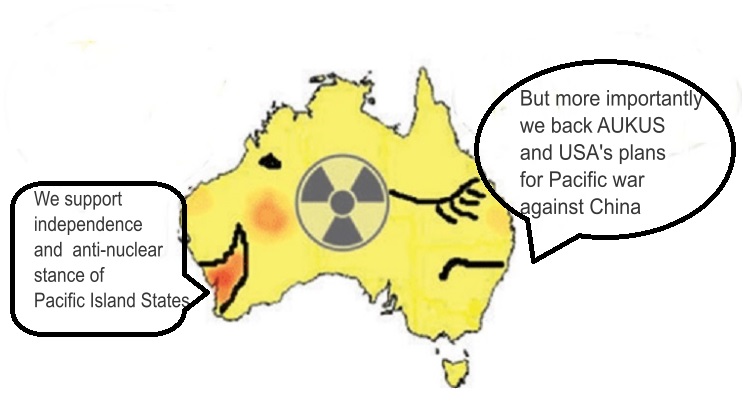
Pacific island States support the Treaty on Prohibition of Nuclear Weapons – a problem for Australia in joining AUKUS nuclear military alliance
French criticism of nuclear ban treaty highlights Canberra’s dilemma
The Interpreter, NIC MACLELLAN, 2 Oct 23
Can Australia rebuild a strategic military partnership with France at
the same time as independence movements claim Pacific support?
On 28 September, the Assembly of French Polynesia unanimously passed a resolution endorsing the Treaty on the Prohibition of Nuclear Weapons (TPNW), the nuclear ban treaty that entered into force in 2021. Even though France refuses to sign the treaty, and still controls the defence and foreign policy of French Polynesia, the local legislature in Tahiti with its new pro-independence government sees TPNW as setting a new norm in international law. The resolution encourages “the participation of France as an observer state at the next TPNW Meeting of the States Parties”, to be held in New York in late November. It also calls on the French government to “work towards France’s adherence to this new international norm.”
A key reason for this pointed message to Paris are the TPNW provisions that call for assistance to nuclear survivors and clean-up of contaminated nuclear test sites. The Ma’ohi people are still seeking compensation for the health and environmental effects of 193 French nuclear tests at Moruroa and Fangataufa.
Beyond this, French Polynesia’s critique of nuclear weapons echoes the views of the majority of members of the Pacific Islands Forum. Unlike Australia, nine independent Pacific Island countries and Aotearoa-New Zealand have already signed and ratified the TPNW.
At the recent Australian Labor Party (ALP) National Conference in Brisbane, the party re-confirmed its support for signing the TPNW – under restrictive conditions – and agreed to send an observer to the next Meeting of State Parties. However key ALP leaders are opposed to signing, and nuclear weapons states such as the United States and France, having long derided the treaty, are now ramping up their opposition to it.
A front-page story in The Australian on 2 October cited an unnamed French diplomat who criticised Australia over its tentative moves towards signing TPNW, though the story fails to mention last week’s resolution from the Assembly of French Polynesia…………………………………………….
the Australian government has held a series of meetings with key French ministers to rebuild relations disrupted by AUKUS, including a summit between Defence Minister Richard Marles and French counterpart Sebastien Lecornu in September 2022, and a 2+2 meeting of defence and foreign ministers in January. Marles and Lecornu are organising the South Pacific Defence Ministers meeting in Noumea in December, to the dismay of the FLNKS independence movement, which is in the midst of talks with the French state over a new political status for New Caledonia.
Last year, Marles congratulated Emmanuel Macron on his re-election to the French presidency, proclaiming “France is our neighbour. France is a Pacific country. And as such, France deeply matters to Australia.”
But France is a European colonial power, not a Pacific country. It is recognised by the United Nations as the administering power of non-self-governing territories. It has responsibilities for decolonisation under international law. Australian governments may be reluctant to talk publicly about this, but the issue of self-determination is firmly on the regional agenda, posing difficult choices for all Forum member countries (as shown by recent debates over West Papua, Bougainville, Guam, etc).
Another problem is that, in both Australia and France, the perspectives of leaders from Francophone island communities are usually missing from the public debate about France’s role in Indo-Pacific security. It’s rare to see the media or think tanks cite President Louis Mapou of New Caledonia or newly elected President Moetai Brotherson of French Polynesia. Both will be attending the next Pacific Islands Forum summit in Rarotonga as it discusses regional security – for the first time, leaders from both French territories in the Forum are supporters of independence and sharp anti-nuclear critics.
So, can Australia rebuild a strategic military partnership with France at the same time as its Pacific neighbours are seeking an independent and sovereign state?
As Penny Wong travelled to Noumea last April, becoming the first Australian Foreign Minister to address the Congress of New Caledonia, Mapou was eager to strengthen ties with Canberra around trade, investment and people-to-people engagement. He also diplomatically highlighted key differences around Australia’s close alignment with the United States under the AUKUS partnership:
The independence movement of New Caledonia – of which I’m a member – is in favour of non-alignment. We regularly attend the summits of the Non-Aligned Movement. From the earliest days, we have supported a nuclear free Pacific – that’s even set out in the preamble of the draft Constitution of Kanaky that we submitted to the United Nations in 1986. When Australia decides to align itself with the United States in the framework of AUKUS to acquire nuclear submarines, it raises the question: if it starts here, where will it end? How does this impact the Treaty of Rarotonga and the Boe Declaration on security?
The Albanese government has proclaimed its support for a world without nuclear weapons. But talk is easy. It’s getting harder for the ALP government to balance tensions between its role as an AUKUS partner, a strategic partner with France and the “security partner of choice” for the island nations of the Pacific, which are deeply opposed to nuclear weapons. Why should Australia side with a European colonial power against its closest neighbours? https://www.lowyinstitute.org/the-interpreter/french-criticism-nuclear-ban-treaty-highlights-canberra-s-dilemma
Aukus: UK defence giant BAE Systems wins Australian £3.95bn nuclear submarine contract

BBC News By Peter Hoskins, Business reporter 2 October Britain’s biggest defence firm, BAE Systems has won a £3.95bn ($4.82bn) contract to build a new generation of submarines as the security pact between the US, UK and Australia moves ahead.
In March, the three countries announced details of the so-called Aukus pact to provide Australia with nuclear-powered attack submarines by the late 2030s.
The pact aims to counter China’s ambitions in the Indo-Pacific region.
Beijing has strongly criticised the three countries over the deal.
……………………..”This multi-billion-pound investment in the Aukus submarine programme will help deliver the long-term hunter-killer submarine capabilities the UK needs to maintain our strategic advantage and secure our leading place in a contested global order,” UK Defence Secretary Grant Shapps said as the Conservative party conference got under way in Manchester.
………………….Other major UK defence contractors are also getting a boost from the Aukus deal.

In March, it was confirmed that Rolls-Royce Submarines would provide all the nuclear reactor plants that will power the SSN-Aukus vessels.
In June, Rolls-Royce said it would almost double the size of its Raynesway facility in Derby as a result of the deal. On Sunday, Babcock International, which maintains and supports the UK’s submarines, said it had signed a five-year deal with the Ministry of Defence to work on the SSN-Aukus design.
The Aukus security alliance – which was first announced in September 2021 – has repeatedly drawn criticism from China.
However, the three Western countries say the deal is aimed at shoring up stability in the Indo-Pacific more https://www.bbc.com/news/business-66979798
Mission to Free Assange: Australian Parliamentarians in Washington

Australia remains the prized forward base of US ambitions in the Indo-Pacific, the spear pointed against China and any other rival who dares challenge its stubborn hegemony. The AUKUS pact, featuring the futile, decorative nuclear submarines …………also makes that point all too clear.
September 24, 2023, Dr Binoy Kampmark, https://theaimn.com/mission-to-free-assange-australian-parliamentarians-in-washington/
It was a short stint, involving a six-member delegation of Australian parliamentarians lobbying members of the US Congress and various relevant officials on one issue: the release of Julian Assange. If extradited to the US from the United Kingdom to face 18 charges, 17 framed with reference to the oppressive, extinguishing Espionage Act of 1917, the Australian founder of WikiLeaks risks a 175-year prison term.
Nationals MP Barnaby Joyce, Labor MP Tony Zappia, Greens Senators David Shoebridge and Peter Whish-Wilson, Liberal Senator Alex Antic and the independent member for Kooyong, Dr. Monique Ryan, are to be viewed with respect, their pluckiness admired. They came cresting on the wave of a letter published on page 9 of the Washington Post, expressing the views of over 60 Australian parliamentarians. “As Australian Parliamentarians, we are resolutely of the view that the prosecution and incarceration of the Australian citizen Julian Assange must end.”
This is a good if presumptuous start. Australia remains the prized forward base of US ambitions in the Indo-Pacific, the spear pointed against China and any other rival who dares challenge its stubborn hegemony. The AUKUS pact, featuring the futile, decorative nuclear submarines that will be rich scrapping for the Royal Australian Navy whenever they arrive, also makes that point all too clear. For the US strategist, Australia is fiefdom, property, real estate, terrain, its citizenry best treated as docile subjects represented by even more docile governments. Assange, and his publishing agenda, act as savage critiques of such assumptions.
The following views in Washington DC have been expressed by the delegates in what might be described as a mission to educate. From Senator Shoebridge, the continued detention of Assange proved to be “an ongoing irritant in the bilateral relationship” between Canberra and Washington. “If this matter is not resolved and Julian is not brought home, it will be damaging to the bilateral relationship.”
Senator Whish-Wilson focused on the activities of Assange himself. “The extradition of Julian Assange as a foreign journalist conducting activities on foreign soil is unprecedented.” To create such a “dangerous precedent” laid “a very slippery slope for any democracy to go down.”
Liberal Senator Alex Antic emphasised the spike in concern in the Australian population about wishing for Assange’s return to Australia (some nine out of 10 wishing for such an outcome). “We’ve seen 67 members of the Australian parliament share that message in a joint letter, which we’ve delivered across the spectrum.” An impressed Antic remarked that this had “never happened before. I think we’re seeing an incredible groundswell, and we want to see Julian at home as soon as possible.”
On September 20, in front of the Department of Justice, Zappia told reporters that, “we’ve had several meetings and we’re not going to go into details of those meetings. But I can say that they’ve all been useful meetings.” Not much to go on, though the Labor MP went on to state that the delegation, as representatives of the Australian people had “put our case very clearly about the fact that Julian Assange pursuit and detention and charges should be dropped and should come to an end.”
A point where the delegates feel that a rich quarry can be mined and trundled away for political consumption is the value of the US-Australian alliance. As Ryan reasoned, “This side of the AUKUS partnership feels really strongly about this and so what we expect the prime minister [Anthony Albanese] to do is that he will carry the same message to President Biden when he comes to Washington.”
The publisher’s brother, Gabriel Shipton, also suggests that the indictment is “a wedge in the Australia-US relationship, which is a very important relationship at the moment, particularly with everything that’s going on with the US and China and the sort of strategic pivot that is happening.” Assange, for his part, is bound to find this excruciatingly ironic, given his lengthy battles against the US imperium and the numbing servility of its client states.
Various members of Congress have granted an audience to the six parliamentarians. Enthusiasm was in abundance from two Kentucky Congressmen: Republican Senator Rand Paul and Republican House Representative Thomas Massie. After meeting the Australian delegation, Massie declared that it was his “strong belief [Assange] should be free to return home.”
Georgian Republican House member Marjorie Taylor Greene expressed her sense of honour at having met the delegates “to discuss the inhumane detention” of Assange “for the crime of committing journalism,” insisting that the charges be dropped and a pardon granted. “America should be a beacon of free speech and shouldn’t be following in an authoritarian regime’s footsteps.” Greene has shown herself to be a conspiracy devotee of the most pungent type, but there was little to fault her regarding these sentiments.
Minnesota Democrat Congresswoman Ilhan Omar also met the parliamentarians, discussing, according to a press release from her office, “the Assange prosecution and its significance as an issue in the bilateral relationship between the United States and Australia, as well as the implications for freedom of the press both at home and abroad.” She also reiterated her view, one expressed in an April 2023 letter to the Department of Justice co-signed with six other members of Congress, that the charges against Assange be dropped.
These opinions, consistent and venerably solid, have rarely swayed the mad hatters at the Justice Department who continue to operate within the same church consensus regarding Assange as an aberration and threat to US security. And they can rely, ultimately, on the calculus of attrition that assumes allies of Washington will eventually belt up, even if they grumble. There will always be those who pretend to question, such as the passive, meek Australian Foreign Minister, Penny Wong. “We have raised this many times,” Wong responded to a query while in New York to attend the United Nations General Assembly. “Secretary [of State Antony] Blinken and I both spoke about the fact that we had a discussion about the views that the United States has and the views that Australia has.”

Not that this mattered a jot. In July, Blinken stomped on Wong’s views in a disingenuous, libellous assessment about Assange, reminding his counterpart that the publisher had been “charged with very serious criminal conduct in the United States in connection with his alleged role in one of the largest compromises of classified information in the history of our country.” The libel duly followed, with the claim that Assange “risked very serious harm to our national security, to the benefit of our adversaries, and put named sources at grave risk – grave risk – of physical harm, and grave risk of detention.” That gross falsification of history went unaddressed by Wong.
Thus far, Blinken has waived away the concerns of the Albanese government on Assange’s fate as passing irritants at a spring garden party. However small their purchase, six Australian parliamentarians have chosen to press the issue further. At the very least, they have gone to the centre of the imperium to add a bit of ballast to the effort.
In Australia, big batteries and solar push new boundaries on the grid
The rapid evolution of Australia’s energy system continues apace as the
mild weather of spring and new production benchmarks give voice to the new
capacity that has been added over the past 12 months. As noted earlier this
week, spring is the season for new records because of the good conditions
and moderate demand.
In South Australia on Sunday, solar set a new record
of 120 per cent of local demand in the state (the excess was exported to
Victoria) and on Wednesday and Thursday it was the turn of wind and battery
storage. Wind hit a peak of 141.4 per cent of local demand at 4.35am on
Thursday morning. That wasn’t a record in itself, but the big share of
wind and later solar during the daytime was accompanied by a record amount
of activity from the state’s growing fleet of big batteries.
Renew Economy 14th Sept 2023
Nuclear submarines challenge trains 10 year old children for war

By Sue WarehamSep 11, 2023 https://johnmenadue.com/nuclear-subs-challenge-trains-10-year-old-children-for-war/
It’s time for education ministers across the country to show leadership and protect our children from vested interests and pro-war propaganda.
On 19 June, the Defence Department launched its Nuclear-Powered Submarine Propulsion Challenge, for years 7 – 12 students across the nation. The program seeks to engage the enthusiasm of young people for the complex and hugely controversial nuclear submarine program, in the hope that some of the students will want to contribute to this form of war-fighting when they leave school.
The nuclear submarine proposal has implications that go far beyond the understanding of the students targeted for this program (which include those as young as 11 years). They include the nuclear weapons proliferation potential, the consequences of a war – possibly nuclear war – with China, for which the submarines are planned, the problem of high-level, long-lived nuclear waste for which there is no solution anywhere, and the matter of what else will suffer financially as we attempt the gargantuan task of paying for this program. In the absence of any awareness or understanding of this context, the schools program is little more than propaganda.
The program fits with the growing prevalence of private weapons company-sponsored STEM (science, technology, engineering and maths) programs in schools. Their purpose is to create positive brand name associations, such as happy memories, from which can flow varying degrees of attachment to the corporate brand. Company logos are displayed on all materials, and there is often direct contact between students, teachers and company representatives. An underfunded public education system is perfect for the companies’ purposes, because overstretched teachers will welcome material that might make their job a little easier.
There is ample evidence that children are very susceptible to the creation of positive associations with an advertised product. Even into adolescence, children don’t necessarily have the skills to critically assess the intentions behind persuasive marketing tactics, or understand what a brand or product really represents.
The militarisation of STEM education is not confined to our schools (and universities, which comprise a huge network in themselves of weapons company partnerships). The National Youth Science Forum has as its primary sponsor Lockheed Martin, the world’s biggest weapons maker. The Questacon National Science and Technology Centre in Canberra receives major funding for its Engineering is Elementary program from the Defence Department, with ADF engineers being actively involved in delivering the program.
The industry’s need is for a workforce socialised to accept warfare as inevitable and the industry itself as always a force for good. The “Minors and Missiles” report of the Medical Association for Prevention of War outlines the problem, its extent in Australia and how it can be addressed. The new organisation Teachers for Peace works to this end also.
In relation to the nuclear submarine challenge for schools, on 1 July the Adelaide Advertiser published an article “Kids, 10, training for to build a workforce for AUKUS, SA’s $368bn nuclear submarine project”, about the Beacon program in some schools, run in conjunction with weapons giant BAE Systems. Among other activities, it allows students to virtually load and fire weaponry, one student stating “It’s a lot more fun, it’s like playing a video game but it’s a lot more educational”. Such presentation of warfare and its associated hardware to children as a game – which extends also to our war commemoration – is an abuse of their right to aspire to live in a peaceful society.
An additional concern with the Nuclear-Powered Submarine Propulsion Challenge is that it anti-democratically circumvents strong community opposition to a technology – nuclear power – which has been consistently rejected by the Australian people. Barely a person in the country, including in our parliament, was even asked about the nuclear submarines, and yet the opposition to the proposal is strong, with much highly critical commentary. To ignore all that and go straight to the next generation with exciting prizes is reprehensible.
On 31 August, the Federal Executive of the Australian Education Union (AEU) passed a strong resolution reaffirming the AEU’s deep commitment to peace and its opposition to militarism. In relation to the nuclear submarine challenge, the resolution stated that the AEU “condemns this program, and the use of Australian schools by the Defence Department, in drawing secondary students into the government’s development of new industries focused on armament manufacture and industries associated with warfare.”
It continued “A politicised pro-AUKUS curriculum has no place in our schools, alongside other private industries who attempt to use schools as a vehicle for promotion of their own products and profits hidden behind spurious educational benefits for students.”
The AEU is to be applauded. It’s time for education ministers across the country to show the same leadership in protecting our children from vested interests and pro-war propaganda.
1 This Month

of the week – Shut Down Drone Warfare!


Tell the Ukrainian Government to Drop Prosecution of Peace Activist Yurii Sheliazhenko

Petition to revoke the licensing of the Near Surface Nuclear Disposal Facility (NSDF) at Chalk River. https://www.ourcommons.ca/petitions/en/Petition/Details?Petition=e-7247
To see nuclear-related stories in greater depth and intensity – go to https://nuclearinformation.wordpress.com
-
Archives
- March 2026 (244)
- February 2026 (268)
- January 2026 (308)
- December 2025 (358)
- November 2025 (359)
- October 2025 (376)
- September 2025 (257)
- August 2025 (319)
- July 2025 (230)
- June 2025 (348)
- May 2025 (261)
- April 2025 (305)
-
Categories
- 1
- 1 NUCLEAR ISSUES
- business and costs
- climate change
- culture and arts
- ENERGY
- environment
- health
- history
- indigenous issues
- Legal
- marketing of nuclear
- media
- opposition to nuclear
- PERSONAL STORIES
- politics
- politics international
- Religion and ethics
- safety
- secrets,lies and civil liberties
- spinbuster
- technology
- Uranium
- wastes
- weapons and war
- Women
- 2 WORLD
- ACTION
- AFRICA
- Atrocities
- AUSTRALIA
- Christina's notes
- Christina's themes
- culture and arts
- Events
- Fuk 2022
- Fuk 2023
- Fukushima 2017
- Fukushima 2018
- fukushima 2019
- Fukushima 2020
- Fukushima 2021
- general
- global warming
- Humour (God we need it)
- Nuclear
- RARE EARTHS
- Reference
- resources – print
- Resources -audiovicual
- Weekly Newsletter
- World
- World Nuclear
- YouTube
-
RSS
Entries RSS
Comments RSS
 nuclear-news