Energy Minister David Mahlobo repeated the mantra on the trillion-rand nuclear programme; that it will be done at a scale and pace the country can afford. Gaye Davis | about 4 hours ago
However, in his comments after Gigaba’s medium-term budget policy speech, Mahlobo appeared to favour a more bullish approach.
Democratic Alliance National Council of Provinces (NCOP) member Farhat Essack put the question: “You said that no one has the figures for a nuclear programme and that the government owns the numbers. Please explain to this House what exactly did you mean by that?”
Mahlobo repeated the mantra on the trillion-rand nuclear programme; that it will be done at a scale and pace the country can afford. Mahlobo says the opposition’s focus on nuclear has nothing to do with policy.
“It has everything to do with who gets the tender. I’m not in the business of tenders. I’m in the business of ensuring that you have energy here to pump our economy and we’re not going to be deterred in doing that.”
LISTEN: Will new Energy Minister push nuclear deal through?
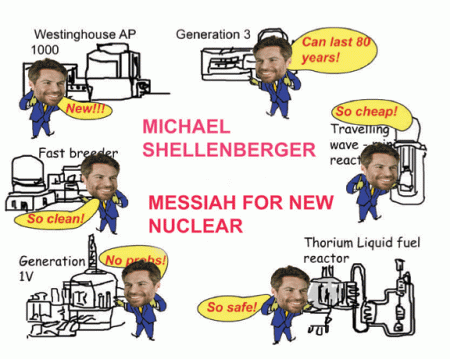
Michael Shellenberger is visiting Australia this week. He has been a prominent environmentalist (of sorts) since he co-authored the 2004 essay, The Death of Environmentalism. These days, as the President of the California-based ‘Environmental Progress’ lobby group, he is stridently pro-nuclear, hostile towards renewable energy and hostile towards the environment movement.
Shellenberger is visiting to speak at the International Mining and Resources Conference in Melbourne. His visit was promoted by Graham Lloyd in The Australian in September. Shellenberger is “one of the world’s leading new-generation environmental thinkers” according to The Australian, and if the newspaper is any guide he is here to promote his message that wind and solar have failed, that they are doubling the cost of electricity, and that “all existing renewable technologies do is make the electricity system chaotic and provide greenwash for fossil fuels.”
Trawling through Environmental Progress literature, one of their recurring themes is the falsehood that “every time nuclear plants close they are replaced almost entirely by fossil fuels”. South Korea, for example, plans to reduce reliance on coal and nuclear under recently-elected President Moon Jae-in, and to boost reliance on gas and renewables. But Shellenberger and Environmental Progress ignore those plans and concoct their own scare-story in which coal and gas replace nuclear power, electricity prices soar, thousands die from increased air pollution, and greenhouse emissions increase.
Fake scientists and radiation quackery
Environmental Progress’ UK director John Lindberg is described as an “expert on radiation” on the lobby group’s website. In fact, he has no scientific qualifications. Likewise, a South Korean article falsely claims that Shellenberger is a scientist and that article is reposted, without correction, on the Environmental Progress website.
Shellenberger says that at a recent talk in Berlin: “Many Germans simply could not believe how few people died and will die from the Chernobyl accident (under 200) and that nobody died or will die from the meltdowns at Fukushima. How could it be that everything we were told is not only wrong, but often the opposite of the truth?”
There’s a simple reason that Germans didn’t believe Shellenberger’s claims about Chernobyl and Fukushima ‒ they are false. Shellenberger claims that “under 200” people have died and will die from the Chernobyl disaster, but in fact the lowest of the estimates of the Chernobyl cancer death toll is the World Health Organization’s estimate of “up to 9,000 excess cancer deaths” in the most contaminated parts of the former Soviet Union. And of course there are higherestimates for the death toll across Europe.
Shellenberger claims that the Fukushima meltdowns “killed precisely no one” and that “nobody died or will die from the meltdowns at Fukushima”. An Environmental Progress report has this to say about Fukushima: “[T]he science is unequivocal: nobody has gotten sick much less died from the radiation that escaped from three meltdowns followed by three hydrogen gas explosions. And there will be no increase in cancer rates.”
In support of those assertions, Environmental Progress cites a World Health Organization report that directly contradicts the lobby group’s claims. The WHO report concluded that for people in the most contaminated areas in Fukushima Prefecture, the estimated increased risk for all solid cancers will be around 4% in females exposed as infants; a 6% increased risk of breast cancer for females exposed as infants; a 7% increased risk of leukaemia for males exposed as infants; and for thyroid cancer among females exposed as infants, an increased risk of up to 70% (from a 0.75% lifetime risk up to 1.25%).
Applying a linear-no threshold (LNT) risk factor to the estimated collective radiation dose from Fukushima fallout gives an estimated long-term cancer death toll of around 5,000 people. Nuclear lobbyists are quick to point out that LNT may overestimate risks from low dose and low dose-rate exposure ‒ but LNT may also underestimate the risks according to expert bodies such as the US National Academy of Sciences’ Committee on the Biological Effects of Ionizing Radiation.
Gigaba says no to nuclear, Fin 24, 2017-10-29 – Sipho Masondo and Setumo Stone, Johannesburg – Finance Minister Malusi Gigaba says drastic steps are needed to help South Africa’s ailing economy – including freezing senior civil servants’ salaries and selling chunks of state-owned enterprises.
In an exclusive interview with City Press on Friday, Gigaba unveiled the surprise moves, which include slamming brakes on the country’s estimated R1 trillion nuclear build programme, saying it is neither affordable nor currently necessary.
“There was a time when it was felt that nuclear is necessary and it must be implemented and programmes were started. But it became clear, as the economy took a serious dip, that we were not going to afford nuclear, that the country couldn’t afford it and the budget couldn’t afford it,” he said.
“It is quite clear that, at present, we can meet our electricity needs and we can even meet them into the future, given the excess electricity that we have.”
Nuclear power, Gigaba said, will remain part of the country’s energy mix. However, this will only happen when the economy is growing fast, when there is “high uptake of electricity from intensive users, when we can see that we are reaching the stage where existing capacity is being fully utilised and the demand and supply margin is very narrow”.
Gigaba said it was not a “malicious view” to shelve the nuclear programme for now, considering the R50bn budget shortfall, a rising budget deficit, National Health Insurance, demands for free higher education, and a national debt to GDP ratio which is set to breach the 60% threshold by 2022.
“If you look at Eskom’s balance sheet, they will not be able to afford nuclear, they will need a guarantee from government. Government guarantees are ultimately state debt, because when a state-owned company cannot afford to pay the guarantees, the national fiscus needs to step in and pay. That is what happened at SAA,” he said…….http://www.fin24.com/Budget/gigaba-says-no-to-nuclear-20171029-3
While Finance Minister Malusi Gigaba indicated that we don’t have enough money for the project, Fitch says it seems that government is still pushing for the project to go ahead with the new Energy Minister driving the process.Ilze-Marie Le Roux , 27 Oct 17, CAPE TOWN– Global ratings agency Fitch has raised questions about whether South Africa’s big nuclear build really is on the back burner.
But in a bleak statement released on Thursday, Fitch says that the appointment of David Mhlobo as the new Energy Minister sends contradictory signals.
Fitch is sceptical about the status of the nuclear build, as the massive programme would see the construction of between six and eight nuclear plants with a very hefty price tag, a price tag South Africa just can’t afford at the moment.
Gigaba made that point crystal clear in his medium-term budget speech but ratings agency Fitch says it seems that government is still pushing for the project to go ahead with the new Energy Minister driving the process.
Fitch’s statement also raised concerns about the lack of a proper plan to cut spending or to raise revenue, saying that it suggests deep divisions within the ruling party.
Fitch has already downgraded both the country’s foreign and local denominated debt to sub-investment grade.
He was speaking ahead of his medium-term Budget speech, which did not mention nuclear power plans.
A new integrated resource plan on energy would provide more clarity, he said.
Proposals for a nuclear building project have been debated with a new urgency since weekend reports that President Jacob Zuma had recently met a Russian delegation.
Both the Presidency and the Russian embassy in Pretoria have denied that there was such a meeting, at which Zuma was said to have come under pressure to start implementing the nuclear power project with Russia.
Zuma’s cabinet reshuffle last week included the appointment of David Mahlobo as energy minister.
Mahlobo was reported to have travelled to Russia with convicts Gayton McKenzie and Kenny Kunene to facilitate a R5-billion nuclear deal with Russian company Rosgeo. Mahlobo was state security minister at the time of the trip.
Allegations that the energy sector has been captured go beyond the nuclear project. PetroSA is also being investigated.
Cope leader Mosioua Lekota says President Jacob Zuma is acting recklessly by looking to enter into nuclear deals with Russia.
Speaking at Parliament on Tuesday, Lekota said last week’s Cabinet reshuffle has paved the way for government to proceed with its nuclear ambitions despite a Western Cape High Court ruling in May that found five cooperation agreements signed by government to have been illegal.
He says Parliament should have interrogated the judgment and stopped Zuma from pressing ahead with his nuclear ambitions.
“The president has already shown the propensity to undermine the law, to ignore the Constitution and even the courts to go ahead with his business. We think once we have those numbers, the Speaker will have no choice but to call president Zuma to account.”
Last week, the Department of Environmental Affairs gave its approval for a site at Duynefontein adjacent to the Koeberg nuclear station in the Western Cape to become the first site for reactors as part of government’s nuclear build programme.
Threat of court action if Govt steps out of line with nuclear plans, fin 24, Oct 22 2017 Cape Town – Should the details of any progress on trying to push through a costly and deemed unnecessary nuclear build programme not be open to the public, the DA will not hesitate to go to court to interdict it.
DA MP Gordon Mackay said in a statement on Sunday that allegations in the media regarding a high-level Russian delegation which met with President Jacob Zuma shortly before the second Cabinet reshuffle earlier this week are “startling to say the least”.
The reshuffle saw David Mahlobo appointed as new energy minister, raising concerns that this step was ostensibly to push through the nuclear deal in favour of the Russians.
Zuma reshuffled his Cabinet allegedly just hours after a meeting with a group of Russian officials in efforts to implement a R1tn new nuclear build project deal, reported the Sunday Times.
Mackay pointed out that the previous minister of energy, Mmamoloko Kubayi, committed on record to abide by the Western Cape High Court’s nuclear ruling in April this year. He added that Mahlobo is bound by the court judgment as well and any deviation will be illegal.
In order for the nuclear deal to be approved, five key pieces of legislation or regulations would need to be updated and amended by Parliament, according to Mackay.
These include the Integrated Resource Plan; the electricity pricing path; procurement regulations; the framework agreements; and changes to the energy act to allow for a different funding/ownership model.
“In addition, the court ruling made clear the need for a substantial public participation process,” emphasised Mackay.
“The fact is that we cannot afford nor do we need the nuclear deal. In any event, it is doubtful that we need nuclear in the energy mix bearing in mind that by the time reactors come online, green energy will be able to fill the gap sufficiently.”
All eyes on nuclear plan amid claim of secret Russian talks, Business Live,
Opposition and anti-corruption groups vow to remain vigilant as news report alleges energy minister deal22 OCTOBER 2017 – 19:50 ASHA SPECKMANAnticorruption bodies and the opposition are closely monitoring developments with SA’s multibillion-rand nuclear build, which may be pushed through despite a lack of capacity in the fiscus.
The urgency for passing the deal has become apparent after a delegation comprising Russian military, police and intelligence allegedly entered the country via Mozambique to coerce President Jacob Zuma into appointing David Mahlobo as energy minister last week, the Sunday Times reported at the weekend.
Mahlobo’s appointment was made even as Zuma’s associates, the Guptas, had allegedly suggested Public Service and Administration Minister Faith Muthambi for the position.
According to the newspaper Mahlobo is believed to be the “Russians’ eyes and ears in the South African government”.
“It’s something we take very seriously,” David Lewis, executive director of Corruption Watch, told Business Day. “It’s real global espionage of a huge scale. Given that the Russians have been involved in subverting democracies all over the world, it’s not an implausible story. The record of the Russians across a vast range of matters speaks for itself.”……. https://www.businesslive.co.za/bd/national/2017-10-22-all-eyes-on-nuclear-plan-amid-claim-of-secret-russian-talks/
New Energy Minister Mahlobo’s first words on his nuclear vision for SA, Fin 24, Oct 19 2017 Matthew le Cordeur , Cape Town– Incoming Energy Minister David Mahlobo on Thursday highlighted his vision for South Africa’s nuclear energy future, following the approval for Eskom to develop 4GW of new power stations near Koeberg last week.
Mahlobo is the third energy minister this year. Tina Joemat-Pettersson was axed in March after the nuclear programme was halted following a court ruling. Her successor, Mmamoloko Kubayi, was this week redeployed to the communications ministry, with speculation that President Jacob Zuma was not happy with her progress in restarting the nuclear procurement programme.
Critics and opposition parties have warned that Mahlobo’s appointment could be an attempt by Zuma to push through the nuclear deal, as the president’s leadership position hangs in the balance ahead of the ANC’s elective conference in December.
4GW of new nuclear next to Koeberg
His appointment comes as the Department of Environmental Affairs (DEA) last week authorised its Final Environmental Impact Report for the power station at Duynefontein, giving Eskom permission to develop a new nuclear plant next to the existing Koeberg power station.
Koeberg, based outside Cape Town, is Africa’s only nuclear power station and contributes 6%, or 1.8GW, to South Africa’s power grid.
Citing the outdated 2010 Integrated Resource Plan (IRP), which states that South Africa requires 9.6GW of nuclear energy before 2030, Mahlobo said the latest development forms part of a “policy decision to pursue nuclear energy as a baseload energy form to mitigate our carbon footprint”………..
Zuma’s nuclear minister?
Allegations that Mahlobo’s appointment is a desperate bid by Zuma to get the nuclear new build programme off the ground hinge on revelation that he accompanied Zuma (with Deputy International Relations Minister Nomaindia Mfeketo) on a state visit to Russia in 2014, where he met with Putin at his residence in Novo-Ogariovo. No aides, advisers or wives went along, creating a veil of secrecy.
It has been widely speculated that Zuma and Putin struck a deal on nuclear cooperation at this meeting, but no evidence has ever emerged to confirm this. Rosatom, Zuma and the Department of Energy have consistently denied such a deal.
Former Eskom employee and self-proclaimed corruption whistleblower Ted Blom briefed the Public Enterprises committee charged with the probe on Wednesday.
Blom, who now heads Outa’s energy division, sketched broad details about corruption at Eskom, claiming that there are up to a thousand cases, many of them unreported.
He took the committee back in time and in an astonishing revelation he claimed to have met with Jacob Zuma at his Forest Town home in 2009 to alert him to the irregularities.
Zuma allegedly told him to meet a team of “fixers”, but Blom told Members of Parliament that the group had a different agenda.
“They introduced themselves and the first question was: Given my vast experience of Eskom, over more than 20-odd years, how could I help them to access some of the gravy train?”
Blom left the meeting furious that he was supposedly being roped into a plan to loot the state-owned company. Parliamentarians asked Blom for the names of the so-called “fixers,” which he promised to provide them with at a later stage.
Earlier, Dames told the committee that Minister Malusi Gigaba’s adviser Siyabonga Mahlangu asked him to meet with “some people,”one of whom he assumed was a Gupta brother.
Stand up to nuclear policy https://www.businesslive.co.za/bd/opinion/letters/2017-10-17-letter-stand-up-to-nuclear-policy/ 17 OCTOBER 2017What was once suspected has finally become reality. Instead of the preferred site of Thyspunt, the Department of Environmental Affairs has approved an environmental authorisation for up to 4,000MW of nuclear power at the current Koeberg site just outside Cape Town.
The department cites increasing need for base-load power and that nuclear energy is in the Integrated Resource Plan (IRP), as reasons for approving the environmental impact assessment. Yet Eskom’s tariff application shows that electricity demand is declining and the IRP has been criticised, with reputable institutes such as the Council for Scientific and Industrial Research (CSIR) showing that nuclear energy is not needed.
Apart from a flimsy economic justification (no substantive assessment of “need and desirability”, as required by environmental law), other fatal flaws in Eskom’s final environmental impact report include:
• An unscientific failure to disclose the actual reactor technology to be assessed;
• An inadequate assessment of the emergency planning for the Koeberg site;
• An unacceptable containment of high-level (used fuel) waste on the Koeberg site;
• A complete failure to assess the plans for decommissioning the reactor; and
• An absence of a final plan for long-term nuclear waste management.
We therefore call on all South Africans to unite behind the Coalition Against Nuclear Energy (www.cane.org.za) and the Koeberg Alert Alliance in defence of an administratively unjust and unacceptable version of the environmental authorisation.
We further call on our fellow citizens to campaign to defeat once and for all the national pro-nuclear energy policy, as we did with the ill-conceived HIV/AIDS policy.
Mike KanteyNational chairman, Coalition Against NuclearEnergy
Jubilation as nuclear vetoed for Thyspunt, Herald Live,Guy Rogers
Surprise as government overrules Eskom, opts for Western Cape site The government’s surprise effective veto of Eskom’s push to build a nuclear reactor at Thyspunt near Cape St Francis has been greeted with jubilation by groups opposed to the move. The Department of Environmental Affairs has instead authorised the construction of Eskom’s proposed nuclear project at Duynefontein in the Western Cape.
NoPENuke said the department’s authorisation of Duynefontein, effectively vetoing the utility’s preferred site at Thyspunt, was “a real victory for the little guy”.
The Thyspunt Alliance said it was “a triumph for due process” and the Gamtkwa Khoisan Council said the ruling opened the way for establishment of a coastal cradle of mankind, a World Heritage site celebrating Thyspunt’s unique cultural and environmental heritage.
In keeping with South Africa’s nuclear process so far, the Environmental Affairs ruling arrived amid conflicting signals.
Less than a week ago, an upbeat nuclear summit at Jeffreys Bay – attended by Deputy Energy Minister Thembisile Majola and Eskom acting general manager Loyiso Tyabashe – declared the readiness of Eastern Cape youth to seize envisaged job opportunities flowing from development at Thyspunt.
More confusing still, on Sunday, Finance Minister Malusi Gigaba said South Africa had no money for nuclear.
Speaking in Washington in the US after meetings with the International Monetary Fund and World Bank, Gigaba said the South African economy “at present is not in a position where it can carry the burden of nuclear technology”.
Eskom’s nuclear aspirations were launched a decade ago, moving through multiple environmental impact assessments (EIAs) which were submitted and resubmitted after successful challenges from the anti-Thyspunt groupings supported by pro bono studies undertaken by scientists living in St Francis.
Besides the cultural heritage issue, concerns have included Thyspunt’s fragile dune wetlands and the sensitivity of the area to flooding, the existing tourism industry, the threat to the flagship chokka industry via the ejection of sand spoil into squid breeding areas during plant construction and the instability of the site, making it vulnerable to earthquakes and tsunamis……http://www.heraldlive.co.za/news/2017/10/17/jubilation-nuclear-vetoed-thyspunt/
Cabinet reshuffle about Zuma chasing nuclear deal: Malema, Times Live 17 October 2017 BY PENWELL DLAMINIThe leader of the Economic Freedom Fighters‚ Julius Malema‚ says the cabinet reshuffle announced by President Jacob Zuma on Tuesday is a tactical move to see the nuclear deal concluded.
“He is chasing the nuclear deal in the energy [department]….She [then minister of energy Tina Joemat-Pettersson] wanted minister Nene to sign some documents which were provided to her by the president. Nene said ‘I cannot sign the documents which have not been taken through the department. If you give me time to go through them‚ we can then sign.‘
“It took forever and [former finance minister Nhlanhla] Nene got removed because they thought he was reluctant on the thing. Peterson got removed because they thought she was not handling the nuclear deal properly‚” Malema charged at a media briefing on Tuesday.
“A confidante has been sent there [Department of Energy] to go and process the nuclear deal. [New minister of energy‚ David] Mahlobo will run the two departments. Both the intelligence and energy because [newly-appointed state security minister Bongani] Bongo is a nobody. He is just a young man who knows nothing. Bongo is put there because he admires Mahlobo. Bongo cannot undermine Mahlobo. He will listen to Mahlobo on what needs to happen.
“You must not be fooled. They are chasing the energy deal‚” Malema told reporters.
He was reacting to Zuma’s decision to remove Mmamoloko Kubayi as the minister of energy‚ replacing her with Mahlobo who was the minister of intelligence. The move‚ Malema said‚ was to have control on the energy department so that no one could block Zuma’s nuclear deal.
In April‚ the Western Cape High Court ruled that government’s decision to call for proposals for the procurement of 9.6 gigawatts of nuclear energy was unlawful and unconstitutional.
They voiced the opinion that Mahlobo’s abilities as a spy will be a handy tool to cast a veil of secrecy around critical deals that need to be hidden.
Concerns were raised that President Jacob Zuma’s Cabinet reshuffle, moving Mmamoloko Kubayi from the energy portfolio to communications and replacing her with the former state security minister, was a definite shift towards nuclear.
“This is all about the nuclear deal. Mahlobo has accompanied the president on visits to Russia, presumably to lay the ground for the Rosatom nuclear deal,” said Lawson Naidoo of the Council for the Advancement of the South African Constitution.
Mahlobo is seen as a close confidant of Zuma, with some labelling him as the president’s loyal “Prime Minister”.
Also significant is that Zuma was accompanied only by Mahlobo and Deputy International Relations Minister Nomaindia Mfeketo on his state visit to Russia in 2014, where he met with Putin at his residence in Novo-Ogariovo. No aides, advisers or wives went along, creating a veil of secrecy.
It has been widely speculated that Zuma and Putin struck a deal on nuclear cooperation at this meeting, but no evidence has ever emerged to confirm this.
The meeting only came to light later that week in 2014.
Democratic Alliance energy spokesperson Gordon Mackay said South Africans should be deeply concerned. “This is the state securitisation of the energy department. It started under Kubayi and will be completed under Mahlobo.”
He said Zuma was effectively taking control of the department, which has always been viewed as a department of former president Thabo Mbeki.
“It is the clearest indication that the state is dead set on pursuing nuclear.”
Mackay said Mahlobo is an enforcer, and a master at creating a murky atmosphere around deals that need to be pushed through and hidden.
The new energy minister is seen as close to Zuma and someone who can drive the nuclear deal, said Daniel Silke, director at the Political Futures Consultancy.
Liz McDaid, spokesperson for the Southern African Faith Communities’ Environment Institute, said since the institute’s court victory earlier this year in the high court, which ordered the government to restart the nuclear process, nothing has apparently happened on the surface to show progress with the deal.
“We suspected something was happening behind closed doors,” she said. “Last Friday’s nuclear site authorisation and now today’s Cabinet reshuffle has seen the Intelligence Minister become the Energy Minister. This is a desperate attempt to force through the nuclear deal.”
The Sunday Times last month added further fuel to the fire on Mahlobo’s Russian links, when the paper reported that Mahlobo had made the introductions between Russian gas company Rosgeo and controversial businessmen Kenny Kunene and Gayton McKenzie. Rosgeo signed a R5.3bn deal with PetroSA for gas exploration off the southern coast to feed the gas to liquids refinery at Mossel Bay at the recent Brics summit in Xiamen, China.
Eskom gets nod to develop new nuclear power station, Fin24, Oct 13 2017 Lameez Omarjee Johannesburg – Eskom has permission to develop a new nuclear plant next to the existing Koeberg power station in the Western Cape.
A statement issued by the power utility on Friday revealed that the Department of Environmental Affairs (DEA) authorised its Final Environmental Impact Report for the power station at Duynefontein.
Eskom’s chief nuclear officer Dave Nicholls said this is considered an “important milestone” in developing the country’s nuclear programme.
Five sites were investigated which include Brazil and Schulpfontein in the Northern Cape, Bantamsklip and Duynefontein in the Western Cape, and Thyspunt in the Eastern Cape.
Following the scoping phase, Brazil and Schulpfontein have been excluded for further environmental studies while the other sites are still usable in the future as no “fatal flaws” have been identified, Eskom said……….
However, the Organisation Undoing Tax Abuse (OUTA) which has been challenging Eskom’s nuclear build programme, claims to have “plenty of ammo” left to dispute any claims of progress being made by the power utility.
Speaking to Fin24 on Friday, Ted Blom, director of the energy portfolio, said that such a decision by the DEA is premature. “It is absolutely premature, with the whole nuclear IRP justification process still a work in progress,” he said. “Any claims of progress are totally premature.”







 nuclear-news