South Africa’s Democratic Alliance refutes government denials over a nuclear deal.
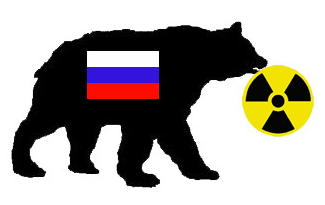
 DA slams nuclear deal July 10 2015 IOL By ANA The DA refutes government denials over a nuclear deal.
Cape Town – South Africa’s inking of two memoranda of understanding with Russia’s state nuclear energy company Rosatom made it clear a deal for a new reactor was already in the pipeline despite government’s denials, the Democratic Alliance said on Friday.
DA energy spokesman Gordon Mackay said he had written to Energy minister Tina Joemat-Petterson following Thursday’s announcement of the agreement on the sidelines of the Brics summit in the southern Russian city of Ufa to demand that she release further details of it.
“That these MOUs reportedly speak of cooperation in order to provide training for five categories of specialists for the South African nuclear industry is the clearest indication yet that Rosatom is the preferred bidder,” Mackay said
“Signing MOUs of this nature, while a competitive bid process is underway, smacks of gross impropriety on behalf of Minister Joemat-Pettersson and can be seen as nothing more than a crude attempt by the Zuma administration to bolster Rosatom’s bid over potential rivals.”
Government on Thursday denied Russia was the preferred bidder for a deal that would increase South Africa’s nuclear power capacity………http://www.iol.co.za/business/news/da-slams-nuclear-deal-1.1883599#.VaBBpF-qpHw
Russia’s nuclear industry to “educate” South Africans
Nuclear deal – 200 South Africans to be “educated” during excursions to Russia http://www.biznews.com/briefs/2015/07/09/nuclear-deal-200-south-africans-to-be-educated-during-excursions-to-russia/ ALEC HOGG JULY 9, 2015 Cape Town – The Department of Energy announced in a statement on Thursday that it has signed two memoranda of understanding with Russian state nuclear energy corporation Rosatom at the 7th summit of the Brics (Brazil, Russia, India, China and South Africa) countries in the Russian city of Ufa.
According to the first document, Russia and South Africa aim to implement several joint projects for education in the nuclear power industry.
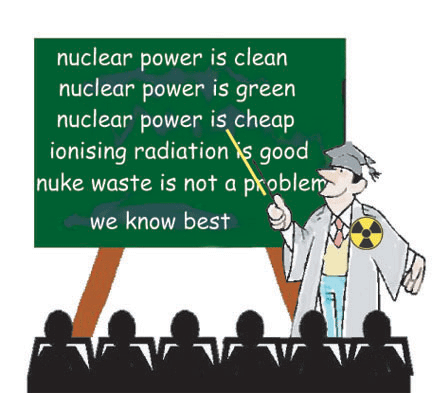
The countries will cooperate to provide training for five categories of specialists for the South African nuclear industry: nuclear power plant personnel, engineers and construction workers, staff for operations not related to the power industry, personnel for nuclear infrastructure, students and teachers.
There will also be education programmes for 200 South African candidates at Russian universities and educational organisations. This memorandum stipulates the development of educational materials and scientific literature on nuclear power, student exchange programmes for students of various levels of training, organisation of internships and summer courses, student competitions and teacher training.
The second memorandum signed in Ufa stipulates joint efforts of the parties to promote nuclear power in South Africa, increasing the awareness of local residents of modern nuclear technologies used in the power industry and in other industries, and ensuring public acceptance of nuclear power.
In particular, the parties have agreed to work out a plan for the implementation of a joint communication programme to be launched in South Africa. This will involve the organisation of round tables and other events aimed at promoting nuclear power and modern nuclear technologies.
A nuclear energy information centre in South Africa is also under consideration. “The parties seek to exchange information and best practices in the nuclear industry by organising working visits and international conferences and exhibitions,” said the Department of Energy. Source: http://www.fin24.com/Economy/Rosatom-seeks-to-educate-SA-on-nuclear-power-20150709
Clearly, South Africa can’t afford nuclear power
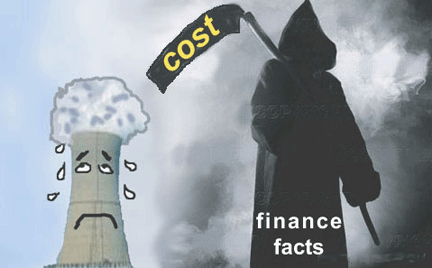 The South African government has said it will not go ahead with nuclear power if the expected construction cost is more than $6500/kW, equivalent to about R130bn per reactor. However, the latest cost estimates are about 25% higher than this. This means that if the South African government sticks to its promise, the tender will fail.
Why South Africa should steer clear of nuclear, By Steve Thomas, Professor of Energy Policy at University of Greenwich Business Tech By The Conversation June
21, 2015 It would be sensible to acknowledge that a nuclear programme is not viable for resolving South Africa’s energy crisis. Rather, the country should be focusing its attention on how to end electricity blackouts and speed up energy efficiency and renewable energy programmes.
Building new nuclear energy capability will cost the country billions of US dollars. It is doubtful that South Africa can afford this.
In addition, nuclear power entails a different but also serious set of risks to climate change. These include the risk of reactor accidents, the danger of weapons proliferation and the hazards of radioactive waste……
Price of nuclear
Uranium promise turned to poverty for Dominionville, South Africa
Uranium mining town hopes long turned to dust, Mail & Guardian 05 DEC 2014 PHILLIP DE WET Dominionville residents expected a boom town when Shiva Uranium foretold promises of riches, but white poverty and black despair remain years later. The people of Dominionville in North West have seen it before, and those who were not around have heard the stories. The residents tell it among themselves like a sort of fairy tale – the pre-Disney kind, full of darkness and foreboding – warning against hope.
In 2006, it was Uranium One, they say, that sold the idea that riches would return to their town. In Canada and Europe, the company sold the story of the rich shafts – almost within sight of the residents – and they sold it well.
The people of Dominionville, more than half resigned to the idea that the tide would never turn their way again, read the articles about hundreds of millions of dollars being poured into the company, and dared to dream……
That was so many years ago that the signboards for the Shiva Uranium mines have been bleached almost illegible by the sun. As yet, the money has not materialised. Dominionville barely clings on, a place of white poverty and black despair……http://mg.co.za/article/2014-12-04-uranium-mining-towns-hopes-long-turned-to-dust
South Africa’s government continues in its historic underestimation of nuclear costs
Government’s nuclear cost muddle http://www.bdlive.co.za/opinion/letters/2015/06/03/letter-governments-nuclear-cost-muddle Steve Thomas, Professor of Energy Policy, Public Services International Research Unit, University of Greenwich JUNE 03 2015, THE SOUTH AFRICAN NUCLEAR ENERGY CORPORATION’S XOLISA MABHONGO CLAIMS THAT “SOUTH AFRICAN PROFESSIONALS DID NOT MAKE FOOLISH ASSUMPTIONS, DO INACCURATE FINANCIAL CALCULATIONS AND GO INTO A CONSTRUCTION PLAN WITHOUT HAVING ACCURATE PROJECTIONS OF THE OUTCOME. THIS WOULD HAVE BEEN IRRESPONSIBLE” (NUCLEAR BUILD WILL POWER ECONOMIC GROWTH, MAY 29).
History suggests otherwise. When the pebble bed programme for SA to develop its own reactor design was announced in 1998, Eskom claimed a commercial reactor could be in operation by 2004 at a construction cost of less than $1,000 per kilowatt of capacity.
By 2010, commercial deployment of the pebble bed was estimated by Eskom to be 20 years away and the estimated cost of a demonstration plant had increased nearly 30-fold.
In 2006, a tender for new nuclear plants from the world market was launched with the expectation that a plant could be bought for $2,500/kW. The lowest bid was 150% more and the tender was abandoned in 2008 because it could not be financed.
Only two years later, a new attempt to order nuclear plants was launched with the publication of the first Integrated Resource Plan for the electricity industry. The prices bid in 2008 were ignored and it was assumed the cost would be only $3,500/kW. A year later, in 2011, the government had to admit this figure was far too low and revised it up to about $5,000/kW, still well below the prices bid in 2008 and below prevailing international price levels.
There are only two explanations for this continued gross underestimation of costs. Either the government is choosing to mislead the public about the actual costs, or it is far too gullible to the claims of nuclear sales people. Neither explanation reflects well on the government.
The government has promised that if the bid prices were higher than $6,500/kW, the tender would be abandoned. Given that prevailing prices in the world are now about $8,000/kW, if the government keeps its promise, the tender being launched this year is doomed to failure. It would be useful for Energy Minister Tina Joemat-Pettersson to confirm now whether the promise still applies and, if it does not, how much the state is prepared to pay.
Secrecy, and no costing known, in South Africa’s plans for nuclear power
Key details of SA’s nuclear procurement plan kept under wraps, BD Live, BY CAROL PATON, 02 JUNE 2015 KEY DETAILS OF SA’S NUCLEAR PROCUREMENT PROGRAMME REMAINED SECRET IN A PRESENTATION BY TOP DEPARTMENT OF ENERGY OFFICIALS, AS WELL ENERGY MINISTER TINA JOEMAT-PETTERSSON TO PARLIAMENT’S PORTFOLIO COMMITTEE ON ENERGY.

However, officials said the procurement would be completed by the end of the financial year when “a strategic partner or partners” would be chosen.
While the officials gave a lengthy motivation on the need for nuclear power and SA’s preparedness for the new nuclear energy build, details about the cost, the financing and the procurement process were not provided. Inter-governmental agreements that SA has signed with various countries on nuclear co-operation, as well as a damning report by the Integrated Nuclear Infrastructure Review on SA’s readiness also remained under wraps.
Ms Joemat-Pettersson is backed by President Jacob Zuma in her quest to build 9.6GW of nuclear generation capacity. However, there are several detractors of the plan, including the former National Planning Commission, opposition political parties and a wide array of civil society and human rights lobby groups……
DA MP Gordon MacKay said that with regard to the financing the government had got the cart before the horse.”It is strange that we are wanting to buy something that we don’t know the cost of and we don’t know how we will pay for,” he said.
Mr MacKay also criticised the secrecy of the report compiled in the Integrated Nuclear Infrastructure Review process.While reports for other countries are available on the website of the International Atomic Energy Agency, the report compiled on SA remains “classified” despite being completed two years ago.
Mr MacKay said it was believed that the report showed SA to be unprepared for the nuclear procurement in 14 of 19 benchmark areas.http://www.bdlive.co.za/business/energy/2015/06/02/key-details-of-sas-nuclear-procurement-plan-kept-under-wraps
Unlikely that South Africa could fund its secretive nuclear power project
Too soon’ to assess SA on funding nuclear BD Live BY CHARLOTTE MATHEWS, 03 JUNE 2015, MOSCOW — Assumptions could not yet be made about SA’s capacity to finance its planned 9,600MW of new nuclear power because a number of other issues needed to be decided first, said Kirill Komarov, Rosatom State Corporation’s first deputy general director for development and international business.
He was speaking on the sidelines of the Atomexpo 2015 conference on nuclear technology in Moscow this week, which has attracted 1,600 delegates from 48 countries. Although Rosatom has the major role, there are speakers and exhibitors from nuclear vendor countries including France, Russia and China……..
The South African government seeks a large nuclear procurement despite doubts about its affordability. The target is to have the first reactor in commission by 2023……..
Given SA’s other spending priorities and weak economic growth, it seemed unlikely it could fund this programme in full………Rosatom had arranged financing for nuclear stations it built in Belarus, Hungary and India,……. • Rosatom sponsored Charlotte Mathews’s visit to Russia http://www.bdlive.co.za/business/energy/2015/06/03/too-soon-to-assess-sa-on-funding-nuclear
South Africa’s nuclear company Eskom runs out of money for assessing environmental impact of nuclear energy
 Eskom runs out of money for assessing environmental impact of nuclear energy SOUTH AFRICA enca.com 23 May 2015 JOHANNESBURG – Government says nuclear power in South Africa is going ahead. Earlier this week Energy Minister Tina Joematt-Peterson said that procurement deals would be signed with prospective partners by the end of 2015.
In the next ten years, government plans to introduce 9600MWs of nuclear energy.
But signing procurement deals is one half of the process. The other half of the process has stalled.
The second version of the environmental impact assessment (EIA) for the site proposed for Nuclear 1, at Thyspunt in the Eastern Cape is not complete.
During a question and answer session in Parliament in March Minister of Public Enterprises Lynne Brown in a written reply said that Eskom had run out of money to complete the report.
“It was put on hold during 2013/14 due to funding constraints in Eskom. In 2014, additional funds were approved and the finalisation of the Draft Environmental Impact Report (revision 2) was initiated,” noted the reply.
Eskom said this version of the report is due to be released to the public in May 2015 for comment but the Minister of Public Works says this has been put on hold due to the limited funding.
In the Nuclear Energy Policy of 2008, Eskom was designated as owner operator for nuclear plants in South Africa. The Department of Energy says this means that Eskom is responsible for applying and obtaining various permits including EIA and nuclear licenses.
Eskom has already spent R35 million on the report, which was funded by the income generated from tariffs.
“Eskom, in terms of the electricity regulations, is allowed to budget for and spend money on activities that are deemed prudent for the development of generation project,” noted the power utility in a statement.
However, in 2014 Eskom had to reprioritise its expenditure, “The funding of the EIA was cut in favour of other projects and activities deemed more essential in nature
Costs for the EIA’s specialist studies are now being managed on an individual study and activity level. Still outstanding is the biodiversity offset study, public participation meetings and some still need to go through the independent phase review.
Eskom says this final stage is vital, “This phase of independent review is necessary to ensure that all issues raised have been addressed in an independent and transparent manner.”
The Department Energy says even though it’s not directly involved in the EIA process it is watching Eskom’s progress on the issue……
- Others watching the process are the Thyspunt Alliance, a group opposing the development in the Eastern Cape.
Trudi Malan said they are working with their own experts to verify the findings of Eskom’s report, “The problem with the Eskom EIA is that their experts only spend three of four days on the site, when we actually need more information,” she said.
The first draft of the EIA was thrown out because incorrect methodology was used to do the assessment……..http://www.enca.com/south-africa/eskom-has-no-money-complete-environment-impact-assessment-nuclear-energy-project-site
Like Japan, South African govt is hiding the true costs of nuclear power
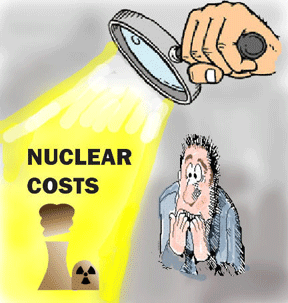 Government hiding nuclear power plant costs: Earthlife Africa http://mybroadband.co.za/news/energy/127160-government-hiding-nuclear-power-plant-costs-earthlife-africa.html
Nuclear critic Earthlife Africa argues that South Africa’s new power plants are another arms deal scandal waiting to happen By Staff Writer – May 24, 2015 The South African government has done studies on what it would cost to build the planned 6 or 8 nuclear power stations, but it is not releasing the information (Also see: ANC wants to use people’s retirement savings to bail out Eskom).
This is according to nuclear critic and Earthlife Africa project co-ordinator Tristen Taylor, the Sunday Times reported.
Taylor was responding to comments from deputy director general of the Department of Energy, Zizamele Mbambo, who said that it would be premature for government to release figures at this stage, as prices were still being negotiated.
Mbambo’s comments were surprising, Taylor said, adding that government is not releasing the studies because it knows the nuclear power plants are going to cost a lot of money. Continue reading
Revolutionary solar rotating system tested in South Africa’s Kalahari desert.
Could this be the world’s most efficient solar electricity system?, Guardian, Jeffrey Barbee, 14 May 15
Using military technology and a zero-emission engine invented by a 19th-century Scot, Swedish firm seeks to revolutionise solar energy production. A new solar electricity generation system that developers claim is the most efficient in the world, is being tested in South Africa’s Kalahari desert.
The Swedish company behind the project – which combines military technology with an idea developed by a 19th-century Scottish engineer and clergyman – says it is on the verge of building its first commercial installation.
In the remote Northern Cape province, huge mirrors reflect the sun across the brown Kalahari sand. This is the test site for Swedish company Ripasso, which is using the intense South African sun and local manufacturing know-how to develop their cutting-edge kit.
“Our whole team in South Africa has been hired locally, and our new systems have all been built with local South African labour. It works great,” says CEO Gunnar Larsson.
This is the only working small-scale concentrated solar energy system of its kind in the world. 34% of the sun’s energy hitting the mirrors is converted directly to grid-available electric power, compared to roughly half that for standard solar panels. Traditional photovoltaic panels are able to turn about 23% of the solar energy that strikes them into electricity, but this is cut to around 15% before it is usable by the grid.
Jean-Pierre Fourie is Ripasso’s South African site manager. His crew has been testing the system in the Kalahari under harsh desert conditions for four years. “What we hope is to become one of the biggest competitors for renewable energy in the world.”
The massive 100 square metre dishes slowly rotate, following the sun. Light clicks and taps fill the still desert air as they constantly adjust to capture the maximum solar energy.
Independent tests by IT Power in the UK confirm that a single Ripasso dish can generate 75 to 85 megawatt hours of electricity a year – enough to power 24 typical UK homes. To make the same amount of electricity by burning coal would mean releasing roughly 81 metric tonnes of CO2 into the atmosphere………
The project has not been without its troubles. “Our major challenge over the last couple of years has been to get the technology accepted by the financing community, especially from the banks,” says Larsson.
Although banks have been unwilling to finance such novel technology, Ripasso has now secured private funding to begin their first large-scale installation. “We are very ready to head into the commercial phase,” says Larsson. http://www.theguardian.com/environment/2015/may/13/could-this-be-the-worlds-most-efficient-solar-electricity-system
USA alarmed at South Africa’s nuclear burglary – unsolved after 8 years
 A break-in at a South African nuclear complex alarms Washington and strains relations years later Two teams of raiders penetrated a site holding enough explosives to fuel six nuclear bombs, but no one was ever caught, Center for Public Integrity , 21 Mar 15 By Douglas Birch
 emailR. Jeffrey Smith
Key findings:
Washington remains spooked by a break-in at Pelindaba, the South African storage site for nuclear explosives, eight years ago.
No one was ever prosecuted for the Pelindaba break-in, even though a nonpublic South African report concluded in 2009 it posed a serious security threat.
South Africa’s government claims the break-in was a petty burglary, but U.S. officials and independent experts worry that the attackers were after nuclear explosives.
The nonpublic South African report described how at every step, the attackers displayed a detailed knowledge of Pelindaba’s layout and security systems, as well as the expertise needed to overcome the site’s defenses.
The incident led to unpublicized collaboration between a U.S. nuclear weapons laboratory and the nuclear site on stronger security measures, but White House officials are convinced more needs to be done at Pelindaba……….http://www.publicintegrity.org/2015/03/20/16917/break-south-african-nuclear-complex-alarms-washington-and-strains-relations-years
South Africa’s stockpile of nuclear fuel – a target for terrorists
Technicians extracted the highly enriched uranium from the apartheid regime’s nuclear weapons in 1990, then melted the fuel down and cast it into ingots. Over the years, some of the cache has been used to make medical isotopes, but roughly 220kg remains, and South Africa is keeping a tight grip on it.
That gives this country – which has insisted that the US and other world powers destroy their nuclear arsenals – a theoretical ability to regain its former status as a nuclear-weapons state. But the US is worried that the nuclear explosives here could be stolen and used by militants to commit the worst terror attack in history.
Senior current and former US officials say they have reason to be concerned given that in November 2007, raiders breached the fences at the Pelindaba research centre and some fear they were after the bomb-grade uranium.
Washington has waged a discreet diplomatic campaign to persuade South Africa to get rid of its stock of nuclear-weapons fuel.
But President Jacob Zuma, like his predecessors, has resisted the White House……..http://www.iol.co.za/news/politics/terrorists-could-steal-sa-nuclear-fuel-us-1.1832093#.VQX8RNKUcnk
Make public the Terms of Reference fo investigation of Nuclear Energy Corporation of South Africa (Necsa).
DA: Gordon Mackay calls for terms of reference of Necsa task team to be made public http://www.polity.org.za/article/da-gordon-mackay-calls-for-terms-of-reference-of-necsa-task-team-to-be-made-public-2015-02-27 The DA has in its possession documents that present a prima facie case of widespread maladministration, a flagrant disregard for due process, and potential fraud being perpetrated at the Nuclear Energy Corporation of South Africa (Necsa).
In terms of the Public Finance Management Act and the Prevention and Combating of Corrupt Activities Act, Necsa is compelled to institute an independent forensic investigation with proper terms of reference.
On 20 February, Minister of Energy, Tina Joemat-Pettersson, appointed a Department of Energy (DoE) Task Team to conduct a thorough investigation into the affairs of the Necsa Board.
While there is a genuine case for an investigation into NECSA, we are concerned that the Task Team’s terms of reference, its composition and the complete scope of its investigation are yet to be made public.
This follows allegations that the Task Team is being used as a smoke screen by the Minister to protect the politically connected CEO, Phumzile Tshelane.
It is reported that on 28 January Mr Tshelane, upon suspension pending a disciplinary inquiry into his actions, contacted the President’s Nuclear Advisor, Senti Thobejane, to intervene regarding his suspension. A board meeting – that was opened by the Minister but led by Thobejane – was hastily called on 2 February. At this board meeting, Thobejane asked the board to stay disciplinary proceedings against Tshelane. The Minister, after giving a directive that the CEO must return to his normal duties, announced the appointment of the Task Team.
This is tantamount to the Board being asked to ignore their fiduciary duty.
I will therefore be writing to the Minister requesting that all relevant details of the Task Team be made public without delay. Until this information is released publicly, the independence of such a Task Team remains questionable. The report must be made public and tabled in Parliament so the true intentions of the probe can be thoroughly interrogated.
If political interference has been used to protect close allies of President Zuma, appropriate remedial steps – which could include dismissal and possibly jail time – must be instituted.
Financial meltdown looming for South Africa’s state-owned nuclear company, Necsa
Nuclear body faces financial meltdown Pelindaba brass scramble to pay scientists JAN-JAN JOUBERT joubertj@sundaytimes.co.za
SOUTH Africa’s beleaguered state-owned nuclear company, Necsa, has for the first time admitted to financial strain, but vows to keep paying staff salaries on time despite “the actual cash inflow not being realised as per plan”.
According to leaked internal documentation, Necsa will not be able to pay its almost 2 000 staff this month unless Finance Minister Nhlanhla Nene’s cashstrapped National Treasury can find an extra R212-million by March 31……..
According to the leaked documents, Necsa has failed to pay suppliers since November, despite President Jacob Zuma’s policy directive that the state pay all its suppliers within 30 days of services rendered.
The documents also claim Necsa is unable to pay its authorisation fees to the National Nuclear Regulator, placing the accreditation of its nuclear scientists at risk, and raising the spectre of a skills exodus on the eve of the planned nuclear build programme.
The current expectation is that Russia will build new nu- clear reactors, and that Necsa staff’s skills could contribute to manufacturing the fuel.
If not, fuel will have to be continually imported at great cost from other major producers such as Russia, raising the consumer price of electricity even further………
DA MP and energy spokesman Gordon Mackay lamented Necsa’s and the regulator’s anger, calling for transparency instead.
“While corruption can be dealt with swiftly by removing those concerned, the long-term cost of maladministration is worse as highly skilled scarce staff quit Necsa for greener international pastures,” he said…….
The DA will raise urgent questions in parliament to clarify how Necsa came to find itself in such a position and what can be done to save the situation…….. ttp://www.pressreader.com/south-africa/sunday-times/20150308/281556584293429/TextView
South Africa: jobs-for-friends among a tightknit clique of government nuclear mandarins
Jobs for pals at state nuclear firm, Mail & Guardian, 06 MAR 2015 LIONEL FAULL A whistle-blower has claimed that the South African Nuclear Energy Corporation created a job for the chief executive’s wife, Ngeniswa Tyobeka. The embattled South African Nuclear Energy Corporation (Necsa) has hired the wife of the chief executive of the National Nuclear Regulator, which polices Necsa’s compliance with stringent safety regulations.
Ngeniswa Tyobeka’s appointment is just one example of a position that “did not exist on the approved Necsa organisational structure”, a Necsa whistle-blower says. It was “unbudgeted and unfunded, which translates into [an] irregular appointment and unauthorised expenditure”.
Both Necsa and the regulator are earmarked to play key roles in the imminent R1-trillion nuclear build programme, the biggest known procurement in South Africa’s history.
The latest allegation of jobs-for-friends among a tightknit clique of government nuclear mandarins raises concerns about decision-makers’ ability to run a process that is in South Africa’s best interests.
Ngeniswa’s appointment as a human resources officer at Necsa places her husband, Bismark Tyobeka, the nuclear regulator’s chief executive, in a difficult position.
It could cloud his judgment when he makes decisions regarding Necsa, from which his wife reportedly draws a R490 000 annual salary.
Ngeniswa was appointed to Necsa last year; her husband has been the head of the regulator since 2013.
The whistle-blower said this week the company’s parlous financial situation, with an apparent shortfall of R82-million this month, is partly a consequence of a “growing salary bill” caused by “unbudgeted and unfunded created [job] vacancies”……..http://mg.co.za/article/2015-03-05-nuclear-frisson-over-jobs-for-mates
1 This Month
Chernobyl: The Lost Tapes – A good documentary on Chernobyl on SBS available On Demand for the next 3 weeks– https://www.sbs.com.au/ondemand/tv-program/chernobyl-the-lost-tapes/2352741955560

of the week–London Campaign for Nuclear Disarmament

Tell the Ukrainian Government to Drop Prosecution of Peace Activist Yurii Sheliazhenko
To see nuclear-related stories in greater depth and intensity – go to https://nuclearinformation.wordpress.com
-
Archives
- April 2026 (127)
- March 2026 (251)
- February 2026 (268)
- January 2026 (308)
- December 2025 (358)
- November 2025 (359)
- October 2025 (376)
- September 2025 (257)
- August 2025 (319)
- July 2025 (230)
- June 2025 (348)
- May 2025 (261)
-
Categories
- 1
- 1 NUCLEAR ISSUES
- business and costs
- climate change
- culture and arts
- ENERGY
- environment
- health
- history
- indigenous issues
- Legal
- marketing of nuclear
- media
- opposition to nuclear
- PERSONAL STORIES
- politics
- politics international
- Religion and ethics
- safety
- secrets,lies and civil liberties
- spinbuster
- technology
- Uranium
- wastes
- weapons and war
- Women
- 2 WORLD
- ACTION
- AFRICA
- Atrocities
- AUSTRALIA
- Christina's notes
- Christina's themes
- culture and arts
- Events
- Fuk 2022
- Fuk 2023
- Fukushima 2017
- Fukushima 2018
- fukushima 2019
- Fukushima 2020
- Fukushima 2021
- general
- global warming
- Humour (God we need it)
- Nuclear
- RARE EARTHS
- Reference
- resources – print
- Resources -audiovicual
- Weekly Newsletter
- World
- World Nuclear
- YouTube
-
RSS
Entries RSS
Comments RSS
 nuclear-news