Radiation hazards in planned uranium mining in the Karoo, South Africa
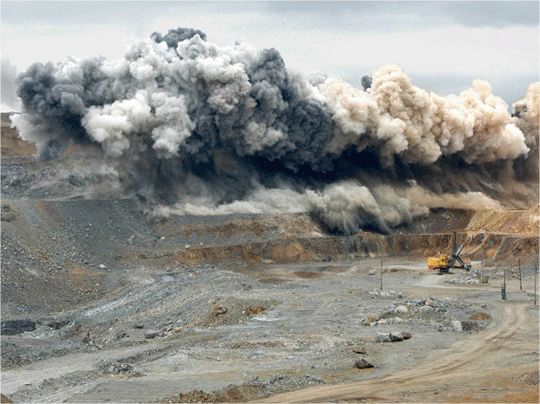 Uranium Mining Threatens the Karoo, Karoo Space, 18 Jan 16 By Dr Stefan Cramer Images sourced by Dr Stefan Cramer “…..According to its documents, Tasman RSA Mines today controls exclusive prospecting rights over more than 750 000 hectares in a circle of nearly 200 kilometres around Beaufort West.
About 32 000 hectares are directly owned under freehold by the company. Local farmers find it hard to resist purchase offers, as farming in this part of the Karoo is particularly difficult due to low rainfall and poor soils.
Unlike in fracking, farms are permanently damaged by uranium opencast mining………
So far the company has not indicated whether they would use ‘in-situ-leaching’, a particularly dangerous but low-cost method. Here, large quantities of leaching agent are injected underground. The uranium is dissolved and recovered in well fields.
The uranium deposits are scattered over large zone of 200 by 300 kilometres which will necessitate trucking of ores over poorly constructed dust roads for hundreds of kilometres to reach the Central Processing Plant.
For this plant, the company has already applied for a water licence to abstract annually 700 million litres of groundwater annually, roughly half of the total water consumption of the Central Karoo Municipality.
It is still unclear what will happen with the contaminated waste water. A discharge of radioactive waste water into the aquatic environment, above or below ground, would be illegal under South Africa’s strict Water Act.
Most probably contaminated slimes will be delivered to large settling ponds, like those around Johannesburg, from which the remaining water will evaporate. This leaves behind a soft and unstable pile of contaminated soil which can be easily mobilised by the strong prevailing winds in the Karoo into large dust dispersal.
Already today, the environment around Beaufort West is contaminated close to the previous mine sites. First field studies by the author show unprotected nuclear wastes with 10 to 20 times the background radiation.
Dust and Radiation – Two Deadly Impacts
The devastating impacts of uranium mining on people, especially the mine workers, and the environment have been well research and documented. Several studies of large number of cases and with exposure over many years (Wismut AG in the former East Germany, theColorado-Plateau in the USA, and Saskatchewan in Canada, have established a particular direct relationship between occupational exposure to uranium and its decay products and lung diseases.
Mining uranium ore in the Karoo will invariably create huge plumes of contaminated dust. Dust clouds are unavoidable during drilling, blasting and transporting.
Dust suppression by spraying water is only partially effective and creates new problems with contaminated slimes, adding to the environmental cost of groundwater abstraction……..http://karoospace.co.za/uranium-mining-threatens-the-karoo/
Legal obstacle to South Africa’s nuclear energy plan

 Energy department faces legal ordeal on nuclear energy deal, Business Day Live, South Africa BY CAROL PATON, 11 JANUARY 2016 THE CURIOUS DEVELOPMENTS ON GOVERNMENT’S NUCLEAR ENERGY PROCUREMENT PROGRAMME LAST MONTH HAVE SUNK THE DEPARTMENT OF ENERGY DEEPER INTO A LEGAL MESS.
Already, an attempt to challenge the legality and constitutionality of the process has been lodged: Earthlife and the Southern African Faith Communities Environmental Initiative (Safcei) filed papers to oppose it in October.
Now, the muddled events that unfolded last month are likely to make matters worse, making an already controversial process even more contested.
It all began in the last Cabinet meeting of the year on December 7, when it took a decision to issue a request for proposals (RFP) to build 9,600MW of nuclear power-generation.
As important as it is, this decision was not communicated in the normal post-Cabinet media statement by Minister in the Presidency Jeff Radebe.
Official confirmation took place only on December 21 in a government gazette. Like the absence of an official announcement, the gazette, too, was strange. Apart from the fact that it was issued on December 21, when the holiday season was under way, the gazette made use of a two-year-old signature by previous minister Ben Martins to establish its legal basis.
In order to call for proposals for new generation, the minister of energy must first make an official determination in terms of the Electricity Regulation Act of 2006. To do so, she must obtain the concurrence of the National Energy Regulator of SA (Nersa). This, it seems, was done two years ago by Mr Martins and the paperwork then lay in a file in the Department of Energy for the next two years.
Last month, the old document was retrieved and slapped into the government gazette.
There are several reasons why the Department of Energy decided to use an old document to make the determination rather than getting a fresh one from serving Energy Minister Tina Joemat-Pettersson. None of them, though, will make the nuclear deal any smoother……..
key to the legal arguments will be the difference of opinion over whether public consultation to build nuclear power stations has taken place. The department says that it has as it consulted widely over the IRP 2010 and has also engaged in environmental impact assessments. Safcei and Earthlife disagree that this amounts to meaningful consultation.
It is also worth noting that an RFP is only the beginning of the shopping process and does not mean that a decision to build plants has been taken. Reaching a decision on whether nuclear energy is affordable, particularly on the scale that SA has in mind, is a bigger and more difficult decision that the Cabinet will still have to take.
Getting there, though, will mean first navigating the procedural legal hurdles along the way. http://www.bdlive.co.za/business/energy/2016/01/11/energy-department-faces-legal-ordeal-on-nuclear-energy-deal
A nuclear expert has serious concerns about safety, in South Africa’s nuclear project
 Serious Nuclear oversight concerns, News 24, Desmund Bernardo , 3 Jan 16 I started my career within the South African Nuclear industry at Koeberg Nuclear Power Station in 1992. The country was going through a serious transition at the time that brought with it excitement as well as trepidation. I had a bright future ahead of me with continuous growth and opportunity. ………
I now ask myself if the NNR is in itself, as an independent government body, skilled enough and have the qualified staff to license current and future licensed staff at Koeberg and future Nuclear Power stations?
To answer this question I had to use common sense and world-best practice. In the USA the NRC is their equivalent of the South African National Nuclear regulator. Within the NRC you find experts and highly skilled professionals that have reached the highest echelons of the American Nuclear industry. These people are accomplished and the Licensees in the industry treat them with utmost respect. The people that oversee and administer exams have at some stage also received a license to manipulate reactor controls. They know what to look out for…….
Today however the invaluable industry experience is sorely lacking within the NNR. Most of the staff in the NNR has never worked within the Nuclear industry at all. Very few have spent time at a Nuclear Power station never mind holding a license to operate from a control room……
Is the Government honest with us when they say that SA is ready to build more Nuclear power stations? Do the Government and the NNR understand their true duty to public safety? Can the President of South Africa assure the public that the employees within the NNR are capable and skilled? Can the NNR assure the public that they will ensure their safety as a watch-dog?
If you are concerned about the oversight issues in the Nuclear industry, the nuclear new build public participation process is a great opportunity for you to raise your concerns and hold the government accountable. Make your voice heard. http://www.news24.com/MyNews24/serious-nuclear-oversight-concerns-20160103
Rejecting nuclear power, Catholic Church in South Africa calls for a referendum
 South Africa’s Catholic Church Rejects Nuclear Procurement Plans, Calls For Referendum, IBT BY MORGAN WINSOR @MORGANWINSOR ON 12/29/15 The Catholic Church in South Africa urged the government Tuesday to suspend its nuclear power procurement plans until a referendum on the issue is held. The Justice and Peace Commission for the Southern African Catholic Bishops’ Conference said in a statement the risks of adding nuclear energy to the national grid outweigh any economic benefits, according to South Africa’sFin24.
“Although the probability of a nuclear accident is relatively low, the consequences of such an accident cause health hazards for thousands of people and render hundreds of kilometers of land uninhabitable and unsuitable for any use for decades,” said Bishop Abel Gabuza, chairperson of the commission. “The commission has therefore appealed to the government to urgently call for a nuclear referendum.”
Gabuza said the South African government, which is struggling with power shortages and an economic crisis, has yet to show evidence that nuclear procurement is affordable to the country and consumers. The Christian-majority nation should instead focus its efforts and financial resources on renewable energy, he added.
“Given the enormity of the risks that the South African government is asking its citizens to bear through the nuclear option, including the enormous safety risks and economic risks, it is only fair that the government directly consults its people on the matter,” Gabuza said in the statement Tuesday. “A referendum is the best instrument for realizing the common good on this important matter.”…….
The Justice and Peace Commission for the Southern African Catholic Bishops’ Conference said the government should look to Italy as a leading example. In June 2011, the Italian government held a similar referendum to poll its citizens on its plans to generate 25 percent of the country’s electricity from nuclear power by 2030. Well over 90 percent of voters rejected the plans for a return to nuclear power generation, the Guardian reported at the time.
“If our government truly believes that its nuclear decision is serving the best interests of the majority of South Africans, it should not be afraid to emulate the Italian example and open up the matter to a national referendum before the formal bidding process commences,” Gabuza said in the commission’s statement Tuesday, according to Fin24. http://www.ibtimes.com/south-africas-catholic-church-rejects-nuclear-procurement-plans-calls-referendum-2242619
South Africa’s govt quietly confirms nuclear power deal
 Cabinet quietly endorses nuclear deal http://www.bdlive.co.za/business/energy/2015/12/15/cabinet-quietly-endorses-nuclear-deal BY NATASHA MARRIAN, 15 DECEMBER 2015, FINANCE MINISTER PRAVIN GORDHAN CONFIRMED ON MONDAY THAT A DECISION WAS TAKEN BY THE CABINET IN ITS MEETING LAST WEEK TO START THE NUCLEAR PROCUREMENT PROGRAMME.
This opens the path for the Department of Energy to call for proposals to provide 9.6GW of nuclear power without first doing a cost-benefit analysis. But Mr Gordhan was adamant on Monday the procurement would go head only if it was “affordable”. Mr Gordhan confirmed that the decision had been made, yet in a post-Cabinet statement and a media briefing last week, no mention was made of the procurement decision.
On Monday, Business Day reported on the decision and that was the first time it was mentioned in public.
Acting Cabinet spokeswoman Nebo Legoabe said on Monday she did not know why the information was not contained in the Cabinet statement. She had not been in the Cabinet meeting and was unaware of what was discussed.
Mr Gordhan said he was not in the Cabinet meeting either last week as he had been unwell, but confirmed the decision.
“There is, I think, a decision on Wednesday that we are going to move in that direction. Part of that decision … is that there will be a formal procurement process in accordance with South African law.’’
He reiterated that the Treasury would only proceed with plans that were affordable. We can’t spend money that we don’t have and we can’t make commitments when we know we are not going to get the money that is required to be spent in this particular regard,” the minister said.
Mr Gordhan added, however, that this did not mean it would never happen, just that it may have to wait.
Former finance minister Nhlanhla Nene has said repeatedly that nuclear energy would not be procured if SA could not afford it. The African National Congress has also expressed caution, passing a resolution at its national general council in October, calling for ‘‘a full, transparent and thorough cost-benefit analysis of nuclear power’’.
With Carol Paton
Secret nuclear dealings behind the sacking of South Africa’s Finance Minister Nene?
Nene axed: Cabinet denies knowledge of secret nuclear dealings http://mg.co.za/article/2015-12-14-nene-axed-cabinet-denies-knowledge-of-secret-nuclear-dealings/
14 DEC 2015 13:03 MATTHEW LE CORDEUR Cabinet has denied reports that it approved the start of the nuclear procurement programme just before Nhlanhla Nene was removed as finance minister. President Jacob Zuma’s Cabinet has denied claims that it secretly approved the start of the nuclear procurement programme during its meeting just before finance minister Nhlanhla Nene was fired last Wednesday.
Business Day journalist Carol Paton, who has a reputation for excellent sources, wrote on Monday that “the decision was made at the last Cabinet meeting of the year on Wednesday, after which Nhlanhla Nene was fired as finance minister. The approval was not announced by Minister in the Presidency Jeff Radebe in his Cabinet briefing on Friday.”
Acting Cabinet spokesperson Phumla Williams said in a brief response on Monday that she was not aware of this. “(I) saw it in Business Day.”
Nene stalled the 9 600 MW nuclear build programme, saying it was too expensive in the current economic climate. He had allocated R200-million in his mini budget for the departments of energy and finance to investigate the costing of the programme. There were no indications of this having produced any results.
Paton said “several independent studies have found that the cost of new nuclear energy will be greater than energy produced by other technologies”.
The nuclear process has been veiled in secrecy for over a year. As a result, non-governmental organisations (NGOs) Earthlife Africa Jhb and the Southern African Faith Communities Environment Institution approached courts to challenge government’s plans to procure nuclear reactors.
Nomura emerging market analyst Peter Attard Montalto told Fin24 on Monday that if Cabinet had approved the programme, it was very serious. “I believe this move is illegal under the Public Sector Finance Management Act. Major public procurement projects have to have National Treasury cost-benefit analysis and affordability sign off.”
Montalto believed Treasury provided initial evidence to Cabinet that the project was unaffordable, which was the “wrong” answer for Zuma. “Hence Nene was ousted,” he said.
Montalto said Finance Minister Pravin Gordhan had always objected to the nuclear deal due to the cost and the possibility of corruption.
“He was in the Cabinet meeting when it was approved (by a majority) and would not have been presented with funding/guaranteeing, as it was a done deal back at National Treasury. Maybe he even didn’t object to it given it wasn’t his area at cooperative governance?” – Fin24
China keenly marketing nuclear technology to South Africa
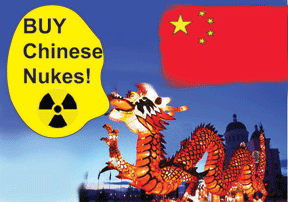 China confident of winning $80b S. Africa nuclear power bid
By Lyu Chang (China Daily): 2015-12-12 Industry officials are confident of China being the front-runner to win the right to build South Africa’s new generation of nuclear power stations.
“We think we are likely to win the bid, after preparing all the documents for the tender,” ZhengMingguang, head of the Shanghai Nuclear Engineering Research and Design Institute, ahigh-tech arm of the State Nuclear Power Technology Corp.
“The nuclear energy industry also involves other issues, so we can’t set any date yet on thefinal bidding process,” he said.
The country hopes to land the contract using its CAP1400 nuclear technology, which isdesigned by SNERDI and based on the AP1000 reactor technology developed by the UnitedStates-based Westinghouse Electric Co LLC.
South Africa currently operates the continent’s only nuclear power plant, near Cape Town, butthe country is currently facing chronic electricity shortages.
The Pretoria government invited tenders in July for an estimated $80 billion contract to buildfour nuclear reactors-the largest contract in the country’s history-which attractedwidespread interest, including from State Nuclear Power Technology Corp, Russia’s stateatomic agency Rosatom and French nuclear firms…….http://www.chinadaily.com.cn/business/2015-12/12/content_22695369.htm
France’s effort to market nuclear technology to South Africa
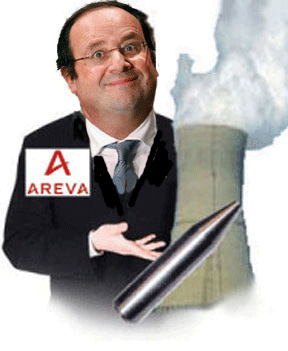 France seeks to win over SA on nuclear energy, Business Day, BY SISEKO NJOBENI, NOVEMBER 06 2015 AMID speculation about SA’s nuclear build programme, the French special envoy for the French-South African nuclear partnership Pascal Colombani is in the country punting his country for the highly anticipated programme.
During his two-day visit to the country, Mr Colombani is scheduled to have meetings “at the political level” as well with relevant public enterprises such as Eskom and the South African Nuclear Energy Co-operation (Necsa). However, he would not say who he was scheduled to meet in government.
“This is my first visit since I have been appointed by President (François) Hollande as his special envoy for the nuclear partnership with SA. Therefore, the overall purpose of my visit is to scale up our co-operation into a long-term strategic partnership in nuclear energy with SA,” Mr Colombani told Fin24.
He said France and SA shared ambitious goals for the development of nuclear energy, “which should become one key component of our strategic partnership”.
Mr Colombani said France was ready to scale up the co-operation between the two countries into a strategic long-term partnership, by supporting the development of SA’s new nuclear programme. Technology, training and safety were at the core of this partnership, he said……http://www.bdlive.co.za/business/energy/2015/11/06/france-seeks-to-win-over-sa-on-nuclear-energy
Pitfalls and huge costs make South Africa’s nuclear programme untenable
The nuclear build is a very risky exercise with numerous potential pitfalls. And there are alternatives. The shortfall in the projected nuclear capacity can be covered by a 50% larger than planned renewable energy investment. Wind and solar energy plants have been operationalised on schedule, and solar panel prices continue falling. The intermittence of renewable energy availability is considered manageable. Finally, energy saving strategies have yet to be fully explored.
 Why SA must abandon nuclear ambitions, The nuclear build is a very risky exercise with numerous potential pitfalls. And there are alternatives. Tech Central, By Hartmut Winkler, 6 Nov 15 It has been an eventful year in South Africa, characterised by power cuts, parliamentary confrontations about wasteful expenditure and student fee protests. There has, however, been an elephant in the room that has impacted all these issues but enjoyed surprisingly scarce attention. The idea, vigorously driven by government, is for the country to build nuclear plants with an expected price tag of R1 trillion.
This equates to 4 000 times the controversial costs to upgrade President Jacob Zuma’s Nkandla residence and 400 times the shortfall the tertiary education sector will experience in 2016 because of the freeze in university fee increases. Continue reading
The financial folly of South Africa’s nuclear power plan
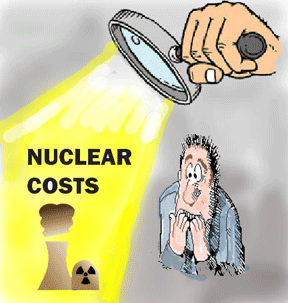 Why South Africa should not build eight new nuclear power stations, Mail &Guardian, 05 NOV 2015 HARTMUT WINKLER South Africa has plans to build new power stations despite many calling for no nuclear energy in the country. t has been an eventful year in South Africa, characterised by power cuts, parliamentary confrontations about wasteful expenditure and student fee protests. There has, however, been a massive elephant in the room that has impacted all these issues but enjoyed surprisingly scarce attention. The idea, vigorously driven by government, is for the country to build nuclear plants with an expected price tag of one trillion rand.
This equates to 4 000 times the controversial costs to upgrade President Jacob Zuma’s Nkandla residence and 400 times the shortfall the tertiary education sector will experience in 2016 because of the freeze in university fee increases………
In South Africa too the need for the continued inclusion of nuclear power in the energy mix was being reexamined. Continue reading
Urgent need for transparency on South Africa’s Integrated Energy Plan (IEP)
IEP 2015 must be tabled urgently: DA http://www.iol.co.za/news/politics/iep-2015-must-be-tabled-urgently-da-1.1938828#.Vjab-dIrLGg November 1 2015 By ANA Reporter Cape Town – The Democratic Alliance on Sunday urged Energy Minister Tina Joemat-Petterson to urgently table the integrated energy plan (IEP) 2015 so that it can be scrutinised in Parliament.
The IEP 2015 presently before Cabinet indicated that government planned not one but up to three R1 trillion nuclear deals by 2050, all the while acknowledging that procurement of nuclear could in fact be delayed until at least 2020, if not later, DA spokesman Gordon Mackay said in a statement.
“The DA therefore calls on Energy Minister Joemat-Petterson to table this IEP as a matter of urgency and allow Parliament to scrutinise this document and address the key issues within this plan.”
According to reports in the Sunday Times on Sunday morning, the proposed IEP nuclear-generating capacity would be expanded to between 12 and 20 times South Africa’s current installed nuclear capacity of 1830 MW, he said.
This effectively meant the energy department envisioned a series of large-scale nuclear deals over the next 20 years, despite ongoing and significant concerns on affordability by National Treasury and uncertainty as to the impact on the cost of electricity for ordinary South Africans, particularly the poor.
The purpose of the IEP was to provide a roadmap of the future energy landscape for South Africa to guide future energy infrastructure investments and policy development by providing a thorough analysis of competing technologies for the provision of sustainable and cost-effective electricity.
“Far from being a thorough assessment of competing technologies however, the IEP is nothing more than a slavish confirmation of the inevitability of the nuclear new build program and is the product of political interference by the ANC government into the terrain of energy planning,” Mackay said.
The IEP therefore failed to provide an assessment of a potential energy mix which excluded nuclear, despite the international energy landscape where major nuclear nations, such as Germany, France, and the US, were all reducing their reliance on nuclear in favour of cleaner and cheaper renewables and gas.
Further, the IEP argued for an energy mix biased towards a combination of large scale nuclear and large scale decentralised renewables, despite general international consensus that the two technologies were largely incompatible due to the variable nature of renewables electricity generation. “Furthermore, the scope for gas in the IEP has deliberately been limited in order to produce a ‘nuclear heavy’ energy roadmap. The IEP is way too conservative on the scope of gas within in the energy mix. Internationally, a number of gas producers are coming online and numerous new gas finds are being made across Africa. This will result in an increased availability of natural gas and the subsequent decrease in the price of natural gas,” he said.
Government should have used the IEP to aggressively pursue gas as an alternative energy form, which was far safer, cleaner, cheaper, and more job friendly compared to the use of the potentially politically motivated and unaffordable nuclear build programme.
“The DA remains fundamentally opposed to costly, secretive nuclear deals which have the real potential to destroy any prospects of future economic growth and job creation, and as such will not support government’s latest and unimpressive solution to the energy crisis in the form of the integrated energy plan,” Mackay said.
South Africa’s flawed and problematic Nuclear Environmental Impact Assessment (EIA)
 New nuke build: EIA problematic and flawed http://gctca.org.za/new-nuke-build-eia-problematic-and-flawed/BY GAVIN, ON OCTOBER 28TH, 2015 As South Africa contemplates building nuclear power stations along the coast, the Environmental Impact Assessment (EIA) consultants, GIBB, are holding public meetings to discuss their recently released draft report. The proposed nuclear builds are in Thyspunt (80 km outside Port Elizabeth) and Duynefontein (next to Koeberg, 30 km outside Cape Town).
“Thyspunt is the preferred site for Nuclear 1,” says Gary Koekemoer from NoPEnuke, “and no public meetings were scheduled for the Nelson Mandela Bay area thereby excluding 1.1-million citizens from this process. Further, it is our view that the current EIA process is fundamentally flawed with key information excluded.”
This EIA is the third draft published over eight years and was made available for scrutiny by GIBB consultants at the end of September. “The draft is a 40,000 page document and a quick count of words in the appendices making up the specialists’ reports alone showed that one would have to read around 90,000 words a day just to skim read it all before the public meetings were held,” says Peter Becker from the Koeberg Alert Alliance.
Widespread dissatisfaction has been expressed from many stakeholders around the limited time period allowed for public participation.
At the meetings, GIBB condensed their findings into a simplified scoring system for risks with ratings of Low, Moderate, High, or Fatally Flawed. “The scoring system is inadequate,” says Dr. Piet Human, project leader at the Bantamsklip Organisation. “The scores do not have a scientific or quantitative basis; what is ‘high’ for one may be ‘medium’ for another scientist. This subjectivity is then further compounded by the scores given by GIBBS.”
Becker describes a hypothetical scenario: “If the consultants found that there was a 51% chance that the new nuclear plant would explode catastrophically in the first year of operation, this would not result in a scoring of Fatally Flawed. Their recommendation in this case would be ‘Project can be authorised but with strict conditions and high levels of compliance and enforcement’.”
Bantamsklip was one of the three proposed nuclear sites alongside Thyspunt and Duynefontein but has now been excluded from this Nuclear 1 EIA. However, it remains a viable site for subsequent nuclear builds. A petition of over 10,000 signatures opposing the nuclear build was handed to the GIBB consultants at the Gansbaai meeting.
“We have only had time to look at one specialist report thus far,” continues Dr. Human, “and we reviewed the Social Impact Assessment which is problematic. The technical, scientific and professional credibility of the report is questionable as it uses outdated data, excludes HIV and Gender Related Issues (a new requirement for all large-scale EIA’s in South Africa), and does no comparative analysis of the three sites nor uses recent experiences with large projects such as Medupi.”
The biggest concerns of those in attendance at the meetings included the risk of a catastrophic nuclear accident and the evacuation plan, the environmental impact of radiation leaks into the sea, land or groundwater, the economic impact to the regions concerned owing to the negative perceptions of a nuclear facility in proximity to large-scale business concerns, costs (and the accompanying corruption), political instability and the risk of terrorism, and the massive problem of accumulating high level nuclear waste.
“The decision to build a nuclear plant must be taken with extreme care,” says Koekemoer. “We are concerned that in the gold rush of unsubstantiated promises of development and jobs we have been blinded to Thyspunt’s true value and potential as a significant local and global heritage area.
“Nuclear is not necessary,” he continues. “Renewables are making a significant contribution to our region. In our haste we are only servicing vested interests and it is a decision our grandchildren would shake their heads at.”
Becker concludes, “The GIBB consultants have a legal responsibility to put all the pertinent facts before the decision makers in a complete, unbiased and quantified way in the EIA report. Failing to do so can lead to criminal prosecution in their personal capacities.” There is concern from stakeholders that GIBB is trying to push through this flawed EIA with only token public participation.
The Sea Vista meeting for public participation in St Francis Bay will take place in early November, dates are not yet finalised. The Humansdorp meeting has been rescheduled due to public demand for more time needed and meetings in Nelson Mandela Bay have also been requested but are unconfirmed at this stage.
Submissions may be emailed to nuclear1@gibb.co.za. The full draft EIA report can be found at http://projects.gibb.co.za/en-us/projects/eskomnuclear1reviseddrafteirversion2 and more information can be found at http://koebergalert.org, http://bantamsklip.org andhttp://noPEnuke.co.za.
South Africa’s Flawed Environmental Assessments for New Nuclear Build
New nuke build: EIA problematic and flawed As South Africa contemplates building nuclear power stations along the coast, the Environmental Impact Assessment (EIA) consultants, GIBB, are holding public meetings to discuss their recently released draft report. The proposed nuclear builds are in Thyspunt (80 km outside Port Elizabeth) and Duynefontein (next to Koeberg, 30 km outside Cape Town).
“Thyspunt is the preferred site for Nuclear 1,” says Gary Koekemoer from NoPEnuke, “and no public meetings were scheduled for the Nelson Mandela Bay area thereby excluding 1.1-million citizens from this process. Further, it is our view that the current EIA process is fundamentally flawed with key information excluded.”
This EIA is the third draft published over eight years and was made available for scrutiny by GIBB consultants at the end of September. “The draft is a 40,000 page document and a quick count of words in the appendices making up the specialists’ reports alone showed that one would have to read around 90,000 words a day just to skim read it all before the public meetings were held,” says Peter Becker from the Koeberg Alert Alliance.
Widespread dissatisfaction has been expressed from many stakeholders around the limited time period allowed for public participation.
At the meetings, GIBB condensed their findings into a simplified scoring system for risks with ratings of Low, Moderate, High, or Fatally Flawed. “The scoring system is inadequate,” says Dr. Piet Human, project leader at the Bantamsklip Organisation. “The scores do not have a scientific or quantitative basis; what is ‘high’ for one may be ‘medium’ for another scientist. This subjectivity is then further compounded by the scores given by GIBBS.”
Becker describes a hypothetical scenario: “If the consultants found that there was a 51% chance that the new nuclear plant would explode catastrophically in the first year of operation, this would not result in a scoring of Fatally Flawed. Their recommendation in this case would be ‘Project can be authorised but with strict conditions and high levels of compliance and enforcement’.”
Bantamsklip was one of the three proposed nuclear sites alongside Thyspunt and Duynefontein but has now been excluded from this Nuclear 1 EIA. However, it remains a viable site for subsequent nuclear builds. A petition of over 10,000 signatures opposing the nuclear build was handed to the GIBB consultants at the Gansbaai meeting.
“We have only had time to look at one specialist report thus far,” continues Dr. Human, “and we reviewed the Social Impact Assessment which is problematic. The technical, scientific and professional credibility of the report is questionable as it uses outdated data, excludes HIV and Gender Related Issues (a new requirement for all large-scale EIA’s in South Africa), and does no comparative analysis of the three sites nor uses recent experiences with large projects such as Medupi.”
The biggest concerns of those in attendance at the meetings included the risk of a catastrophic nuclear accident and the evacuation plan, the environmental impact of radiation leaks into the sea, land or groundwater, the economic impact to the regions concerned owing to the negative perceptions of a nuclear facility in proximity to large-scale business concerns, costs (and the accompanying corruption), political instability and the risk of terrorism, and the massive problem of accumulating high level nuclear waste.
“The decision to build a nuclear plant must be taken with extreme care,” says Koekemoer. “We are concerned that in the gold rush of unsubstantiated promises of development and jobs we have been blinded to Thyspunt’s true value and potential as a significant local and global heritage area.
“Nuclear is not necessary,” he continues. “Renewables are making a significant contribution to our region. In our haste we are only servicing vested interests and it is a decision our grandchildren would shake their heads at.”
Becker concludes, “The GIBB consultants have a legal responsibility to put all the pertinent facts before the decision makers in a complete, unbiased and quantified way in the EIA report. Failing to do so can lead to criminal prosecution in their personal capacities.” There is concern from stakeholders that GIBB is trying to push through this flawed EIA with only token public participation.
The Sea Vista meeting for public participation in St Francis Bay will take place in early November, dates are not yet finalised. The Humansdorp meeting has been rescheduled due to public demand for more time needed and meetings in Nelson Mandela Bay have also been requested but are unconfirmed at this stage.
Submissions may be emailed to nuclear1@gibb.co.za. The full draft EIA report can be found at http://projects.gibb.co.za/en-us/projects/eskomnuclear1reviseddrafteirversion2 and more information can be found at koebergalert.org, bantamsklip.org andnoPEnuke.co.za.
South Africa’s govt questioned on costs of nuclear power programme
Nuclear build programme under fire http://www.iol.co.za/business/news/nuclear-build-programme-under-fire-1.1936163#.Vi_xstIrLGg October 27 2015 By Siyabonga Mkhwanazi Johannesburg – Energy Minister Tina Joemat-Pettersson faces another round of tough questions in Parliament today on the nuclear build programme.
Joemat-Pettersson has hardly escaped questions on the nuclear build programme in Parliament since it was announced by President Jacob Zuma three years ago.
She will be part of the economics cluster of ministers responding to questions on a range of issues, including nuclear, in the National Council of Provinces in the next two days.
Tomorrow Economic Development Minister Ebrahim Patel will also answer questions on South Africa’s controversial nuclear programme.
The opposition parties have been asking Joemat-Pettersson to come clean on the project.
One of the key questions has been on the funding for nuclear power when the government has not given an indication where the money will come from.
In his medium-term budget policy statement last week, Finance Minister Nhlanhla Nene was non-committal on the funding for nuclear energy.
However, he told journalists ahead of the statement that preparatory work had started, but did not indicate the detailed work that had been undertaken.
He said R200 million had been committed to the preparatory work.
A few weeks ago the Department of Energy said the procurement process had been postponed to the end of this financial year. This was due to outstanding work, including the funding model for nuclear.
The shifting of the deadline for the procurement process came after Joemat-Pettersson said in her budget vote speech in May that procurement would start during the second half of this year.
She also said the winning company would be announced before the end of the year.
It has been said the nuclear build programme will cost between R500 billion and R1 trillion. But the government has been coy on costs, saying this would disrupt the bidding process.
It said it would wait for the bidders to reveal their prices first, in the bidding phase, before any figure could be made public.
The department also said despite the delay in the procurement process, it would stick to the deadline of 2030 to complete the construction of the nuclear reactors.
Joemat-Pettersson has also been accused of keeping the information on the nuclear build programme out of Parliament.
Opposition parties have warned that they could not afford to have such a massive programme kept under wraps.
Today it will be their turn to turn up the heat on Joemat-Pettersson on the programme.
The government has insisted that it will build nuclear power plants that will be within its means and easy to afford.
One of the key questions to Patel is on job creation, localisation and long-term benefits of the reactors to the country.
South Africa; court action to stop nuclear procurement
Court bid to stop SA nuclear procurement http://citizen.co.za/820348/court-bid-to-stop-sa-nuclear-procurement/Paperswere lodged with the Cape High Court this week in an application against Energy Minister Tina Joemat-Pettersson and President Jacob Zuma, aimed at stopping the country’s nuclear procurement programme.
Environmental group Earthlife Africa and the South African Faith Communities Environment Institute (SAFCEI) on Thursday announced that it had lodged an application in this regard. Other respondents are the National Energy Regulator (Nersa), Chairperson of the National Council of Provinces and the Speaker of the National Assembly. No relief is sought against these three.
The applicants, however, need money for what is expected to be a long and costly fight against government. They currently have less than R1 million available for legal costs and are busy raising more funds.
The South African government is preparing for a nuclear power procurement programme based on the 2010 Integrated Resource Plan (IRP) that suggests the country will need 9 600MW nuclear generation capacity by 2030. Details about which State entity will implement the project and the structure of the procurement process are however still unknown and there is much concern about the affordability of nuclear power.
The applicants argue in their papers that Joemat-Pettersson has failed to put the necessary processes in place to ensure that the nuclear procurement is conducted lawfully and meets the requirements of the Constitution for a fair, equitable, transparent, competitive and cost-effective process.
“Notwithstanding the vast sums of money to be committed, and the potentially long-term effect on the economy and for consumers of electricity and present and future generations of South Africans, the decision to proceed with procuring these nuclear power plants (the so called nuclear fleet), and to have concluded such procurement in the next few months, has occurred without any of the necessary statutory and constitutional decisions having been lawfully taken,” the applicants argue.
They are challenging the legality of the inter-governmental agreements between South Africa and Russia, the US and Korea, respectively. These agreements were held by the Department of Energy to be done in preparation of the actual procurement.
They are asking the court to set these agreements aside and, among other things, challenge certain decisions by Joemat-Pettersson, in consultation with Nersa, prior to making the formal determination about the amount of nuclear capacity the country needs.
They maintain a fair, equitable, transparent, cost-effective and competitive procurement process cannot take place in the current circumstances and are seeking a declaratory order in this regard.
In terms of the court rules Joemat-Pettersson and President Zuma have ten days to file opposing papers.
SAFCEI spokesperson Liziwe McDaid said the organisation does not support the notion that the country needs base load energy with coal and nuclear being the only viable options. She said a mix of renewable energy technologies as well as gas, but excluding fracking, is more appropriate.
It will be a mistake to lock the country into unaffordable nuclear projects that are in actual fact outdated technology, she said. Decommissioning of the country’s older coal-fired power stations will begin in about ten years’ time. During this period huge strides may be made with regard to technological solutions for the storage of renewable energy and that will be a better replacement for the coal-fired fleet than nuclear, she said.
Brought to you by Moneyweb
1 This Month
To see nuclear-related stories in greater depth and intensity – go to https://nuclearinformation.wordpress.com/
12 February – Webinar The Big Push: New Nuclear Projects in Canada
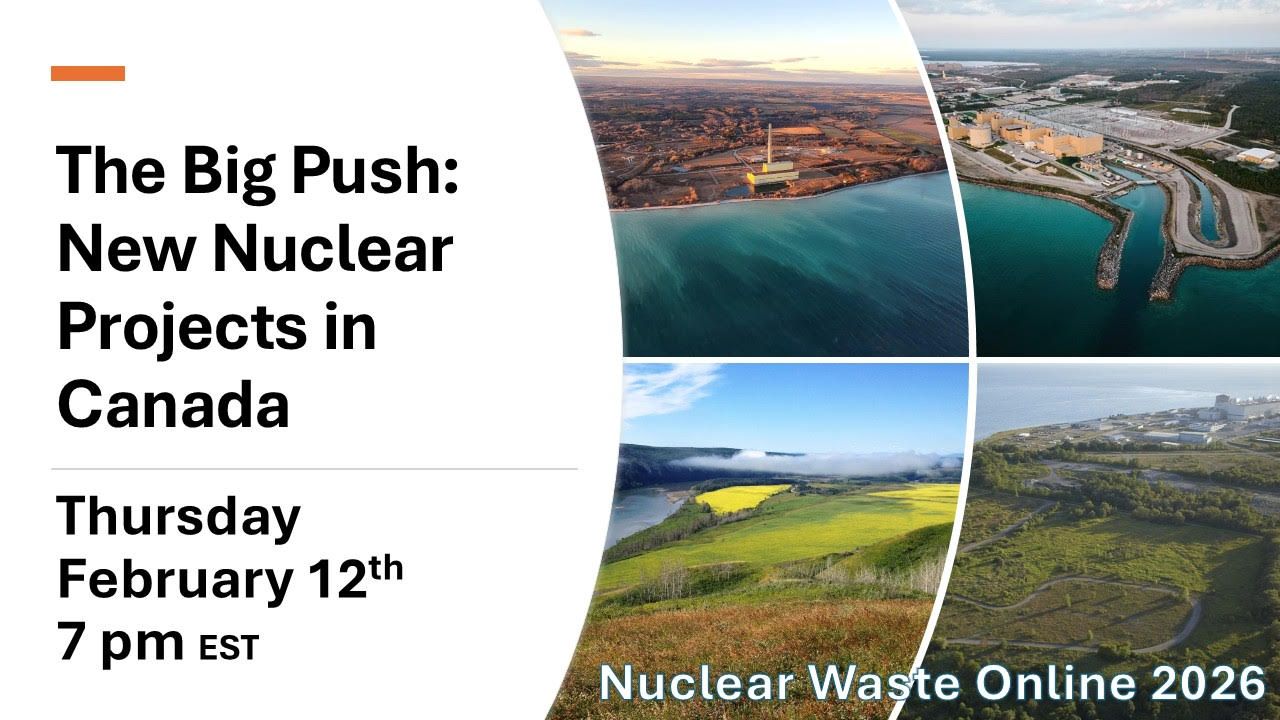
Thursday, February 12, 7 pm Eastern | 2nd of 4 sessions in the 2026 Nuclear Waste Online webinar series
Join a webinar on the push for new nuclear generation in Canada. Go to Northwatch.org to register or use the registration link https://us02web.zoom.us/webinar/register/WN_ZfWOf1GITqSRIZX8CB-A9w
-
Archives
- February 2026 (127)
- January 2026 (308)
- December 2025 (358)
- November 2025 (359)
- October 2025 (376)
- September 2025 (258)
- August 2025 (319)
- July 2025 (230)
- June 2025 (348)
- May 2025 (261)
- April 2025 (305)
- March 2025 (319)
-
Categories
- 1
- 1 NUCLEAR ISSUES
- business and costs
- climate change
- culture and arts
- ENERGY
- environment
- health
- history
- indigenous issues
- Legal
- marketing of nuclear
- media
- opposition to nuclear
- PERSONAL STORIES
- politics
- politics international
- Religion and ethics
- safety
- secrets,lies and civil liberties
- spinbuster
- technology
- Uranium
- wastes
- weapons and war
- Women
- 2 WORLD
- ACTION
- AFRICA
- Atrocities
- AUSTRALIA
- Christina's notes
- Christina's themes
- culture and arts
- Events
- Fuk 2022
- Fuk 2023
- Fukushima 2017
- Fukushima 2018
- fukushima 2019
- Fukushima 2020
- Fukushima 2021
- general
- global warming
- Humour (God we need it)
- Nuclear
- RARE EARTHS
- Reference
- resources – print
- Resources -audiovicual
- Weekly Newsletter
- World
- World Nuclear
- YouTube
-
RSS
Entries RSS
Comments RSS
 nuclear-news