Floods in South Africa – a ”climate catastrophe of enormous proportions”
After the relentless rain, South Africa sounds the alarm on the climate
crisis. Many are still missing after this month’s floods. Extreme weather
is becoming more frequent, and it can be devastating.
The South African president, Cyril Ramaphosa, described a “catastrophe of enormous
proportions” and attributed the disaster to the climate emergency. “It
is telling us that climate change is serious, it is here,” Ramaphosa said
as he visited the flooded metropolitan area of eThekwini, which includes
Durban, shortly after the floods. “We no longer can postpone what we need
to do, and the measures we need to take to deal with climate change.”
Guardian 24th April 2022
South Africa. Fired National Nuclear Regulator board member takes Minister Gwede Mantashe to court
Daily Maverick By Sasha Planting 20 Apr 22,
Peter Becker is seeking declaratory relief that the minister’s decision to discharge him as a board member was unlawful and unconstitutional, and wants an order reviewing and setting aside this decision.
Peter Becker, formerly a member of the board of the National Nuclear Regulator, has served papers on the minister of mineral resources and energy, the National Nuclear Regulator and the chairman of that body to challenge his dismissal in February this year.
Becker is seeking declaratory relief that the minister’s decision to discharge him was unlawful and unconstitutional, and wants an order reviewing and setting aside this decision.
Becker’s initial suspension came in January, just days before the regulator approved the extension of life project for the Koeberg nuclear power station, a decision that should be reviewed, given the delays and safety concerns that have arisen since.
The role of the regulator is not to protect the interests of Koeberg or nuclear power, but to ensure that nuclear activities are conducted safely in South Africa, ultimately in the interests of the public.
Becker was appointed to the board in June 2021 by Minister of Mineral Resources and Energy Gwede Mantashe. He was nominated by civil society organisations, including the Koeberg Alert Alliance, the Southern African Faith Communities’ Environment Institute and the Pelindaba Working Group, to represent communities that may be affected by nuclear activities.
However, on 25 February Mantashe fired Becker, arguing that he was guilty of misconduct and was conflicted. This was because Becker had, in his personal capacity, and before his appointment, expressed critical and challenging views on the use of nuclear energy.
“The minister has fundamentally misunderstood those duties. His decision is vitiated by substantive and procedural irrationality, errors of law and fact and unreasonableness,” Becker responds in the affidavit.
His removal has not come at a good time. Maintenance and replacement work are being carried out at Koeberg, under authorisations granted by the regulator. However, this work is already behind schedule and several safety concerns have been raised.
Moreover, Mantashe has signalled his intention to tender for new nuclear power proposals as soon as possible, possibly before the year is out.
The alleged conflict of interest arose because Becker is concerned about the use of nuclear power in South Africa, is opposed to the building of more reactors at Koeberg and is worried about its lifespan being extended. He has been publicly vocal in this regard. However, as Becker has deposed, these views were well known and were included in his CV before he was appointed to the job. ………………………..
At least one member of the board is actively and vocally pro-nuclear. This is Katse Maphoto, the chief director of nuclear safety and technology in the minister’s department. On several occasions he has indicated his support for nuclear power, saying it should form part of SA’s energy mix.
Thus Becker says, it is inconsistent and irrational to take the position that people who are generally critical of nuclear activity should be disqualified from exercising proper judgment concerning safety issues, while those who are supportive, are not.
The minister has 15 days in which to submit a “record of proceedings” — the documents, evidence, arguments and other information relating to the dismissal — failing which, a court date will be set. https://www.dailymaverick.co.za/article/2022-04-19-fired-national-nuclear-regulator-board-member-takes-minister-gwede-mantashe-to-court/
South African Anti-nuclear activist taking Energy Minister to court for firing him
Anti-nuclear activist taking Gwede Mantashe to court for firing him
Fin 24, Lameez Omarjee, 13 Apr 22
- Anti-nuclear activist Peter Becker has launched a legal challenge against Energy Minister Gwede Mantashe.
- The minister had axed Becker from the board of the National Nuclear Regulator over an alleged conflict of interest.
Becker is the spokesperson of Koeberg Alert Alliance, a civil society group concerned with the safety of nuclear activity……………….. https://www.news24.com/fin24/economy/anti-nuclear-activist-taking-gwede-mantashe-to-court-for-firing-him-20220413
South Africa removes critic of nuclear power from regulatory board.
South Africa Removes Anti-Nuclear Activist From Regulatory Board
Antony Sguazzin, Bloomberg, 24 Feb 22— South African Energy Minister Gwede Mantashe fired community representative Peter Becker from the board of the National Nuclear Regulator, citing a conflict of interest.
Mantashe said Becker was opposed to the development of new nuclear-power facilities or the extension of the life of South Africa’s existing one, Koeberg, and therefore couldn’t be objective, according to a letter sent to the activist on Friday that was seen by Bloomberg.
The dispute that led to Becker’s removal highlights the difficulties Eskom Holdings SOC Ltd. is facing in its fight to keep its Koeberg nuclear plant in Cape Town operating until 2044. Mantashe, a former coal-mining labor unionist and chairman of the ruling African National Congress, has emerged as a vocal supporter of the nuclear industry, while drawing criticism from environmental activists. Becker, by contrast, is also a spokesman for the Koeberg Alert Alliance, which wants the plant closed……….
By law, the minister has to appoint a community representative to the board. He complained, in the letter, that Becker had brought the board into disrepute by objecting publicly to its decisions. Becker was suspended on July 18 and then sued Mantashe, forcing the minister to make a decision whether to retain him or fire him from the board.
Becker said he will consult with his legal team and the communities he was representing before responding.
While Eskom has yet to receive final permission to extend the life of Koeberg, the only nuclear-power facility in Africa, it has started a program to spend about 20 billion rand ($1.3 billion) on new steam generators as part of the work needed to keep it operating. Becker and Koeberg Alert have opposed the extension of Koeberg’s operating license because of the nuclear plant’s proximity to Cape Town, a city of 4 million people, citing what they say is a potential for earthquakes. https://www.bnnbloomberg.ca/south-africa-removes-anti-nuclear-activist-from-regulatory-board-1.1728817
Fight Over Africa’s Sole Atomic Plant Entangles Energy Minister Mantashe
Mantashe sued over suspension of activist from the board
Eskom plans to extend Koeberg plant’s operating lifetime, Bloomberg, By Antony Sguazzin, 2 February 2022, South African Energy Minister Gwede Mantashe is being sued following the suspension of a National Nuclear Regulator board member who also works with a civil society group fighting against the lifetime extension of the continent’s only power reactors.
The suit filed by Peter Becker, who in addition to serving on the nuclear regulator’s board is a spokesman for the Koeberg Alert Alliance, will be heard by the High Court of Cape Town on Feb. 8, according to public documents seen by Bloomberg. South Africa is legally obliged to appoint a nuclear regulatory board member who represents communities potentially affected by industry decisions…………..
Becker, who was suspended on Jan. 18, argues in the documents that Mantashe didn’t have the legal authority to suspend him from performing his duties on the regulatory board. “The role of a board member representing the interests and concerns of communities is defined by the National Nuclear Regulatory Act” and “while I am suspended, decisions are being taken by the board without that representation,” he wrote in a reply to questions.
The court case highlights the difficulties Eskom Holdings SOC Ltd. is facing in its fight to keep its Koeberg nuclear plant in Cape Town operating until 2044. Mantashe, a former coal mining unionist and chairman of the ruling African National Congress, has emerged as a vocal supporter of the nuclear industry, while drawing criticism from environmental activists. ……………… https://www.bloomberg.com/news/articles/2022-02-02/fight-over-africa-s-sole-nuclear-plant-ensnares-energy-minister
Call to rally against extending the lifespan of ageing Koeberg Nuclear Power Station
Call to rally against extending the lifespan of ageing Koeberg Nuclear Power Station, IOL. By Kristin Engel, 17 Dec, Cape Town – The Koeberg Alert Alliance (KAA) and the Southern African Faith Communities Environment Institute (Safcei), together with concerned Capetonians gathered on Bloubergstrand Beach for an anti-nuclear protest to question the safety of the nearby nuclear plant operated by Eskom.
The protesters’ chants of “down with nuclear” came as Eskom tries to extend the Koeberg plant’s operating life by another 20 years, after its initial 40-year lifespan ends in 2024, despite numerous challenges and safety concerns at the plant.
Safcei executive director Francesca de Gasparis said Eskom had been quiet about its plans for South Africa’s only nuclear power plant and have not provided information about this process or given the public sufficient evidence that it was safe and in the interests of electricity users to extend the lifespan of the ageing nuclear plant.
Ubuntu Rural Women and Youth Movement member Vainola Makan said: “We are certain that because of the lack of access to information and the lack of transparency, only private business individuals will benefit from this deal and the interests of citizens is of no concern.”
KAA spokesperson Peter Becker called on Eskom to shut down the Koeberg nuclear power plant as planned in 2024, and stop their attempts to extend its designed lifespan, especially with the old engineering and increasing problems at the plant.
However, the electricity supplier was adamant about the extension of the plant’s lifespan.
……… National Nuclear Regulator (NNR) spokesperson Gino Moonsamy said Eskom’s application would be undergoing a detailed review process in which the NNR would direct Eskom to publish the application for comment in local newspapers and serve notification letters to stakeholders.
Moonsamy said only after the NNR considered the insights and representations from public consultation, would they finalise the decision on the application and announce the decision on whether the plant would be able to operate beyond its current licensing basis. https://www.iol.co.za/capeargus/news/call-to-rally-against-extending-the-lifespan-of-ageing-koeberg-nuclear-power-station-3826d950-5658-410e-9ca9-6dc8d2fc202b
We must question why small modular reactors and the rebirth of nuclear energy are all the rage

These considerations should lead us to make saner and more realistic choices for our children and our children’s children
Roland Ngam • 11 October 2021, We must question why small modular reactors and the rebirth of nuclear energy are all the rage, Daily Maverick,
Small modular nuclear reactors are being widely punted as the energy source of the future. But if we are looking only at costs, solar and wind are way cheaper than small modular reactors and battery technology is way better today than it was only three years ago.
Small modular reactors (SMRs) seem to be all the rage these days. Dismiss them at your peril. I am no conspiracy theorist, but everyone is talking about them just as energy prices are spiking in Europe, the UK is struggling to supply its filling stations with fuel, the green parties want to cancel Nord Stream 2 and China is rationing electricity after recent widespread outages in 22 states.
Could it be that some of these crises — and ergo, energy panic — are artificially made in order to give fossils one last hurrah in the limelight? Nuclear energy is renewable [Ed. this is not true] , but I mean, you need fossils and a lot of capital investment to make them! Also, are those who are betting on SMRs as the technology of the future right to place their hopes in this sector rather than in greener alternatives?………………
America has been subsidising research in SMRs for more than a decade now. They paid $226-million in research grants for the light-water SMR built by Nuscale Power for Energy Northwest. The US Congress has already passed a nuclear production tax credit (PTC) act to subsidise energy from the plant for the next 10 years and the Department of Energy further approved $1.355-billion to fund the Carbon Free Power Project (CFPP), which involves investing massively in SMRs.
China already has a bunch of floating SMR powerships and started construction on a 125 MWe land-based pressurised water reactor (PWR) in Hainan province in June 2021. The project was officially launched by the Ministry of Ecology and Environment (which is another point I will get back to in a moment, i.e. that countries are pushing nuclear hard as the green solution of the future).
In the United Kingdom, SMRs are a key part of the decarbonisation strategy. Last year, Prime Minister Boris Johnson announced a £525-million investment in SMR development and Business Secretary Kwasi Kwarteng is about to approve a contract for Rolls-Royce to build a fleet of them in order to assure energy self-sufficiency, which has become a hotly debated topic after Brexit and now amidst the fuel shortages that have hit the nation.
Not to be outdone, French President Emmanuel Macron wants to make SMRs a cornerstone of his 2022 re-election campaign. It is believed that France will spend €50-million from the Euro Recovery Plan on SMR research. Industry players in the nuclear space have already announced plans for the construction of a university of nuclear research. About 30 research centres have also received funds from the France Relance plan for nuclear research. Although France is a world leader in nuclear technology, they have been caught napping by Russia, the US and China which are already way ahead of them in SMR technology.
So the race is on to scale up production of affordable commercial land-based SMRs which could potentially fill up the manufacturing companies’ order books.
Now, back to why nuclear technology is enjoying a comeback — well, it never went away, but it is enjoying a renaissance of sorts among the ever-more confident G20 leaders — because, as Maud Bregeon puts it in Nucléaire: un patrimoine industriel et écologique, even the IPCC and the UN say that “all low-carbon technologies are needed to meet our climate goals, including nuclear.
…….. is the world right to focus on SMRs as the future? If we are looking only at costs, solar and wind are way cheaper than SMRs and battery technology is way better today than it was only three years ago.
According to the International Energy Agency and the OECD Nuclear Energy Agency, the kilowatt-hour price for SMR is almost certainly always going to be higher than what bigger power plants can offer. It is for this reason that many question why South Africa’s Energy Minister is still determined to commit to new nuclear capacity in line with the integrated resource plan (IRP). That allocation could be shifted to a cheaper energy source.
Three billion dollars is a massive drop from the $10-billion that is the going rate for a big nuclear plant. However, even at $3-billion in start-up for a small plant, the average African country simply cannot afford this type of technology. By comparison, they can get going on a modular solar plant with only a few thousand dollars.
Then there is the toll that continued investment in nuclear has on the environment. In an essay titled An Obituary for Small Modular Reactors, Friends of the Earth Australia argues that “about half of the SMRs under construction (Russia’s floating power plant, Russia’s RITM-200 icebreaker ships, and China’s ACPR50S demonstration reactor) are designed to facilitate access to fossil fuel resources in the Arctic, the South China Sea and elsewhere”.
Drought-hit Namibia, which has about 5% of the world’s uranium resources has seen an increase in investments in the uranium sector. Russia (
Helpless activists in Namibia have also been trying to draw the world’s attention to the unusually high numbers of former uranium mine workers who have been dying of cancer, without much success. As investments in uranium pick up, and as some environmental activists make the case for nuclear as green technology, it is important to remember the toll that it is taking on people and ecological systems in the Global South.
These considerations should lead us to make saner and more realistic choices for our children and our children’s children. https://www.dailymaverick.co.za/opinionista/2021-10-11-we-must-question-why-small-modular-reactors-and-the-rebirth-of-nuclear-energy-are-all-the-rage/
.
Walking the nuclear dog – a South African tale

Walking the nuclear dog – a South African tale, ESI Africa, By Chris Yelland, managing director, EE Business Intelligence, 6 Sept 21
Apparently, in government, there is an activity known as “walking the dog” – a strategy intended to keep self-serving politicians, officials and stakeholders quiet, and to calm them down when they are getting agitated and fidgety for some of the action.
Of course, there is some excitement at the prospect of sniffing out the territory on a brisk walk, with the anticipation that something big is on the cards. But this is inevitably short-lived, and things soon revert back to the normal and more leisurely state of inaction. Mission accomplished.
There are some examples of this in the coal and nuclear energy sectors of South Africa. The media and the public need to be careful not to be bamboozled by the noxious smoke and mirrors, sometimes radioactive, that emanate from these quarters in their excitement.
2,500MW of new nuclear power?
However, in the days following the board meeting, Nersa seemed to be acting very coy – firstly about clarifying exactly what it was that the board had concurred with, and secondly, whether this was even a concurrence by Nersa after all, as opposed to a conditional concurrence that was still subject to a number of suspensive conditions.
Of course, the independent Regulator was treading a very delicate line – to at least give the appearance that the noisy nuclear sector had got its way, while covering all political bases and legal angles, protecting its fragile reputation, and taking care not to become the scapegoat for scuppering the nuclear ambitions of a fractious Minister.
However, on 3 September 2021, Nersa finally succumbed to the growing pressure to release full details of its actual decision on 26 August 2021, with the reasons for the decision (RFD) to follow in due course. In so doing, the tricky game that Nersa was having to play became clearer.
Following a meeting by the board of the National Energy Regulator of South Africa (Nersa) on 26 August 2021, there were breathless public statements to the media by officials at the Department of Mineral Resources and Energy (DMRE) regarding a decision by the Regulator in respect of 2,500MW of new nuclear power in South Africa.
The Regulator was said to have “concurred” with a so-called Section 34 ministerial nuclear determination in terms of the Electricity Regulation Act (ERA). Some in the media fell for this hook, line and sinker. The nuclear energy sector was ecstatic, asserting that the procurement of 2,500MW of new nuclear power in South Africa would now commence.
Suspensive conditions?
Contrary to the public statements and media interviews by DMRE officials, written details of the board decision reveal that Nersa has in fact not yet concurred with the Section 34 determination per se, but that such concurrence is still subject to a number of suspensive conditions which have not yet been met.
The precise wording of Nersa’s decision of 26 August 2021 in respect of the suspensive conditions, indicate that the Energy Regulator has decided:
To concur with the commencement of the process to procure the new nuclear energy generation capacity of 2,500MW as per Decision 8 of the Integrated Resource Plan for Electricity 2019 – 2030 … subject to the following suspensive conditions:
Satisfaction of Decision 8 of IRP 2019 – 2030, which requires that the nuclear build programme must be at an affordable pace and modular scale that the country can afford because it is no regret option in the long term;
- Recognition and taking into account technological developments in the nuclear space; and
- To further establish rationality behind the 2,500MW capacity of nuclear. A demand analysis aimed at matching the envisaged load profile post 2030, with the generation profile that would be needed to match that load profile, is required. This will assist to determine the capacity and the scale at which the country would need to procure nuclear.
It is thus clear that Nersa is only concurring with Decision 8 of the current Integrated Resource Plan for Electricity, IRP 2019 – 2030, to “commence preparations for a nuclear build programme to the extent of 2,500MW”, with this itself being subject to the suspensive conditions listed.
The Regulator is not concurring with the commencement of a request for proposals (RFP) for new nuclear power in South Africa, nor is Nersa giving the green light to any new nuclear construction programme.
Not so fast please!
It goes without saying that any public procurement must still comply with the requirements of the Public Finance Management Act (PFMA) and the Constitution. As such, National Treasury remains a gatekeeper through the requirement for a positive outcome to a detailed cost-benefit analysis, and the requirement for National Treasury to establish the affordability of any such procurement.
It is still far from resolved as to the technology to be used for a nuclear new-build programme in South Africa. Would these be giant pressurised water reactors (PWRs) such as the Rosatom VVER 1200 units? Or small modular nuclear reactors (SMRs) that still have to be developed, piloted, commercialised, licenced and proven elsewhere in the world?
The suspensive conditions even indicate that the very rationality of a 2,500MW nuclear new-build programme still needs to be established through long-term demand forecasting for the period post-2030 in order to determine the mix of the generation capacity required to meet that demand.
Finally, as no new nuclear power is provided for in the current IRP in the years to 2030, it is clear that any new nuclear procurement can only commence, at the earliest, after an updated IRP has been considered by government’s “social partners”, approved by the Cabinet, and promulgated.
1,500MW of new, clean, coal-fired power?
A further example of “walking the dog” may be found in ongoing suggestions by the Minister and his officials at the DMRE that “clean coal” technologies can be deployed……………….
The 9,600MW nuclear fleet?
Yet another case of “walking the dog” was detailed in an article in Daily Maverick on 26 August 2021. In the article, former Deputy Finance Minister Mcebisi Jonas reveals that there was a general understanding in government that the 9600 MW nuclear deal with Russia, being pushed in 2017 by then-President Jacob Zuma and Energy Minister David Mahlobo, would be terrible for South Africa.
| According to Jonas, President Ramaphosa’s instruction was to “walk it” as long as possible. “He [Ramaphosa] said that by the time we have to make a decision, Zuma will be gone. He told us to find everything in the book to delay”.Does a question arise as to whether the upsides of dog walking really outweigh the downsides? It is hard to give a clear answer to this question, but it would seem that our President clearly prefers walking the dog to dealing firmly with self-serving elements within the party circle.However, a poorly-founded but nagging question keeps popping up as to what Vice-President DD Mabuza was really up to during his extended five-week leave of absence in Russia in July 2021?Putin would likely be a big, vicious dog, ready for a fight, and not easily controlled on the walk – actually more of a bear than a dog. And I would hate to be walking a grumpy bear. https://www.esi-africa.com/industry-sectors/generation/op-ed-walking-the-nuclear-dog-a-south-african-tale/ |
As South Africa restarts nuclear plan, critics and advocates clash over its clean energy credentials
As SA restarts nuclear plan, critics and advocates clash over its clean energy credentials, Fin 24, Jan Cronje 30 August 21, As South Africa’s revived nuclear power plan moves forward, questions over the green credentials of atomic power have added another dimension to an already fraught debate between critics and proponents of nuclear energy.
The debate mirrors one taking place internationally about where, if at all, nuclear power should fit into the battle against climate change…… (Subscribers only) https://www.news24.com/fin24/economy/as-sa-restarts-nuclear-plan-critics-and-advocates-clash-over-its-clean-energy-credentials-20210830
South Africa’s Organisation Undoing Tax Abuse (Outa) opposes plan for new nuclear power
Nersa gets green light to approve new nuclear power procurement, but Ts & Cs apply, Fin24, 20 Aug 21, A National Energy Regulator of South Africa (Nersa) committee has recommended that the regulator approve a plan to procure 2 500 MW of new nuclear power.
It will now be up to Nersa’s full board to make a decision on whether it agrees with the plan as set out by Mineral Resources and Energy Minister Gwede Mantashe in August last year.
At a meeting on Friday morning, Nersa’s electricity subcommittee was broadly supportive of Mantashe’s plan. This followed public hearings earlier in the year. Liz McDaid, Parliamentary and energy advisor to the Organisation Undoing Tax Abuse (Outa), said that South Africans would now have to wait see what Nersa’s board decides.
If the board decides to concur with Mantahse’s determination, it will have to publish the reasons behind its decision, including the “suspensive conditions” mentioned in the meeting on Friday.
Outa is opposing the new nuclear build, saying it is “not affordable, not appropriate and should not be approved”. No requests for proposal have yet been issued for the new nuclear build. …….. https://www.news24.com/fin24/companies/industrial/nersa-gets-green-light-to-approve-new-nuclear-power-procurement-but-ts-cs-apply-20210820
South Africa the only country to have dismantled its nuclear weapons capability,
SA the only country to have dismantled its nuclear weapons capability, Robin Möser 25 Jun 2021 ext month, on 10 July, marks the 30th anniversary of South Africa’s accession to the Treaty on the Non-Proliferation of Nuclear Weapons (NPT), but it seems this step will not receive the world’s attention it should get. South Africa is still the only example of a state that has given up its indigenously developed nuclear weapons arsenal and subsequently adhered to nonproliferation norms.
Today, developments concerning continuous missile and nuclear tests in North Korea, the United States’ unilateral withdrawal from the nuclear deal with Iran in 2018, and the last-minute extension of the New Start Treaty between the US and Russia in February this year demonstrate the urgency of discussing nuclear disarmament on a global scale.
Revisiting the unique South African case of nuclear disarmament and NPT accession provides a crucial starting point, as it demonstrates that disarmament is possible. Moreover, the South African example shows that to forgo nuclear weapons needs both domestic political preconditions and an international context perceived to be conducive. It cannot succeed solely based on the moral conviction of political leaders that disarmament is good. The actions taken by the FW De Klerk government between 1989 and 1991 illustrate that his decisions gravitated to assessing domestic political risks and potential benefits that the decision to disarm and sign the NPT would bring for his government………………………. https://mg.co.za/opinion/2021-06-25-sa-the-only-country-to-have-dismantled-its-nuclear-weapons-capability
‘Koeberg Nuclear Plant is like an old car that simply can’t be kept on the road’

Cape Talk, 7 June 2021, by Barbara Friedman Refilwe Moloto speaks to Hilton Trollip, a research fellow in energy at UCT’s Global Risk Governance Programme.
- Koeberg GM suspended but energy expert says the nuclear power station is past its sell-by date
- Researcher Hilton Trollip is skeptical about refurbishing Koeberg
- All coal-firing and nuclear plants need to end and move over to renewable sources, says Trollip
On Friday the general manager of Koeberg Nuclear Power Station was replaced by Eskom’s Chief Nuclear Officer. Velaphi Ntuli has been suspended for operational reasons.
RELATED: Eskom suspends Koeberg Power Station GM for ‘performance-related issues’
One of those being that one of Eskom’s biggest generating units with a capacity of 900MW, Koeberg Unit 1 has been on an outage since January 2021.
Just how concerned should we be as we head into winter, and at the same time, try to revive our economy?
We don’t know what’s happening inside Koeberg because we have no information on that, but what we do know is that Eskom is sitting with a power station fleet that is 30, 40, and 50 years old.
Hilton Trollip, Research Fellow – Global Risk Governance Programme UCT
Koeberg was built in 1985 and reaches the end of its design life in 2024, he notes.
It’s like a 20 or 30-year-old car. There comes a stage when it simply can’t be kept on the road, or to keep it on the road is too expensive or you are going to have regular breakdowns.
…………….Should the Koeberg Nuclear Power Station be given a longer lease on life?
There are plans to refurbish it, but I am skeptical about the wisdom of that. I am an engineer and everybody knows, things wear out, including power stations. Hilton Trollip, Research Fellow – Global Risk Governance Programme UCT
He says the government as a whole has not taken on board the fact that this energy era has to come to an end and be replaced with renawables……….. https://www.capetalk.co.za/articles/418543/koeberg-nuclear-plant-is-like-an-old-car-that-simply-can-t-be-kept-on-the-road
The corruption surrounding the South African government’s push for nuclear power

Part one | Zondo’s nuclear deal revelations, https://www.newframe.com/part-one-zondos-nuclear-deal-revelations/
- By: Neil Over 12 May 2021, In the first of this two-part series, evidence before the state capture inquiry shows how the multibillion-rand deal went ahead despite warnings about the exorbitant cost and danger to health.
It is common knowledge that former president Jacob Zuma fired then minister of finance Nhlanhla Nene in December 2015 because he would not support Zuma’s 9.6GW nuclear deal. But what is less well known are the falsehoods told by the deal’s supporters to coerce reluctant Cabinet ministers – and the country at large – into believing that nuclear power was in South Africa’s best interests.
Witnesses before the Zondo commission investigating state capture revealed the lies told about nuclear power relating to its alleged safety, its alleged cost and the alleged handling of nuclear waste. Evidence before Judge Raymond Zondo shows that parts of the ANC executive were hell-bent on pursuing the deal, with scant regard for South Africa’s fiscal health, or the health and interests of its residents.
The Department of Energy presented these falsehoods to Cabinet on 9 December 2015, in a presentation declassified before the Zondo commission. The department was then headed by Tina Joemat-Pettersson, a Zuma loyalist.
To start, the department led Cabinet to believe that seven other African countries would be operating nuclear power plants within the following 10 to 15 years, five of which were said to be procuring nuclear power by 2020. To date, only one has begun to build a nuclear power station: the controversial El Dabaa plant that Russian state-owned Rosatom is building in Egypt for $30 billion. No other African country has made a commitment to nuclear power.
The department told Cabinet that nuclear power is safe. It said only 60 people died because of the Chernobyl catastrophe in then Soviet Ukraine in 1986, and that no one died because of the Fukushima Daiichi disaster caused by an earthquake and subsequent tsunami in Japan in 2011. The Chernobyl fatalities figure that the department cited was based on the original assessment by the United Nations, which it increased dramatically in 2005 to 4 000 fatalities. But many consider this figure to be a gross underestimate, with some sources claiming that as many as 500 000 will die because of that nuclear disaster (the Russian Academy of Sciences estimates 200 000).
The Ukrainian government compensates 35 000 spouses of people it has deemed to have died from Chernobyl-related health problems, while non-profit science advocacy organisation the Union of Concerned Scientists estimates the death toll at 27 000.
We will never know the true fatality total because there has not been a comprehensive, longitudinal examination of the health impacts of the disaster. This means that deaths from cancer in the Ukraine, Belarus and Russia are simply recorded as such and are not linked to Chernobyl, despite increasing evidence that long-term exposure to low levels of ionising radiation is more dangerous to human health than previously thought.
For the same reasons, we will also never know how many people have died or will die from the Fukushima accident because deaths from cancer are not linked to the disaster. There is also a problem in simply recording death rates as this tends to hide chronic illnesses, suffering caused by illnesses and negative impacts on mental health.
In Fukushima, for example, nearly 600 people died after they were evacuated from around the plant owing to what has been described as “evacuation stress”. The stress of forcing thousands of people to abandon their homes, most permanently, is significant. In Japan, 160 000 people were forced to abandon their homes, while 350 000 were evacuated in the Ukraine.
Hidden costs
The department also brazenly told Cabinet that nuclear waste was not a problem because it “is stored deep underground”. Nowhere is nuclear waste from power generation stored underground. Where it is being attempted, for example in Finland, it is hugely expensive and no one knows yet if it will work.
Critically, the department told Cabinet that nuclear power was the cheapest option for South Africa. It presented figures stating that the operating costs of nuclear were six times cheaper than those of coal in the country. What the department conveniently forgot to mention was that these costs excluded the enormous cost of construction for Koeberg – Africa’s only nuclear power station on the Western Cape coast, which cost more than planned – and the colossal cost of decommissioning this plant when the time comes.
It did not include the cost of “safely” disposing of nuclear waste. Neither did it include the cost of renewable energy compared with nuclear generation.
South Africa – Cabinet appoints critic as member of nuclear regulator board
Cabinet appoints critic as member of nuclear regulator board, IOL, By Mwangi Githahu 26 Apr 21, Cape Town – The government has responded to civil society demands for a public representative on the National Nuclear Regulator’s (NNR) board by appointing one of its most vocal critics, Koeberg Alert Alliance (KAA) spokesperson Peter Becker.
Spokesperson Phumla Williams said the Cabinet approval of the appointment of Becker and three others would be subject to the verification of qualifications and the relevant clearance……
Last year in response to concerns raised by the KAA, the Southern African Faith Communities’ Environment Institute (SAFCEI) and other groups, department spokesperson Thandiwe Maimane said Energy Minister Gwede Mantashe had initiated a comprehensive consultative process with Nedlac and Sanco to identify suitable candidates.
Becker said: “The NNR board has been without a representative since August last year and while this announcement is welcome, it is long overdue……….. https://www.iol.co.za/capeargus/news/cabinet-appoints-critic-as-member-of-nuclear-regulator-board-31357be2-1d75-406b-928a-79bf389c97ba
1 This Month
To see nuclear-related stories in greater depth and intensity – go to https://nuclearinformation.wordpress.com/
12 February – Webinar The Big Push: New Nuclear Projects in Canada
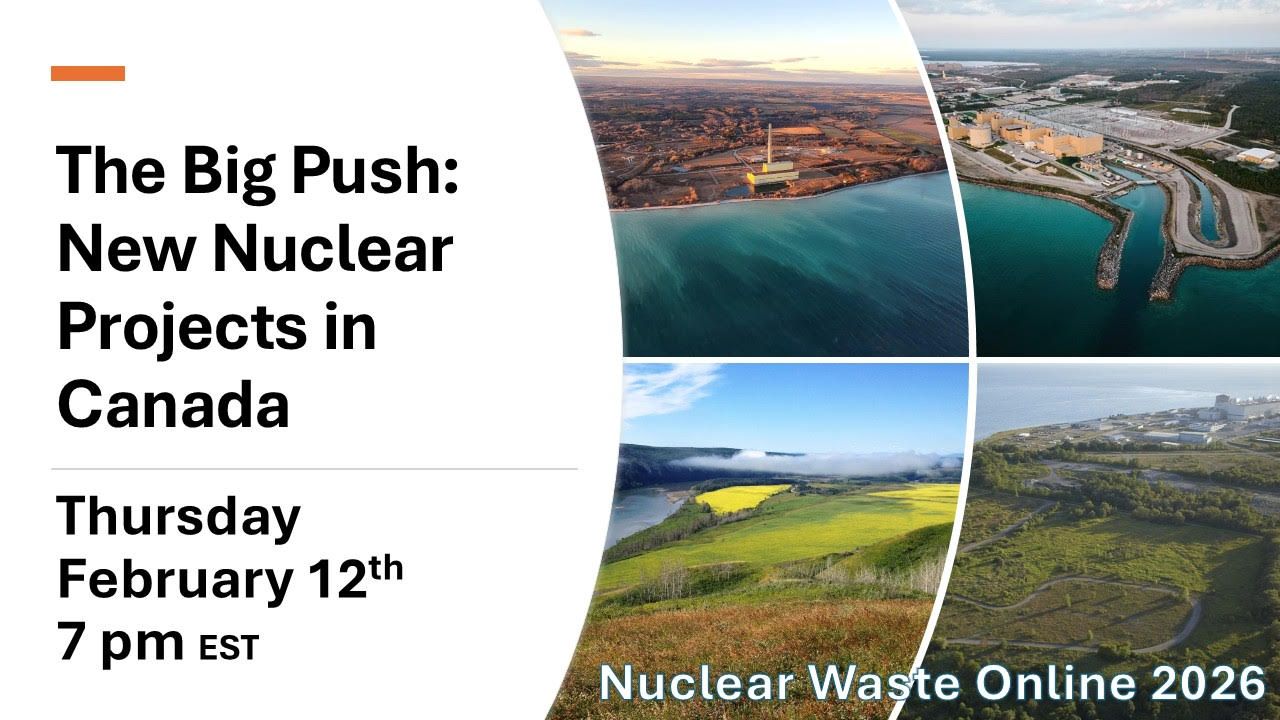
Thursday, February 12, 7 pm Eastern | 2nd of 4 sessions in the 2026 Nuclear Waste Online webinar series
Join a webinar on the push for new nuclear generation in Canada. Go to Northwatch.org to register or use the registration link https://us02web.zoom.us/webinar/register/WN_ZfWOf1GITqSRIZX8CB-A9w
-
Archives
- February 2026 (115)
- January 2026 (308)
- December 2025 (358)
- November 2025 (359)
- October 2025 (376)
- September 2025 (258)
- August 2025 (319)
- July 2025 (230)
- June 2025 (348)
- May 2025 (261)
- April 2025 (305)
- March 2025 (319)
-
Categories
- 1
- 1 NUCLEAR ISSUES
- business and costs
- climate change
- culture and arts
- ENERGY
- environment
- health
- history
- indigenous issues
- Legal
- marketing of nuclear
- media
- opposition to nuclear
- PERSONAL STORIES
- politics
- politics international
- Religion and ethics
- safety
- secrets,lies and civil liberties
- spinbuster
- technology
- Uranium
- wastes
- weapons and war
- Women
- 2 WORLD
- ACTION
- AFRICA
- Atrocities
- AUSTRALIA
- Christina's notes
- Christina's themes
- culture and arts
- Events
- Fuk 2022
- Fuk 2023
- Fukushima 2017
- Fukushima 2018
- fukushima 2019
- Fukushima 2020
- Fukushima 2021
- general
- global warming
- Humour (God we need it)
- Nuclear
- RARE EARTHS
- Reference
- resources – print
- Resources -audiovicual
- Weekly Newsletter
- World
- World Nuclear
- YouTube
-
RSS
Entries RSS
Comments RSS
 nuclear-news