Chaotic planning in South Africa: nuclear power not necessary
 Nuclear power call is based on outdated plans, warns Yelland, BD Live South Africa
BY CHARLOTTE MATHEWS, 16 SEPTEMBER 2016, SA DID not need to commission huge new inflexible nuclear power capacity because the government’s chaotic planning meant there was a big chance the country would have a surplus of electricity in the next few years, Chris Yelland, the MD of EE Publishers, said on Thursday.
“SA does not have an energy crisis, it has a management crisis,” he said.
Yelland was speaking at the launch of Powermode’s monitoring portal, shortly after Energy Minister Tina Joemat-Pettersson said a request for proposals for 9,600MW of nuclear power would be issued on September 30.
Yelland said government figures released in Parliament this week showed electricity demand since 2011 had trended significantly lower than in the low-growth scenario in the outdated 2010 Integrated Resource Plan, and its 2013 update. Flagging demand reflected slow global growth in recent years and an economy moving towards lower energy intensity.
“Government cannot forecast correctly for five years, let alone 50. If SA moves to nuclear newbuild, it is committing to one vendor for 9,600MW, based on 2010 estimates, which are clearly wrong.”………..
Members of the Energy Intensive Users Group, SA’s biggest power consumers, were installing more solar power to reduce their reliance on Eskom.
As Eskom’s market share was shrinking, its unit costs were rising, requiring ever-higher tariffs, which in turn forced more customers to become self-sufficient. Yelland said Eskom’s next application to recover costs was likely to be for a R22bn clawback, double what it was allowed in 2016.
In the past decade, Eskom’s tariffs have risen fourfold in nominal terms and were now increasing at double its historical average, adjusted for inflation.
Yelland said SA had to move away from centralised planning to a market-driven model for power-generation and create more distributed generation rather than generating most of its power on the Highveld. It needed a greater mix of different sources, not a large amount of new nuclear power. All this would provide the flexibility to meet changing demand patterns.http://www.bdlive.co.za/business/energy/2016/09/16/nuclear-power-call-is-based-on-outdated-plans-warns-yelland
South African govt says no nuclear deals made, but now there is one!
Zuma pals clinch first nuclear deal, Mail and Guardian, Jessica Bezuidenhout 16 Sep 2016 Shantan Reddy, the son of President Jacob Zuma’s friend Vivian Reddy, has clinched what appears to be a landmark deal for the country’s controversial multibillion-rand nuclear programme.
Details of the R171-million contract for “the procurement of the nuclear build programme management system” emerged after an innocuous-looking entry appeared on the department of energy’s website.
Listed under the category “awarded bids”, it is scant on detail, simply naming the winning bidder of BAC-10/2016 as Central Lake Trading 149, a company trading as Empire Technology.
The little-known company’s sole director is Shantan Reddy, the son of flamboyant power and property mogul Vivian Reddy, a longtime friend of the president.
Although there is no suggestion of wrongdoing on the part of Reddy or his company, the awarding of this contract has set off alarm bells with industry experts and politicians because the government continues to maintain that it has not entered into any nuclear deal.
The contract awarded to Reddy’s company, if indeed linked to the “nuclear build”, as stated by the energy department, suggests that work may have already begun behind the scenes.
“Considering that the minister of energy is on record stating no deal has been signed and the deputy president [has said] that South Africa will not commence on nuclear if it can’t afford it, the issuance of a contract is highly irregular,” said Gordon Mackay, the Democratic Alliance’s spokesperson on energy.
The Mail & Guardian briefly spoke to Shantan Reddy about the energy department deal. He asked for questions to be sent on SMS but did not respond by deadline….. (subscribers only) http://mg.co.za/article/2016-09-16-00-zuma-pals-clinch-first-nuclear-deal
Secret nuclear management contract given to donor to South Africa’s President Zuma
‘Predatory elite’ eye nuclear deal http://mg.co.za/article/2016-09-16-00-editorial-predatory-elite-eye-nuclear-deal The looming nuclear deal that seems to be President Jacob Zuma’s biggest pet project (and will be South Africa’s biggest financial and construction deal ever, if it happens) has been questioned by many commentators, including MPs and civil society groups. The deal, which already has links with Russia’s notoriously oligarchic government, worries anyone who can see in it the largest opportunity yet for the looting of state resources by the group currently devoting all their means to that end.
The nation was told, in the National Assembly, that all the necessary checks would be put in place and that the legal and other hurdles would be diligently cleared before the deal went ahead. The intimation was that any serious obstacles to the deal would come to light and could possibly scupper it entirely – a prospect many would welcome.
But the nation was also told, by a different minister in the other House of Parliament, that it was full steam ahead on the project – with the intimation that no objections would be allowed to stand in its way.
The first utterance came from Deputy President Cyril Ramaphosa, who seems to have been given the job of placating the objectors and the intelligentsia, or anyone concerned about the ongoing plans of what unionist Zwelinzima Vavi long ago called “the predatory elite”.
The second utterance came from Zuma’s extremely loyal energy minster, Tina Joemat-Pettersson, so it was to be expected that she would show every sign of wanting to do his bidding as soon as possible.
It has emerged that a contract worth R171-million for a “programme management system” to help get the nuclear deal off the ground has been awarded, in practical secrecy, to a company called Empire Technology. This is wholly owned by Shantan Reddy, the son of controversial businessperson Vivian Reddy, who has given Zuma considerable financial support over the years, including a contribution to the building of the president’s family complex in Nkandla.
That so little is known about the company, and that the deal appears to have gone through so quickly, is cause for concern.
Is the nuclear deal going ahead or not? Will South Africa be taking adequate precautions to ensure that it doesn’t overly indebt the nation? Was the evidence collated and presented to Zuma’s Cabinet? There are no clear answers to any of these questions.
Without a rational and sensible evaluation of the logic of the deal, and an accounting of the costs and benefits to South Africa if it goes ahead, it can’t be seen as much more than another way for the predatory elite to milk money from the state.
South Africa: Jacob Zuma’s disastrous nuclear deal
Zupta’s nuclear deal: either we end it or it ends us, Politics Web, 16 Sept 16, Jacob Zuma’s nuclear deal will be disastrous for South Africa. It will literally bankrupt us, diverting billions of rands from poverty reduction projects, while producing a nuclear white elephant in two decades’ time. But it will make a lot of money for Zuma, the Guptas and ANC cronies in the short-term and they will be long gone by the time we feel the real pain.
In Parliament last week, Energy Minister Tina Joemat-Pettersson confirmed that government is going ahead with the nuclear procurement process and Public Enterprises Minister Lynne Brown confirmed that information on the process will not be made public. In other words: “We’re going to tie you into far more debt that you can ever repay, but this is none of your business.”
This morning, a DA-assisted Mail and Guardian investigation has revealed the first concrete signs of corruption associated with the nuclear deal. A R171 million contract for the “Nuclear New Build Programme Management System” has been issued, potentially irregularly, to the son of Vivian Reddy, a close friend and ally of President Jacob Zuma.
South Africans should be deeply concerned about the government’s nuclear project. Let’s be clear. It is in no way motivated by a genuine desire to secure South Africa’s energy future in the most cost effective and sustainable way. Rather, this huge project is going ahead because Zuma, the Guptas and other ANC elites stand to make millions in bribes and tenders.
Like the Arms Deal, Nkandla and the President’s new jet, there is no intention to use state resources judiciously in order to derive the maximum public benefit. And like these ill-conceived projects, the nuclear deal will have the ultimate effect of stealing from all of us, but particularly the poor, in order to enrich a small group of connected ANC cadres……….
In forging ahead with this ill-conceived plan, our hapless government is locking SA into an over-priced, outdated technology within Eskom’s monopoly, while blocking the development of renewables which are dynamic, increasingly cost-effective and more job-creating. It is no coincidence that Eskom is refusing to sign any new contracts with independent power producers…………http://www.politicsweb.co.za/opinion/zuptas-nuclear-deal-either-we-end-it-or-it-ends-us
Nuclear power procurement costs for South Africa could cost triple the estimate
 MPs told nuclear power could cost triple the estimate http://www.timeslive.co.za/thetimes/2016/09/08/MPs-told-nuclear-power-could-cost-triple-the-estimate JAN-JAN JOUBERT | 08 September, 2016
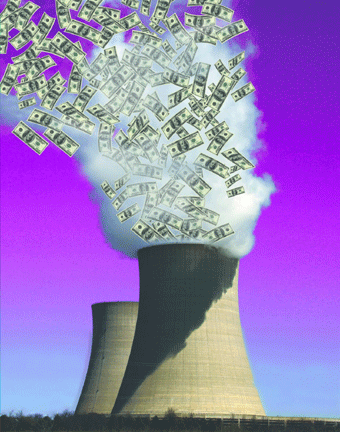
Parliament was warned yesterday that the final bill for nuclear power procurement could be three times higher than projected because of unpredictable cost escalations and the expense of decommissioning nuclear power plants.
The parliamentary budget office briefed MPs yesterday morning on the cost and other considerations of the country’s electricity generation options.
The office’s research on the costs incurred by more than 400 projects worldwide found that nuclear power generation costs exceeded the original estimates by an average of 117%, compared with 70% for hydroelectric power, 13% for thermal, including coal, 8% for wind power and 1% for solar power.
The office agreed with DA MP Gordon Mackay when he said that decommissioning added 100% to nuclear power costs. The office said the outlay for nuclear power was 67% higher than for gas and 16% more than for coal.
Mackay took the budget office to task for a lack of clarity on:
- The actual cost of the projected nuclear building programme, estimated at R600-million to R1.7-billion;
- Infrastructure construction costs not factored into projections for gas as an energy resource;
- No reference being made by the budget office to the energy preferences listed in the National Development Plan, which supposedly guided government policy;
- The budget office had not reached any conclusion on the costs to consumers of the energy options;
- The effect of each option on the country’s economic growth was not adequately estimated;
- The huge decline in South African energy demand was not sufficiently explained; and
- The decommissioning of the coal-fired power stations was not factored in.
Budget office head Mohammed Jahed said that Mackay’s objections fell outside the mandate given to his office by parliament’s appropriations committee but could be dealt with at a follow-up meeting.
Deputy President South Africa says that there is no nuclear deal!
 South Africa: No Nuclear Deal Entered Into – Deputy President . All Afric a, 8 Sep 16 Cape Town — Deputy President Cyril Ramaphosa says no nuclear deal has been entered into with any country. The Deputy President said this when responding to oral questions at the National Council of Provinces (NCOP) on Wednesday.
A Member of Parliament had asked, among other questions, whether government has entered into a nuclear deal with any country.
“Government has not entered into a nuclear deal with any country,” the Deputy President said.
The Deputy President said government remains committed to an open, fair and transparent procurement process.
Government wants to implement the programme at a scale and pace that the country can afford.
“A request for proposals for a nuclear new build programme of 9,600 MW will be released to the market during this financial year in line with the Cabinet decision taken on 9 December 2015.
“The Department of Energy is currently consulting with relevant stakeholders to finalise the documentation,” he said…….http://allafrica.com/stories/201609081107.html
South Africa’s parliamentary budget office warns on high cost of nuclear power
 Government quibbles over true cost of nuclear – but it’s going to be very expensive http://mg.co.za/article/2016-09-08-government-quibbles-over-true-cost-of-nuclear-but-its-going-to-be-very-expensive Phillip de Wet 08 Sep 2016 Any decision to proceed further with the nuclear build programme will only take place after the request for proposal process has been completed,” Deputy President Cyril Ramaphosa told the National Council of Provinces (NCOP) in Parliament during a question session on Wednesday afternoon.
Almost simultaneously, Energy Minister Tina Joemat-Pettersson told Parliament’s other house, the National Assembly: “As far as I’m concerned, a request for proposal will be issued on September 30 for the procurement process in which we have Cabinet approval to test the market on the procurement of nuclear.”
Both insisted that there is, as yet, no firm commitment to buy a fleet of nuclear power stations, which it is estimated will cost more than R1-trillion, despite long-standing signals of an obstinate political will to do so.
“Within the range of conventional technologies considered, nuclear energy is the most expensive,” the parliamentary budget office said in a report it delivered to Parliament’s standing committee on appropriations, also on Wednesday.
Its 23-page report, Electricity Generation Technology Choice: Costs and Considerations, the office said “present the key factors that need to be considered by Members of Parliament concerned with public finances in considering technology choice”. The standing committee had requested the report.
Throughout its study, the office steered scrupulously clear of recommending or denigrating any type of electricity generation. Selection of technology is complicated, it explained, and needs to take into account everything from the carbon footprint to local industrialisation.
But nuclear fares very poorly, indeed, in the office’s analysis.
Nuclear is 16% more expensive than the most expensive type of coal electricity production, the office said, drawing on figures more current than any the department of energy has released and 67% more expensive than the most costly way of using natural gas to generate power.
Eskom, which was once excluded from the nuclear preparations, has recently claimed in a series of statements by its CEO, Brian Molefe, that nuclear generation is the cheapest way for South Africa to build additional base-load capacity.
The plans that supposedly underpin the plans to build new nuclear power stations are wildly out of date, the parliamentary budget office said. The official integrated resource plan (IRP) dates from 2010 and its 2013 update does not yet have official status — because, some have speculated, it provided an insufficiently rosy picture to justify a nuclear build.
“Using an out-of-date IRP will result in a sub-optimal mix of generation plants and higher electricity prices,” the office said, with graphs showing how electricity demand declined as prices soared and the economy stalled. Even the most pessimistic integrated resource plan projection had forecast fast-growing demand.
Overbuilding generation capacity based on mistaken assumptions can be costly, the office warned gently. And past experience shows that nuclear and hydropower projects are most prone to high cost overruns and delays — and are almost impossible to adjust once ground is broken.
“It may be prudent in situations of high uncertainty to avoid very large capital investments where the repayments of loans are certain but returns from the project are uncertain and possibly volatile,” it said.
“In pursuance of a suitable energy mix, government is determined that our investment in generation capacity should be evidence-based,” Ramaphosa told the NCOP.
“astonishing and reckless” – South Africa’s Energy Minister’s statement on nuclear deal to commence soon
 News that nuclear deal will start by end-September is ‘reckless’, DA says http://www.bdlive.co.za/business/energy/2016/09/08/news-that-nuclear-deal-will-start-by-end-september-is-reckless-da-says BY LINDA ENSOR, ENERGY Minister Tina Joemat-Pettersson’s shock announcement that the first phase of the nuclear deal is to commence by the end of September was both “astonishing and reckless,” DA energy spokesperson Gordon Mackay said on Thursday.
The minister announced in the National Assembly on Wednesday that a request for proposals for the nuclear build programme would be issued on September 30. The government has decided to build nuclear plants that will generated 9,600MW.
“Not only is the proposed nuclear deal the subject of litigation in the Western Cape High Court, but the announcement will add yet further fuel to the fire that will see SA’s international credit rating go up in smoke,” Mackay said.
“Critically, the minister’s decision to commence with the first phase of the nuclear new build programme, despite the fact that not a single document with regard to the deal has ever been presented to Parliament, is a blatant abuse of power.”
Mackay said Joemat-Pettersson’s announcement came before October’s tabling of the medium-term budget statement by Finance Minister Pravin Gordhan, and represented a “blatant attempt to bully the Treasury into to coughing up the trillions of rand required to fund this unaffordable pet project of President Jacob Zuma”.
He said the DA would demand that all documentation relating to the nuclear deal be made available to Parliament’s energy committee and tabled in the National Assembly.
The DA was in possession of a parliamentary legal adviser opinion, which requires ministers to provide all necessary documentation to portfolio committees, irrespective of their so-called sensitivity.
South Africa’s Energy Minister Tina Joemat-Pettersson maintains the secrecy on nuclear power procurement plans
 Tina Joemat-Pettersson refuses to provide papers on nuclear plans, BD Live, BY LINDA ENSOR, 06 SEPTEMBER 2016, ENERGY Minister Tina Joemat-Pettersson has refused to supply the DA with a range of documents related to the government’s nuclear power procurement plans, saying they are privileged, sensitive state documents the release of which “could compromise the new build process”.
Another ground for her refusal is that the requested documents are also subject to the sub judice rule as there is litigation in the High Court in Cape Town in a case brought in October last year by Earthlife Africa and the Southern African Faith Communities’ Environment Institute against the minister and President Jacob Zuma.
The two organisations which are attempting to stop what they say is a flawed and illegal, nontransparent nuclear procurement process, have requested the same information from the government.
The minister’s refusal was contained in a written reply to a parliamentary question by DA energy spokesman Gordon Mackay, who asked for copies of the proposal for the roll-out of new nuclear power plants as signed off by her; the Integrated Nuclear Infrastructure Review by the International Atomic Energy Agency; the terms of reference for the National Nuclear Energy executive co-ordinating committee, its communication and stakeholder engagement strategy and its phased decision-making approach to implementing government’s nuclear programme; and the designation of Eskom as the owner and operator of nuclear power plants in SA……..http://www.bdlive.co.za/business/energy/2016/09/06/tina-joemat-pettersson-refuses-to-provide-papers-on-nuclear-plans
Wind and solar the cheapest way to power South Africa
Wind, solar can supply bulk of South Africa’s power at least cost, CSIR model shows, Creamer Engineering News 22nd August 2016 BY: TERENCE CREAMER , There has been much discussion in recent months about the work done by the Council for Scientific and Industrial Research Energy Centre into the role that renewable energy could play in South Africa’s future electricity mix. In an extensive interview with Engineering News Online, Dr Tobias Bischof-Niemz outlines the key findings of the research and unpacks the possible implications. The article follows:
The dramatic fall in the cost of supplying power from wind and solar photovoltaic (PV) plants has moved the global electricity supply industry beyond a critical “tipping point”, which leading energy scientist Dr Tobias Bischof-Niemz says is irreversibly altering the operating model, with significant implications for sun-drenched and wind-rich South Africa.
Instead of renewable energy playing only a modest and supportive role in the future supply mix, research conducted by the Council for Scientific and Industrial Research (CSIR) Energy Centre shows that, having the bulk of the country’s generation arising from wind and solar is not only technically feasibly, but also the lowest-cost option.
“The notion of baseload is changing,” Bischof-Niemz tells Engineering News Online. Over a relatively short period, renewables have become cost competitive with alternative new-build options in South Africa, dramatically altering the investment case.
Until the large-scale global adoption of wind and solar PV, a phenomenon that has only really taken hold over the last ten years, generation technologies were not dispatched by nature. The objective was, thus, to use the assets as often as possible in order to reduce unit costs. Under such conditions, it made sense to first build baseload, such as coal and nuclear plants, and use these as much as possible, before deploying the more expensive mid-merit plants and the peakers, which acted as the ultimate safety net.
With the large-scale adoption of renewables (in 2015 a record 120 GW of wind and solar PV were added globally, more than any other technologies combined), the model is being turned on its head, particularly as costs have fallen, making them competitive when compared with alternative new-build options in many countries, including South Africa.
CSIR Energy Centre research goes so far as to suggest that it now makes sense, for cost reasons, to favour renewables generation over traditional baseload sources, and to supply any “residual” demand using “flexible” technologies able to respond to the demand profile created when the sun sets and/or the wind stops blowing.
This has been stress tested using a simulated time-synchronous model, integrating wind and solar data from the Wind Atlas South Africa and the Solar Radiation Data respectively. The outcome is reflective of South Africa’s impressive wind and solar resource base, with a capacity factor of 35% found to be achievable anywhere in the country – far superior to the 25% actually achieved in Spain and the 20% in Germany.
“On almost 70% of suitable land area in South Africa a 35% capacity factor or higher can be achieved,” Bischof-Niemz says, noting that a key finding is that South Africa’s wind resource is far better than first assumed.
“The wind resource in South Africa is actually on par with solar, with more than 80% of the country’s land mass having enough wind potential to achieve a 30% capacity factor or more. In addition, on a portfolio level, 15-minute gradients are very low, which makes the integration of wind power into the electricity system easier compared to countries with smaller interconnected areas. On average, wind power in South Africa is available around the clock, but with higher output in the evenings and at night.”
TECHNICAL & FINANCIAL FEASIBILITY
The unit’s research has gone further, though, testing the technical feasibility of supplying a theoretical baseload of 8 GW resulting in a yearly electricity demand of 70 TWh using a mix of solar PV (6 GW) and wind (16 GW), backed up by 8 GW of flexible power, which could be natural gas, biogas, coal, pumped hydro, hydro, concentrated solar power, or demand-side interventions. In such a mix, 83% of the total electricity demand is supplied by solar PV and wind, and the flexible power generators make up the 17% residual demand. The carbon dioxide emissions of this mix per kilowatt hour are only 10% of what a coal-fired power station would emit.
The economic feasibility, meanwhile, has been tested using the 69c/kWh achieved for wind in the fourth bid window of the Renewable Energy Independent Power Producer Procurement Programme (REIPPPP) and the 87c/kWh achieved for solar. The flexible solutions to fill the gaps are assumed, “pessimistically”, to carry a cost of 200c/kWh.
Bischof-Niemz notes that 200c/kWh for flexible generation is a “worst-case” assumption, as is the assumption that any excess energy produced when solar PV and wind supply more than the assumed load is simply discarded and, thus, has no economic value.
The outcome shows that it is technically feasible for such a 30 GW mix to supply the 8 GW baseload in as reliable a manner as conventional baseload generators, while the economic analysis suggests that such a mix will deliver electricity at a blended cost of 100c/kWh. “Does it make sense to supply 8 GW baseload with an installed capacity of 30 GW? Yes, because it’s about energy, not capacity,” Bischof-Niemz avers………http://m.engineeringnews.co.za/article/wind-solar-can-supply-bulk-of-south-africas-power-at-least-cost-csir-model-shows-2016-08-22#.V8UXNQMApLs.twitter
South Africa nuclear electricity company non compliant with govt rules on advertising
Eskom may re-advertise nuclear notices after noncomplaint E Cape notice http://www.engineeringnews.co.za/article/eskom-may-re-advertise-nuclear-notices-after-noncomplaint-e-cape-notice-2016-08-26 26TH AUGUST 2016 BY: TERENCE CREAMER CREAMER MEDIA EDITOR State-owned electricity utility Eskom may re-advertise notices relating to its NuclearInstallation Site Licence (NISL) applications for Thyspunt, in the Eastern Cape, and Duynefontyn, in the Western Cape, having acknowledged that a notice published in the Eastern Cape Provincial Gazette on August 8, failed to comply with the 30-day comment period prescribed in the National Nuclear Regulator (NNR) Act.
Earlier Eskom had insisted that it had complied with the NNR’s prescribed processes, after Organisation Undoing Tax Abuse (Outa) alleged that it was attempting to side-step public participation processes by publishing notices in provincial gazettes rather than the National Gazette, which had shortened the comment deadline to below the 30 days.
In a statement released on Friday, Eskom said it published NISL notices in ten newspapers in and around the two sites on July 29, as well as in the Western Cape Provincial Gazette.
However, the notice in Eastern Cape Provincial Gazette had been published on only August 8, which meant it failed to comply with the NNR Act’s prescribed 30 days for public comment.
Outa slammed the publication of the notice in the Eastern Cape Provincial Gazette and said the shortened comment period negated the “spirit and constitutional rights for the public to participate in decisions that affect them”.
Eskom said it was in discussions with the NNR to extend the comment period for interested and affected parties and indicated that it might re-advertise the notice in the Eastern Cape Provincial Gazette, as well as in the National Gazette to give more time for public comment.
“Eskom will communicate once the NNR has given a response,” Eskom said in a statement
Critical documents missing – secrecy in South Africa’s nuclear negotiations
Joemat-Pettersson to be quizzed on missing nuclear documents, Engineering News, Creamer Media,
19TH AUGUST 2016 Energy Minister Tina Joemat-Petterssonwill be asked in Parliament next week to account for missing documents in a court case regarding the nuclear energy programme.
That is according to Democratic Alliance (DA) MP and shadow energy minister Gordon Mackay on Thursday, who sits on the energy portfolio committee in Parliament. He was responding to a claim on Thursday that government failed to disclose about ten documents in justifying its decision to enter into an intergovernmental agreement withRussia.
The claim was made by Southern African Faith Communities’ Environment Institute (Safcei) and Earthlife AfricaJohannesburg (ELA), who are challenging government in court to prove this nuclear agreement was not in fact a done deal.
Government wants to build about eight nuclear reactors to add 9.6GW of baseload energy in its drive to boost industrialisation in South Africa. However, many economists and pro-renewable energy advocates believe it is too expensive and unnecessary for South Africa, with some suggesting it would result in rating agencies downgrading the country to junk status.
“Parliamentary committees recommence next week and the DA will be asking the minister to account for the missing documents,” Mackay told Fin24.
“The DA remains deeply perturbed by the state’s lack of compliance in this case,” he said.
ELA’s Dominque Doyle said government continues to promise a fair and accountable process of nuclearprocurement, but its deeds do not live up to its promises.
“We need answers,” said Doyle. “Parliament should hold government accountable in a transparent manner.”
“Getting information out of government has been like pulling teeth,” said Safcei spokesperson Liz McDaid. “The case has been drawn out since October 2015, with government reluctant to provide the information necessary for a fair hearing.”
No nuclear deal, says minister
However, on Wednesday Joemat-Pettersson emphasised that there is no “nuclear deal”…….
Safcei and ELA said it was picked up that documents were missing while their legal team was reviewing a 700-page responding affidavit from government.
“Detailed analysis reveals the government has failed to disclose at least ten documents to which it refers when justifying its decisions to enter into a nuclear deal withRussia,” it claimed on Thursday.
On August 4, they sent the department a letter requesting the missing documents, “as they are clearly relevant to the case … and we are still awaiting a response”.
The missing documents include:
1. The proposal to cabinet that the minister signed off for the roll-out of the new nuclear power plants;
2. The Integrated Nuclear Infrastructure Review by the International Atomic Energy Agency;
3. The terms of reference for the National Nuclear EnergyExecutive Coordinating Committee;
4. The communication and stakeholder engagement strategy;
5. The phased decision making approach for implementing the nuclear programme ;
6. The designation of Eskom as the owner and operator ofnuclear power plants in South Africa;
7. The 2004 Bilateral International Agreement with the Russian Federation;
8. The May 2013 agreement between Russia and South Africasigned during the Brics summit meeting in Durban;
9. The invitation to attend vendor parade workshops sent to the Republic of Korea, the United States of America, the Russian Federation, the French Republic, the People’s Republic of China, Canada and the Kingdom of Japan; and
10. The list of topics each vendor country was requested to address relating to the invitation referred to in the previous point. http://www.engineeringnews.co.za/article/joemat-pettersson-to-be-quizzed-on-missing-nuclear-documents-2016-08-19
Drone crash into Koeberg Nuclear Power Station
 DRONE CRASHES INTO KOEBERG NUCLEAR POWER STATION http://www.htxt.co.za/2016/08/10/drone-crashes-nuclear-power-station/ An small unmanned aerial vehicle (UAV) – commonly known as drones – has crashed into the nuclear power station at Koeberg near Cape Town.
While it appears that no damage was done, South Africa’s drone regulations are clear: you are not allowed to fly drones over roads and you keep them at least 50 meters away from buildings.
According to Eskom, the drone not only flew towards and over Koeberg, but crashed into a building on site. Surprisingly, Eskom says that the drone pilot had his UAV returned to him after the incident.
“A drone crashed on the Koeberg site in contravention of the nuclear safety regulations and was returned to its owner without the investigation having been completed,” the parastatal said in a statement.
Eskom says that it has subsequently suspended the Koeberg safety officer as a precautionary measure ahead of an investigation. It also highlighted the dangers of flying drones close to government installations.
“Eskom has placed the Koeberg power station manager and the plant manager on precautionary suspension as a result of the distribution of documentation containing unauthorised facts and assumptions relating to Koeberg’s Production Plan and in particular, the steam generator replacement,” it said.
Eskom is this week facing strike action by 15 000 National Union of Mineworkers (NUM) members. In essence, it is illegal for any Eskom employees to strike, and NUM is protesting this.
“The decision to strike was taken at an urgent NUM Eskom national shop stewards council held at the NUM head office today. All 15 000 members of the NUM at Eskom will be fighting for the restoration of the right to strike at Eskom,” NUM said in a statement.
South Africa at the crossroads – clean economic renewable energy or dirty uranium nuclear industry?
WHAT LEGACY DO WE WANT FOR SOUTH AFRICA? http://safcei.org/what-legacy-do-we-want-for-south-africa/
On 6 July they announced that they would withdraw their current uranium mining application and reapply for a much smaller area – in essence only 12% of the original application – and start the process at the beginning again. This we celebrated as an important step towards stopping uranium mining in its tracks, as well as nuclear down the line.
For, as Dr Stefan Cramer, who was instrumental in lifting the veil of silence on this new threat to the Karoo, points out, uranium mining is the dirty underbelly of the nuclear industry and where it all begins.
One must stop nuclear industries in (their) tracks because it leaves future generations with an immeasurable task and legacy. The best point to start is at the source, where the whole cycle of nuclear technology begins, and that is at uranium mining. Uranium mining is very much the dirtiest part of the entire industry,” he says.
Kim Kruyshaar writes on Green Audits that choosing between renewable energy and nuclear is about much more than just an energy option. Instead it is “a choice between two divergent socio-economic opportunities and the consequent legacies.” This rings even more true when one looks at the building blocks of nuclear energy.
Uranium mining will leave us with our iconic Karoo damaged for centuries to come and many people without a future or income as the jobs gained through uranium mining would in no way compensate for those lost in the agricultural, tourism and renewable industry businesses.
Mining will also deplete the already scarce water reserves of the Karoo and present serious health problems to all living beings there, as the radioactive dust can be carried for kilometres by winds.
Renewable energy in contrast presents us with a far brighter future that, very importantly, doesn’t contain a radioactive legacy. Far more jobs are created in the renewable energy industry than the nuclear industry ever can.
The speed in which renewable energy projects can be installed and the lower investment costs also make it highly attractive to a country like South Africa, where many people need access to energy now, not in 15 years time when a nuclear reactor would only come online.
Decentralising the power from Eskom and putting it into the hands of individuals and local companies would also only serve to empower South Africans and the economy. Nuclear energy would instead indebt us and future generations to a foreign company and leave us with the further enormous cost of decommissioning.
So it’s not simply a choice between two energy options, as Kim sums it up, it is a choice about what path we would like to take South Africa down.
What is needed to stop uranium mining and nuclear for good?
- Spreading of information on uranium mining and our nuclear court case
- Education on the devastating effects of uranium mining in schools and communities
- Legal challenges to the uranium mining application
- Support of our nuclear legal challenge
- Monitoring of these processes
- Read Kim Kruyshaar’s full article: http://greenaudits.co.za/renewables-vs-nuclear-choose-a-legacy/
Read the full Fin24 article and watch Stefan talking on uranium mining:http://www.fin24.com/Economy/uranium-is-the-dirty-underbelly-of-nuclear-scientist-20160721
See Stefan’s presentation on uranium mining here: http://safcei.org/dr-cramers-presentation-of-uranium-mining-in-the-karoo/
South Africa’s nuclear company Eskom urging government to freeze renewable energy program
 Is Eskom building a case for nuclear power?, Business Day Live, BY SALIEM FAKIR JULY 28 2016, IT IS disconcerting that Eskom is advising the government to freeze a globally acclaimed renewable energy programme based on a perceived misunderstanding of the benefits of the renewable energy independent power producer (IPP) programme.
Eskom has justified its recent announcement not to sign further power purchase agreements with independent power producers with reasons that range from questions about the need for additional renewables and baseload IPPs, to improved operating performance, its large-scale new build programme, and protecting consumers from higher prices by not buying additional capacity.
Yet, the renewable energy programme is regarded as highly successful, and it delivers a wide range of benefits at the best prices given that it is a buyer’s market.
Eskom’s own 2016 financial report states that wind and solar are now cheaper than coal-generated electricity. The Treasury has stated that 92 renewable energy programme projects have attracted R193bn in private sector investment, totalling a contribution of 6,327 MW of capacity to the national grid. The total projected value of goods and services to be procured from broad-based black economic empowerment suppliers is put at more than R101bn.
Investment in renewables accounted for 85.8% of total direct foreign investment in SA in 2014. A Council for Scientific and Industrial Research report revealed that wind energy produced net savings of R1.8bn in the first half of 2015 and was also cash positive for Eskom by R300m.
The net savings can be attributed to avoiding diesel and coal fuel costs, as well as the economic costs of load shedding. Renewable energy in total generated a net benefit for the economy of up to R4bn. Renewable energy production has cut 4.4m tonnes of carbon dioxide.
At a policy level, the government has indicated that renewable energy has to be ramped up. The country’s energy vision and the National Development Plan call for a greater mix of energy sources and a greater diversity of IPPs in the energy industry, with the 2010 Integrated Resource Plan’s vision calling for 17,800 MW of renewable energy to be in place by 2030.
Internationally, SA is a signatory to the Intergovernmental Panel on Climate Change (IPCC) global climate change agreement to keep planet emissions beneath 1.5°C by honouring carbon emissions reduction targets.
Legally speaking, Eskom is a buyer of electricity, with the Department of Energy procuring capacity in line with ministerial determinations. The government’s commitment has been laudable. It is worrying that Eskom seems to wish to erode this………..
It seems Eskom is building a case for nuclear and this is the real reason behind the freeze on further renewable procurement. There is no guarantee that the proposed large nuclear new build programme will be cheap, considering that Medupi and Kusile are proving to be more expensive than some renewables. We would urge pragmatism and prudence on their part.
• Fakir is the head of the policy and futures unit with the World Wide Fund for Nature in SA. http://www.bdlive.co.za/opinion/2016/07/28/is-eskom-building-a-case-for-nuclear-power
1 This Month
Chernobyl: The Lost Tapes – A good documentary on Chernobyl on SBS available On Demand for the next 3 weeks– https://www.sbs.com.au/ondemand/tv-program/chernobyl-the-lost-tapes/2352741955560

of the week–London Campaign for Nuclear Disarmament

Tell the Ukrainian Government to Drop Prosecution of Peace Activist Yurii Sheliazhenko
To see nuclear-related stories in greater depth and intensity – go to https://nuclearinformation.wordpress.com
-
Archives
- April 2026 (114)
- March 2026 (251)
- February 2026 (268)
- January 2026 (308)
- December 2025 (358)
- November 2025 (359)
- October 2025 (376)
- September 2025 (257)
- August 2025 (319)
- July 2025 (230)
- June 2025 (348)
- May 2025 (261)
-
Categories
- 1
- 1 NUCLEAR ISSUES
- business and costs
- climate change
- culture and arts
- ENERGY
- environment
- health
- history
- indigenous issues
- Legal
- marketing of nuclear
- media
- opposition to nuclear
- PERSONAL STORIES
- politics
- politics international
- Religion and ethics
- safety
- secrets,lies and civil liberties
- spinbuster
- technology
- Uranium
- wastes
- weapons and war
- Women
- 2 WORLD
- ACTION
- AFRICA
- Atrocities
- AUSTRALIA
- Christina's notes
- Christina's themes
- culture and arts
- Events
- Fuk 2022
- Fuk 2023
- Fukushima 2017
- Fukushima 2018
- fukushima 2019
- Fukushima 2020
- Fukushima 2021
- general
- global warming
- Humour (God we need it)
- Nuclear
- RARE EARTHS
- Reference
- resources – print
- Resources -audiovicual
- Weekly Newsletter
- World
- World Nuclear
- YouTube
-
RSS
Entries RSS
Comments RSS
 nuclear-news