A judicial appeal is widely expected. But it’s unlikely that the government will succeed in overturning the essence of the judgement. And an appeals process will delay any legitimate future nuclear power procurement.
given the prevalent suspicion around the nuclear expansion, the regulator will be hard pressed to show that the nuclear option is in the public interest.
It is therefore unlikely that any nuclear development will succeed in the foreseeable future.
 HARTMUT WINKLER: Inside Zuma’s nuclear meltdown https://www.businesslive.co.za/rdm/business/2017-05-02-hartmut-winkler-how-zumas-nuclear-ambitions-have-been-blown-to-pieces/ ‘The judge was unequivocal that by slipping the Russian agreement through parliament as a routine matter for noting, the former Energy Minister Joemat-Petterssen had committed a gross error’ 02 MAY 2017 – 08:01 HARTMUT WINKLER A South African court has ruled that critical aspects of the country’s nuclear procurement process are illegal and unconstitutional. The outcome is a significant setback for a network of entities that had been aggressively promoting a 9.6 GW nuclear expansion programme in the face of popular opposition.
Over the past four weeks controversy over the proposed nuclear build has reached new highs. This was sparked by a major cabinet reshuffle in which President Jacob Zuma ousted both his finance and energy ministers, replacing them with individuals regarded as pro-nuclear.
The reshuffle prompted some of the largest and most diverse street protests since the dawn of the country’s democracy in 1994. While many factors contributed to the outpouring of public anger against the president, the nuclear question was a common motif in the protests.
Opposition to the nuclear expansion programme centred on two points: the first was its prohibitive costs – some estimates put it at R 1 trillion which is roughly equivalent to the government’s total annual tax revenue.
The second is that it has become contaminated by allegations of corruption, with evidence pointing to politically connected groups and individuals benefiting handsomely from it.
Back to the drawing boardThe court’s ruling in effect means that the planners will have to go back to the drawing board. The case in the Western Cape High Court was brought by two civil society organisations, Earthlife Africa and the Southern African Faith Communities’ Environmental Institute (SAFCEI).
The most far reaching aspects of the judgment were that it overturned ministerial proclamations made in 2013 and 2016 that enabled the development of 9.6 GW of nuclear power. It furthermore invalidated the intergovernmental nuclear collaboration agreements South Africa had signed with Russia, the US and South Korea.
The court’s ruling on the promulgations was damning and unambiguous.
South Africa’s Electricity Regulation Act requires the Minister of Energy to promulgate any energy generating capacity expansion through the National Energy Regulator of South Africa (NERSA). The regulator is required to vet the proclamation to ensure that it is in the public interest.
The Minister of Energy issued two promulgations to establish 9.6 GW of nuclear energy generation. The first one was concluded in 2013 but only made public two years later. The second one, which delegated the nuclear procurement to the state electricity utility Eskom, whose leadership is strongly pro-nuclear, was hurriedly and stealthily implemented in 2016 on the eve of the first sitting of Western Cape High Court on the matter.
Neither of these proclamations allowed a public participation process.The court ruled that both promulgations were illegal and unconstitutional. It found that the regulator had failed to carry out its mandate because it had endorsed the minister’s directives uncritically and hurriedly. In doing so it had not allowed public input nor had it considered the necessity of the nuclear build or the consequences of its delegation to Eskom.
The court was equally clear on the collaboration agreements. Unlike the relatively vague agreements concluded with the US and South Korea, the Russian agreement had a great deal more detail in it. It specifically committed South Africa to build nuclear power plants using Russian technology, set out a timeframe and placed specific liabilities on South Africa.
South Africa’s constitution stipulates that international agreements that will have a substantive impact on the country must be approved by parliament. The agreement with Russia clearly falls into this category and therefore needed to be submitted to parliament for debate and approval.
The judge was unequivocal that by slipping the Russian agreement through parliament as a routine matter for noting, the former Energy Minister Joemat-Petterssen had committed a gross error. In his judgment he said: It follows that the Minister’s decision to table the agreement in terms of section 231(3) was, at the very least, irrational. At best the minister appears to have either failed to apply her mind to the requirements of sec 231(2) in relation to the contents of the Russian IGA or at worst to have deliberately bypassed its provisions for an ulterior and unlawful purpose.This could open the door for further action against the minister as well as Zuma, who, according to the court papers, instructed her to sign the Russian agreement.
The US agreement was concluded in 1995 and the South Korean agreement in 2010. But they were only presented to parliament in 2015. The court declared them invalid in view of the inexplicable time delay.
The medium and long term impact A judicial appeal is widely expected. But it’s unlikely that the government will succeed in overturning the essence of the judgement. And an appeals process will delay any legitimate future nuclear power procurement.
Any attempt to re-initiate a nuclear build would have to start from scratch. Based on the judgement it can safely be assumed that the regulator can only endorse nuclear expansion if it can demonstrate that it’s necessary and that it’s a better solution to any other energy option.
But given the prevalent suspicion around the nuclear expansion, the regulator will be hard pressed to show that the nuclear option is in the public interest.
It is therefore unlikely that any nuclear development will succeed in the foreseeable future.
May 3, 2017
Posted by Christina Macpherson |
Legal, South Africa |
Leave a comment
New energy minister departs from nuclear script, Times Live, Linda Ensor | 02 May, 2017 Energy minister Mmamoloko Kubayi has committed her department to public participation and transparency around the nuclear procurement programme. In her first public comments since taking office‚ the minister told members of parliament’s energy portfolio committee that she did not have any problems with a call for public participation in last week’s Western Cape High Court judgment.
Judge Lee Bozalek declared that the determinations gazetted by former energy minister Tina Joemat-Pettersson were unconstitutional and unlawful because the National Energy Regulator of SA had not followed legal prescripts around public participation.
These determinations were the basis on which Eskom has proceeded with its request for information for the procurement of 9‚600MW of nuclear energy.
However‚ while supporting the need for public participation‚ the minister said she was concerned about the status of the determinations. It might be necessary to seek a declaratory order from the court or appeal the judgment……http://www.timeslive.co.za/politics/2017/05/02/New-energy-minister-departs-from-nuclear-script
May 3, 2017
Posted by Christina Macpherson |
politics, South Africa |
Leave a comment
 Government will challenge High Court’s nuclear energy ruling Business Tech, 2 may 17 Energy minister Mmamoloko Kubayi told the portfolio committee on energy on Tuesday that she would be challenging the recent High Court ruling that called the country’s nuclear procurement processes unconstitutional.
She said that the department remains committed to the nuclear energy plan, and would seek a declaratory order from the court that it can continue with its plans, or alternatively appeal the judgment.
According to Kubayi, she has not problem with the request in the judgement that more public participation take place, saying she is in favour of running an open and transparent process.
She stressed, however, that the nuclear plan couldn’t be abandoned, with nuclear energy forming an integral part of the country’s energy future, with predictability and certainty needed for investors…….
The ruling has set back South Africa’s nuclear ambitions significantly, with even appeals processes and the litigation surrounding it likely to push back the process by about a year.
According to analysts, this delay is likely to put even more pressure on president Jacob Zuma and the political sphere leading up to the ANC’s elective conference in December, as the nuclear programme is a key component in pushing certain political interests.
The appeal comes as no surprise.
“The stakes politically and geopolitically for the government, and specifically for President Zuma, are simply too high. So much has been invested in terms of political capital, including two reshuffles. We therefore fully expect the government to continue to push down this road,” said research analyst at Nomura, Peter Attard Montalto.https://businesstech.co.za/news/energy/172967/government-will-challenge-high-courts-nuclear-energy-ruling/
May 3, 2017
Posted by Christina Macpherson |
Legal, South Africa |
Leave a comment
 CSIR proposes excluding nuclear http://www.iol.co.za/business-report/energy/csir-proposes-excluding-nuclear-8920098
 2 May 2017 Johannesburg – For the latest Integrated Resource Plan for Electricity in South Africa, IRP 2016, the Council for Scientific and Industrial Research (CSIR) proposes a “Least Cost”, unconstrained scenario, or a “Decarbonised” scenario, both of which exclude nuclear power in the electricity mix to 2050.
This is the executive summary of the full submission and response by the CSIR to the Draft Integrated Resource Plan for Electricity (Draft IRP 2016) issued by the South African Department of Energy in November 2016, for comment and input from relevant stakeholders and the general public by end March 2017.
The CSIR is the national scientific and industrial research facility of South Africa, reporting to the South African Department of Science and Technology.
Click here to download the full CSIR response, study and report
Executive summary
by Jarrad G. Wright, Tobias Bischof-Niemz, Joanne Calitz, Crescent Mushwana, Robbie van Heerden and Mamahloko Senatla, CSIR
As defined in the Electricity Regulation Act, 2006; the Department of Energy (DoE), the system operator and the National Energy Regulator of South Africa (NERSA) are responsible for the development of the Integrated Resource Plan (IRP) as a plan for the electricity sector at the national level in South Africa. The IRP broadly includes input planning assumptions (on the supply and demand side), a modelling process and scenario planning following which a base plan is derived from the least-cost generation investment requirements within the electricity sector. The primary result from the IRP is the identification of the generation capacity required (per technology) and the requisite timing in the long-term based on a set of input assumptions and predefined constraints.
The most recent approved and gazetted version of the IRP is the IRP 2010-2030. The current revision of the IRP (the Draft IRP 2016) was published by the DoE for public comment in October 2016 and includes updated input assumptions including demand forecasts, existing plant performance, supply technology costs, decommissioning schedules and newly commissioned/under construction as well as preferred bidder power generators (as part of the Renewable Energy Independent Power Producer Programme (REIPPPP) and base-load coal Independent Power Producer (IPP) program). The time horizon for the draft IRP 2016 is up to the year 2050. The plan defined some preliminary results in the form of a proposed Base Case and two other selected scenarios.
As part of the IRP update process, the DoE engages in a multi-stage stakeholder engagement process (including public engagements) to ensure all affected stakeholders are consulted including national and local government, business, organised labour and civil society. This document contains the CSIR’s formal comments on the draft IRP 2016.
The CSIR determined the least cost, unconstrained electricity mix by 2050 as input into the IRP 2016 public consultation process. A conservative approach is always taken where pessimistic assumptions for new technologies and optimistic assumptions for established technologies are always made. More specifically; conventional technologies (coal, nuclear, gas CAPEX) were as per IRP 2016, stationary storage technologies (batteries) were as per IRP 2016, natural gas fuel costs were assumed slightly more expensive than IRP 2016, solar PV was aligned with original IRP 2010 cost assumptions while wind is kept constant into the future at the latest South African REIPPPP result (by 2030/2040/2050). Job numbers were also conservative (from McKinsey study commissioned by the DoE in the context of the Integrated Energy Plan (IEP)) but adjusting upwards for coal power generation
and coal mining.
The result of this is that it is least cost for any new investment in the power sector to be solar PV, wind or flexible power. Solar PV, wind and flexible power generators (e.g. gas, CSP, hydro, biogas) are the cheapest new-build mix. There is no technical limitation to solar PV and wind penetration over the planning horizon until 2050. A >70% renewable energy share by 2050 is cost optimal, replacing all plants that decommission over time and meeting new demand with the new optimal mix.
South Africa has the unique opportunity to decarbonise its electricity sector without pain. By this, the authors mean that clean and cheap are no longer trade-offs anymore. The Least Cost scenario run is the mix that is the cheapest, emits less CO2, consumes less water and creates more jobs in the electricity sector than both Draft IRP 2016 Base Case and Carbon Budget scenarios.
In this submission, deviations from Least Cost have been quantified to inform policy adjustments. Compared to the Least Cost:
The IRP 2016 Base Case is R70-billion/year more costly, emits twice as much CO2, two and a half times more water is consumed and provides 10% less jobs by 2050.
The IRP 2016 Carbon Budget scenarion is R60-billion/year more costly, emits 15% more CO2, consumes 20% more water and provides 20% less jobs by 2050.
The Decarbonised scenario is R50-billion/year more costly, 95% decarbonised, uses 30% less water and provides 5% more jobs by 2050.
Read also: #NuclearDeal: Full judgment
The Least Cost scenario is also adaptable and resilient to a range of input assumption changes relative to other scenarios and therefore more robust against unforeseen changes in demand and cost. In addition to the detailed study performed to determine the Least Cost energy mix for South Africa, this submission includes technical aspects of power system operations and planning including transmission network infrastructure requirements and system services.
The cost of ensuring system frequency stability (sufficient system inertia) has been quantified in this submission. Connecting conventional technologies (nuclear/coal/gas) via HVDC and/or solar PV/wind to the grid reduces system inertia. This reduces the inherent stabilising effect of synchronous inertia during contingency events. Many technical solutions to operate low-inertia systems are available but the CSIR assumed a worst case using state-of-the-art technology (very high costs, no further technology and/or cost advancements) nor further increase in engineering solutions to deal with low-inertia systems. In all scenarios, the worst-case cost are well below 1% of total cost of power generation by 2050 (some scenarios are much lower than 1%).
Transmission network infrastructure was costed at a high level for selected scenarios (Base Case, Carbon Budget and Least-Cost). The high-level cost estimates for shallow and deep grid connection costs for all scenarios showed that the Least Cost scenario scenario is also R20-30 billion/yr cheaper compared to the Draft IRP 2016 Base Case and Carbon Budget case on transmission network infrastructure requirements.
Click here to download the full CSIR response, study and report
May 3, 2017
Posted by Christina Macpherson |
business and costs, politics, South Africa |
Leave a comment
 Big win for little folk in nuclear plant fight
29 April 2017 Sheree Bega, Johannesburg – Fighting Eskom’s proposed nuclear reactor has given Trudi Malan a l

ot of sleepless nights. Lucky, then, that she’s an insomniac.
It’s often late when Malan, who describes herself as a “believer in the power of civil society, environmental activists (and) African penguin propagandists” pores over nuclear-related documents.
And after 13 years interrogating Eskom’s plans for the plant at Thyspunt near St Francis Bay, there’s a lot of them. So far, the 49-year-old has packed 13 arch-lever files, she says, somewhat proudly.
For Malan, who leads the Thyspunt Alliance, a grouping of organisations fighting the project, this week’s sensational ruling in the Western High Court, blocking the government’s R1 trillion nuclear programme, is a victory for the “little guy”.
Malan says organisations like hers feel a sense of solidarity with the SA Faith Communities Environment Institute (SAFCEI) and Earthlife Africa Johannesburg which took the government to court two years ago to set aside nuclear agreements with Russia.
This week, Judge Lee Bozalek with Judge Elizabeth Baartman ruled that the secret tabling of intergovernmental agreements with Russia, the US and Korea were unconstitutional and unlawful and ruled that they be set aside.
“It does feel like a David and Goliath battle. We feel vindicated. We’ve been saying all along that due process had not been followed, not just with regard to this, but with the whole process against nuclear.
“It’s continuously the small organisations which have to engage with environmental lawyers just to make sure due process is followed.
“We’re up against big money. We see Dr Kelvin Kemm (chief of the SA Nuclear Energy Corporation) slating us because we’re environmentalists, not nuclear physicists, so we’re not allowed to say anything.
“Fighting this takes money and a hell of a lot of commitment to get to the truth. You have to stick to your guns. But the victory is kind of hollow because the road ahead of us is still so long.
“Our organisations are the small voices. We’re not even a pawn on the chessboard, we’re the floor the table is standing on. The chessboard is where the big guys are playing the game.”
Dr Piet Human of the NPO Save Bantamsklip, agrees.
Bantamsklip, near Gansbaai, is another site mooted for nuclear power station roll-out.
“We’re extremely happy with the court outcome but we have to recognise it’s still part of the process, which has now been postponed for a while.
“That’s part of our strategy as activists to cause friction and slow down processes. That’s what we did during apartheid – getting the state in court all the time. They’re little obstacles because we’re little people.
“The longer we can postpone their commitment to nuclear, the better. The world is changing. Everyone is pushing for renewable energy, and nuclear will vanish.”
Bantamsklip is the smallest of six floral kingdoms but boasts more than 9 200 species of fynbos. There are 22 Red Data listed species on the property.
“Our coastline is unique. This is a beautiful place and now you want to plonk down a big nuclear power station that could take 45 years to build. It will create havoc environmentally, socially and economically.
“The judgment shows people’s voices do matter. It just becomes unbearable for the government, that’s why they choose these remote places and that’s why it’s important for us to make a big noise.
“We’re like little birds that plump themselves up to make themselves look bigger.”
Makoma Lekalakala of Earthlife Africa Johannesburg says the court victory is part of a much bigger battle, while Liz McDaid, SAFCEI spokesperson, says the organisations “experienced delays and dirty tricks, but we persevered and now we have been vindicated”.
For Malan, the fight centres on saving “the heritage of the first nation – the Khoisan”.
“This is the coastal cradle of humankind and should not be used for nuclear development.
“One of the two judges in this case was Judge Baartman, and it’s very apt considering we’re in the Sarah Baartman municipality. Maybe there is some justice along the way.”
May 1, 2017
Posted by Christina Macpherson |
opposition to nuclear, South Africa |
Leave a comment
 Eskom confirms that Russians will continue nuclear bid, IOL, 30 April 2017, SIYABONGA MKHWANAZI
Cape Town – The Russians will continue to prepare to bid for the nuclear-build programme, despite the decision by the Western Cape High Court to halt it.
Eskom confirmed this and awaits further directives from the government.
Friday was the deadline for all bidding companies to submit Request for Information documentation to Eskom.The court decision has also affected the deadline for the issuing of the Request for Proposals in June.
Head of Rosatom in Southern Africa, Viktor Polikarpov, told Independent Media nothing had changed with their plans to bid for the nuclear programme.
He said they would not want to comment on the case because it was a matter involving government and civil society, who took the matter to court.
Energy Minister Mmamoloko Kubayi has said she is still studying the judgment, and would not comment on whether to appeal against the court decision or not.
Kubayi will appear before MPs on Tuesday, where she will face questions on the nuclear programme.
Polikarpov said the nuclear process was not in their hands, but in the hands of the government.“We are prepared on the bidding, but much will depend on the government, how it will sort out the court issue,” he said.
Eskom spokesperson Khulu Phasiwe said the court decision had effectively nullified the process……..
He said it was clear that everything had to be nullified and started from scratch if the government still wanted to continue with the nuclear programme.
The judgment found the process followed was unlawful and unconstitutional………http://www.iol.co.za/news/politics/eskom-confirms-that-russians-will-continue-nuclear-bid-8877208
May 1, 2017
Posted by Christina Macpherson |
marketing, Russia, South Africa |
Leave a comment
Ndungane warns that the government will not give up after nuclear deal ruling, Business Day, 28 APRIL 2017 Anglican archbishop emeritus Njongonkulu Ndungane expressed his “profound relief” at Wednesday’s High Court ruling on the nuclear deal, but warned that he expected Eskom and the government to “fight tooth and nail” to have it overturned.
Ndungane commended Earthlife Africa, the Southern African Faith Communities’ Environment Institute (Safcei), and other civil society organisations that have been in the forefront of opposing the deal for several years.
“This is a salutary lesson. Civil society in SA has doggedly persevered in doing what it believes is right in respect of the nuclear deal.
“That they have been vindicated by the high court is a triumph of David against mighty Goliath. Government and Eskom should know that we do not intend to be brow beaten into submission,” the archbishop said.
However, he said he fully expected the government and Eskom to appeal against the ruling, since the small cabal of people led by the President in whose interests the nuclear deal appeared to have been negotiated, were unlikely to simply give up.
In addition, the various departments and state-owned enterprises involved would not want to see their expenditure to date being written off as “fruitless and wasteful expenditure”.
Ndungane expressed his deep concern that the South African government, which had been elected by the people to act for the people, was failing in its duty to protect the interests of the poorest people…….
He asked South Africans, when next they are called to exercise their ballot, to vote for a government that will act in the full interests of all the people of the land, and not just a select few.
“I have said previously that this nuclear deal will cripple the country’s economy. Our current debt stands at R1.89-trillion. When we borrow money to pay for the nuclear deal, our country will owe R3-trillion. Anyone with the most basic ability to balance a budget can see that increasing one’s debt by more than half is financial suicide,” the archbishop said. He asked South Africans, when next they are called to exercise their ballot, to vote for a government that will act in the full interests of all the people of the land, and not just a select few.
“I have said previously that this nuclear deal will cripple the country’s economy. Our current debt stands at R1.89-trillion. When we borrow money to pay for the nuclear deal, our country will owe R3-trillion. Anyone with the most basic ability to balance a budget can see that increasing one’s debt by more than half is financial suicide,” the archbishop said. https://www.businesslive.co.za/bd/national/2017-04-28-ndungane-warns-that-the-government-will-not-give-up-after-nuclear-deal-ruling/
April 29, 2017
Posted by Christina Macpherson |
Religion and ethics, South Africa |
Leave a comment
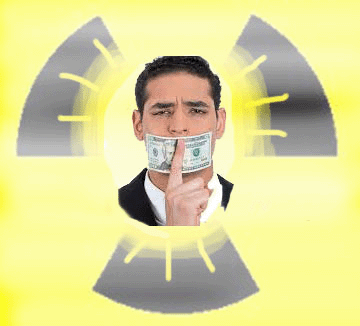 Eskom funding may be muffling dissenting voices on nuclear amaBhungane Centre for Investigative Journalism, 28 Apr 17, The lure of millions in Eskom funding appears to have gagged two research institutions previously critical of the utility’s nuclear procurement plans. The lure of millions in Eskom funding appears to have muzzled two research institutions previously highly critical of the state-owned utility’s plans to procure a fleet of nuclear power stations.
In the case of the Council for Scientific and Industrial Research (CSIR) amaBhungane understands that the CSIR’s Energy Centre has been effectively gagged since a secrecy-shrouded meeting in March this year between acting Eskom CEO Matshela Koko and his counterpart at the CSIR, Dr Thulani Dlamini.
In the other case, the Centre for Renewable and Sustainable Energy Studies (CRSES) at Stellenbosch University withdrew comments it had submitted for publication that were highly critical of Eskom’s nuclear plans.
In an email seen by amaBhungane, CRSES director Wikus van Niekerk said: “We receive significant funding from Eskom, some from a programme where Matshela is personally involved in, and I need to be careful how I react in public not to put this at risk.”……..
Case 1: CSIR Energy Centre
Several industry insiders, who asked not to be named, raised the alarm after the CSIR Energy Centre’s head, Dr Tobias Bischof-Niemz, suddenly pulled out of an event on South Africa’s future energy supply in early April.
They told amaBhungane that a strong rumour had emerged that at Koko’s March meeting with the CSIR chief executive, Eskom had pledged a significant sum – R100 million was mentioned – for CSIR research on technology related to nuclear energy.
AmaBhungane was unable to independently verify the claim.
While there is no evidence of any untoward quid-pro-quo, the same sources noted that the Energy Centre has withdrawn from other public engagements on renewable energy and South Africa’s future energy mix.
Adding to suspicions is the reluctance of both Eskom and the CSIR to disclose any detail of the meeting between Koko and Dr Dlamini.
Both institutions declined to answer questions about who attended the meeting, what was discussed and whether Koko offered the CSIR additional funding, as rumoured……..
Eskom spokesperson Khulu Phasiwe said Eskom had R30.8 million worth of “multi-year collaborative projects” underway with CSIR and another R17.5 million worth were “actively under consideration”.
The CSIR insisted the organisation “did NOT receive any payments from Eskom in order to stop any research that we are conducting,” but ignored questions about Bischof-Niemz’s non-attendance at the April event where he was scheduled to give a presentation on renewable energy.
Up to now the Energy Centre has been vocal about its research on South Africa’s optimal energy mix, which suggested that the price of renewables had dropped to the point where government’s plan to procure 9,600 MW of nuclear power did not make financial sense.
…….
Case No 2: CRSES Stellenbosch
The CSIR is not the only research institution that Eskom channels money to. The Centre for Renewable and Sustainable Energy Studies (CRSES) at Stellenbosch University is another, and it too seems wary of upsetting Eskom.
Email correspondence seen by amaBhungane suggests that the independent research institute is willing to self-censor for fear of offending its funder.
The correspondence between CRSES director Wikus van Niekerk and the staff of Energize magazine – an energy sector trade publication – concerns a submission written by Van Niekerk that is strongly critical of Eskom’s nuclear plans.
After submitting the draft to the editors, Van Niekerk then refused to have it published as a standalone piece. In the correspondence Van Niekerk writes that “We [CRSES] receive significant funding from Eskom, some from a programme where Matshela [Koko] is personally involved in, and I need to be careful how I react in public not to put this at risk.”
According to Eskom, CRSES received R2.6 million in 2016 from Eskom’s Power Plant Engineering Institute, with planned funding for this year projected at around R4 million. CRSES receives additional funding from Eskom’s Research, Testing and Development business unit for R2.5 million photovoltaic penetration study……..
Joemat-Pettersson had previously ordered Eskom to sign the outstanding agreements by 11 April. However, under Mmamoloko Kubayi, who replaced Joemat-Pettersson after Jacob Zuma’s Cabinet reshuffle, the deadline passed without agreements being signed.
Talk of the nuclear deal has revved up since Zuma’s highly controversial reshuffle, which many see as an attempt by the president to remove ministers – particularly at Treasury and the Department of Energy – seen as obstacles to a future deal.
The DoE under Kubayi asked that signing of power purchase agreements be delayed until she could meet with public enterprises minister Lynne Brown on the matter.
Meanwhile the investments of 37 independent power producers, worth approximately R58 billion, remain plagued by uncertainty.http://amabhungane.co.za/article/2017-04-28-exclusive-eskom-funding-may-be-muffling-dissenting-voices-on-nuclear
April 29, 2017
Posted by Christina Macpherson |
investigative journalism, secrets,lies and civil liberties, South Africa |
1 Comment
South Africa’s nuclear deals unlawful, court rules http://www.bbc.com/news/world-africa-39717401 26
April 2017 A South African court has annulled initial agreements the government reached with three countries to help it build nuclear power stations.
April 28, 2017
Posted by Christina Macpherson |
Legal, South Africa |
2 Comments
 Back to square one for Eskom as judge sets nuclear decisions aside https://www.businesslive.co.za/bd/national/2017-04-26-court-rules-on-nuclear-plans-and-it-is-not-good-news-for-eskom/ LINDA ENSOR In a major reversal for Eskom’s nuclear plans the Western Cape High Court has set aside the two determinations issued by former minister Tina Joemat-Pettersson which lay the basis for the nuclear procurement.
It is back to square one for the utility as the court found that the determinations relating to the construction of 9,600MW of nuclear plants were unconstitutional and invalid.
It also declared the nuclear co-operation agreement signed between the South African and Russian governments to be unconstitutional and unlawful. This agreement is widely seen as laying the foundation for the involvement of Russian energy giant Rosatom in the South African nuclear build programme.
The first determination which was set aside was issued under section 34 of the Electricity Regulation Act and ruled that 9,600MW was required and should be acquired by the Department of Energy. It was signed in November 2013 by then energy minister Ben Martins but gazetted only in December 2015. The second determination was signed in December 2016 by Joemat-Petterson and identified Eskom as the procurer of new nuclear energy.
The determinations were approved by the National Energy Regulator of SA but the court found that the regulator’s concurrence with them was procedurally unfair, irrational and in breach of the National Energy Regulator Act as there was no public participation.
Judge Lee Bozalek, with the concurrence of Judge Elizabeth Baartman, also found that the request for information issued by Eskom in December last year was unlawful and unconstitutional and it was set aside.
The request for information, which closes at the end of this month, would form the basis for a request for proposal and for the procurement of 9,600MW of nuclear energy.
In a written judgment handed down Wednesday Judge Bozalek declared that the manner in which Joemat-Pettersson had tabled the nuclear co-operation agreements with the US, Russia and South Korea in Parliament was unconstitutional and unlawful, and set aside them aside.
The nature of the agreements meant they had to be tabled in terms of section 231 (2) of the Constitution, which requires the approval of both houses of Parliament, and not section 231 (3), as the minister irrationally decided to do, the judge said. Tabling in terms of Section 231 (3) does not require parliamentary endorsement.
There were joyous scenes outside the court after the judgment was handed down in the case, which was brought by Earthlife Africa and the Southern African Faith Communties’ Environment Institute against the Minister of Energy, President Jacob Zuma, the National Energy Regulator of SA, speaker of the National Assembly Baleka Mbete, chairperson of the National Council of Provinces Thandi Modise and Eskom.
Spokespersons for the two organisations said the judgment would ensure there was proper oversight by Parliament and the people in the process of procuring of nuclear energy, which would have to be undertaken in an open and transparent process.
The two NGOs argued there had been no proper public participation or consultation process over the determinations, which were “irrational and unreasonable”. The government rejected these arguments on the ground that these determinations amounted to “executive policy”.
Judge Bozalek, however, said the determinations – which would have far-reaching consequences for the country – were not merely administrative decisions, and a “rational and fair decision-making process” was required before Nersa decided whether or not to concur with the minister’s proposed determination.
The National Energy Regulator Act required that decisions that materially and adversely affected the rights of others had to be procedurally fair. The regulator decided to concur with the 2016 ministerial determination by means of a round-robin exercise a mere three days after being asked to do so by Joemat-Pettersson.
“In taking the decision Nersa was under a statutory duty to act in the public interest and in a justifiable and transparent manner but also to utilise a procedurally fair process giving affected persons the opportunity to submit their views and present relevant facts and evidence. These requirements were clearly not met by Nersa in taking its far-reaching decision to concur in the minister’s section 34 determination,” Judge Bozalek said.
He also ruled the two-year delay in gazetting the 2013 determination breached the minister’s decision, “thus rendering it irrational and unlawful”. The delay also violated the requirements of open, transparent and accountable government. The minister should have consulted with Nersa again in 2015 before gazetting the determination.
Red flag
The government’s nuclear plans have been red-flagged by credit ratings agencies, which downgraded SA to junk status.
President Jacob Zuma has been determined to proceed with the nuclear build programme, despite critics saying it is not necessary and beyond the means of a fiscally constrained government. His stance led to the removal of Joemat-Pettersson as energy minister and her replacement by Zuma supporter Mmamoloko Kubayi in the recent Cabinet reshuffle that also removed Pravin Gordhan as finance minister.
The draft 2016 Integrated Resource Plan (IRP) says SA will not need new nuclear power plants before 2037, but until it is finalised, Eskom has been operating on the basis of the 2010 IRP, which proposes the construction of 9,600MW in nuclear plants.
In December, the power utility issued a request for information, which closes on April 28, and by the end of June it planned to issue a request for binding proposals from potential vendors, provided it obtained the approvals to do so.
April 28, 2017
Posted by Christina Macpherson |
Legal, South Africa |
Leave a comment
Eskom admits trying to dodge procurement procedures for nuclear deal, Business Tech By Staff WriterApril 21, 2017 State power utility, Eskom, says that earlier reports made by the Democratic Alliance about trying to dodge correct procedures for nuclear procurement are partially true, but stressed that it is only looking for exemption from certain areas of the process.
Earlier this week, the DA alleged that Eskom had made a direct application to the National Treasury chief procurement officer, Schalk Human, asking to be exempted from the prescribed procurement procedures for the new nuclear power acquisition.
The party stated that this was done in an apparent bid to accelerate the nuclear new build programme, “in a move that would mean that the country’s biggest ever procurement deal would not be subject to due diligence and correct procedures”……….
As indicated in the original report by the DA, it appears that the political party will fight the rushed process.
DA shadow minister of energy, Gordon Mackay, said that the exemption is ‘significant’ and would mean Eskom is embarking on the country’s single biggest public procurement – without fully assessing associated risks and consequences for South Africa’s economy.
“All state entities are bound by specific procurement standards and requirements. These processes are vital to ensure the effective, efficient and transparent acquisition of goods and services by the State and its entities. If procurement standards cannot be met – procurement should not commence,” Mackay said.
“The DA is strongly opposed to the nuclear deal and will continue to pursue all avenues to scrutinise every process involved and to ultimately put a stop to a deal that will enslave future generations of South Africans.”https://businesstech.co.za/news/energy/171505/eskom-admits-trying-to-dodge-procurement-procedures-for-nuclear-deal/
April 22, 2017
Posted by Christina Macpherson |
politics, South Africa |
Leave a comment
The applications are for exemptions from the rules governing government procurement as set out in the Public Finance Management Act.
Eskom chief nuclear officer, Dave Nicholls, told Business Day that much of the work on the nuclear procurement had been done before the promulgation of the regulations over the last year.
He reportedly said Eskom wanted Treasury to assure it that the work already done would be seen as compliant with regulations, to avoid having to start the process from scratch.
He said there was nothing untoward with the applications.
“We believe the work that has already been done is adequate and is equivalent to what Treasury is asking for,” he told the paper.
DA energy spokesman Gordan Mackay told Business Day the party objected to any “unacceptable” attempts to rush through the procurement process.
April 22, 2017
Posted by Christina Macpherson |
Legal, South Africa |
Leave a comment
The resolution takes forward multilateral negotiations on complete nuclear disarmament.
States started negotiations on nuclear disarmament in 1946, a year after the atom bombs were dropped on Japan. But the talks faltered as the Cold War warmed up.
Fearing that the spread of nuclear weapons would make those states that had them even more reluctant to give them up, the Treaty on the Non-Proliferation of Nuclear Weapons was negotiated and entered into force in 1970.
The treaty was the first building bloc on the road to a world without nuclear weapons. It prevented states that didn’t have nuclear weapons before 1968 from acquiring them. And it prohibited states that had nuclear weapons from providing other states with them.
The non-proliferation obligation of the treaty has been exceptionally successful. Nuclear weapons have spread to only four other states since its inception. Today there are nine states with nuclear weapons: the original five, namely the US, Russia, the UK, France and China. The other nuclear armed states are India, Pakistan, Israel and North Korea. They are not members of the nonproliferation treaty.
The non-proliferation obligation of the treaty should be seen in the context of Article VI of that treaty, requiring all its members – including the five original nuclear weapon states – to negotiate in good faith general and complete disarmament of nuclear weapons, in other words, to negotiate a world without nuclear weapons.
This is the disarmament obligation of the treaty. Unfortunately, it stated no deadline for these negotiations. This legal loophole has been used by the nuclear weapon states to delay giving up their arsenals.
In fact, the treaty is disingenuously interpreted to suggest that the five original nuclear weapon states should be allowed to have these weapons, but not any other states. Continue reading →
April 12, 2017
Posted by Christina Macpherson |
2 WORLD, Reference, South Africa, weapons and war |
Leave a comment
 Rigorous review process needed for SA nuclear deal http://www.iol.co.za/news/opinion/rigorous-review-process-needed-for-sa-nuclear-deal-8625269 | 11 April 2017 New Finance Minister Malusi Gigaba has the rubber stamp of approval out that Pravin Gordhan kept locked away, writes Lauren Hermanus.
The day before Ahmed Kathrada passed, on 27 March, now ex-Finance Minister Pravin Gordhan was recalled from an investor roadshow. In shock, we all asked ‘why?’ Our president knew the answer but he wasn’t in a talking mood. After Gordhan’s axing the rand took a dive and so did our nerves. Overnight the nuclear expansion programme and the South Africa-Russia procurement deal that’s been looming since 2013 became an imminent reality.
It took the debutant Minister of Finance Malusi Gigaba only hours to declare that the energy system has stabilised in South Africa and that it was time to unite to stimulate “investment, create new jobs, increase productivity and raise incomes”. Perhaps he got his notes from Eskom CEO Matshela Koko, who claimed just a few months ago, “The successful execution of the new nuclear build programme will not only fuel GDP growth, but could alleviate levels of unemployment in SA.”
In keeping with the vacuous tone of pro-nuclear discourse to date, these statements lack supporting evidence and analysis. How will it boost unemployment? How many jobs will it deliver? How does this compare with jobs in renewables and what are the relative returns on investment and payback periods?
During a recent press conference in Pretoria, Minister Gigaba said that no formal decision has yet been taken, but nuclear-based energy generation would be implemented to ‘diversify our energy mix’ based on ‘what the country can afford’ and that the process would be managed at a pace and scale our fiscus can handle.
Okay Minister, but take into consideration that our fiscus is already struggling to handle housing, social grants, higher education and public health. It has not yet handled water management infrastructure upgrading (just to make it real for the middle class), and if it can handle nuclear, we certainly have not been told how, and over what time period.
Gigaba has the rubber stamp of approval out that Gordhan kept locked away. And this is a problem, because the numbers we saw from the government-sponsored CSIR are very worrying and indicate that we should be investing in renewables instead.
What is Gigaba’s plan?
Conservative estimates put the cost of nuclear construction at $50 billion. Given the scale of the 9,600MW nuclear programme, it would be wise to draw on our experience with other large-scale energy infrastructure investments to learn some valuable lessons and check our assumptions. The almost 4,800MW coal-fired Medupi has fallen behind schedule, and while estimated at R69.1 billion in 2007, stood at R195 billion in June of 2016. So, what happens when the nuclear deal, large as it is, goes even a little off course, which nuclear builds typically do? How will we pay for that? What is Gigaba’s plan?
If the nuclear deal goes ahead, the much-beleaguered Eskom will conduct the procurement process and secure the necessary finance. It bears repeating that a loan by Eskom ultimately falls to the public purse to pay. Eskom, already weighed down in debt and scrambling to pull in payments from defaulting municipal clients, cannot afford to fail. National Treasury will not let it, as its success is critical to the survival of our economy. A bad bet on nuclear is a bad bet on our behalf, and when the need for fiscal triage arises, we will pay for it through increasing electricity prices, and tax funds diverted from other urgent priorities. Additionally, the integrity of Eskom’s procurement processes was called into question in the State of Capture Report. We should reasonably require that no massive procurement is undertaken before the extent of financial mismanagement is publically determined and transparently addressed.
The need for nuclear is the most fundamental concern
Any energy investments made must be deemed absolutely necessary before adding to Eskom’s indebtedness and our national debt. The 2010 Integrated Resource Plan (IRP) that Gigaba used to justify nuclear was replaced by a 2013 update that called for only around a third of the nuclear capacity of its predecessor. Now, four years later, it is unclear that we need any nuclear at all.
2013, we will recall, was also the year that, against the Department of Energy’s (DoE) official position, a nuclear transaction was first designed and taken into talks with Russian service providers the following year.
While Cabinet pushes for nuclear, local governments pull in a different direction. Municipalities like Nelson Mandela Bay (well before they went DA) and the City of Cape Town have identified renewables as engines of local economic development, inclusive of local manufacturing opportunities, the holy grail of our industrial policy. In fact, many municipalities are pursuing localised renewable energy, which is at odds with a national nuclear expansion strategy. Mayor Patricia de Lille announced earlier this year that she would take the Minister of Energy to court over the right to buy energy directly from REIPPPP power producers without having to go through Eskom.
It will not be the only court case requiring the attention of the recently appointed Minister of Energy, Mmamoloko “Nkhensani” Kubayi. The nuclear deal is already the subject of a Cape High Court case, for allegedly failing to meet the standards of parliamentary review and public participation required for an investment of this scale.
Reframing the debate
The bare facts of the nuclear deal have been obscured by political rhetoric and false opposites. There is now an urgent need to unearth points of common concern between actors that may have very different views on how our energy sector should be structured.
Something must be said that has not often been said. You do not need to believe that REIPPPP (South Africa’s Renewable Energy IPP Procurement Programme) is the future of the South African energy sector to oppose this deal. REIPPPP is one possible tool. But you can equally argue for an Eskom-led renewable energy strategy, building on their already growing portfolio of wind and solar investments. You could argue for further municipalisation of the energy sector, for localised, small-scale energy generation and the use of residential and commercial microgrids. I happen to be pro a combination of all of the above, aimed primarily at keeping energy affordable and accessible for all.
This nuclear deal must be opposed because it makes no economic sense. It appears to benefit private interests against the public good, it may bankrupt the country over the coming decades and it will likely leave us with an overcapitalised energy sector. Moreover, like Gigaba said, our energy system is stable for now, and there is no reason to rush on nuclear. Let’s talk numbers and put this investment through the appropriate rigorous parliamentary and public review processes of our hard-won democracy.
Being opposed to the nuclear deal does not make you a racist, a classist, anti-ANC, pro-DA, pro-EFF, pro-privatisation or anti-transformation. It is a valid, evidence-based position that can be held by a range of different actors, some terrible and some not so terrible. Consensus building to create coherent policy and strategy in a pluralistic and contested political space is the point and prize of democracy.
Minister, give us, the people of South Africa, policy, finance and energy experts, NERSA, Eskom, Municipalities, the DOE and all interested parties, the chance to flex our democratic muscle and apply our minds, and through contest and collaboration we will develop a national energy plan so thorough as to eclipse the draft 2016 IRP and support the economic development of our beloved country with our best knowledge, experience and collective intelligence.
* Lauren Hermanus is a sustainable development specialist and Strategic Director of the Massive Small Collective, focused on urban resilience, energy innovation and equity.
April 12, 2017
Posted by Christina Macpherson |
politics, South Africa |
Leave a comment
 Eskom: SA has not signed nuclear deal http://northglennews.co.za/106808/eskom-sa-not-signed-nuclear-deal/ The power utility has not received any formal proposals from potential supplier SOUTH Africa has not signed any nuclear deal, Eskom recently said. Responding to last week’s media reports alleging that a nuclear deal has been signed, Eskom reiterated the remarks made by National Treasury that no deal has been signed.
“Eskom expects to issue a full Request for Proposal (RFP) to the open market once the Request for Information (RFI) has been assessed and the relevant approvals have been obtained,” said Eskom Chief Nuclear Officer, Dave Nicholls.
Nicholls said the power utility has not received any formal proposals from potential suppliers and has not signed any power plant procurement agreements.
“Eskom has not undertaken any pre-qualification assessment to date related to the potential respondents to a potential RFP,” he said.
South Africa plans to introduce 9 600 megawatts of nuclear energy to the grid in the next decade.
“The funding model of the project will be determined by the response received from the markets once bidders have responded to the RFP. This will also be done at a pace and scale that government can afford,” said the department.
April 12, 2017
Posted by Christina Macpherson |
politics, South Africa |
Leave a comment

 CSIR proposes excluding nuclear http://www.iol.co.za/business-report/energy/csir-proposes-excluding-nuclear-8920098 2 May 2017 Johannesburg – For the latest Integrated Resource Plan for Electricity in South Africa, IRP 2016, the Council for Scientific and Industrial Research (CSIR) proposes a “Least Cost”, unconstrained scenario, or a “Decarbonised” scenario, both of which exclude nuclear power in the electricity mix to 2050.







 nuclear-news