SA utility educates youth on nuclear ESI Africa, 6 Oct 17

Eskom has recently launched its first school’s nuclear debate programme in Port Elizabeth in the Eastern Cape Province.
The School Nuclear Debate initiative is part of Eskom’s five-year Schools Adoption & Skills Development programme……….“Eskom aims to create awareness about the most important aspects of nuclear power, to bring facts to the fore and to debate, correct myths, fears and misconceptions that may exist regarding nuclear power.”
October 7, 2017
Posted by Christina Macpherson |
Education, South Africa |
Leave a comment

 The truth about nuclear power in SA https://www.iol.co.za/sunday-tribune/news/the-truth-about-nuclear-power-in-sa-11245644 17 SEPTEMBER 2017, NABEELAH SHAIKH, nabeelah.shaikh@inl.co.za, DURBAN: Two international anti-nuclear activists visited Durban on Saturday to educate the community on the harmful effects of nuclear energy. They highlighted why South Africans must continue to oppose its proliferation in our country.
Russian activist Vladimir Slivyak and American activist Chris Williams claim African countries are “easy targets” for nuclear reactor companies who have wanted to sell the idea of nuclear energy, as more Western countries oppose it.
Slivyak, a member of the Russian environmental organisation Ecodefense, has been an environmental and energy activist since 1989. Williams, a long time sustainable energy policy activist, is currently the Vermont USA organiser for the Citizens Awareness Network.
These activists have already been to Joburg and Port Elizabeth where they visited rural communities near a proposed nuclear site to educate them about what nuclear energy was and what it would mean for them if it were introduced.
In Durban yesterday, Slivyak and Williams spoke at an event at St Paul’s Church. Recently Earthlife Africa Johannesburg and the Southern African Faith Communities’ Environment Institute challenged the government’s nuclear deals with Russia, the US and South Korea.
In April, judgment was delivered in the Cape Town High Court and these deals were set aside and declared unlawful and unconstitutional. In a press briefing yesterday morning Slivyak and Williams emphasised the need for South Africa to distance itself from nuclear energy and said renewable energy was the way of the future.
“South Africa has enough sun as well as wind. There are other alternatives like solar and wind energy which is now becoming the way of the future. When these international nuclear companies try to sell you the idea of nuclear energy, they don’t tell you that in the long run, it’s actually going to cost you a whole lot more than you expect,” said Williams.
He said the financial markets internationally were also moving away from nuclear energy to renewable energy because it was cost effective and the safer alternative.
In Germany, they’ve already taken a decision to close 23 nuclear reactor plants in the next five to six years. They’ve made a commitment to source all their power through sustainable energy and other countries should follow in this path. We are here to spread the word in terms of what’s happening on the international front and countries can make informed decisions based on this,” said Slivyak.
Earthlife Africa Durban, who hosted the anti-nuclear activists, said it was concerned that the South African government still planned to pursue the nuclear deal.
“It is at the heart of the state capture and the cabinet reshuffle. If it goes ahead the R1 trillion deal will bankrupt the country. It is a risky and dangerous source of power as witnessed by the many nuclear disasters, most notably Fukushima in Japan”.
“Earthlife Africa Durban and the South Durban Community Environmental Alliance supports a renewable energy future and an end to coal and nuclear power stations. We call on the people of South Africa to oppose the government’s shady nuclear deals and to support a safe, clean and green future with renewable energy,” said Earthlife Durban spokeswoman, Alice Thompson.
September 18, 2017
Posted by Christina Macpherson |
opposition to nuclear, South Africa |
Leave a comment
SA could start nuclear procurement process again as soon as next month
The chairperson of the Necsa, speaking at the World Nuclear Association conference in London, says the politicians just have ‘to press the re-start button’ Business Live 15 SEPTEMBER 2017 ALEXANDER WINNING LONDON —SA could re-start a procurement process for its nuclear expansion project as soon as next month, but the government still has to determine the exact timing, the chairperson of the South African Nuclear Energy Corporation (Necsa) said on Friday.
SA is planning to build several new nuclear reactors with a combined capacity of 9,600MW, which could be one of the world’s biggest nuclear deals in decades. The plans aim to help resolve the country’s chronic power shortages.
The plans were disrupted this year when SA’s High Court ruled that a nuclear co-operation pact with Russia was unlawful, after which the government started to draw up new pacts with countries with nuclear expertise. South African officials have made progress on the nuclear project since the court ruling, selecting potential sites for the new power stations, Necsa chairperson, Kelvin Kemm told Reuters.
Speaking on the sidelines of the World Nuclear Association conference in London, he said Eskom and Necsa were ready to proceed. “All that needs to happen is for the politicians to press the re-start button.”…….
Nuclear reactor makers, including Russia’s Rosatom, South Korea’s Kepco, France’s EDF and Areva, Toshiba-owned Westinghouse and China’s CGN are eyeing the South African project, which could be worth tens of billions of dollars.
A senior executive from Russian state firm Rosatom told Reuters on Thursday his firm was keen to win the contract and was ready to use a business model suitable to SA…….
Zuma’s opponents have said the project could be used as a conduit for corruption, a charge the president and officials deny. Some investors say the project is too big and expensive for a developing economy, such as SA.
Kemm said all top nuclear reactor makers were still in the running for the project and that he hoped a firm contract with a foreign partner would be signed next year. SA aimed to achieve 50% local input to the project to lift the economy, he said, adding that ordering several plants at once should help bring down costs. https://www.businesslive.co.za/bd/national/2017-09-15-sa-could-start-nuclear-procurement-process-again-as-soon-as-next-month/
September 16, 2017
Posted by Christina Macpherson |
marketing, South Africa |
Leave a comment
Time for the energy sector to self-correct. EE, August 15th, 2017, by Prof. Hartmut Winkler, University of Johannesburg, May and June 2017 will go down as two of the most dreadful months in the history of the South African power utility Eskom. Its credibility in the eyes of the public has reached rock bottom after a series of well-publicised scandals.
Following the suspension of the then acting Eskom CEO, Matshela Koko, over a large contract allegedly benefitting his step-daughter, the nation was stunned by the reinstatement of the former CEO, Brian Molefe, who had previously left the utility under a cloud. The saga also forced the power utility to face the wrath of the parliamentary portfolio committee on Public Enterprises.
Highly damaging revelations followed from leaked emails, corroborating the findings of the Public Protector that Eskom’s leadership had allegedly irregularly assisted the Gupta family’s Oakbay Investments in securing the Optimum mine and the associated coal supply contract. The emails apparently also highlighted indefensibly close links between the Guptas and specific Eskom board members and executives. To top it off, the R4-billion Duvha boiler replacement was inexplicably awarded to a Chinese company, at a much higher cost than proposed by its competitors.
The scale of these alleged transgressions and the initial unwillingness or inability of government to deal with these matters has generated the impression that there are other agendas at play. It suggests that, like many other state-linked entities, Eskom has been taken over by persons furthering individual interests at the expense of the national good, a phenomenon now referred to as state capture.
This further raises the suspicion that the brazen taking of sides in the rollout of new generating capacity is also driven by other motives. Koko and Molefe have been outspokenly pro-nuclear and have blocked the long outstanding conclusion of power purchase agreements with successful bidders under the Renewable Energy Independent Power Producers Procurement Programme (REIPPPP). The power utility appears to have also promoted the distorted narrative that renewables are chiefly responsible for job losses at Mpumalanga coal mines.
The latest REIPPPP projects offer vastly reduced power purchase tariffs compared to the early rounds. Most renewables are now clearly cheaper than the cost of new coal and nuclear. Therefore Eskom’s opposition to REIPPPP on affordability grounds sounds decidedly hollow. The perception has therefore been created that Eskom is part of an effort to sabotage the renewable energy sector, which is the nuclear industry’s chief competitor in South Africa’s future energy landscape……..
While at this stage not directly compromised in the manner of Eskom, the nuclear industry too is in need of deep introspection. The sector has failed to condemn the irregularities and presidential interference in the nuclear procurement process to date, which saw Russian developer Rosatom allegedly placed in a dominant position over its competitors.
The Western Cape High Court ruling that the Russian nuclear agreement is invalid is viewed in some quarters as merely a speed hump rather than a call to return to the drawing board. NECSA board chair Kelvin Kemm’s defiant pronouncement in Moscow that the nuclear deal will be finalised before year end, probably to Rosatom’s advantage, is the worst thing the nuclear sector could do right now. Whatever the intention, such sabre rattling will merely harden the opposition from a public seemingly skeptical of all things nuclear.
There are respected people working in the nuclear field who genuinely believe that nuclear technology has a role in the future South African energy mix. These nuclear advocates have to now recognise that rehabilitating their sector requires the rebuilding of public trust, and honest attempts to allay concerns about costs, safety and potential corruption associated with new builds.
The renewable energy sector has been riding high on the back of positive international sentiment and the successful implementation of projects from the first three REIPPPP phases. That ride is however about to get much bumpier as the sector runs into opposition from unions and government.
While this opposition is to some degree based on misinformation, possibly planted deliberately, the renewable industry also needs to re-evaluate its tactics. Green hype and crude PR are no longer going to cut it, and current and past mistakes are about to be exploited ruthlessly. As with nuclear, sober engagement and diplomacy are now crucial to take the renewable energy sector forward to its rightful place in South Africa’s energy landscape. Send your comments to energize@ee.co.za http://www.ee.co.za/article/time-energy-sector-self-correct.html
September 1, 2017
Posted by Christina Macpherson |
secrets,lies and civil liberties, South Africa |
Leave a comment
 [LISTEN] ‘NUCLEAR DOCS FUEL PUBLIC PERCEPTION OF DODGY DEALS’ http://ewn.co.za/2017/08/24/listen-nuclear-docs-fuel-public-perception-of-dodgy-deals Radio 702 | Energy expert Chris Yelland says that the latest documents linked to the nuclear industry are deepening public suspicion about dubious dealings in the procurement process.
JOHANNESBURG – Energy expert Chris Yelland says the latest documents linked to the nuclear industry are deepening public suspicion about dubious dealings in the procurement process.
The Auditor-General (AG) apparently found key nuclear-related contracts entered into by the Department of Energy are irregular and unauthorised, according to the Democratic Alliance.
Radio 702’s Bongani Bingwa speaks to Yelland about an alleged report yet to be finalised by the AG, this is according to the DA energy spokesperson Gordan McKay.
For more information listen to the audio
August 25, 2017
Posted by Christina Macpherson |
secrets,lies and civil liberties, South Africa |
Leave a comment
 Nuclear and Coal Lobbies Threaten to Scupper Renewables in South Africa, http://energypost.eu/nuclear-and-coal-lobbies-threaten-to-scupper-renewables-in-south-africa/ August 17, 2017 by Hartmut Winkler, South African power utility Eskom recently repeated that it will not conclude supply contracts with the developers of new renewable energy power stations. These developers were selected under a programme to facilitate private sector involvement in the building of medium-sized renewable energy power stations.
The programme has won plaudits for its success in facilitating the establishment of multiple solar and wind farms in record time. But Eskom is once again stalling.
The power utility’s stand threatens the viability of the entire renewable energy sector in the country. It’s hostility also defies logic given that the whole world is embracing renewable energy as key to a clean energy future and combating climate change.
So what lies behind the opposition?
The answer lies in the fact that two powerful lobbies are at work in South Africa. One is pro-coal, the other pro-nuclear. This has made the success of the renewable energy projects a target for attacks from interested parties in both. Disrupting the renewable energy sector would ensure that the coal sector remains dominant. And that, over time, it is gradually displaced by nuclear.
Eskom has pointed to the oversupply of electricity as the reason for its objection. But elsewhere it has trumpeted the need for more nuclear power. It can’t have it both ways
The lobby groups attached to coal and nuclear appear to have had powerful allies on the state utility’s board. There is mounting evidence that they have been furthering the interests of a group linked to the Gupta family. It in turn has been accused of capturing state entities to further its own ends, as well as those of President Jacob Zuma, his family and allies.
It has also been widely argued that the massively expensive proposed nuclear build is being driven by the same interest groups.
The battle over renewables is therefore closely linked to a wider political confrontation over control of key aspects of the South African economy.
Eskom’s flawed argument
The renewables dispute centres on the state utility’s refusal to endorse 1121 MW of new renewable energy. This translates to about 1% of Eskom’s current generated electricity, given that renewable energy supply is intermittent. This additional renewable energy would make up 5% of the total renewable energy generating capacity projected by 2030.
Eskom accepts the need to expand its generating potential in the long term. The additional contribution from renewables is well within its broader expansion targets. And tariffs on the energy from renewable sources would be almost half of the estimated cost of new coal and new nuclear power.
Until two years ago Eskom was seen as a neutral player committed to effectively provide electric power in the best interests of the country. But that all changed in 2015 after Brian Molefe was appointed CEO
The Public Enterprises Minister Lynne Brown has been disingenuous in citing cost as a reason to stop the last phase of renewables. The higher costs she recently quoted were presumably those associated with the first round of renewable energy projects. These contracts were concluded in 2012 and prices for renewables have come down considerably since.
For its part Eskom has pointed to the oversupply of electricity as the reason for its objection. But elsewhere it has trumpeted the need for more nuclear power. It can’t have it both ways.
Powerful forces at play
Until two years ago Eskom was seen as a neutral player committed to effectively provide electric power in the best interests of the country. It threw its weight behind previous power procurement plans.
But that all changed in 2015 after Brian Molefe was appointed CEO.
Molefe and his successor Matshela Koko are both linked to the controversial Gupta family. Their names featured in the Public Protector’s State of Capture report as well as in a bulk leak of emails which implicated the Guptas and other leading figures in the state capture network.
Molefe and Koko played a pivotal role in helping the Guptas purchase a coal mine – the Optimum mine – and to secure a lucrative coal supply contract with Eskom. Both are also strongly pro-nuclear. They have also gone on record to argue that renewable energy is too expensive.
Eskom has furthermore listed renewables as the reason for planning to shut down four coal power plants. In reality, these old plants had already been destined for closure in anticipation of the imminent additional power supply expected from two new coal plants – Medupi and Kusile.
Ultimately South Africa won’t be able to buck international trends. That means that, in the longer term, the future of renewables in South Africa remains bright
It’s suspicious that one of the power stations facing closure, Hendrina, is supplied by coal from the Optimum mine. The effect of stalling renewable power expansion could force the extension of Hendrina’s life span.
Brown is in the process of restructuring the Eskom board after Molefe departed, Koko was suspended and the chairperson of the board resigned. Although there are signs that the minister is aware that she has been misled by the Eskom board on other matters, she doesn’t seem to believe this is true when it comes to renewables, repeating recently the view that it’s too expensive.
Brown’s counterpart in the energy portfolio, Nkhensani Kubayi, has displayed little sympathy for the renewable energy sector, also making far-fetched and easily disprovable claims that the initial solar and wind power stations have resulted in zero jobs. Renewable energy is in fact estimated to eventually generate over 100 000 jobs in South Africa.
Kubayi has also shown that she’s highly receptive to the nuclear lobby. Visiting a nuclear industry fair in Russia in the middle of June she expressed concern that the judicial disqualification of the existing nuclear cooperation agreement damaged relations with that country.
It has been convincingly argued that South Africa can’t afford the nuclear option in the current economic environment.
The immediate future
The global ascendancy of renewables and their particular pertinence in South African climatic conditions may even make coal and nuclear energy technologies obsolete in the distant future. Ultimately South Africa won’t be able to buck international trends. That means that, in the longer term, the future of renewables in South Africa remains bright.
August 18, 2017
Posted by Christina Macpherson |
politics, South Africa |
Leave a comment
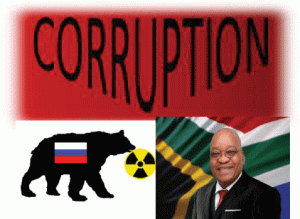 Energy minister investigates R80m in irregularities in nuclear contract https://www.timeslive.co.za/politics/2017-08-10-exclusive-energy-minister-investigates-r80-million-in-irregularities-in-nuclear-contract/?platform=hootsuite BY JAN-JAN JOUBERT Energy Minister Mmamoloko Kubayi has launched an investigation into several senior officials in her department for alleged nuclear tender irregularities amounting to R80-million.
Kubayi’s office has confirmed that it is probing the possible violation of National Treasury regulations when the department awarded an R80-million contract to a nuclear transactional adviser‚ Mahlaka-A-Phalala (M-A-P).
“There are still investigations going on the matters raised in your questions and therefore we are unable to respond as it will jeopardise and weaken the case‚” said a short statement from Kubayi’s office in response to 29 questions posed by TimesLIVE.
The minister can expect heavy questioning on the matter from DA MP Gordon Mackay when she appears before Parliament’s portfolio committee on energy on Tuesday.
Mackay said this was further evidence why the government nuclear procurement was “captured”.
“The nuclear deal is a prime example of state capture. The DA will demand from committee chairperson Fikile Majola that the energy portfolio committee tackle this matter with extreme urgency when we reconvene next month‚ and question the investment.
“We will also demand to know why deputy director-general [Zizamele] Mbambo remains in his post‚ and will propose an ad hoc committee to get to the bottom of this mess‚” said Mackay.
According to documents TimesLIVE has seen‚ energy director-general Thabane Zulu‚ his deputy Zizamele Mbambo‚ procurement specialist Ndaba Ngwane‚ and chief financial officer Yvonne Chetty have signed a deviation request to sign off the deal.
Zulu has since been moved to head the Strategic Energy Fund while Ndaba has quietly exited the department.
Mbambo remains in his position despite awarding the contract‚ which a leaked document shows amounts to R80-million. The scandal started at the end of August last year‚ when one of the consulting firms in the nuclear build programme‚ M-A-P – against which no allegations are made – compiled a report finding that the department was not ready to issue a request for proposal for the intended nuclear new build programme‚ estimated to be worth R1-trillion.
On September 22‚ Mbambo and Ngwane asked Chetty and Zulu to approve a deviation from normal procurement processes‚ in practice allowing M-A-P to continue work on the development of a transactional adviser.
The next day‚ Chetty and Zulu agreed to the deviation‚ which Chetty warned was subject to the buy-in of the National Treasury and the office of the attorney-general.
However‚ Mbambo and Ngwane merely told M-A-P to continue with a second phase of the contract‚ the cost of which would grow by R80-million to R100-million by March despite the required governance processes allegedly not having been followed.
On September 27‚ then minister of energy Tina Joemat-Pettersson suspended all payments related to the transactional adviser to M-A-P until the department had submitted a verification report to her on all deliverables received.
According to sources close to the events‚ this decision was never communicated to M-A-P as a service provider.
Instead‚ Mbambo‚ Zulu and Ngwane continued to engage M-A-P and received work deliverables towards the procurement process without a contract and without all regulations being followed. Among the serious allegations that TimesLIVE put to the Department of Energy over the past 10 days is that M-A-P was not subjected to a competitive bid process.
Instead‚ section 16 (a) 6.6 of the Public Finance Management Act was used – despite warnings by the relevant tender committee that this was wrong – to keep paying M-A-P.
This was done despite the law only allowing for the cost of the project to be extended by 15% without an open tender process.
At the beginning of March‚ M-A-P‚ which remained ignorant of Joemat-Pettersson’s instruction to stop payments‚ went to see her about payments outstanding‚ adding R60-million to the initial R20-million contract.
M-A-P also revealed to Joemat-Pettersson that it had a copy of the deviation request approved by Chetty and Zulu as given to it by Mbambo and Ndaba‚ despite the strict rules regarding the leaking of internal documents.
The whole matter came to a climax on March 16 when the departmental tender committee met and reviewed M-A-P’s bills.
Mbambo was in hot water and held to account as the meeting continued on March 22.
During the meeting‚ it came to light that Mbambo had already on September 1 given verbal instruction to M-A-P to extend its contract by a further R80-million to R100-million.
In the end‚ the Department of Energy shifted funds from the sundries account and paid M-A-P R56-million of the additional R80-million by the end of the financial year (March 31).
Zulu said only the department could comment. Numerous efforts to contact Mbambo for comment failed last week‚ and Ngwane could not be tracked down.
August 11, 2017
Posted by Christina Macpherson |
secrets,lies and civil liberties, South Africa |
Leave a comment
 ROSATOM SAYS IT HAS PLANS TO DEVELOP NUCLEAR CLUSTER IN SA http://ewn.co.za/2017/06/19/rosatom-says-it-has-plans-to-develop-nuclear-cluster-in-
 sa In April, the Western Cape High Court ruled that government’s decision to call for proposals for the procurement of 9.6 gigawatts of nuclear energy was unlawful and unconstitutional.Tara Penny JOHANNESBURG – Russia’s Rosatom has confirmed it is in contact with South African authorities on plans concerning the civilian use of nuclear energy.
The CEO of Rosatom’s foreign unit, Anastasia Zoteyeva made the comment while answering questions on the sidelines of a conference in Moscow on Monday morning.
She also told reporters that the Russian state nuclear corporation is proposing to develop a whole nuclear cluster in South Africa.
In April, the Western Cape High Court ruled that government’s decision to call for proposals for the procurement of 9.6 gigawatts of nuclear energy was unlawful and unconstitutional.
Earthlife Africa, which brought the case, said the judgment vindicates its argument that the process government has followed was unlawful because it failed to consult the public about its decision.
The case was first brought in October 2015, when Earthlife Africa Johannesburg and the Southern African Faith Communities’ Environment Institute argued that former Energy Minister Tina Joemat-Pettersen had not consulted the public nor Parliament before deciding to procure 9.6 gigawatts of nuclear power.
The judgment meant all deals that government had pursued with Russia and the United States were not valid.
July 22, 2017
Posted by Christina Macpherson |
marketing, politics international, Russia, South Africa |
Leave a comment
 Nuclear energy development under the spotlight http://bereamail.co.za/114003/nuclear-energy-development-under-the-spotlight/, 1 July 17
“The money planned to build the power stations can be used to improve our ailing education system.” THE jury is still out on why a country like South Africa, rated number five on the world as best suitable for renewable energy, would want to build eight new nuclear power stations at cost of R1 trillion.
Should the 9,600MW of nuclear capacity project go ahead, it could be one of the world’s biggest nuclear contracts in decades. The South African Faith Communities Environmental Institute (SAFCEI) and the South Durban Community Environmental Alliance (SADCEA) held a Nuclear Court Case Feedback workshop, at Diakonia on Friday, following their landmark victory at the Western Cape High Court, which saw government’s notorious nuclear deal agreements with Russia, the United States and South Korea set aside and declared unlawful and unconstitutional.
According to Lydia Mogano, who is Safcei’s regional coordinator, a nuclear energy development in South Africa will have negative socio-economic and environmental implications on ordinary citizens.
“Electricity tariffs are already high, with residents paying close to R1.50 per unit, but with nuclear energy they will pay R1.80 and above, making it even more difficult for them survive. Even the government’s own research done by the CSIR, shows that we do not need nuclear at all and renewable energy will be much cheaper. Nuclear energy demand is on the decline across the world, it takes 10 to 15 years to build a nuclear power station. Research done by CSIR shows that solar provides 70 percent of energy globally,” Mogano said.
Despite critics saying the country does not have the money, necessary skills to procure, build, operate, maintain and regulate six new nuclear power stations, Presient Jacob Zuma, addressing Parliament last month, said government still intended to pursue the acquisition of nuclear power stations at a “pace and scale” that the country could afford. He further added that building nuclear power stations would “bring dividends and profits for many thousands of years to come.”
However, Mogano said funds planned to build the power stations could be used to improve our ailing education system, the backlog of houses millions of people still needed houses and improvements could be made to the country’s water and sanitation systems.
Legal representative for Safcei and Earthlife, Adrian Pole, who was also in attendance said: “Transparency in the nuclear procurement process, including access to cost estimates and feasibility studies, has been at the heart of this case. Public participation without that kind of information being made available would render it, in itself, unfair.”
Environmental activist Desmond D’sa said should the nuclear energy development not go ahead, the R240 million that has already been spent on two years of research needs to be accounted for. According to industry executives, regulators and scientists with proper management, vigilance and safety enhancements, a nuclear power plants lifespan is 40-70 years and the decommission costs the same amount as when you build it.
July 21, 2017
Posted by Christina Macpherson |
Legal, politics, South Africa |
Leave a comment
Anti-nuclear groups will do ‘everything possible’ to stop government’s plans, https://www.businesslive.co.za/bd/national/2017-07-18-anti-nuclear-groups-will-do-8216everything-possible8217-to-stop-government8217s-plans/ 18 JULY 2017 – 17:19 BEKEZELA PHAKATHI Anti-nuclear lobby groups say they will do all that is possible, including turning to the courts and mass protests, to stop the government’s nuclear plans.
On Tuesday, groups belonging to #StopCorruptNuclearSA spent 67 minutes as part of Mandela Day, occupying bridges on highways in Cape Town to protest government’s ongoing pursuit of nuclear power, which they say represents SA’s “most urgent threat”.
Last month, President Jacob Zuma said in Parliament that the government was still intent on pursuing the nuclear new-build programme at a pace and scale the country could afford. He said the nuclear programme remained firmly part of the energy mix SA was pursuing to ensure energy security. The mix includes hydro, solar, coal, wind and gas.
Kate Davies, one of the founding members of the Southern African Faith Communities’ Environment Institute (SAFCEI) which forms part of the anti-nuclear lobby, told Business Day that the groups would do everything to stop government from continuing with the nuclear programme. “We firmly believe that it is a great mistake for our country to pursue nuclear. We simply cannot afford it … We are also hearing that Eskom is already bankrupt … hopefully, sense will prevail. We are waiting and watching, and we remind civil society to be vigilant,” said Davies.
She said the secret nature of the programme meant it was open to corruption at a scale worse than the arms deal and that the government should rather focus on renewables, which have been proven to be cheaper and safer than nuclear. Furthermore, she said, demand for electricity was decreasing as consumers find smarter ways to use power and the current consumption patterns meant the country did not need nuclear.
Vainola Makan, from Right2Know Campaign, which is also part of the anti-nuclear lobby, said: “Citizens face a major issue with government at the moment, in that our government continues to purposefully exclude South Africans from important decisions.”
The High Court in Cape Town recently set aside the two determinations issued by former energy minister, Tina Joemat-Pettersson, that laid the basis for the nuclear procurement. It found that the determinations relating to the construction of nuclear plants with a capacity of 9,600MW were unconstitutional and invalid.
The court also declared the nuclear co-operation agreement between the South African and Russian governments to be unconstitutional and unlawful. The case was brought against the government by Earthlife Africa and SAFCEI.
Following the ruling, Energy Minister Mmamoloko Kubayi said the government was reviewing its nuclear agreements with many countries.
Last month, Zuma said it was important to note that the High Court found fault with the process followed, especially in tabling the intergovernmental agreements in preparation for the nuclear new-build programme. The judgment, said Zuma, did not deal with substantive matters pertaining to the country’s future energy programmes.
July 18, 2017
Posted by Christina Macpherson |
opposition to nuclear, South Africa |
Leave a comment
 Global Meltdown? Nuclear Power’s Annus Horribilis, Jim Green, New Matilda, 9 July 2017 https://newmatilda.com/2017/07/09/global-meltdown-nuclear-powers-annus-horribilis/
This year will go down with 1979 (Three Mile Island), 1986 (Chernobyl) and 2011 (Fukushima) as one of the nuclear industry’s worst ever ‒ and there’s still another six months to go, writes Dr Jim Green.
Two of the industry’s worst-ever years have been in the past decade and there will be many more bad years ahead as the trickle of closures of ageing reactors becomes a flood ‒ the International Energy Agency expects almost 200 reactor closures between 2014 and 2040. The likelihood of reactor start-ups matching closures over that time period has become vanishingly small.
In January, the World Nuclear Association anticipated 18 power reactor start-ups this year. The projection has been revised down to 14 and even that seems more than a stretch. There has only been one reactor start-up in the first half of the year according to the IAEA’s Power Reactor Information System, and two permanent reactor closures.
The number of power reactors under construction is on a downward trajectory ‒ 59 reactors are under construction as of May 2017, the first time since 2010 that the number has fallen below 60.
Pro-nuclear journalist Fred Pearce wrote on May 15: “Is the nuclear power industry in its death throes? Even some nuclear enthusiasts believe so. With the exception of China, most nations are moving away from nuclear ‒ existing power plants across the United States are being shut early; new reactor designs are falling foul of regulators, and public support remains in free fall. Now come the bankruptcies…. The industry is in crisis. It looks ever more like a 20th century industrial dinosaur, unloved by investors, the public, and policymakers alike. The crisis could prove terminal.”
Pro-nuclear lobby groups are warning about nuclear power’s “rapidly accelerating crisis“, a “crisis that threatens the death of nuclear energy in the West“, and noting that “the industry is on life support in the United States and other developed economies“.
United States
The most dramatic story this year has been the bankruptcy protection filing of US nuclear giant Westinghouse onMarch 29. Westinghouse’s parent company Toshiba states that there is “substantial doubt” about Toshiba’s “ability to continue as a going concern”. These nuclear industry giants have been brought to their knees by cost overruns ‒estimated at US$13 billion ‒ building four AP1000 power reactors in the U.S.
The nuclear debate in the US is firmly centred on attempts to extend the lifespan of ageing, uneconomic reactors with state bailouts. Financial bailouts by state governments in New York and Illinois are propping up ageing reactors, but a proposed bailout in Ohio is meeting stiff opposition. The fate of Westinghouse and its partially-built AP1000 reactors are much discussed, but there is no further discussion about new reactors ‒ other than to note that they won’t happen.
Six reactors have been shut down over the past five years in the US, and another handful will likely close in the next five years. How far and fast will nuclear fall? Exelon ‒ the leading nuclear power plant operator in the US ‒ claims that “economic and policy challenges threaten to close about half of America’s reactors” in the next two decades. According to pro-nuclear lobby group ‘Environmental Progress‘, almost one-quarter of US reactors are at high risk of closure by 2030, and almost three-quarters are at medium to high risk. In May, the US Energy Information Administration released an analysis projecting nuclear’s share of the nation’s electricity generating capacity will drop from 20 per cent to 11 per cent by 2050.
There are different views about how far and fast nuclear will fall in the US ‒ but fall it will. And there is no dispute that many plants are losing money. More than half in fact, racking up losses totalling about US$2.9 billion a year according to a recent analysis by Bloomberg New Energy Finance. And a separate Bloomberg report found that expanding state aid to money-losing reactors across the eastern US may leave consumers on the hook for as much as US$3.9 billion a year in higher power bills.
Japan
Fukushima clean-up and compensation cost estimates have doubled and doubled again and now stand at US$191 billion. An analysis by the Japan Institute for Economic Research estimates that the total costs for decommissioning, decontamination and compensation could be far higher at US$443‒620 billion.
Only five reactors are operating in Japan as of July 2017, compared to 54 before the March 2011 Fukushima disaster. The prospects for new reactors are bleak. Japan has given up on its Monju fast breeder reactor ‒ successive governments wasted US$10.6 billion on Monju and decommissioning will cost another US$2.7 billion.
As mentioned, Toshiba is facing an existential crisis due to the crippling debts of its subsidiary Westinghouse. Toshibaannounced on May 15 that it expects to report a consolidated net loss of US$8.4 billion for the 2016‒2017 financial year which ended March 31.
Hitachi is backing away from its plan to build two Advanced Boiling Water Reactors in Wylfa, Wales. Hitachi recentlysaid that if it cannot attract partners to invest in the project before construction is due to start in 2019, the project will be suspended.
Hitachi recently booked a massive loss on a failed investment in laser uranium enrichment technology in the US. A 12 May 2017 statement said the company had posted an impairment loss on affiliated companies’ common stock of US$1.66 billion for the fiscal year ended 31 March 2017, and “the major factor” was Hitachi’s exit from the laser enrichment project. Last year a commentator opined that “the way to make a small fortune in the uranium enrichment business in the US is to start with a large one.”
France
The French nuclear industry is in its “worst situation ever” according to former EDF director Gérard Magnin. France has 58 operable reactors and just one under construction.
French EPR reactors under construction in France and Finland are three times over budget ‒ the combined cost overruns for the two reactors amount to about US$14.5 billion.
Bloomberg noted in April 2015 that Areva’s EPR export ambitions are “in tatters“. Now Areva itself is in tatters and is in the process of a government-led restructure and another taxpayer-funded bailout. On March 1, Areva posted a €665 million net loss for 2016. Losses in the preceding five years exceeded €10 billion.
In February, EDF released its financial figures for 2016: earnings and income fell and EDF’s debt remained steady at €37.4 billion. EDF plans to sell €10 billion of assets by 2020 to rein in its debt, and to sack up to 7,000 staff. The French government provided EDF with €3 billion in extra capital in 2016 and will contribute €3 billion towards a €4 billioncapital raising this year. On March 8, shares in EDF hit an all-time low a day after the €4 billion capital raising was launched; the share price fell to €7.78, less than one-tenth of the high a decade ago.
Costs of between €50 billion and €100 billion will need to be spent by 2030 to meet new safety requirements for reactors in France and to extend their operating lives beyond 40 years.
EDF has set aside €23 billion to cover reactor decommissioning and waste management costs in France ‒ just over half of the €54 billion that EDF estimates will be required. A recent report by the French National Assembly’s Commission for Sustainable Development and Regional Development concluded that there is “obvious under-provisioning” and that decommissioning and waste management will take longer, be more challenging and cost much more than EDF anticipates.
In 2015, concerns about the integrity of some EPR pressure vessels were revealed, prompting investigations that are still ongoing. Last year, the scandal was magnified when the French Nuclear Safety Authority (ASN) announced that Areva had informed it of “irregularities in components produced at its Creusot Forge plant.” The problems concern documents attesting to the quality of parts manufactured at the site. At least 400 of the 10,000 quality documents reviewed by Areva contained anomalies. Work at the Creusot Forge foundry was suspended in the wake of the scandal and Areva is awaiting ASN approval to restart the foundry.
French environment and energy minister Nicolas Hulot said on June 12 that the government plans to close some nuclear reactors to reduce nuclear’s share of the country’s power mix. “We are going to close some nuclear reactors and it won’t be just a symbolic move,” he said.
India
Nuclear power accounts for just 3.4 percent of electricity supply in India and that figure will not rise significantly, if at all. In May, India’s Cabinet approved a plan to build 10 indigenous pressurized heavy water reactors (PHWR). That decision can be read as an acknowledgement that plans for six Westinghouse AP1000 reactors and six French EPR reactors are unlikely to eventuate.
The plan for 10 new PHWRs faces major challenges. Suvrat Raju and M.V. Ramana noted: “[N]uclear power will continue to be an expensive and relatively minor source of electricity for the foreseeable future…. The announcement about building 10 PHWRs fits a pattern, often seen with the current government, where it trumpets a routine decision to bolster its “bold” credentials. Most of the plants that were recently approved have been in the pipeline for years. Nevertheless, there is good reason to be sceptical of these plans given that similar plans to build large numbers of reactors have failed to meet their targets, often falling far short.”
South Africa
An extraordinary High Court judgement on April 26 ruled that much of South Africa’s nuclear new-build program is without legal foundation. The High Court set aside the Ministerial determination that South Africa required 9.6 gigawatts (GW) of new nuclear capacity, and found that numerous bilateral nuclear cooperation agreements were unconstitutional and unlawful. President Jacob Zuma is trying to revive the nuclear program, but it will most likely be shelved when Zuma leaves office in 2019 (if he isn’t removed earlier). Energy Minister Mmamoloko Kubayi said on June 21 that South Africa will review its nuclear plans as part of its response to economic recession.
South Korea
South Korea’s new President Moon Jae-in said on June 19 that his government will halt plans to build new nuclear power plants and will not extend the lifespan of existing plants beyond 40 years. President Moon said: “We will completely re-examine the existing policies on nuclear power. We will scrap the nuclear-centred polices and move toward a nuclear-free era. We will eliminate all plans to build new nuclear plants.”
Since the presidential election on May 9, the ageing Kori-1 reactor has been permanently shut down, work on two partially-built reactors (Shin Kori 5 and 6) has been suspended pending a review, and work on two planned reactors (Shin-Hanul 3 and 4) has been stopped.
Taiwan
Taiwan’s Cabinet reiterated on June 12 the government’s resolve to phase out nuclear power. The government remains committed to the goal of decommissioning the three operational nuclear power plants as scheduled and making Taiwan nuclear-free by 2025, Cabinet spokesperson Hsu Kuo-yung said.
UK
Tim Yeo, a former Conservative politician and now a nuclear industry lobbyist with New Nuclear Watch Europe, saidthe compounding problems facing nuclear developers in the UK “add up to something of a crisis for the UK’s nuclear new-build programme.”
The lobby group noted delays with the EPR reactor in Flamanville, France and the possibility that those delays would flow on to the two planned EPR reactors at Hinkley Point; the lack of investors for the proposed Advanced Boiling Water Reactors at Wylfa; the acknowledgement by the NuGen consortium that the plan for three AP1000 reactors at Moorside faces a “significant funding gap”; and the fact that the Hualong One technology which China General Nuclear Power Corporation hopes to deploy at Bradwell in Essex has yet to undergo its generic design assessment.
The only reactor project with any momentum in the UK is Hinkley Point, based on the French EPR reactor design. The head of one of Britain’s top utilities said on June 19 that Hinkley Point is likely to be the only nuclear project to go ahead in the UK. Alistair Phillips-Davies, chief executive officer of SSE, an energy supplier and former investor in new nuclear plants, said: “The bottom line in nuclear is that it looks like only Hinkley Point will get built and Flamanville needs to go well for that to happen.”
There is growing pressure for the obscenely expensive Hinkley Point project to be cancelled. The UK National Audit Office report released a damning report on June 23. The Audit Office said: “The Department for Business, Energy and Industrial Strategy’s deal for Hinkley Point C has locked consumers into a risky and expensive project with uncertain strategic and economic benefits… Today’s report finds that the Department has not sufficiently considered the costs and risks of its deal for consumers…. Delays have pushed back the nuclear power plant’s construction, and the expected cost of top-up payments under the Hinkley Point C’s contract for difference has increased from £6 billion to £30 billion.”
Writing in the Financial Times on May 26, Neil Collins said: “EDF, of course, is the contractor for that white elephant in the nuclear room, Hinkley Point. If this unproven design ever gets built and produces electricity, the UK consumer will be obliged to pay over twice the current market price for the output…. The UK’s energy market is in an unholy mess… Scrapping Hinkley Point would not solve all of [the problems], but it would be a start.”
And on it goes. Hinkley Point is one of the “great spending dinosaurs of the political dark ages” according to The Guardian. It is a “white elephant” according to an editorial in The Times.
EDF said on June 26 that it is conducting a “full review of the costs and schedule of the Hinkley Point C project” and the results will be disclosed “soon”. On July 3, EDF announced that the estimated cost of the two Hinkley reactors has risen by €2.5 billion (to €23.2 billion, or €30.4 billion including finance costs). In 2007, EDF was boasting that Britons would be using electricity from Hinkley to cook their Christmas turkeys in December 2017. But in its latestannouncement, EDF pushes back the 2025 start-up dates for the two Hinkley reactors by 9‒15 months.
Oliver Tickell and Ian Fairlie wrote an obituary for Britain’s nuclear renaissance in The Ecologist on May 18. Theyconcluded: “[T]he prospects for new nuclear power in the UK have never been gloomier. The only way new nuclear power stations will ever be built in the UK is with massive political and financial commitment from government. That commitment is clearly absent. So yes, this finally looks like the end of the UK’s ‘nuclear renaissance’.”
Switzerland
Voters in Switzerland supported a May 21 referendum on a package of energy policy measures including a ban on new nuclear power reactors. Thus Switzerland has opted for a gradual nuclear phase out and all reactors will probably be closed by the early 2030s, if not earlier.
Germany will close its last reactor much sooner than Switzerland, in 2022.
Sweden
Unit 1 of the Oskarshamn nuclear power plant in Sweden has been permanently shut down. Unit 2 at the same plant was permanently shut down in 2015. Ringhals 1 and 2 are expected to be shut down in 2019‒2020, after which Sweden will have just six operating power reactors. Switzerland, Germany and Taiwan have made deliberate decisions to phase out nuclear power; in Sweden, the phase out will be attritional.
Russia
Rosatom deputy general director Vyacheslav Pershukov said in mid-June that the world market for the construction of new nuclear power plants is shrinking, and the possibilities for building new large reactors abroad are almost exhausted. He said Rosatom expects to be able to find customers for new reactors until 2020‒2025 but “it will be hard to continue.”
China
With 36 power reactors and another 22 under construction, China is the only country with a significant nuclear expansion program. However nuclear growth could take a big hit in the event of economic downturn. And nuclear growth could be derailed by a serious accident, which is all the more likely because of China’s inadequate nuclear safety standards, inadequate regulation, lack of transparency, repression of whistleblowers, world’s worst insurance and liability arrangements, security risks, and widespread corruption.
Dr Jim Green is the national nuclear campaigner with Friends of the Earth, Australia, and editor of the World Information Service on Energy’s Nuclear Monitor newsletter.
July 10, 2017
Posted by Christina Macpherson |
2 WORLD, business and costs, China, France, Germany, India, Japan, politics, Russia, South Africa, South Korea, Sweden, Switzerland, Taiwan, UK, USA |
Leave a comment
Nuclear and coal lobbies threaten to scupper renewables in South Africa The Conversation, Hartmut Winkler
Professor of Physics, University of Johannesburg June 27, 2017 South African power utility Eskom recently repeated that it will not conclude supply contracts with the developers of new renewable energy power stations. These developers were selected under a programme to facilitate private sector involvement in the building of medium-sized renewable energy power stations.
The programme has won plaudits for its success in facilitating the establishment of multiple solar and wind farms in record time. But Eskom is once again stalling.
The power utility’s stand threatens the viability of the entire renewable energy sector in the country. It’s hostility also defies logic given that the whole world is embracing renewable energy as key to a clean energy future and combating climate change.
So what lies behind the opposition?
The answer lies in the fact that two powerful lobbies are at work in South Africa. One is pro-coal, the other pro-nuclear. This has made the success of the renewable energy projects a target for attacks from interested parties in both. Disrupting the renewable energy sector would ensure that the coal sector remains dominant. And that, over time, it is gradually displaced by nuclear.
The lobby groups attached to coal and nuclear appear to have had powerful allies on the state utility’s board. There is mounting evidence that they have been furthering the interests of a group linked to the Gupta family. It in turn has been accused of capturing state entities to further its own ends, as well as those of President Jacob Zuma, his family and allies.
t has also been widely argued that the massively expensive proposed nuclear build is being driven by the same interest groups.
The battle over renewables is therefore closely linked to a wider political confrontation over control of key aspects of the South African economy.
Eskom’s flawed argument
The renewables dispute centres on the state utility’s refusal to endorse 1121 MW of new renewable energy….
The Public Enterprises Minister Lynne Brown has been disingenuous in citing cost as a reason to stop the last phase of renewables. The higher costs she recently quoted were presumably those associated with the first round of renewable energy projects. These contracts were concluded in 2012 and prices for renewables have come down considerably since.
For its part Eskom has pointed to the oversupply of electricity as the reason for its objection. But elsewhere it has trumpeted the need for more nuclear power. It can’t have it both ways.
Powerful forces at play
June 28, 2017
Posted by Christina Macpherson |
politics, renewable, secrets,lies and civil liberties, South Africa |
Leave a comment
There’s more to state capture than meets the eye, News24, Sipho Pityana, 23 June 17, The leadership crisis and the ravaging uncertainty that South Africa is going through now affect all of us.

I say this because the ethical failures committed by Zuma are not confined to the president’s office. They are cascading down, like a disease, into every aspect of South African life. They are killing our country, and killing us with it. Every extra day Zuma remains in power, this erosion continues and our crisis deepens.
Zuma’s strategy is simple: keep the ANC firmly captured by stealing the leadership elections at the party’s elective conference in December, and install his protégé. His successor as president of the ANC – and, subsequently, the country – would make sure that he not only stays out of jail, but also that the state capture project continues unabated…….
I believe it is true that the fish rots from the head. The problem we face, as South Africans, is that the rot is so advanced that it’s already approaching the tail. And unless we act soon, this beautiful creature that we call South Africa will soon be a rotten pile of bones…..
The state capture project, with Zuma at its epicenter, is effectively an international crime syndicate. It is a global mafia operation involving business and sometimes state interests in China, Russia, Asia, the Middle East and several African countries……..
Finally, there is Russia. The Russians have a very, very keen interest in the nuclear energy deals that the president allegedly signed irregularly on our behalf, which our courts have now stalled. There are billions of rands at stake. We have already seen indications that a deal is in the making, and there are consistent allegations that the captains of state capture, Zuma and the Guptas, have already received – or at least stand to get – massive kickbacks from any Russian nuclear energy deal.Given the scale of the deals (estimated at about R1.8 trillion), even a small kickback is going to run into hundreds of millions. And, as we’ve seen from the various reports on state capture – from the SACC, the Public Affairs Research Institute and the former Public Protector herself – the kickbacks are never small.
So if you join the dots: in effect, and based merely on the uncontested evidence we have at hand, we have a president and his cronies who stand at the centre of a global crime network that involves China, Russia, Asia, the Middle East and certain parts of Africa.
…….you have a South African president with an even more broken ethical compass than Trump? A president who is prepared to let business interests take precedence over the national interest? A president who is prepared to sell his own country to the highest bidder?……….
June 24, 2017
Posted by Christina Macpherson |
secrets,lies and civil liberties, South Africa |
Leave a comment
Zuma: The Nuclear Deal Is Still Happening, Folks He says nuclear power stations will eventually bring the country profits once they are built. Huff Post, Amil Umraw, Politics Reporter 23/06/2017 South Africa’s controversial nuclear build programme is still very much on the cards.
In his responses to parliamentary questions on Thursday, President Jacob Zuma said government still intends to pursue the acquisition of nuclear power stations at a “pace and scale” that the country can afford…..
He denied that the deal is going to push the agenda of any country, especially Russia.
However, Energy Minister Mmamoloko Kubayi reportedly told a delegation at a nuclear conference in Moscow on Wednesday that the deal would be awarded to the “most experienced people who have a track record”.
Kubayi reportedly met Russian Energy minister Alexander Novak and Rosatom head Alexei Likhachev during her visit. Rosatom is a Russian state company believed to be the strongest contender for the award of the nuclear contract.
The nuclear build programme was dealt a blow by the Cape Town High Court after Earthlife Africa and the Southern Africa Faith-Communities’ Environmental Institute successfully challenged the way in which the state determined the country’s nuclear power needs. The plan would have seen South Africa purchasing 9 600 megawatts of extra nuclear power.
The programme is expected to cost the country around R1 trillion.http://www.huffingtonpost.co.za/2017/06/22/zuma-the-nuclear-deal-is-still-happening-folks_a_22580816/
June 24, 2017
Posted by Christina Macpherson |
politics, South Africa |
Leave a comment
ZUMA ‘HAS NO KNOWLEDGE’ OF HIS FAMILY BENEFITING FROM NUCLEAR PROGRAMME http://ewn.co.za/2017/06/22/zuma-has-no-knowledge-of-his-family-benefiting-from-nuclear-programme, President Jacob Zuma said the government will pursue a nuclear power project at a pace and scale that the country can afford. Rahima Essop CAPE TOWN – President Jacob Zuma has told the National Assembly he has no knowledge of his family benefitting from South Africa’s proposed nuclear build programme.
He was responding to a question by Democratic Alliance leader Mmusi Maimane, who asked him directly, whether he or any of his family members have received payments related to the project.
Zuma was asked questions about state capture, the recession and his government’s nuclear power ambitions.
The president was terse in his response to Maimane’s frank question about the possibility of corruption in the proposed nuclear build programme.
Zuma said the government would pursue a nuclear power project at a pace and scale that the country could afford.
He also reaffirmed the state’s position that nuclear is a clean and reliable form of energy.
Earlier this year, the Western Cape High Court dealt a legal blow to government’s plans when it found certain agreements related to the project were unconstitutional and unlawful.
June 23, 2017
Posted by Christina Macpherson |
politics, South Africa |
Leave a comment









 nuclear-news