Whilst the National Energy Regulator of South Africa (NERSA) public hearings on the guidelines for the electricity reseller tariffs were ongoing inside Gallagher convention centre today, Earthlife Africa Johannesburg and different community based organisations were demonstrating their frustrations over the unreasonably high electricity tariffs charged by Eskom and its many electricity resellers outside the venue.
Confusion over South Africa’s secret nuclear deal with Russia
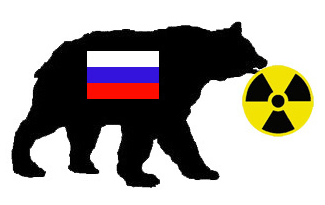
 Nuclear Deal With Russia Brings Political Storm Clouds in South Africa VOA October 09, 2014 JOHANNESBERG, SOUTH AFRICA— Opposition lawmakers are crying foul about a multibillion-dollar nuclear power deal with Russia, saying the agreement could give Moscow the power to veto South African trade with other nuclear providers.The Sept. 22 strategic partnership, signed on the sidelines of the International Atomic Energy Agency conference in Vienna, comes as Moscow has sought to boost lucrative exports of nuclear equipment, technology and expertise in recent years…….
Lance Greyling, a top lawmaker with the opposition party Democratic Alliance, said there was confusion about the Sept. 22 deal. A draft agreement signed last year gave Russia the power to veto South African trade with other nuclear providers, party officials have said.
- “What the government is saying at the moment is that they’ve just signed a framework agreement with Russia and that there will still be a procurement process that is followed,” he told VOA on Oct. 3. “But what we are unclear about is what exactly is in this framework agreement, and the fact that they’re not willing to show it to us makes us highly suspicious.”…..
- If the government has nothing to hide in the deal then it needs to share details of the arrangement with lawmakers, Greyling said…….
http://www.voanews.com/content/south-africa-russia-nuclear-power/2478224.html
South Africa’s murky and uneconomic nuclear deal
 A nuclear deal as clear as mud October 7 2014 Cape Argus, By Jasson Urbach The decision to “go nuclear” in SA has more to do with politics than economics, writes Jasson Urbach.
South Africa is “going the nuclear route”, according to the Department of Energy’s acting director-general, Dr Wolsey Barnard. But given Eskom’s dire financial predicament, the government is opting for a “vendor-financed” option.
We should applaud the fact that Eskom, probably, will not be building South Africa’s next power station.
The delays and cost overruns associated with Medupi and Kusile demonstrate it’s not competent as a project manager for the building of such large plants.
However, the decision to “go nuclear” has more to do with politics than economics. Nuclear is costly – given the dramatic fall in gas prices, a private enterprise would not build a nuclear plant in the current operating environment. And nuclear will take too long to deliver – South Africa needs power sooner rather than later. Continue reading
South Africa’s present, and future, nuclear waste problem
 Nuclear waste is going nowhere slowly Mail & Guardian 03 OCT 2014 ANSIE VICENTE, SARAH WILD Generations from now, there will still be no-go areas storing radioactive by-products of nuclear power production. In 300 years, South Africa’s Vaalputs nuclear waste site – a 10 000ha reserve in the dusty Northern Cape – will be opened for unrestricted use. Until then, it needs to be guarded and monitored; no small feat considering that if the 1820 British settlers had buried nuclear waste on their arrival, we would still be guarding the site.
About 100km from the town of Springbok, a warm wind raises dust from the ground, which has not seen rain in many months. Eight metres underground, concrete and metal drums containing low- and medium-level nuclear waste are biding their time, as the natural and sparse shrubbery reclaims the surface of the trenches they were buried in.
This is one of the major question marks over nuclear technology: What do we do with the waste?……….
the urgent question posed at the scientific forum in Vienna was what to do with the more dangerous high-level waste. For South Africa, with its plans to build a nuclear fleet to generate an additional 9 600MW of electricity, about 23% of the country’s power requirements, this issue is even more pressing.
Koeberg and Pelindaba’s high-level nuclear waste remains on site and is not moved. According to South Africa’s 2011 report to the Joint Convention on the Safety of Spent Fuel Management and on the Safety of Radioactive Waste Management, “used fuel from the Koeberg nuclear power station is currently stored in authorised used fuel pools on the site as well as in casks designed and constructed for storage of used fuel”………
“it is recognised that the current storage capacity at the Koeberg and Pelindaba sites [is] finite and the practice of storing used fuel on a reactor site is not sustainable indefinitely”.
So what will happen to the nuclear waste from the country’s proposed 9 600MW nuclear build?
Storage ‘pools’,…..
As Carl-Magnus Larsson, the chief executive of the Australian Radiation Protection and Nuclear Safety Agency, said: “We must remember that storage is an interim solution until final management and disposal … it remains a temporary measure.”….http://mg.co.za/article/2014-10-02-nuclear-waste-is-going-nowhere-slowly/
Very worrying financial implications for South Africa’s nuclear deal with Russia
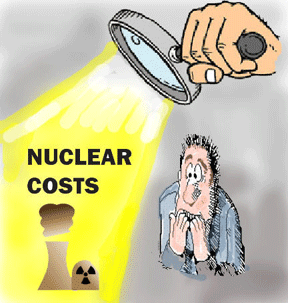 Nuclear urgency raises alarm, Mail & Guardian , South Africa 27 JUN 2014 LYNLEY DONNELLY The state seems set on going the atomic route despite the huge financial implications. Pressure to find a nuclear solution to South Africa’s power problems continues unabated, despite persistent concerns over its affordability.
Experts point out that nuclear vendor financing may be the way to fund the country’s nuclear ambitions, but there are unresolved legal and financial implications.
There is speculation in the energy sector that political pressure cost former energy minister Ben Martins his job, because he failed to secure a nuclear deal with Russia’s Rosatom.
Martins was replaced by Tina Joemat-Pettersson in President Jacob Zuma’s recent Cabinet reshuffle and goes back to Parliament as chairperson of the portfolio committee on public works……….
The apparent urgency about nuclear procurement runs counter to key government policies, specifically the National Development Plan, which calls for an in-depth investigation of the financial viability of nuclear procurement, and the draft update of the integrated resource plan (IRP), published last year. The document, which is government’s electricity planning road map, suggested that a nuclear decision could be delayed given revised projections of electricity demand.
Nevertheless, a decision about ways to procure nuclear power could be expected within the next two months, theMail & Guardian understands.
Elusive payment plan
The answer to how South Africa will pay for a planned 9 600 megawatts of nuclear capacity remains elusive. Eskom was named the owner and operator of new nuclear plants by the Cabinet, but it is in dire financial straits. It has declared a R225‑billion funding gap and has been placed on credit watch by ratings agency Standard & Poor’s………
The cost of nuclear energy could reach R1-trillion and faces competing energy investment demands.
Nuclear vendor financing models have been touted as a way to get around this, which Martins confirmed is the preferred model. “It was never the intention that South Africa would fund the entire nuclear programme. The stakeholders that have an interest in it would substantially fund the nuclear programme,” he said.
Ross Harvey, a visiting research fellow at the South African Institute of International Affairs, said a likely arrangement is that a nuclear vendor would build, own and operate a plant and take full responsibility for the financing.
Buy-back guarantee
In turn, an electricity buy-back guarantee by the government is the most likely way for the vendor to recover costs.
But it is not clear what legislative and tender processes would need to be in place to manage procurement, he said, and much more work is needed to create “legislative coherence” to govern a nuclear bid.
And, although this model would eliminate initial capital constraints, the government would still have to make good on a buy-back guarantee, Harvey said. It is also not clear that, in the time taken to complete a nuclear build programme, there would be sufficient electricity demand, supported by heavy industrial activity, to support such a guarantee. In addition, other technologies could rapidly develop to provide cheaper base-load power.
Rosatom is constructing a similar “build, own and operate” project in Turkey.
Harvey estimated that, based on Rosatom’s investment there, a Rosatom plant would cost between $5-billion to $7-billion, which is a “massive investment to recoup”. http://mg.co.za/article/2014-06-26-nuclear-urgency-raises-alarm?ars=true
Delays and impediments to South Africa getting Russian nuclear power plants
Analysis: Why we won’t be getting any nuclear power plants from Russia anytime soon, Daily Maverick, DIRK DE VOS SOUTH AFRICA
25 SEP 2014 The Department of Energy recently issued a statement regarding a new partnership in nuclear energy. But let’s not get excited. Nuclear power is a diversion from the real issues in the energy sector – and the culmination of a whole lot of dreaming. By DIRK DE VOS.
The recent media release issued by the Department of Energy, on the agreement regarding a strategic partnership in nuclear energy, will go nowhere.
We are advised that the agreement was signed between the Director-General of state-owned Rosatom but on behalf of the Russian government and Ms Tina Joemat-Pettersen, our minister of Energy, at the 58th session of the Atomic Energy General Conference. While the actual agreement is not available, the announcement reads that it “lays the foundation for the large-scale nuclear power plants (NPP) procurement and development programme of South Africa, based on the construction…of new nuclear power plants with Russian VVER reactors with a total installed capacity of up to 9,6GW (up to 8 NPP units)”. It goes on: “Rosatom seeks to create in South Africa a full-scale nuclear cluster of a world leader’s level – from the front-end nuclear fuel cycle up to engineering and power equipment manufacturing.” (sic) It ends with the sentence: “This agreement opens the door for South Africa to access Russian technologies, funding, [and] infrastructure, and provides a proper and solid platform for future extensive collaboration”.
So, not that clear at all……..
Already, the Rosatom view has been qualified with a senior government source telling Reuters “[t]hey jumped the gun” and Xolisa Mabhongo, an executive at South African state agency Nuclear Energy Corporation confirming that there would be a bidding process before any final contracts were signed.
The whole drive for nuclear power is very hard to understand, especially since it goes against the government’s own policy document, the Integrated Development Plan, which advises that commitments to long range, large-scale investment decisions “should be avoided” in order to ensure “decisions of least regret”. Nuclear builds take a long (a decade) to be completed and therefore do nothing to ease our current pressing energy problems. If nuclear were to get the green light, other shorter-term solutions would still be needed and then, when nuclear eventually comes online, we will find ourselves sitting with thousands of megawatts of excess and extremely expensive baseload capacity. ……….
…..Perhaps “jumping the gun” has something to do with the pressure Rosatom is facing from its various foreign nuclear power station builds, which it says amounts to $100 billion due to tighter economic sanctions imposed against Russia for its role in Ukraine’s civil war. This includes a $8.4-billion nuclear power project in northern Finland (where Rosatom has a 34% ownership stake) and a $10 billion nuclear plant expansion deal brokered between Rosatom and a Hungarian utility company. The Hungarian one is especially interesting. It is reported that Benedek Javor, a Hungarian member of parliament, requested that the EU investigate Rosatom deal because he says that it secured its deal without a public procurement process in violation of EU regulations……….
Despite everything, nuclear energy is just uneconomic and will not solve our immediate energy problems either. Countries that select power supplies through democratic, transparent and market-based methods aren’t building new nuclear reactors. The cost differentials between nuclear energy and anything else can’t be fixed by sharpening pencils – the gulf is just too big. None of this means that we should not be vigilant. Rosatom’s footprints in Hungary and Turkey should be closely tracked.
Perhaps the biggest problem with our government’s apparent fixation with nuclear power is that it diverts attention away from the very many things in our energy sector that desperately require our attention. We can but hope that our decision makers will consult the IRP and put these nuclear dreams aside.DM http://www.dailymaverick.co.za/article/2014-09-25-analysis-why-we-wont-be-getting-any-nuclear-power-plants-from-russia-anytime-soon/#.VCXSO2ddUnl
Financial problems for South Africa in planned nuclear deal
 Nuclear economist warns SA will ‘run into problems’http://www.bdlive.co.za/business/energy/2014/09/19/nuclear-economist-warns-sa-will-run-into-problems BY CAROL PATON, 19 SEPTEMBER 2014, SA’s last tender to build nuclear power stations was canned in 2008 after credit rating agencies made it clear that they would downgrade Eskom to junk if it went ahead, Steve Thomas of the University of Greenwich said in a lecture on nuclear economics at the University of Cape Town on Thursday.
Details of Eskom’s nuclear tender in 2006 have not been fully disclosed, except that Eskom dropped it for being too expensive.
Eskom had expected a construction price of $2,500/kW but bids came in at $6,000/kW. It was also made clear, said Prof Thomas, that ratings agencies demanded “unconditional, timely guarantees” across all Eskom’s debt stock for it to maintain its credit rating.
Prof Thomas, visiting as guest of antinuclear lobby group EarthLife, said he expected SA’s nuclear endeavour to run into the same problems. Financing of nuclear projects had become highly risky and was regarded as credit-negative by ratings agencies.
“In the past, financing was not a problem. Utilities were blue-chip stock. They built plants and the costs were passed on to consumers. From a banking point of view this was ideal,” he said.
But accidents such as Chernobyl had led to increased costs in nuclear construction as additional safety measures must be included. Cost and time overruns had led banks to see nuclear power as too risky.
New regulatory approaches, in which prices are set by an independent regulator that assesses their fairness, have made it more difficult for utilities to pass on price increases to consumers.
“Of 70 nuclear power plants under construction, 50 are significantly late and the odds are against you to build to time and cost. So if banks won’t take the risk, then consumers must. But regulators are less likely to say consumers should sign a blank cheque. “For most countries that is not a viable option,” he said.
The remaining option was for taxpayers to provide the guarantees, should the nuclear vendor or utility go bankrupt.
n the UK, where a new plant is under construction at Hinkley Point, the British government has provided £10bn in loan guarantees, equal to 62% of the estimated cost.
“Unless SA consumers or taxpayers can guarantee the loan, a nuclear deal will not be financeable.”
South Africa’s nuclear power plans clouded in secret deals
Eskom not taking part in nuclear acquisition BUSINESS DAY BY CAROL PATON, 15 SEPTEMBER 2014, ESKOM, FORMERLY DESIGNATED THE “OWNER AND OPERATOR” OF SA’S NUCLEAR PROGRAMME, WILL NOT BE INVOLVED IN THE UP COMING NUCLEAR PROCUREMENT, SAY DEPARTMENT OF ENERGY OFFICIALS, EXCEPT AS THE PURCHASER OF POWER FROM A NEW — POSSIBLY FOREIGN — NUCLEAR ENTITY.
The Cabinet subcommittee on energy security is deep into the technical work needed to procure a massive nuclear fleet. Key to the procurement going ahead will be the financing arrangements, as the construction of nuclear plants has enormous capital costs.
While the Nuclear Energy Policy for SA of 2008 designates Eskom as the “owner and operator of nuclear power plants in SA”, department acting director-general Wolsey Barnard said recently that both Eskom’s financial circumstances and the availability of alternative financing arrangements for energy meant this would have to change.
“The nuclear policy has not yet changed, but what needs to be realised is that the financial position of Eskom has deteriorated since 2008 and to expose Eskom to such a project at this stage would not be sustainable. ……..
Insufficient consultation
Though the government feels confident that public opinion has been taken into account, neither business nor labour agrees that consultation has been sufficient.
The National Development Plan urged caution on nuclear power, saying other options — such as natural gas — should be explored first.
Business Unity SA (Busa) acting CEO Cas Coovadia said “an effective debate on our energy options in the long term” was urgently required. Busa is working to draft an energy policy both for SA’s immediate and long-term needs, he said.
National Union of Mineworkers general secretary Frans Baleni, whose union is a leading opponent of nuclear energy in the Congress of South African Trade Unions, said the union was dead-against nuclear power over safety and cost issues.
“As a country we have not had a dialogue on nuclear power. The process is not transparent and will be easily corrupted. It will make the arms deal look like a Sunday picnic. And the National Development Plan (NDP) is not positive on nuclear. Government can’t pick and choose on the NDP; if they do it is not a plan,” said Mr Baleni……….
Eskom spokesman on nuclear power Tony Stott. said there would be another opportunity for comment through the National Nuclear Regulator’s and Nersa’s licensing processes.
However, these will be long after the contracting is completed. http://www.bdlive.co.za/business/energy/2014/09/15/eskom-not-taking-part-in-nuclear-acquisition
South Africa’s very suspect plan for vendor-financed nuclear power
A nuclear tale that sounds too good to be true Business Day BY CAROL PATON, 15 SEPTEMBER 2014, BUILD now, pay much later. That is the good news story about nuclear energy being told to SA’s decision-makers. In this model, a nuclear vendor and a financier — usually the government of the country of the vendor or a state-owned enterprise or bank — come as a package. The loan from the financier is repaid from the electricity tariff over the long term, 15 to 20 years, and repayments begin when electricity is produced.
This is the simple picture, which has given rise to the perhaps apocryphal story in which a very senior member of the executive told Treasury officials after meeting his Russian counterparts: “We don’t need to pay for it!”
The vendor-financed option has made the scary R1-trillion price tag, wielded by Department of Energy and Treasury officials as a warning to their political principals, disappear in a puff of smoke. The nuclear option appears even more attractive when vendors move onto the next part of the story: as operating costs for nuclear energy are low, and the expense lies in construction, once the loan is repaid, energy becomes a virtual “cash cow” for the operator, and any private investors, for up to 30 years………
The clear frontrunners in this are French company Areva and Russian state-owned enterprise Rosatom. Both offer technology and finance in one package, with some differences. At the heart of both is a power purchase agreement in which the operator of the grid, Eskom, would make an irrevocable commitment to purchase the electricity at an agreed tariff………
An important part of the financing package for vendors interested in SA is the government’s commitment in the nuclear policy of 2008 to a fleet approach. Vendors are able to offer better prices if a fleet of reactors is procured as they get better at building them. Some vendors will not consider SA at all without a fleet procurement.
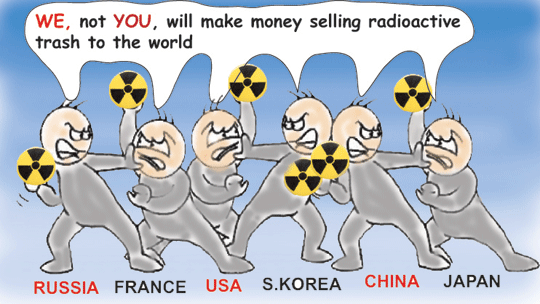
This is what lies behind SA’s curious decision in the IRP 2010, SA’s electricity plan, to include 9,600MW of nuclear power in the energy mix. This would amount to a fleet of six Areva reactors (or more, if other vendors with smaller reactors are selected). As electricity demand is far from certain, and has not grown as expected over the past two years or more, overbuilding capacity is a risk.
Independent analysts, such as Prof Harald Winkler of the University of Cape Town, argue that even a nuclear fleet would be more expensive than other options and would lock SA into even higher electricity prices with negative effects on the economy.
Costs such as insurance in the event of a nuclear accident, dealing with the waste, and decommissioning the plant, are not built into the construction prices.
The conclusion of all of this is that the magnitude of the government guarantees required in a R400bn-R800bn nuclear plant building exercise remain very difficult to estimate. Whatever the size of the guarantee and its purpose — for construction or as a guarantee to purchase the power — it would have to find its way onto SA’s contingent liabilities……..
Despite the good “build now, pay later” message being punted by nuclear vendors, the probability is that it will be business and consumers that not only pay later, but pay much more. http://www.bdlive.co.za/business/energy/2014/09/15/news-analysis-a-nuclear-tale-that-sounds-too-good-to-be-true
UN and Denmark help boost Renewable Energy Technology Transfer between China and Ghana and Zambia
 New initiative boosts Renewable Energy Technology Transfer between China and Ghana and Zambia with UNDP and Danish Development Assistance as catalysts Jakarta Post BEIJING, Aug. 19, 2014 /PRNewswire/ — A milestone partnership was forged today inBeijing between China, Denmark, Ghana, Zambia and UNDP with the signing of a project agreement for Renewable Energy Technology Transfer.
This project is one of the first examples of triangular South-South cooperation betweenChina and Africa with support from a donor. Its objective is to ensure that Chinese renewable energy technologies are optimally responding to priorities and needs inGhana and Zambia, and critical skills are also transferred and developed to make the technologies actually work on the ground. This approach will have a tremendous impact on increasing access to energy for the rural poor in the two countries, and for other developing countries interested in such cooperation withChina in the future.
The project is part of the UNDP-China agreement for Strengthened Partnership signed in 2010 to promote South-South cooperation through innovative programmes. “UNDP is pleased to embark on this cooperation and is committed to making projects more impactful and more sustainable by providing ‘software’ support with the transfer of renewable energy technologies, rather than just relying on the traditional hardware of equipment or infrastructure,” said Xu Haoliang, UN Assistant Secretary-General, UNDP Director of the Regional Bureau ofAsia and Pacific
The Government of Denmark provided funding for the initial formulation of the project and a contribution of29.25 million DKK, equivalent of US$ 5.4 million, to UNDP for its implementation inGhana and Zambia. This implementation will be led by the Government of the two countries with the Ministry of Sciences and Technology as the Chinese counterpart institution, and support from the UNDP offices inBeijing, Accra and Lusaka……..
The project will help with achieving the objective of Sustainable Energy for All (SE4ALL) of the UN Secretary- GeneralBan Ki-Moon by increasing access to energy through off-grid and community-based electrification. Support will not be in the form of hardware transfer but instead will focus on creating conditions required to make adoption of renewable energy technologies more effective, removing barriers and strengthening local capacities to respond to national priorities and meet local needs. ……
UNDP partners with people at all levels of society to help build nations that can withstand crisis, and drive and sustain the kind of growth that improves the quality of life for everyone. On the ground in 177 countries and territories, we offer global perspective and local insight to help empower lives and build resilient nations.www.undp.org http://prnw.cbe.thejakartapost.com/news/2014/new-initiative-boosts-renewable-energy-technology-transfer-between-china-and-ghana-and-zambia-with-undp-and-danish-development-assistance-as-catalysts.html
On costs and safety, solar energy far better than nuclear, for South Africa
Nuclear plan incomprehensible http://www.bdlive.co.za/opinion/letters/2014/08/05/letter-nuclear-plan-incomprehensible Liz McDaid AUGUST 05 2014 THE Southern African Faith Communities’ Environment Institute (Safcei) shares the government and Eskom’s commitment to service the energy needs of the country and the poor in particular. We therefore find the growing emphasis on and commitment to nuclear energy incomprehensible on economic and moral grounds.
Following Eskom’s revelations to Parliament at the end of last month, Safcei believes that, financially, we cannot afford nuclear energy and calls on the Cabinet to abolish the nuclear focus and expand its renewable energy programme.
According to Eskom, 60% of our power stations are older than the recommended design age of 30 years, resulting in increased breakdowns and need for maintenance.
Life extensions and environmental retrofits will require between R50bn and R260bn. Eskom is looking to claw back additional revenue through more electricity tariff increases. Yet poor communities struggle to afford electricity right now.
According to Deputy President Cyril Ramaphosa, we will find additional finances to build new nuclear energy plants. Given that the cost of nuclear has been put at R1-trillion, who will provide the money?
By contrast, globally, a record of 39GW of new solar photovoltaic capacity was installed last year, which required less financing than in 2012, when only 31GW was deployed. In South Africa, renewable energy plants have added 1,300MW to the grid in just less than two years (with a further 1,200MW expected by end of next year.).
As people of faith, we express our deep concern that our public policies are not in line with the best options for preserving our natural environment, saving energy and alleviating poverty. Safcei believes therefore that there is an ethical imperative to expand renewable energy, which is cheaper to build, has zero fuel costs and can provide sustainable, affordable energy for the people of South Africa.
Public Enterprises Minister Lynne Brown says she is hoping to appoint a CEO for Eskom in the next few weeks. If the government is serious about addressing the Eskom crisis, it needs to direct the utility to abandon 19th-century thinking and catch up with the 21st century.
We therefore call on Ms Brown to appoint someone who can consider the long-term energy needs of the country. Appointing a renewable energy expert as a CEO would be a good first step.
Anti uranium protest in Johannesburg South Africa
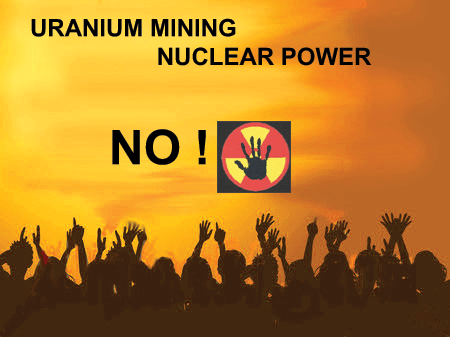 PROTESTERS RAISE CONCERNS OF THE ENVIRONMENTAL INJUSTICE POSED BY NUCLEAR http://earthlife.org.za/2014/07/protesters-outside-nersa-public-hearing/
http://earthlife.org.za/2014/07/protesters-outside-nersa-public-hearing/“…………..protesters are concerned that South African consumers are not seeing the promised investment in social infrastructure because of the huge national debt being accumulated by Eskom. But one of the reasons for the debt is the cheap electricity supply deal that the power utility holds with Australian company BHB Billiton resulting in losses estimated at more than R11.5 billion. Lerato Maragele, Education and Outreach Officer at Earthlife Africa Jhb, explains that: “NERSA must investigate and widely publicise how lost Eskom revenue translates into electricity tariff increases for households.”
Thirdly, protesters are concerned by NERSA’s apparent inactivity on Eskom’s failure to build electricity power stations to budget and on time, and the resultant electricity price increases. “The mandate of NERSA is to promote the protection of the interests of vulnerable groups within the Electricity Supply Industry. The delays at Medupi and Kusile are causing a ripple effect throughout the whole supply chain and impacting on the most vulnerable consumers,” explains Dominique Doyle, Energy Policy Officer at Earthlife Africa Johannesburg.
CONTACTS:
Earthlife Africa Johannesburg:Makoma Lekalakala
Senior Programme Manager
Tel (w): 011 339 3662
Mobile: 082 682 9177
Email: makoma [at] earthlife.org.za Dominique Doyle
Energy Policy Officer
Tel (w): 011 339 3662
Mobile: 079 331 2028
Email: dominique [at] earthlife.org.za
A plea for support for anti uranium protesters arrested in Niger
Dear South African Fellows of the SALT
 Please note that it was agreed by common consent this year
that the campaign to end uranium mining in Niger with regard
would be a primary focus of the African Uranium Alliance,
founded in Tanzania in 2010.
Now our comrades in Niger have been arrested for their dissent
and need our active support in South Africa, through BRICS,
through the Department of International Relations and through
the African Union, not to mention Amnesty International and the
United Nations.
Remember how much we were supported in our struggles against
Apartheid by foreign governments, by overseas donors, and by
ordinary citizens of the global Anti-Apartheid Movement.
Now let us return the favour by standing by our leaders in Niger.
Contact your local press, your radio stations, and television stations.
Write to your local Member of Parliament, your leaders in Faith and
your union leaders. Raise the matter on Facebook, Twitter and by way
of public speaking.
The citizens of Niger cannot be held accountable for resistance to the
unjust and unacceptable system of uranium exploitation. Rather should
they be listened to with respect and their basic human rights to free speech
and free association afforded by the State of Niger and its allies in France.
The French Government would never be allowed to get away with
such a breach of human rights in their own country. They should not be
given any right to do so in their former colonies abroad.
After all, they are the architects of the slogan, “Liberte, Egalite, Fraternite”.
Let them practise today what their ancestors did before them.
Let the NIGER TEN go free.
Living on a radioactive uranium dump
 What does uranium do?
When uranium is ingested it is deposited in the kidneys, lungs, brain and bone marrow. The alpha particles – which contain massive doses of energy – sit in these parts and damage the tissue around them. Because it is an endocrine disrupter, it increases the risk of fertility problems and reproductive cancer. Large doses are fatal, but the constant exposure to low levels has intergenerational effects that are still not fully understood
One man’s home is another man’s uranium dump, Mail & Guardian, Africa 18 JUL 2014 SIPHO KINGS With nowhere else to live, many seek refuge in the radiation wastelands in Gauteng, unaware of the deadly dangers the abandoned mining areas present……..Faded photographs in the town museum show people sunbathing and swimming in the lake in the 1980s. There were bars, a jetty and a miniature putting course. Now only the foundations remain after it was closed because of the increasing concentration of uranium in Robinson Lake.
In the past it was a place for the residents of Randfontein – 50km west of Johannesburg – to relax on the weekend and forget their jobs in the mining industry. But in the late 1990s the underground mines started closing because the falling price of gold and uranium made them unprofitable. The mines were abandoned and the water levels inside started rising. Acid mine drainage began seeping into the dam, increasing the level of uranium to levels 220 times higher than the safe limit. The resort closed.
Deep into winter a chill breeze blows across the lake, creating ripples in the clear water. The surface is a stark blue reflection of the sky, with the bottom tainted red from the heavy metals in the water. No alga grow here, no fish swim, no underwater life ripples the surface.
The periphery of the lake is a wide ring of cracked yellow earth. The soil beyond is brown. There are 20m-high blue gum trees. There are yellow signs with “Radiation area – Supervised area” wired to the fence around the area and nailed to the trees.
Gold seam
The Witwatersrand gold seam runs for about 100km, from Randfontein in the west of Johannesburg to Springs in the east. A century of mining drove a mining boom, thanks to this being the world’s largest concentration of the precious metal.
Mine shafts up to 3km deep were sunk. The waste was dumped above ground in over 400 mine dumps or tailings dams that now dot the province. These contain a mixture of heavy metals, and an estimated 600 000 tonnes of uranium.
The Cancer Association of South Africa (Cansa) says this is the only place in the world where large numbers of people live next to dumps full of uranium. Continue reading
USA and France co-operating on the militarisation of Africa: Niger uranium
Uranium games in Niger and the US-Franco competition Andrew Korybko for RT June 11, 2014 The West has actively been making multidimensional inroads into Africa over the past decade, largely of a malignant nature. The US and its NATO allies are interested in market potential, energy prospects, and military engagement…….
France has been de-facto appointed as the US’ “lead from behind partner” in this region, but the relationship between the two NATO allies is not as secure as it initially seems. Through the overlap of security responsibilities in uranium-rich Niger, the US is positioning itself for long-term control of the uranium mines that help drive France’s economy…….
uranium significance cue in American military involvement in Niger. Last year the US sent 100 troops there to build and operate a drone base for use against the militants traversing the country and staged nearby. Just last month, the US announced that it will also be training so-called elite counterterrorism units in Libya, Mali, Mauritania, and Niger. While the US is delegating a large share of military responsibility to France in the region, it is still directly involving itself in specific matters that it deems of critical importance. Niger is arguably a tinderbox of terror, but it is also exceptionally important for France’s strategic energy needs. Hegemonic influence over Niger would indirectly lead to substantial control over France’s uranium dependency, thereby allowing Washington to leverage influence over Paris……….
Altogether, the US and France are closely cooperating in the NATO militarization of Africa during the “Second Scramble”. Despite being somewhat different in their approaches, they represent “two hands from the same magician” working behind the scenes to advance the Western interest there. Concurrently, as can be seen by the NSA spying directed against European “allies”, Washington does not place full trust in those that it cooperates with. Therefore, it is fully in line with America’s established track record of deceit to hedge itself towards a position of guiding influence over its partners, specifically France. In the event that Paris’ ambitions for power get the best of it and it once more “goes rogue” from Atlantic command, the US will play the Nigerien uranium card to enact maximum pressure on the country and force it back into the unipolar fold. http://rt.com/op-edge/165092-west-africa-uranium-games/
Total costs of nuclear power make it uneconomic for South Africa
Long time frames and dodgy numbers justify worry about nuclear power’s cost, Business Report, South
Africa June 10 2014 By Yvette Abraam
“………My chief objection to nuclear power is precisely on the cost issue……….from 2008 to early 2010 nuclear costs were stated to be twice as much by nuclear power vendors than by the state. By early 2011, after a multitude of submissions by civil society, even the state admitted that it had undercosted nuclear power by about 40 percent and included a new estimate. The new estimate remained substantially lower than the two tenders submitted by suppliers.
Yet the amount of nuclear energy planned in the IRP II remains unchanged, despite the variation in costs. International experience rates the cost of constructing nuclear plants at about $6 000 (R63 500) per kilowatt hour.
The South African energy planning process calculated this cost as $3 000 in 2010 and $4 300 in 2011 – on what basis remains a mystery.
The second problem with assembling a budget for nuclear procurement is that the costs of waste disposal and decommissioning are of the same order as the cost of construction, but are beset by large uncertainties. For example, in the 2007/08 annual report and accounts of nuclear power generator British Energy, it was estimated the cost of decommissioning its eight plants was £9.4 billion (R167bn) and the cost of disposing of the spent fuel was £5.5bn.
Although we can estimate the order of magnitude, the actual costs are affected by the choice of technology. As such, it is important to include these costs in a tender since they deeply affect the final choice of bidder. So far these costs have not been included in South African energy planning.
As far as the cost of waste disposal is concerned, it has to be borne in mind that these costs have to be borne for a minimum of two and a half centuries before the waste can safely be neglected. Even a very small error in calculation can lead to very large divergences across this timespan. Under conventional accounting procedure, liabilities that must be met in the future should be discounted.

Effectively, this means that a sum of money (or assets of that value) is set aside now and it is assumed that money will earn interest and grow to meet the liability……..What happens if, as is the case in Germany and Japan, the interest rate is negative? It would mean we have to set aside more money now than will be required in the future.
This example demonstrates the point that the really difficult part of nuclear energy planning is that the amount it is going to cost is not knowable. Calculating the net present value of a 250-year expenditure would require that we could foresee the interest rate and the inflation rate for the next 250 years. But we are citizens, not soothsayers. Anybody who tells you they can predict these costs is talking through their hat. To any suggestion that we should give the approval anyway and trust officials to prevent any unreasonable cost overruns, I have but one word: Nkandla.
* Dr Yvette Abrahams works in the department of women and gender studies at University of the Western Cape and with Electricity Governance Initiative South Africa. http://www.iol.co.za/business/opinion/long-time-frames-and-dodgy-numbers-justify-worry-about-nuclear-power-s-cost-1.1700897#.U5oL1HJdUnk
1 This Month

10 March A LIVE WEBINAR THE REAL EFFECTS OF NUCLEAR POWER
What the Industry Isn’t Telling Us
1:00 PM Mountain, 2 pm Central, 3 pm Eastern. Live on the Keepers of the Water Facebook page


18 March Webinar @ 1 PM EST: An Assessment of SMR Projects: The Case of Canada
register for the zoom:
https://us02web.zoom.us/webinar/register/WN_o8BIIOUvQ2ONJR1nta65DQ#/registration


of the week – STOP SMALL MODULAR REACTORS IN CANADA
To see nuclear-related stories in greater depth and intensity – go to https://nuclearinformation.wordpress.com
-
Archives
- March 2026 (76)
- February 2026 (268)
- January 2026 (308)
- December 2025 (358)
- November 2025 (359)
- October 2025 (376)
- September 2025 (258)
- August 2025 (319)
- July 2025 (230)
- June 2025 (348)
- May 2025 (261)
- April 2025 (305)
-
Categories
- 1
- 1 NUCLEAR ISSUES
- business and costs
- climate change
- culture and arts
- ENERGY
- environment
- health
- history
- indigenous issues
- Legal
- marketing of nuclear
- media
- opposition to nuclear
- PERSONAL STORIES
- politics
- politics international
- Religion and ethics
- safety
- secrets,lies and civil liberties
- spinbuster
- technology
- Uranium
- wastes
- weapons and war
- Women
- 2 WORLD
- ACTION
- AFRICA
- Atrocities
- AUSTRALIA
- Christina's notes
- Christina's themes
- culture and arts
- Events
- Fuk 2022
- Fuk 2023
- Fukushima 2017
- Fukushima 2018
- fukushima 2019
- Fukushima 2020
- Fukushima 2021
- general
- global warming
- Humour (God we need it)
- Nuclear
- RARE EARTHS
- Reference
- resources – print
- Resources -audiovicual
- Weekly Newsletter
- World
- World Nuclear
- YouTube
-
RSS
Entries RSS
Comments RSS
 nuclear-news