Paladin, Australian uranium mining company accused of radioactively polluting Lake malawi
Government officials in Malawi are upset about the situation. “I am very shocked with the situation I have seen after monitoring the mine here and all my questions to the Paladin boss have not been answered satisfactory”
Meanwhile international experts are starting to question the benefits of the Kayelekera mine
Australian Uranium Mining Company Accused of Contaminating Lake Malawi By Mayu Chang……Global Research, January 29, 2015 CorpWatch Paladin Energy, an Australian mining company, has been accused of discharging uranium-contaminated sludge into Lake Malawi, which supports 1.7 million people in three countries – Malawi, Mozambique and Tanzania. The company began uranium mining operations in Malawi in 2009 although it suspended operations last year after ore prices fell.
“It is rumored that Paladin secretly have started discharging the so called purified water. Reports from the Beach Village Chairman indicates that this started in late November,” wrote Rafiq Hajat of Malawi’s Institute for Policy Interaction on Facebook. “[At] a radius of 35 km from the Boma, you will be shocked to see fish of different species dead with some communities along the lakeshore collecting [the fish].”……………“Uranium is radioactive and that with open-pit mining, like the one to be conducted at Kayelekera, the soil drains into rivers and contaminates the water,” Titus Mvalo, a lawyer representing several civil society organizations in Malawi, told Inter Press Service in 2007. “When humans drink the water, it damages kidneys and causes cancer.”
At the time, the activist groups warned that the mine would pose a threat to Lake Malawi, Africa’s third largest freshwater lake, which is a major source of drinking water and fish for the country. Christopher Mwambene, the executive director of Coordination Union for Rehabilitation of the Environment (CURE), a Blantyre-based environmental NGO, estimated that catch from the lake provides 20 percent of the protein requirement for Malawi’s population.
Perhaps even more damning was the assertion that Paladin was planning to use lower standards to build the Kayelekera mine. “Paladin are certainly not meeting Australian standards and they would not get approval in Australia if they were to present the same EIS here.” Dr. Gavin Mudd, an environmental engineering professor at Monash University in Melbourne, told ABC television news in 2007.
Mudd says that uranium tailings (waste) are typically stored under the water table in Australia and Canada, to reduce the risk of contamination. In Malawi, however, Paladin chose to store the tailings above ground behind a specially contructed dam.
“What Paladin is proposing for Kayelekera is it will depend on what happens with the rainfall and climate, but every few years or so allowing the excess build-up of water to be discharged into the local river system and local water resources,” Mudd added.
“This dam is in a catchment area of the stream,” Reinford Mwangonde, the executive director of Citizens for Justice, an NGO in Malawi, told ABC at the time. “The stream runs into Lake Malawi. A number of people in the community depend on that river for domestic water purposes.”
Mudd’s predictions appear to have come true. On January 5, a heavy storm caused the liner in a Kayelekera run-off tank to rupture, releasing up to 500 cubic meters of waste…………….
Government officials in Malawi are upset about the situation. “I am very shocked with the situation I have seen after monitoring the mine here and all my questions to the Paladin boss have not been answered satisfactory,” Alex Major, the deputy chairperson of the Parliamentary Natural Resources and Climate Change Committee told a local town hall meeting on January 10.
Meanwhile international experts are starting to question the benefits of the Kayelekera mine. After visiting the country last July, Olivier de Schutter, the United Nations Special Rapporteur on the Right to Food, came out against the project. “The criticism is the deals could have been much more equitable, and could have allowed Malawi to use its resources better for the benefit of the population,” he told ABC television news in Australia.
In any case, today Malawi is no longer benefiting financially from Paladin’s operations. ……..
Experts says that the ultimate costs of the Kayelekera mine could be very high. “Uranium mining is associated with high environmental impacts and human health risks’” Fleur Scheele, then researcher at the World Information Service on Energy (WISE), an Amsterdam-based anti-nuclear organization, and author of a report on uranium mining in Africa published in 2011. “The costs of rehabilitation of the mining area are often many times higher than the total revenues derived during the mine’s entire lifetime.”http://www.globalresearch.ca/australian-uranium-mining-company-accused-of-contaminating-lake-malawi/5428142
Radioactive pollution of Lake Malawi by Australian uranium company Paladin?
 The lake provides water for drinking and domestic use to millions of Malawians. Part of the lake is protected as a national park, and it is inhabited by more than 850 cichlid fish species found nowhere else on Earth.
Malawi: Paladin Accused of Discharging Uranium-Contaminated Sludge in Lake Malawi http://allafrica.com/stories/201412301012.html A coalition of Malawi civil society organisations (CSOs) has accused Paladin Energy Ltd, a company that is mining Uranium ore at Kayerekera in the northern district of Karonga over reports the mining company is secretly discharging into Lake Malawi uranium contaminated sludge from the tailings dam at the mining site.
Renowned human rights activist, Rafiq Hajat shared a report compiled by a members of the Natural Resources Justice Network (NRJN) in which it is alleged paladin is discharging uranium sludge from Kayerekera into Lake Malawi.
“A radius of 35 km from the Boma, you will be shocked to see fish of different species dead with some communities along the lakeshore collecting [the fish]. Collectiong as part of their relish. The cause not yet known. Reports from the Beach Village Chairman indicates that this started in late November but Government was not forth coming (sich)” reads part of the post.
Paladin had aroused the wrath of the coalition of the CSOs under the banner of Natural Resources Justice Network (NRJN) over reports which emerged late November that Paladin Energy was planning of discharging uranium mining sludge into the Sere and North Rukuru rivers.
The toxic substances that would flow from the tailings pond at the Kayelekera Uranium Mine into Lake Malawi 50 kilometers (30 miles) downstream include waste uranium rock, acids, arsenic and other chemicals used in processing the uranium ore, the coalition fears.
“It is rumored that Paladin secretly have started discharging the so called purified water and the trip was one of the verification. This is terrible news and may have catastrophic ramifications if not checked immediately.” Reads the statement shared by Hajat.
However, in a statement issued last month, Paladin Energy stated that water from its tailings dam at Kayelekera uranium mine which is discharging into the North Rukuru River poses no human or environmental risks.
The process has been reviewed and agreed by relevant agencies of the Government of Malawi, which is imposing conditions regulating critical water quality parameters, including uranium, consistent with international guidelines” a statement issued in November by Paladin Energy stated.
The company also said that it plans to start discharging the water in early 2015 and that reports it is discharging the contaminated wastes are not true.
Lake Malawi in eastern Africa is the world’s ninth largest lake, some 580 kilometers (360 miles) long, and 75 kilometres (47 miles) wide at its widest point. It extends into Malawi’s neighbours Tanzania and Mozambique.
The lake provides water for drinking and domestic use to millions of Malawians. Part of the lake is protected as a national park, and it is inhabited by more than 850 cichlid fish species found nowhere else on Earth.
Paladin Africa is the Malawi subsidiary of Australian mining giant Paladin Energy Ltd, with 15 percent owned by the Government of Malawi.
Last year, Paladin Africa’s Kayelekera Mine in Karonga produced 1,066 metric tonnes of U3O8, triuranium octoxide, a compound of uranium. One of the more popular forms of yellowcake, U3O8 is converted to uranium hexafluoride to make enriched uranium for use in nuclear power plants and nuclear weapons.
The international battle to market nuclear technology to South Africa
 Geopolitics key in battle to gain SA’s nuclear nod, IOL Zambia, December 23 2014 By BloombergPaul Burkhardt and Franz Wild POLITICS may tip the balance as Russia’s Rosatom and France’s Areva prepare to battle it out for South Africa’s planned nuclear energy project that could cost $100 billion (R1.2 trillion).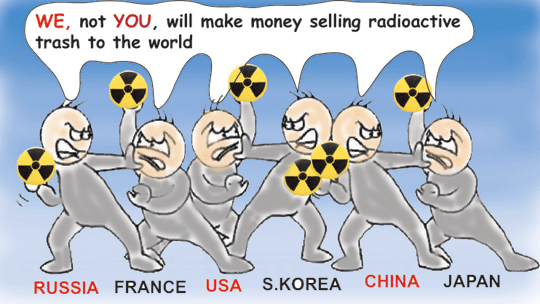
“Geopolitical and industrial relations between South Africa and the nuclear-vendor countries will play an important role,” Des Muller, the head of Johannesburg-based building company Group Five’s nuclear construction division, said last week. “It does with all major infrastructure projects and more so on nuclear infrastructures where reliance on nuclear safety and construction know-how is paramount.”
South Africa could pay as much as $100bn spread out over a period of 15 years for nuclear reactors to provide 9 600 megawatts of power, Muller said………
“The South African government has stressed that through the new build process we wish to revitalise a nuclear industry in South Africa with a view to long-term self-sufficiency,” Xolisa Mabhongo, the group executive corporate services at the Nuclear Energy Corporation of SA, or Necsa, said in response to questions………
Russia might already have a head-start as President Jacob Zuma fostered stronger economic co-operation with the country and China in a shift from his Western and Africa-leaning predecessor Thabo Mbeki, Robert Besseling, an analyst with IHS Country Risk, said.
The Soviet Union and then Russia historically kept close ties with the ruling ANC from the days in which it was battling against the apartheid regime. Under Zuma’s watch, South Africa was incorporated into the Brics alliance with Brazil, Russia, India and China.
“Considering the much stronger relationship between the Zuma presidency and the Russian government than under the previous South African administration, it looks much more likely that the expansion of the nuclear programme will be awarded to Russia,” Besseling said………http://www.iol.co.za/business/news/geopolitics-key-in-battle-to-gain-sa-s-nuclear-nod-1.1798374#.VJsqssA8
Australian uranium mining project strongly opposed by Zambia’s Green Party
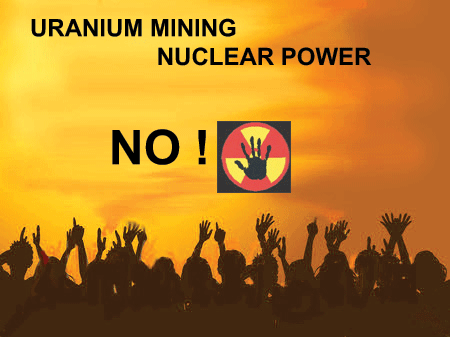 the uranium mining issue a symptom of an extremely serious malaise affecting Zambia.
ZEMA and Zambia are woefully unqualified to deal with the environmental effects of the proposed uranium mining upstream of the Park and the management of the radiation and its very serious genetic impacts on people.
The Green Party of Zambia and the Lower Zambezi National Park Preserving the Zambezi ecosystem Ian Manning 16 Dec 14,The leader of the Green Party of Zambia, Peter Sinkamba, has set out their platform for the Presidential elections of 20 January 2015: to cancel the mining licence issued to Australia’s Zambezi Resources Limited for the Lower Zambezi National Park. Reading this, the electorate will wonder what could possibly be so important about the proposed mining of a National Park. And why do the Greens consider it the single most important issue facing Zambia today?
Perhaps Sinkamba sees the mining issue – as do I – as a symptom of an extremely serious malaise affecting Zambia. For the mining issue removes the trousers to reveal a suppurating Zambian ulcer on the nations bottom: the continuing existence of a dictatorial, grasping Executive, uncurbed by Government, Parliament, the Judiciary or the Constitution……………..
As a backdrop to this crime against customary people, the International Tribunal for the Rights of Nature meeting took place on 5 and 6 December 2014 in Lima, the judges referring ‘to the Rights of Nature and the Universal Declaration of the Rights of Mother Earth, from the World People’s Conference on Climate Change and the Rights of Mother Earth in Cochabamba, Bolivia in 2010’. ………….
Another reason, I would hope, for putting the mining up in lights, is that the Greens need to expose the fact that consumer capitalism is dying, and that therefore Zambia should adjust its thinking; for we live in a world of declining resources, one increasingly prone to Liebig’s Law where the amount that a species or ecosystem can produce in a given place and time is limited by the resource in shortest supply – something politicians fail to understand……………….
For mining the SNDP lists the mid-Zambezi uranium mines as coming into production – for which no strategic EIA has been conducted, let alone full environmental management plans – as a UNESCO/IUCN mission discovered – mandatory for the issue of prospecting and large-scale mining licences.
ZEMA and Zambia are woefully unqualified to deal with the environmental effects of the proposed uranium mining upstream of the Park and the management of the radiation and its very serious genetic impacts on people. Brugge & Buchner of Tufts University in 2011 concluded that ‘the strong biological plausibility of adverse effects on the brain, on reproduction, including estrogenic effects, on gene expression, and on uranium metabolism’ will not only affect mine workers but also villagers living near uranium mines and processing facilities. They ended on a chilling note, ‘As much damage is irreversible, and possibly cumulative’. In addition, no strategic socio-environmental impact study has been made of the State’s past and present programmes; nor has there been given any thought to maintaining the integrity of Zambia’s cultural and religious heritage………
The Green Party, with the Lower Zambezi National Park as its platform, has certainly provided a litmus test for the future.
For more information on the issue see:
(Archived by WebCite® at http://www.webcitation.org/6CeIIPlmD)
Future publication by I. P. A. Manning:
Out of Zambia: its history, conservation and plunder; and an alternative way http://zambeziheritage.wordpress.com/
1,000 MW of renewable energy contracts for South Africa
South Africa to announce 1,000 MW of renewable energy contracts Fri Dec 12, 2014 JOHANNESBURG (Reuters) – South Africa will announce a series of renewable energy projects on Monday that will add 1,000 megawatts (MW) of power into the country’s constrained electricity grid, sources close to the deals told Reuters……http://af.reuters.com/article/investingNews/idAFKBN0JQ19W20141212
Report: Russian Nuclear Industry in Review
 “PAY MORE WITH NUCLEAR” : REPORT 4 http://earthlife.org.za/2014/12/pay-more-with-nuclear-report-4/ The report, entitled “Russian Nuclear Industry in Review”, is authored by Russian environmental activist and academic Vladimir Slivyak; and provides an insider view into the workings of the Russian nuclear industry. The report is fourth in the series “Pay more with nuclear”, which examines the enormous costs involved in building, operating and decommissioning nuclear power plants.
The Russian deal is being marketed as preferential because it includes Russian government funding, construction assistance and fuel cycle services. But the “Russian Nuclear Industry in Review” report shows fatal flaws with the concept and reveals the shady corners of the Russian nuclear industry.
Key Documents:
How the South African government shafts renewables, in its policy fixated on nuclear power
Nuclear fixation shafts renewables, Mail &Guardian, Africa 21 NOV 2014 00:00 SIPHO KINGS The third window is waiting to be signed off but the energy department is preoccupied elsewhere Within two years, South Africa could have a further 1 200 megawatts (MW) of renewable energy entering the grid. The bidders have been selected and the companies are waiting for financial sign-off so they can start building.
But policy uncertainty and a new focus on nuclear energy are responsible for a nearly 18-month delay in the government giving them the go-ahead, industry insiders say.
In the wake of the 2009 energy crisis, the energy department set out an ambitious renewable energy programme: independent power producers (IPPs) would build the capacity to produce 3 725MW of electricity. This was split into three bidding opportunities, or windows, with companies bidding for a certain allocation in each.
The first two were hailed as great successes and, for the past three years, South Africa has been listed as one of the top five destinations for investment in renewable energy. Wind energy is already producing 660MW. Updated plans envision 9?800MW of solar, 3 300MW of concentrated solar and 4 400MW of wind energy by 2030.
But the third window has been delayed repeatedly. Several concerned individuals, working for renewable companies and unwilling to disclose their names for fear of jeopardising their relationship with the government, said political considerations were to blame.
“We have been told that the new minister’s [Tina Joemat-Pettersson] mandate is strongly towards nuclear energy,” said one………..
The renewable energy companies, the majority of which provide wind and photovoltaic power, are incurring costs all the time. These include leasing the land on which the power stations will be built, which is spread out across the Eastern, Western and Northern Cape.
If the delays continued, the sources said, there would be a point beyond which companies would be unable to recoup their costs, even if they started producing power soon. “We are not far from that point,” warned one renewable company employee. ………
A chance to reindustrialise
Groups such as Cosatu have hailed renewable energy as a chance to “reindustrialise” the country and companies are required to spend up to 70% of their budgets locally. Hundreds of millions of rands have been spent building factories to produce parts locally, such as the R300-million wind tower factory in Atlantis outside Cape Town. Solar panel factories alone have created 500 jobs.
This week the South Africa Renewable Energy Council said delaying the third window would have “extremely adverse consequences” for the industry and could also jeopardise the planned fourth renewable window.
Unlike South Africa’s centralised and state-owned power plants, renewables are financed by the private sector. The government, through Eskom, signs an agreement to buy their electricity at the rate presented in their bid. But they carry the risk.
The owner of one solar company said: “The worst thing for investors is uncertainty. The first two windows attracted so much investment and goodwill because the government was decisive. That is being thrown out of the window.”
If the third window was delayed, and there was another window to come, companies would hesitate to gamble with their money, they said………
Policy uncertainty
Twenty-six renewable energy projects have already been connected to the grid. The more than 60 projects have brought in R120-billion in foreign direct investment. Many of these are ahead of schedule, such as the 96MW Jasper solar plant near Upington in the Northern Cape.
It is the continent’s largest solar photovoltaic power plant. It has been built in the time that costs of the coal-fired Medupi and Kusile power stations, which are currently five years behind schedule, have nearly tripled.
But industry insiders are adamant that, if the policy uncertainty is not cleared up, the initial promise shown by the renewable programme will falter.
The department of energy was not available to respond to questions. http://mg.co.za/article/2014-11-20-nuclear-fixation-shafts-renewables
China joins the throng trying to flog off nuclear reactors to South Africa
China becomes latest country to sign SA nuclear accord http://www.moneyweb.co.za/moneyweb-south-africa/china-becomes-latest-country-to-sign-sa-nuclear-ac Kevin Crowley, Bloomberg| 09 November 2014
Deal signed by Energy Minister Tina Joemat-Pettersson and her Chinese counterpart Wu Xinxiong.— South Africa, the continent’s second- largest economy and biggest power producer, signed a nuclear cooperation accord with China following similar agreements with Russia and France.
The framework agreement, which is a precursor to procurement, was signed by South Africa Energy Minister Tina Joemat-Pettersson and her Chinese counterpart Wu Xinxiong, the Pretoria-based Department of Energy said today in an e-mailed statement.
South Africa is planning agreements with other countries including Japan as it decides how best to procure as many as 9,600 megawatts of nuclear energy by 2030. The country, which through its state-owned utility has installed capacity of about 42,000 megawatts, is struggling to meet power demand and on Nov. 2 had rolling blackouts, a consequence of decades of underinvestment in generation.
Companies that have expressed interest in building nuclear power plants in South Africa include France’s Areva SA and Electricite de France SA, Westinghouse Electric Corp., a unit of Japan’s Toshiba Corp., Russia’s Rosatom Corp., China Guangdong Nuclear Power Holding Corp. and Korea Electric Power Corp.
South Africa’s Cabinet not informed on nuclear agreements signed with France and Russia
 Cabinet still not briefed over nuclear agreements — Radebe, Business Day Live BY PAUL VECCHIATTO, 07 NOVEMBER 2014, THE Cabinet, the government’s highest decision-making body, has not been briefed on the nuclear framework agreements signed with France and the Russian Federation……..Business Day, Sunday Times and the Council for the Advancement of the South African Constitution will together make an application under the Promotion of Access to Information Act (PAIA) requesting evidence of a record of decision to forge ahead with nuclear power plants.
The application will also request information on the protocols and processes followed prior to the signing of the agreements as well as for documentation on any affordability study into the commissioning of nuclear power plants.
An earlier PAIA application by the Sunday Times to the Presidency, Parliament and the Department of Energy for access to the framework agreement SA signed with Russia two months ago, was refused this week by the Department of Energy. The department said the release of the agreements would compromise the delicate negotiations that SA was holding with other countries.
The department said the agreements contained sensitive scientific and commercial information.
The Sunday Times now has 60 days to lodge an appeal on its first application with the department in order to change its decision.
The opaqueness of the decision to build nuclear reactors has caused consternation among observers, the suspicion being that the government has already struck a secret deal with the Russian Federation.
It is believed that the Cabinet has not made a formal decision to procure nuclear power stations, yet Department of Energy officials have insisted on several occasions “that a procurement will take place”.
Director of the council, Lawson Naidoo, said clarity was needed on the decision-making process to establish whether proper governance was followed. “I don’t understand how an international agreement can be signed (by the minister) without the approval of Cabinet. How does a minister get the authority to sign without the approval of Cabinet?”…….http://www.bdlive.co.za/business/energy/2014/11/07/cabinet-still-not-briefed-over-nuclear-agreements–radebe
Secretive deals between Russia and South Africa about buying nuclear technology
Secret nuclear deal talks held in KZN, news 24, 2014-10-24 Rowan Philp, The Witness Pietermaritzburg – Twenty of Vladimir Putin’s top nuclear experts pitched for South Africa’s biggest-ever deal – with an estimated R1 trillion price tag – at a secret meeting in the Drakensberg on Thursday.
The Witness can reveal that 50 South African experts – including its nuclear chief, Zizamele Mbambo – grilled officials from Russia’s state atomic energy company, Rosatom, at a secretive four-day conference at the Champagne Sports Resort.
 Secrecy
However, a Witness reporter gained access to one key meeting for 15 minutes before being ejected, and also traced the name of the South African head of Rosatom to a chalet at the hotel. Rosatom officials pitched eight of their “VVER” pressurised water reactors for South Africa’s massive “nuclear build” programme.
It is intended to add 9 600 megawatts to the grid by 2030.
In an interview at the hotel, Mbambo said a French company was expected to pitch six of its slightly larger reactors at a similar conference.
The Russians were given the opportunity to present the first workshop in which to “parade” their offering, and France and China are set to follow later.
However, Mbambo revealed that other invited countries – including South Korea and the US – could potentially miss out on consideration if their presentations were not ready in terms of an unspecified deadline.
‘Window dressing’
Echoing the concerns of unions and accountability watchdogs, the DA last week alleged that the secretive workshops with various countries were “window dressing”, and that “all evidence points to a done deal with the Russians”.
This follows the revelation that President Jacob Zuma had struck a private agreement with Putin in August, and a statement by Rosatom in September that a deal for “actual joint construction” had been struck with the South African government.
The department of energy later said the statement had been “misunderstood”, and Mbambo on Thursday said: “No vendor has been chosen, and the procurement process has not yet begun.”………
The event was so secretive that the name “Rosatom” did not appear on any conference badges or place cards, and Russian officials also refused to confirm who they were when they were questioned about their identities.
But two members of the Russian delegation wore “Rosatom” golf shirts at the breakfast buffet, and The Witness established that Rosatom’s Vladimir Polikarpov was staying in chalet 27.
An energy department official later confirmed they were the bidding vendor………http://www.news24.com/SouthAfrica/News/Secret-nuclear-deal-talks-held-in-KZN-20141024
South Africa a juicy target for the nuclear reactor marketers
State shops for ‘nuclear vendor’ IOL October 20 2014 Cape Town – The government has confirmed it is shopping around for its nuclear build programme and says it is consulting “nuclear vendors” in the US, South Korea, Russia, France, Japan and China.

The announcement by the Department of Energy yesterday comes weeks of controversy about the multibillion-rand nuclear project since it emerged last month that a R1-trillion agreement had been signed with Russia, followed by another with France.
The department said the government was consulting “nuclear vendor countries” with pressurised water reactor nuclear technology, similar to that used at Koeberg………
DA leader Helen Zille has said the nuclear co-operation agreement with France, signed by Joemat-Pettersson on Wednesday, is nothing more than a “decoy”.
“This is… to muddy the waters and divert attention from the Russian deal negotiated by President (Jacob) Zuma and signed by Minister Joemat-Pettersson last month.
“We are led to believe a similar agreement with the Chinese is next and that a proper procurement process has yet to begin, but all evidence points to a done deal with the Russians. No amount of obfuscation can allow our focus to shift from this.” – Cape Times http://www.iol.co.za/business/companies/state-shops-for-nuclear-vendor-1.1767746#.VEcGcSJ4pBE
South Africa’s Treasury advised against getting Russian nuclear reactors, but Putin is pushing for the sale
Vladimir Putin’s quest for a nuclear monopoly, Mail & Guardian, South Acfrica 17 OCT 2014 00:00 QAANITAH HUNTER Somehow Russia has persuaded President Jacob Zuma into agreeing to a deal for a nuclear fleet that the treasury opposed. The Russians are coming. The nuclear deal with Russia is to dominate the agenda when the South Africa-Russia joint intergovernmental committee on trade and economic co-operation meets next month.
Even though the South African government insists it has not entered into the procurement phase for the nuclear fleet, it has become clear that Russian President Vladimir Putin managed to sway President Jacob Zuma and Energy Minister Tina Joemat-Pettersson into giving Russia the entirety of the deal.
Zuma and his most trusted Cabinet ministers went against the strict advice of the national treasury and his senior advisers when a nuclear energy “agreement” was signed with Russia last month.
Two sources who also advised against it revealed this week to the Mail & Guardian that an initial bid made by Russian nuclear company Rosatom last year was rejected by the treasury and a number of Zuma’s advisers. A third credible source who was close to the negotiations confirmed their version of events.
The treasury this week did not deny advising against the initial Russian proposal.
“Nuclear would be a substantial financial commitment and government can only make that kind of commitment after careful and thorough-going modelling and an affordability assessment,” said spokesperson Jabulani Sikhakhane.
He said they had yet to discuss how the treasury would pay for nuclear energy.
Exclusive rights
It has emerged that the Russians wanted exclusive rights to South Africa’s nuclear industry. This was substantiated by a statement made by Putin in March last year, following his visit to South Africa, saying his country did not want to merely build the nuclear plants but would bid to run the entire nuclear industry here.
South Africa plans to enhance its energy mix by creating 9.6 gigawatts of nuclear energy by 2030.
The M&G spoke to three highly placed sources – all of them indicated that:
- The initial Russian proposal was not affordable and the treasury rejected it;
- The technology proposed was sub standard and dangerous;
- It would exclude and be damaging to local industries; and
- Even public servants who seemed loyal to Zuma had concerns about it.
One source close to the nuclear talks said the signing of the agreement was a result of about two years of courting by the Russians……….http://mg.co.za/article/2014-10-16-vladimir-putins-quest-for-a-nuclear-monopoly
France’s nuclear giant AREVA gets agreement to supply reactors to South Africa

France and South Africa sign nuclear energy agreement By Martine Pauwels, Cécile Feuillatre Paris (AFP) 14 Oct 14, – Paris and Pretoria signed Tuesday an agreement which could open the way for French nuclear giant Areva to bid to build eight nuclear reactors in South Africa worth up to $50 billion (39.5 billion euros).
French Foreign Minister Laurent Fabius and South African Tina Joematt Pettersson signed an intergovernmental agreement on cooperation in nuclear energy development which is necessary for any commercial deal……..http://news.yahoo.com/france-south-africa-sign-nuclear-energy-agreement-133802965.html
What a mess South Africa’s new ‘nuclear deal’ is in !
Bid to stem fallout from nuclear ‘deal’ IOL. October 12 2014 By Wiseman Khuzwayo The apparent deficiencies in how the nuclear deal with Russia was handled have sent President Jacob Zuma’s office into overdrive in trying to contain the fallout from indications proper procedures had not been followed.
The nuclear build from this agreement reportedly will cost South Africa a record R3 trillion.
To stem the tide of criticism, Zuma’s spokesman, Mac Maharaj, said on Friday that the president had granted Energy Minister Tina Joemat-Pettersson authority to sign a similar agreement with the French government.
This is obviously the administration’s attempt to mitigate the fallout. Maharaj said Zuma had granted the same authority to the energy minister to sign the earlier controversial agreement with Russia.
On Wednesday, Beeld newspaper reported that Joemat-Pettersson had been alone when she signed the “mysterious” agreement with Russia.
According to the report, the rest of the South African delegation attending the general conference of the International Atomic Agency in Vienna was told to go and wait somewhere else because the meeting with Russia was “private”.
The announcement on September 22 followed a secretive trip to Moscow by Zuma and prompted allegations that the government was dodging procurement policies.
This then prompted officials from the Department of Energy to call a press conference to placate the critics………
Lance Greyling, DA spokesman on energy, said on Friday that Joemat-Pettersson and officials of Rosatom must, with urgency, appear before the energy portfolio committee.
He said they must account for what appeared to be a deal riddled with irregularities.
Greyling said in a bizzare attempt to deflect criticism regarding the secret agreement, Rosatom had blamed a poor translation of its statement as the cause of misunderstanding behind the agreement, disavowing its earlier claim of having been awarded the contract.
“The desperate move comes as South Africans express clear dissatisfaction with the lack of transparency surrounding the ‘agreement’, which is set to cost the fiscus nearly R3 trillion.”
The National Union of Mineworkers does not support the agreement. Its national executive committee said it believed there had to be transparency and a tendering process. http://www.iol.co.za/business/news/bid-to-stem-fallout-from-nuclear-deal-1.1763840#.VDyy_GddUnk
Russia’s Rosatom now denying that there is a contract with South Africa

 Nuclear deal was ‘lost in translation’, Business Day BY SIKONATHI MANTSHANTSHA, OCTOBER 10 2014 ROSATOM, THE STATE-OWNED RUSSIAN NUCLEAR COMPANY, SPENT ON THURSDAY AFTERNOON TRYING TO DISOWN ITS EARLIER CLAIM OF HAVING BEEN AWARDED A CONTRACT TO BUILD SA’S PROPOSED FLEET OF POWER STATIONS.
The company blamed a poor translation for its late September statement in which, quoting South African government officials, it said it had been granted the right to build a fleet of nuclear power stations for SA.
The news that Russia would build nuclear power stations came as a surprise as no announcement had been made by the government that it had begun any tender process to procure the 9.6GW it said it would be actively seeking.
“The wording (in the statement) from Rosatom wasn’t well chosen,” said Viktor Polikarpov, regional vice-president for sub-Saharan Africa. “We have to admit that we worded the statement wrongly. It was lost in translation (from the original Russian).”
In this statement Rosatom quoted Energy Minister Tina Joemat-Pettersson. After going to ground and for days being unavailable to confirm the Rosatom claim, the Department of Energy eventually released a statement on its website, which was almost identical to Rosatom’s “translated” statement.
Following this, the department said the statement in no way confirmed SA had reached a deal with Russia. The agreement only envisioned possible future co-operation on nuclear energy issue……….
When Business Day asked for a copy of the co-operation agreement, Mr Polikarpov said the document “is classified … it is not available for public consumption”.
Mr Polikarpov was asked how Rosatom arrived at the $50bn price estimate for the project. After much discussion in Russian with Alex Kirillov, head of marketing in SA, he said this was the estimated cost of Rosatom’s plants……..
Rosatom will apply for a $50bn loan from the Russian government if SA chooses a build, own and operate model, he said……..http://www.bdlive.co.za/business/energy/2014/10/09/nuclear-deal-was-lost-in-translation
1 This Month

of the week – Shut Down Drone Warfare!


Tell the Ukrainian Government to Drop Prosecution of Peace Activist Yurii Sheliazhenko

Petition to revoke the licensing of the Near Surface Nuclear Disposal Facility (NSDF) at Chalk River. https://www.ourcommons.ca/petitions/en/Petition/Details?Petition=e-7247
To see nuclear-related stories in greater depth and intensity – go to https://nuclearinformation.wordpress.com
-
Archives
- April 2026 (79)
- March 2026 (251)
- February 2026 (268)
- January 2026 (308)
- December 2025 (358)
- November 2025 (359)
- October 2025 (376)
- September 2025 (257)
- August 2025 (319)
- July 2025 (230)
- June 2025 (348)
- May 2025 (261)
-
Categories
- 1
- 1 NUCLEAR ISSUES
- business and costs
- climate change
- culture and arts
- ENERGY
- environment
- health
- history
- indigenous issues
- Legal
- marketing of nuclear
- media
- opposition to nuclear
- PERSONAL STORIES
- politics
- politics international
- Religion and ethics
- safety
- secrets,lies and civil liberties
- spinbuster
- technology
- Uranium
- wastes
- weapons and war
- Women
- 2 WORLD
- ACTION
- AFRICA
- Atrocities
- AUSTRALIA
- Christina's notes
- Christina's themes
- culture and arts
- Events
- Fuk 2022
- Fuk 2023
- Fukushima 2017
- Fukushima 2018
- fukushima 2019
- Fukushima 2020
- Fukushima 2021
- general
- global warming
- Humour (God we need it)
- Nuclear
- RARE EARTHS
- Reference
- resources – print
- Resources -audiovicual
- Weekly Newsletter
- World
- World Nuclear
- YouTube
-
RSS
Entries RSS
Comments RSS
 nuclear-news