Rejecting nuclear power, Catholic Church in South Africa calls for a referendum

 South Africa’s Catholic Church Rejects Nuclear Procurement Plans, Calls For Referendum, IBT BY MORGAN WINSOR @MORGANWINSOR ON 12/29/15 The Catholic Church in South Africa urged the government Tuesday to suspend its nuclear power procurement plans until a referendum on the issue is held. The Justice and Peace Commission for the Southern African Catholic Bishops’ Conference said in a statement the risks of adding nuclear energy to the national grid outweigh any economic benefits, according to South Africa’sFin24.
“Although the probability of a nuclear accident is relatively low, the consequences of such an accident cause health hazards for thousands of people and render hundreds of kilometers of land uninhabitable and unsuitable for any use for decades,” said Bishop Abel Gabuza, chairperson of the commission. “The commission has therefore appealed to the government to urgently call for a nuclear referendum.”
Gabuza said the South African government, which is struggling with power shortages and an economic crisis, has yet to show evidence that nuclear procurement is affordable to the country and consumers. The Christian-majority nation should instead focus its efforts and financial resources on renewable energy, he added.
“Given the enormity of the risks that the South African government is asking its citizens to bear through the nuclear option, including the enormous safety risks and economic risks, it is only fair that the government directly consults its people on the matter,” Gabuza said in the statement Tuesday. “A referendum is the best instrument for realizing the common good on this important matter.”…….
The Justice and Peace Commission for the Southern African Catholic Bishops’ Conference said the government should look to Italy as a leading example. In June 2011, the Italian government held a similar referendum to poll its citizens on its plans to generate 25 percent of the country’s electricity from nuclear power by 2030. Well over 90 percent of voters rejected the plans for a return to nuclear power generation, the Guardian reported at the time.
“If our government truly believes that its nuclear decision is serving the best interests of the majority of South Africans, it should not be afraid to emulate the Italian example and open up the matter to a national referendum before the formal bidding process commences,” Gabuza said in the commission’s statement Tuesday, according to Fin24. http://www.ibtimes.com/south-africas-catholic-church-rejects-nuclear-procurement-plans-calls-referendum-2242619
South Africa’s govt quietly confirms nuclear power deal
 Cabinet quietly endorses nuclear deal http://www.bdlive.co.za/business/energy/2015/12/15/cabinet-quietly-endorses-nuclear-deal BY NATASHA MARRIAN, 15 DECEMBER 2015, FINANCE MINISTER PRAVIN GORDHAN CONFIRMED ON MONDAY THAT A DECISION WAS TAKEN BY THE CABINET IN ITS MEETING LAST WEEK TO START THE NUCLEAR PROCUREMENT PROGRAMME.
This opens the path for the Department of Energy to call for proposals to provide 9.6GW of nuclear power without first doing a cost-benefit analysis. But Mr Gordhan was adamant on Monday the procurement would go head only if it was “affordable”. Mr Gordhan confirmed that the decision had been made, yet in a post-Cabinet statement and a media briefing last week, no mention was made of the procurement decision.
On Monday, Business Day reported on the decision and that was the first time it was mentioned in public.
Acting Cabinet spokeswoman Nebo Legoabe said on Monday she did not know why the information was not contained in the Cabinet statement. She had not been in the Cabinet meeting and was unaware of what was discussed.
Mr Gordhan said he was not in the Cabinet meeting either last week as he had been unwell, but confirmed the decision.
“There is, I think, a decision on Wednesday that we are going to move in that direction. Part of that decision … is that there will be a formal procurement process in accordance with South African law.’’
He reiterated that the Treasury would only proceed with plans that were affordable. We can’t spend money that we don’t have and we can’t make commitments when we know we are not going to get the money that is required to be spent in this particular regard,” the minister said.
Mr Gordhan added, however, that this did not mean it would never happen, just that it may have to wait.
Former finance minister Nhlanhla Nene has said repeatedly that nuclear energy would not be procured if SA could not afford it. The African National Congress has also expressed caution, passing a resolution at its national general council in October, calling for ‘‘a full, transparent and thorough cost-benefit analysis of nuclear power’’.
With Carol Paton
Secret nuclear dealings behind the sacking of South Africa’s Finance Minister Nene?
Nene axed: Cabinet denies knowledge of secret nuclear dealings http://mg.co.za/article/2015-12-14-nene-axed-cabinet-denies-knowledge-of-secret-nuclear-dealings/
14 DEC 2015 13:03 MATTHEW LE CORDEUR Cabinet has denied reports that it approved the start of the nuclear procurement programme just before Nhlanhla Nene was removed as finance minister. President Jacob Zuma’s Cabinet has denied claims that it secretly approved the start of the nuclear procurement programme during its meeting just before finance minister Nhlanhla Nene was fired last Wednesday.
Business Day journalist Carol Paton, who has a reputation for excellent sources, wrote on Monday that “the decision was made at the last Cabinet meeting of the year on Wednesday, after which Nhlanhla Nene was fired as finance minister. The approval was not announced by Minister in the Presidency Jeff Radebe in his Cabinet briefing on Friday.”
Acting Cabinet spokesperson Phumla Williams said in a brief response on Monday that she was not aware of this. “(I) saw it in Business Day.”
Nene stalled the 9 600 MW nuclear build programme, saying it was too expensive in the current economic climate. He had allocated R200-million in his mini budget for the departments of energy and finance to investigate the costing of the programme. There were no indications of this having produced any results.
Paton said “several independent studies have found that the cost of new nuclear energy will be greater than energy produced by other technologies”.
The nuclear process has been veiled in secrecy for over a year. As a result, non-governmental organisations (NGOs) Earthlife Africa Jhb and the Southern African Faith Communities Environment Institution approached courts to challenge government’s plans to procure nuclear reactors.
Nomura emerging market analyst Peter Attard Montalto told Fin24 on Monday that if Cabinet had approved the programme, it was very serious. “I believe this move is illegal under the Public Sector Finance Management Act. Major public procurement projects have to have National Treasury cost-benefit analysis and affordability sign off.”
Montalto believed Treasury provided initial evidence to Cabinet that the project was unaffordable, which was the “wrong” answer for Zuma. “Hence Nene was ousted,” he said.
Montalto said Finance Minister Pravin Gordhan had always objected to the nuclear deal due to the cost and the possibility of corruption.
“He was in the Cabinet meeting when it was approved (by a majority) and would not have been presented with funding/guaranteeing, as it was a done deal back at National Treasury. Maybe he even didn’t object to it given it wasn’t his area at cooperative governance?” – Fin24
China keenly marketing nuclear technology to South Africa
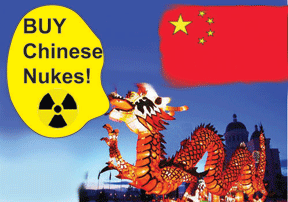 China confident of winning $80b S. Africa nuclear power bid
By Lyu Chang (China Daily): 2015-12-12 Industry officials are confident of China being the front-runner to win the right to build South Africa’s new generation of nuclear power stations.
“We think we are likely to win the bid, after preparing all the documents for the tender,” ZhengMingguang, head of the Shanghai Nuclear Engineering Research and Design Institute, ahigh-tech arm of the State Nuclear Power Technology Corp.
“The nuclear energy industry also involves other issues, so we can’t set any date yet on thefinal bidding process,” he said.
The country hopes to land the contract using its CAP1400 nuclear technology, which isdesigned by SNERDI and based on the AP1000 reactor technology developed by the UnitedStates-based Westinghouse Electric Co LLC.
South Africa currently operates the continent’s only nuclear power plant, near Cape Town, butthe country is currently facing chronic electricity shortages.
The Pretoria government invited tenders in July for an estimated $80 billion contract to buildfour nuclear reactors-the largest contract in the country’s history-which attractedwidespread interest, including from State Nuclear Power Technology Corp, Russia’s stateatomic agency Rosatom and French nuclear firms…….http://www.chinadaily.com.cn/business/2015-12/12/content_22695369.htm
France to spend billions on African renewable energy projects
 COP21: France to spend billions on African renewable energy projects Guardian, 1 Dec 15
François Hollande tells Paris climate summit that his government will double investments in wind, solar and hydropower to €2bn France plans to spend billions of euros in renewable energy and other environmental projects in its former west African colonies and across Africa over the next five years, President François Hollande said on Tuesday.
Africa produces little of the greenhouse gases such as carbon dioxide, produced by burning fossil fuels, linked by scientists to rapid climate change. But it is particularly vulnerable to a changing climate, as much of its population is poor, rural and dependent on rain-fed agriculture.
Hollande told a conference on Africa, held as part of climate change talks in Paris, that his government would double investments in renewable energy generation, ranging from wind farms to solar power and hydroelectric projects, across the continent to €2bn between 2016 and 2020……..
African leaders want the biggest polluting nations to commit to financing as part of contributions to an internationally administered Green Climate Fund, that hopes to dispense $100bn a year after 2020 as a way to finance the developing world’s shift towards renewables. http://www.theguardian.com/environment/2015/dec/01/cop21-france-to-spend-billions-on-african-renewable-energy-projects
Pope and Muslim leaders in call for climate action
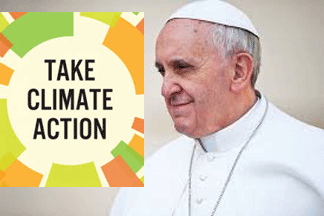 Pope Francis says failure of climate summit would be catastrophic, Guardian 26 Nov 15
Pope meets Muslim and other religious leaders in Nairobi to call for success at the Paris summit and for greater environmental protections in Africa. World leaders must reach a historic agreement to fight climate change and poverty at coming talks in Paris, facing the stark choice to either “improve or destroy the environment”, Pope Francis said in Africa on Thursday.
Francis chose his first visit to the world’s poorest continent to issue a clarion call for the success of the two-week summit, known as COP21, that starts on Monday in the French capital still reeling from attacks that killed 130 people and were claimed by Islamic State.
In a long address in Spanish at the United Nations regional office, Francis said it would be “catastrophic” if particular interests prevailed over the common good of people and the planet or if the conference were manipulated by business interests.
In Kenya, at the start of his three-nation Africa trip, the pope also said dialogue between religions was essential to teach young people that violence in God’s name was unjustified.
Bridging the Muslim-Christian divide and climate issues are major themes of the trip that also takes him to Uganda, which like Kenya has been a victim of extremist attacks, and the Central African Republic, a nation riven by sectarian conflict.
“We are confronted with a choice which cannot be ignored: either to improve or destroy the environment,” the pope said in Nairobi, home to the UN Environment Programme headquarters.
He noted that some scientists consider protection of the Congo basin tropical forest, which spreads over six countries and is the world’s second-largest after the Amazon, essential for the future of the planet because of its biodiversity.
Francis, who took his name from St Francis of Assisi, the patron saint of nature, has made protecting “God’s creation” a plank of his pontificate. In June, he issued a landmark encyclical calling for urgent action to save the planet……. http://www.theguardian.com/environment/2015/nov/26/pope-francis-says-failure-of-climate-summit-would-be-catastrophic
Did China dump nuclear trash in Northern Sudan?

 Sudan: Govt Urged to Investigate ‘Nuclear Waste Dumping’ http://allafrica.com/stories/201511170207.html Khartoum / Merowe — The Sudanese Parliament and the Communist Party of Sudan (CpoS) have called on the government to “immediately investigate the burial of nuclear waste” from China in the Northern State. The director of the governmental Dams Implementation Unit has strongly denied the “presence of containers with chemicals or harmful substances to Sudan from any other country”.
The former director of the Sudan Atomic Energy Commission in Sudan, Mohamed Siddig, said at a conference in Khartoum last Tuesday that 60 containers with nuclear waste were brought from China to Sudan during the construction of the Merowe Dam in the Northern State.
Siddig told the audience that 40 containers were buried in the desert not far from the Merowe Dam construction site. Another 20 containers were disposed of in the desert. He did not mention the date the waste was dumped, however China worked on the dam between 2004 and 2009. On Sunday, the spokesman for the caucus of the independent MPs, Mubarak El Nur, called for an immediate investigation into the alleged crime. The perpetrators should be brought to justice, he stressed.
The chairman of the Northern State’s parliamentary Services Committee, Ali Hassan Bateik, said that the northern MPs will also demand an investigation into the rapid rise of cancer and kidney failure in the region
Medics The medical contingent of the Communist Party demanded that the government disclose the exact sites of the 60 Chinese containers.
In a statement on Sunday, the doctors emphasise the need for holding those involved in the operation accountable: “Charge them with murder, and sentence them to maximum penalties”.
The medics also blame the government for keeping silent on the growing number of people in the area who suffer from kidney failure or cancer.
Rumours The director of the governmental Dams Implementation Unit, Jaafar Mohamed Hammad, however, strongly denied the “presence of containers with chemicals or harmful substances to Sudan from any other country”.
He told the Sudan News Agency (Suna) in Khartoum last week that he will take legal action “against those who spread the rumours” about the dumping of Chinese nuclear waste in the Northern State.
France’s effort to market nuclear technology to South Africa
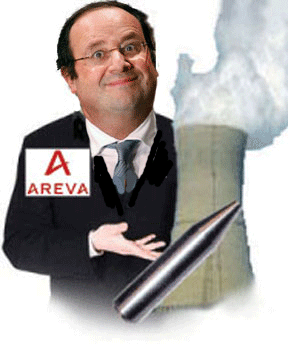 France seeks to win over SA on nuclear energy, Business Day, BY SISEKO NJOBENI, NOVEMBER 06 2015 AMID speculation about SA’s nuclear build programme, the French special envoy for the French-South African nuclear partnership Pascal Colombani is in the country punting his country for the highly anticipated programme.
During his two-day visit to the country, Mr Colombani is scheduled to have meetings “at the political level” as well with relevant public enterprises such as Eskom and the South African Nuclear Energy Co-operation (Necsa). However, he would not say who he was scheduled to meet in government.
“This is my first visit since I have been appointed by President (François) Hollande as his special envoy for the nuclear partnership with SA. Therefore, the overall purpose of my visit is to scale up our co-operation into a long-term strategic partnership in nuclear energy with SA,” Mr Colombani told Fin24.
He said France and SA shared ambitious goals for the development of nuclear energy, “which should become one key component of our strategic partnership”.
Mr Colombani said France was ready to scale up the co-operation between the two countries into a strategic long-term partnership, by supporting the development of SA’s new nuclear programme. Technology, training and safety were at the core of this partnership, he said……http://www.bdlive.co.za/business/energy/2015/11/06/france-seeks-to-win-over-sa-on-nuclear-energy
Pitfalls and huge costs make South Africa’s nuclear programme untenable
The nuclear build is a very risky exercise with numerous potential pitfalls. And there are alternatives. The shortfall in the projected nuclear capacity can be covered by a 50% larger than planned renewable energy investment. Wind and solar energy plants have been operationalised on schedule, and solar panel prices continue falling. The intermittence of renewable energy availability is considered manageable. Finally, energy saving strategies have yet to be fully explored.
 Why SA must abandon nuclear ambitions, The nuclear build is a very risky exercise with numerous potential pitfalls. And there are alternatives. Tech Central, By Hartmut Winkler, 6 Nov 15 It has been an eventful year in South Africa, characterised by power cuts, parliamentary confrontations about wasteful expenditure and student fee protests. There has, however, been an elephant in the room that has impacted all these issues but enjoyed surprisingly scarce attention. The idea, vigorously driven by government, is for the country to build nuclear plants with an expected price tag of R1 trillion.
This equates to 4 000 times the controversial costs to upgrade President Jacob Zuma’s Nkandla residence and 400 times the shortfall the tertiary education sector will experience in 2016 because of the freeze in university fee increases. Continue reading
The financial folly of South Africa’s nuclear power plan
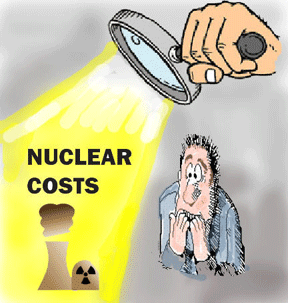 Why South Africa should not build eight new nuclear power stations, Mail &Guardian, 05 NOV 2015 HARTMUT WINKLER South Africa has plans to build new power stations despite many calling for no nuclear energy in the country. t has been an eventful year in South Africa, characterised by power cuts, parliamentary confrontations about wasteful expenditure and student fee protests. There has, however, been a massive elephant in the room that has impacted all these issues but enjoyed surprisingly scarce attention. The idea, vigorously driven by government, is for the country to build nuclear plants with an expected price tag of one trillion rand.
This equates to 4 000 times the controversial costs to upgrade President Jacob Zuma’s Nkandla residence and 400 times the shortfall the tertiary education sector will experience in 2016 because of the freeze in university fee increases………
In South Africa too the need for the continued inclusion of nuclear power in the energy mix was being reexamined. Continue reading
Urgent need for transparency on South Africa’s Integrated Energy Plan (IEP)
IEP 2015 must be tabled urgently: DA http://www.iol.co.za/news/politics/iep-2015-must-be-tabled-urgently-da-1.1938828#.Vjab-dIrLGg November 1 2015 By ANA Reporter Cape Town – The Democratic Alliance on Sunday urged Energy Minister Tina Joemat-Petterson to urgently table the integrated energy plan (IEP) 2015 so that it can be scrutinised in Parliament.
The IEP 2015 presently before Cabinet indicated that government planned not one but up to three R1 trillion nuclear deals by 2050, all the while acknowledging that procurement of nuclear could in fact be delayed until at least 2020, if not later, DA spokesman Gordon Mackay said in a statement.
“The DA therefore calls on Energy Minister Joemat-Petterson to table this IEP as a matter of urgency and allow Parliament to scrutinise this document and address the key issues within this plan.”
According to reports in the Sunday Times on Sunday morning, the proposed IEP nuclear-generating capacity would be expanded to between 12 and 20 times South Africa’s current installed nuclear capacity of 1830 MW, he said.
This effectively meant the energy department envisioned a series of large-scale nuclear deals over the next 20 years, despite ongoing and significant concerns on affordability by National Treasury and uncertainty as to the impact on the cost of electricity for ordinary South Africans, particularly the poor.
The purpose of the IEP was to provide a roadmap of the future energy landscape for South Africa to guide future energy infrastructure investments and policy development by providing a thorough analysis of competing technologies for the provision of sustainable and cost-effective electricity.
“Far from being a thorough assessment of competing technologies however, the IEP is nothing more than a slavish confirmation of the inevitability of the nuclear new build program and is the product of political interference by the ANC government into the terrain of energy planning,” Mackay said.
The IEP therefore failed to provide an assessment of a potential energy mix which excluded nuclear, despite the international energy landscape where major nuclear nations, such as Germany, France, and the US, were all reducing their reliance on nuclear in favour of cleaner and cheaper renewables and gas.
Further, the IEP argued for an energy mix biased towards a combination of large scale nuclear and large scale decentralised renewables, despite general international consensus that the two technologies were largely incompatible due to the variable nature of renewables electricity generation. “Furthermore, the scope for gas in the IEP has deliberately been limited in order to produce a ‘nuclear heavy’ energy roadmap. The IEP is way too conservative on the scope of gas within in the energy mix. Internationally, a number of gas producers are coming online and numerous new gas finds are being made across Africa. This will result in an increased availability of natural gas and the subsequent decrease in the price of natural gas,” he said.
Government should have used the IEP to aggressively pursue gas as an alternative energy form, which was far safer, cleaner, cheaper, and more job friendly compared to the use of the potentially politically motivated and unaffordable nuclear build programme.
“The DA remains fundamentally opposed to costly, secretive nuclear deals which have the real potential to destroy any prospects of future economic growth and job creation, and as such will not support government’s latest and unimpressive solution to the energy crisis in the form of the integrated energy plan,” Mackay said.
Tanzania: police raid Legal and Human Rights Center
After the elections in TANZANIA last Sunday, 25. Oct. 2015, the situation is not very good.
Among other things, we were informed that the LHRC – Legal and Human Rights Center, one of our partner NGOs in Tanzania and host of the 2013 Uranium Conference – has been raided by police, and – according to a newspaper article, staff has been arrested. http://www.thecitizen.co.tz/News/Police-raid-observers–office–arrest-staff/-/1840340/2935620/-/3i6896z/-/index.html
Earlier this week, offices of CHADEMA, the oppostion party, have obviously been raided by police
South Africa’s flawed and problematic Nuclear Environmental Impact Assessment (EIA)
 New nuke build: EIA problematic and flawed http://gctca.org.za/new-nuke-build-eia-problematic-and-flawed/BY GAVIN, ON OCTOBER 28TH, 2015 As South Africa contemplates building nuclear power stations along the coast, the Environmental Impact Assessment (EIA) consultants, GIBB, are holding public meetings to discuss their recently released draft report. The proposed nuclear builds are in Thyspunt (80 km outside Port Elizabeth) and Duynefontein (next to Koeberg, 30 km outside Cape Town).
“Thyspunt is the preferred site for Nuclear 1,” says Gary Koekemoer from NoPEnuke, “and no public meetings were scheduled for the Nelson Mandela Bay area thereby excluding 1.1-million citizens from this process. Further, it is our view that the current EIA process is fundamentally flawed with key information excluded.”
This EIA is the third draft published over eight years and was made available for scrutiny by GIBB consultants at the end of September. “The draft is a 40,000 page document and a quick count of words in the appendices making up the specialists’ reports alone showed that one would have to read around 90,000 words a day just to skim read it all before the public meetings were held,” says Peter Becker from the Koeberg Alert Alliance.
Widespread dissatisfaction has been expressed from many stakeholders around the limited time period allowed for public participation.
At the meetings, GIBB condensed their findings into a simplified scoring system for risks with ratings of Low, Moderate, High, or Fatally Flawed. “The scoring system is inadequate,” says Dr. Piet Human, project leader at the Bantamsklip Organisation. “The scores do not have a scientific or quantitative basis; what is ‘high’ for one may be ‘medium’ for another scientist. This subjectivity is then further compounded by the scores given by GIBBS.”
Becker describes a hypothetical scenario: “If the consultants found that there was a 51% chance that the new nuclear plant would explode catastrophically in the first year of operation, this would not result in a scoring of Fatally Flawed. Their recommendation in this case would be ‘Project can be authorised but with strict conditions and high levels of compliance and enforcement’.”
Bantamsklip was one of the three proposed nuclear sites alongside Thyspunt and Duynefontein but has now been excluded from this Nuclear 1 EIA. However, it remains a viable site for subsequent nuclear builds. A petition of over 10,000 signatures opposing the nuclear build was handed to the GIBB consultants at the Gansbaai meeting.
“We have only had time to look at one specialist report thus far,” continues Dr. Human, “and we reviewed the Social Impact Assessment which is problematic. The technical, scientific and professional credibility of the report is questionable as it uses outdated data, excludes HIV and Gender Related Issues (a new requirement for all large-scale EIA’s in South Africa), and does no comparative analysis of the three sites nor uses recent experiences with large projects such as Medupi.”
The biggest concerns of those in attendance at the meetings included the risk of a catastrophic nuclear accident and the evacuation plan, the environmental impact of radiation leaks into the sea, land or groundwater, the economic impact to the regions concerned owing to the negative perceptions of a nuclear facility in proximity to large-scale business concerns, costs (and the accompanying corruption), political instability and the risk of terrorism, and the massive problem of accumulating high level nuclear waste.
“The decision to build a nuclear plant must be taken with extreme care,” says Koekemoer. “We are concerned that in the gold rush of unsubstantiated promises of development and jobs we have been blinded to Thyspunt’s true value and potential as a significant local and global heritage area.
“Nuclear is not necessary,” he continues. “Renewables are making a significant contribution to our region. In our haste we are only servicing vested interests and it is a decision our grandchildren would shake their heads at.”
Becker concludes, “The GIBB consultants have a legal responsibility to put all the pertinent facts before the decision makers in a complete, unbiased and quantified way in the EIA report. Failing to do so can lead to criminal prosecution in their personal capacities.” There is concern from stakeholders that GIBB is trying to push through this flawed EIA with only token public participation.
The Sea Vista meeting for public participation in St Francis Bay will take place in early November, dates are not yet finalised. The Humansdorp meeting has been rescheduled due to public demand for more time needed and meetings in Nelson Mandela Bay have also been requested but are unconfirmed at this stage.
Submissions may be emailed to nuclear1@gibb.co.za. The full draft EIA report can be found at http://projects.gibb.co.za/en-us/projects/eskomnuclear1reviseddrafteirversion2 and more information can be found at http://koebergalert.org, http://bantamsklip.org andhttp://noPEnuke.co.za.
Small scale solar power opens up big future for millions in Tanzania
“People who have small shops no longer close their shops early because they don’t have electricity. They can now operate until late at night. The availability of solar electricity has helped control immigration of people to urban areas,” says alternative energy specialist Dr Brenda Kazimili at the University of Dar es Salaam.
The government now wants all health centres and dispensaries that are not connected to the grid countrywide to be provided with solar panels.
How Tanzania plans to light up a million homes with solar power, Guardian, Erick Kab
endera, 29 Oct 15, In a country where only 40% of people have access to grid electricity, the government is looking to sunshine to power health centres and homes efore solar panels were installed at Masaki village’s only health centre, doctors, nurses and midwives had to use dim flashlights or the glow from their cellphones to deliver babies and treat night-time emergencies.
In one case in 2010, a man arrived late after a motorcycle accident and needed a wound stitching. As the nurse began the procedure by the light of her torch, she felt a cold slithering sensation against her legs.
A large black snake was moving across the dark, cement floor. The nurse fled, leaving the patient in the dark with the snake.
The work of the centre, which is five hours drive down a dirt track from the capital Dar es Salaam and serves a population of 1.5 million people in surrounding villages, is now transformed by a two kilowatt solar array installed on the roof at a cost of $15,000 (£9,700). And the government wants many more like it.
In February, it launched its One Million Solar Homes initiative to provide the sun’s power to 1m properties by 2017. Off Grid Electric, the Tanzanian company implementing the initiative, says it will provide power to 10% of the country’s homes. Currently, only 40% have access to grid power with access particularly sparse in rural areas.
The challenge across Africa is daunting. ……
Funding for the million homes initiative has come partly from the government’s Rural Energy Agency – which spends $400m a year – and international donors such as the World Bank. And in rural areas, microfinance organisations are now lending to allow householders to by solar panels. The total installation can cost up to $1,000.
“People who have small shops no longer close their shops early because they don’t have electricity. They can now operate until late at night. The availability of solar electricity has helped control immigration of people to urban areas,” says alternative energy specialist Dr Brenda Kazimili at the University of Dar es Salaam.
The government now wants all health centres and dispensaries that are not connected to the grid countrywide to be provided with solar panels.
Back at Masaki village health centre, the changes were much needed. “We’d begged for so long for solar power at this health centre. Life was unbearable here. We faced so many challenges and it was hard to work at night or do tests that required electricity,” said clinical officer Ahmed Mkamba.
“[Now] we have even installed a satellite dish to keep the health workers entertained after work. Mothers no longer have to be sent to far-away health centres to conduct simple tests and health workers don’t have to walk long distances simply to charge mobile phones.”
Health workers use the power from the solar panels (and the battery installed so that they can use the power at night) to run a computer which keeps patient records, to light the centre’s compound which covers about three or four acres of land and to operate HIV/Aids testing equipment. This means that patients no longer need to be sent to the district hospital 28km away.
And says Mkamba: “The lights keep away the snakes.” http://www.theguardian.com/environment/2015/oct/29/how-tanzania-plans-to-light-up-a-million-homes-with-solar-power
South Africa’s Flawed Environmental Assessments for New Nuclear Build
 New nuke build: EIA problematic and flawed As South Africa contemplates building nuclear power stations along the coast, the Environmental Impact Assessment (EIA) consultants, GIBB, are holding public meetings to discuss their recently released draft report. The proposed nuclear builds are in Thyspunt (80 km outside Port Elizabeth) and Duynefontein (next to Koeberg, 30 km outside Cape Town).
“Thyspunt is the preferred site for Nuclear 1,” says Gary Koekemoer from NoPEnuke, “and no public meetings were scheduled for the Nelson Mandela Bay area thereby excluding 1.1-million citizens from this process. Further, it is our view that the current EIA process is fundamentally flawed with key information excluded.”
This EIA is the third draft published over eight years and was made available for scrutiny by GIBB consultants at the end of September. “The draft is a 40,000 page document and a quick count of words in the appendices making up the specialists’ reports alone showed that one would have to read around 90,000 words a day just to skim read it all before the public meetings were held,” says Peter Becker from the Koeberg Alert Alliance.
Widespread dissatisfaction has been expressed from many stakeholders around the limited time period allowed for public participation.
At the meetings, GIBB condensed their findings into a simplified scoring system for risks with ratings of Low, Moderate, High, or Fatally Flawed. “The scoring system is inadequate,” says Dr. Piet Human, project leader at the Bantamsklip Organisation. “The scores do not have a scientific or quantitative basis; what is ‘high’ for one may be ‘medium’ for another scientist. This subjectivity is then further compounded by the scores given by GIBBS.”
Becker describes a hypothetical scenario: “If the consultants found that there was a 51% chance that the new nuclear plant would explode catastrophically in the first year of operation, this would not result in a scoring of Fatally Flawed. Their recommendation in this case would be ‘Project can be authorised but with strict conditions and high levels of compliance and enforcement’.”
Bantamsklip was one of the three proposed nuclear sites alongside Thyspunt and Duynefontein but has now been excluded from this Nuclear 1 EIA. However, it remains a viable site for subsequent nuclear builds. A petition of over 10,000 signatures opposing the nuclear build was handed to the GIBB consultants at the Gansbaai meeting.
“We have only had time to look at one specialist report thus far,” continues Dr. Human, “and we reviewed the Social Impact Assessment which is problematic. The technical, scientific and professional credibility of the report is questionable as it uses outdated data, excludes HIV and Gender Related Issues (a new requirement for all large-scale EIA’s in South Africa), and does no comparative analysis of the three sites nor uses recent experiences with large projects such as Medupi.”
The biggest concerns of those in attendance at the meetings included the risk of a catastrophic nuclear accident and the evacuation plan, the environmental impact of radiation leaks into the sea, land or groundwater, the economic impact to the regions concerned owing to the negative perceptions of a nuclear facility in proximity to large-scale business concerns, costs (and the accompanying corruption), political instability and the risk of terrorism, and the massive problem of accumulating high level nuclear waste.
“The decision to build a nuclear plant must be taken with extreme care,” says Koekemoer. “We are concerned that in the gold rush of unsubstantiated promises of development and jobs we have been blinded to Thyspunt’s true value and potential as a significant local and global heritage area.
“Nuclear is not necessary,” he continues. “Renewables are making a significant contribution to our region. In our haste we are only servicing vested interests and it is a decision our grandchildren would shake their heads at.”
Becker concludes, “The GIBB consultants have a legal responsibility to put all the pertinent facts before the decision makers in a complete, unbiased and quantified way in the EIA report. Failing to do so can lead to criminal prosecution in their personal capacities.” There is concern from stakeholders that GIBB is trying to push through this flawed EIA with only token public participation.
The Sea Vista meeting for public participation in St Francis Bay will take place in early November, dates are not yet finalised. The Humansdorp meeting has been rescheduled due to public demand for more time needed and meetings in Nelson Mandela Bay have also been requested but are unconfirmed at this stage.
Submissions may be emailed to nuclear1@gibb.co.za. The full draft EIA report can be found at http://projects.gibb.co.za/en-us/projects/eskomnuclear1reviseddrafteirversion2 and more information can be found at koebergalert.org, bantamsklip.org andnoPEnuke.co.za.
1 This Month

of the week – Shut Down Drone Warfare!


Tell the Ukrainian Government to Drop Prosecution of Peace Activist Yurii Sheliazhenko

Petition to revoke the licensing of the Near Surface Nuclear Disposal Facility (NSDF) at Chalk River. https://www.ourcommons.ca/petitions/en/Petition/Details?Petition=e-7247
To see nuclear-related stories in greater depth and intensity – go to https://nuclearinformation.wordpress.com
-
Archives
- April 2026 (68)
- March 2026 (251)
- February 2026 (268)
- January 2026 (308)
- December 2025 (358)
- November 2025 (359)
- October 2025 (376)
- September 2025 (257)
- August 2025 (319)
- July 2025 (230)
- June 2025 (348)
- May 2025 (261)
-
Categories
- 1
- 1 NUCLEAR ISSUES
- business and costs
- climate change
- culture and arts
- ENERGY
- environment
- health
- history
- indigenous issues
- Legal
- marketing of nuclear
- media
- opposition to nuclear
- PERSONAL STORIES
- politics
- politics international
- Religion and ethics
- safety
- secrets,lies and civil liberties
- spinbuster
- technology
- Uranium
- wastes
- weapons and war
- Women
- 2 WORLD
- ACTION
- AFRICA
- Atrocities
- AUSTRALIA
- Christina's notes
- Christina's themes
- culture and arts
- Events
- Fuk 2022
- Fuk 2023
- Fukushima 2017
- Fukushima 2018
- fukushima 2019
- Fukushima 2020
- Fukushima 2021
- general
- global warming
- Humour (God we need it)
- Nuclear
- RARE EARTHS
- Reference
- resources – print
- Resources -audiovicual
- Weekly Newsletter
- World
- World Nuclear
- YouTube
-
RSS
Entries RSS
Comments RSS
 nuclear-news