Russia looks to nuclear colonise Africa
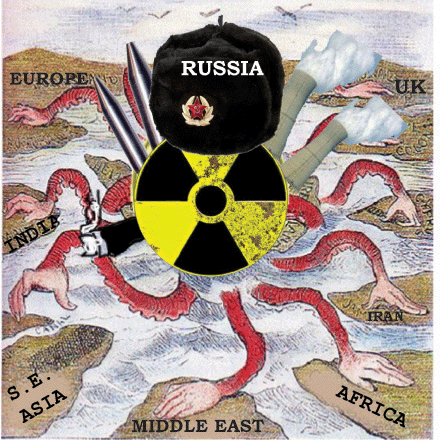 Russia’s Rosatom seeks cooperation agreements for African nuclear expansion By Wendell Roelf CAPE TOWN (Reuters) 20 May 16, – Russia’s state nuclear agency Rosatom plans to sign cooperation agreements with Kenya, Uganda and Zambia to lay the groundwork for an expanded presence in Sub-Saharan Africa beyond its planned bid to build nuclear power plants in South Africa.
Rosatom has voiced confidence in its ability to see off competition from China, France and South Korea in a planned South African tender to build a 9,600 megawatts (MW) nuclear power fleet in the continent’s most industrialised country. It sees scope, however, for more deals across the region, from the building of plants to supplying reactor fuel……
Victor Polikarpov, Rosatom’s regional vice-president for Sub-Saharan Africa, said on Thursday.
“We want South Africa to become our springboard for the rest of Africa. We want to create a nuclear cluster, a group of companies here that can operate with us in Africa.”
President Jacob Zuma’s government was checking the financial and commercial impact of its nuclear ambitions before it issues a tender.
South Africa’s 1,800 MW Koeberg station near Cape Town is the continent’s only commercial nuclear power plant at present, though Rosatom is building a nuclear plant in Egypt that is expected to be completed by 2022.
Meanwhile, South Africa’s nuclear energy corporation Necsa is being encouraged by government to revive nuclear enrichment and conversion facilities to reduce dependence on imported reactor fuels……
Rosatom’s Polikarpov, however, said it might not be viable for South Africa to restart enrichment facilities dismantled before white minority rule ended in 1994.
“Another solution is just to have fuel supplied from Russia. We can guarantee supply of fuel non-stop for the duration of operation of all power plants,” he said.
Nigeria, however, looks a more distant prospect as its economy contracts amid the global plunge in oil prices.
“Given the extremely bad economic situation in Nigeria today, it might take a bit longer. But the government and the new president are still determined to go nuclear,” Polikarpov said.
(Editing by James Macharia and David Goodman) http://af.reuters.com/article/investingNews/idAFKCN0YA1CH
Russia plans for Africa to be its nuclear colony, starting with south Africa
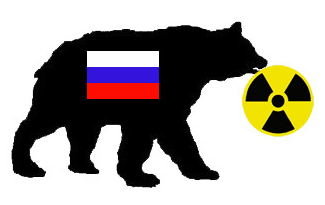
 How Russia Is Expanding Its Vast Nuclear Empire Into Africa, AFK Insider By Dana Sanchez May 19, 2016, Russia’s government-owned nuclear agency Rosatom hopes to use South Africa as a springboard into the rest Africa as it seeks to expand its influence on the continent by building nuclear power plants.
Rosatom plans to sign framework cooperation agreements with Kenya, Uganda and Zambia, adding to those already made with South Africa, Nigeria and Ghana, Reuters reported.
Right now, South Africa may be the best prospect. Nigeria looks less likely as its economy contracts in the global oil price plunge.
“Given the extremely bad economic situation in Nigeria today, it might take a bit longer. But the government and the new president are still determined to go nuclear,” said Viktor Polikarpov, Rosatom’s vice-president of sub-Saharan Africa.
South Africa in 2015 approved a plan to develop up to 600 megawatts of nuclear capacity by 2030 as part of a bigger plan to build 9,600 megawatts of nuclear power at up to nine new nuclear reactors……
Environmental activist group Greenpeace warned the ANC in 2015 to abandon nuclear build plans or face massive resistance, NuclearNews reported.
“The ANC needs to know that if it does go for the nuclear option as part of the (energy) mix, then they are on a collision course with the broader spectrum of the South African civil society,” said Greenpeace Director Kumi Naidoo said on Monday that the ANC should “take nuclear off the table.
Russia has competition to do the nuclear build from China, France and South Korea, Reuters reported. It’s already planning to seek more deals across the region that range from building power plants to supplying reactor fuel.
“What we are targeting is to build South Africa as a nuclear cluster of nuclear industries so that we can use our partners and our partnership for our expansion into Africa,” Polikarpov said in an interview Tuesday in Cape Town.
Rosatom can offer financing options, Polikarpov said, according to Bloomberg. These include a contract with a state-export credit offered to the government of South Africa, a buyer-owner operator agreement, a public-private partnership, or a combination of them…….
The allure of the turnkey nuclear power plant, built, owned and operated by Rosatom, allows governments across the world to embrace such projects. But for Russia they are much more than a major economic export. They are another geopolitical tool, allowing the Kremlin to tie up strategic governments into long-term cooperation. http://afkinsider.com/126032/how-russia-is-expanding-its-vast-nuclear-empire-into-africa/
South Africa: renewable energy growth, promise that nuclear development will be “corruption-free”
South Africa targets more renewable power, nuclear expansion to go ahead
*Renewable energy seen contributing 17,800 MW by 2030
* Nuclear expansion process to be affordable, above board
Africa’s most industrialised country has turned to solar and wind power to diversify its energy mix and help plug electricity shortages. The first 47 renewable energy independent power producers are due to be fully operational by July.
It also hopes to install 9,600 megawatts of nuclear power in the next 15 years to address chronic electricity shortages but the cost of the project estimated at about $100 billion has raised budgetary concerns.
Tina Joemat-Pettersson reaffirmed in parliament that the planned nuclear expansion would be “corruption free”, following concerns by opposition parties over the tender process and about the affordability of the project in a country whose economic growth has stagnated.
The department of energy would issue a request for proposal to confirm market appetite for the fleet of nuclear plants and help secure commercial and financial information for the government to make a final decision, she said.
“We will only implement what our country can afford,” Joemat-Pettersson said.
Forecasts for growth in South Africa have fallen to below 1 percent for 2016 as a global commodity slump drags on and rising inflation rates curb domestic spending.
South Africa Dept of Energy to press on woth nuclear power despite huge costs
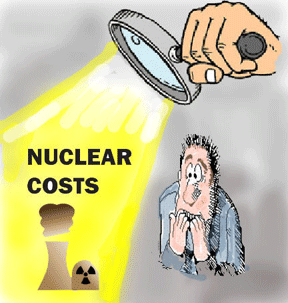 Department of energy presses ahead with nuclear, Business Day Live, BY BEKEZELA PHAKATHI, 10 MAY 2016 THE Department of Energy said on Monday it was still confident of conducting a successful nuclear-procurement process.
SA is aiming to install 9,600MW of nuclear power within the next 15 years to tackle the electricity shortages. However, the cost of the project, estimated at about $100bn, continues to be a major budgetary headache for government.
Earlier this year, the Treasury put brakes on nuclear spend, putting more emphasis on gas and smaller coal-fired power stations to attend to the electricity crisis. It said in its budget review that the nuclear energy newbuild programme would proceed after a “thorough and transparent tender process”.
There have been reports that the Treasury’s reluctance to sanction the procurement of the new nuclear power stations was one of the major reasons behind the sacking of Nhlanhla Nene as finance minister in December.
The National Nuclear Regulator expects to finalise a decision by 2018 on Eskom’s two new site licence applications. ……http://www.bdlive.co.za/business/energy/2016/05/10/department-of-energy-presses-ahead-with-nuclear
No to Nuclear Energy in Nigeria
Nigeria: Say No to Nuclear Energy in Nigeria AllAfrica, 1 May 16“…..Nigeria’s history of disaster management or maintenance culture in the past and the present has much to be desired of, so how can it want to project into a future of nuclear energy with all the attendant risk.
It does not take an expert in Nuclear energy to be able to state basic obvious facts that are glaring. Any major mishap involving radiation leaks from nuclear energy can lead to a disaster of catastrophic proportion that could lead to thousands of death, long term health problems, spikes in cancer incidents and birth defects. The devastation of a nuclear disaster in a highly populated country like Nigeria would send shock waves around the world. A breach in the nuclear containers of a nuclear reactor or a nuclear meltdown would release nuclear materials into the atmosphere and ground and could literally obliterate parts of the country and turn them into waste lands and “ghost lands”.
No matter how prepared even the extremely prepared and efficient countries are, in a case of a nuclear disaster they can only try to mitigate the damage, so what chance would Nigeria have if a nuclear melt down were to occur in the country. Even if the argument is that the likelihood of a nuclear disaster is minuscule, should Nigeria of today, the way it is, subject its people to that risk? The risk out weighs the benefit.
 Was it not in Koko, Delta State, that someone shipped in containers of nuclear waste?
Countries try to get rid of their radio-active waste, yet a Nigerian shipped it into his country and dumped it amongst his people. The community, struggling under their daily routine for survival did not sense the eminent danger and instead opened up the containers, used them to collect water and for other domestic use. By the time the government brought it to public knowledge, the people in the affected area of Koko had been exposed to radiation. When scientist came with Geiger counters to measure the amount of radiation in the area and also on the people, a lot of them did not understand what was going on and had little understanding of the dangers of nuclear radiation. Have the people of Koko been followed? Have longitudinal studies been done on their health status? Were children born in that area since the episode monitored? Is the soil in that area still being tested regularly or have the people of Koko been forgotten? These are but a few of the questions…….
Nigeria is blessed with sunshine; it can invest in solar energy. It has vast areas of empty flat land so it can invest in wind energy by using turbines……..http://allafrica.com/stories/201605010001.html
Russian nuclear corporation Rosatom to “educate” South Africans on benefits of nuclear power
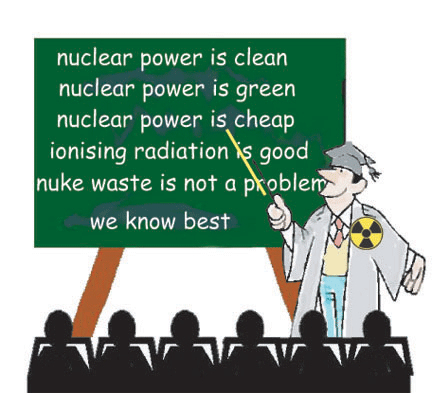
 ROSATOM TO GROW PUBLIC AWARENESS ON NUCLEAR ENERGY, Eyewitness News, The Russian atomic energy company faces strong resistance from environmental lobbyists in SA. Rahima Essop 21 Apr 16 CAPE TOWN – Rosatom says it has to ‘gradually grow public awareness and acceptance’ about nuclear energy as the Russian atomic energy company faces strong resistance from environmental lobbyists and opposition politicians in South Africa.
Two organisations have challenged the legality of government’s proposed 9,600 MW nuclear build programme in court before Energy Minister Tina Joemat-Pettersson calls for quotes for the tender.
Rosatom is said to be on the inside track for the contract.
The Democratic Alliance (DA), meanwhile, is pushing for the project to be abandoned on the basis that it’s unaffordable and shrouded in secrecy.
Rosatom has billed nuclear as a cheap source of energy and a job-creating solution for the country.
The company, which is building 34 reactors across the globe, is hoping to influence South African perceptions about nuclear…….Rosatom has sponsored a press trip to Hungary. http://ewn.co.za/2016/04/21/Rosatom-to-gradually-grow-public-awareness-on-nuclear-energy
In Tanzania, distributed solar power not only for home lighting, now for business, too
 Solar panels power business surge – not just lights – in Tanzania BY KIZITO MAKOY UKARA, Tanzania (Thomson Reuters Foundation) 19 Apr 16 –
“………SOLAR STEPS UP
Around the world, as the costs of solar energy plunge, it is increasingly being used to power industry and businesses, a huge step forward from simply supplying lighting and basic electrical power in places like Tanzania, experts say.
Nyakalege, for instance, now uses solar power to operate his three milling machines simultaneously. He has employed three people to help him and has seen his customer base rise to 600 a day…….
The solar system at Bwisya is part of a project to provide reliable and affordable electricity to the nearly 2,000 households and more than 200 businesses on Ukara, in order to boost opportunities to earn an income.
It is the first of 30 such systems JUMEME plans to install over the next two years. They are expected to supply power to around 100,000 people, company officials said.
The company has even bigger plans for the longer-term, they said.
“Our goal is to set up 300 systems and serve up to 1 million people in rural areas across Tanzania by 2022, making JUMEME the largest mini-grid operator in the country,” said Thadeus Mkamwa, one of the company’s directors.
The project, jointly funded by the European Union and private investors with political support from the Tanzanian government , has a total budget of 38.4 billion shillings ($17.6 million), Mkwama said.
PRE-PAID SOLAR POWER
In Bwisya, the largest village on Ukara, 250 customers are due to be connected to a hybrid power station consisting of a 60-kilowatt (KW) solar photovoltaic system and a 240 KW-hour battery bank. A diesel generator provides back-up.
The system will be extended in the second half of this year to connect the other villages on the island, Mkamwa said.
The installation charges for individual homes and business are repaid by customers in installments. Consumers pre-pay for their power, with costs per unit depending on the amount of electrical equipment they use…….http://www.reuters.com/article/us-tanzania-solar-energy-idUSKCN0XG1VX
Western Kenya’s solar minigrids – a rural electricity solution
A solar minigrid for 100 villages in Western Kenya, Clean Leap by DAVID KARIUKI Mar 19th 2016, Scalable solar mini grids will continue to play a major role in the rural electrification agenda in developing countries in the future. This will be fueled by the increased entry of private players into the field, and the change of regulations in respect to generation and supply of power from scalable mini grid solutions. These two are already being witnessed in Kenya. This year, Kenya is witnessing a major solar micro-grid project expected to demonstrate exactly how these power solutions can fit in rural electrification agenda now that the country is targeting 100% electricity access by 2030. The project is notable as it marks the first scalable community micro grid project since last year’s granting of the first utility concession for off-grid power supply…….

Murder of South African activist: Australian mining company denies involvement
Australian mining company denies role in murder of South African activist
Campaigners claim death of Sikhosiphi Rhadebe is an escalation of violence against opponents of a mine owned by Perth’s Mineral Commodities Limited, Guardian, Joshua Robertson, 25 Mar 16 An Australian-owned mining company has denied any link to the murder of an activist leading a campaign against its plans to mine titanium in South Africa.
Sikhosiphi “Bazooka” Rhadebe was gunned down at his home in Xolobeni on South Africa’s Wild Coast on Tuesday, in what fellow activists claimed was an escalation of violence and intimidation against local opponents of a mine owned by Perth-based Mineral Commodities Limited (MRC).
MRC, which has repeatedly denied inciting violence involving its supporters, said it was “in no way implicated in any form whatsoever in this incident”.
Mzamo Dlamini is a fellow activist who believes he is among the “prime targets” on the anti-mining Amadiba crisis committee following Rhadebe’s death.
Despite fearing for his life, Dlamini vowed to continue organising resistance to a project that campaigners said would force the relocation of an estimated 100 households and up to 1,000 people.
“The assassination affects us all,” he said. “There will be more Bazookas long after we have died.”
Six people associated with the mining venture were subject to court orders last May after a clash over land access, during which a TEM director fired a “warning shot” in the air.
Four people, including an alleged employee of another MRC mine at Tormin, are due to face court next month over alleged assault and intimidation, including with firearms, of mining opponents in Xolobeni in December. These allegations are yet to come before a court and there is no suggestion these or any other employees were involved in Rhadebe’s murder……..
Lawyer Henk Smith of the Legal Resources Centre, which has acted for landholders opposing MRC’s Tormin mine, said the killing of Rhadebe, a “principled democrat”, had likely ended the prospect of conciliation meetings between the miner and its opponents.
“I think the company has made a few statements condemning the violence but it comes after the event and the company has never taken any steps to encourage conciliation or mediation or consultation even a meeting,” Smith said.
“In fact the company shies away from meeting the community which as a result, there’ll be little chance of simply starting a process of meetings now.
“For the rest, they’ve got [to] swallow what the company offers.” http://www.theguardian.com/environment/2016/mar/25/australian-mining-company-denies-role-in-of-south-african-activist
New proof that South Africa planned a binding nuclear deal with Russia
 SA planned binding nuclear deal with Russia, Business Day BY CAROL PATON, 31 MARCH 2016, NEW proof has emerged that SA intended to sign a binding deal with Russia to buy a fleet of nuclear reactors, bypassing public finance management rules along the way.
This is contained in court papers lodged on Wednesday by the Southern African Faith Communities Environmental Initiative and Earthlife Africa in the High Court in Cape Town.
The lobby groups, which are asking the court to declare the inter-governmental agreements on nuclear energy signed in 2014 unlawful, secured the new information through court processes that compelled the government to provide the record of decisions on the deal.
Among the records provided is an explanatory memorandum drafted by the state law adviser in November 2013 on the draft Russian deal, which makes clear — they say — that the deal was “intended” and was “understood as creating a firm commitment that Russia would construct the required nuclear plants in SA”.
The state law adviser’s memo has been long sought by the media and opponents of the forthcoming nuclear procurement as it was widely rumoured at the time that the office had given a strong warning that the proposed agreement was binding in nature, had budgetary implications and had to be debated publicly before it could be adopted.
Asked at the time to comment, chief state law adviser Enver Daniels refused, citing client confidentiality……..http://www.bdlive.co.za/business/energy/2016/03/31/sa-planned-binding-nuclear-deal-with-russia
South Africa and the madnessof its nuclear build programme
The madness of the nuclear build programme http://www.rdm.co.za/politics/2016/03/29/the-madness-of-the-nuclear-build-programme
Nuclear vendors are loathe to submit to a competitive tendering process based on a long-term, fixed-priced contract ANTON EBERHARD 29 MARCH 2016 IT IS time for the gloves to come off. The onus is on those who support the procurement of nuclear power stations to demonstrate that this initiative is not corrupt and will not be ruinous for the economy.
We face a possible credit rating downgrade to junk, which will make us all poorer: it will cost a lot more to service our debt, there will be less money for social programmes, the rand will fall even further, and inflation will rise.
Yet some still promote a huge nuclear programme that is not needed, that is more expensive and risky than alternative energy sources, that is hard to finance, and that will create contingent liabilities for the Treasury when we can least afford them.
SA does not need to procure large chunks of new power now. Electricity demand is not growing: it’s falling, and is lower than it was a decade ago. Depressed economic activity is partly the reason, but it’s not the most important one.
Electricity and economic growth data no longer track each other. The size of SA’s economy has continued to increase, albeit slowly, but electricity consumption has headed in the opposite direction. Countries such as Australia have seen a similar decoupling of energy and economic growth.
Could electricity demand in SA rebound if economic growth revives? Do we need to cater for depressed electricity demand as a result of Eskom supply constraints? Possibly. But we also need to recognise that there are profound changes to the energy-intensity of our economy, as smelters and mines close. The structure of our economy is changing. A fourfold increase in electricity prices in the past decade has accelerated energy-efficiency investments and energy conservation.
Official electricity demand forecasts and plans are obsolete. If demand for electricity were to reignite, it would fire off a lower base, and the rate of growth would be lower. When we project demand forward to 2030 or beyond, it’s obvious that we need a lot less power than was forecast in the Integrated Resource Plan of 2010 (the basis for the 9600MW nuclear commitment).
But we also need to replace old coal power plants, and compensate for the decline in the performance of Eskom’s existing power stations. I’ve taken all these arguments into account, and calculate that we need about 17GW of new electricity generating capacity by 2030. Some may calculate a slightly different number, but the required capacity will be close to this.
We have already ordered more power than we need by 2030. The new Eskom Medupi and Kusile coal power stations will add 9.6GW; its Ingula pumped storage scheme, 1.3GW. Two peaking power stations — Desisa and Avon, ordered by the Department of Energy — will add 1GW.
Contracted industrial co-generation and the department’s coal independent power producers (IPPs) will each add 1GW, with plans for more. In addition, 92 projects, totalling 6,347MW, have been contracted in the first four rounds of the department’s renewable energy IPP programme. Granted, this is intermittent power and will need to be complemented by gas power plants that the department plans to procure this year. More than 3GW are in the pipeline.
In the meantime, SA has negotiated 2.5GW of hydro power from the Inga 3 development in the Democratic Republic of Congo, and is considering further hydro imports from the region.
Together, these power procurements exceed what we need in the next 15 years.
Our cheapest sources of power are now wind and solar energy. The Department of Energy has awarded long-term, fixed-price contracts for wind energy as low as 57c/kWh, far below Eskom’s average cost of supply. Renewable energy combined with gas power can offer reliable base load supply at less than R1/kWh. Imported hydro and coal IPPs will also beat this.
I challenge any nuclear power vendor to sign a long-term power contract at less than R1/kWh. Whenever I ask them what nuclear power will cost in the country, they say “it depends”, and “it will need to be negotiated”.
This is the point: nuclear vendors are loathe to submit to a competitive tendering process based on a long-term, fixed-priced contract in which they take the risks of construction time and cost overruns. But all the other energy technology providers are prepared to do so. This has been the basis of the success of the IPP programme that has delivered such spectacular investment outcomes and price certainty for consumers. So why would we opt for a nuclear procurement programme that aims only to select a strategic partner, with subsequent price negotiations that have uncertain outcomes?
Nuclear power plants are also hard to finance. A couple of years ago in Davos, President Jacob Zuma was asked how 9,600MW of nuclear power would be financed. His answer, remarkably, was: “I’ll speak to my finance minister.”
He would have had that conversation by now and it will be clear that there is no fiscal space to finance a programme that will cost more than a half-a-trillion rand, when we raise just more than a trillion rand annually in taxes to fund all SA’s needs. Debt financing is now the fastest-growing component of the national budget and interest payments are more than twice the spend on higher education.
Our traditional mechanisms for funding power investments are also constrained. Eskom’s balance sheet is stressed, and it is struggling to raise sufficient debt on private capital markets to complete Medupi and Kusile. It has no possibility of raising finance for even one nuclear power station.
The private sector will not finance a nuclear plant in SA. The only possibility is funding from nuclear vendor countries. France will struggle: its nuclear company, Areva, is technically bankrupt and its latest UK nuclear contract — at £92.50/MWh (R2/kWh) — would be unaffordable for us.
Russia will not be able to finance all of its nuclear ambitions. China is a possibility, but financing will need to be backed by a long-term contract with an agreed electricity tariff, and the government will have to provide a sovereign guarantee and insurance cover, which will add contingent liabilities to the Treasury that will hasten a credit rating downgrade.
Eskom’s management recently expressed interest in further investments in large coal and nuclear projects. Its big coal, big nuclear, and big networks strategy is Neanderthal. Why would SA want to go down this route? It’s irrational. SA’s economic situation is precarious. The government now needs to act in concert and remove uncertainty about this nuclear folly. We don’t need it, it is too expensive, and we cannot afford it.
• Eberhard is a professor at the University of Cape Town’s Graduate School of Business
Once again, access to South Africa’s nuclear documents is denied
Access to nuclear documents denied once again http://www.bdlive.co.za/business/energy/2016/03/22/access-to-nuclear-documents-denied-once-again BY LINDA ENSOR, 22 MARCH 2016 ENERGY Minister Tina Joemat-Pettersson has turned down an appeal by the Open Democracy Advice Centre (Odac) against her department’s refusal to grant access to sensitive documents relating to government’s nuclear procurement plans.

The centre — acting on behalf of Business Day — used the Promotion of Access to Information Act (Paia) last year to request access to three reports relating to the estimated cost of building 9,600MW nuclear plants. The reports on nuclear-procurement models, the cost of nuclear plants and financing models were compiled for the department by three international consultancies — KPMG, Ingerop and Deloitte.
Former Business Day editor Songezo Zibi, speaking last year after the application was lodged, said the newspaper had “reason to believe that the cost studies the department does not want the public to see until it is too late in the process, show that 9,600MW of nuclear will be unaffordable”.
The affordability of the nuclear plans has become even more concerning given the financial straits government finds itself in. But the Treasury has insisted that it will approve only what is affordable.
The energy department rejected the original Paia request, saying the documents were classified as secret and would not be made available to the public. Its view was confirmed by the minister in a letter sent last week to Odac’s head of advocacy and special projects, Alison Tilley. Ms Joematt-Pettersson said “there is no evidence before me to suggest that the public interest in the disclosure of the record sought outweighs the harm contemplated by the release of the reports”.
She said the records sought included “information (which includes financial information) to be used in the procurement process and if released, in all likelihood, would be detrimental to the procurement process, most especially the competitive bidding process that is soon to be under way.
“Disclosure thereof would have the effect of materially jeopardising the economic interests or financial welfare of the republic.”
Similar reasons were given by the department to maintain the secrecy of the intergovernmental agreements on nuclear co-operation that were found to contain no proprietary or commercial information when they were tabled in Parliament last June.
When the department rejected Odac’s request, Right 2 Know Campaign spokesman Murray Hunter said the affordability study for SA’s strategic arms procurement in 1999 had been classified until last year. “When this was unclassified, it was clear that there had been enormous financial risks. Governments often overclassify documents to shield themselves from accountability and end up making the wrong decisions. The fact that these documents are being withheld, makes it impossible for SA to have the conversation about nuclear energy.”
Odac has three months within which to lodge an appeal against the minister’s decision.
Future for nuclear energy in South Africa is not looking good.
Future looks bleak for nuclear energy: expert, Times Live Matthew le Cordeur | 22 March, 2016 Nuclear power generation has turned into an expensive operation, even when the machines are amortised, said nuclear expert Mycle Schneider. Schneider, author of the World Nuclear Industry Status Report, told Fin24 on Monday that he questioned whether nuclear power can be seen as an alternative to a whole range of other energy options.
Schneider’s 2015 report, which was released in South Africa this month, concluded that “the promise that Generation III+ designs would be simpler and therefore easier to build appears not to have been fulfilled”.
“Real costs have increased significantly compared to their predecessors suggesting the attempt to reduce complexity was not a success.
“The ‘nuclear renaissance’ appears, in retrospect, to have been a last chance for light water reactor technology,” the report says. “Given the failure to reduce costs – and there are few who would forecast costs are going to go down at all, much less decline to the levels originally claimed – and the apparent failure to reduce the incidence of construction overruns, the future looks bleak for light water technology.”
South Africa is forging ahead to build 9.6 GW of nuclear energy, which critics believe will drain the country’s fiscus due to the large upfront infrastructure costs they say will experience time and budget overruns.
Request for proposals – which would focus on the Generation III+ designs – will be released before the end of the month, the Department of Energy said.
Nuclear for SA would only be ready by 2025
“Nuclear power has the longest lead time of any option to generate electricity,” Schneider told Fin24. “The average construction time of the 40 nuclear reactors that have been brought on line in the world in the past 10 years was about 9.5 years, to which one has to add several years of site preparation and licensing procedures.
“In other words, new nuclear would only be available in SA after 2025. Other options, especially efficiency and renewables, can be implemented within months,” he said.
Schneider said that nuclear energy’s high capital expenditure (capex), low operating expenditure (opex) paradigm is gone.
“Nuclear power generation has turned into an expensive operation, even when the machines are amortised,” he said. “As assessments by the French Energy Regulatory Commission (CRE) and the French Court of Accounts have shown, all of the cost items have increased significantly, to reach a 20.6% increase between 2010 and 2013 to reach about 60 €/MWh.
“The ‘base load’ concept is also rapidly outlived by reality in the market,” he said. “With increasing penetration of renewables, flexibility is the master word.”
Nuclear the least flexible power
“Nuclear power is the least flexible of all of the power generating technologies and is therefore hardly suitable for a future orientated power grid with high levels of decentralised renewables,” he said……..http://www.timeslive.co.za/local/2016/03/22/Future-looks-bleak-for-nuclear-energy-expert
Solar powered airport for South Africa
 Africa gets its first solar-powered airport By Milena Veselinovic, for CNN March 4, 2016 (CNN) South Africa has ramped up its green credentials by unveiling the continent’s first solar-powered airport.
Located halfway between Cape Town and Port Elizabeth, George Airport will meet 41% of its energy demand from a brand new 200 square meter solar power plant built on its grounds.
The facility, which was officially launched last week, has 3,000 photovoltaic modules, and will gradually increase capacity to deliver 750Kw power when it reaches full production…….
The airport serves the Western Cape town of George which lies in the heart of the scenic Garden Route, famous for its lush vegetation and lagoons which are dotted along the landscape.
It handles over 600,000 passengers a year, many of them tourists, but it’s also a national distribution hub for cargo such as flowers, fish, oysters, herbs and ferns.
The clean energy initiative follows in the footsteps of India’s Cochin International airport — the world’s first entirely solar powered airport, and Galapagos Ecological Airport, built in 2012 to run solely on Sun and wind power.
Around 635 million people, or 57% of the population, are estimated to live without power on the continent, with that number climbing to 68% in Sub-Saharan Africa.
Last year, a UK start-up collaborated with Shell to build a solar-powered soccer pitch in the Nigerian city of Lagos, but governments are also increasingly harnessing the Sun’s energy for major infrastructure projects.
Last month, Morocco switched on what will be the world’s largest concentrated solar plant when it’s completed. It is predicted to power one million homes by 2018. In Rwanda, a $23.7 million solar plant has increased the country’s generation capacity by 6% and lighting up 15,000 homes. http://edition.cnn.com/2016/03/04/africa/george-airport-solar-south-africa/index.html?utm_source=twitter&utm_medium=post&utm_term=africa,airport,solar,renewables&utm_campaign=greenpeace&__surl__=IgNX8&__ots__=1457298969501&__step__=
Trouble brewing in South Africa over nuclear energy programme
Storm brewing over nuclear energy programme, My Broadband, 23 Feb 16 A storm that has been brewing over the Department of Energy’s nuclear energy programme and PetroSA could erupt, reports News24. By News24 Wire – February 23, 2016 A storm that has been brewing over the Department of Energy’s (DoE) nuclear energy programme and PetroSA could erupt at its portfolio committee meeting on Tuesday, after Minister Tina Joemat-Pettersson snubbed the session last week.
“Tomorrow’s (Tuesday) committee meeting will present the minister with a real opportunity to deliver on her promise of transparency and provide the South African public much needed and vital information on South Africa’s proposed nuclear deal,” according to Democratic Alliance MP Gordon Mackay on Monday.
Last week, the committee asked Joemat-Pettersson to explain the implications of President Jacob Zuma’s State of the Nation (Sona) address in which he cautioned that the country would “only procure nuclear on a scale and pace that our country can afford”.
“The minister, who arrived an hour late, dodged addressing the issue by saying she is going to be part of a parliamentary debate on Wednesday and couldn’t pre-empt this in a portfolio committee meeting,” according Liz McDaid, spokesperson for environmentalist group Safcei.
“The chair then promised that the committee would hear what the minister planned to do given Sona and also for her to account for her own parliamentary comments,” she said. “This is all meant to take place on Tuesday 23rd”.
During her Sona debate on February 17, Joemat-Pettersson said the country had to go nuclear because of the water situation in the country.
“We simply have to go the nuclear route,” said Joemat-Pettersson, “because we don’t have enough freshwater. Koeberg recycles 22bn litres of seawater, while Medupi (coal-fired) power station uses 17bn litres of freshwater.”
Gordon, who heads up the DA’s energy portfolio, told Fin24 that the committee has been clear.
“We want all pertinent documentation relating to SA’s proposed nuclear new build programme,” he said. “Specifically, the Integrated Nuclear Infrastructure Programme (an assessment of SA’s readiness for civil nuclear expansion), all financing options and economic impact assessments.”
“Without these documents any decision to proceed with nuclear must be seen to be irrational,” he said.
McDaid said Parliament has failed to hold Joemat-Pettersson to account. “At one stage, the chair told the public that there would be a discussion on the nuclear deal, but it never happened,” she said. “Then last year, the minister arrived at the meeting with a classified document, which could not be discussed.”
Nuclear train steams ahead
“At the end of last year, during the budget review process, the DoE failed to account for Necsa (SA Nuclear Energy Corporation), which did not report and asked to be exempt from reporting to parliament.”
“Necsa has major liabilities for its failure to address nuclear contamination,” she said. “There is no information on the extent of the contamination, the amount of the liability and the timeline to fix this. Now Necsa is saying that the government must pay and that it is not liable.
“Despite the lack of the accountability, the nuclear train steams ahead.”…….. http://mybroadband.co.za/news/energy/156097-storm-brewing-over-nuclear-energy-programme.html
1 This Month

of the week – Shut Down Drone Warfare!


Tell the Ukrainian Government to Drop Prosecution of Peace Activist Yurii Sheliazhenko

Petition to revoke the licensing of the Near Surface Nuclear Disposal Facility (NSDF) at Chalk River. https://www.ourcommons.ca/petitions/en/Petition/Details?Petition=e-7247
To see nuclear-related stories in greater depth and intensity – go to https://nuclearinformation.wordpress.com
-
Archives
- April 2026 (68)
- March 2026 (251)
- February 2026 (268)
- January 2026 (308)
- December 2025 (358)
- November 2025 (359)
- October 2025 (376)
- September 2025 (257)
- August 2025 (319)
- July 2025 (230)
- June 2025 (348)
- May 2025 (261)
-
Categories
- 1
- 1 NUCLEAR ISSUES
- business and costs
- climate change
- culture and arts
- ENERGY
- environment
- health
- history
- indigenous issues
- Legal
- marketing of nuclear
- media
- opposition to nuclear
- PERSONAL STORIES
- politics
- politics international
- Religion and ethics
- safety
- secrets,lies and civil liberties
- spinbuster
- technology
- Uranium
- wastes
- weapons and war
- Women
- 2 WORLD
- ACTION
- AFRICA
- Atrocities
- AUSTRALIA
- Christina's notes
- Christina's themes
- culture and arts
- Events
- Fuk 2022
- Fuk 2023
- Fukushima 2017
- Fukushima 2018
- fukushima 2019
- Fukushima 2020
- Fukushima 2021
- general
- global warming
- Humour (God we need it)
- Nuclear
- RARE EARTHS
- Reference
- resources – print
- Resources -audiovicual
- Weekly Newsletter
- World
- World Nuclear
- YouTube
-
RSS
Entries RSS
Comments RSS
 nuclear-news