UK-Australian and French uranium companies polluting the “unpolluted” African States
 Uranium from Russia, with love, Ecologist, Nick Meynen 4th August, 2016
“………..the bigger issue should be that uranium mining is just a very dirty business that we didn’t clean up but source out. France used to have 200+ uranium mines but thanks to better care for environment and workers the last one closed in 2001. Instead, new ones were opened in places like Niger, Namibia and Malawi. In short: places where we can shift the real costs from uranium mining to the people and environment. As a matter of fact, CEOs in the business are quite frank about that. The former CEO of Paladin, John Borshoff, an Australian uranium producer who opened mines in Namibia, said that Canadian and Australian environmental norms are “over-sophisticated“. What he actually means is that in African countries you don’t need to pay much or anything at all to “protect” either your workers or the people living in the vicinity from dying from cancer due to exposure to uranium.
He’s just implementing the Lawrence Summers Principle. This ‘principle’ originates from a 1991 memo written or dictated by Summers whilst he was the World Bank’s chief economist. In this memo, he promoted dumping toxic waste in the Third World for economic reasons: “Just between you and me, shouldn’t the World Bank be encouraging more migration of the dirty industries to the LDCs [Least Developed Countries]? […] A given amount of health impairing pollution should be done in the country with the lowest cost, which will be the country with the lowest wages. I think the economic logic behind dumping a load of toxic waste in the lowest wage country is impeccable and we should face up to that.”
The uranium sector squared up to that. But for how much longer will it get away with that?
Last time rebels in Mali came too close to the AREVA mines in Niger for comfort, France suddenly sent in their army. Under some humanitarian pretext. And if rebels don’t succeed in capturing these remote mines, the global environmental justice movement might just succeed in closing a couple of them down.
The legacy from uranium mining
Being part of that movement, I’ve had the ‘pleasure’ of making a toxic tour around a now closed uranium mine in Bulgaria. Massive amounts of toxic sludge were stored behind a weak dam that showed signs of distress after heavy rains caused a spill in 2009. Old EU money was still keeping the dam up but as we’re talking about radioactive waste, money will need to keep flowing to dam repairs for millennia to come.
Since 1992, when the mines closed, and for time immemorial, that will be public money. And that’s how it goes with uranium mines in places with weak or no legislation: short-term private profits followed by perpetual public losses. In Bulgaria the people are still lucky enough to be in the EU with at least some environmental regulations and EU money for environmental protections. The same goes for other EU countries like France, which has dozens of zombie mines: dead but still active. The US also has plenty more zombie mines. The lands of the Navajo Nation include over 500 abandoned uranium mines (AUMs) as well as homes and drinking water sources with elevated levels of radiation. Despite the fact that they stopped operating in 1986, new and related lung cancers, bone cancers and impaired kidney functions keep appearing.
But while EU and US now have enough safeguards to keep their own uranium safe under the ground, there’s nothing of that in Namibia or Niger. These two countries are rising players on the uranium market, both exporting their uranium to the EU. Niger has now produced more uranium than France ever did in it’s whole history. It’s here that UK-Australian and French companies are doing the dirty digging that destroys local environment and populace.
Three reports from the EU-funded EJOLT project deal with the environmental and social issues related to uranium mining. One deals with the impacts, one concentrates on a mine in Malawi and the third dwells on the examples of successful resistance to big mining in general.
Bruno Chareyron, a French nuclear engineer who authored most of these reports, has been carrying out toxic tours along uranium mines for the last two decades. That’s not always an easy job, with for example the police confiscating most of your measuring equipment upon arrival in Niger. Nevertheless, Bruno was able to measure that radioactive scrap metal from the mines and mills is sold on the market. Waste rocks from the mines were used to pave roads, build homes and even at the local hospital where the radiation was 100 times above normal. Piles of radioactive waste were left in open air, unprotected, next to two cities with a total population of 120.000.
The missing piece of the puzzle
Where is uranium in the whole debate about nuclear energy? It’s usually only mentioned when the industry says: uranium is only a tiny part of the total cost of our energy model, unlike the situation in the gas and oil industry.
Well, there’s a reason why it’s only a tiny part of the total cost and it’s called cost shifting.
Ecological economists have given names to processes witnessed in the uranium sector:accumulation by contamination, ecologically unequal exchange and ecological debt. More and more, people all over the world are coming together to resist against environmental justice.
Our EU and US based nuclear power is currently coming at the cost of poisoning people in Africa. But it begs the question: are we ready to face that reality?
This Author:
Nick Meynen is one of The Ecologist New Voices contributors. He writes blogs and bookshttp://www.epo.be/uitgeverij/boekinfo_auteur.php?isbn=9789064455803 on topics like environmental justice, globalization and human-nature relationships.
When not wandering in the activist universe or his Facebook pagehttps://www.facebook.com/nick.meynen
is dead, he’s probably walking in nature.
@nickmeynen http://www.theecologist.org/News/news_analysis/2987988/uranium_from_russia_with_love.html
Nuclear enthusiast Bill Gates again trashing renewable energy
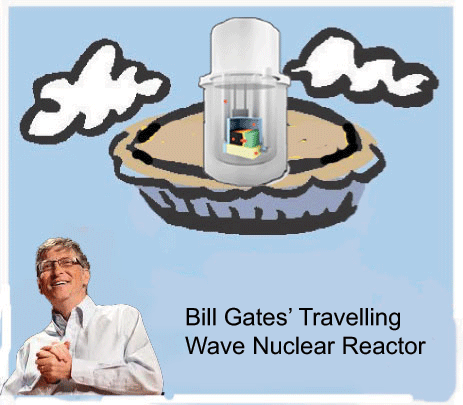 Bill Gates Again Dismisses Solar’s Value In Africa, Clean Technica July 22nd, 2016 by Joshua S Hill Bill Gates, delivering the 14th Nelson Mandela Annual Lecture on the eve of Mandela Day, has again dismissed the potential global role of solar, and in particular the value it could have in solving energy crises in Africa.
In the long run, what Africa needs is what the whole world needs: a breakthrough energy miracle that provides cheap, clean energy for everyone,” Gates said on the 17th. However, Gates doesn’t believe that that breakthrough has been made in the form of solar.
In an interview with Tech Insider earlier this year in February, which saw the billionaire philanthropist discuss the need to bring electricity to the millions who do not yet have access to reliable grid-provided energy, Bill Gates dismissed the role of solar. Gates discussed the need for an “energy miracle” then as well. “You might say, well, aren’t people saying that about wind and solar today? Not really. Only in the super-narrow sense that the capital costs per output, when the wind is blowing, is slightly lower.”
Gates continued, saying that the reason solar and wind “still needs subsidies, and it can’t go above a certain percentage, is this intermittency — it changes the economics, particularly the requirement that the power company at all times be able to require power.”
Speaking last Sunday as he delivered the 14th Nelson Mandela Annual Lecture, Gates again dismissed the role of solar in bringing electricity to the millions throughout Africa who are without reliable access to electricity……
What’s disappointing is that, at every step along Bill Gates’ arguments, we find reason to disagree with his increasingly-outdated points of view. Integrating energy storage with wind and solar generation mitigates much of the intermittency concerns, while reliance upon fossil fuels such as coal in Africa rely on massive levels of infrastructure — infrastructure which simply doesn’t exist, and would cost billions to develop, in excess of the cost of developing large-scale renewable energy deployment. Already the levelized cost of electricity (LCoE) has seen to be decreasing for both solar and onshore wind, and in some parts of the world are already cost competitive with existing fossil fuel energy sources.
Bill Gates isn’t unable to access this information, so what’s driving his seeming intentional ignorance towards the potential benefits of renewable energy, and solar energy in particular, for providing widespread electricity throughout Africa? http://cleantechnica.com/2016/07/22/bill-gates-dismisses-solars-value-africa/
South Africa’s nuclear company Eskom urging government to freeze renewable energy program
 Is Eskom building a case for nuclear power?, Business Day Live, BY SALIEM FAKIR JULY 28 2016, IT IS disconcerting that Eskom is advising the government to freeze a globally acclaimed renewable energy programme based on a perceived misunderstanding of the benefits of the renewable energy independent power producer (IPP) programme.
Eskom has justified its recent announcement not to sign further power purchase agreements with independent power producers with reasons that range from questions about the need for additional renewables and baseload IPPs, to improved operating performance, its large-scale new build programme, and protecting consumers from higher prices by not buying additional capacity.
Yet, the renewable energy programme is regarded as highly successful, and it delivers a wide range of benefits at the best prices given that it is a buyer’s market.
Eskom’s own 2016 financial report states that wind and solar are now cheaper than coal-generated electricity. The Treasury has stated that 92 renewable energy programme projects have attracted R193bn in private sector investment, totalling a contribution of 6,327 MW of capacity to the national grid. The total projected value of goods and services to be procured from broad-based black economic empowerment suppliers is put at more than R101bn.
Investment in renewables accounted for 85.8% of total direct foreign investment in SA in 2014. A Council for Scientific and Industrial Research report revealed that wind energy produced net savings of R1.8bn in the first half of 2015 and was also cash positive for Eskom by R300m.
The net savings can be attributed to avoiding diesel and coal fuel costs, as well as the economic costs of load shedding. Renewable energy in total generated a net benefit for the economy of up to R4bn. Renewable energy production has cut 4.4m tonnes of carbon dioxide.
At a policy level, the government has indicated that renewable energy has to be ramped up. The country’s energy vision and the National Development Plan call for a greater mix of energy sources and a greater diversity of IPPs in the energy industry, with the 2010 Integrated Resource Plan’s vision calling for 17,800 MW of renewable energy to be in place by 2030.
Internationally, SA is a signatory to the Intergovernmental Panel on Climate Change (IPCC) global climate change agreement to keep planet emissions beneath 1.5°C by honouring carbon emissions reduction targets.
Legally speaking, Eskom is a buyer of electricity, with the Department of Energy procuring capacity in line with ministerial determinations. The government’s commitment has been laudable. It is worrying that Eskom seems to wish to erode this………..
It seems Eskom is building a case for nuclear and this is the real reason behind the freeze on further renewable procurement. There is no guarantee that the proposed large nuclear new build programme will be cheap, considering that Medupi and Kusile are proving to be more expensive than some renewables. We would urge pragmatism and prudence on their part.
• Fakir is the head of the policy and futures unit with the World Wide Fund for Nature in SA. http://www.bdlive.co.za/opinion/2016/07/28/is-eskom-building-a-case-for-nuclear-power
Pro nuclear propaganda revs up in South Africa
Why Eskom’s Brian Molefe is pumping up the nuclear propaganda
The issue of relative costs is an area in which Eskom likes to play fast and loose with facts. Molefe, for instance, loves to talk about the relative cheapness of nuclear power Rand Daily mail CAROL PATON
26 JULY 2016 “……..As Eskom prepares to roll back the rise of independent power producers (IPPs) and lay the basis for the nuclear build, the propaganda war is going to be critical. This is because, on the facts alone, Eskom’s central argument — that SA’s energy future is a straight choice between variable and unreliable renewables and reliable base load nuclear — is nonsense.
What SA needs to do to break Eskom’s stranglehold
Even before Eskom’s letter to Energy Minister Tina Joemat-Pettersson drawing the line under the IPP programme surfaced last week, Molefe and Eskom’s head of generation, Matshela Koko, have been pushing this line. As SA can’t have more coal plants because of its commitments to reduce emissions, and as renewable energy is available during the day, when it’s not really required, the only solution lies with nuclear power.
This is a misrepresentation of the choices available. A great deal of technical work and international experience has shown that the next round of large investments SA should be making should be in gas. Unlike renewable energy, nuclear energy or a coal-fired power station, gas can be switched on and off to provide peaking power. The turbines need to turn only when you need them. With large discoveries in Mozambique, investing in gas is the logical next step. The CSIR has done detailed work on this and has put forward a third option to the baseload debate: to use gas and renewables — now by far the cheapest — in concert to create baseload power.
The issue of the relative costs of the technologies is another area in which Eskom likes to play fast and loose with the facts. Molefe, for instance, loves to talk about the relative cheapness of nuclear power. Koeberg — built in 1985 and long since paid for — supplies energy at R0.43/kWh. This should be compared with solar thermal power — the only renewable energy technology that can store energy — he says, the cost of which ranges between R2/kWh and R6/kWh. It’s a ridiculous comparison. In the absence of an agreed-on and updated Integrated Resource Plan (IRP) that would provide an authoritative view on the relative costs of the technologies, the CSIR’s Energy Centre calculated the following in 2015: new nuclear power is projected to cost at least R1/kWh, but very likely more; new coal R0.80/kWh — it is now much higher at about R1; wind R0.60/kWh and solar R0.80/kWh.
A new draft of the IRP by Eskom’s technical modellers — that has been sent back to the drawing board by the Department of Energy — has suggested that the overnight cost (capital cost excluding interest) of building new nuclear power would be $6 000/kW. The department reckoned on about $4 166/kW.
These are not numbers Eskom is likely to use in the public debate. Eskom, in particular Molefe, has a talent for spinning a good story. After less than five months in the job, he made the startling and completely untrue statement that Eskom’s plant performance had improved vastly. At that point, Eskom’s plant performance was still in decline. More recently, in May, he insisted at a news conference in Parliament that Eskom’s ability to meet demand had nothing to do with lower-than-anticipated demand. This too, turned out not to be true, with Eskom’s own demand curve showing real decline over 2015.
These are perhaps minor skirmishes with the truth. But getting the nuclear build on track is a far bigger fight. Expect Eskom to pump up the propaganda war. — Business Day http://www.rdm.co.za/business/2016/07/26/why-eskom-s-brian-molefe-is-pumping-up-the-nuclear-propaganda
Nuclear power salesmen vie with each other to sell nukes to South Africa
Eskom Influence Growing In Proposed South African Nuclear Tender, AFK Insider,

While South Africa’s energy department will choose the successful vendor, Eskom, as the owner-operator of the new nuclear plants, will have a large input. David Nicholls, chief nuclear officer at Eskom, gave delegates a glimpse this week of Eskom’s vision for nuclear by defining a leading role for the state utility at the Power-Gen and DistribuTech Africa conference in Johannesburg.
A chosen vendor will lead the early process with Eskom’s input. This is how South Africa’s only operating nuclear plant, Koeberg, north of Cape Town, was built in the 1980s, he said.
Once the design base has been established with the first plant, South Africa will increasingly take charge.
Nicholls’ remarks show that Eskom is in favor of a proven standardized fleet of reactors, with sibling international plants to learn from. This indicates South Africa is likely to choose one vendor and stick with them……….. Vendors from Russia, France, South Korea, the U.S. and China are all hoping to win the lucrative South African nuclear contract.South Africa has opted for a pressurized water reactor technology,……..http://afkinsider.com/130186/eskom-influence-growing-in-proposed-south-african-nuclear-tender/
Dirty uranium industry not a job creator for South Africa

 Uranium is the dirty underbelly of nuclear – scientist http://www.engineeringnews.co.za/article/uranium-is-the-dirty-underbelly-of-nuclear-scientist-2016-07-21 21ST JULY 2016 BY: NEWS24WIRE Anti nuclear sentiment tends to focus onnuclear waste or operational risks, but more focus should be on the “dirty underbelly” of uranium mining, according to a science adviser.
“Whenever people get excited about nuclear power stations, they kind of forget where the actual uranium comes from,”Dr Stefan Cramer, science adviser for environmentalist groupSafcei, told Fin24 in an interview recently.
“Nuclear is a fallacy, both economically and environmentally,” Cramer, who was born in Germany but not now lives in Graaff-Reinet, claimed.
“Uranium mining is the dirty underbelly of this whole nuclearcycle,” he said. “It’s where it all starts.”
“One must stop nuclear industries in (their) tracks because it leaves future generations with an immeasurable task and legacy,” he said. “The best point to start is at the source, where the whole cycle of nuclear technology begins, and that is at uranium mining.
“Uranium mining is very much the dirtiest part of the entire industry.”
Anti-uranium mining boost Cramer’s focus on anti-uranium mining was given a boost this month when Australian company Tasman Pacific Minerals Limited said it is downsizing its mining application in South Africa by almost 90%.
“Overall, the area covered by Tasman’s new and existingmining right and prospecting right applications in the Western and Eastern Cape will reduce by almost 300 000 ha to approximately 465 000 ha,” it said.
Tasman is punting job creation as necessitating the success of its new application. “Currently very few opportunities for additional economic development exist,” it said in a recent report.
“Tasman believes that uranium mining has a significant role to play in improving the economic outlook of the region, not only from an employment perspective, but also in the economic activity that is generated by associated businessactivities that extend beyond mining itself.”
“We desperately need jobs in the Karoo,” he said. “The Karoo is an area of high poverty, (with) very low employment opportunities. Any opportunity is usually highly welcome and it is to be welcomed because we need jobs desperately. Buturanium mining is a very poor process to create jobs.
“If we are really serious about job creation in the Karoo, there are other opportunities, which are much more valuable.
“Agriculture is still the main employment opportunity and needs to be protected and improved. Agri-tourism is a very new and very fast rising opportunity, but the best (opportunity) of all is renewable energy.”Renewable energy jobs boost
“South African already has 28 000 jobs in the renewable energy industry as compared to 2 600 in the nuclearindustry,” said Cramer. “Even the most ambitious job projections in the nuclear field would be up to 30 000 jobs if they whole country is run onnuclear energy. If we go into renewable energies, it’s an order of magnitude.
“The Department of Energy predicts up to 350 000 jobs inrenewable energy, so uranium mining is clear(ly) not a good strategy,” he said.
Cramer said nuclear is also a fallacy from a democratic point of view, “because it creates a veil of secrecy over this whole industry”. “That is clearly shown in our court case against the South African government for its failure to disclose the contents of an agreement with Russia,” he said.
South Africa’s nuclear energy plans stalled: too expensive
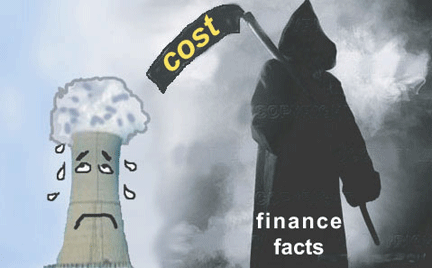 Energy plan stalls on cost of nuclear, Business Day Live, BY CAROL PATON, 15 JULY 2016 THE Integrated Resource Plan (IRP), the government’s long-term plan for electricity generation, is again stuck in the works, despite being six years out of date, with modellers and government officials wrestling over an appropriate price estimate for nuclear energy.
Should the cost of nuclear energy come in too high compared to other technologies, then the nuclear build programme, which is championed by President Jacob Zuma, could be blown out of the water.
The IRP is a 20-year plan that estimates demand, plans for supply, and makes policy decisions on the energy mix based on a range of factors, including energy security and affordability. Regular updates to the IRP — every two years — are crucial to ensure energy security and prevent overbuilding capacity.
In the latest draft, being drawn up by technical experts based at Eskom on behalf of the Department of Energy, the overnight cost for nuclear energy is said to have been estimated at $6,000/kW.
The number comes from several industry sources, who are privy to the information, but was not confirmed by the government. Overnight costs include construction costs, but exclude interest…..
In previous drafts of the IRP, overnight costs for nuclear were estimated at $5028/kW in 2010, and $5800/kW in 2013. The 2013 IRP, which cautioned against nuclear energy due to lower than expected demand and the high risk involved, has never been adopted by the Cabinet.
At the time, it was speculated that the Department of Energy held it back, as it was not nuclear-friendly enough. Instead, the government has continued to use the 2010 IRP, despite its outdated assumptions and modelling, and a wide acknowledgement in the energy industry that its credibility is shot.
The IRP process under way right now is a new attempt to update the plan, which is six years out of date.
But since the modelling team submitted its draft to the department earlier in 2016, the process appears to have stalled. Energy Minister Tina Joemat-Pettersson said in September that the new IRP would be completed by March. But the draft is far from finished, and public consultations — which should take place under the policy framework — are still far from a reality……
South Africa’s nuclear sector in crisis
Nuclear sector in crisis as SA weighs options, Business day Live, BY MARK ALLIX, 15 JULY 2016 THE world nuclear industry status report for 2016 may give SA pause for thought about its ambitions to build nuclear power capacity.
The report says the global nuclear industry is in crisis, and renewable energy is taking over……
SA’s government is adamant that nuclear will be part of the energy mix, and of the country’s commitments to cutting carbon emissions. Existing solar and wind energy technologies cannot cater for base-load electricity demand to run modern industries, it says.
Safety and the funding of huge initial financial costs for nuclear reactors remain critical factors, despite the promise of lower carbon emissions, and ultimately, much lower electricity retail costs. Costs of up to R1-trillion have been estimated for SA’s proposed 9,600MW of nuclear power.
Knox Msebenzi, MD of the Nuclear Industry Association of SA, said on Thursday it was difficult to obtain an authoritative figure. The association, whose members included potential nuclear bidders, had not made an independent estimation of what such a project would cost.
“There are a lot of variables, which if not defined, could push the price up or down,” he said.
Project cost estimations could use typical industry accepted valuations. But despite including plenty of local content such as concrete and steel, costs were also subject to possible litigation over projects and exchange rate volatility for imported technologies.
Silas Zimu, the special energy adviser to President Jacob Zuma, said earlier in July that SA would have to build nuclear power plants on a piecemeal basis, according to what it could afford. It would also need to purchase the best technology, amid huge delays in the global nuclear industry…..http://www.bdlive.co.za/business/energy/2016/07/15/nuclear-sector-in-crisis-as-sa-weighs-options
South Africa’s Zuma government backing India’s effort to join Nuclear Suppliers Group
SA backs India to join Nuclear Suppliers Group enca, SOUTH AFRICA Friday 8 July 2016 PRETORIA – South African President Jacob Zuma agreed on Friday to support India’s controversial bid to join the Nuclear Suppliers Group (NSG), an international body that controls commerce in nuclear materials and technology.
Indian Prime Minister Narendra Modi announced this at a joint press conference at the Union buildings in Pretoria on Friday after meeting Zuma.
He thanked Zuma for his promise of support in the meeting….
- The bid is controversial because all the current NSG members, including South Africa, are also members of the NPT, the Nuclear Non Proliferation Treaty, which restricts the possession of nuclear weapons to the five major powers, the US, UK, France, Russia and China.
India acquired nuclear weapons in 1974 and so could not join the NPT, which it in any case did not want to because it regards it as discriminatory.
When she was asked earlier this week about this, International Relations and Cooperation Minister Maite Nkoana-Mashabane noted that all current NSG members were also members of the NPT. But she also hinted that in his one-on-one meeting with Modi, Zuma might lend his support to India’s bid…….https://www.enca.com/south-africa/sa-backs-india-to-join-nsg
EDF/AREVA keen to get in on selling nuclear reactors to South Africa
 Bullish Areva wants in on SA’s nuclear tender, City Press Yolandi Groenewald 2016-06-
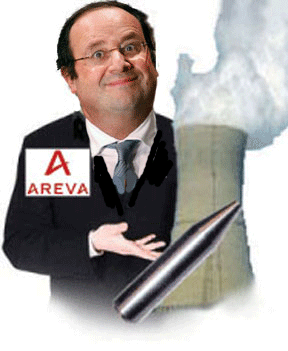 10 France’s state-owned nuclear businesses are focused on winning the lucrative South African nuclear tender despite recent financial difficulties.
The French will bid as EDF/Areva – nuclear technology company Areva sold its reactor business to the state-owned energy utility EDF earlier this year……..
EDF was facing large investments at its French operations. Its investment compromised about €50 billion (R869.6 billion) over 10 to 15 years, which would extend the operating lifespan of its ageing fleet to 60 years……
The French nuclear industry has faced a number of storms during the past year. Areva teetered on the edge of bankruptcy after years of losses wiped out its equity. It was rescued by French state aid and a sale of its reactor business to EDF.
The Flamanville project in France, Areva’s first European Pressurised Reactor (EPR) nuclear pressurised water reactor, is years behind schedule, way over budget and riddled with technical difficulties…….
France, Russia, China, the US and South Korea are competing for what could be South Africa’s biggest procurement project. The contract, estimated to cost between R580 billion and R1.56 trillion, aims to add nuclear capacity of 9 600 megawatts.
The government has said the nuclear programme would be developed at a pace the country can afford……..http://city-press.news24.com/Business/bullish-areva-wants-in-on-sas-nuclear-tender-20160603
South Africa’s Energy Minister again misses legal deadline to file nuclear procurement papers for the High Court
Joemat-Pettersson misses third deadline to file papers in nuclear case http://www.bdlive.co.za/business/energy/2016/06/03/joemat-pettersson-misses-third-deadline-to-file-papers-in-nuclear-case
BY CAROL PATON, ENERGY Minister Tina Joemat-Pettersson has missed a third deadline to file papers to oppose an application by the SA Faith Communities Environmental Initiative (Safcei) and Earthlife Africa to have the proposed procurement of nuclear energy declared unconstitutional.
The two groups filed papers in October asking the High Court in Cape Town to rule that government had failed to meaningfully consult the public on the nuclear procurement.
They will also argue that the inter-governmental agreements on nuclear procurement signed with Russia, France, China and the US are illegal as they were not preceded by a determination in the government gazette by the minister.
Safcei and Earthlife Africa said on Friday that this was the third deadline that Joemat-Pettersson had missed in as many weeks.
Government failed to respond by the May 13, and asked for an extension until May 30. Earthlife and Safcei then instructed their lawyers to issue a rule 30A notice, which gave the government until the May 31 to respond.
“On Tuesday June 1, our attorneys were advised that the answering affidavit has been drafted, is currently being reviewed by the Office of the Presidency, and that the State Attorney hopes to be in a position to file it on or about June 7,” they said in a statement.
If this latest deadline is missed, the Safcei/ ELA legal team will approach the courts to force government to comply with the legal time frames. Failing this they will ask the courts to strike out the government defence and for their application to be unopposed.
“We believe that this consistent failure to comply with the legal time frames points to an unaccountable government,” says Liz McDaid, Safcei spokeswoman.
China, South Korea and Russia battle to win Kenya as nuclear customer
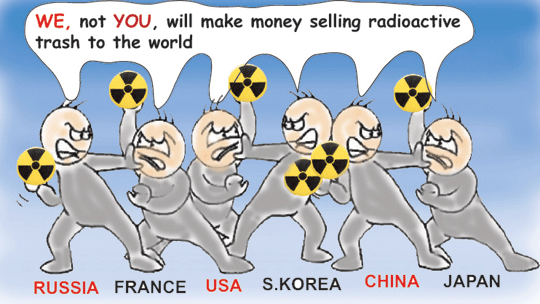 Africa Energy: China, Russia and South Korea In Race To Build Kenya’s Nuclear Plant
By Allan Akombo AFKI : June 2, 2016– In less than 24 hours this week Kenya signed two pacts on nuclear energy cooperation with South Korea and Russia, setting the stage for a dead-heat race against China to clinch the east Africa nation’s forthcoming nuclear energy development contract.
The first deal was in Moscow on May 30, 2016 where Russia’s state nuclear agency, Rosatom Deputy Director Nikolai Spasskiy and Deputy Head of the Kenyan Embassy to Russia Hillary N. Kyengo signed a Memorandum of Understanding (MoU) that involves the creation of a working group to identify peaceful nuclear projects and also continue consultations on the possibility of building the first nuclear power plant in Kenya.
A day later and thousands of miles away in the Kenyan capital, Nairobi host President Uhuru Kenyatta and Korean President Park Geun-Hye witnessed the signing of a nuclear corporation pact after they held bilateral talks.
The MOU on electric power and nuclear energy development was signed by Energy and Petroleum Cabinet Secretary Charles Keter and Korean Trade, Industry and Energy Minister Joo Hyunghwan.
Barely two weeks ago, Rosatom said it plans to sign cooperation agreements with Kenya, Uganda and Zambia to lay the groundwork for an expanded presence in Sub-Saharan Africa beyond its planned bid to build nuclear power plants in South Africa.
Rosatom has voiced confidence in its ability to see off competition from China, France and South Korea in a planned South African tender to build a 9,600 megawatts (MW) nuclear power fleet in the continent’s most industrialized country.
It sees scope, however, for more deals across the region, from the building of plants to supplying reactor fuel.http://afkinsider.com/126827/africa-energy-china-russia-south-korea-race-build-kenyas-nuclear-plant/#sthash.f40J0946.dpuf
Political scandal hangs over South Africa’s nuclear energy plans
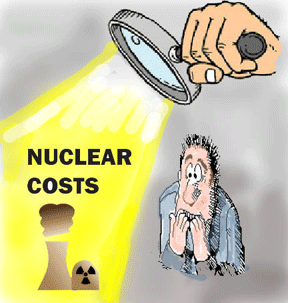 How the state capture controversy has influenced South Africa’s nuclear build , Sunday Times, 29 May 16 South Africa is facing a critical decision that could see it investing about R1 trillion – or US$60 billion to $70 billion – in a fleet of new nuclear power stations. Proponents argue that it will greatly increase electrical base-load capacity and generate industrial growth. But opponents believe the high cost would cripple the country economically.
What should be an economic decision has now been clouded by controversy, with political pressure to push through the nuclear build and the increasingly apparent rewards it would bring to politically linked individuals.
The nuclear expansion programme needs to be considered exceptionally carefully given that the required financial commitment is roughly equal to the total South African annual tax revenue. Loan repayments could place a devastating long-term burden on the public and on the economy as a whole……..
South Africa has had remarkable success with speedy, cost-effective installation of renewable energy power plants. In addition to this, technologies for harvesting South Africa’s plentiful wind and solar energy resources are rapidly becoming cheaper, raising the question of whether the country should not invest more in these options rather than in going nuclear.
The argument that nuclear energy provides a stable base load, independent of weather conditions, is mitigated by improvements in energy storage technologies……
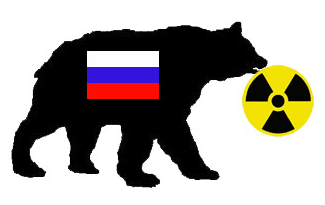 Zuma and the Russians The nuclear debate gained a political dimension when President Jacob Zuma and his Russian counterpart, Vladimir Putin, started to develop an unusually close relationship. It culminated in an announcement that the Russian nuclear developer, Rosatom, had been awarded the potentially highly lucrative contract to build the new reactors. The agreement was later denied.
Rosatom was considered the preferred contender, with other bidders only there to lend the process legitimacy, according to some observers. The lack of transparency surrounding the process, coupled with a history of corruption in South African mega-projects like the arms deal, has made the whole scheme seem suspicious to the broader public.
A thickening plot
A crucial thread in this saga involves the Shiva uranium mine, about 30km north-west of Pretoria, the country’s executive capital. It originally belonged to a company called Uranium One, a subsidiary of Russia’s Rosatom. It was sold in 2010 to Oakbay Resources, a company controlled by members of the politically connected Gupta family and the president’s son, in a deal that greatly surprised economists.
The mine was deemed unprofitable and thus unattractive to other mining companies. But it was still considered worth a whole lot more than the R270 million paid by Oakbay. The mine would, however, become highly profitable if it became the uranium supplier to the new nuclear power stations. Oakbay and its associates therefore have a very strong incentive for this nuclear build to happen.
 It is here that the nuclear build drama feeds into the recent major controversy surrounding alleged state capture, meaning a corrupt system where state officials owe their allegiance to politically connected oligarchs rather than the public interest. This was highlighted by the shock dismissal of Finance Minister Nhanhla Nene, a reported nuclear build sceptic, but also by subsequent allegations of ministerial positionsbeing offered to people by members of the Gupta family.
Political, legal and civil opposition
The nuclear build’s association with the Zuma faction in the ruling African National Congress (ANC) will be a political hot potato for decades to come. ……
A negative nuclear outlook
Building these plants is a risky business proposition, especially for Rosatom, which is implicated in the developing scandal. The recent political mood swing against state capture and a likely credit rating downgrade add to the risk.
Rosatom has suggested a nuclear build financing option that effectively amounts to it providing a loan. It is, however, conceivable that a future government may not honour debt repayments if there is a view that the construction deal was secured irregularly.
The narrow public support base and downright hostility in some quarters to a nuclear build has already effectively stalled local nuclear construction plans. The level of controversy, high costs and potential for further disruption mean that the planned implementation could only proceed under severe social strain.
Such a scenario could very well cost the ruling ANC the 2019 national elections. And the party is becoming increasingly aware of this. As such, it is posited that the nuclear build will not happen any time as soon as planned.
– Hartmut Winkler, Professor of Physics, University of Johannesburg http://www.timeslive.co.za/sundaytimes/opinion/2016/05/27/How-the-state-capture-controversy-has-influenced-South-Africa%E2%80%99s-nuclear-build
Pentagon’s “small” giant military footprint in Africa
The Pentagon’s War on Accountability: Slush Funds, Smoke and Mirrors, and Funny Money Equal Weapons Systems Galore By William D. Hartung, Tom Dispatch, Reader Supported News, 24 May 16 Colonel Mark Cheadle, a spokesman for U.S. Africa Command (AFRICOM), recently made a startling disclosure to Voice of America (VOA). AFRICOM, he said, is currently mulling over 11 possible locations for its second base on the continent. If, however, there was a frontrunner among them Cheadle wasn’t about to disclose it. All he would say was that Nigeria isn’t one of the countries in contention.
Writing for VOA, Carla Babb filled in the rest of the picture in terms of U.S. military activities in Africa. “The United States currently has one military base in the east African nation of Djibouti,” she observed. “U.S. forces are also on the ground in Somalia to assist the regional fight against al-Shabab and in Cameroon to help with the multinational effort against Nigeria-based Boko Haram.”
A day later, Babb’s story disappeared. Instead, there was a new article in which she noted that “Cheadle had initially said the U.S. was looking at 11 locations for a second base, but later told VOA he misunderstood the question.” Babb reiterated that the U.S. had only the lone military base in Djibouti and stated that “[o]ne of the possible new cooperative security locations is in Cameroon, but Cheadle did not identify other locations due to ‘host nation sensitivities.’”
U.S. troops have, indeed, been based at Camp Lemonnier in Djibouti since 2002. In that time, the base has grown from 88 acres to about 600 acres and has seen more than $600 million in construction and upgrades already awarded or allocated. It’s also true that U.S. troops, as Babb notes, are operating in Somalia — from at least two bases — and the U.S. has indeed set up a base in Cameroon. As such, the “second” U.S. base in Africa, wherever it’s eventually located, will actually be more like the fifth U.S. base on the continent. That is, of course, if you don’t count Chabelley Airfield, a hush-hush drone base the U.S. operates elsewhere in Djibouti, or the U.S. staging areas, cooperative security locations, forward operating locations, and other outposts in Burkina Faso, Central African Republic, Chad,Ethiopia, Gabon, Ghana, Kenya, Mali, Niger, Senegal, the Seychelles, Somalia, South Sudan, and Uganda, among other locales. When I counted late last year, in fact, I came up with 60 such sites in 34 countries. And just recently, Missy Ryan of the Washington Post added to that number when she disclosed that “American Special Operations troops have been stationed at two outposts in eastern and western Libya since late 2015.”
To be fair, the U.S. doesn’t call any of these bases “bases” — except when officials forget to keep up the fiction. For example, the National Defense Authorization Act for Fiscal Year 2016 included a $50 million request for the construction of an “airfield and base camp at Agadez, Niger.” But give Cheadle credit for pushing a fiction that persists despite ample evidence to the contrary.
It isn’t hard, of course, to understand why U.S. Africa Command has set up a sprawling network of off-the-books bases or why it peddles misinformation about its gigantic “small” footprint in Africa. It’s undoubtedly for the same reason that they stonewall me on even basic information about their operations. The Department of Defense, from tooth to tail, likes to operate in the dark.
Today, TomDispatch regular Bill Hartung reveals another kind of Pentagon effort to obscure and obfuscate involving another kind of highly creative accounting: think slush funds, secret programs, dodgy bookkeeping, and the type of financial malfeasance that could only be carried out by an institution that is, by its very nature, too big to fail (inside the Beltway if not on the battlefield).
Rejecting both accurate accounting and actual accountability — from the halls of the Pentagon to austere camps in Africa — the Defense Department has demonstrated a longstanding commitment to keeping Americans in the dark about the activities being carried out with their dollars and in their name. Luckily, Hartung is willing to shine a bright light on the Pentagon’s shady practices……..-Nick Turse, TomDispatch http://readersupportednews.org/opinion2/277-75/37052-the-pentagons-war-on-accountability-slush-funds-smoke-and-mirrors-and-funny-money-equal-weapons-systems-galore
South Africa’s govt coy about its secret nuclear deal with Russia

 Govt misses deadline to open up alleged Russian nuclear deal http://businesstech.co.za/news/energy/124645/govt-misses-deadline-to-open-up-alleged-russian-nuclear-deal/ By News24Wire May 24, 2016 The government must respect the rules and commit to following the timeframes, leading environmentalists said after the state once again failed to submit answering affidavits in the court case regarding its nuclear energy agreement with Russia.
Earthlife SA and the Southern African Faith Communities’ Environment Institute (Safcei) claim that Energy Minister Tina Joemat-Pettersson acted unconstitutionally in not submitting the government’s nuclear deal with Russia to Parliament.
Following the Department of Energy (DoE) and Joemat-Pettersson’s failure to meet the original May 13 deadline to submit answering affidavits, the State Attorney on Monday said they could also not meet the 20 May Rule 30A notice deadline, a rule that prohibits further delays.
“Unfortunately the first and the second respondents are still not in a position to file answering affidavits and are still in the process of drafting same,” the State Attorney’s office said in a letter to the environmentalists on Monday.
“As already pointed out the respondents have difficulty in finalising their answering affidavits due inter alia to the bulk of the founding affidavit, as supplemented, the complexity of the application as well as the importance thereof for all parties concerned. The incomplete draft already runs to more than 200 pages.
“The first and the second respondents will endeavour to have their answering affidavits finalised in terms of the provisions of the notice … by Tuesday, 31 May 2016.”
Safcei spokesperson Liz McDaid said on Monday that “it is not unexpected that government once again fails to meet their own deadlines”.
“But what is of concern is that government lawyers are even not committing to the legal rule 30a notice deadline, but only going to ‘endeavour’ to meet it.
“If the country is to function as a democratic state under the rule of law, then the state must respect the rules and commit to following the timeframes, which are set out under the law,” she said.
In October last year, Earthlife Africa JHB and Safcei filed court papers challenging the constitutionality of the intergovernmental framework agreements the DoE signed with Russia, China, South Korea and the USA on the country’s planned nuclear development.
Safcei said it waited for Joemat-Pettersson to provide the records of the decisions that are being challenged. “In that period, Safcei and Earthlife Africa generously allowed the government extensions, which eventually meant that government only provided the requisite documents on February 16 2016.”
Legal documents indicate that South Africa did sign a nuclear deal with Russia, claim the environmentalists in their affidavit.
Here, they said “the Russian agreement was entered into unlawfully, but makes (an) internationally binding commitment to buy a fleet of nuclear reactors from Russia”.
From the state law adviser’s explanatory memorandum that was prepared in November 2013 but only revealed recently to Safcei/ELA, “it is evident that the Russian agreement is to build reactors and an enrichment plant”, the group said.
They said other subsequent agreements would “cover the details of how it is to be financed, not if it would go ahead”. The court case appears to be stalling the country’s bid to launch its request for proposals for the 9.6GW nuclear procurement programme. This was supposed to occur on April 1.
1 This Month

10 March A LIVE WEBINAR THE REAL EFFECTS OF NUCLEAR POWER
What the Industry Isn’t Telling Us
1:00 PM Mountain, 2 pm Central, 3 pm Eastern. Live on the Keepers of the Water Facebook page


18 March Webinar @ 1 PM EST: An Assessment of SMR Projects: The Case of Canada
register for the zoom:
https://us02web.zoom.us/webinar/register/WN_o8BIIOUvQ2ONJR1nta65DQ#/registration


of the week – STOP SMALL MODULAR REACTORS IN CANADA
To see nuclear-related stories in greater depth and intensity – go to https://nuclearinformation.wordpress.com
-
Archives
- March 2026 (64)
- February 2026 (268)
- January 2026 (308)
- December 2025 (358)
- November 2025 (359)
- October 2025 (376)
- September 2025 (258)
- August 2025 (319)
- July 2025 (230)
- June 2025 (348)
- May 2025 (261)
- April 2025 (305)
-
Categories
- 1
- 1 NUCLEAR ISSUES
- business and costs
- climate change
- culture and arts
- ENERGY
- environment
- health
- history
- indigenous issues
- Legal
- marketing of nuclear
- media
- opposition to nuclear
- PERSONAL STORIES
- politics
- politics international
- Religion and ethics
- safety
- secrets,lies and civil liberties
- spinbuster
- technology
- Uranium
- wastes
- weapons and war
- Women
- 2 WORLD
- ACTION
- AFRICA
- Atrocities
- AUSTRALIA
- Christina's notes
- Christina's themes
- culture and arts
- Events
- Fuk 2022
- Fuk 2023
- Fukushima 2017
- Fukushima 2018
- fukushima 2019
- Fukushima 2020
- Fukushima 2021
- general
- global warming
- Humour (God we need it)
- Nuclear
- RARE EARTHS
- Reference
- resources – print
- Resources -audiovicual
- Weekly Newsletter
- World
- World Nuclear
- YouTube
-
RSS
Entries RSS
Comments RSS
 nuclear-news