Uganda says Russia to help it develop nuclear energy, KAMPALA (Reuters) 18 Sept 19,– Uganda said on Wednesday it had signed an Inter-Governmental Agreement (IGA) with Russia to help the East African country build capacity to exploit nuclear technology for energy, medical and other peaceful purposes.The government of President Yoweri Museveni has previously said it is eager to use the country’s uranium deposits to boost energy production capacity.
In May last year Uganda also signed a memorandum of understanding with China National Nuclear Corporation (CNNC) to help Uganda build capacity in the use of atomic energy for peaceful purposes.
In an emailed statement, Uganda’s energy ministry said the IGA with Russia was signed in Vienna on Tuesday between Energy Minister Irene Muloni and Nikolai Spasskiy, the deputy director general of Russian state corporation ROSATOM……….
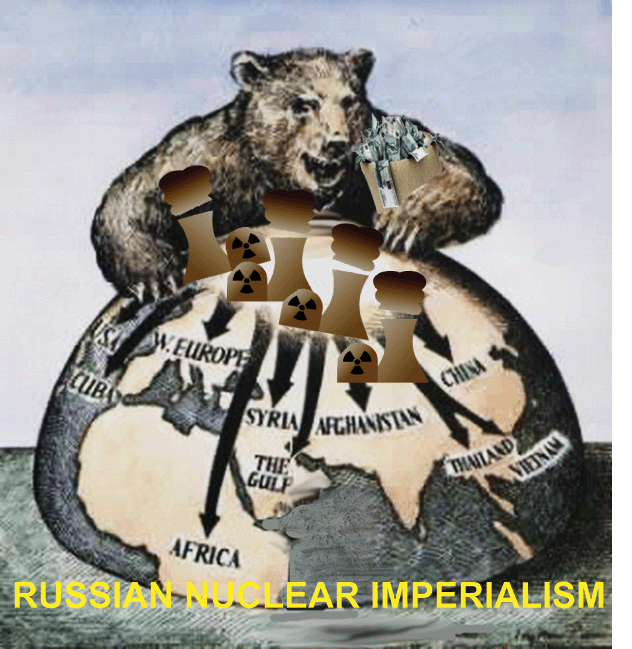
Russia Spreads Influence in Africa Using Nuclear Power – Reports, Moscow Times, 30 Aug 19, Russia is working to win influence in at least 10 African states with high-cost nuclear technology that for the most part does not suit their needs, researchers and NGOs have told The Guardian newspaper.
With booming exports, nuclear energy is one example of Russia’s increasing presence in Africa in recent years. Elsewhere, a businessman known as “Putin’s chef,” Yevgeny Prigozhin, is widely reported to be spearheading Russia’s push to exchange security and electioneering services for mining rights in Africa.
Russia’s state nuclear agency Rosatom has approached the leaders of “dozens” of African countries with various nuclear energy projects in the past two years, The Guardian reported Wednesday. Rosatom has existing deals with Egypt and Nigeria and other various agreements with other countries on the continent.
By Jean-Jacques Cornish Led by their former Finance Minister Pravin Gordhan, South Africans breathed a sigh of relief when President Cyril Ramaphosa scrapped plans to buy a nuclear power plant from Russia that would have been ruinously expensive. But the saga is not over.
Energy Minister Gwede Mantashe said this week that South Africa is still in the market for nuclear energy, provided it can be purchased economically.
Official: China buried nuclear waste in Sudan desert, Dabanga Sudan, November 12 – 2015KHARTOUMChina has buried dozens of containers with toxic waste in the desert of Northern Sudan, according to a high-ranking official. The waste was most probably coming from nuclear plants in China.
According to the former director of the Sudan Atomic Energy Commission in Sudan, Mohamed Siddig, 60 containers have been brought to Sudan together with construction materials and machinery for the building of the Merowe Dam (Hamdab Dam) in the Northern part of Sudan. He did not mention the exact year of the import and the date the nuclear waste was disposed. China worked on the dam between 2004 and 2009.
During a conference held by the Sudanese Standards and Metrology Organisation (SSMO) in Khartoum on Tuesday, he disclosed how the Sudanese authorities allowed the import of the waste ‘without inspection’. He told the audience that 40 containers were buried in the desert not far from the Merowe Dam construction site. Another 20 containers were also disposed in the desert, though not buried…..
Mohamed Siddig was responsible for the Sudan Radioactive Waste Management programme that started in 1995, a central radioactive waste management facility was established in Soba near Khartoum. The Atomic Energy Committee is responsible for overseeing the safety in activities that involve the use of atomic energy in Sudan, and promoting the use of nuclear techniques.
Gold miners complain
In 2010, the government was already confronted by complaints of local gold diggers, according to the Sudanese newspaper El Tariq. Several gold workers approached the government complaining about many of the worker suffering from cancer and skin diseases. The Sudan authorities downplayed the questions saying the waste they dug up were remnants from earlier times. However witnesses told El Tariq that 500 sealed barrels were discovered in the El Atmur desert area in River Nile State…….https://www.dabangasudan.org/en/all-news/article/official-china-buried-nuclear-waste-in-sudan-s-desert
Shutting down SA’s nuclear future https://www.news.uct.ac.za/article/-2019-07-16-shutting-down-sas-nuclear-future16 JULY 2019 | STORY DAVID FIG. Located 33 km west of South Africa’s capital city Pretoria, the Pelindaba precinct has been home to South Africa’s official nuclear research corporation since the 1960s. The Nuclear Energy Corporation of South Africa (NECSA) hosts the country’s earliest nuclear reactor, originally designed to take weapons-grade uranium. It was also the original site for the development of nuclear weapons under the apartheid government between 1978 and 1990.Over the years the corporation has experimented with reactor development, uranium enrichment, fuel fabrication, and the production of isotopes used in nuclear medicine.
In the years to 1994, it was given relatively free range with budgets and personnel to conduct these experiments. The whims of nuclear scientists were indulged as they were seen to be essential to apartheid’s semi-clandestine weapons, energy and sanctions-busting plans. However, many of these projects – except for the isotopes, which remain lucrative – have been abandoned.
In recent years, governance has become dysfunctional. The corporation no longer sustains itself financially, there have been tensions between ministers and the board and the production of medial isotopes ceased for over a year.
Long-standing problems
Problems in the running of the corporation have been evident for some time.
Earlier this year the former energy minister Jeff Radebe dealt with the growing internal problems by suspending and later firing the CEO, Phumzile Tshelane. He also took steps to fire the organisation’s entire board.
Radebe acted because he claimed the board had failed in its fiduciary duties. This included oversight of the shut down of the production of isotopes for over a year, rendering NECSA in grave debt. Another reason was the signing of a deal with Russia’s Rosatom to build two “solution reactors” in South Africa. Radebe regarded the co-operation agreement irregular.
In December 2018, Radebe appointed former NECSA CEO Rob Adam as the new non-executive chair of the board. In July this year Adam confirmed he had resigned. In seven months the task of restoring NECSA to functionality had become too onerous and time-consuming.
Adam’s resignation signals grave difficulties faced by NECSA in its attempts to restructure and improve its balance sheet. Most worrying is that NECSA has spun off its former waste management responsibilities to a recent formation, the National Radioactive Waste Disposal Institute, which has also experienced severe governance problems.
The future
NECSA was the heir of an earlier Atomic Energy Board, which entered its life at the outset of the apartheid regime on 1 January 1949. At the time there was much debate about where to locate atomic research. Some sections of the scientific establishment argued that it should become part of the government-sponsored Council for Scientific and Industrial Research (CSIR). However, security and military issues prevailed and atomic research was hived off into its own enterprise.
South Africa, in deciding on NECSA’s future, should consider that for the present the country has decided to give up its nuclear ambitions, specifically in the area of energy generation. In 2010 the government wound up South Africa’s attempts at designing a high-temperature small-scale reactor, the Pebble Bed Modular reactor.
The project failed to attract foreign investors and customers, and Eskom was reluctant to become a guinea pig. Cost and time overruns became too burdensome. Expensive enrichment technologies had also failed to become cost effective, and when unhooked from bomb production, were terminated.
Isotope production is still viable. But the question is whether it requires an entire Pelindaba-sized research establishment to proceed. The reactor is now too elderly to have a bright future, and there’s no money to replace it.
South Africa’s plans to build a series of nuclear power stations, championed by former president Jacob Zuma, were halted in 2017. This followed litigation by two environmental NGOs – Earthlife Africa and the Southern African Faith Communities’ Environmental Institute. This decision, as well as the draft contents of the Integrated Resource Plan 2018 underscore that, for the time being, extra nuclear capacity is unviable.
What to do with the facility
Now that South Africa no longer ascribes to a nuclear energy future, it is legitimate to consider what to do with the Pelindaba facility. The suitably pared-down nuclear research establishment needs to be reconceptualised and relocated.
NECSA should be dismantled and its legacy projects, where viable, should be housed inside institutions like the CSIR and the universities. Nuclear scientists could be retired or retrained, while the rest of the workforce could be subjected to a “just transition” along the lines proposed in the carbon-intensive industries.
Pelindaba as a precinct could be repurposed. First the nuclear waste from previous activities which is housed in numerous buildings and trenches at Pelindaba would need to be decontaminated and removed, so that future users can avoid any exposure to radioactivity.
The site could become a new campus dedicated to innovation in the field of sustainable energy and related sciences. Subsidies once dedicated to nuclear research could be redirected to repositioning South Africa as a leading energy innovator in the global South. The new Pelindaba could also be dedicated to finding Africa-wide solutions to the climate crisis.
Part of the site could also be dedicated to promoting nuclear disarmament. After all, the Treaty of Pelindaba declared the African continent a nuclear weapons-free zone. South Africa, the first country to give up its nuclear weapons, has a duty to the rest of the continent to champion nuclear disarmament.
Repurposing of Pelindaba would be a just, cost-effective and practical solution to the problem of taxpayers continuing to support an increasingly dysfunctional NECSA, especially since nuclear energy is no longer seen as a viable way forward.
David Fig, Honorary Research Associate, University of Cape Town.
Extreme heat to hit one third of the African urban population, Science Daily
Date:
June 5, 2019
Source:
Université de Genève
Summary:
An international team of researchers has combined demographic projections and climate scenarios across Africa for the first time. Their results reveal the number of people who will potentially be exposed to extreme temperatures.
Climate change, population growth and urbanisation are instrumental in increasing exposure to extreme temperatures. Researchers at the University of Geneva (UNIGE), Switzerland, — in collaboration with the University of Twente (Netherlands) and the EU Joint Research Centre in Ispra (Italy) — assessed a range of possible scenarios regarding the rate of climate change and socio-economic development in 173 African cities for the years 2030, 2060 and 2090. Their results, which are published in the journal Earth’s Future, show that a third of African city-dwellers could be affected by deadly heat waves in 2090. The projections also highlight the influence of socio-economic development on the impact of climate change.
The effects of climate change are felt specifically in countries with tropical climates, which are characterised by high humidity and very high temperatures. Furthermore, countries in these regions — especially in Africa — are experiencing heavy urbanisation and socio-economic development, leading to an explosion in the size of urban populations. A combination of these two factors is having a major impact on the living conditions of city-dwellers in Africa, especially in terms of exposure to extreme — or even lethal — temperatures. “We consider the critical threshold to be 40.6°C in apparent temperature, taking humidity into account,” says Guillaume Rohat, a researcher at UNIGE’s Institute for Environmental Sciences (ISE). In fact, high outdoor humidity levels disrupt our ability to thermoregulate, with potentially fatal consequences………
The Best Summary Of Kenya Renewable Energy (& Dirty Energy) You Can Find, Clean Technica, David Zarembka, 24 May 19 I do not need to feel guilty about contributing to global warming when my grandchildren turn on the TV to watch cartoons. This is because I live in rural, western Kenya, where 87% of the electricity is from renewal sources — the nirvana of Green Deal activists.With a population of almost 50 million (one-seventh the size of the US population), electricity capacity is only 2370 MW and peak demand is only 1770 MW. The average Kenyan consumes only 167 kWh of electricity per year. Kenyans also contribute only 0.03 percent of worldwide carbon admission to the atmosphere each year, equal to about 1 percent of what each American contributes.
It is useful to study the sources of electricity in Kenya to see how this renewable rate is achieved.
Not as surprising is that the second largest source of electricity is hydropower, at 705 MW, or 30%. Kenya is already a water-stressed country with only two year-around rivers that reach the ocean. 80% of the country is semi-arid or arid, with only 20% arable where most of the people live. The problem with hydropower is that is depends upon rainfall.
In 2017, there was a drought and the water levels in the lakes behind the dams that produce electricity fell too low to generate their normal amount of electricity. Then, as frequently happens in a climate such as Kenya’s, in 2018 there was major flooding and all the dams on the Tana River, including Masinga Dam, overflowed, leading to flooding in the lower reaches of the river. Hydropower cannot be considered a reliable source of power, so alternative sources need to be available.
The Lake Turkana Wind Farm, the largest in Africa at 310 MW, just came online last September. It had taken nine years for this to happen. In addition to the regulatory and financial issues, the $740 million cost included upgrading 125 miles of road to carry the wind turbines to the remote site and a transmission line to carry the electricity back to the center of the country. At one point in 2012, the World Bank withdrew their funding for the project because they thought (incorrectly, it turns out) that the wind farm would generate too much excess electricity that could not be used. Another delay occurred when the Spanish company that received the contract to build the transmission line went bankrupt. These are the usual type of issues that occur in a developing country.
The wind farm is sited in one of the best places for wind in the world. The wind blows off of Lake Turkana and is funneled between two hills, giving an extremely high wind potential. The project uses 365 Vestas 850kW wind turbines. In this day and age, I was disappointed that the wind farm used such small turbines, but the problem was transporting the turbines over 750 miles from the coast on two-lane roads.
There is a second smaller wind farm in the Ngong Hills near Nairobi. Originally, it had a capacity of 5.1 MW, but it is now being upgraded with more turbines to 25.5 MW.
Since the equator runs right through the middle of Kenya and that much of the country is arid and semi-arid, one would assume that solar generation of electricity would be a no-brainer. Although home/small-scale solar systems are very common in Kenya (which I will cover in another article), grid-scale projects are just beginning to be built. The largest one currently under construction is the 55 MW solar farm in Garissa, 225 miles northeast of Nairobi. One of the issues with solar farms is that they take up a considerable amount of land. But land in the arid and semi-arid areas ideal for solar farms are controlled by pastoralists who move from place to place, sometimes for hundreds of miles, in search of grass and water. The land is, therefore, group controlled and it is difficult to get the group to agree on the siting and compensation for the use of the land for a solar farm. Perhaps as more solar farms are built and people realize the benefits, people will become more cooperative and accommodating. Solar power potential in Kenya is enormous and their development is just beginning. …….. https://cleantechnica.com/2019/03/30/the-best-summary-of-kenya-renewable-energy-dirty-energy-you-can-find/
The Dance of Nuclear, Coal, & Renewables in South Africa, Clean Technica May 25th, 2019 by David Zarembka, “……… South Africa has the most mining and industry of any country in Africa and consequently needs the largest amount of electricity – 54,400 megawatts. This can be broken down as follows:
Type
Capacity [MW]
Percent
Coal
40,036
73.6%
Gas turbine
3,449
6.3%
Hydro
3,573
6.6%
Wind
2,096
3.9%
Nuclear
1,860
3.4%
Solar PV
1,479
2.7%
Solar Concentrated
400
0.7%
Landfill gas
7.5
–
Nuclear accounts for 3.4% of power capacity in South Africa, thermal energy sources 79.9%, and renewable sources 16.7% (hydro alone is 9.4%).
Nuclear Power: South Africa has two nuclear power plants in Koeberg near Capetown. Each unit produces 830 MW of power. The first was commissioned in 1984 and the second in 1985. Their closure dates are 2024 and 2025, although there are already attempts to keep them open longer than their 40 year lifespan.
The real story, the dance of nuclear power, began in 2010 when South Africa planned to build 8 more nuclear reactors for 9600 MW of additional energy at Koeberg and Thyspunt. These were projected to come online between 2024 and 2030. At different times, the United States, Russia, France, China, and South Korea were involved in negotiations. In March 2017, when the Finance Minister, Pravin Gordhan, opposed these new nuclear plants because South Africa could not afford the costs, he was fired by then President Jacob Zuma and replaced with a minister who approved the projects. Due to major corruption scandals, including the nuclear power projects, President Zuma was ousted on February 18, 2018. Zuma’s replacement, Cyril Ramaphosa, immediately canceled the nuclear projects until 2030. By that time, I am sure nuclear power will be seen as obsolete, like the horse and buggy is today.
There is another important side issue to the two nuclear power plants in operation. From mid-2017 through mid-2018, Capetown and the surrounding communities where the nuclear power plants are sited almost ran out of water, as the reservoirs were falling below 30% of capacity. Not only were restrictions placed on washing cars, watering lawns, and filling swimming pools, the water people did receive was rationed. “Day Zero” was announced when the city would run out of water. Since people cut their consumption by more than half, the day was postponed a number of times. Strong rains in June 2018 ended the crisis. Nonetheless, Capetown residents are restricted to 105 liters (26 gallons) of water per person per day. The issue was that the two nuclear power plants were using lots of scarce water. They have now been required to install ocean desalination plants for their water requirements.
Coal: South Africa has the seventh highest coal reserves in the world. In 2018, it exported $6.2 billion of coal, mostly to China, Japan, and India. Yet in 2008, 2015, and 2018, South Africa had “load shedding,” planned rolling backouts where parts of the country are routinely without power on a scheduled basis. This was because, due to mismanagement and corruption in Eskom, the public electricity utility, South Africa’s power stations were short of coal. South Africa has 17 coal-fired plants in operation producing 40,036 MW of electricity. Electric consumption has been flat or declining slightly in the last decade.
One of the problems with these coal plants is that many are old, needing repairs, and expensive to operate. In the next five years, two coal plants with 3,454 MW of capacity are scheduled to be retired, while from 2025 to 2030 seven coal plants with 7,822 MW of capacity are scheduled to be retired. There are two coal plants under construction for 6,800 MW of additional capacity, but they are already years behind schedule at substantially increased costs. The question then is, “Will renewable energy be able to fill the electricity deficit in the country?”
Renewables: South Africa has 2,096 MW of wind power currently providing electricity, 400 MW of concentrated solar power, and 1,479 MW of solar PV. This totals 3,975 MW or 7.3% of the total electric generation capacity.
What is most interesting is that as soon as the new Ramphosa government canceled the nuclear power plants, the government approved thousands of MW of renewable power. These included 2,097 MW of wind power, 200 MW of concentrated solar, and 1,094 of solar PV, totaling 3,391 MW of additional renewable energy. This will almost double the amount of wind/solar power in the next few years.
South Africa has a plan for energy projection to 2030. The additional generating capacity by that time would be 9.5 GW of wind, 6.8 GW of solar, 6.7 GW of coal, and 2.5 GW of hydropower. This, therefore, assumes that the two coal plants now under construction will be completed, but no more coal plants will be built. Hurrah!
Nonetheless, the 2030 projections still indicate that coal will provide 64% of the electricity produced. Wind would then be 13%, solar 8%, nuclear 4%, hydropower 3%, and gas 1%. This implies that the lifespan of the two current nuclear plants will be extended beyond their expiration date.
Over the next eleven years, even with the phaseout of 11,276 MW of coal capacity, the use of coal will decline by less that 10%. With the price of wind and solar declining each year, these goals seem to be without sufficient ambition. Boo! South Africa ought to do better than this.https://cleantechnica.com/2019/05/25/the-dance-of-nuclear-coal-renewables-in-south-africa/
David Zarembka I am a retired Quaker peace activist focusing on genocide, war, violent conflict, election violence, and refugees in Rwanda, Burundi, eastern Congo, Uganda, Kenya, and South Sudan. Since 2007, I have lived in a small town in western Kenya, called Lumakanda, in the home area of my Kenyan wife, Gladys Kamonya. I write a weekly blog called “Reports from Kenya” on current happenings in East Africa. To sign up for the weekly blog, contact me at davidzarembka@gmail.com.
Deadly cyclone leaves trail of destruction across Mozambique, Aljazeera, 27 Apr 19
At least one killed as second powerful cyclone in six weeks strikes Mozambique. Cyclone Kenneth has killed at least one person and left a trail of destruction in northern Mozambique, destroying houses, ripping up trees and knocking out power, authorities said on Friday.
The cyclone brought storm surges and wind gusts of up to 280km per hour when it made landfall on Thursday evening, after killing three people in the island nation of Comoros.
It was the most powerful storm on record to hit Mozambique’s northern coast and came just six weeks after Cyclone Idai battered the impoverished nation, causing devastating floods and killing more than 1,000 people across a swath of Southern Africa.
On the surface, not much seems to be happening in nuclear news. Tensions between Pakistan and India have pulled back from the brink. USA and North Korea remain at a nuclear stalemate, while South Korea tries for moderate progress. The mainstream media continues to regurgitate nuclear lobby propaganda about solving climate change, especially by developing small nuclear reactors.
The optimistic picture that’s often given of Chernobyl’s supposed recovery from the 1986 nuclear catastrophe has been thoroughly contradicted, as three new books reveal. Manual for Survival: A Chernobyl Guide to the Future byKate Brown– details the dedicated research done in Belarus and Ukraine, on radiation effects, and draws attention to the pervasive and growing effects of ionising radiation, globally. Midnight in Chernobyl: The Untold Story of the World’s Greatest Nuclear Disaster– by Adam Higginbotham describes the course of the disaster and investigates the propaganda, secrecy, and myths that have obscured the truth on its effects. Chernobyl: The History of a Nuclear Catastrophe– by Serhii Plokhy dramatically reconstructs the meltdown, and condemns the USSR’s bureaucratic dysfunction, censorship, secrecy and mismanagement that preceded the disaster, and hindered the Soviet’s response to it. https://www.youtube.com/watch?v=SRu-Xs4U2r4All point to the danger of ionising radiation to the world, as nuclear activities continue, and the radioactive wastes accumulate.
Once again the twin threats of climate change and ionising radiation come together. As glaciers melt, ionising radiation, (from nuclear bomb testing) is released from ice surface sediments. Good news : how we could get (almost) all ourenergy from the sun by 2050.
SAFCEI concerned at Koekerg nuclear power station ‘incidents’ Koeberg released radioactive waste into the environment in three separate incidents years ago. The Citizen, 7 Apr 19,
The recent revelations by Public Enterprises Minister Pravin Gordhan that three separate safety “incidents” had occurred at the Koeberg nuclear power station north of Cape Town in 2014 and 2015 should raise red flags for South African citizens, the Southern African Faith Communities’ Environment Institute (SAFCEI) said on Saturday.
“Not only is the executive decision to keep the public in the dark about these incidents problematic, but possible safety issues contradict the South African government’s assertion that nuclear energy is safe, clean, and a solution to climate change,” SAFSEI said in a statement……..
In the SAFCEI statement, Peter Becker of the Koeberg Alert Alliance said, “When something happens at Koeberg, the [NNR] decides whether it should be classed as an ‘incident’ or not. If it is an incident, they need to report on this and the public would be better informed. But, if they deem it to be less than an incident, then they do not need to report on it, and since the public is none the wiser, there would be no public outcry. The question is, how does the NNR decide what to report on and what to omit? And, shouldn’t citizens have some say in what the NNR is obliged to share with them?
“While the NNR’s 2014 annual report does mention ‘minor occurrences’, the 2015 report stated that there were no nuclear incidents reported during that period,” Becker said.
Government and the nuclear industry were “downplaying the dangers associated with nuclear energy production and have concealed incidents from the public”, SAFCEI’s executive director Francesca de Gasparis said in the statement.
“Not alerting the public to nuclear incidents is problematic because it gives a false picture of the realities of nuclear energy production. The issue of access to information, what information is available in the public realm, and who gets to decide what is shared is particularly risky when dealing with this kind of energy production. It makes us ask, once again, whether South Africa needs or wants nuclear energy as a part of its energy future?” De Gasparis said.
While many politicians, world leaders and big corporations speak about the future effects of climate change, poor and impoverished nations are already struggling to battle the consequences of rising global temperatures. Hundreds of people have been confirmed dead in Mozambique, Malawi and Zimbabwe after Cyclone Idai tore through the southern African countries on 14 and 15 March. With wind speeds reaching up to 177km/h, the United Nations has said the cyclone is potentially one of the worst natural disasters to hit the region.
James Kambaki, head of field HR at Doctors Without Borders Southern Africa told Daily Maverick on Friday that the organisation can only reach the city of Beira, which was hardest-hit by Idai, by ship and by helicopter. According to Kambaki, 90% of the city’s infrastructure was destroyed, and much of it is still under water.
Jamie LeSueur, one of the first people to lead a team from the International Federation of Red Cross, said: “The situation is terrible. The scale of devastation is enormous.”
Although the storm itself tore through the country more than a week ago, the citizens of Mozambique were still struggling to survive its effects.
“Two days ago the people reported that their reservoir of clean, treated water would last another two or three days. It’s now the third day and they need clean water still,” said Kambaki when speaking of Beira, which has a population of about 500,000 people.
First responders describe seeing victims of the storm “stranded on rooftops, in trees and other elevated areas”, Unicef spokesperson Christophe Boulierac told BBC.
The cyclone has created a humanitarian catastrophe in both Beira and other parts of southern Africa hit by the storm. With thousands still missing or injured in some of the poorest places in the world, Mozambique, Zimbabwe and Malawi will probably feel the effects of Idai for years.
But according to environmental activists Noëlle Garcin and Glen Taylor-Davies, Idai is just the start of extreme weather patterns.
“Politicians speak of global warming as if it’s a future problem, but it’s already here, it’s already happening,” said Garcin, Project Manager of Action 24, a programme that forms part of the African Climate Reality Project, “and the poor are affected the most.”
According to Taylor-Davis, South African team leader for 350 Africa, the people who are causing climate change — big corporations that burn fossil fuels and governments that support coal mining and the extractive industry –are not affected by it.
“The poor aren’t causing the problem, but they bear the brunt of climate change. They are suffering from drought, they suffer the worst in storms because they just aren’t able to build houses that can withstand storms or escape to higher ground,” Taylor-Davis told Daily Maverick.
Both Garcin and Taylor-Davis agree that climate change is unjust. Although President Cyril Ramaphosa recently launched the Good Green Deed initiative, which encourages South Africans to do one good green action per day, ordinary citizens are not the root cause of climate change.
It has been well documented that 71% of greenhouse gas emissions are produced by just 100 companies. Although Garcin acknowledges that it is important for people to reduce their carbon footprint, placing the onus of climate change on regular people is not only unrealistic, it is also dangerous.
Mozambique is a prime example of the inequalities of global warming. The country ranks 180 out of 189 countries on the UN’s Human Development Index, which measures education, economic prosperity and life expectancy. The country contributes a measly 0.14% of global greenhouse gas emissions. According to the World Bank at least half of the population of Mozambique lives in poverty, with the divide between rich and poor quickly becoming more extreme. A legacy of colonialism and civil war has left the country unable to protect itself against extreme weather and rising ocean levels.
“Looking at Beira, this was a city that was absolutely not prepared to deal with such an event, and there are multiple reasons for that, but one of the main reasons is that it’s a poor area,” said Garcin.
“This cyclone is laying bare the fundamental injustices of climate change, and it’s something we need to talk about because this is just going to keep happening.”
Although many people, including US President Donald Trump, refuse to believe that climate change is real, the evidence is surely undeniable: Extreme weather disasters are becoming more prevalent around the world, be it Mozambique’s cyclone, South Africa’s drought or even the wildfires in California. DM
Cyclone Idai: thousands still missing in Mozambique
Mozambique Is Drowning. Nebraska Has Flooded. We Need a Green New Deal. BY William Rivers Pitt, Truthout, March 23, 2019 The ocean has come for the coastal African nation of Mozambique. Tropical Cyclone Idai, a devastating storm that pummeled the country with fierce winds, was followed by a massive flood that has obliterated dams, swept away homes and bridges, erased roads, shuttered airports, and damaged 90 percent of the city of Beira, home to more than 500,000 people. There are bodies in the water and no one to collect them, making diseases like cholera an imminent threat.
More than 1,000 are confirmed dead, a number that is sure to rise. Thousands more are homeless and seeking refuge. “Many people were waiting for food, water and medicine,” reportsThe New York Times, “in makeshift shelters in primary schools and other government buildings.” Satellite imagery over Mozambique shows a new flood-made inland sea that is 30 miles wide in places. “We’ve never had something of this magnitude before in Mozambique,” said non-governmental organization coordinator Emma Beatty. To the west in Zimbabwe and Malawi, more than 100 people are known dead, hundreds more are missing and the damage is extensive.
“There are at least three major ways that the Mozambique floods are related to climate change,” reports Eric Holthaus for Grist. “First, a warmer atmosphere holds more water vapor, which makes rainfall more intense. Idai produced more than two feet of rainfall in parts of the region — nearly a year’s worth in just a few days. Second, the region had been suffering from a severe drought in recent years in line with climate projections of overall drying in the region, hardening the soil and enhancing runoff. Third, sea levels are about a foot higher than a century ago, which worsens the effect of coastal flooding farther inland.”
For years, stories of massive climate disasters such as these may have felt distant to many U.S. readers, but the climate crisis has arrived here, too.
Eastern Nebraska Flooding – March 15 2019
A massive climate change-driven flood has transformed the middle of the United States into a bowl of soup. The waters have rolled down the Mississippi and Missouri Rivers and inundated huge swaths of Kansas, Nebraska, Missouri, Minnesota, Wisconsin and Iowa. Multiple towns in every state have been severely damaged, and thousands of farms that were already struggling have been scourged. On average, it takes about 28 days for river-borne floodwaters to recede, but repairing the wreckage left behind is expected to take years. Tens of thousands of people have been affected, and many are now without homes.
“In case you were wondering, the climate crisis isn’t coming. It’s already here,” writes Charles P. Pierce regarding flood preparations at Offutt Air Force Base near Omaha. “The one institution of government that actually believes that is the United States military, and that’s a good thing, too, because, in this case, the exaggerated effect of the crisis and the extreme weather that results from it — the blizzards, the ‘bomb cyclone,’ the huge snowmelt, and the flooding — has become the national security threat that the Pentagon has seen coming.”……..
The ongoing pushback against the Green New Deal (GND) by most Republicans and some Democrats highlights the degree to which our leaders are willing to wait until the roof caves in on us before they act. ……
According to various polls, more than 70 percent of people in the U.S. believe that climate change is happening right now, and two-thirds of Republicans believe their party is out of step with reality on the issue. Activists like those in the Sunrise Movement are petitioning lawmakers to get it in gear, and are planning a traveling explanation tour through coal states like Kentucky and Pennsylvania to make the case that waiting is no longer an option.
Although experts have said it was too early to draw specific conclusions from Idai, for a continent already wracked by the effects of climate change, the Tropical Cyclone has been another chilling reminder of the destructive power of the kind of storms that will become more common in the future. It has been described as the worst weather-related disaster to hit the southern hemisphere, and the UN says more than 2 million people have been affected.
VERDADE By Adérito Caldeira
A week after Tropical Cyclone IDAI “massacred” the center of Mozambique, there are still people under siege in the trees and on the roofs of houses in the provinces of Sofala and Manica.
“The affected area is much larger than we thought, there are almost 125 kilometers of flood areas” said Saviano Abreu of the United Nations Office for the Coordination of Humanitarian Affairs (OCHA). The location of 92 more corpses raised the number of fatalities to 294.
In Nhamatanda in Sofala province 47 bodies were found. Government official Toze Joseph said that there are other communities under water with which communication is impossible
The remaining 45 bodies were located and removed at Dombes administrative post in Sussundenga, Manica province.
In the neighboring province of Manica other 45 bodies were removed from the water at the Administrative office of Dombe in Sussendenga district, said the governor Manuel Rodrigues.
Since Tuesday, March 19, the Government has not publicly updated the number of affected people or fatalities.
“We are still updating the numbers. When the flood waters subside, more bodies will be discovered. When I addressed the nation and world, I said the numbers of dead will increase and that is what is happening,” said President Philip Nyusi in Tete.
Nyusi had earlier said that the number of deaths could rise to a thousand.
Zuma said the country would have spent trillions over a short period, but it would have been able to make returns.
But energy expert Tobias Bischof-Niemz disagrees with Zuma, saying the process could have taken about ten years, leaving the country in crisis till 2023.
“The nuclear project that was in discussion for years stems from the integrated nuclear plan.
“As for that plan, the first reactor would have come online in 2023,” said Bischof-Niemz.
“Even if we had implemented the IRP 2010, the first reactor would come online in four years from now.”


 – by
– by  – by
– by 




 nuclear-news