THe Nuclear Medusa AREVA and its uranium mining harm to Niger
 No matter where Uranium is mined on this planet the story is the same. The marketeers operate without conscience. Uranium should not be a marketable commodity.
 World’s Poorest Suffer From Radioactive Sickness as Areva Mines for Uranium http://ecowatch.com/2014/01/24/worlds-poorest-radioactive-areva-uranium/Brandon Baker | January 24, 2014 More than 60 percent of Niger’s population lives on less than $1 per day, and even more have no electricity.
Still, French company Areva keeps contaminating those residents and their environment while mining away for uranium—one of the few resources the world’s poorest country still has. Continue reading
Wide implications for uranium industry of test case in Niger
Niger uranium mining dispute a test case for use of African natural resources by Mark Tran Friday 10 January 2014 theguardian.com The wrangle between Niger and a state-owned French firm over payments for uranium extraction has wider ramifications
The protracted negotiations on uranium mining between Niger andAreva, the French energy multinational, are not just a trial of strength between an African government and a big company. The face-off will also test whether there is more than just pious sentiment to the notion that African countries should derive greater benefit from their natural resources.
Areva, which owns stakes in the Somair and Cominak mines, has been negotiating with Niger over new uranium mining contracts for two years. The mines’ 10-year licences expired on 31 December without a new agreement, although Niger issued a decree on 27 December providing a legal framework under the 2006 mining law for operations to continue.
The company is tight-lipped on discussions……..
The mines have been closed since mid-December for what Areva describes as routine maintenance. Some see the move as hardball tactics by the company to put pressure on the Nigerien government.
At heart of the matter is the country’s desire for a better deal. Niger accounts for more than a third of Areva’s uranium production, and President Mahamadou Issoufou’s government wants to increase the royalties the company pays from 5.5% of revenues to 12%, officials told Reuters…….
Niger is desperately poor, ranking last of the 187 countries in the 2012 UN Human Development Index. Three-quarters of its people live on less than $2 a day and malnutrition is rife, with the country beset by droughts. Although mining made up 70.8% of Niger’s exports in 2010, it contributed only 5.8% of the country’s gross domestic product.
According to a report from Oxfam France and the Niger arm of Publish What You Pay, the transparency group, Areva’s two mines produced uranium worth more than €3.5bn (£2.9bn) in 2010, but Niger received just €459m, or 13% of this amount. In 2012 Areva received tax exemptions worth €320m, the report says….http://www.theguardian.com/global-development/poverty-matters/2014/jan/10/niger-uranium-mining-dispute-african-natural-resource
Call for a fair deal from AREVA, for Niger
Niger says seeks better uranium terms from French Areva au news 6 Dec 13Paris (AFP) – Niger’s President Mahamadou Issoufou said in Paris on Friday that his country wanted to renew its uranium mining agreement with French nuclear giant Areva, but on more equitable terms….. Areva’s contract to extract uranium in the west African country expires on December 31, after more than four decades of mining at two sites on the southern edge of the Sahara, with a third under development………http://au.news.yahoo.com/thewest/business/world/a/20197961/niger-says-seeks-better-uranium-terms-from-french-areva/
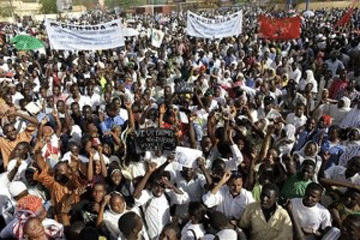
Thousands march in Niger to protest against AREVA
5,000 march against French uranium miner in Niger http://www.mining.com/5000-march-against-french-uranium-miner-in-niger-17954/Frik Els | October 12, 2013 Thousand of protestors marched against French uranium miner Areva (EPA:AREVA) in the remote town of Arlit in Niger on Saturday.
Areva has been operating in Niger for more than 50 years with two sites, Somair and Cominak, currently producing, and its long-term deal with the government of Niger is up for renegotiation at the end of 2013.
The roughly 5,000 protesters in Arlit were out in support of a Niger government audit to determine how to better distribute revenues from the two mines Reuters reports:
“We’re showing Areva that we are fed up and we’re demonstrating our support for the government in the contract renewal negotiations,” Azaoua Mamane, an Arlit civil society spokesman, said in an interview with a private radio station.
“We don’t have enough drinking water while the company pumps 20 million cubic meters of water each year for free. The government must negotiate a win-win partnership,” Mamane said.
The two mines together produce 4,500 tonnes of uranium for export to France and another project at Imouraren, which will be the largest uranium mine in Africa, is set to start operations in 2015.The Somair mine was back to full production in August, after a suicide attack in May killed one worker and injured 14 partially shutting down mining.
Prices for uranium are languishing at 8-year lows of $34 a pound and have not recovered since the Fukushima disaster in Japan in 2011
Niger aiming to get more taxes from Areva’s uranium mning
Niger’s Hedges Bets on French Uranium Assets Oil Price.com. By Editorial Dept | Fri, 04 October 2013 Bottom Line: Under constant threat of terrorist attacks in the security nightmare of Niger, French nuclear group Areva will now face an audit of its uranium mines as the Nigerien government seeks a better deal.
Analysis: Areva has two mines in Niger: Somair and Cominak. Together these two facilities produce about one-third of France’s nuclear power. But the 10-year contract for these mines ends this year, and the government of Niger is planning to take advantage of that by auditing the company and determining how it can get a better deal. The plan will be to increase tax revenues from Areva and to force it into more significant investments in infrastructure. Areva was operating at a loss last year, but is eyeing over 1.1 billion euros in operating profits for this year—and Niger is hoping to get a bigger chunk of this through taxes and infrastructure deals. The government of Niger already owns a 36.4% stake in Somair and a 31% stake in Cominak. Areva will now be audited first based on claims from some groups that it is not transparently reporting its revenues and operating costs. A third mine that is under construction—Areva’s Imouraren uranium mine—is also under scrutiny. The government of Niger has warned that the company will face fines if there are any further delays to the opening of this mine, now slated for 2015.
Recommendation: This could all play into the security question due to the level of government corruption in Niger,…(furher reading -subscription only) http://oilprice.com/Alternative-Energy/Nuclear-Power/Nigers-Hedges-Bets-on-French-Uranium-Assets.html
Niger government wants French uranium company AREVA to stop ripping it off
 Niger audits Areva uranium mines, seeking better deal By Daniel Flynn and Abdoulaye Massalatchi NIAMEY | Fri Sep 20, 2013 (Reuters) – Niger has ordered an audit of French nuclear group Areva’s (AREVA.PA) uranium mines in the West African country as it presses for a better deal in talks over a new long-term contract, Mining Minister Omar Hamidou Tchiana told Reuters.
Areva’s two mines in Niger – Somair and Cominak – produce the fuel for roughly one-third of France’s nuclear power, providing some of the cheapest electricity in the West.
Niger, a former French colony and one of the world’s poorest countries, has long complained it does not reap enough benefits from these resources……..
Extractive industries watchdogs, including the local branch of Publish What You Pay, have accused Areva of a lack of transparency in its revenues and costs in Niger…….
Previous Niger governments have struggled to substantially increase the state’s take from uranium and details of the 2003 mining contract have been kept confidential. The IMF estimates Niger’s gross domestic product at around 5.5 billion euros, only just over half of Areva’s revenues of 9.3 billion in 2012……..http://www.reuters.com/article/2013/09/20/us-niger-areva-idUSBRE98J0MY20130920

Uranium is France’s major strategic economic interest in the Sahel,
How long before the bombings hit Paris?
Niger’s Uranium Facilities Under Assault Oil Price, By John Daly, 03 June 2013 One of the scariest scenarios for Western intelligence analysts is the possible nexus between terrorism and nuclear materials Recent events in Africa have heightened these scenarios. Continue reading
Niger uranium mine struck by suicide bombers
Suicide bombers strike African uranium mine http://www.miningaustralia.com.au/news/suicide-bombers-strike-african-uranium-mine 24 May, 2013 Alex Heber Suicide bombers have killed at least 20 people in a French-run uranium mine in northern Niger.
About 50 people were injured at the mine when a suicide bomber drove into the front of the plant and blew up his vehicle, ABC reports.
The mine, located in the remote town of Arlit, has also reported key infrastructure has been badly damaged.
Islamist militants MUJWA are claiming responsibility for the attack.
The group which is also known as Movement for Unity and Jihad in West Africa is an offshoot of terrorist group Al Qaeda. MUJWA says the attack was at act of revenge for Niger’s involvement in the French-led intervention in Mali.
Niger’s president, Mahamadou Issoufou, has also confirmed French Special Forces have now moved in to protect the plant.
The heavy footprint of uranium company AREVA, in impoverished Niger
Areva, world’s 2nd uranium company heavily present in Niger, Expatica.comm 23 May 13 French nuclear group Areva, the world’s second-largest uranium producer whose mine in northern Niger was hit by a car bomb on Thursday, extracts more than a third of its mineral in the impoverished west African country.
Areva has been present in Niger for more than 40 years, operating two big mines near the northern town of Arlit through two affiliated companies — Somair and Cominak — which represent 37 percent of its total uranium production. Continue reading
Foreign uranium companies rip off impoverished Niger
the grievances expressed by representatives of local populations in the mining zones and pastoral peoples as well as government representatives. Concerns relate to radioactive pollution, water resource depletion, work-related diseases for mine workers, and the appropriation of land and water resources, including legally enshrined common property regimes and pastoral territories, without required compensation.
It is widely acknowledged among government staff that the Nigerien government is not able to properly implement its environmental legislation and monitor the uranium mining industry.
Niger: Development Cooperation Must Support the Environmental Governance of Uranium Mining THE ISN BLOG, Rasmus K Larsen 2 May 2013 Niger’s new development strategy, the Economic and Social Development Plan, is also intended to guide international development cooperation. Environmental governance of uranium mining, the country’s by far largest single economic activity, appears hitherto to have constituted a ‘blind spot’ for environmentally oriented development cooperation. It is now time to remove the blinkers and include support to strengthen environmental governance of the mining sector in new programmes to assist Niger in meeting its development challenges
Niger is well known in international media as one of the world’s poorest countries, struggling with chronic structural hunger and malnutrition. UNDP ranks Niger 186 out of 187 countries in the Human Development Index, and in 2011, five million people (33% of Niger’s population) were at ‘high risk’ to food insecurity.
What is less well known is that Niger also hosts the fourth largest uranium production in the world. Export values totalled over EUR 348 million in 2010, representing more than twice the total development assistance finance received during the same year. However, the state retains less than one fifth of the value of the uranium ore that is exported. The exploitation of the mineral wealth by international investors is expanding, with granted and requested mining concessions comprising close to 10% of the national territory…….
Attention to environmental impacts or risks associated with the mining sector goes seemingly without mention in the guiding documents of the principal development partners, including the EU, the World Bank, the UNDP, and the African Development Bank.
Severe environmental governance issues
This is in stark contrast to the grievances expressed by representatives of local populations in the mining zones and pastoral peoples as well as government representatives. Concerns relate to radioactive pollution, water resource depletion, work-related diseases for mine workers, and the appropriation of land and water resources, including legally enshrined common property regimes and pastoral territories, without required compensation.
It is widely acknowledged among government staff that the Nigerien government is not able to properly implement its environmental legislation and monitor the uranium mining industry. The Environmental Impact Assessment Bureau has only one person in place to verify all mining project applications in the country and, although legally required, not all verification missions are undertaken. The same applies to the National Centre for Radioprotection, which lacks the necessary capacity e.g. to undertake surprise inspections. The impacts and risks highlighted by civil society must be taken seriously. Due to deficiencies in the public administration, there are considerable constraints in enforcing and implementing the legislative and administrative framework – the very same framework, which development cooperation has helped to put in place……
Any mining activity will carry with it an environmental toll. The decision to sacrifice natural resources and human health, and ultimately lives of citizens, for economic gain will be the executive decision of the mandated political authority – in this case the Nigerien government……..
The Nigerien uranium mining sector is also intricately linked to the geopolitical energy security interests of some donor countries. The mines are operated by foreign companies (the French AREVA Group and Chinese investors). EU countries such as France, which has been involved in uranium mining since Niger gained independence, remain some of the largest buyers of the uranium ore – thus directly stimulating the mining activities and their detrimental impacts. This raises the question how donor countries could better supervise the behaviour of corporations incorporated within their own territories, thus implementing the recent UN guidelines for the supervision of multinational corporations (in “Protect, Respect and Remedy: a Framework for Business and Human Rights”). Indeed, when transparent and comprehensive problem identification is missing as the basis for donor support, then it opens for speculation that the ignorance of mining-related environmental issues and the crisis discourse on desertification and food insecurity are mobilized as instruments to divert attention from geopolitical interests in the country’s mineral wealth.
With its new development strategy, the Nigerien government emphasises the urgency of increasing mining fees and extraction tariffs to raise the state revenue and strengthen oversight with mining corporations. Importantly, specific attention is also directed at the need to improve the coordination between the mining and environmental sectors and their limited human and institutional capacities. This should be interpreted as an invitation from the Nigerien government to its development partners to proactively support enforcement of the existing environmental regulations of the mining sector……
Hopefully, the concerns expressed by people experiencing the impacts of the uranium mining industry first hand will be included in the list of priorities for the on-going negotiation between the Nigerien government and its development partners, among them the European Commission and Danida, on how to spend the EUR 3.7 billions. http://isnblog.ethz.ch/isn-security-watch/niger-development-cooperation-must-support-the-environmental-governance-of-uranium-mining
USA military in Niger to establish control over uranium resources
Obama’s Military Presence in Niger: US Control over Uranium under the Disguise of Counter-terrorism Global Research, By Wayne Madsen, 3 Mar 13, President Obama’s military incursion into Niger, ostensibly to establish a drone base to counter «Al Qaeda» and other Islamist guerrilla activity in neighboring Mali, has little to do with counter-insurgency and everything to do with establishing U.S. control over Niger’s uranium and other natural resources output and suppressing its native Tuareg population from seeking autonomy with their kin in northern Mali and Algeria. Continue reading
Uranium mining companies might not be able to rip off African countries any more
it’s not acceptable” that Niger’s most
valuable export only contributes about 5 percent to the nation’s
annual budget.
Increased revenue for Niger may come in the form of more mining
taxes, royalties or even a stake in AREVA; any of those options would
lower returns for investors and discourage future investment
Investment analysts are advising those with resource investments in
Mali to get out while they can
 Mali, Niger Unrest Highlights Need for Uranium Asset Diversification
February 14, 2013, By Melissa Pistilli Uranium Investing News
France’s military intervention in Mali, its former West African
colony, highlights industrialized nations’ supreme need to secure
access to economically strategic assets — in France’s case, uranium.
That theme will increasingly be seen playing out on the world stage
over the coming years. Continue reading
Niger gets a poor deal from AREVA’s uranium mining
In Niger, New Disputes Over French Uranium Extraction International Business Times, 6 Feb 13, “....no wonder Paris sent its own special security forces to Niger this week to protect a French-operated uranium mine there.
But mineral resources have long been a touchy subject in Niger, and the extra security has generated some controversy as to whether foreign investors have dealt a fair hand to the country’s 16 million people.
“Uranium is really a crucial point of contention,” said Leonardo A. Villalón, an associate professor at the University of Florida and expert on the Sahel, the band of semi-arid land just south of the Sahara Desert. “The notion of exactly who benefits from the resource is the central question of political economy in Niger.”….. President Mahamadou Issoufou suggested on Sunday that Nigeriens are getting the short end of the stick…..
The exact details regarding Areva’s current dealings with Niger are murky. …. Areva did not respond to requests for comment regarding its current agreement with the Nigerien administration….. http://www.ibtimes.com/niger-new-disputes-over-french-uranium-extraction-1064546
France’s military in Niger to protect AREVA’s uranium mines
 France orders special forces to protect Niger uranium: source PARIS Jan 24, 2013 (Reuters)– France has ordered special forces to protect uranium sites run by state-owned Areva in Niger as the threat of attacks on its interests rises after its intervention against rebels in Mali, a military source said on Thursday Reporting by John Irish, Geert de Clercq, Muriel Boselli, Michel Rose in Paris and Abdoulaye Massalatchi in Niamey; …….
The military source confirmed a report in weekly magazine Le Point that special forces and equipment would be sent to Areva’s uranium production sites in Imouraren and Arlit very quickly, but declined to go into further details.
Defense ministry officials declined to comment on the report and Areva said it did not talk about security issues….
Areva, Niger’s biggest single investor, has about 2,700 workers in Niger and is planning to start up a third mine in Imouraren.
 The planned startup of production in Imouraren was delayed to 2013 or 2014 from 2012, following the kidnappings and a labor dispute.
A Niger army officer said that there were already security arrangements agreed with France since 2011 after the kidnappings in Arlit and they had been reinforced over time.
“We also have our counter-terrorism units in the Agadez region,” he said. “For now, I don’t know of a decision by the Nigerien government to allow French special forces to base themselves in the north.”
An Areva spokeswoman said this month the French government had not asked the company to reduce staffing in Niger. She added Areva has an extensive security plan for its employees and that the plan has been reviewed by the French authorities.
Areva has been mining uranium in Niger for more than five decades and the country provides one third of the group’s uranium supplies.
According to a parliamentary committee enquiring into France’s supplies of uranium, about 18 percent of the raw material used to power France’s 58 nuclear reactors came from Niger in 2008…. http://www.reuters.com/article/2013/01/24/us-mali-rebels-niger-areva-idUSBRE90N0OD20130124
Production stops at AREVA’s Niger uranium mine, as workers strike
Niger Areva uranium workers begin 72-hour strike, NIAMEY, Jul 9, (Reuters) – About 1,200 workers at Niger’s Akouta uranium mine owned by COMINAK, a subsidiary of France’s Areva, have began a 72-hour strike to demand higher wages, a union official said on Monday. Inoua Neino, secretary general of the SYNTRAMIN union, said production had stopped at the over 1,600 tonnes a year mine in the north of the west African nation after the workers downed tools.
“We embarked on a strike after our demand for a 3 percent raise in salaries, even though insignificant, was not met with satisfaction by management,” Neino told journalists.
“Workers did not go down into the mine today and if they are not down there, it means that there was no extraction, and if there was no extraction, there is no production,” he said.
The company was not immediately available for comment….. http://www.reuters.com/article/2012/07/09/niger-areva-strike-idUSL6E8I9CEF20120709
1 This Month

of the week – Shut Down Drone Warfare!


Tell the Ukrainian Government to Drop Prosecution of Peace Activist Yurii Sheliazhenko

Petition to revoke the licensing of the Near Surface Nuclear Disposal Facility (NSDF) at Chalk River. https://www.ourcommons.ca/petitions/en/Petition/Details?Petition=e-7247
To see nuclear-related stories in greater depth and intensity – go to https://nuclearinformation.wordpress.com
-
Archives
- March 2026 (237)
- February 2026 (268)
- January 2026 (308)
- December 2025 (358)
- November 2025 (359)
- October 2025 (376)
- September 2025 (257)
- August 2025 (319)
- July 2025 (230)
- June 2025 (348)
- May 2025 (261)
- April 2025 (305)
-
Categories
- 1
- 1 NUCLEAR ISSUES
- business and costs
- climate change
- culture and arts
- ENERGY
- environment
- health
- history
- indigenous issues
- Legal
- marketing of nuclear
- media
- opposition to nuclear
- PERSONAL STORIES
- politics
- politics international
- Religion and ethics
- safety
- secrets,lies and civil liberties
- spinbuster
- technology
- Uranium
- wastes
- weapons and war
- Women
- 2 WORLD
- ACTION
- AFRICA
- Atrocities
- AUSTRALIA
- Christina's notes
- Christina's themes
- culture and arts
- Events
- Fuk 2022
- Fuk 2023
- Fukushima 2017
- Fukushima 2018
- fukushima 2019
- Fukushima 2020
- Fukushima 2021
- general
- global warming
- Humour (God we need it)
- Nuclear
- RARE EARTHS
- Reference
- resources – print
- Resources -audiovicual
- Weekly Newsletter
- World
- World Nuclear
- YouTube
-
RSS
Entries RSS
Comments RSS
 nuclear-news